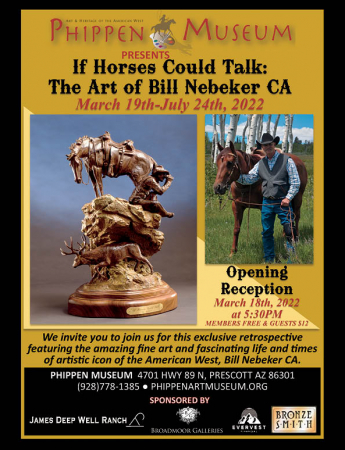
“You know the old saying, most people aren’t recognized by their hometown. But I always have been,” says Bill Nebeker. The beloved Western sculptor needs no introduction. He’s the longest serving full member of the Cowboy Artists of America at 44 years running, serving as president four times. He’s also won numerous prestigious awards, and his bronzes are in the collections of the Eiteljorg Museum, National Cowboy & Western Heritage Museum, Booth Western Art Museum, Phoenix Art Museum and Phippen Museum in Nebeker’s hometown of Prescott, Arizona—and that’s just scratching the surface.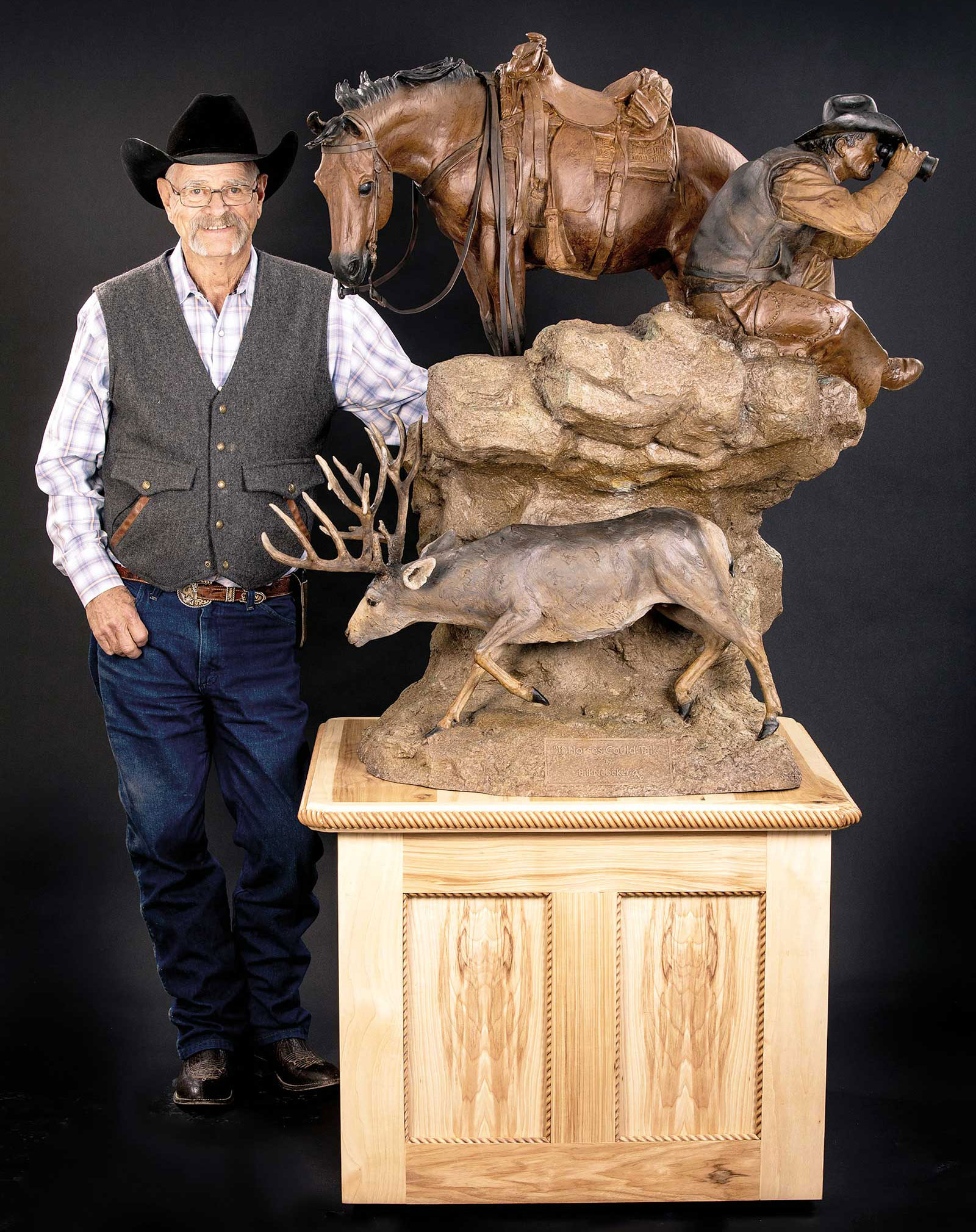 Bill Nebeker stands with If Horses Could Talk, bronze, ed. of 15, 48 x 47 x 36”.
Nebeker is part of the old guard—a true cowboy—and in his world of roping, ranching and riding, Prescott has shaped him as much as he’s shaped it. (He’s also a member of Arizona Cowpunchers. In 2006, he and his partner won the “60 and Over Team Roping” competition at the Arizona Cowpunchers rodeo, a regional staple.) “[Prescott] has become an art center in a sense, and we have a lot of great artists that live here in the area. We have several foundries…It has become a great town supporter of the arts,” says Nebeker. “Of course, we have a tremendous history. I’m glad I was in on the early part.” He’s referring to his roots with the Cowboy Artists of America, founded in the mid-1960s in Sedona, Arizona, near Prescott. Nebeker found inspiration in one of the organization’s co-founders and first president, George Phippen, whom the Phippen Museum was named after.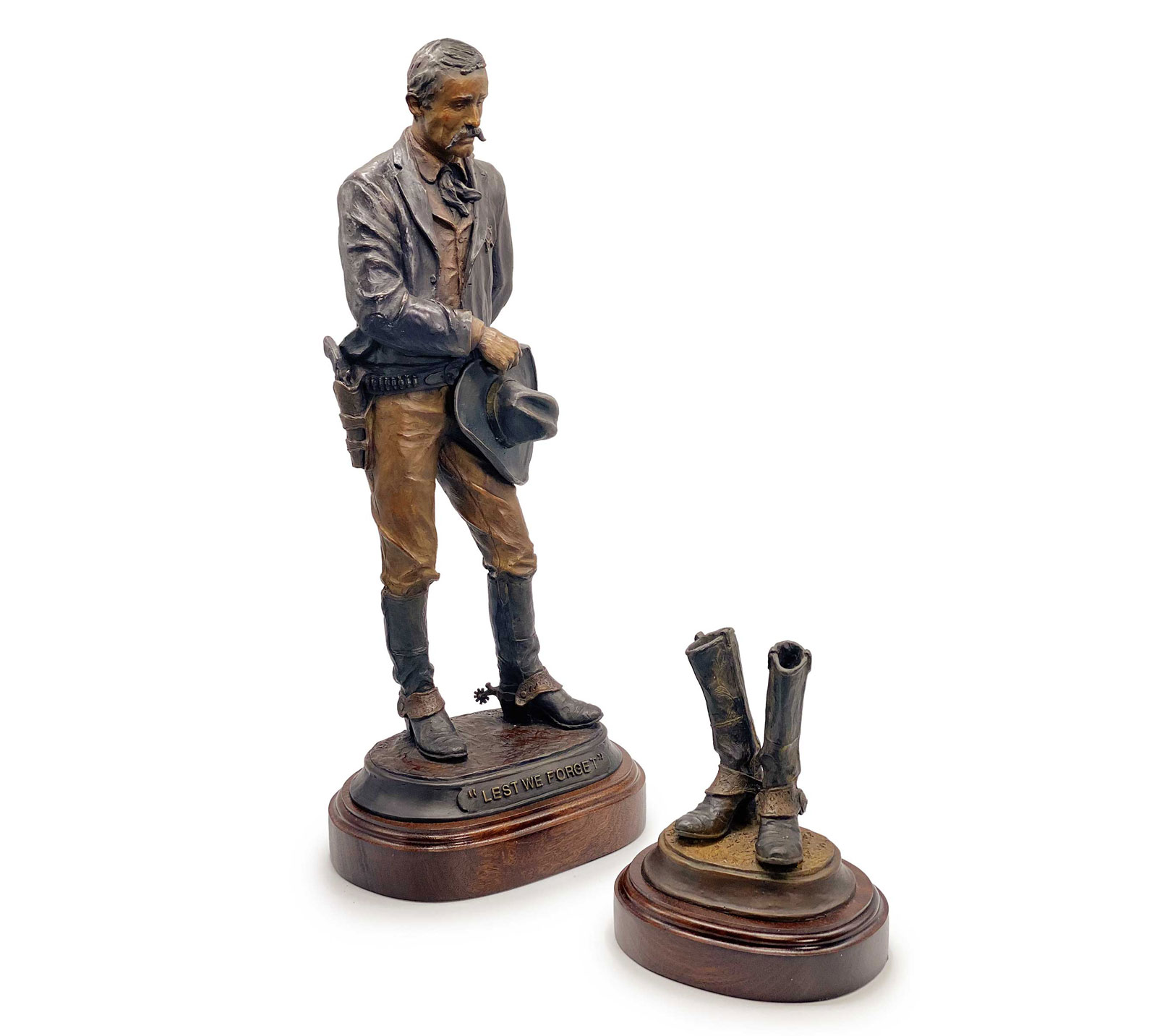 Lest We Forget, bronze, ed. of 50, 21 x 9 x 7”
Nebeker would eventually join the CA in 1978, but before that he worked at Bear Paw Bronze, a foundry in Skull Valley near Prescott, run by the Phippen family. Nebeker was hired there and created bronzes depicting numerous CA members, including Bill Owen, Joe Beeler and Frank Polk. “I would work in the foundries all day and learn that business and then go home and work on my own clays in the evening time,” he recalls.
To this day, Prescott is a bronze town through and through, with multiple foundries throughout the area. And it holds a rich history as a frontier gold and silver mining town, with miners, pioneers and ranchers shaping the development of the town back in the 19th century. Several public monuments by Nebeker are situated around Prescott harkening back to that history. He recalls his large four-figure monument Early Prescott Settlers located across from Yavapai College. “This was the first monument I did,” he says. The Prescott Community Art Trust opened up a contest to the county asking that they create a piece of artwork that “represents the beginning of Prescott,” Nebeker explains. His winning piece, Early Prescott Settlers, features a miner, freighter, rancher and pioneer woman standing together on a rock formation. Nebeker’s wife, Merry, dressed in full historic garb to pose as the pioneer woman.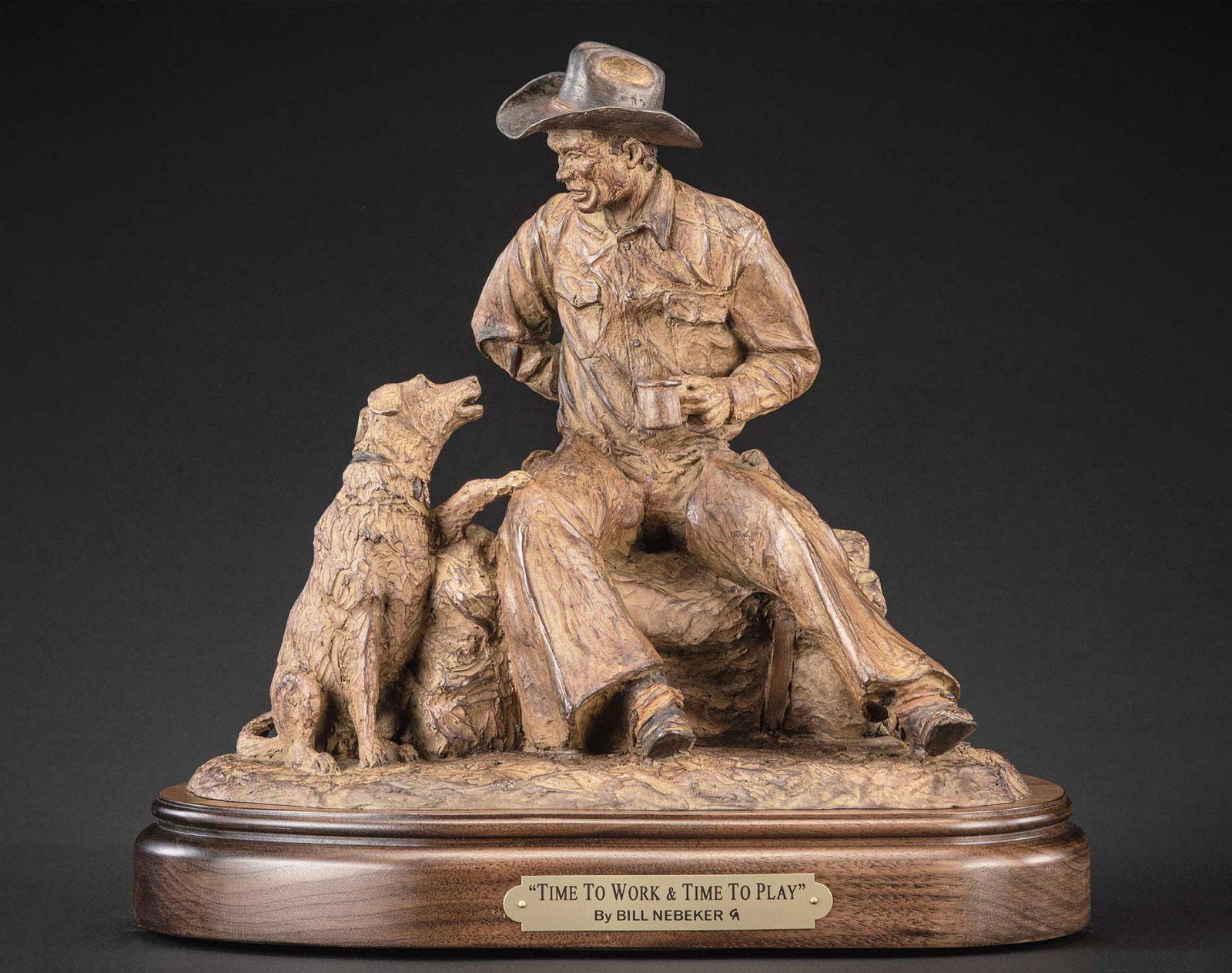 Time to Work and Time to Play, bronze, ed. of 20, 13 x 14 x 10”
In 2019, Nebeker started a massive 14-foot version of his well-loved sculpture If Horses Could Talk. To understand the gravity of this endeavor, we have to go back in time about 35 years. (Though die-hard Nebeker collectors likely know all about the piece). Merry recounts that the sculpture was originally completed in 1987 at about 22 inches tall as part of the 1987 Cowboy Artists of America exhibition at the Phoenix Art Museum. The entire edition of 25 sold out in one night, which had never happened before. “It was like sharks around bait,” says Merry. “It was hysterically funny because everyone wanted one. And through the years we have had many people come to the studio wanting to buy his art, and people would keep asking ‘do you have any more If Horses Could Talk?’” The bronze depicts a cowboy on the hunt peering keenly through his binoculars. All the while, his target is making a stealthy getaway beneath him. His horse seems to be aware of the situation but can’t communicate this to him.
Fast forward to 2018. A philanthropist named Ron James, whose family owns the property on which the Phippen Museum sits, wanted to transform the many roundabouts throughout Prescott into places of beauty, rather than plain plots of dirt. Eventually, James got in touch with Nebeker hoping to install a sculpture near the Prescott Regional Airport. Nebeker completed the large-scale version of If Horses Could Talk around the beginning of 2020, and it was officially installed that August. “It’s exquisitely creative, but it’s also got humor in it. It’s a part of Prescott,” says Merry.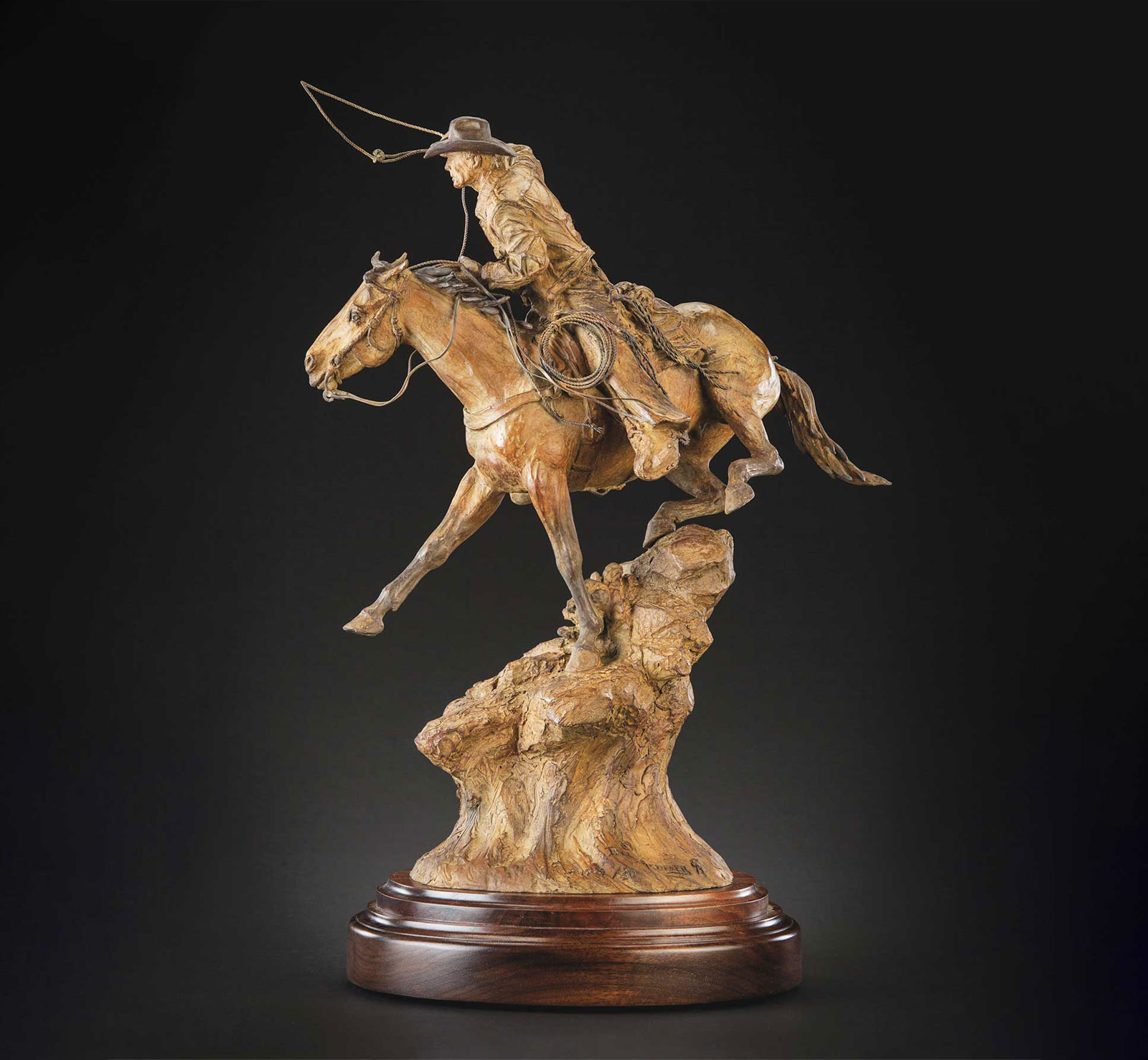 Chasin’ Mavericks, bronze, ed. of 30, 23 x 17 x 9”
The sculpture is also the inspiration for the title of a major retrospective taking place at the Phippen Museum this March. Organized in chronological order, If Horses Could Talk: The Art of Bill Nebeker CA takes visitors through the entire trajectory of Nebeker’s rich and storied career. “As soon as that big statue was put up, [the Phippen] knew that had to be the title,” Merry adds. The show features about 50 to 60 works from throughout Nebeker’s nearly 50-year career. “So many people have seen certain aspects of me and my life and what I do. But many people haven’t seen me in my early years and the early pieces I made, and I think that’s going to be a really neat thing,” says Nebeker. “Even if they’ve known me forever, they may not be familiar with this story of my work from those early days to now.” This is Nebeker’s first retrospective since 1996, which took place at the Museum of Western Art in Kerrville, Texas. A smaller retrospective was held at the Phippen back in the late ’80s to early ’90s, the couple says.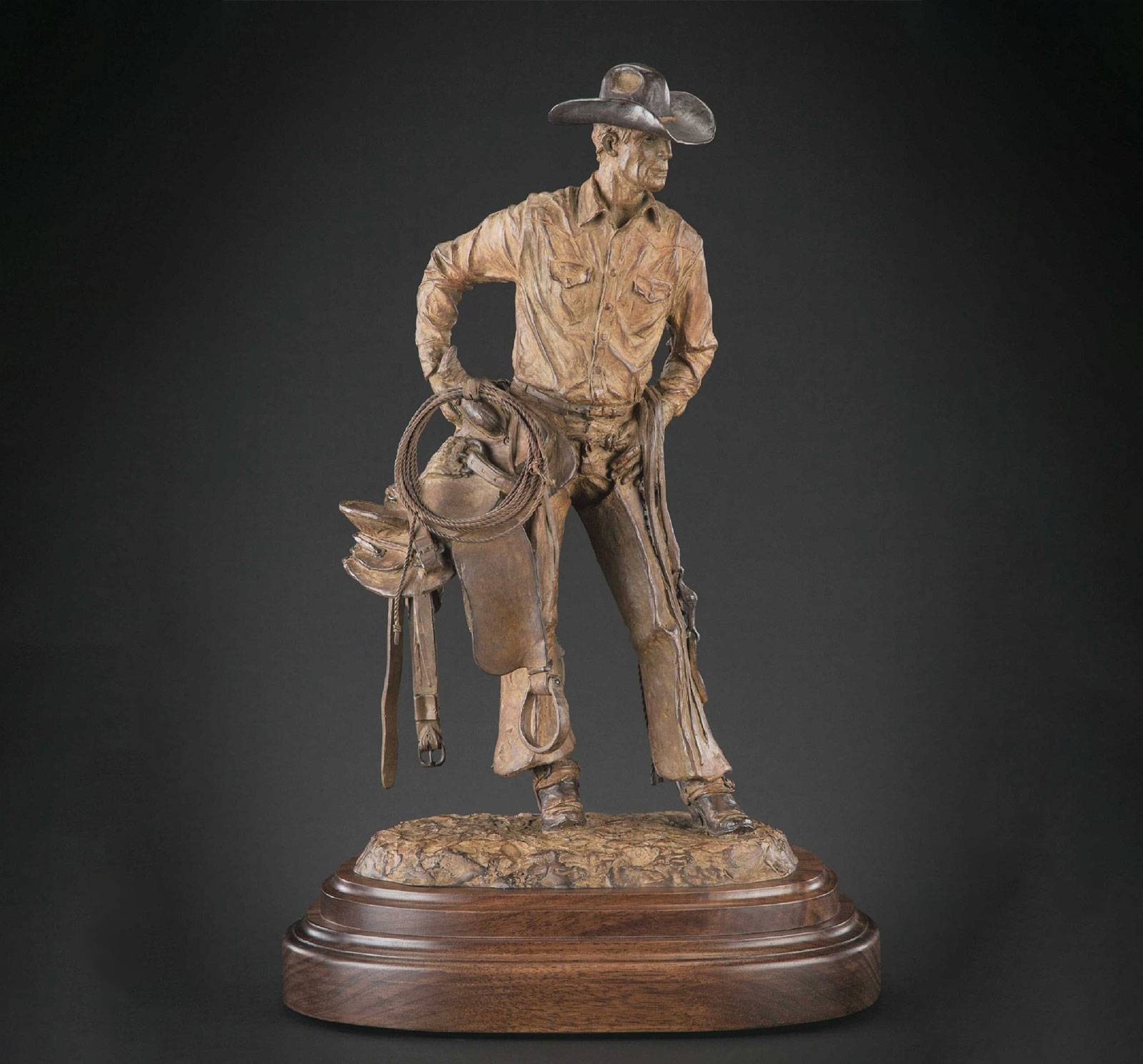 Beats Any Job in Town, bronze, 20 x 12 x 9”
“I’m probably best known for my cowboy work because that was part of my life.
I rode horses, I roped,” says Nebeker. “If you mentioned my name, people would probably respond more to my cowboy and horse work, but I also do Native American pieces. It fascinates me. I love learning as much as
I can about the Native American way of life. I like working with Southwestern tribes. [I try to] present in a way that’s representative of a way of life. This is one thing that’s always made Western art stand out for me. You try to present it in a true way. You’re representing real life.” An art critic might think a piece looks great, but a cowboy could take one look at it and see all kinds of problems, he adds. “With Western art, you try to be as authentic as you can. And that’s always been important for me, because I grew up with it.”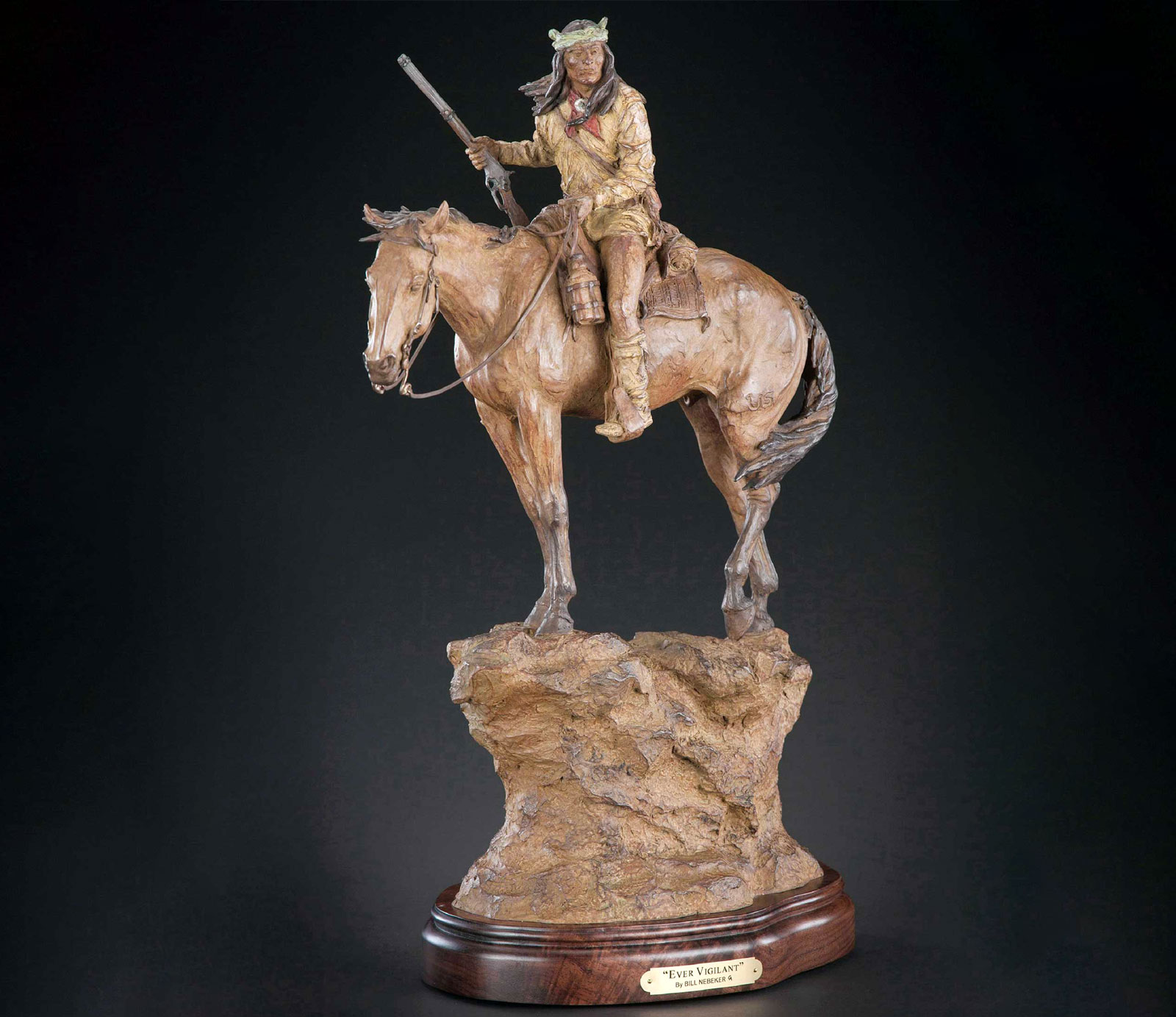 Ever Vigilant, bronze, 25 x 18 x 9”
Part of that authenticity is giving what you get. “Because we both grew up here [in Prescott], Bill and I have joined together to donate three sculptures a year to different non-profits in our area,” says Merry. “Two of them are for scholarships for local high schools.” She cites a number of organizations they’ve donated to over the years. It’s about giving back to the community—about connection. And Nebeker has always been about connection.
“Bill is the kindest person you would ever want to meet,” says Merry, who has been married to the artist for almost 57 years. “He has a sense of humor that is famous with all of the artists, the galleries, the museum curators…When you walk into an art show and there’s Bill Nebeker, there’s a group of people standing around him listening to him tell funny jokes and stories…funny stories of cowboys and the Southwest. And he can do dialects and all the other stuff. So if he ever can’t do art, he can always do stand-up comedy.”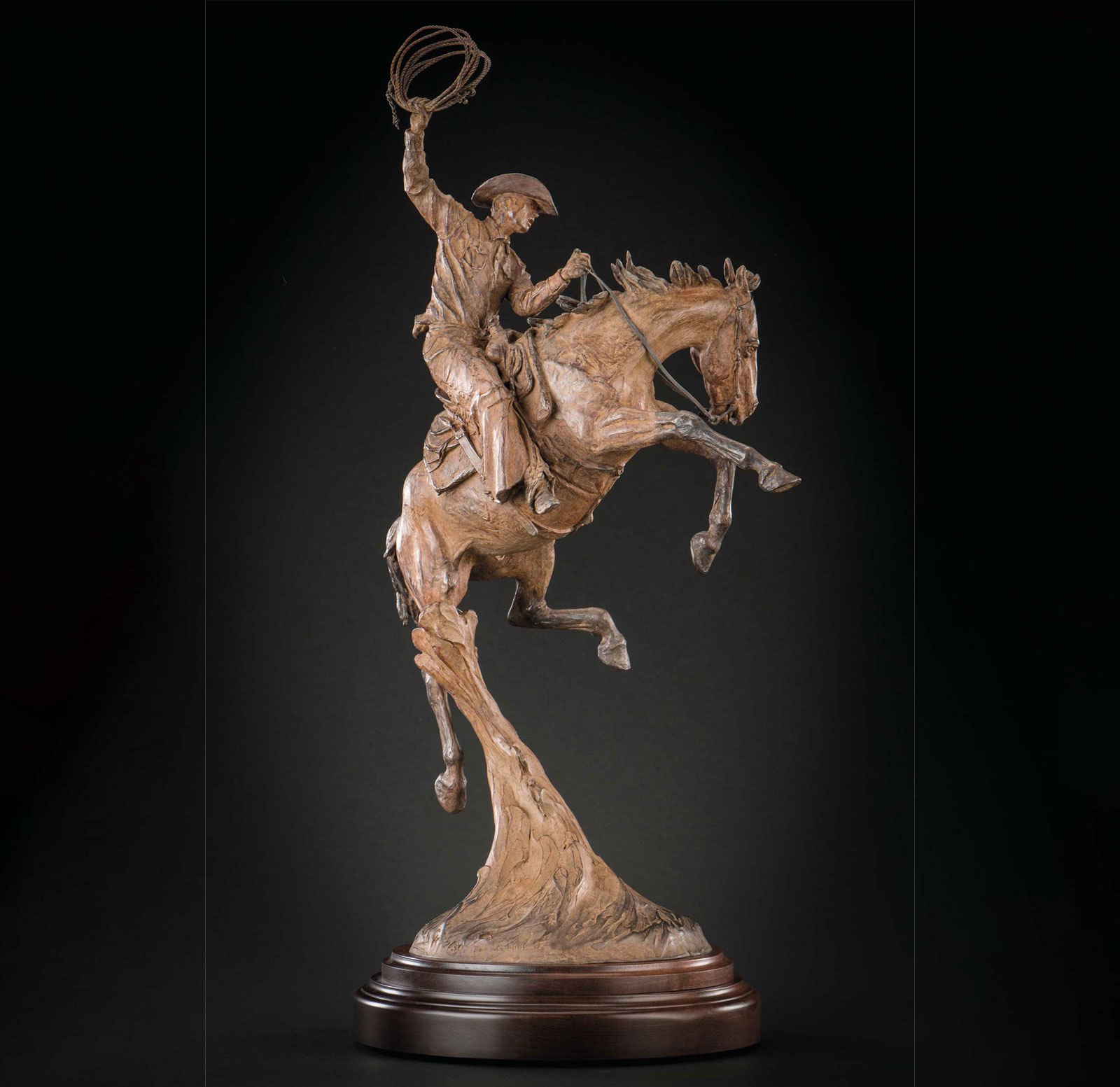 Waltzin’ Across Texas, bronze, ed. of 30, 30 x 17 x 12”
Trailside Galleries is producing a major catalog to accompany the Phippen Museum retrospective, which includes photos taken by Nebeker’s long-time photographer Christopher Marchetti. Because Nebeker has been a bright light in the Western art world for half a century, the Phippen Museum and Merry have asked that Nebeker’s artist friends, local friends, museum curators and gallery owners each write a passage about who Nebeker is to them. “Whether it’s Martin Grelle or John Coleman or our local ranch friends, we have all said a few lines about his value to the Western art world and humanity as a person,” says Merry. These passages will be part of the exhibition catalog.
If Horses Could Talk: The Art of Bill Nebeker CA is on view in the museum’s Marley Gallery from March 19 through July 24. An opening reception and members preview takes place Friday, March 18. —
If Horses Could Talk: The Art of Bill Nebeker CA
March 19-July 24, 2022
Phippen Museum, 4701 Highway 89 North, Prescott, AZ 86301
(928) 778-1385, www.phippenartmuseum.org
Powered by Froala Editor