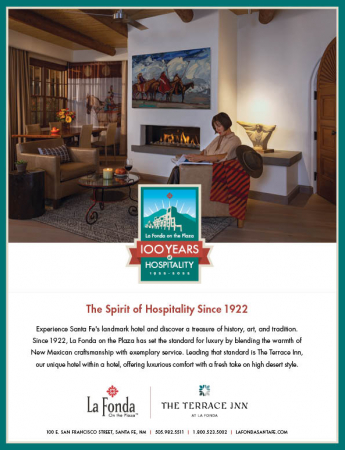
The first manifestation of La Fonda on the Plaza in Santa Fe, New Mexico, opened its doors in 1922. The site has seen hostelries since Santa Fe was founded by the Spaniards early in the 1600s. This year, celebrating its centennial, La Fonda welcomes guests to a facility expanded and refined over the years including last year’s unveiling of the upgraded Terrace Inn.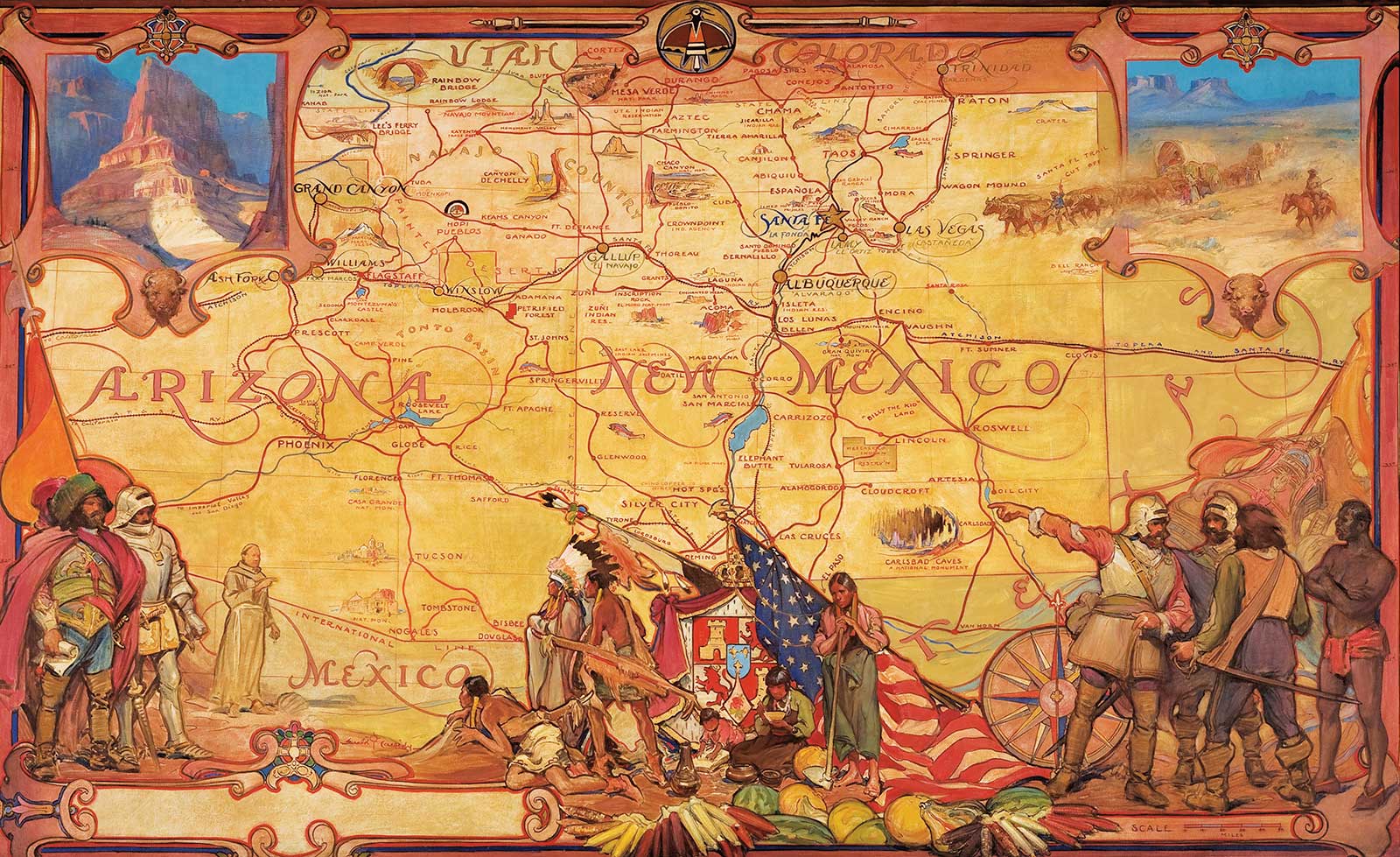 Gerald Cassidy (1869-1934), The Four Corners Map, 1926, oil on canvas
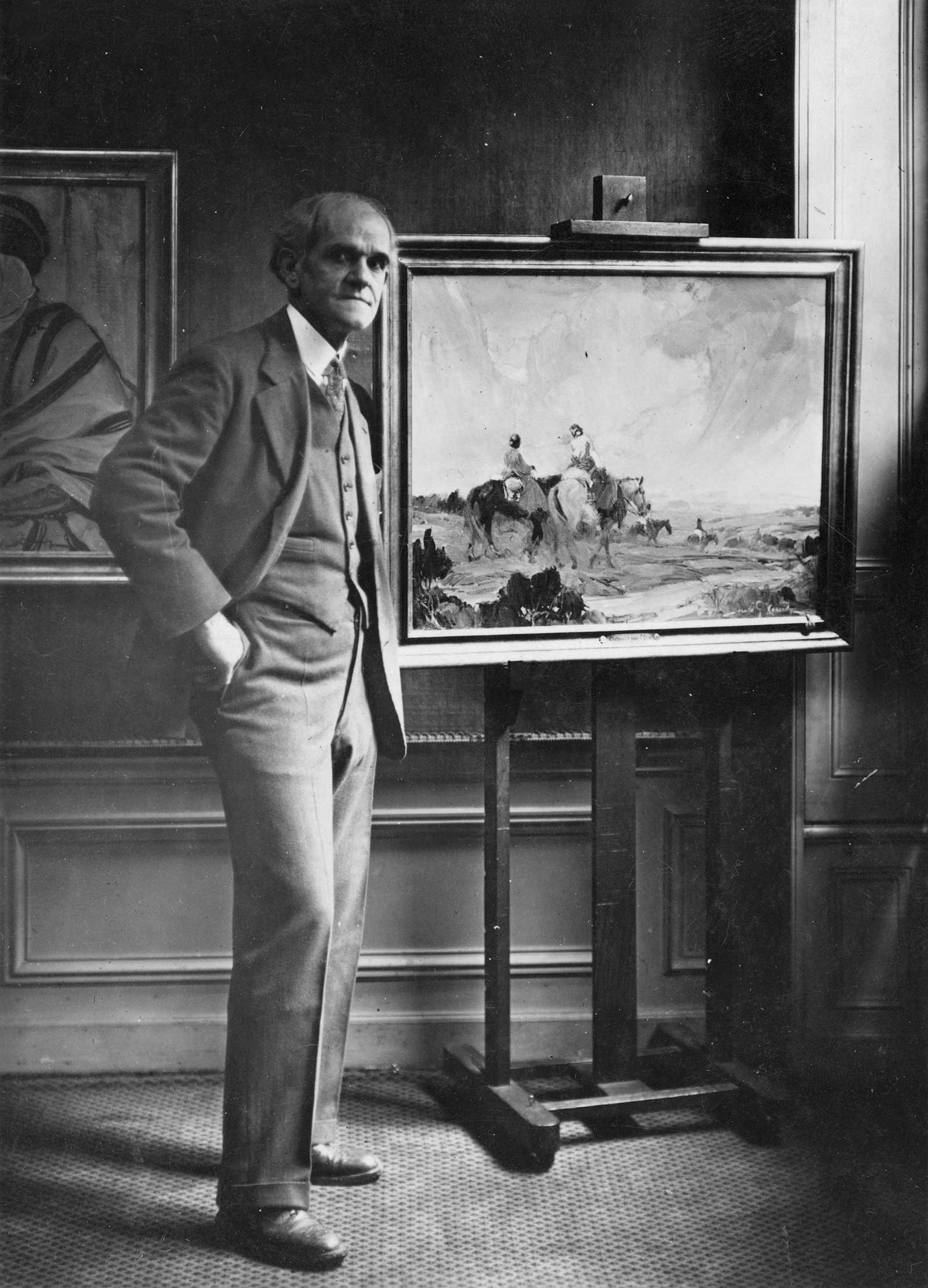 Gerald Cassidy with his painting Navajo Romance, which was purchased by the French government for the Luxembourg Galleries in Paris. Courtesy of the Palace of the Governors Photo Archives (NMHM/DCA). Negative Number: 007121.
Ten years ago, when I worked with the staff of La Fonda to write the text for the book In Every Room: A Story of the Art, the hotel was well on its way on a multi-phased project to bring all the rooms and public spaces to a new standard of luxury and comfort. La Fonda honored the artists and designers who had contributed to its ambiance over the years. Acknowledging its responsibility as steward of a growing collection of art, it had recently restored paintings by Gerald Cassidy (1879-1934) that had been created the year the hotel opened.
The Atchison, Topeka and Santa Fe Railway commissioned Cassidy to create paintings that could be reproduced to promote travel to the Southwest in railroad stations across the country. The Railway acquired the La Fonda in 1926 and turned its management over to the Fred Harvey Company. Harvey was an innovator in cultural tourism. He pioneered the printing and sale of postcards to promote his hotels and restaurants, producing postcards and 36-by-24-inch posters of Cassidy’s 10 portrait paintings that now hang in the hotel.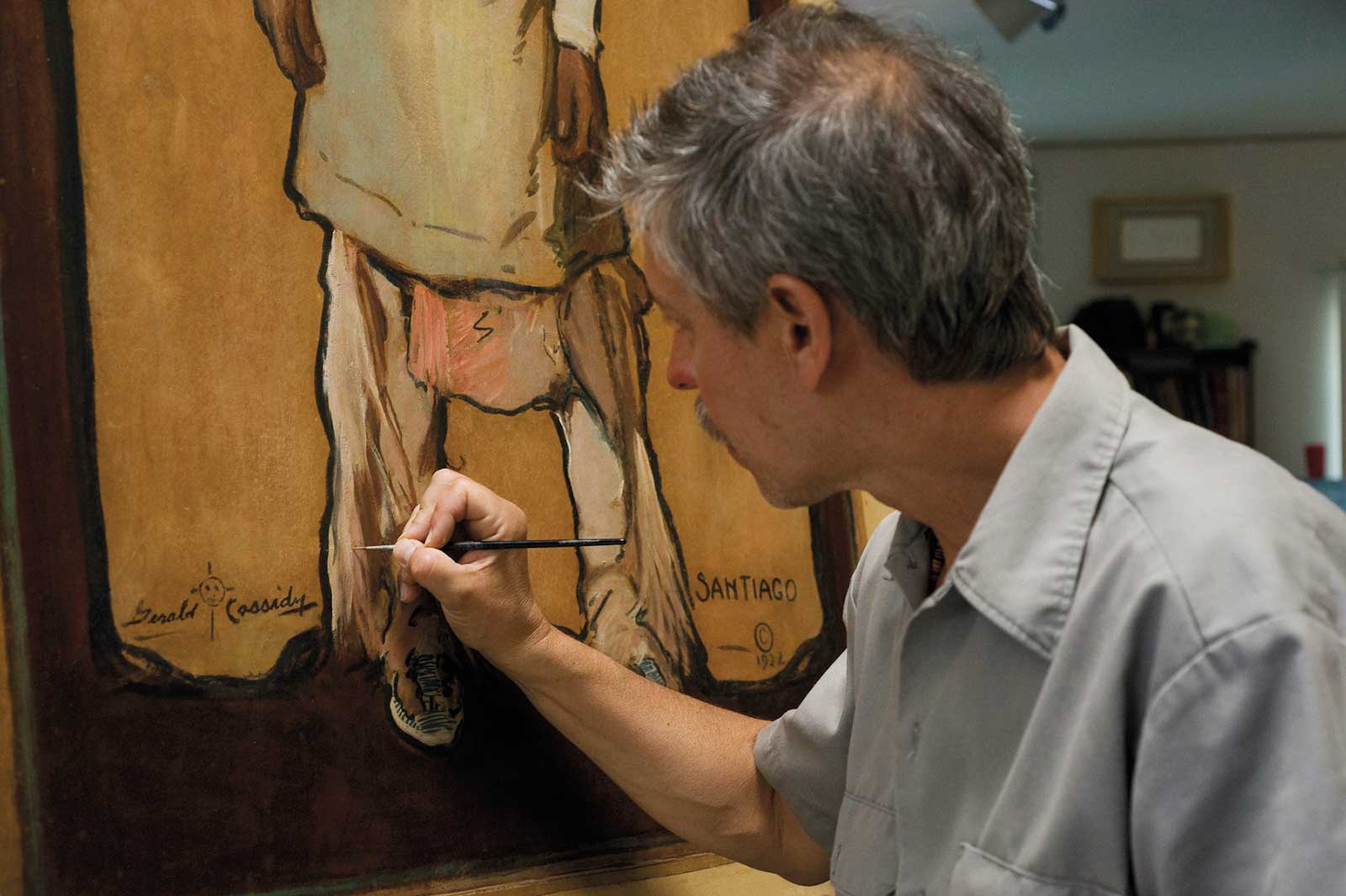 John Andolsek of Andolsek Conservation of Fine Paintings in Santa Fe, works on the conservation of Cassidy’s Santiago.
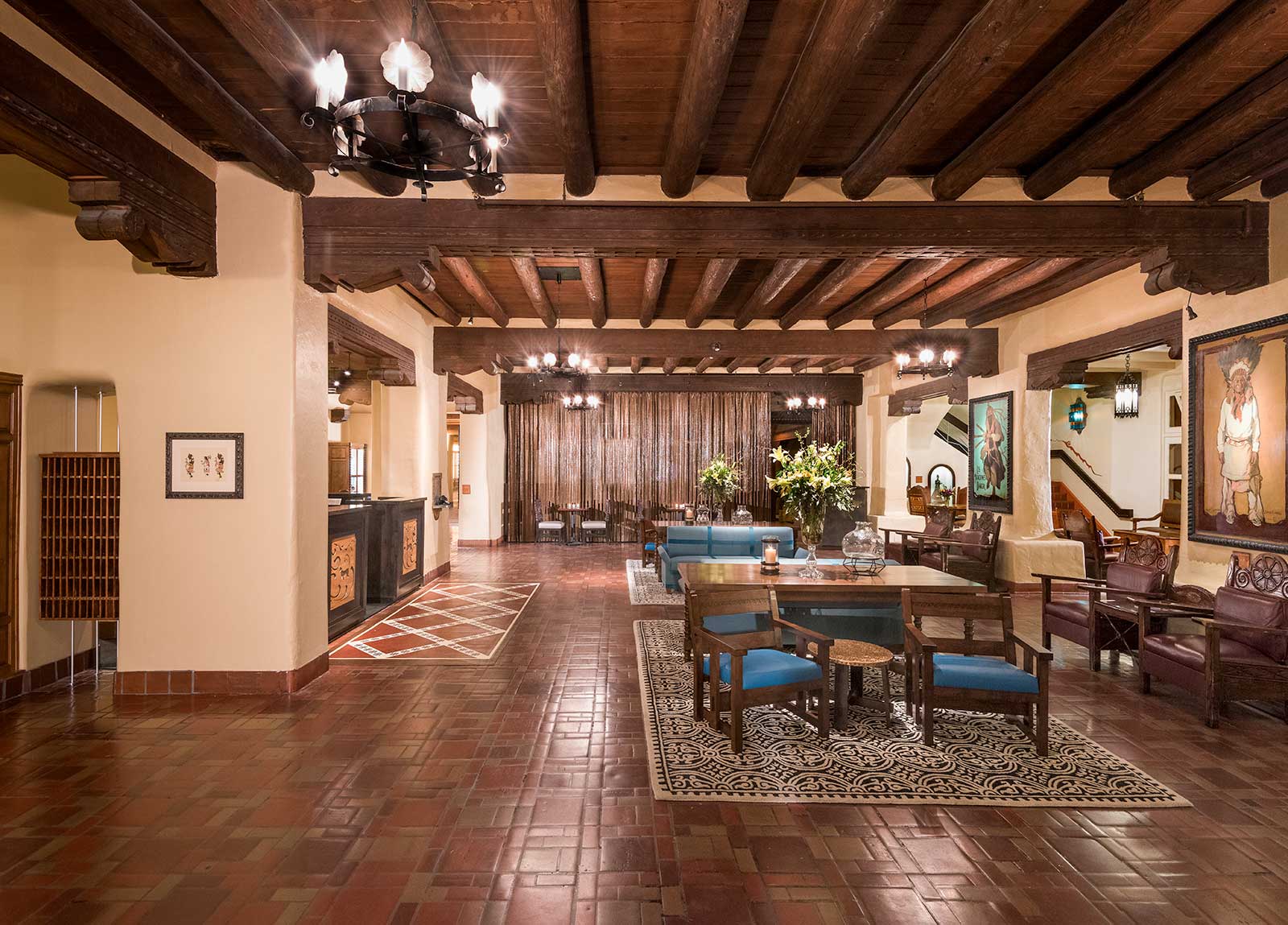 The lobby of the La Fonda on the Plaza in Santa Fe, New Mexico. Cassidy’s Santiago can be seen on the far right.
The subjects of the paintings range from conquistadors to Native Americans to Kit Carson. The AT&SF Railway also commissioned The Four Corners Map that now hangs above the banco in the Santa Fe Room. The painting was originally displayed in the Courier Lounge, the headquarters of Indian Detours, the Harvey Company’s innovative collaboration with the pueblos to provide a unique experience for tourists.
Cassidy was a well-established, prize-winning artist by the time he was commissioned by the railway. Born in Covington, Kentucky, he began studying with Frank Duveneck at the age of 12. Duveneck, also a Covington native, later taught Joseph Henry Sharp and Walter Ufer, who would become members of the Taos Society of Artists. Cassidy was diagnosed with tuberculosis in 1898 and moved to Albuquerque to enter a sanitarium. After recovering, he moved to Denver where he met and married the sculptor Ina Sizer (1869-1965). In 1912, the couple moved to Santa Fe which was a town of fewer than 5,000 people. Ina Cassidy remarked that it had “no paved streets, no automobiles and one sewer line. A passenger could ride all over town in a horse-drawn taxi for a quarter.”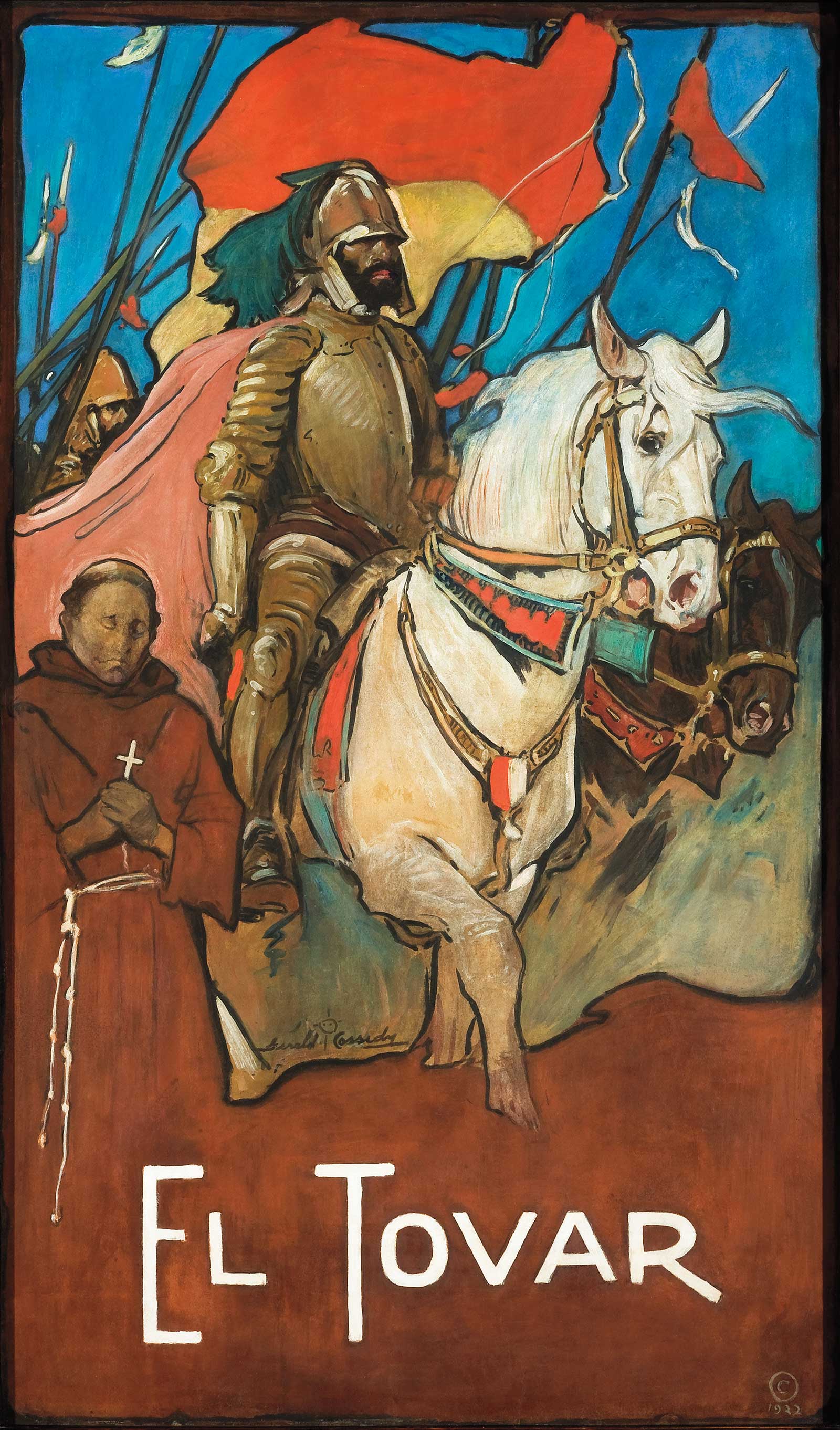 Gerald Cassidy (1869-1934), El Tovar, 1922, casein on paper, 36 x 24”
In Santa Fe, Cassidy met Edgar Lee Hewett (1865-1946), founder and director of the Museum of New Mexico. At the time, Hewett was also organizing the New Mexico Building for the Panama-California Exhibition in San Diego to be held in 1915. He commissioned Cassidy to create murals for the pavilion, one of which received a gold medal and the grand prize. During the mid-1920s Cassidy traveled in Europe, where his work was well thought of by the European public. While he and Ina were traveling in Europe, the French Government purchased his painting Navajo Romance for the Luxembourg Galleries in Paris.
Cassidy had become fascinated by the people and locales of the Southwest. After moving to Santa Fe, he shortened his signature on his paintings from Gerald Ira Diamond Cassidy to Gerald Cassidy with the Tewa Indian sun symbol between his first and last names. He immersed himself in tribal culture and the history of the region to bring a high level of authenticity to his paintings.
Among the many vignettes in The Four Corners Map, is a group of four men in the lower right corner. They are thought to be explorer Cabeza de Vaca; his Moroccan slave, Estevanico; and two other Spaniards. The four were the sole survivors of a much larger expedition who reached the Rio Grande in 1535.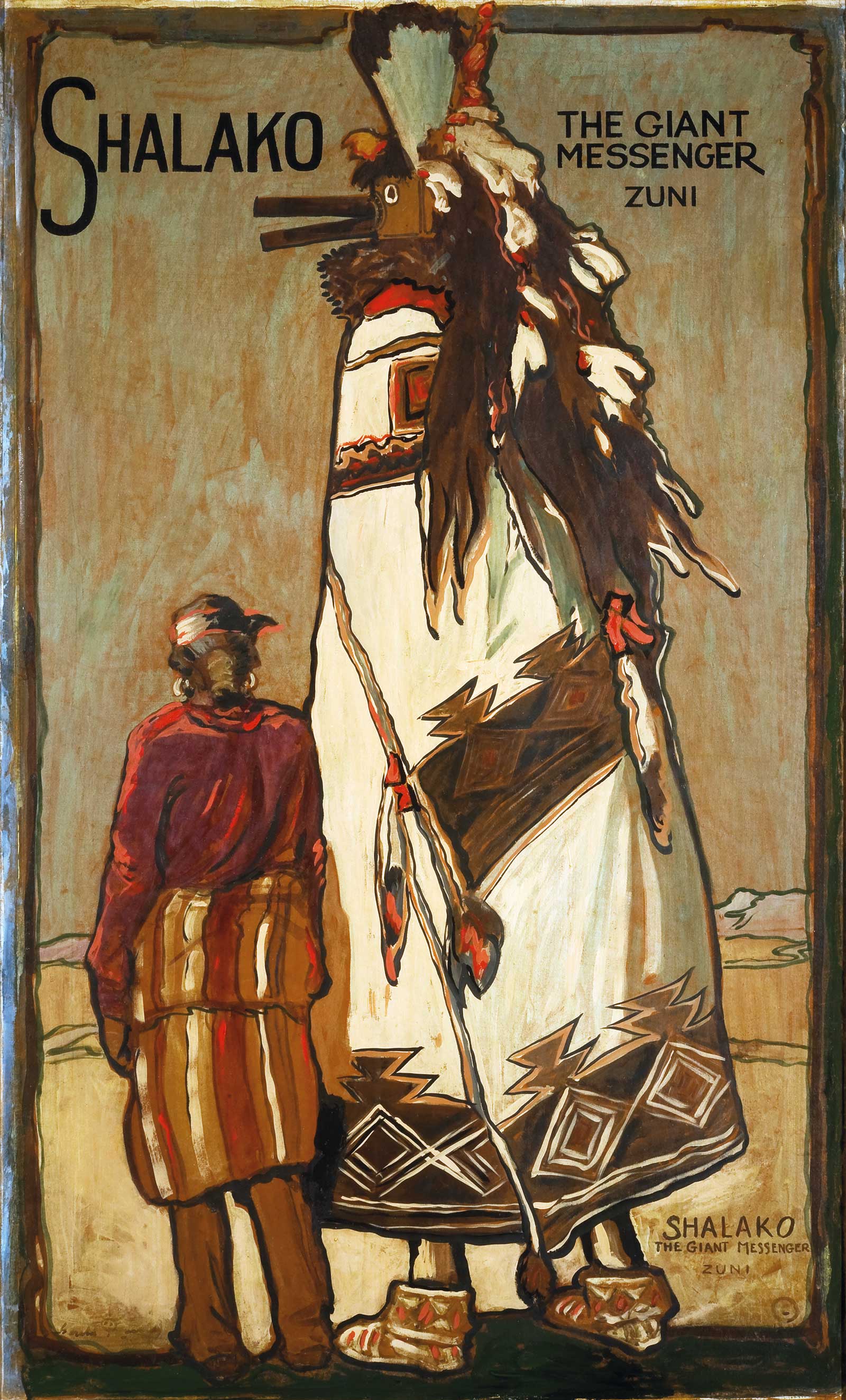 Gerald Cassidy (1869-1934), Shalako, The Giant Messenger, 1922, casein on paper, 36 x 24”
Another Spanish explorer is honored in one of Cassidy’s 10 portraits. Fray Marcos da Niza was an Italian missionary and Franciscan friar. He came to the Americas in 1531 and is credited as the first European to visit the territory that is now Arizona. Cassidy paints him dressed in his simple Franciscan robes, silhouetted against a golden yellow background.
Cassidy had worked as a lithographer and brought his graphic skills to the compositions for his railway commission. As a lithographer, he also knew how to create a painting that would maintain its color vibrancy in the printing process.
The dramatic and colorful painting El Tovar depicts Don Pedro de Tovar at 22 years old, one of the leaders of Francisco Vázquez de Coronado’s 1539-1542 expedition that was the first to enter what is now New Mexico. The Franciscan monk with Tovar may be Fray Juan Padilla, who accompanied Tovar to the Hopi villages in Arizona.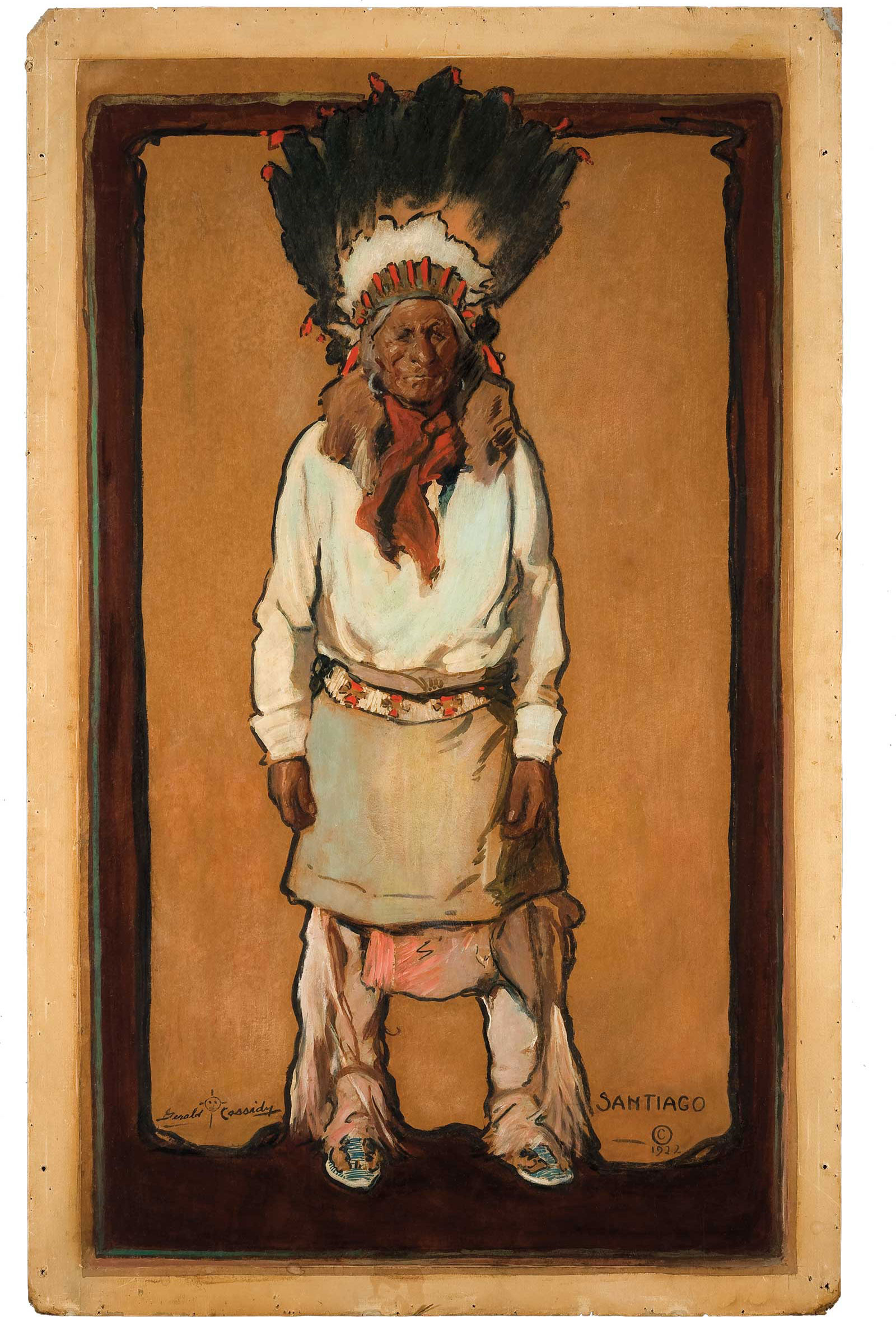 Gerald Cassidy (1869-1934), Santiago, 1922, casein on paper, 36 x 24”
His dramatic painting, Shalako, The Giant Messenger, represents Shalako, a Zuni Pueblo katsina dance that celebrates the winter solstice. It offers prayers for rain, abundance, propagation of plants and animals, good health for the community and blessings on new houses. Shalako appears elsewhere in the La Fonda collection in a large terra-cotta panel above the fireplace in the portal adjacent to the hotel’s restaurant, La Plazuela. Arnold Rönnebeck (1885-1947) incorporated Zuni and Hopi motifs in his work at La Fonda, presaging the hotel’s concentration on acquiring Native American art.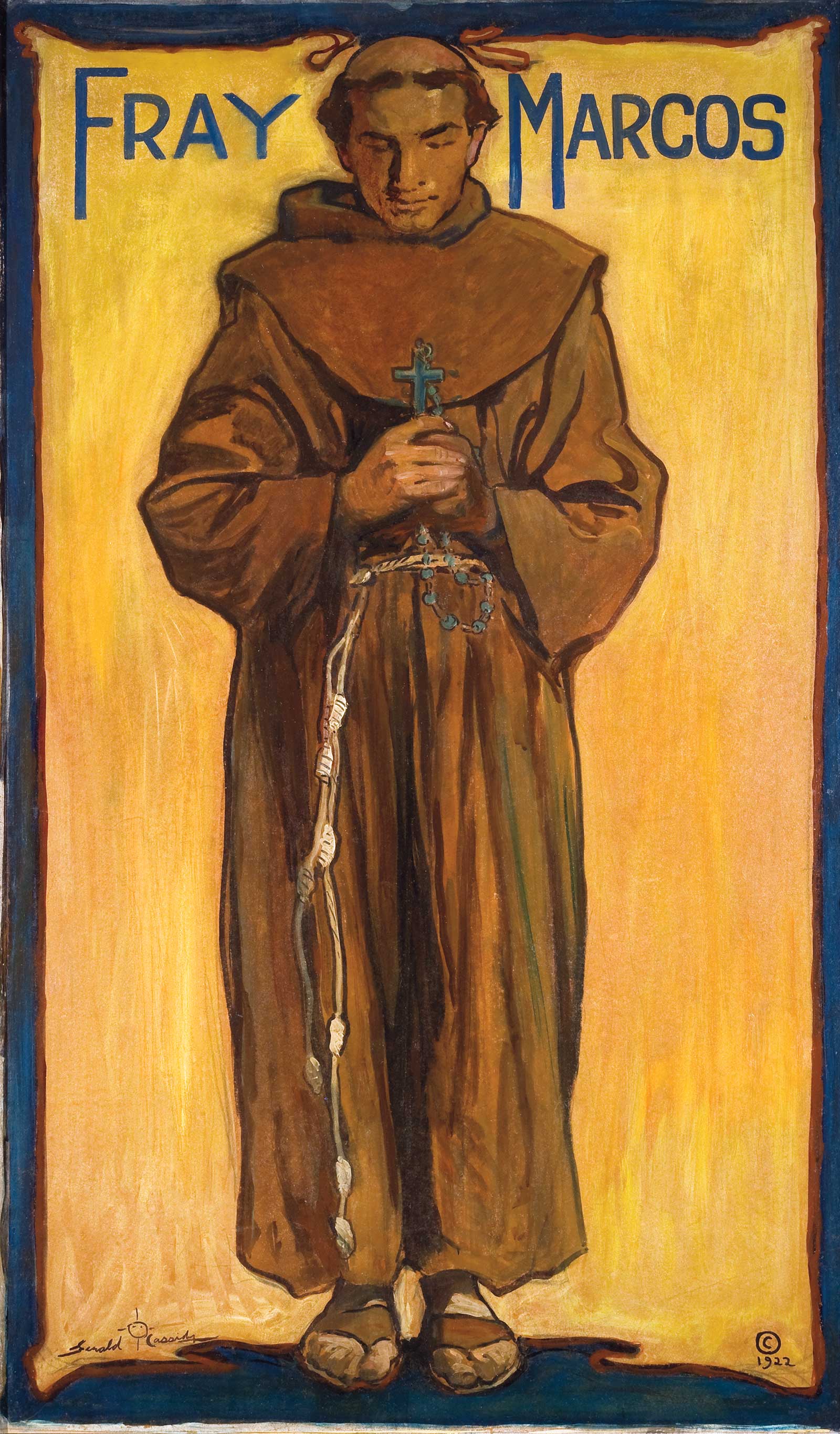 Gerald Cassidy (1869-1934), Fray Marcos, 1922, casein on paper, 36 x 24”
During the Great Depression, Cassidy was commissioned by the Federal Public Works of Art Project to create several murals in Santa Fe. Working in an enclosed studio space, he became increasingly ill from exposure to carbon monoxide and turpentine fumes and, in 1934, succumbed. Stacia Lewandowski, author of Light Landscape and the Creative Quest: Early Artists of Santa Fe, quotes an article in the Santa Fe New Mexican that outlines Cassidy’s last hours: “He was awake most of the night last night, talking most interestingly to his wife on art, philosophy and life. This noon she was pouring him some coffee when he said ‘that’s enough,’ and expired instantly.” —
Powered by Froala Editor