Somewhere between Lewis & Clark’s expedition in 1804 and the prevalence of American car culture in the 1950s, there was a sweet spot in the Western United States when it was no longer dangerous or lawless, and yet it was still adventurous and thrilling for those lucky enough to venture into its vast territory.
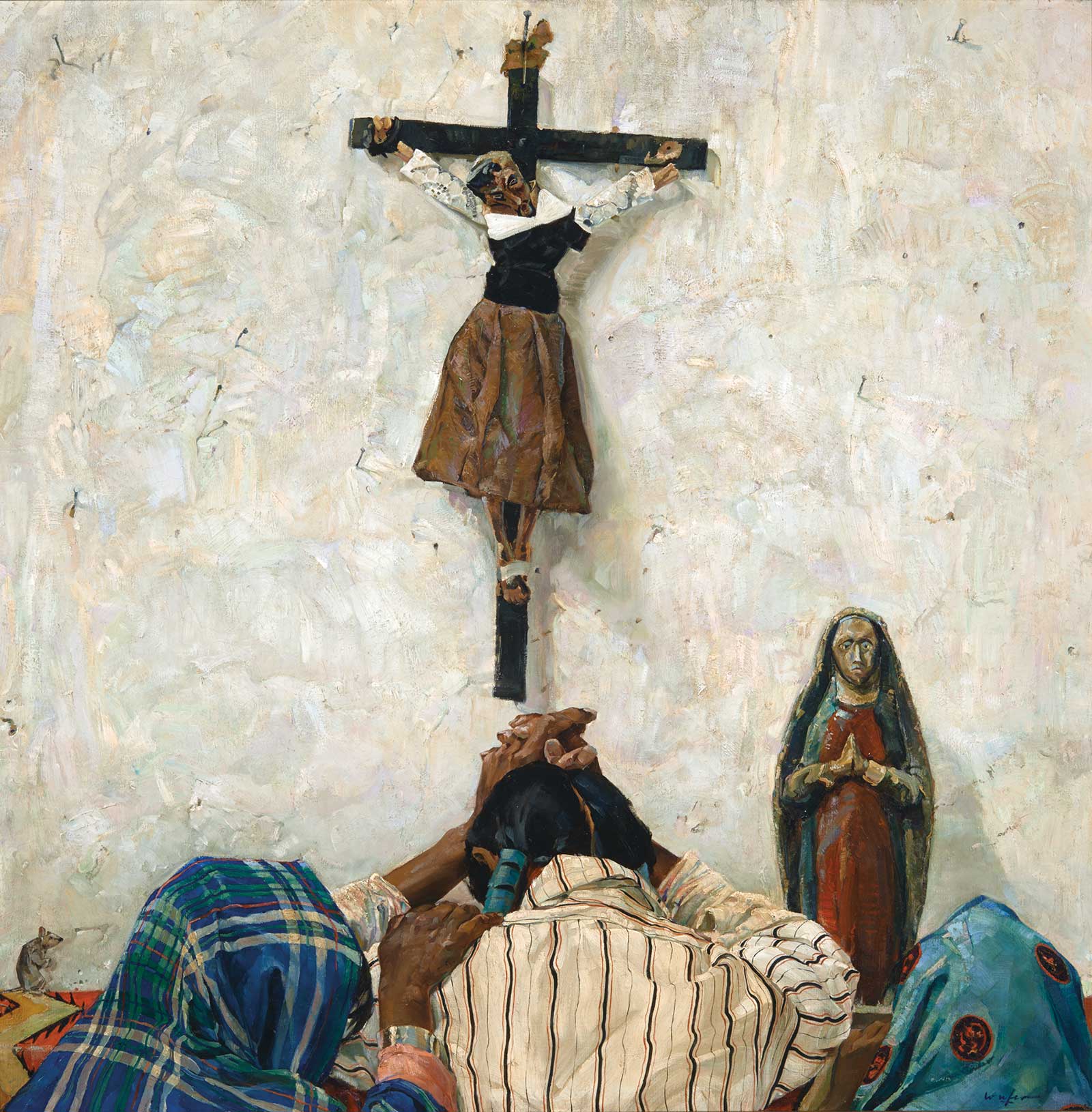
Walter Ufer (1876-1936), Hunger, 1919, oil on canvas, 50½ x 50 ½ in. Gilcrease Museum, Tulsa, OK. 17489.
It was the time of the Santa Fe Railroad, Fred Harvey and his Harvey Houses, trading posts in dusty out-of-the-way destinations and East Coast newspapers that devoted enormous amounts of space to the exploits of artists, authors, lawmen, outlaws and socialites who were calling the West home. Americans were obsessed with this new frontier, and it was a time when it wasn’t out of reach. Those brave enough, and wealthy enough, to make the trip need to simply board a series of trains, and maybe a wagon or two. And then there they were in Santa Fe, Denver, Jackson Hole or Cody.
While all of the West benefited from this accessibility, the Southwest received a tremendous response from outsiders. It was the people and cultures, the land, the deserts, the wonders of nature that would soon become national parks, the rustic towns and outposts, and the endless skies—there was mythology built around the West. When visitors came to the Southwest, they witnessed these elements, but also others.
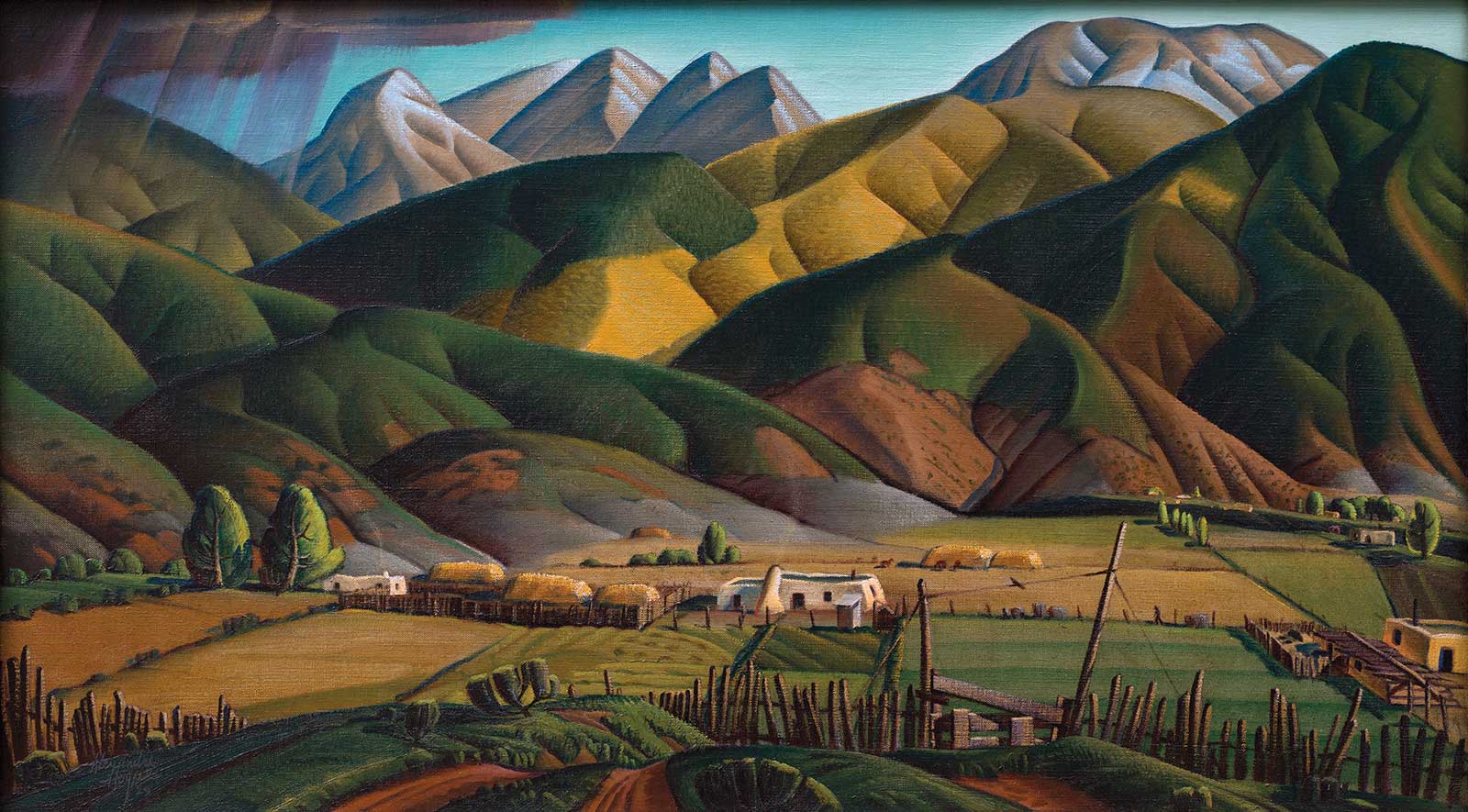
Alexandre Hogue (1898-1994), Across the Valley, 1929, oil on canvas, 20 x 36 in. Photography by James Hart Photography, Santa Fe, New Mexico. Courtesy of Tia Collection, Santa Fe, New Mexico.
One of the more interesting parts of the Southwest was the fusion of cultures and traditions. America had been called a melting pot, where people from different places with different ways of life could come together and share a future. In places like Arizona, New Mexico, California and Texas, the cultures were Native American, Mexican and Spanish, as well as others. They were enormously different, and yet frequently symbiotic. And each contributed to the scrappy and gritty monoculture of the Southwest.
This was reflected in the art, from Alexandre Hogue’s Across the Valley, which shows the Taos Valley dotted with farms and adobe homes, to Kenneth Miller Adams’ Reapers (Harvest),showing women working in a field. “Kenneth Miller Adams studied in France and Italy before moving to Taos in 1924, where he became interested in the local Spanish American population,” writes the Denver Art Museum, which owns the Adams work. “Here, he surrounds the strong bodies of two female workers with golden harvest tones. The viewer’s eye travels around the composition—from the upright woman in the green dress, through her sheaf of wheat, and down the stooping woman’s back and arm. This movement imitates the endless motion of these women’s exhausting labor.”
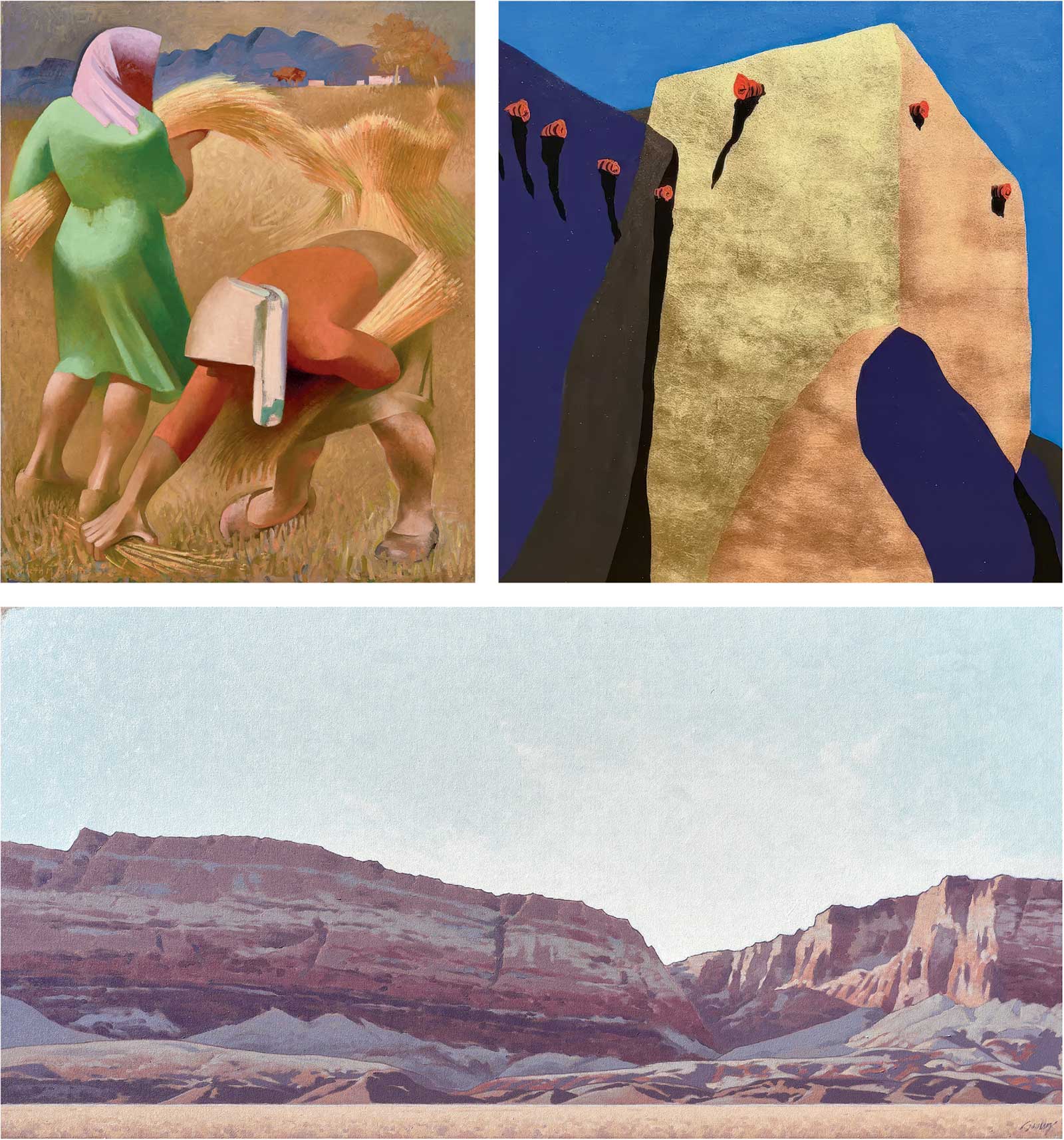
Top: Kenneth Miller Adams (1897-1966), Reapers (Harvest), 1946, oil on canvas, 40 x 32 in. Denver Art Museum: Gift from Dr. George C. Peck and Catherine M. Peck, 2013.466. © Estate of Kenneth Miller Adams. Legacy Gallery, San Francisco Dinner Time, gold and copper leaf with acrylic on canvas, by Alvin Gill-Tapia. Bottom: Altamira Fine Art, House Rock Valley, oil on panel, 30 x 60 in., by Jared Sanders.
Some of the work spoke about the difficult and strained histories that were shared by the people of the West. Consider Walter Ufer’s Hunger, which was “derived from Ufer’s personal introspection, his courageous attempt to bring symbolism to paintings that deal with the painful issues faced daily by the Taos Indians and the Hispanics,” writes the curators of the 2013 exhibition Walter Ufer: Rise, Fall, Resurrection.
Ufer, Hogue, Adams and countless others contributed to the spirit, history and mythology of the Southwest. Today, a new generation contributes to this region. There are still unwritten chapters.
“What makes the Southwest so compelling is that there is no single story that defines it. It is a place shaped by generations of people, cultures and traditions living alongside one another—pueblo and other Indigenous peoples, Spanish and Mexican influences, ranching and Western traditions, and the artists who have long been drawn to this extraordinary landscape,” says Cyndi Hall at Legacy Gallery,one of the great venues for Southwest art. “That history is still very much alive, and you see it reflected in the work being created today. These artists capture different pieces of that story: the enduring presence of Pueblo communities and architecture, the music and traditions carried across generations, the unmistakable light and color of New Mexico, and the way Native identity and cultural traditions continue to evolve while remaining deeply rooted. The best Southwestern art does more than depict a place, it gives you a sense of the people, history and experiences that have shaped it. That is what continues to inspire our artists, and I think it is what makes this region such an enduring source of creativity.”
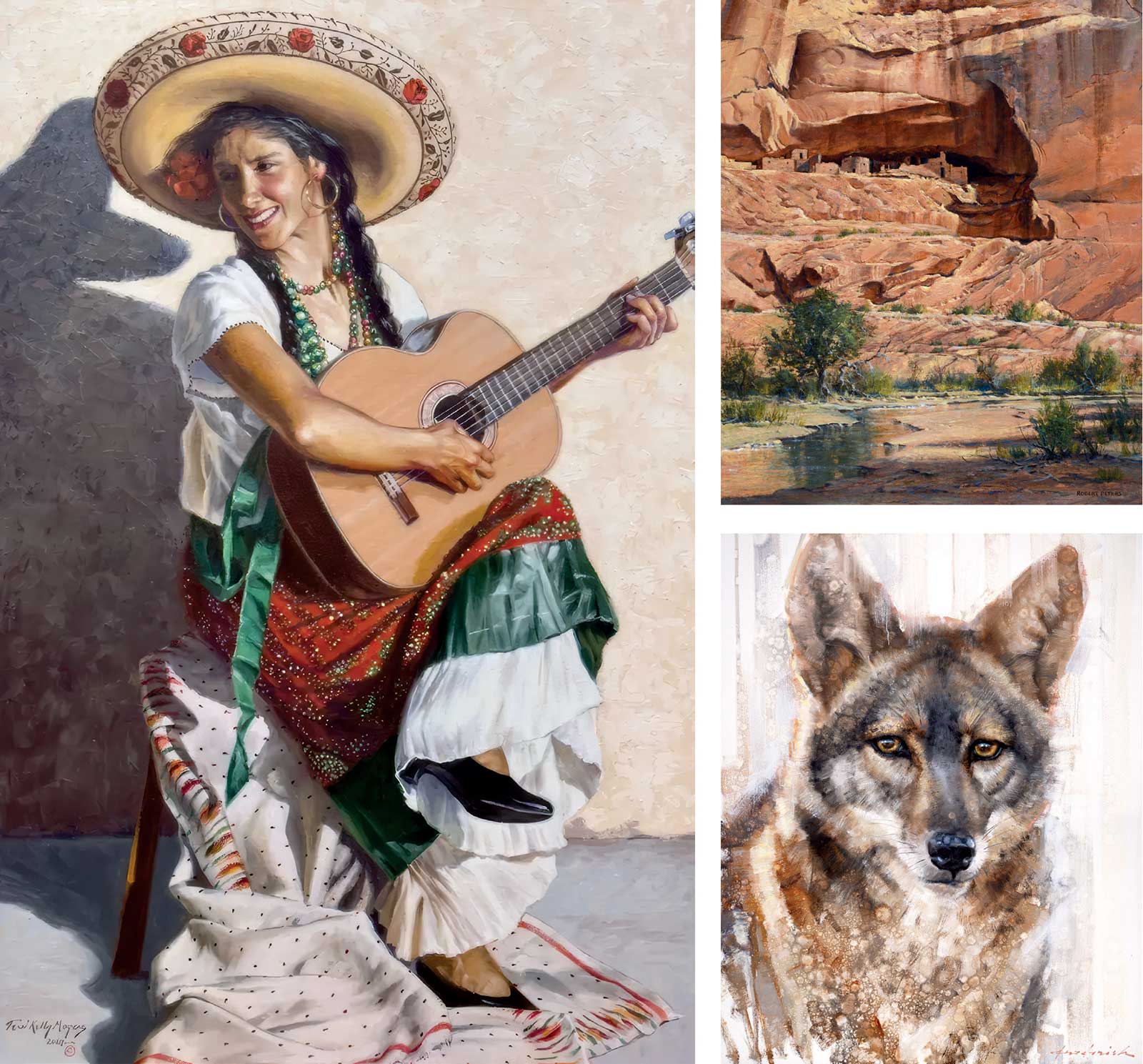
Clockwise from left: Legacy Gallery, Musica, oil, 36 x 24 in., by Terri Kelly Moyers. Legacy Gallery, Pueblo Culture, Canyon de Chelly, oil, 24 x 20 in., by Robert Peters. Altamira Fine Art, Kai Yote, oil on canvas, 60 x 48 in., by David Frederick Riley.
Another premier destination that celebrates the Southwest is Altamira Fine Art, which has locations in Wyoming and Arizona. “The Southwest has a presence that artists can approach from completely different directions, and that is what makes it such an enduring subject. Rocky Hawkins taps into its mystery and spiritual intensity, using color, gesture and the human figure to create something that feels mythic. David Frederick Riley approaches that same sense of place through wildlife; his coyote is intimate and beautifully observed, but still carries the intelligence and wildness we associate with the desert landscape. Jared Sanders pulls the view outward, reducing the land to these quiet, beautifully balanced shapes, colors and immense spaces,” gallery owner Jason Williams says. “Together, the works remind us that the spirit of the Southwest isn’t defined by one image of the West. It exists in its people, its animals, its geology, its light and, perhaps most importantly, in the emotional response the landscape continues to inspire.”
At First Freedom Art,the Southwest is honored through the work of Arnold Friberg, whose paintings of the people and cultures of the West are among the highlights of the collection.
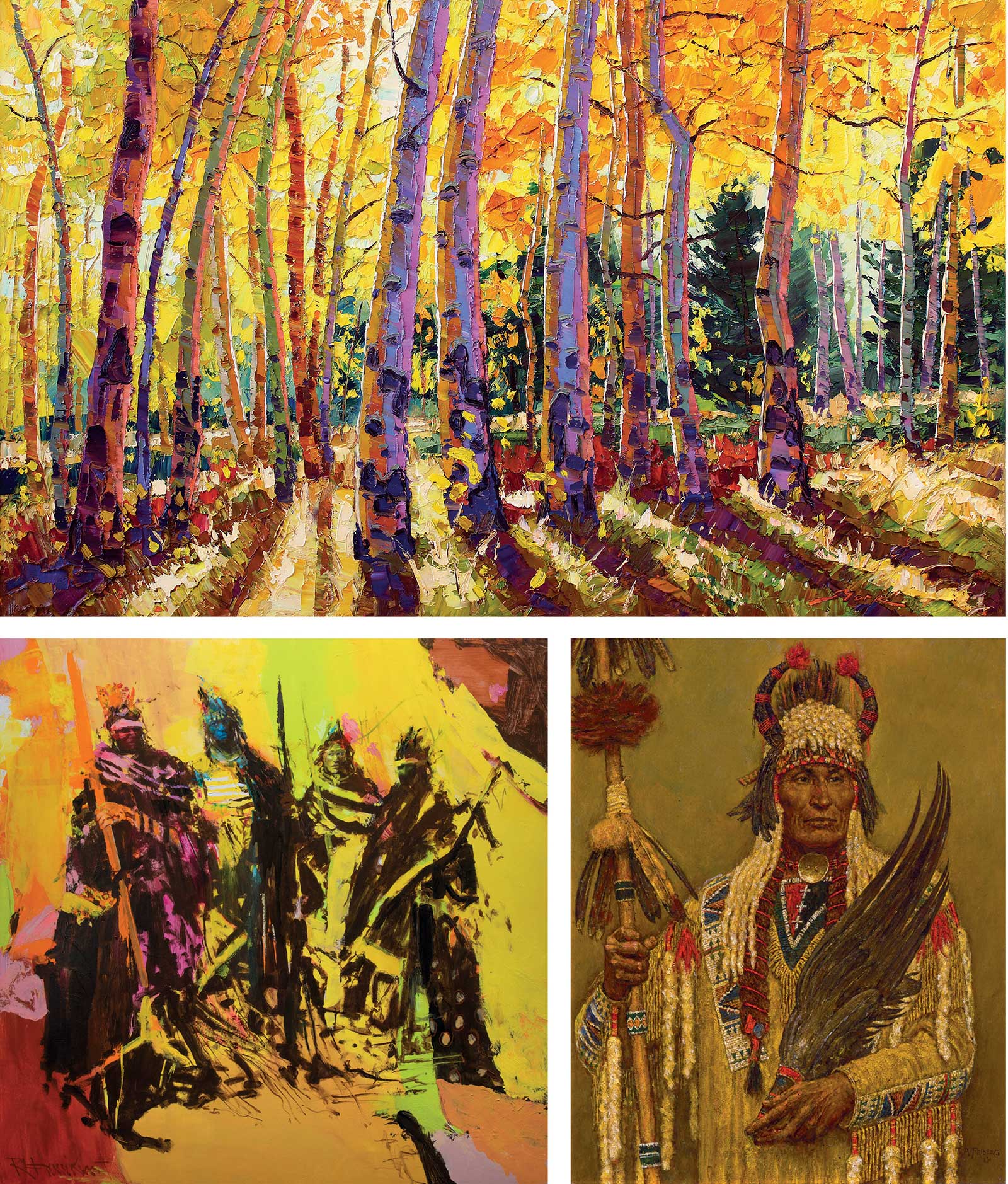
Top: Maya Gallery, Joy in Peace, oil, 30 x 48 in., by Carl Bork. Bottom: Altamira Fine Art, The Mystics, oil on canvas, 48 x 48 in., by Rocky Hawkins. First Freedom Art, Indian Chief, oil on canvas, 19½ x 15½ in., by Arnold Friberg (1913-2010).
“What drew Arnold Friberg to Native American subjects was his fascination with the enduring relationship among people, nature and tradition. He approached these works as a storyteller as much as a painter, seeking to move beyond stereotypes and portray Native Americans with the same dignity and heroic stature that distinguished his biblical and historical art, including his magnum opus, The Prayer at Valley Forge,” the organization notes about the artist. “Friberg was captivated by the artistry and patience embodied in Native cultural objects. He devoted countless hours to studying ceremonial regalia and beadwork, examining every stitch and pattern with meticulous care. To him, these objects were more than beautiful artifacts. They were living expressions of identity, heritage and cultural memory. By faithfully rendering their intricate designs, he honored the generations of Native artisans and the traditions they preserved.”
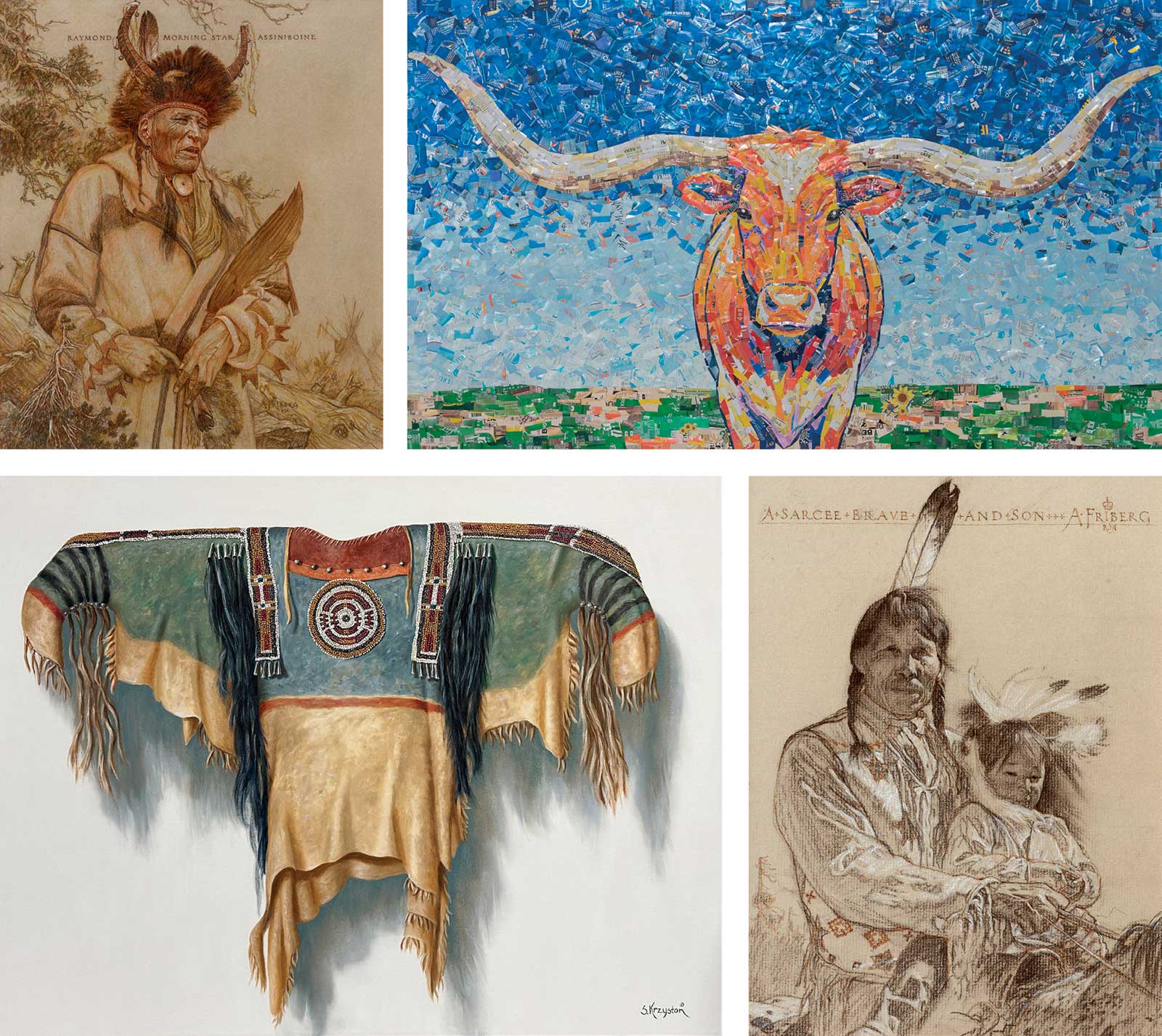
Top: First Freedom Art, Raymond Morningstar, oil on board, 32 x 28 in., by Arnold Friberg (1913-2010). Kendall Pace, El Jefe, recycled aluminum cans on board, 36 x 60 in. Private collection, Bottom: Sue Krzyston, A Richness of Heritage, oil, 30 x 40 in. First Freedom Art, Untitled, pastel on paper, 20 x 18 in., by Arnold Friberg (1913-2010).
For Kendall Pace, the Southwest is reinterpreted through recycled aluminum cans, which are flattened and arranged on a board. The materials are unique, but the messages will be familiar to collectors. “I build the icons of the American West from the cultures that made it: Anglo-Texas ranching heritage in El Jefe, my longhorn portrait; Mexican-Catholic devotion in Our Lady of Guadalupe; the charrería tradition in El Charro; and Texas history’s most complicated inheritance in Quanah Parker, the last free chief of the Comanche, half-Anglo, half-Comanche by birth, and a bridge between worlds,” Pace says. “Every figure I portray is built from thousands of hand-cut fragments drawn from hundreds of recycled aluminum cans. Every red, blue and gold comes from a can: soda, beer or sparkling water. No paint touches the image itself.”
Still life painter Sue Krzyston has been painting pieces of the Southwest for her entire career. She began by collecting Native American artifacts and objects. She is drawn to the intricacy and beauty that each artisan has created. “I love the challenge of bringing life to ‘still life.’ Light and how it falls on each different surface and texture helps to make a lively arrangement,” Krzyston says. “The shadows help create drama and depth to a painting. In Enduring Legacies the lovely Santa Clara pot, with its intricate carving and subtle reflections, tie this richly toned composition together. The beautiful beadwork and details of Native American artisans have always intrigued me. I thought of the maker of the shirt in A Richness of Heritageand each painstaking stitch they sewed to create this piece as I painted many layers onto each bead to try to make them come to life.”
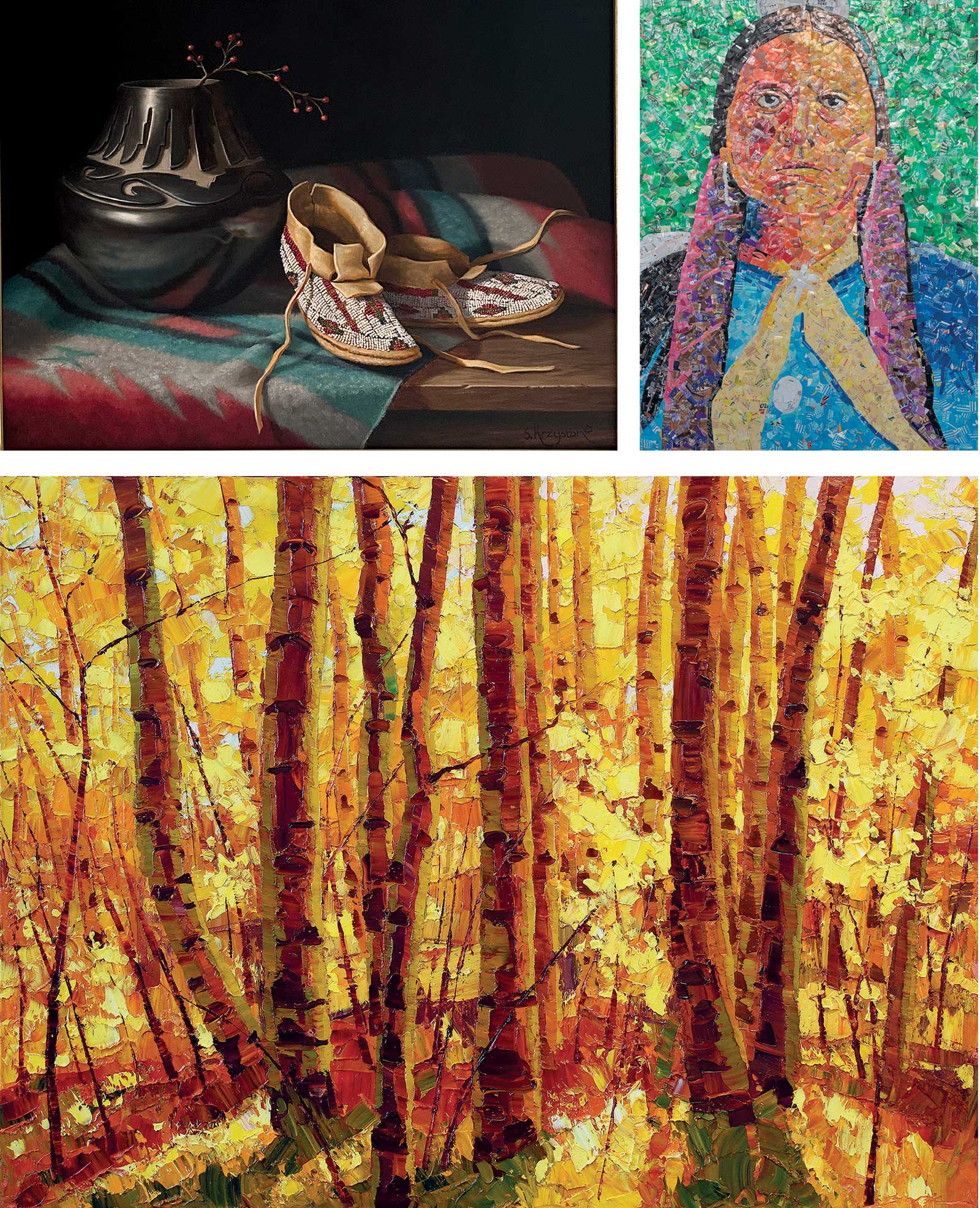
Top: Sue Krzyston, Enduring Legacies, oil, 18 x 24 in. Kendall Pace, Quanah Parker, recycled aluminum cans on board, 48 x 36 in. Bottom: Maya Gallery, Orange Thicket, oil, 30 x 40 in., by Carl Bork.
Maya Gallery in Santa Fe, New Mexico, is now offering work by Carl Bork, who paints the beauty of nature. “Aspens have always fascinated me because they seem to hold a kind of quiet energy. When you walk through an aspen grove in autumn, you are surrounded by hundreds of individual trees, yet somehow they become one living presence,” Bork says. “The light moves through the trunks and leaves, constantly changing the color and character of the forest. That feeling is what I am trying to capture in my paintings. I’m less interested in simply documenting a particular place than I am in recreating the emotional experience of standing there.”
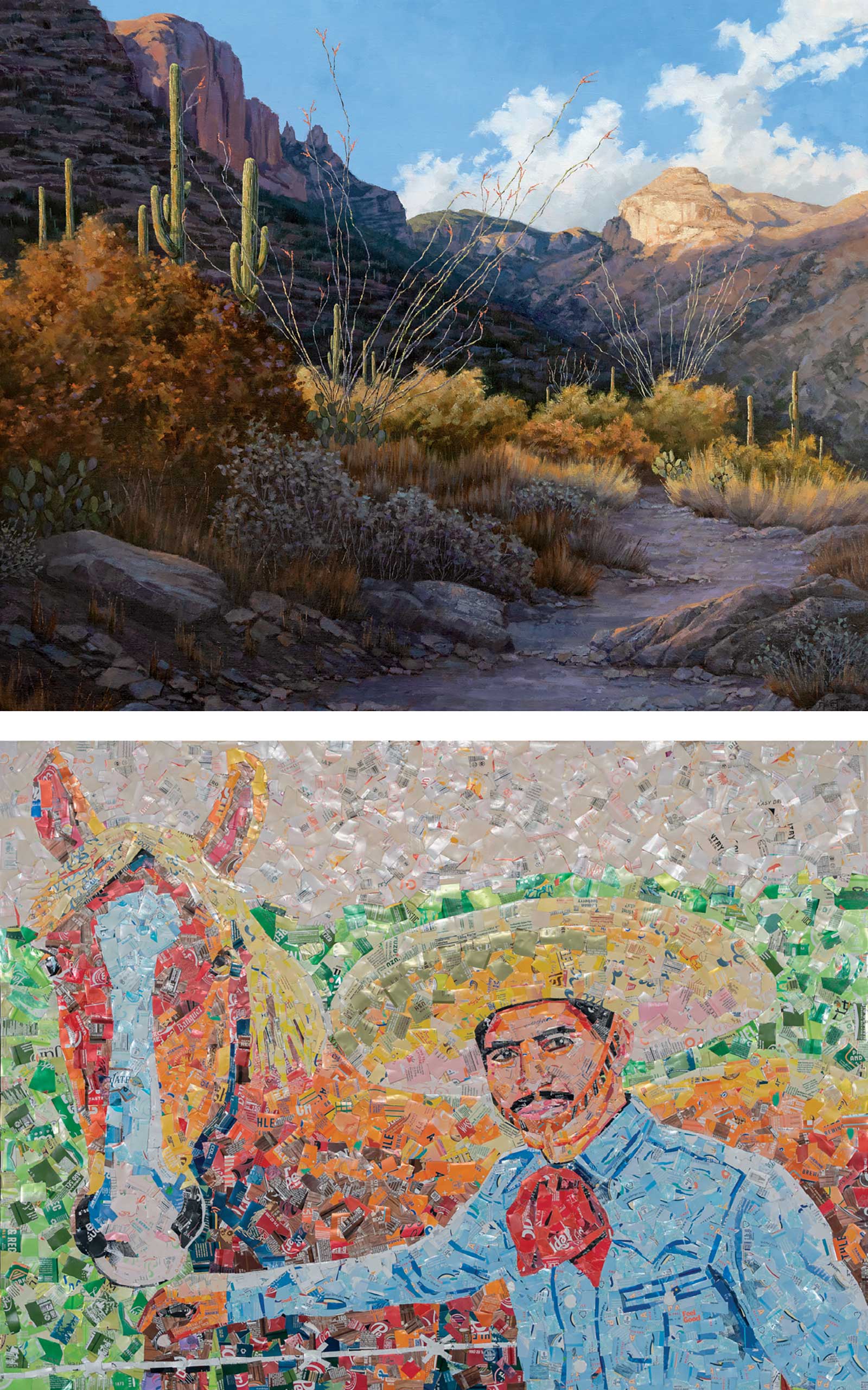
From top: Darcie Peet, Evening Trail to Finger Rock, oil, 30 x 36 in. Kendall Pace, El Charro, recycled aluminum cans on board, 48 x 48 in.
Landscape painter Darcie Peet has painted the desert and surrounding biomes for much of her career. “Having explored the outdoors since childhood, this is where the inspiration for my paintings evolves. Whether hiking, cycling, kayaking, riding or skiing, it is the mood, changing light and shadow, sounds or silence, nature’s aroma’s, boldness or the little things that I spy and absorb to translate into a painting,” Peet says. “Evening Trail to Finger Rock is of the fascinating canyons in the Catalina Mountains on the edge of Tucson, Arizona. Hiking the rocky trails at the end of the day brings the rich color of deep shadows; strong light against canyon walls and often singular silhouettes of saguaro, ocotillo and prickly pear cactus scattered amongst tall, soft, wispy desert grasses. The painting highlights an iconic element from the canyon…the distant shape of Finger Rock up a steep and long trail into the mountains. Times of quiet and serenity as most hikers are gone before darkness falls.” The painting will be available at Settlers West Galleries’ Great American West show on November 21 in Tucson. —
Featured Artists & Galleries
Altamira Fine Art
172 Center Street, Jackson, WY 83001
7038 E. Main Street, Scottsdale, AZ 85251
(480) 949-1256
www.altamiraart.com
az@altamiraart.com
First Freedom Art
www.firstfreedomart.com
contact@firstfreedomart.com
Sue Krzyston
(602) 615-0327
www.suekrzyston.com
skrzyston@aol.com
Legacy Gallery
225 Canyon Road, Santa Fe, NM 87501
7178 E. Main Street, Scottsdale, AZ 85251
www.legacygallery.com
Maya Gallery
82 E. San Francisco Street, Santa Fe, NM 87501
www.mayagallery.com
info@mayagallery.com
Kendall Pace
Austin, TX & Durango, CO
www.kendallpace.com
kgpace@gmail.com
IG: kendallpaceart
Darcie Peet
www.darciepeet.com
FB: /DarciePeet
Powered by Froala Editor


