

In 2003 and 2004, the National Gallery of Art and the Gilcrease Museum partnered on the groundbreaking exhibition Frederic Remington: The Color of Night, which explored the great painter’s late-period nocturnes. Remington did not invent the nocturne, but what became clear in that exhibition and catalog was that the artist reinvented them in his own style. Darkness, at least in Western paintings, would never be the same again.
“Shortly after the turn of the century, Remington began to explore the technical and aesthetic difficulties of painting darkness. In a series of works that took as their subject the color of night, Remington sought to capture the elusive silver tones of moonlight, the hot flame of firelight and the charged interaction of both,” writes Earl A. Powell III in the catalog’s forward. “Technically dazzling, the late nocturnes are also richly metaphoric, for they were created just as electricity began to alter the character of night. They were also completed after Remington had returned from the Spanish-American War haunted by his experience of combat and violent death. The late nocturnes thus reflect both the external beauty of night and the internal threat of darkness.”
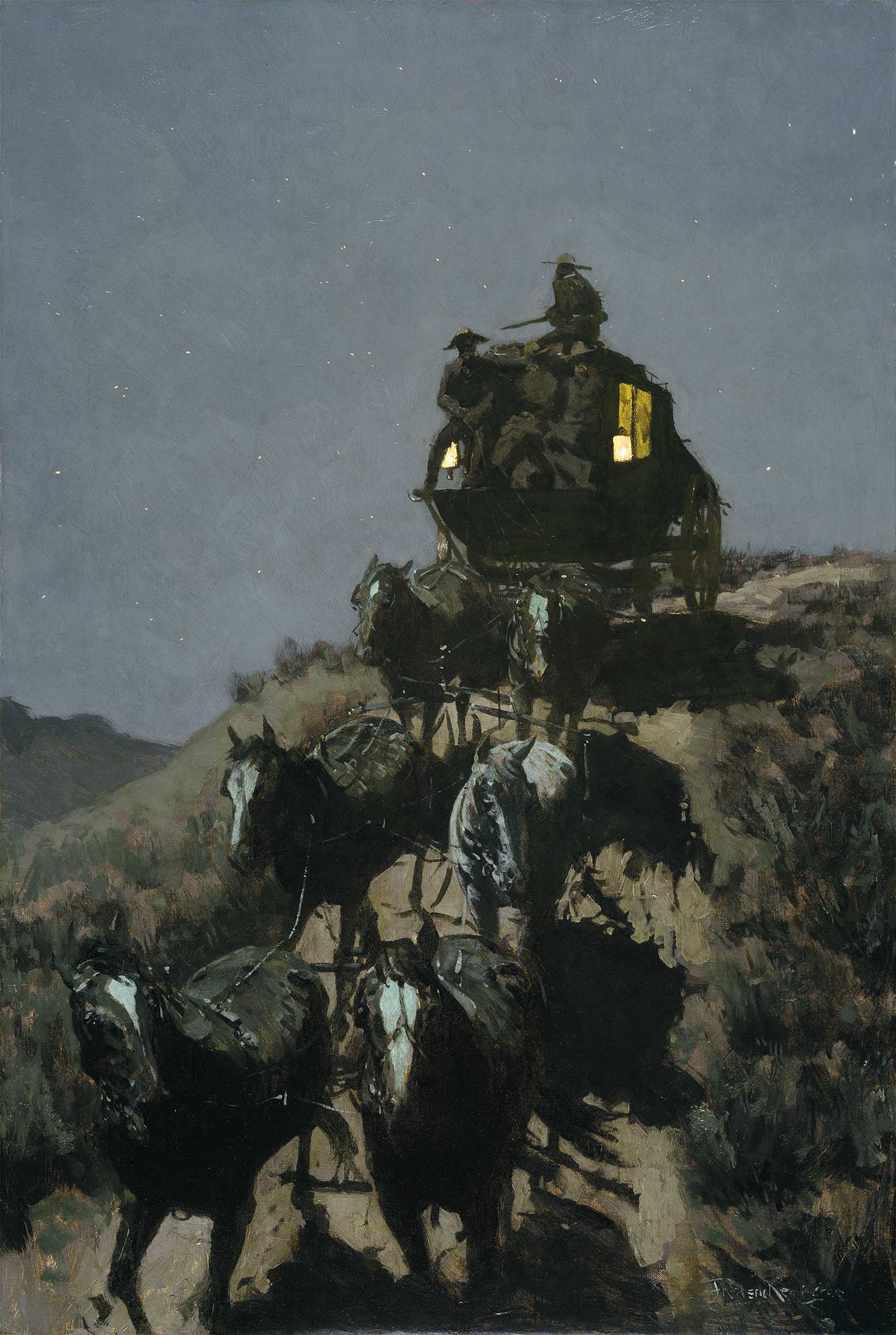
Frederic Remington (1861-1909), The Old Stage-Coach of the Plains, 1901, oil on canvas, 40¼ x 27¼ in. Amon Carter Museum, Fort Worth, TX
What’s remarkable about this work is how dark he was willing to go. In many of the works, his skies are not just faint shades of blue but almost pure black pigment, his shadows are inky and hide detail, and he uses snow and firelight to create highlights that add further contrast between the black voids of night and the faintest presence of light. Consider In from the Night Herd, one of his most famous nocturnes, showing a cowboy returning to camp after his shift watching cattle in the darkness. The standing figure is lit by the fire, and yet the night sky still swallows him up. Remington wrote in his journal in October of 1907: “I worked on my In from the Night Herd and am going to study a fire light out doors to night.”
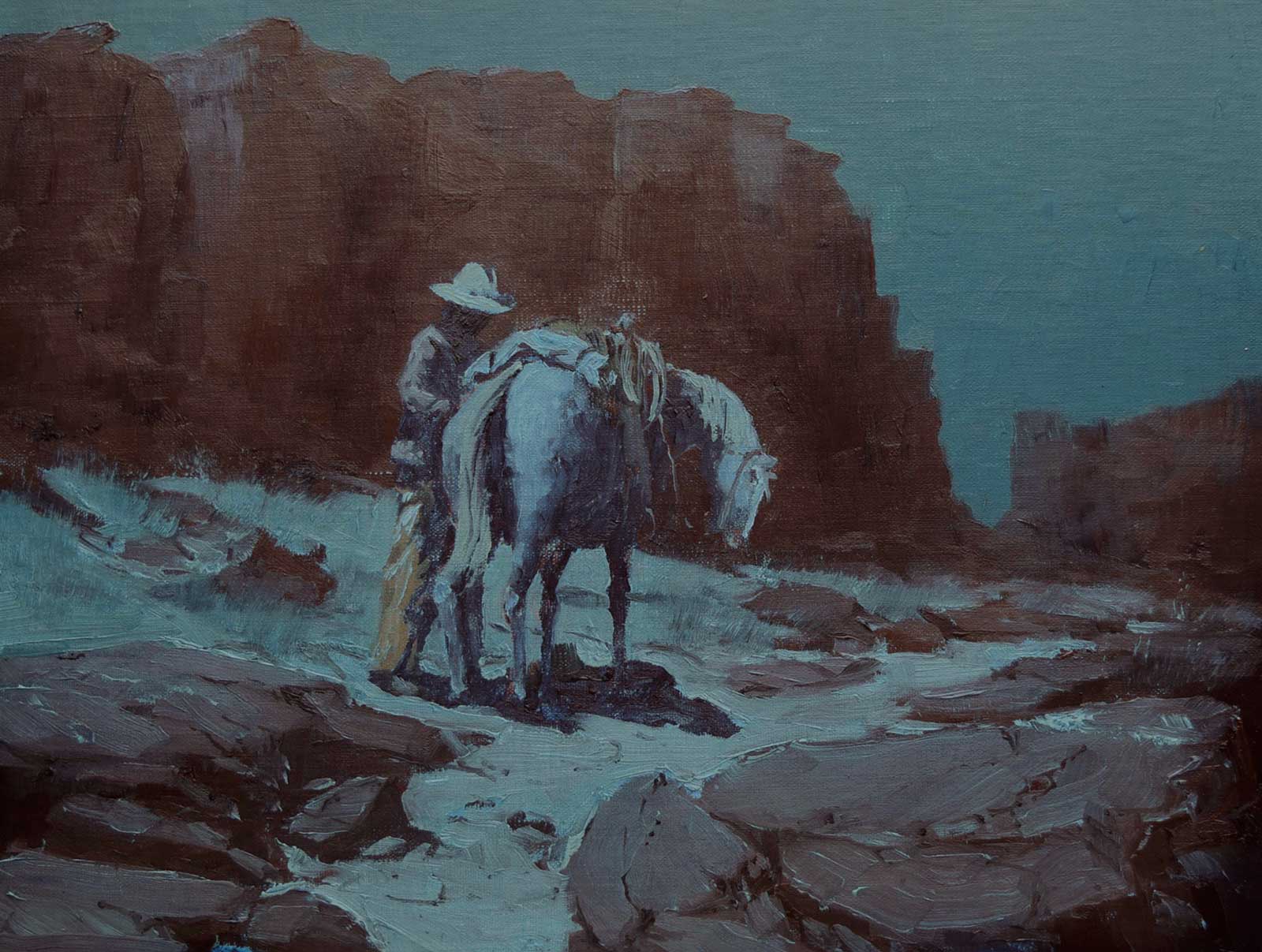
Legacy Gallery, Study; A Path in Purgatory, oil, 11 x 14 in., by Michael Ome Untiedt.
Earlier in his career, while still exploring the possibilities of the nocturne, Remington’s paintings had a more subtle nighttime appearance. In The Old Stage-Coach of the Plains, the sky is in a muted blue-gray to emphasize the silhouette of the stagecoach driver cresting and then descending down a hill. Many years later, Frank Tenney Johnson, another master of the moonlight, would employ a similar nighttime palette. (Although, consider his very Remington-like masterpiece, Night on the Oregon Trail, which pushes the darkness way beyond blue or grey.)
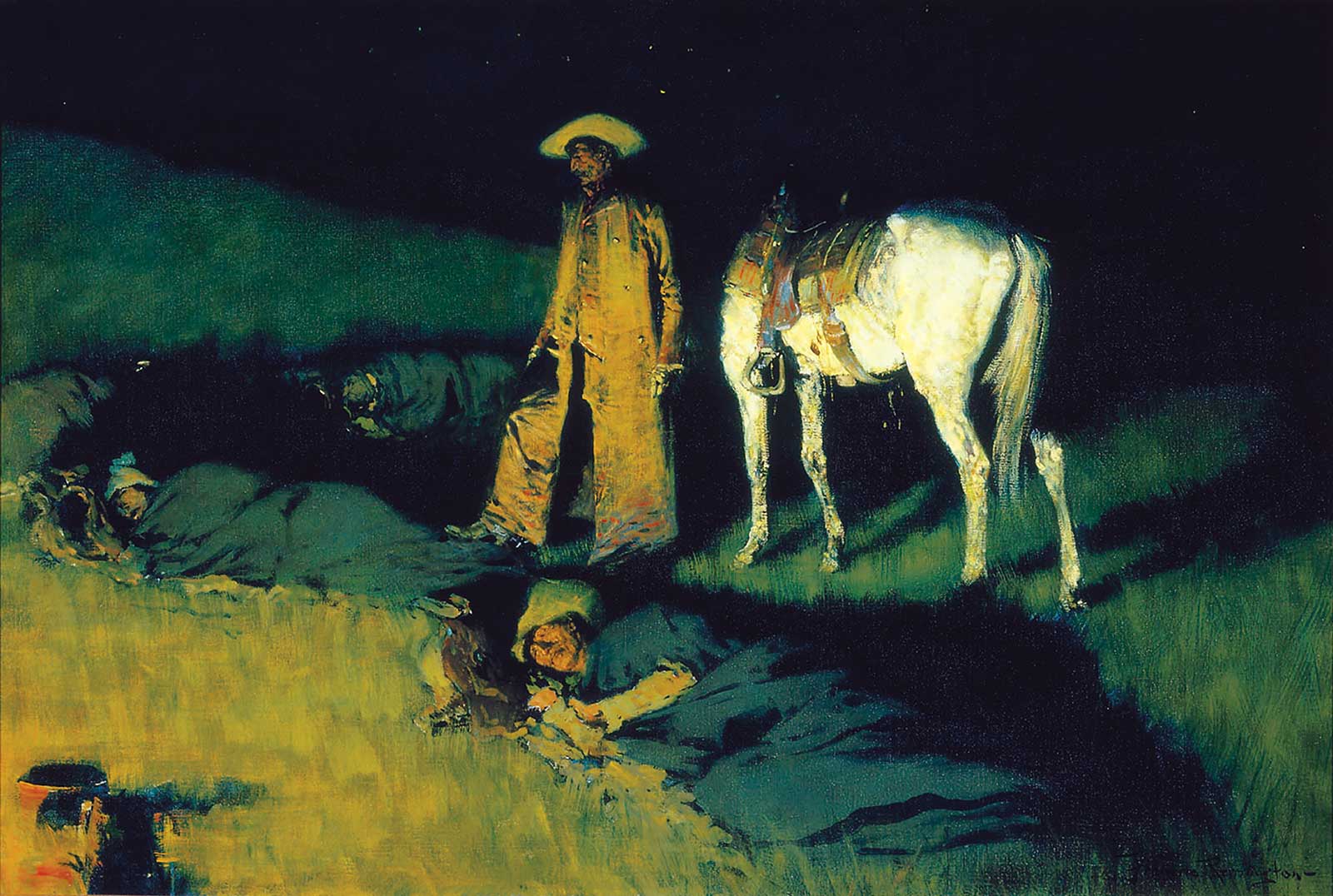
Frederic Remington (1861-1909), In from the Night Herd, 1907, oil on canvas, 27 x 40 in. National Cowboy & Western Heritage Museum, Oklahoma City, OK.
Johnson, who famously began exploring nocturnes after several nights spent outdoors waiting for money to be wired to him while on a trip in the West, painted the night more frequently than Remington and over a longer period of time. Between the two of them they created the foundation of Western nocturnes as a genre unto itself. Today, there are still many artists who are exploring what is possible with the limited light and color of night.
Continue reading through this new collector’s focus for more interpretations of nighttime scenes.
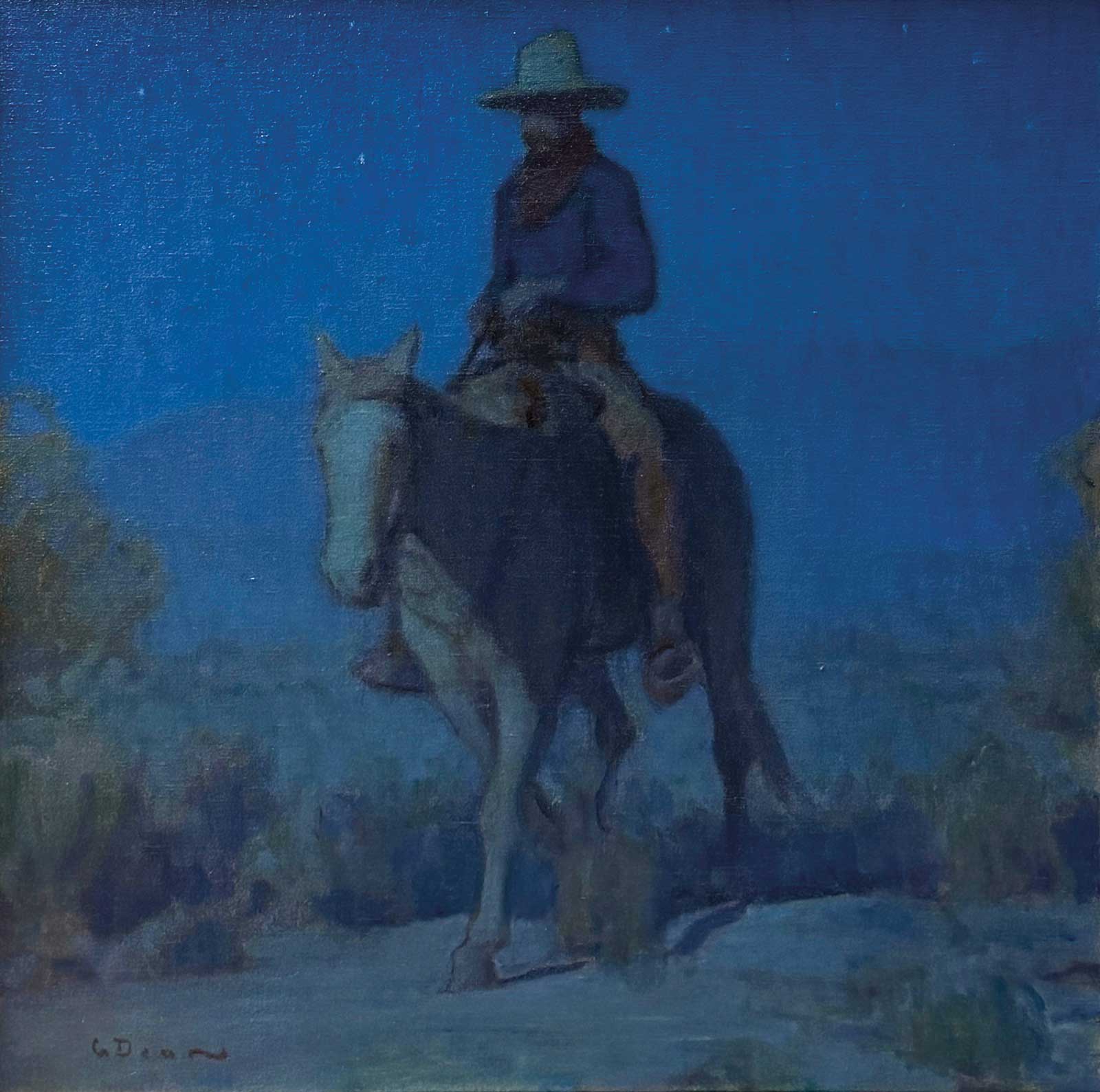
Maxwell Alexander Gallery, Night Hawk, oil, 24 x 24 in., by Glenn Dean.
In a nocturne, the artist has less information to work with—and, in many ways, more opportunity. “There is something about the landscape after the sun goes down that asks us to look more closely…Color becomes quieter, edges disappear and familiar subjects are transformed by moonlight, shadow and atmosphere,” notes Legacy Gallery, located in Scottsdale, Arizona. “In the West especially, that sense of mystery feels completely natural. The landscape is already vast, and at night it can feel almost limitless.”
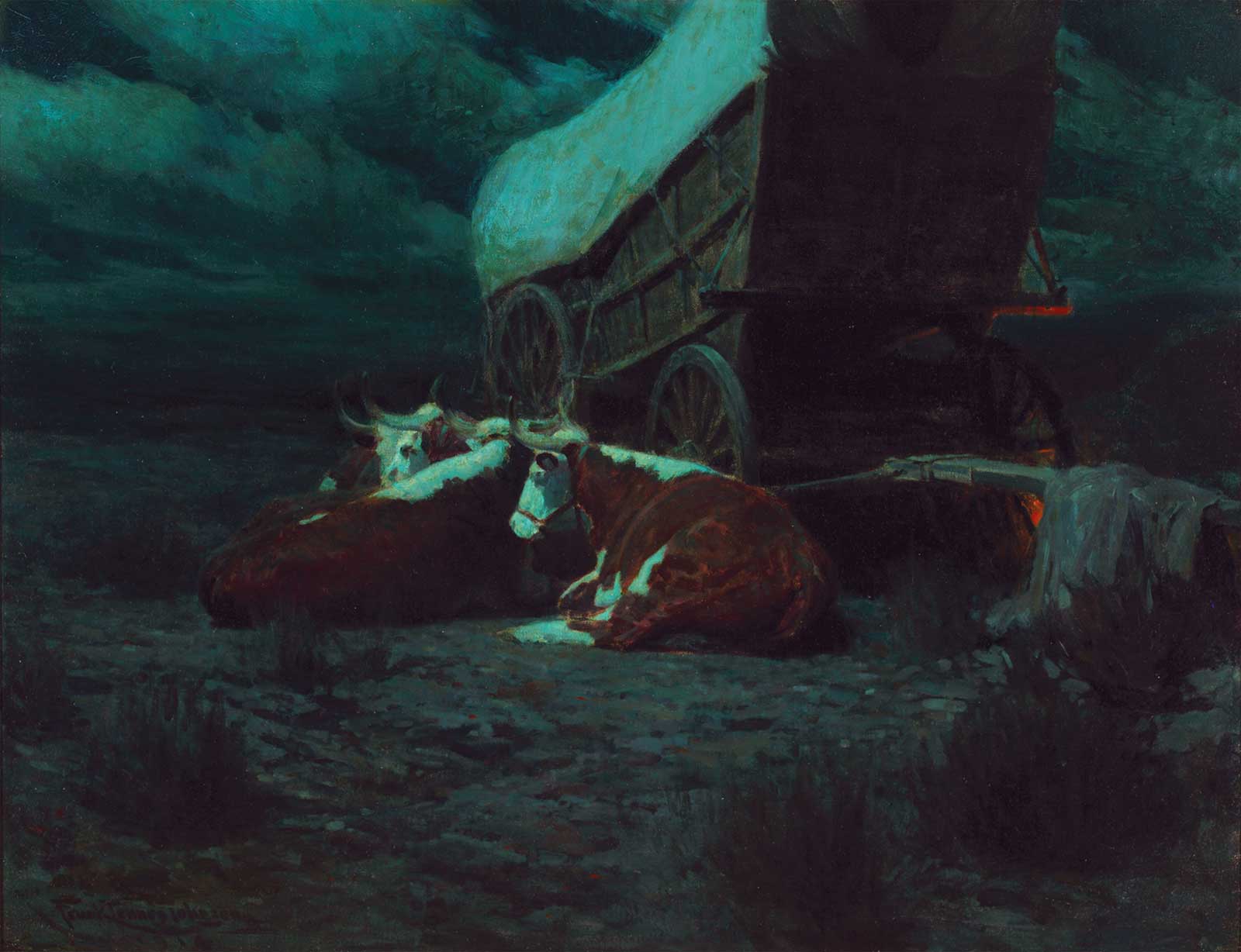
Frank Tenney Johnson (1874-1939), Night on the Oregon Trail, 1930, oil on canvas, 27 x 36 in. Joslyn Art Museum, Omaha, NE.
The paintings the gallery included for this new special section illustrate how differently artists can interpret that experience, with nocturnes by Bill Anton, Michael Ome Untiedt and Albin Veselka. “A figure on horseback, a solitary horse and rider, or cowboys moving quietly through the landscape become less about narrative and more about mood. The viewer begins to notice the temperature of the light, the depth of a shadow, or the small illuminated passage that might be overlooked in daylight. For us, the most compelling nocturnes don’t simply depict nighttime. They capture the stillness, uncertainty and beauty of being in the landscape when much of the world has disappeared into shadow,” Legacy Gallery notes.
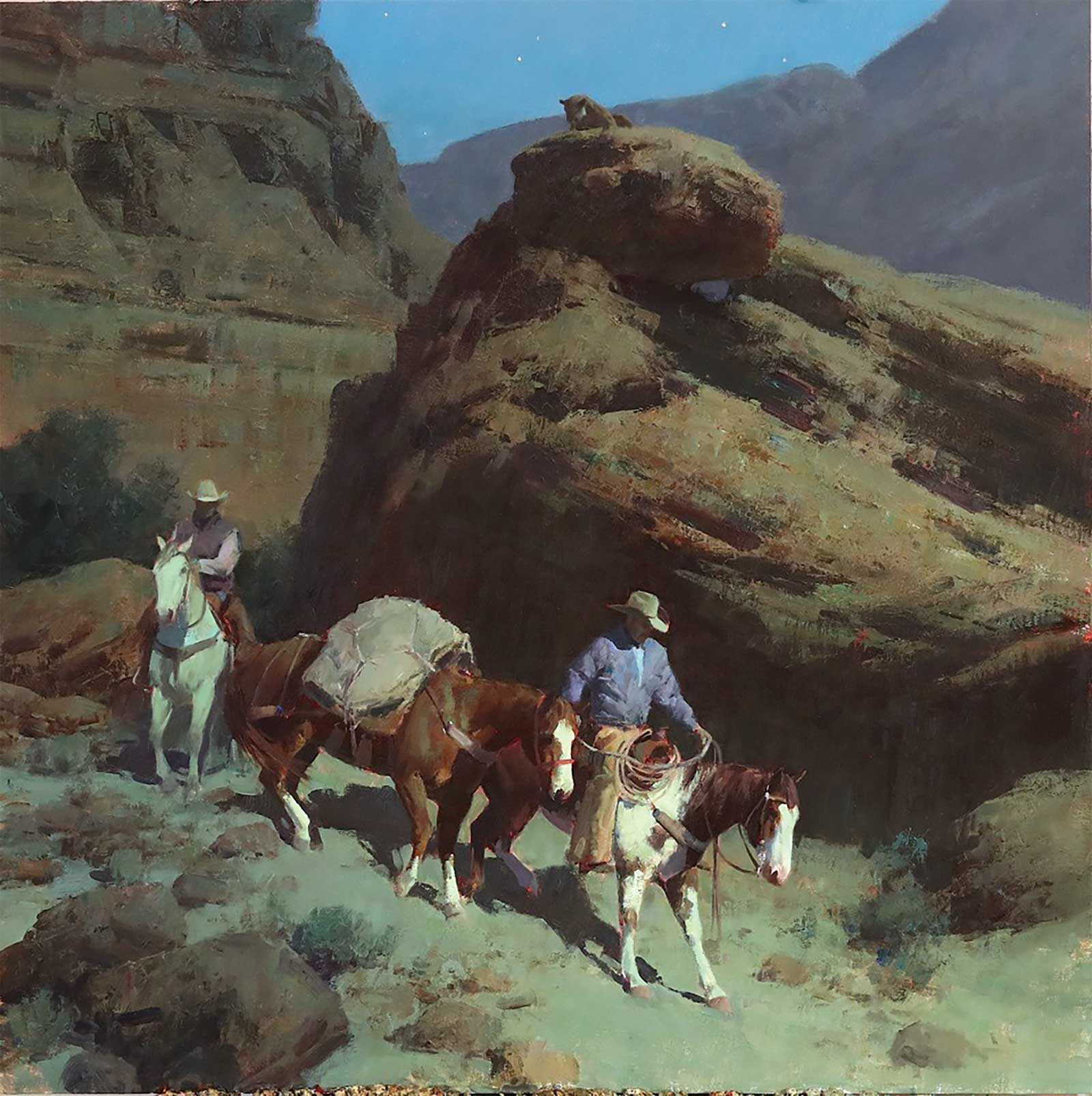
Legacy Gallery, Undetected, oil, 40 x 40 in., by Bill Anton.
“When considering a nocturne, I tell collectors not to judge it by how much detail they can see, but by how much they can feel. A great nocturne should still have life and depth in its darkest passages,” says Cyndi Hall, general manager of Legacy Gallery. “Look at how the artist handles subtle shifts in value, temperature and light. Most importantly, give the painting time. The best nocturnes reveal themselves slowly, much like your eyes adjusting to the dark.”
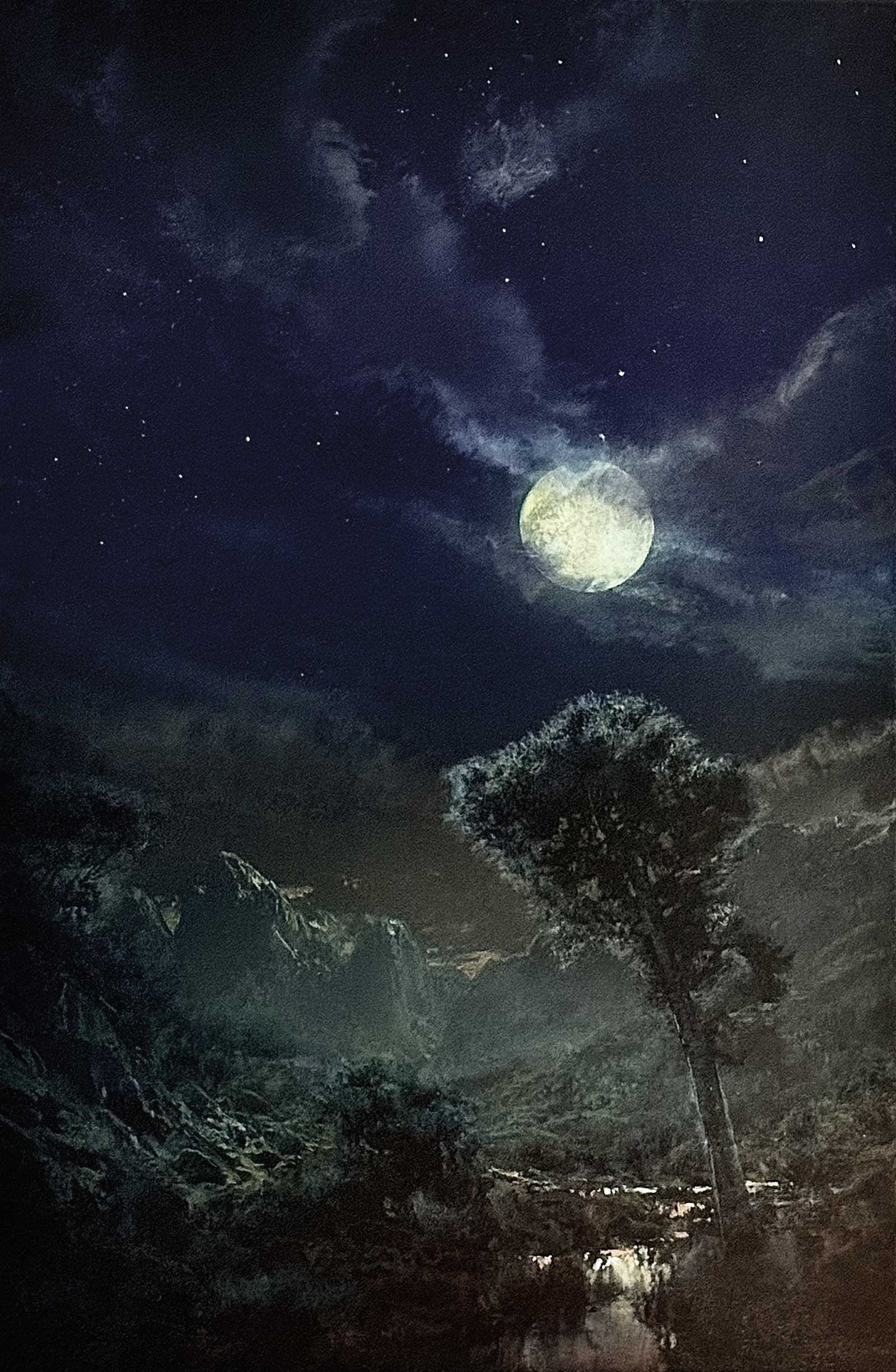
Dale Terbush, as far as the eye and the moon can see!, acrylic, 16 x 12 in.
For Maxwell Alexander Gallery owner Beau Alexander, there is something about the Western landscape at night that completely changes the way an artist sees it. “During the day, the landscape is vast and details are clearly visible, but at night much of that disappears,” he says. “The artist is left with simplified shapes, strong silhouettes, subtle shifts in color and small areas of light that suddenly become incredibly important.” This naturally lends itself to the kind of strong design and simplification that Maxwell Alexander Gallery values in Western art.
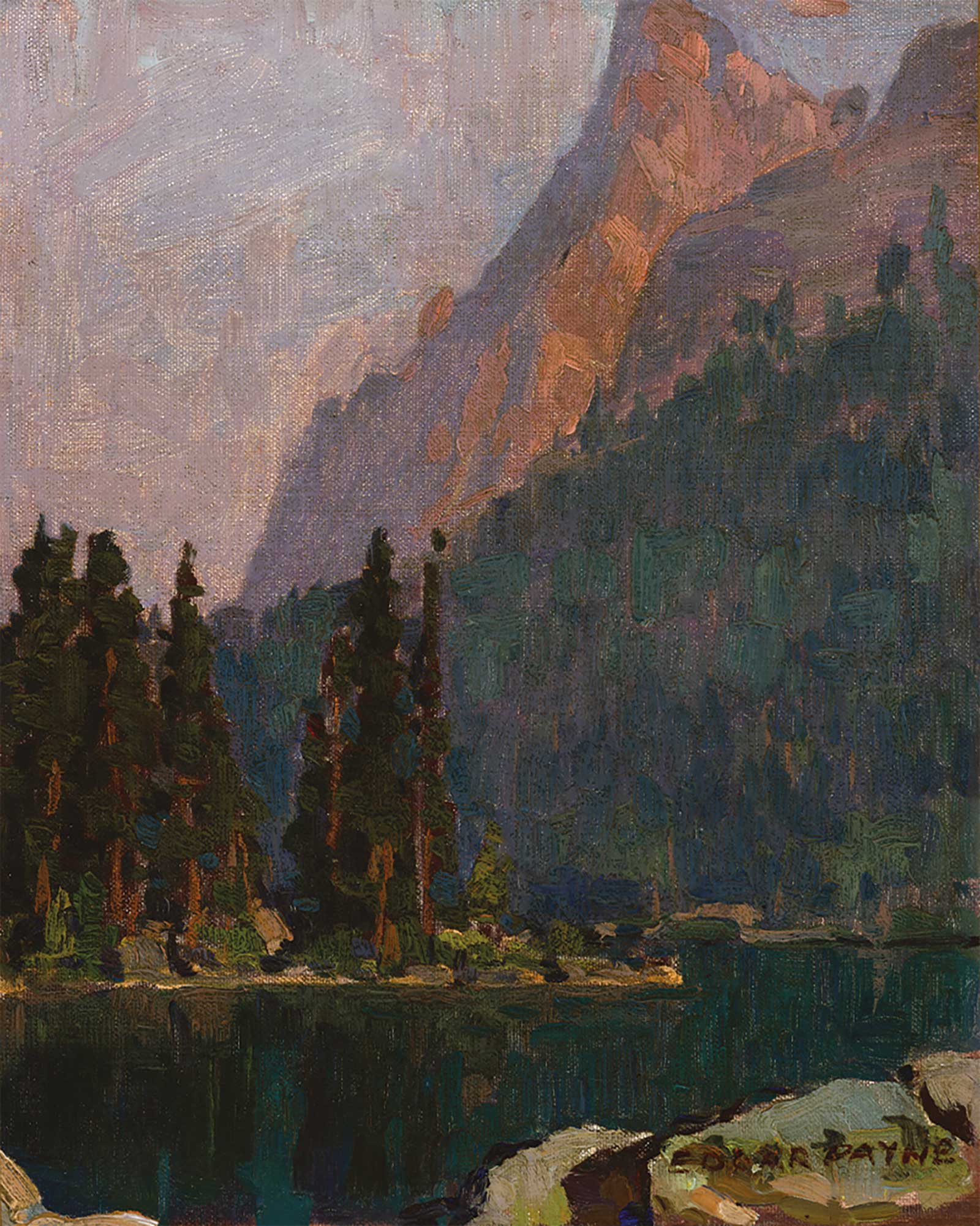
Maxwell Alexander Gallery, Evening Glow, oil, 13½ x 10¾ in., by Edgar Payne (1883-1947).
“My advice to collectors is the same whether they are buying a nocturne or any other work of art: start with the quality of the painting and the strength of the artist’s individual voice,” says Alexander. “With nocturnes in particular, look closely at how the artist handles value and light. A successful night painting shouldn’t rely on the novelty of being dark, it should still have a strong composition and hold your attention.”
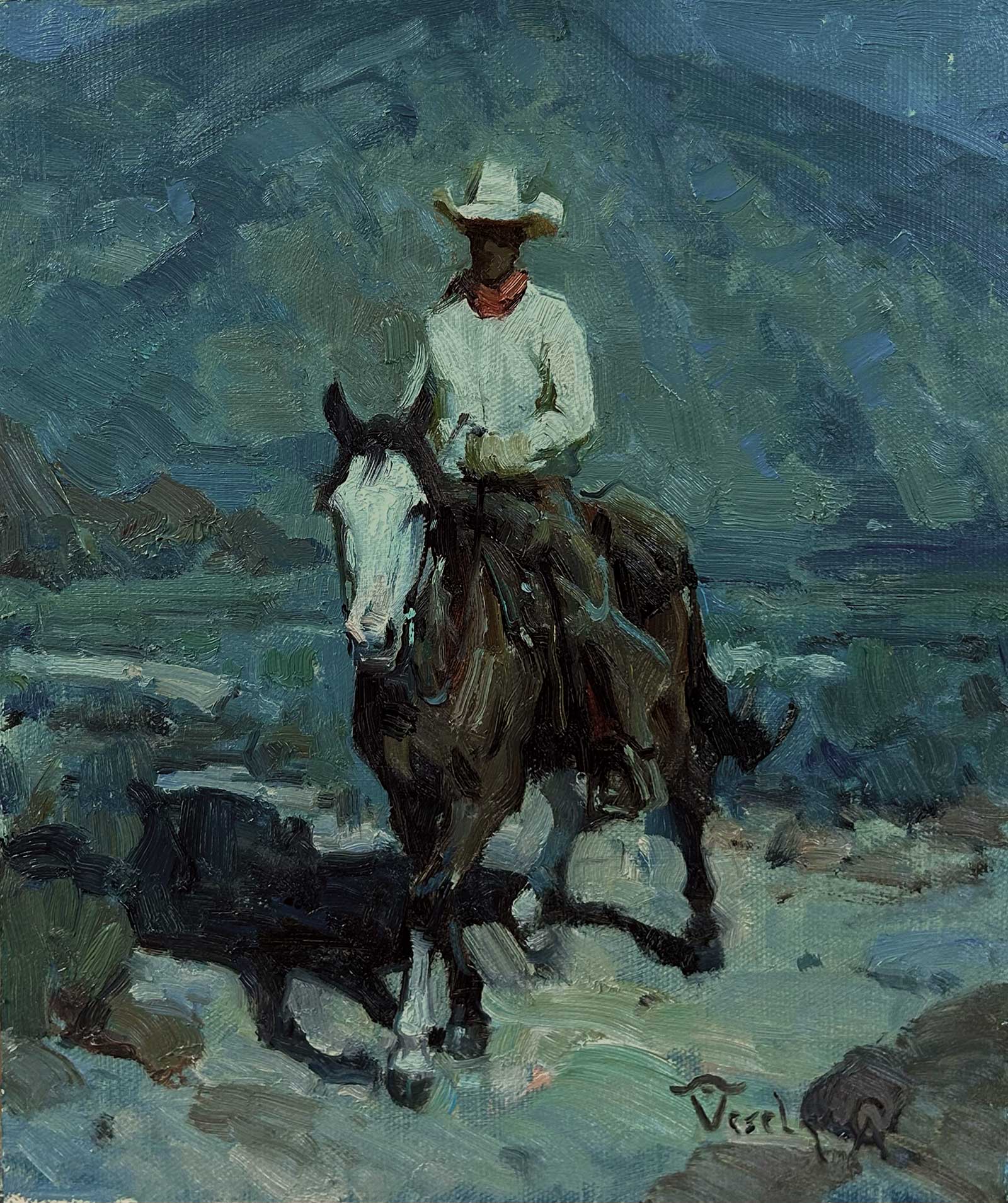
Legacy Gallery, Riding by Midnight, oil, 12 x 10 in., by Albin Veselka.
Arizona-based painter Dale Terbush, who has lived in multiple locations across the Southwest, focuses on the region’s expansive skies. His almost otherworldly skyscapes capture the majesty and allure of this desert land, and lately he’s been turning his attention more and more toward nighttime scenes. In this special section, glimpse one of Terbush’s nocturnes: a cool palette of blues and grays featuring a bright moon breaking through the clouds on a cold winter night. —
Featured Artists & Galleries
Dale Terbush
daleterbush@cox.net
www.daleterbushart.com
Legacy Gallery
7178 E. Main Street, Scottsdale, AZ 85251
(480) 945-1113, www.legacygallery.com
Maxwell Alexander Gallery
1300 N. Lake Avenue, Pasadena, CA 91103
(213) 275-1060
www.maxwellalexandergallery.com
Powered by Froala Editor


