Between 1904 and 1906, N.C. Wyeth made three trips to the West. His initial excursion in 1904 was to the Gill Ranch, east of Denver, where he witnessed the fall roundup with 35 cowpunchers. Story goes that the riders outfitted Wyeth with authentic cowboy gear and he looked (and felt) magnificent in the saddle as the cows were brought in. The trip had a profound impact on his career.
At this point in his life, Wyeth was not yet the Wyeth we know. His work with Scribner’s was only barely starting, he had not yet illustrated Treasure Island or The Last of the Mohicans,and he had only started studying with Howard Pyle two years earlier. It was Pyle who encouraged him to go West to experience some adventure and get reference material for his East Coast art career.
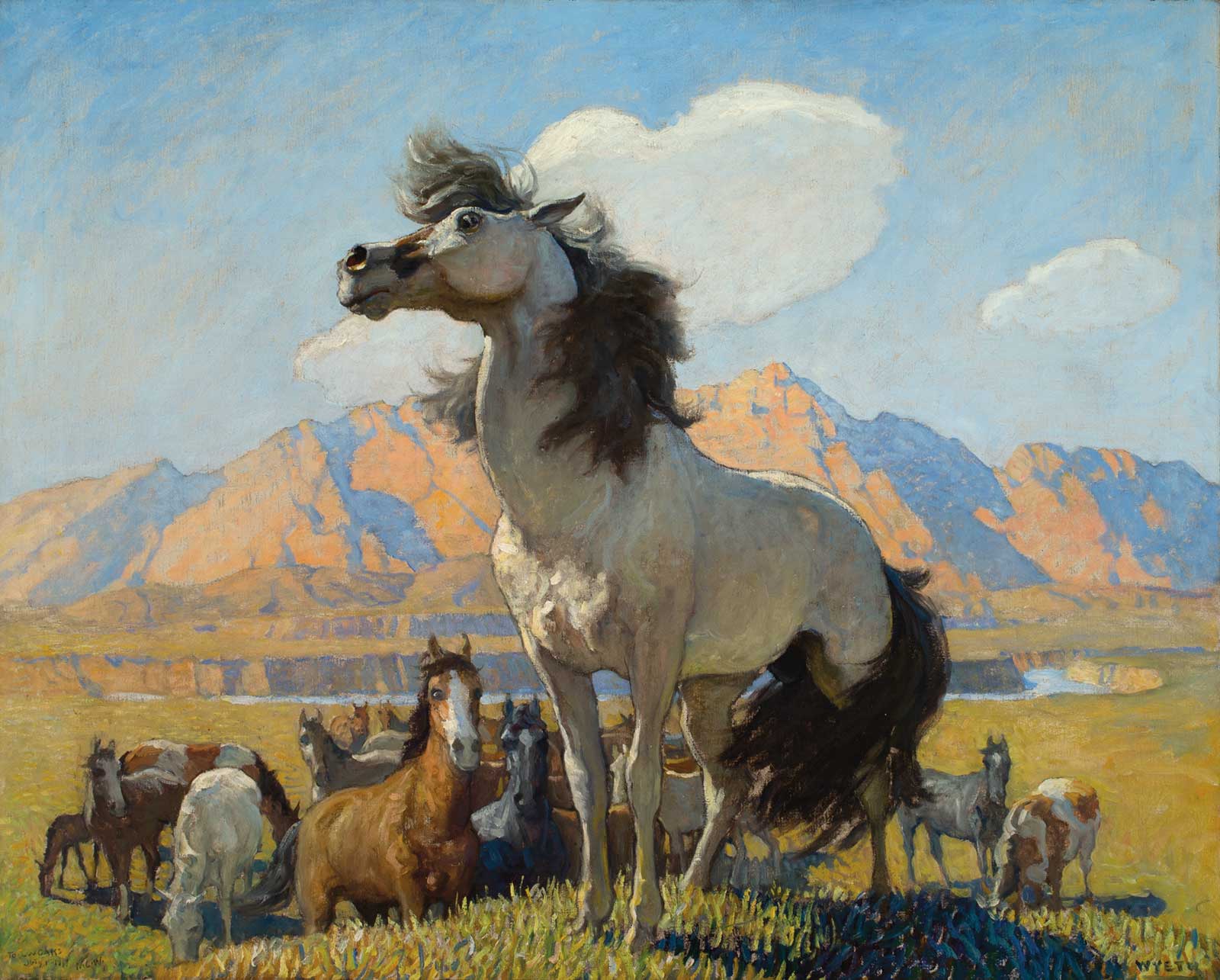
N.C. Wyeth (1882-1947), Smokey Face, 1917, oil on canvas, 32¼ x 40 in. Brigham Young University Museum of Art. Gifted in memory of L. Weston Oaks and Jessie Nelson Oaks, 1989.
So what did he come back with? Cowboys, cattle and lots of horses.
There were horses back East, but the equine subjects Wyeth put to canvas were uniquely Western. They remain highlights of his distinguished career.
Other painters who were known for horses include William R. Leigh, who painted them as chaotic tornados of limbs somehow tamed just enough to allow a rider to stay (barely) saddled, and Frank Tenney Johnson, whose subjects were less stylized but more authentic and often featured expert horsemen with heroically posed horses.
French painter Rosa Bonheur frequently painted images of the American West, especially after meeting Buffalo Bill Cody in Europe. Although it wasn’t set within the American West, Bonheur’s most famous painting, the Paris-set image The Horse Fair,was studied by many American painters who were in Paris in 1853 and after. Today the 200-inch-wide painting occupies a massive wall at the Metropolitan Museum of Art in New York City. Her horses convey power, strength and beauty.
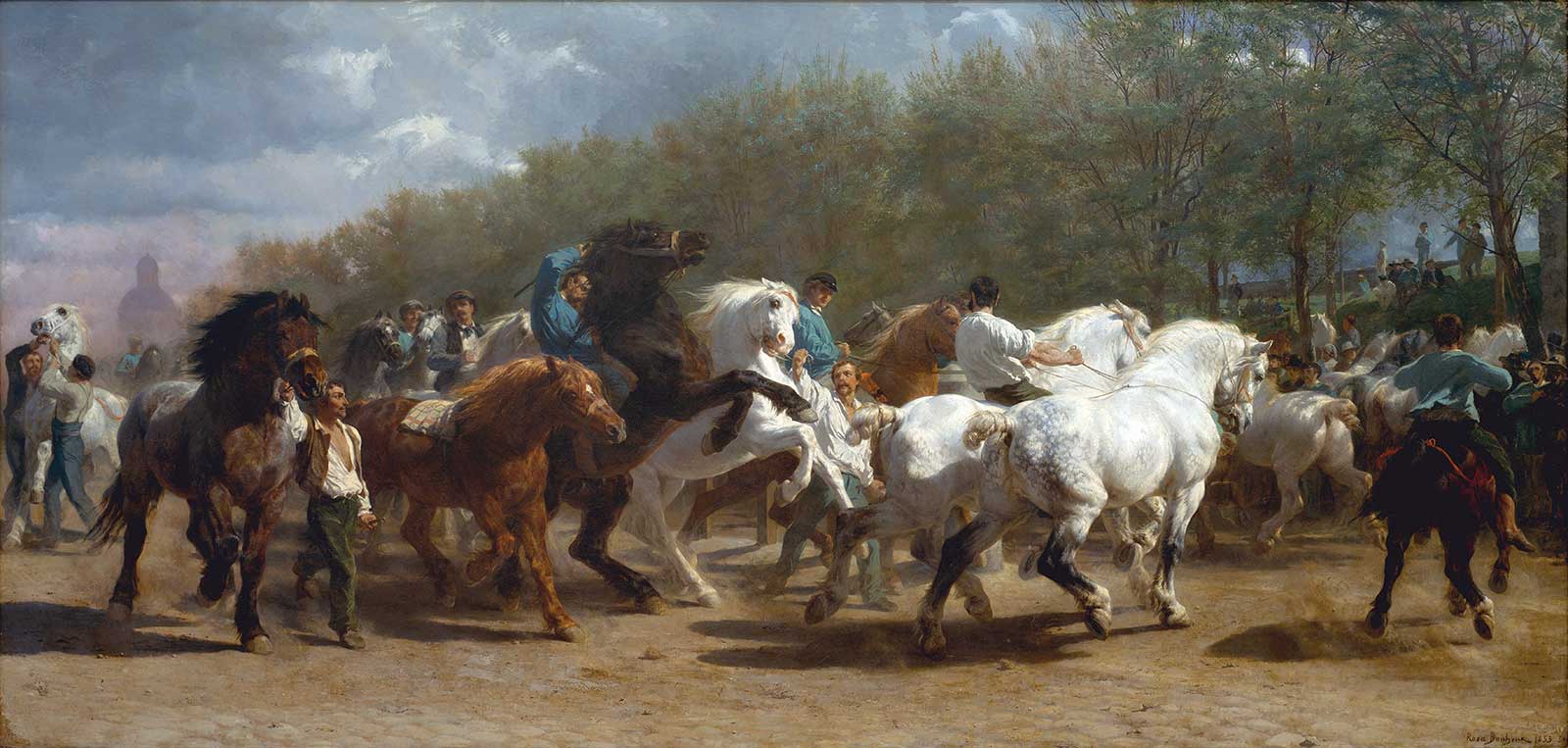
Rosa Bonheur (1822-1899), The Horse Fair, 1852-55, oil on canvas, 96¼ x 199½ in. Metropolitan Museum of Art. Gift of Cornelius Vanderbilt, 1887, 87.25.
What these artists and their works proved then, and continue to show today, is that horse paintings (and sculptures) speak to our primal connection to these magnificent animals and the culture around them. Looking at images of horses also offers a familiar and timeless experience. Consider the Gene Autry lyrics that convey that familiar feeling:
I’m back in the saddle again / Out where a friend is a friend
Where the longhorn cattle feed / On the lowly jimson weed
I’m back in the saddle again
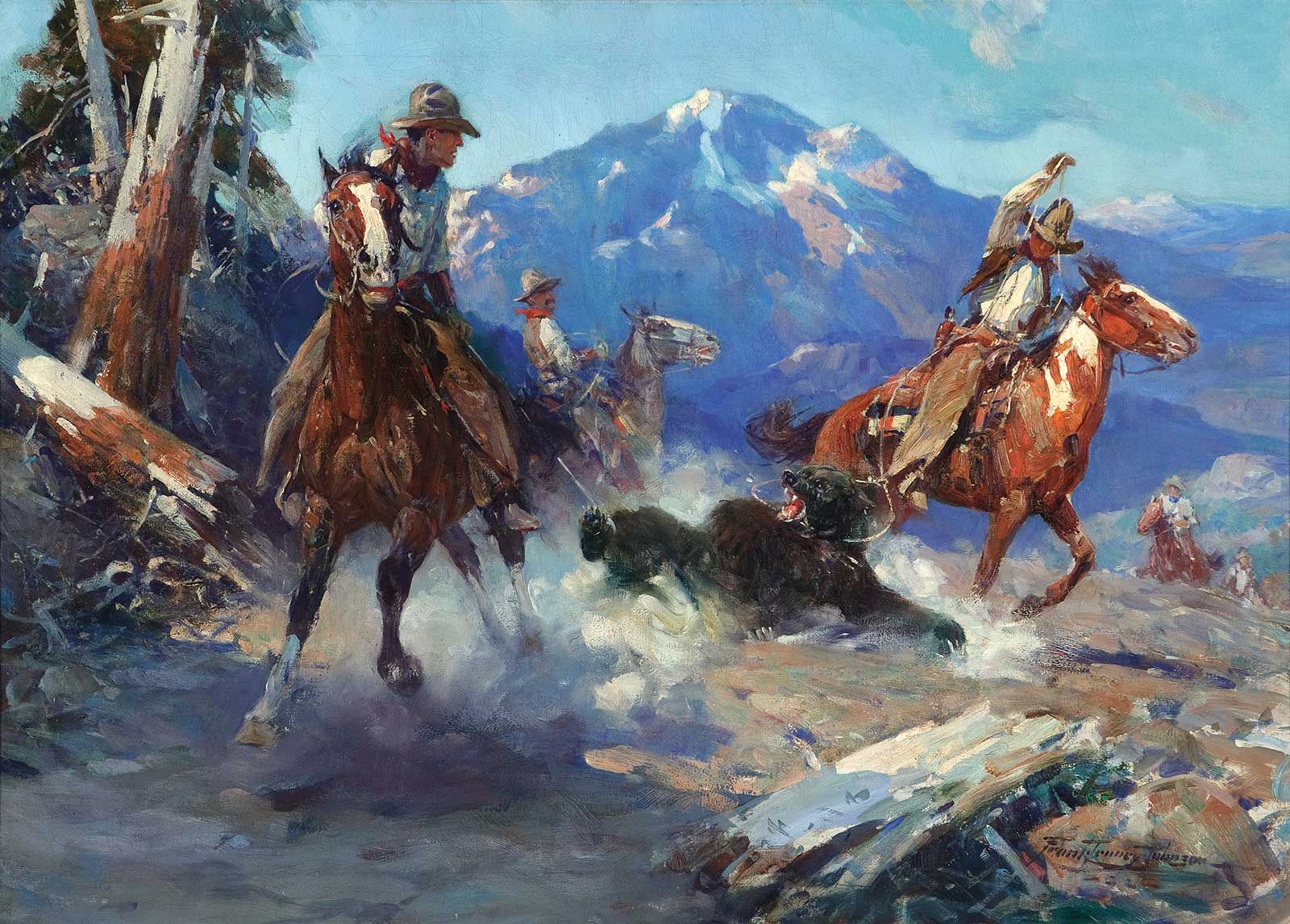
Frank Tenney Johnson (1874 - 1939), Cowboys Roping the Bear, oil on canvas laid on board, 26¼ x 36¼ inches
Among the artists Claggett/Rey Gallery represents is Robert Lougheed, who often depicted the equine form. “Those who knew painter Robert Lougheed were savvy of his profound dedication to his art and his love of the horse,” says Claggett/Rey Gallery owner Maggie DeDecker. “He believed that to paint outdoors was the only way to capture the refraction of light as it affected every element of the subject or environment being painted. One of his favorite subjects to paint in that natural light was the horse. His friend and fellow artist John Clymer once quoted, ‘Don’t go painting with Bob unless you like to paint horses. We painted horses, front view, side view, three-quarters and back, in sunshine, in rain, standing in the snow and once even in a hailstorm.’ If there was ever an artist as dedicated to their subject and artistic talents as Lougheed I would be pleasantly surprised. His portfolio is proof of his lifelong pursuit to capture and perfect the beauty of his favored subject, and Claggett/Rey Gallery is honored to be the humble custodians of a broad collection of Lougheed’s work.”
Artist Cheryl Koenis best known for her depictions of the Southwest and her ability to capture the natural beauty of both landscapes and equine subjects. Though currently residing in Texas, Koen lived for several years in New Mexico, including in Santa Fe, where she was fortunate to be mentored by plein air masters and paint in the areas surrounding Abiquiu and Ghost Ranch. Koen’s main influences include icons like Nicolai Fechin, Edgar Payne and Frederic Remington, among others. Her work has appeared in many juried exhibitions and she continues to be a presence on the national stage.
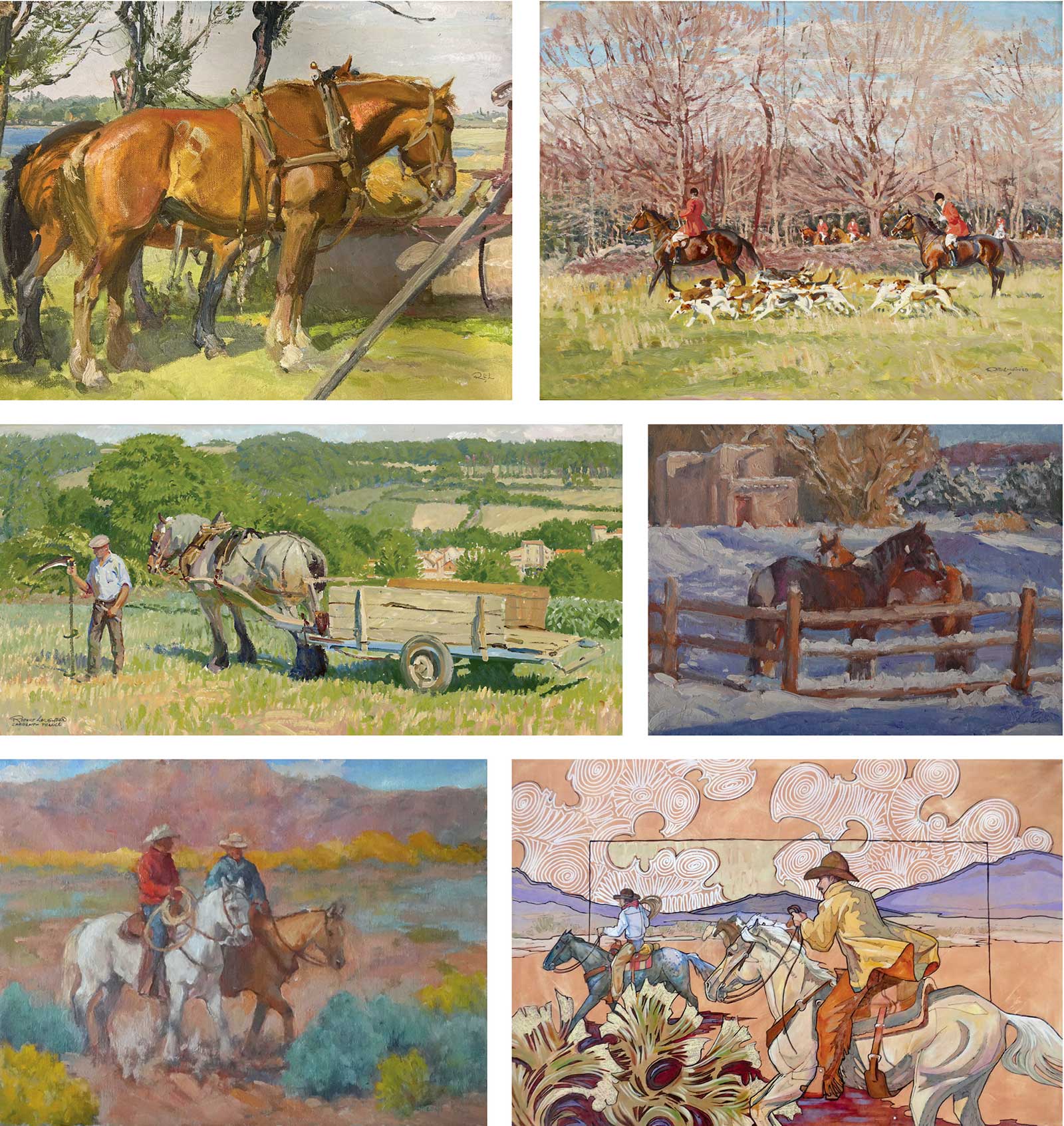
Top: Claggett/Rey Gallery, Portrait of a Team Partner, oil, 12 x 16 in., by Robert Lougheed (1910-1982). Claggett/Rey Gallery, Fairfield Hounds, oil, 20 x 26 in., by Robert Lougheed (1910-1982). Center: Claggett/Rey Gallery, Louis & Tintin in Chadrat, France, oil, 12 x 24 in., by Robert Lougheed (1910-1982). Cheryl Koen, Dreaming of a White Christmas, oil on canvas, 12 x 16 in. Bottom: Cheryl Koen, Compadres, oil on linen, oil on linen, 18 x 24 in. Maia Chavez Larkin, Riders in the Sage, oil and ink on canvas, 24 x 36 in.
Maia Chavez Larkin’s inspiration rides the line between the Old West of her childhood dreams and the contemporary, living West that her hardworking subjects inhabit today. “I have the privilege of working with a horse ranch in the wild northwest corner of Colorado for my contemporary inspiration,” she says. “The rest comes from the stories that my mother read to me in the cabin on our ranch in southern Colorado when I was a child, and the tales of my late father’s childhood that spanned the Dust Bowl days between New Mexico and Colorado. As an erstwhile illustrator, I have developed a deliberately illustrative style that combined ink and oil on canvas for a more durable take on the Western illustrations of yore.”
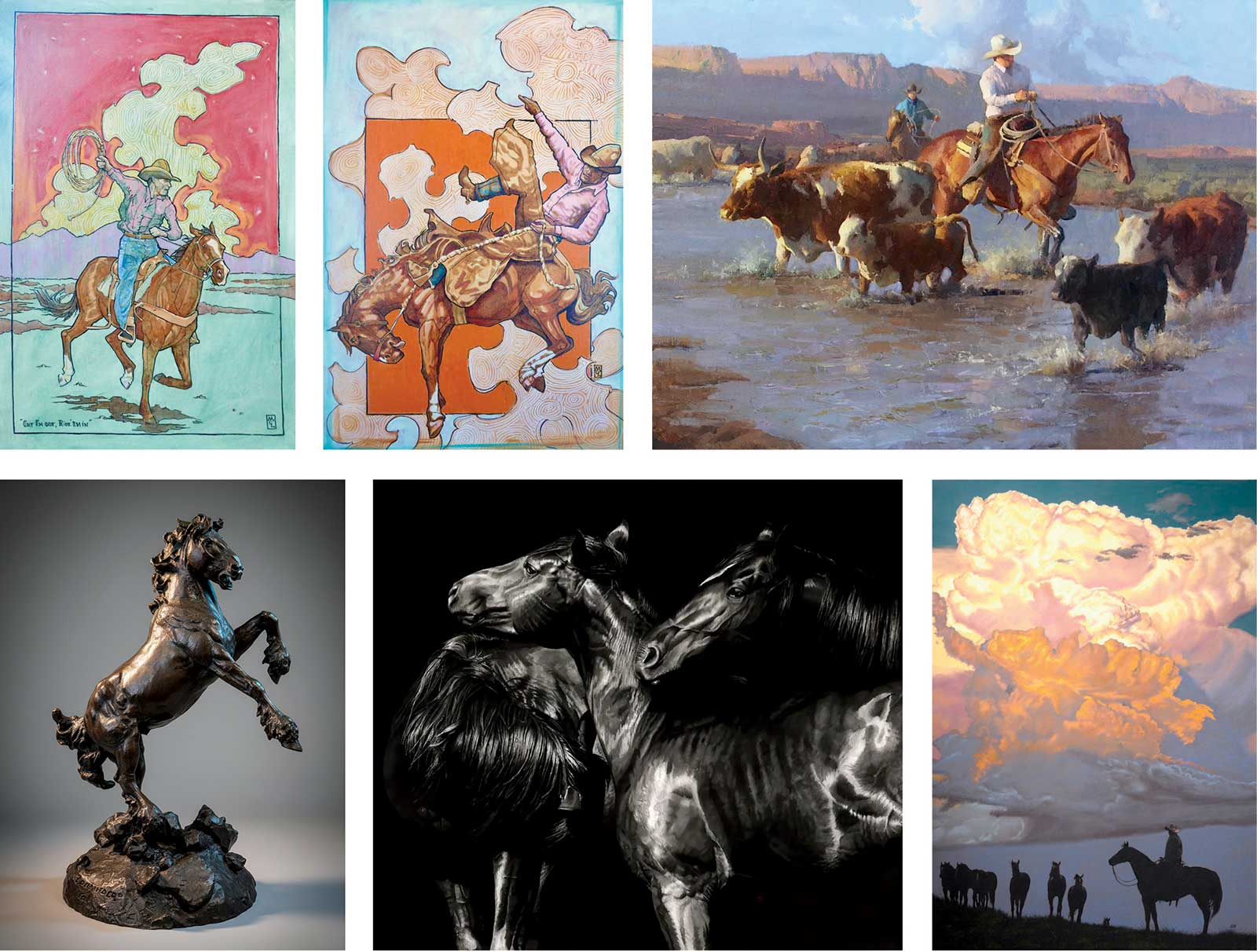
Top: Maia Chavez Larkin, Ride ‘Em In, oil and ink on canvas, 36 x 24 in. Maia Chavez Larkin, Sky Puncher, oil and ink on canvas, 36 x 24 in. Legacy Gallery, Treading Water, oil on linen, 30 x 40 in. by Bill Anton. Bottom: Legacy Gallery, Commander, bronze, ed. of 30, 39 x 20 x 26 in., by Scott Rogers. Legacy Gallery, Nighthawks, charcoal, 48 x 54 in., by Rachel Brownlee. Kadra Nevitt, Cresting, pastel, 27 x 39 in.
Cyndi Hall, general manager of Legacy Gallery, says, “The horse has always held a central place in Western art because it is inseparable from the story of the American West itself. Long before highways and engines, the horse represented movement, survival, work and partnership. It carried people across vast distances, worked cattle, explored unknown country, and became one of the most enduring symbols of freedom and resilience in the Western landscape. For artists, the horse presents both a challenge and an opportunity. Its anatomy, power and motion require real understanding to portray well. A convincing horse cannot be painted from imagination alone; it demands observation, respect for form, and sensitivity to movement. When done well, the horse becomes far more than a subject—it becomes the emotional center of a painting.”
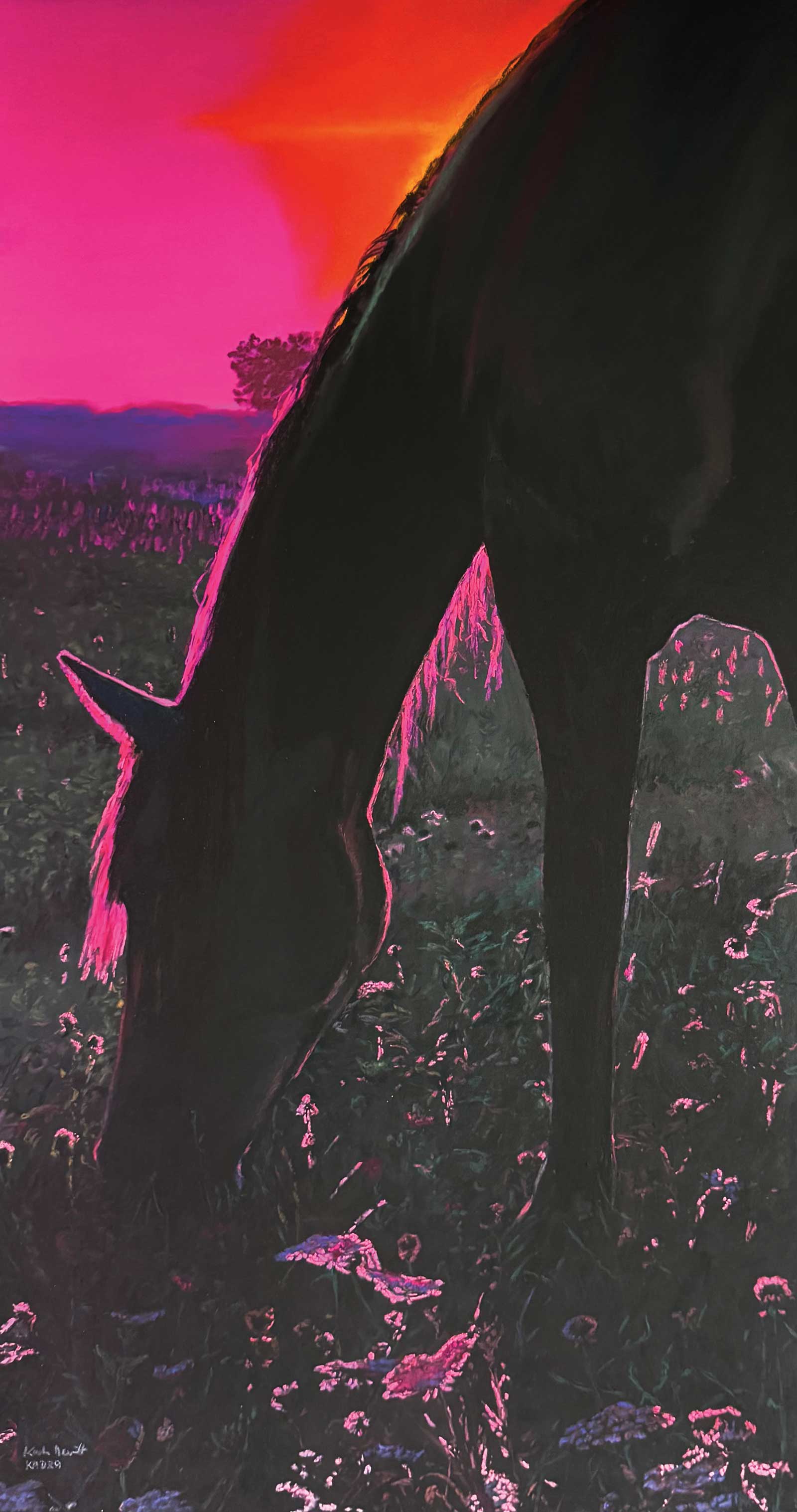
Kadra Nevitt, Neon Nights, pastel, 24 x 13 in.
Among the highly skilled artists represented by Legacy Gallery who work with horses as their subjects are Bill Anton, Rachel Brownlee and Scott Rogers, among others.
For Kansas-based artist Kadra Nevitt, anatomy is one of the most important things in equine art. “If something feels off, it usually is. Above all, look for a connection when collecting. Fads fade, but meaningful art holds true, always,” she says. “The world isn’t perfect. Tragedy comes often enough to unsettle even the calmest soul. Yet I see the moments. I feel them. A sunrise over golden Kansas fields. Horses grazing, their quiet rhythm slowing time itself. These moments are not rare, only overlooked. They live in the honest work, the stillness, the everyday. Through my work, I seek to hold them—to balance life’s rough edges with the steady light that still shines all around us.”
Altamira Fine Artin Old Town Scottsdale represents talented Western artists like Rocky Hawkins, Kenneth Peloke and Stephanie Revennaugh. “The horse has always held a central place in the visual language of the American West because it represents far more than an animal. Horses embody motion, partnership, and the enduring history of the frontier. What makes this subject so compelling is the incredible range of ways artists interpret it,” says gallery owner Jason Williams. “Rocky Hawkins approaches the horse through expressive color and movement, capturing the raw energy and personality of the animal in bold, gestural compositions. Kenneth Peloke, by contrast, leans into a hyperrealistic sensibility, focusing on the subtle textures of muscle, light and form that reveal the physical beauty and intelligence of the horse. Stephanie Revennaugh takes yet another path, translating the spirit of the horse into sculptural form through glass and steel, where light and structure combine to suggest both strength and elegance.”
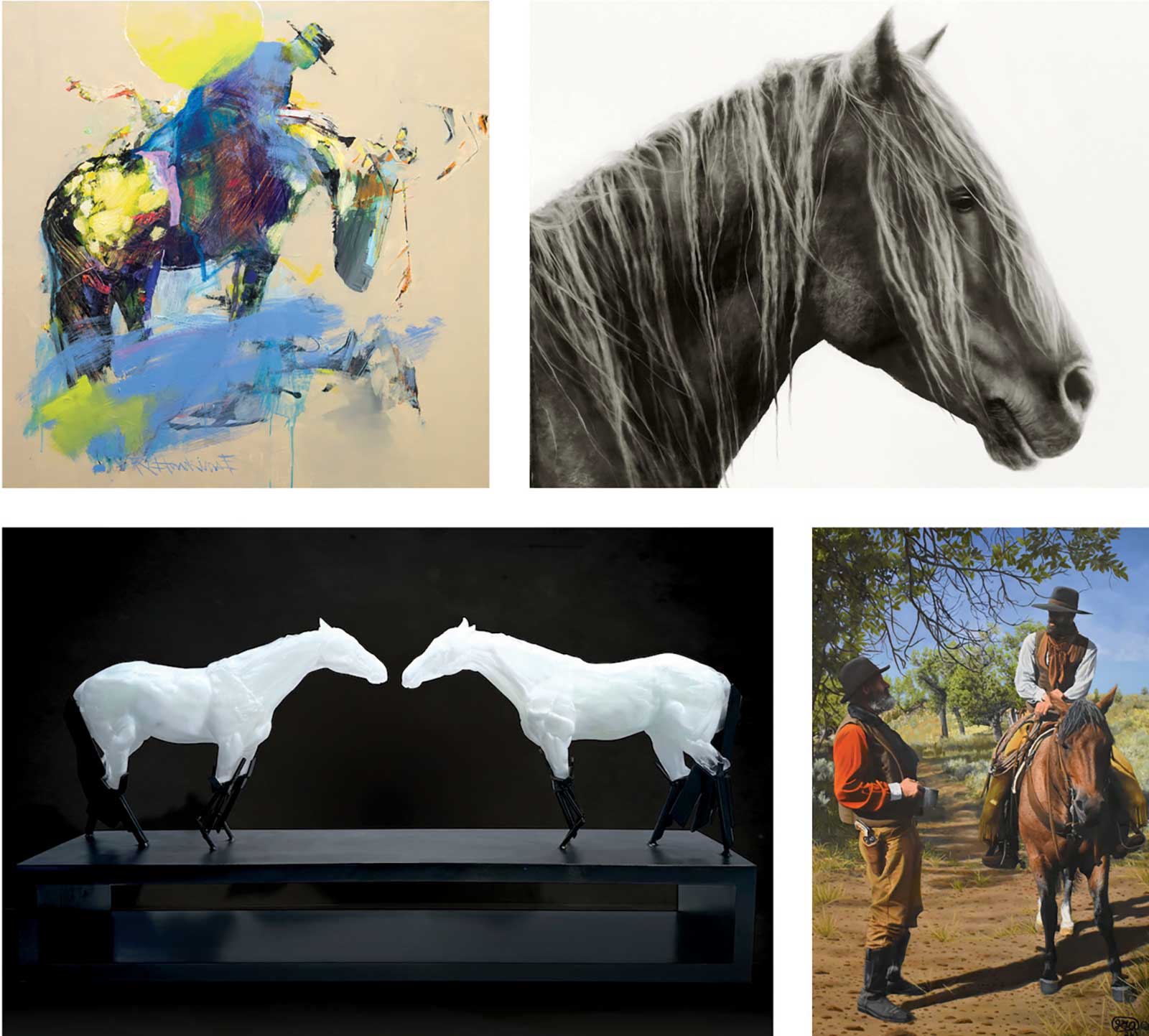
Top: Altamira Fine Art, Moonlight Tracker, acrylic on canvas, 40 x 40 in., by Rocky Hawkins. Altamira Fine Art, Visionary, oil on panel, 48 x 60 in., by Kenneth Peloke. Bottom: Altamira Fine Art, Magnetic, glass and steel, 18 x 36 x 8 in., by Stephanie Revennaugh. Phippen Museum, Trail Side Conversation, oil, 20 x 13 in., by Andrew James.
Every year, the Phippen Museum in Prescott, Arizona, hosts the Hold Your Horses! Invitational Exhibition & Sale, a celebration of the spirit, power and beauty of the horse in Western art. Held annually, this exhibit and sale brings together talented artists who capture the essence of these magnificent animals in a variety of styles and mediums. Each artwork reflects the artists’ deep admiration for the horse, often drawing inspiration from personal experiences, historical narratives and the role of these animals in Western heritage. Whether depicting a working ranch horse, a wild mustang or a quiet moment between rider and horse, every piece tells a unique story. “For collectors, authenticity and emotional connection are key when purchasing Western horse art. Collectors look for artwork that speaks to them—pieces that evoke an emotion or memory,” the museum notes. This year’s show takes place July 25 to September 27.
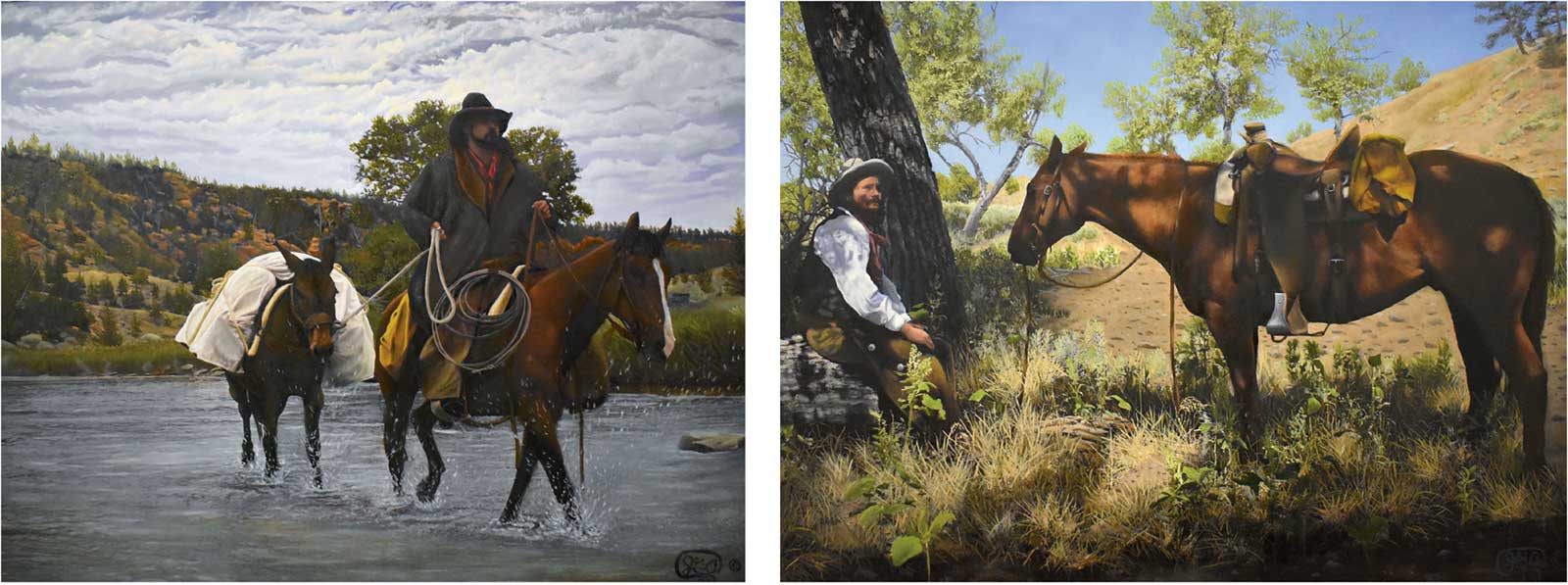
Phippen Museum, Headed to Camp, oil, 11 x 14 in., by Andrew James. Phippen Museum, Among the Cottonwoods, oil, 12 x 16 in., by Andrew James.
“For the cowboy, the horse was the very center of their world and a trusted partner in a life’s legacy. Whether carrying a mountain man through the high Rockies, a pioneer family toward a new horizon, or a Native American warrior across the plains, these animals were the heartbeat of survival,” says Colorado-based artist Gregory Mayse. “I paint to honor this vital relationship. Through realism, I capture the weight of that connection, ensuring we never forget the animals that didn’t just carry riders, but carried the very spirit of the West.”
The equine art of Teresa Lynn Johnson, who lives in Aztec, New Mexico, is inspired by the grace, beauty and freedom that wild horses represent. Growing up on a farm surrounded by animals, the artist developed a deep love and respect for both domestic and wild creatures, particularly horses. “This connection informs my artistic vision as I strive to capture the true essence of these magnificent animals,” she says. “I enjoy painting wild horses and focus on portraying the expression of the horse in a specific moment or time, aiming to convey feelings of grace, courage and freedom.” Working with oil paints and solid foundation of drawing techniques, she seeks to create pieces that reveal the subtle details and unique expressions that bring the horse’s spirit to life. “Through my art,” Johnson says, “I hope viewers feel a profound connection that communicates the courage it takes to be self-reliant and free.”
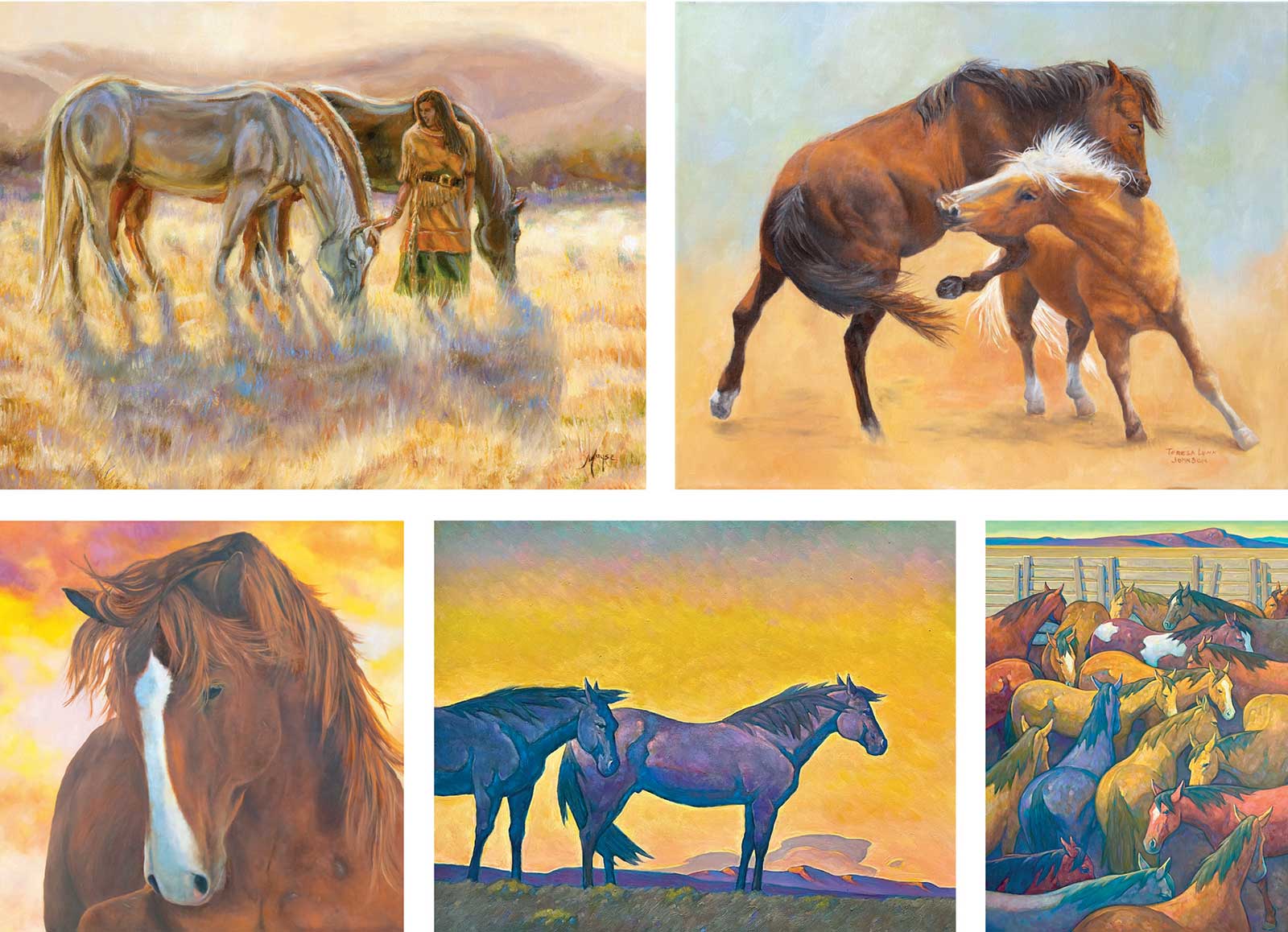
Top: Gregory Mayse, Common Ground, oil on linen, 12 x 16 in. Teresa Lynn Johnson, Power Play, oil on linen, 16 x 20 in Bottom: Teresa Lynn Johnson, Wild and Free Come with Me, oil on canvas, 30 x 30 in. Maxwell Alexander Gallery, Hillside, oil, 24 x 30 in., by Howard Post. National Cowboy & Western Heritage Museum, The New Remuda, oil, 48 x 36 in., by Howard Post.
The artwork of Howard Post, represented by Maxwell Alexander Gallery, is rooted in a deep appreciation for the American Southwest, shaped through lived experience. His paintings distill the horse and desert into their essential forms, using flattened planes of color, silhouetted mesas, and the dramatic contrast of light and shadow to create powerful compositions. Rather than documenting a place, Post seeks to interpret it by capturing the stillness of open land, the solitude of wild horses and the timeless geometry of the terrain.
Beau Alexander, owner of Maxwell Alexander Gallery,says, “Buy work that holds your attention longer than a moment; art that reveals itself slowly over time.”
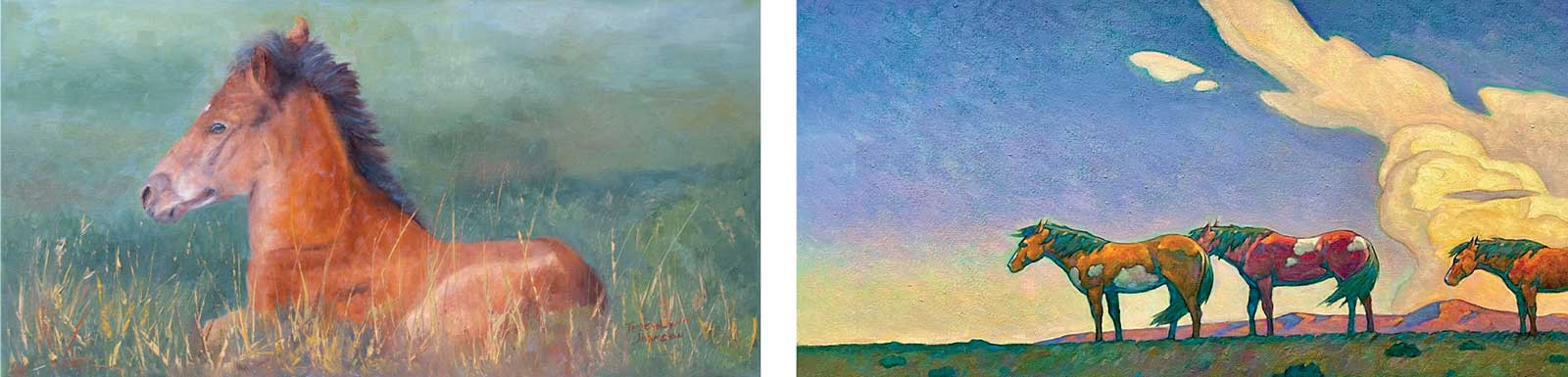
Teresa Lynn Johnson, Babe, oil on canvas, 12 x 24 in. Maxwell Alexander Gallery, Three Mustangs, oil, 18 x 36 in., by Howard Post.
The National Cowboy & Western Heritage Museum is based in Oklahoma City and hosts one of the top Western art events in the country, the Prix de West. “At the National Cowboy & Western Heritage Museum, we’ve long recognized that the horse is central to the story of the American West,” says Seth Spillman, chief marketing officer. “For collectors, the most compelling works are those that go beyond anatomy to convey the horse’s intelligence, power and partnership with people. Look for artists with a deep understanding of equine movement and a consistent body of work in the genre. Those are the pieces that hold both artistic and historical significance over time.”
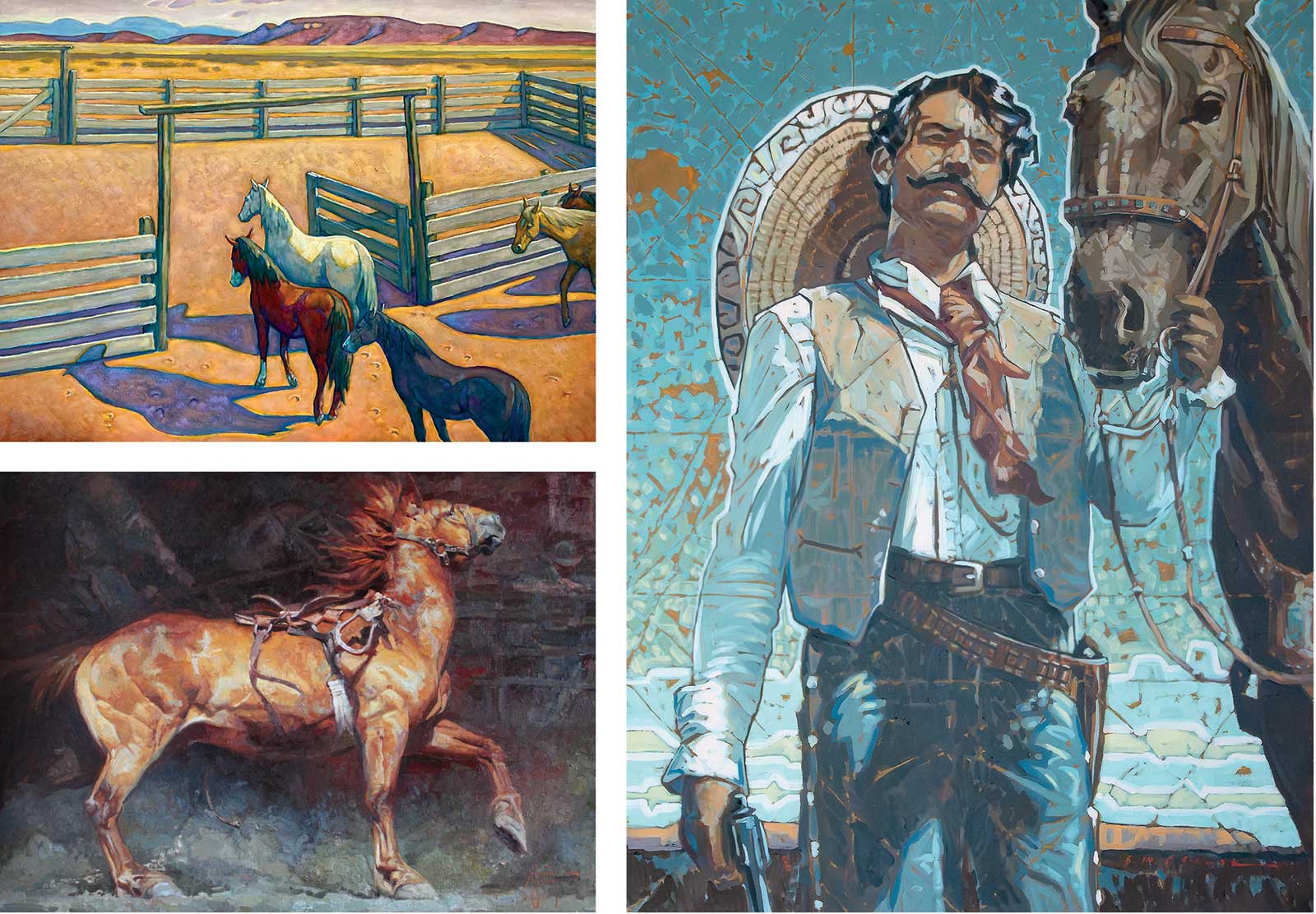
Clockwise from top left: Maxwell Alexander Gallery, Sortin’ the Mares, oil, 30 x 40 in., by Howard Post; National Cowboy & Western Heritage Museum, Crossdraw Trucha, oil on canvas, 40 x 30 in., by Sean Michael Chavez; National Cowboy & Western Heritage Museum, Full of Fight, oil on linen, 30 x 40 in., by Abigail Gutting.
Based in Jackson Hole, Wyoming, Gallery Wild has always been about wildlife and animal art. So it comes as no surprise that the gallery represents a number of highly skilled artists working in the equine genre. Among these artists are Carrie Penley, Julie T. Chapman and Nealy Riley, each of whom have new paintings depicting horses in three totally distinct styles. Gallery Wild is owned and operated by wildlife painter, Carrie Wild, and aims to “inspire collectors and impassion others to help protect wildlife and wild places for future generations through the acquisition and enjoyment of fine art.”
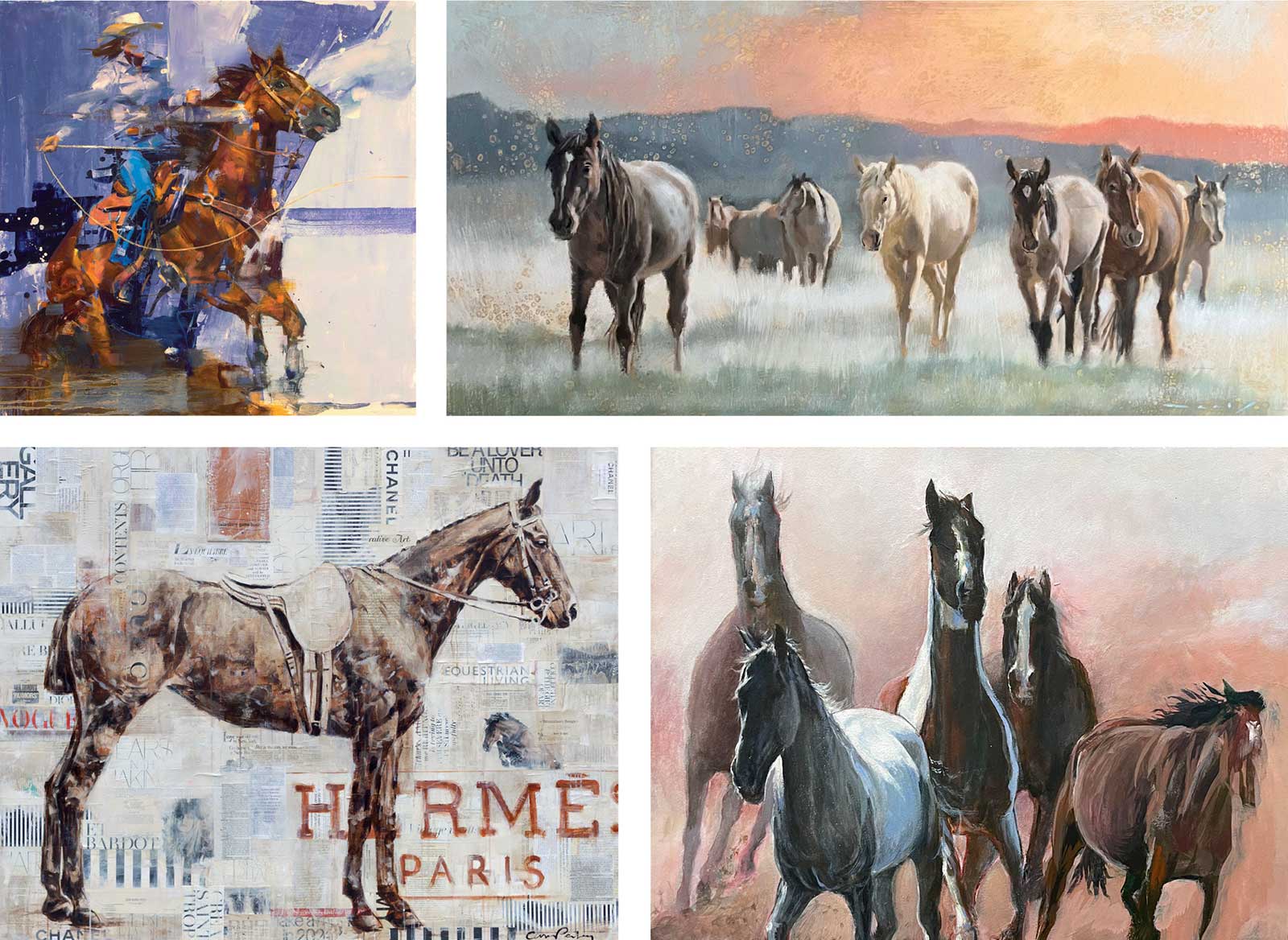
Top: Gallery Wild, Setting the Rope, mixed media, 30 x 30 in., by Julie T. Chapman; Gallery Wild, Pathfinders, oil on panel, 30 x 60 in., by Nealy Riley. Bottom: Gallery Wild, Years in the Making, mixed media on canvas, 48 x 60 in., by Carrie Penley; Jim E. Miller, WIP Alley Race, acrylic, 12 x 16 in.
Acrylic painter Jim E. Miller describes the story behind two recent paintings, Alley Race and Retired from Rodeo: “The horses running, as well as the three at rest, were from photos I took while visiting a California horse sanctuary. I got to meet and hangout with these gals who were former rodeo athletes…These mares were let out of their stalls midday and would race down the alleyway to the large open arena to play and stretch their legs. After running about, they would calm down, get brushed and pampered by the ranch workers. The first piece is a work-in-progress study titled Alley Race. It portrays their daily rush down the alley leading to the ‘playground.’ The second piece, titled Retired from Rodeo, captures three mares at rest, sunning on a perfect Southern California day.”
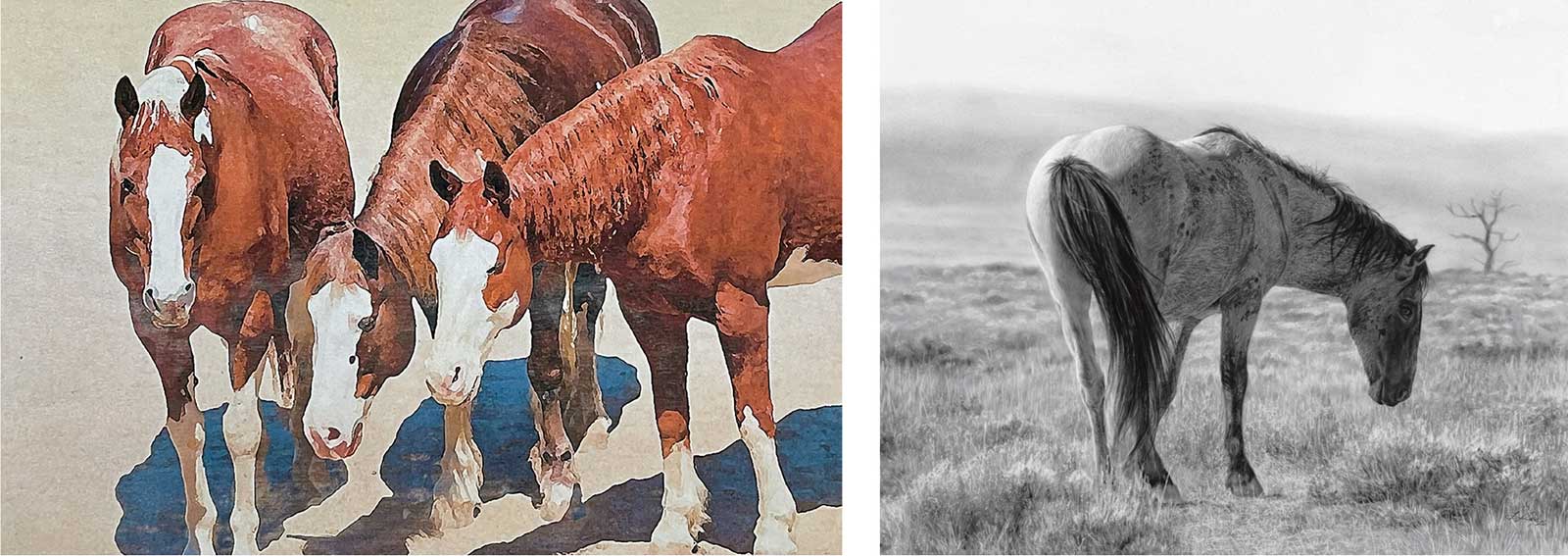
Jim E. Miller, Study - Retired From Rodeo, acrylic, 12 x 16 in.; Amber Rae Scally, Solitary Bliss, charcoal on panel, 16 x 20 in.
“There is something in the human spirit that is drawn to horses,” says Montana-based artist Amber Rae Scally. “They communicate without words in a way I relate to. A subtle glance back, that flick of the tail, the turn of an ear all send a message: ‘I see you, I hear you.’ When I work on a drawing, I feel I am engaging with the animal. Through every curve and detail I get to know them. Together, we have a silent conversation. They draw me in again and again.”
Scally’s advice to collectors is this: “If the spirit of the horse speaks to you through the artwork, you know the piece was created mutually between the animal and the artist. Your connection completes the circle.” —
Featured Artists & Galleries
Altamira Fine Art
7038 E. Main Street, Scottsdale, AZ 85251
(480) 949-1256, az@altamiraart.com
www.altamiraart.com
Amber Rae Scally
Martinsdale, MT
(406) 647-0006
araeartwork@gmail.com
www.amberscally.com
Cheryl Koen
www.cheryllkoen.com
Claggett/Rey Gallery
216 Main Street, Suite C-100 Edwards, CO 81632
www.claggettrey.com
@claggettreygallery
@galleryVailCO
Gallery Wild
80 W. Broadway Avenue Jackson, WY 83001
(307) 203-2322
www.gallerywild.com
Gregory Mayse
Wolf River Studio LLC
2751 Brush Creek Drive
Fort Collins, CO 80528
(970) 412-3600
www.gregorymayse.com
Facebook: Gregory Mayse Fine Art
Instagram: gregorymaysefineart
Jim E. Miller Art
james007twi@gmail.com
www.jimemillerart.com
Kadra Nevitt
2221 Wagon Road, Fort Scott, KS 66701
(360) 508-5884, www.kadrasart.com
Legacy Gallery
7178 E. Main Street, Scottsdale, AZ 85251
(480) 945-1113, www.legacygallery.com
Maia Chavez Larkin
www.maiachavezlarkin.com
Represented by Manitou Galleries Santa Fe, NM
www.manitougalleries.com
Maxwell Alexander Gallery
1300 N. Lake Avenue Pasadena, CA 91104
(213) 275-1060
www.maxwellalexandergallery.com
National Cowboy & Western Heritage Museum
1700 NE 63rd Street Oklahoma City, OK 73111
(405) 478-2250
pdw.nationalcowboymuseum.org
Phippen Museum
4701 Highway 89 North Prescott, AZ 86301
(928) 778-1385
www.phippenartmuseum.org
Teresa Lynn Johnson
457B Road 3000, Aztec, NM 87410
(505) 334-1744
teresa@teresalynnjohnson.com
www.teresalynnjohnson.com
Instagram: teresalynnjohnsonartist
Powered by Froala Editor


