Although it’s certainly debatable, as are most things in the world of art, Ernest L. Blumenschein was the most modern of the six founders of the Taos Society of Artists. His work frequently broke through boundaries that largely contained the other founders: Eanger Irving Couse, Joseph Henry Sharp, Oscar E. Berninghaus, William Herbert “Buck” Dunton and Bert Geer Phillips.
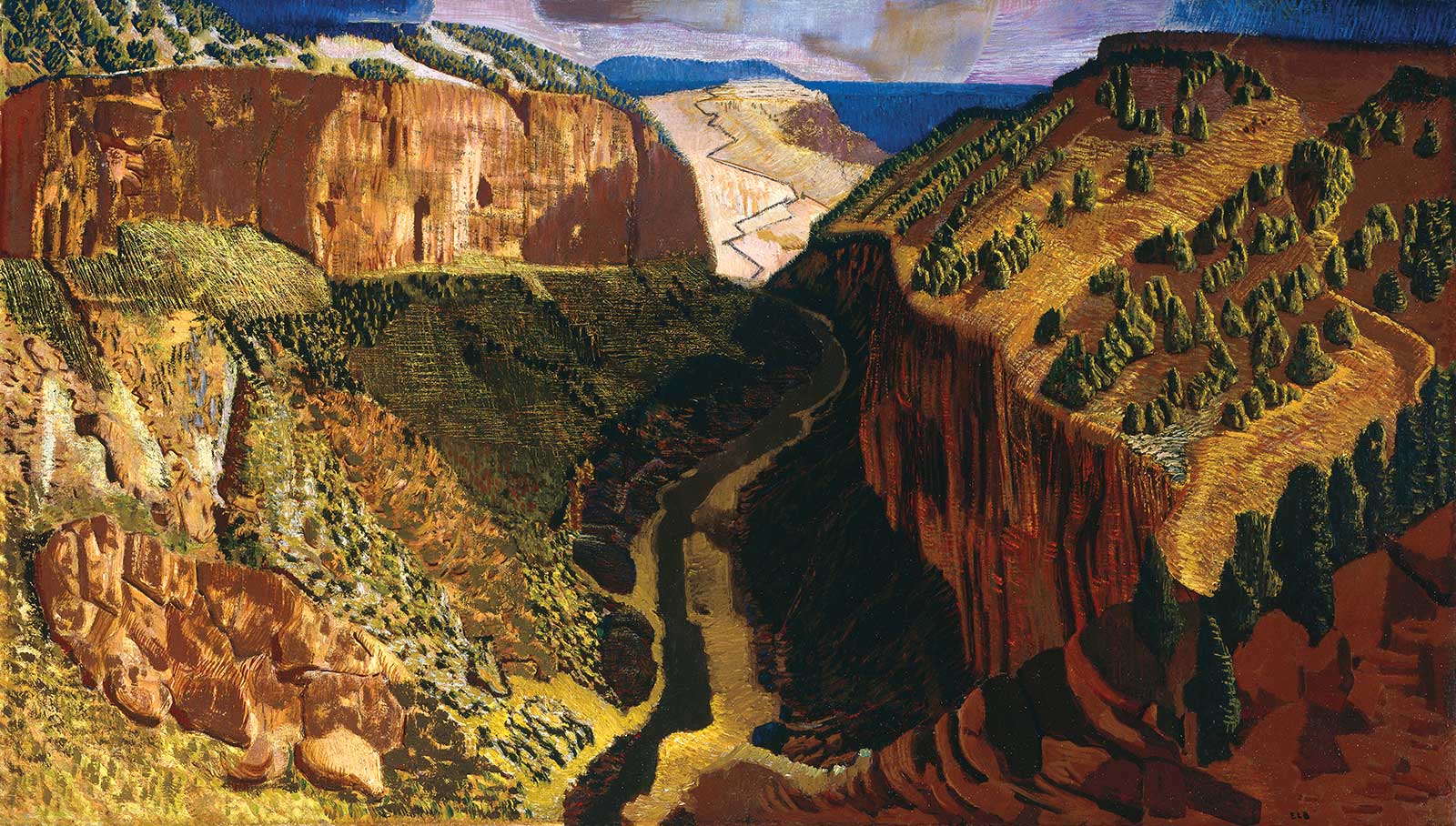
Ernest L. Blumenschein (1874-1960), The Canyon (aka Strength of the Earth and Rio Grande Cañon at Taos), 1944, reworked 1949, oil on canvas, 27 x 47 in. The Eugene B. Adkins Collection at the Fred Jones Jr. Museum of Art, University of Oklahoma, Norman, and the Philbrook Museum of Art, Tulsa, Oklahoma.
The proof is right there in the brushstrokes, which sing with every painting. I use a music analogy because that’s what Blumenschein did in a letter in 1901:
“The cottonwoods and the pines are the violins, the sweeping grass of the prairies play the cello, a plunging brook is a silver flute, the quivering aspen leaves a tremulous oboe, and the master musician blows through the canyons from afar across the desert, and the music wavers in the gulches and ravines and modulates in rarest harmonies,” he wrote. “There are no singing bards, save the quail that plays his two tones, and the dove, but many a harp is strung in the cedars.”
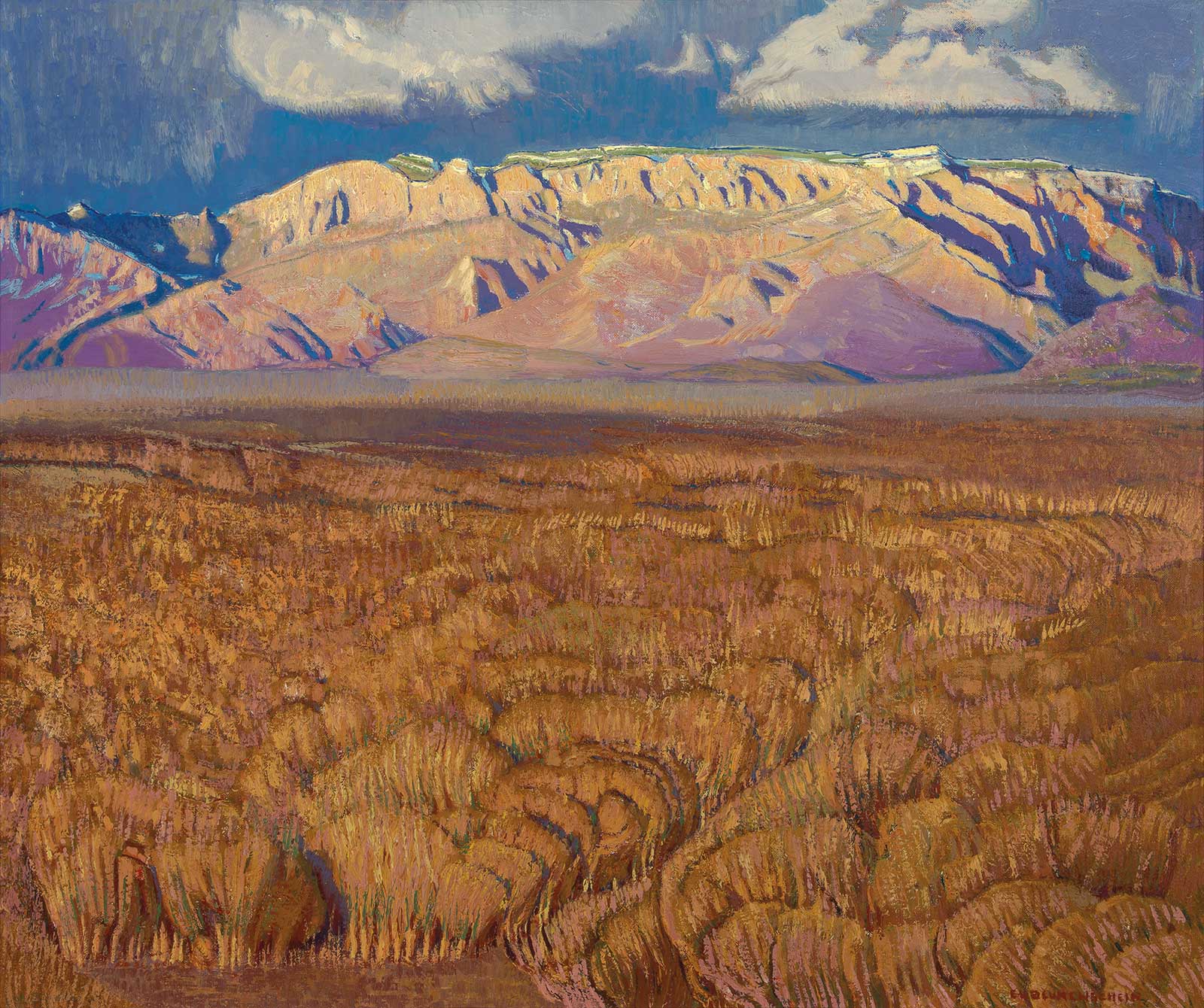
Ernest L. Blumenschein (1874-1960), Sandia Mountains, 1942, oil on canvas, 21 x 25 in.
Of course, landscapes are really quite simple: trees, horizon, sky, dirt, rocks, water, clouds; they don’t have to be complicated. And yet they are. Landscapes are much more than the sum of their parts. They are about emotion and memory. They are not about sky, but rather the feel of wind on your skin, the smell in the air, the heat on your neck or a chill down your sleeve. The dirt is home and foundation. The water is life and rebirth. Landscapes are about forms and their pleasing arrangement with each other, and how those forms interact in harmony or fight for attention. Landscapes are anything but simple, even when they are.
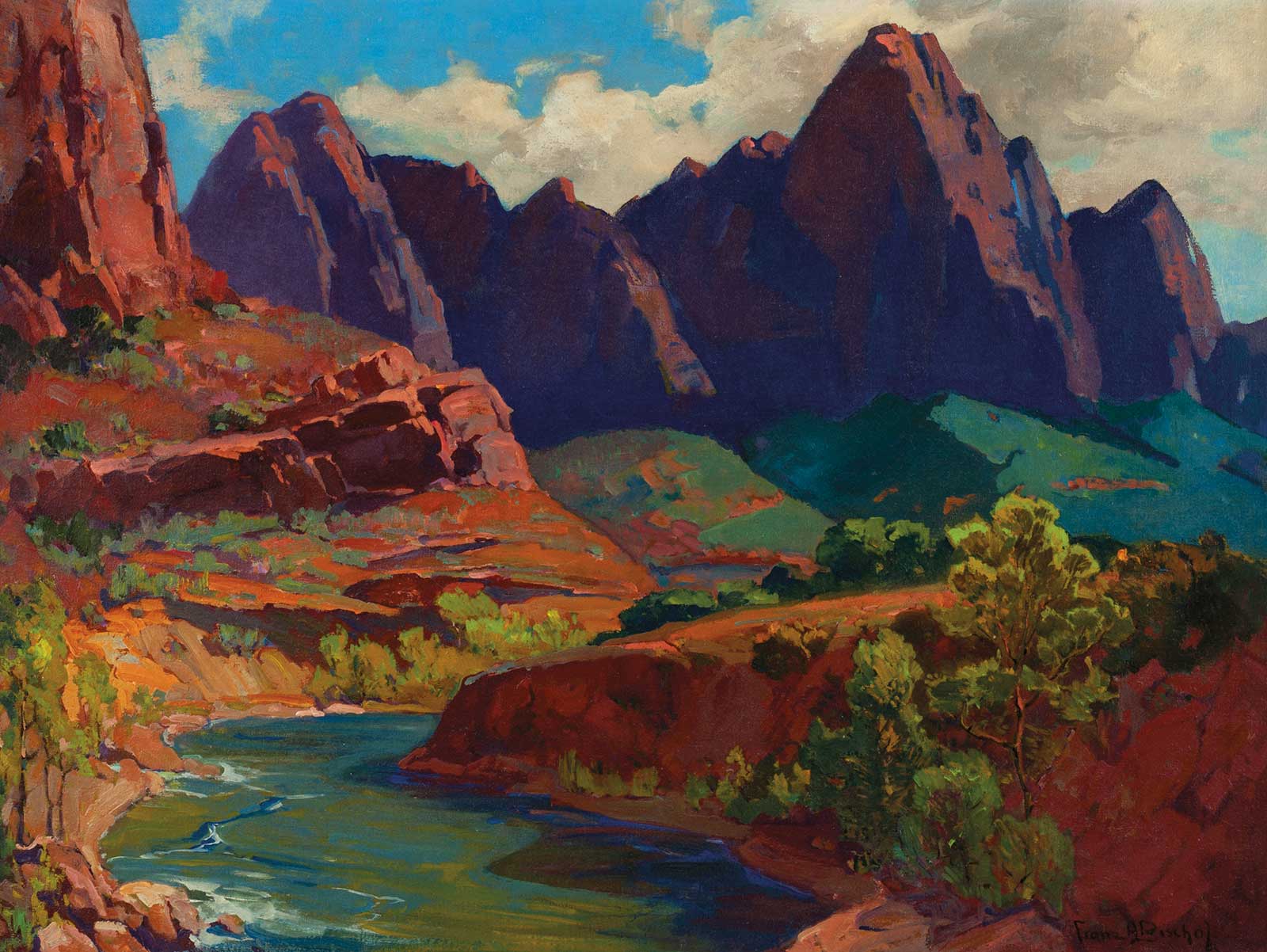
Franz Bischoff (1864-1929), Cathedral Point, Utah, oil on canvas, 30 x 40 in.
In the painting The Canyon—which was also known by three other names: Strength of the Earth, Rio Grande Cañon at Taos and Rio Grande Gorge Near Taos—Blumenschein laid down the last strokes in 1944, but reworked further in 1949. The delay was mostly because of a ruptured appendix, but a delay benefited the artist. “Rio Grande Gorge Near Taos, was originally somewhat more expansive, showing the canyon appearing to recede from view as it wound into a bluff with mountains in the background,” writes Elizabeth J. Cunningham in In Contemporary Rhythm: The Art of Ernest L. Blumenschein. “In the repainted version, Blumenschein changed the bluff to extend the river in a lightning design reminiscent of petroglyphs pecked into the canyon walls that suggests the Rio Grande Rift was about to continue expansion. Dark browns divide the picture near the center and up the canyon until it intersects with a diagonal downslope topped by juniper and piñon. The dark blue of cliffs and highlighted mountains contrast with pink clouds against a robin’s egg blue sky. All the geomorphic forms, though recognizable, are reduced to essentials of design and structure.”
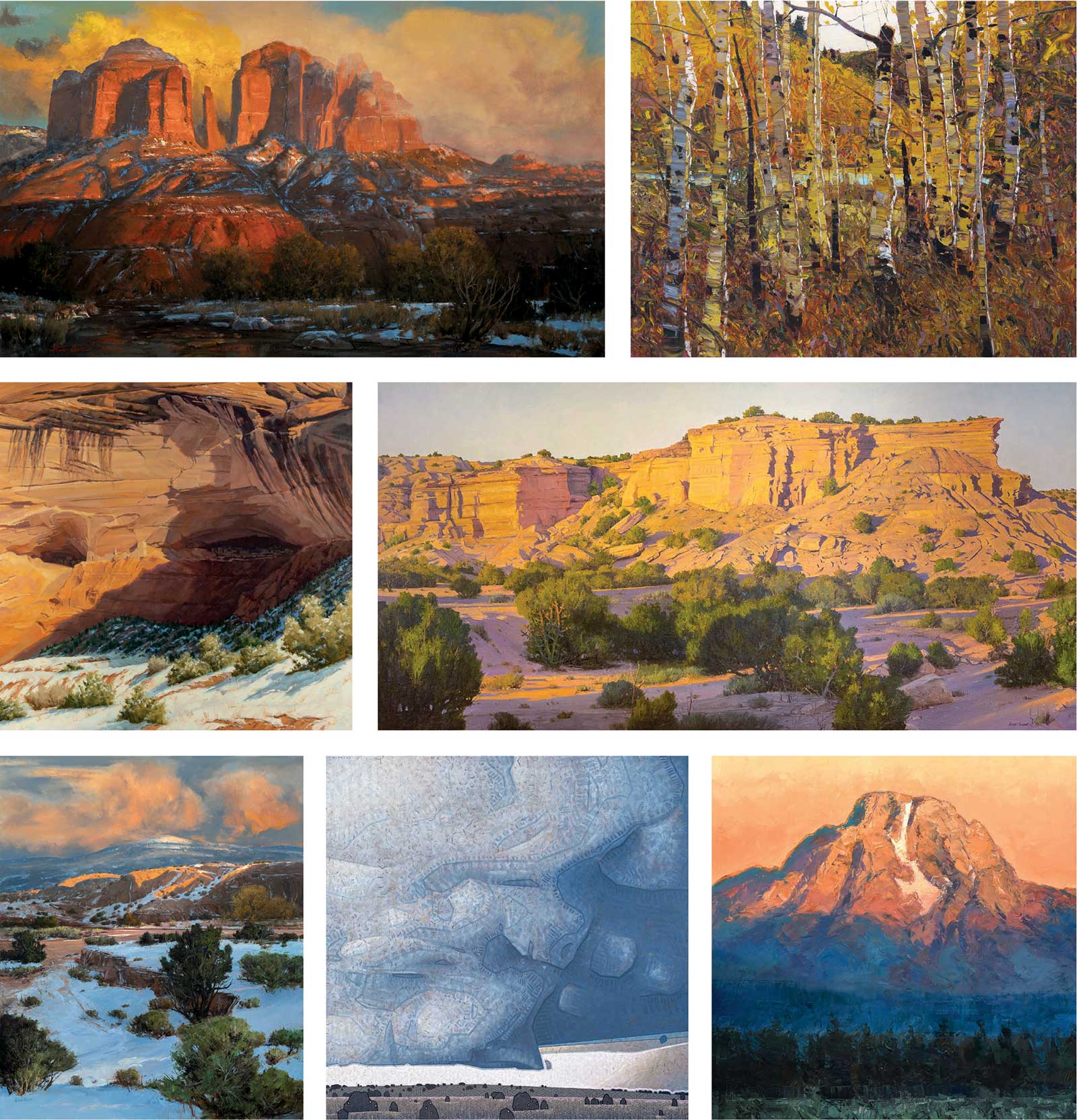
Top: Arturo Chávez, Cathedral Mountain Mist, oil, 36 x 60 in. Gallery Wild, A Proclamation, oil on canvas, 48 x 60 in., by Silas Thompson. Center: Darcie Peet, Ghosts in the Shadows, oil, 30 x 30 in. Arturo Chávez, Place Where They Threw the Rocks Down, oil, 48 x 96 in. Bottom: Arturo Chávez, Chimayo Winter, oil, 72 x 60 in. Gallery Wild, Supercell with Juniper, acrylic and oil on canvas, 36 x 36 in., by Luke Anderson. Gallery Wild, Sunlight Fades, oil on canvas, 48 x 48 in., by Caleb Meyer.
For Blumenschein, the landscape held beauty, but also rifts, expansion and drama, and all of it played out in his paint. And he wasn’t the only one doing it. Many Western artists offered much more than beauty in their work. Consider the work of Franz Bischoff, Edgar Payne, Fremont Ellis, Sheldon Parsons and many others. Artists weren’t just exploring the land but also man’s tenuous relationship with it.
As you explore the landscapes in this section, consider what the artist wants you to see, but also what they want you to feel. It’s a fun experiment that instantly expands the world of the landscape into exciting new places.
Arturo Chávez,who is represented by Manitou Galleries and Legacy Gallery, creates striking landscapes of classic Western terrain. His artwork, he says, consists of three things: the x, y and z axes of the picture plane. “Once these three components are balanced in the composition through linear and aerial perspective, and the compositional placement of the various components, I find myself in an altered place of time and space whereby I’m transported to the inexplicable realm of ‘wow!’” he says. “It is my hope that my viewers will experience the same inspiration when participating in my painting experience.”
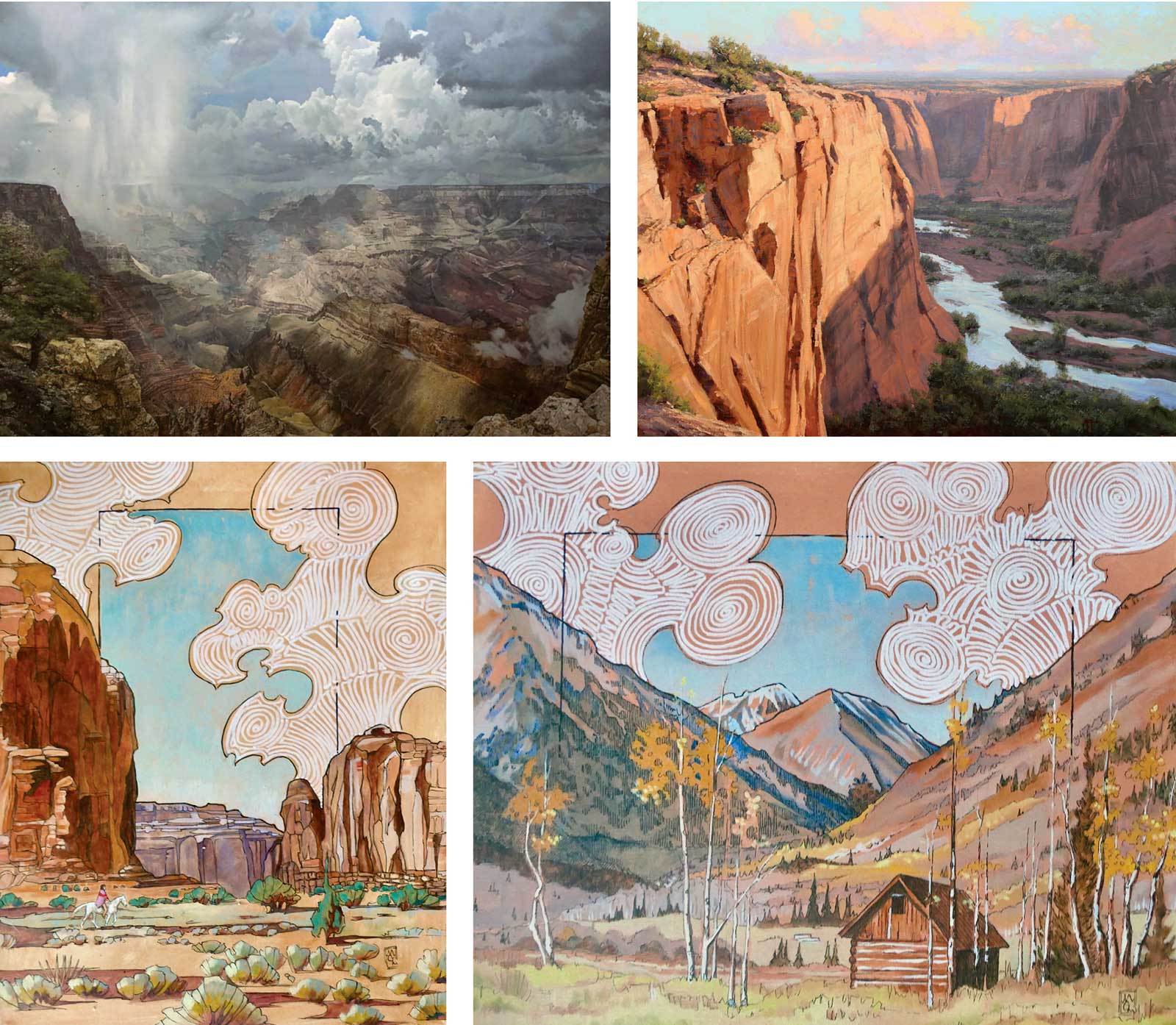
Top: Legacy Gallery, Cloudburst Over the Great Chasm, oil on canvas, 64 x 90 in., by Phillip Philbeck. Legacy Gallery, Morning Rim Walk, oil, 40 x 50 in., by Kenny McKenna. Bottom: Maia Chávez Larkin, Crossing the Valley, oil and ink on panel, 20 x 16 in. Maia Chávez Larkin, Stay Gold, oil and ink on panel, 16 x 20 in.
Ever since spending five days in spring painting with several other artists in Canyon de Chelly National Monument, artist Darcie Peet has always wanted to return in the winter. “Snow in the canyon can be unpredictable, so we waited and watched for an approaching storm. Close to Christmas, we were rewarded and thus began our trip exploring both canyons over several days,” Peet explains of the story behind her recent painting Ghosts in the Shadows. “On a cold, snowy, December day, along with our Navajo guide, we drove as far as possible into Canyon Del Muerto, in the Canyon De Chelly National Monument…What history, legend and knowledge of the cliff dwellings we listened to as we slowly drove through snow and across ice-covered streamlets deep into the canyon. Able to go no further, we had arrived at Mummy Cave Ruins that so eerily look out over the valley, echoing the storied history of these unusual, red rock canyons, and thus the title of the painting, Ghosts in the Shadows. Peet’s artwork is available through David Wilkinson of Artzline at www.artzline.com/darcie-peet.
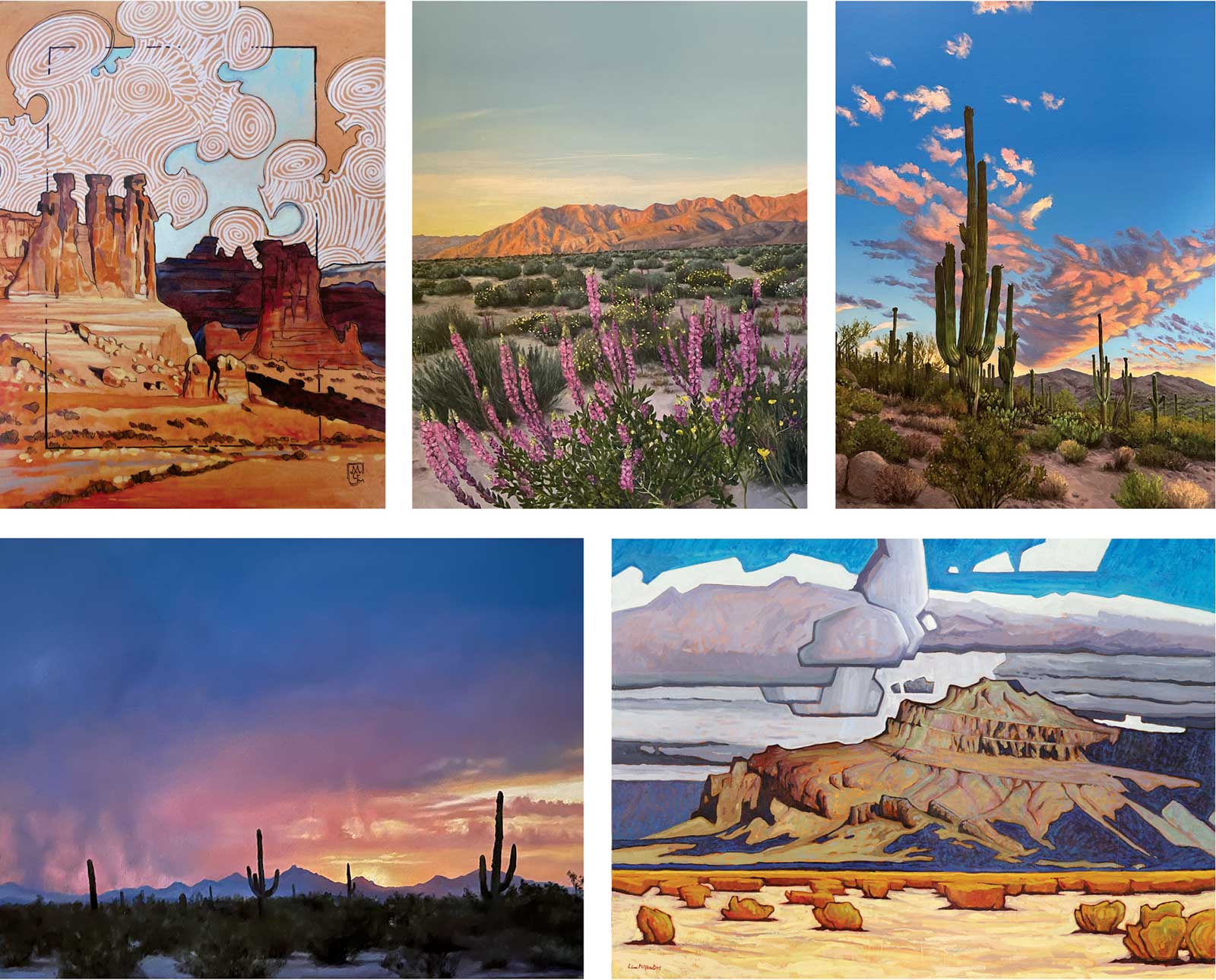
Top: Maia Chávez Larkin, Redrock Drama, oil and ink on panel, 18 x 14 in. Naomi Brown, Desert Lupines, oil and acrylic on canvas, 30 x 24 in. Naomi Brown, Teal Sky, oil and acrylic on canvas Bottom: Naomi Brown, Desert Magic, oil, 16 x 20 in. Liam Matthew Dye, Superstitions, oil, 36 x 48 in.
Gallery Wild in Jackson Hole, Wyoming, represents some of the top artists working in contemporary Western art today, including Silas Thompson, Caleb Meyer and Luke Anderson, each of whom have recently completed landscape pieces. “From rolling sagebrush hills and dense, quaking aspen groves to the quiet drama of distant mountain silhouettes, the West offers an endless range of moods and moments,” says owner Carrie Wild. “For centuries, artists have returned to these landscapes, drawn by the ever-shifting light and the subtle color changes that occur from dawn to dusk, season to season. Silas Thompson and Caleb Meyer stand firmly within this lineage, having mastered the palette knife technique to effortlessly capture movement, atmosphere and depth. Their work feels intuitive and physical, echoing the terrain itself. At the same time, contemporary voices like Luke Anderson expand the genre forward—abstracting familiar forms into bold geometric shapes and layered shadows that feel both modern and timeless.”
Phillip Philbeck, represented by Legacy Gallery in Scottsdale, Arizona, is a nationally recognized landscape painter known for his richly detailed, atmospheric depictions of the American wilderness. Born in Washington, D.C., in 1968 and raised in North Carolina, he began painting professionally in 1992. Deeply influenced by the Romantic and Realist traditions, Philbeck’s work reflects a love for the natural world and a deep respect for early American masters like Albert Bierstadt and Frederic Edwin Church.
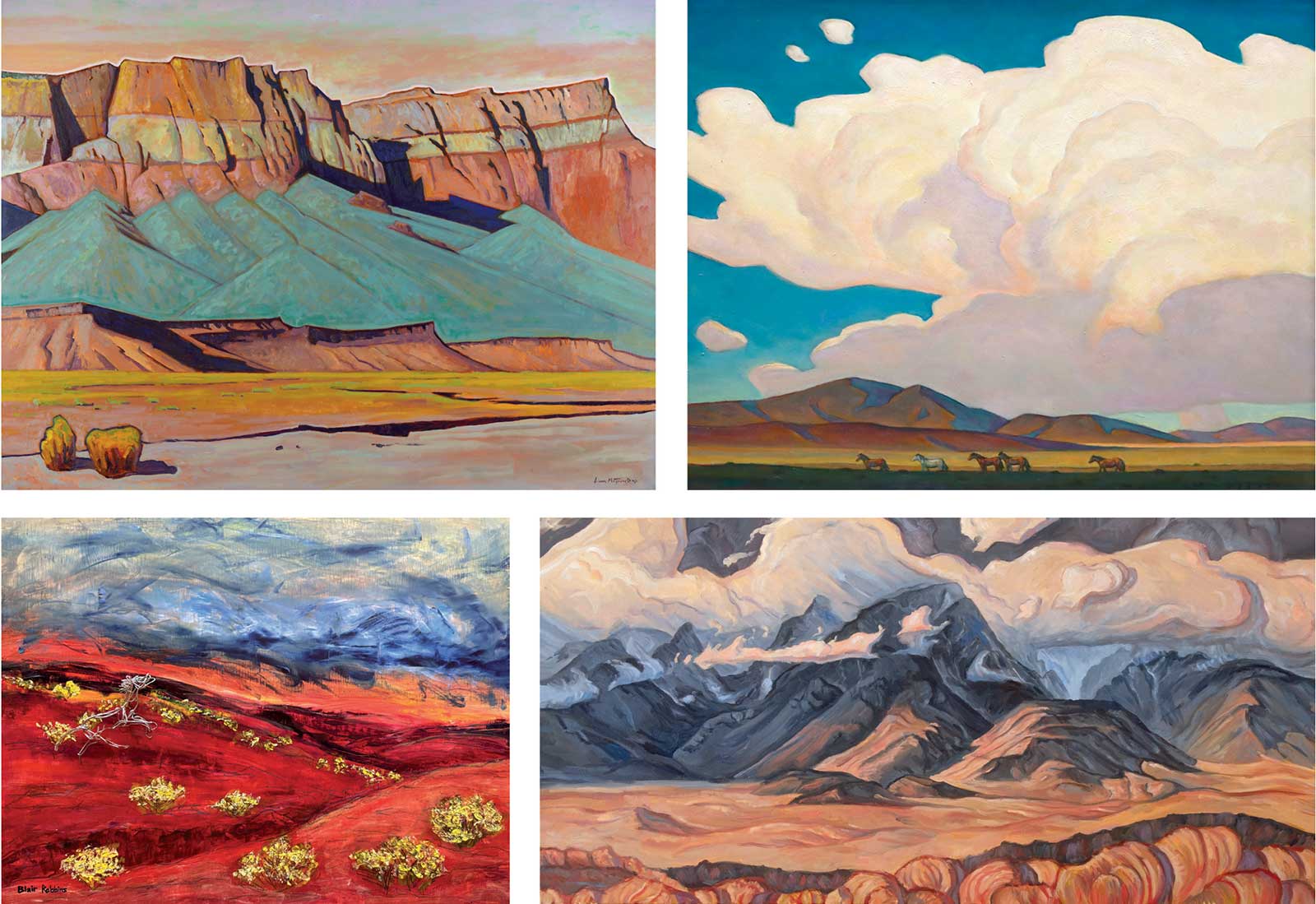
Top: Liam Matthew Dye, Vestiges, oil, 36 x 48 in. Mark Sublette Medicine Man Gallery, Five of the Ranch Remuda, oil on canvas, 24 x 30 in., by Howard Post. Bottom: Blair Robbins, Dancing Ground of the Blue-eyed Paint Pony, watercolor on cradled wood panel with accents of steel wire and graphite markings, 18 x 24 x 1⅛ in. Mark Sublette Medicine Man Gallery, Shadow of the Giants, oil, 18 x 36 in., by Erika Victor.
Also represented by Legacy Gallery is Kenny McKenna, whose painting subjects are widely diverse. With an emphasis on landscapes, he says, “I simply paint what interests me.” The artist works exclusively in oils, creating an impressionistic style with texture and loose brushwork. His paintings elicit a sense of warmth and calm, an open invitation to explore and all share the inherent ingredient of the infusion of sunlight. McKenna was fortunate to have parents that loved to travel. With relatives residing on both coasts, the road trips from Kansas covered a lot of territory. The desert landscape, canyons and colors of the Southwest was especially appealing to him when covering the miles to California.
“My family roots are deep in the Southwest, and although I’ve lived in a number of different states and countries, the West has always been my lodestone,” says artist Maia Chávez Larkin, represented by Manitou Galleries in Santa Fe. “My late father was born in Northern New Mexico, and as a young artist apprenticed to Colorado artist Frank Mechau, [and] received commissions to do WPA murals throughout the country...My mother is a landscape and wildlife artist also inspired by the vistas of the Southwest. Since my childhood, my family of artists has traveled the western states for artistic inspiration, and I follow the same path today, traversing the red rocks of Southern Utah, the piñon and sage plateaus of New Mexico and the high, rough peaks of the Colorado Rockies. All of these things—the shifting light, the perfume of sage and creosote [and] the scudding clouds—end up on my canvases when I’m back in my studio, which overlooks the length and breadth of the Front Range.”
Southwest-based artist Naomi Brownpaints the stunning colors and forms of the Sonoran Desert. “Western art is trending more than ever,” she says. “Art collectors have been in love with the Wild West and the wild deserts for a very long time…These vast and open landscapes are the backdrop for these great Western stories that have been painted for over a century. The sunsets, the rising moon in the night sky and the beautiful blue skies with the big, white clouds floating in the distance are irresistible to the Western art collector. These Western landscapes are a staple in most Western art collectors’ homes.”
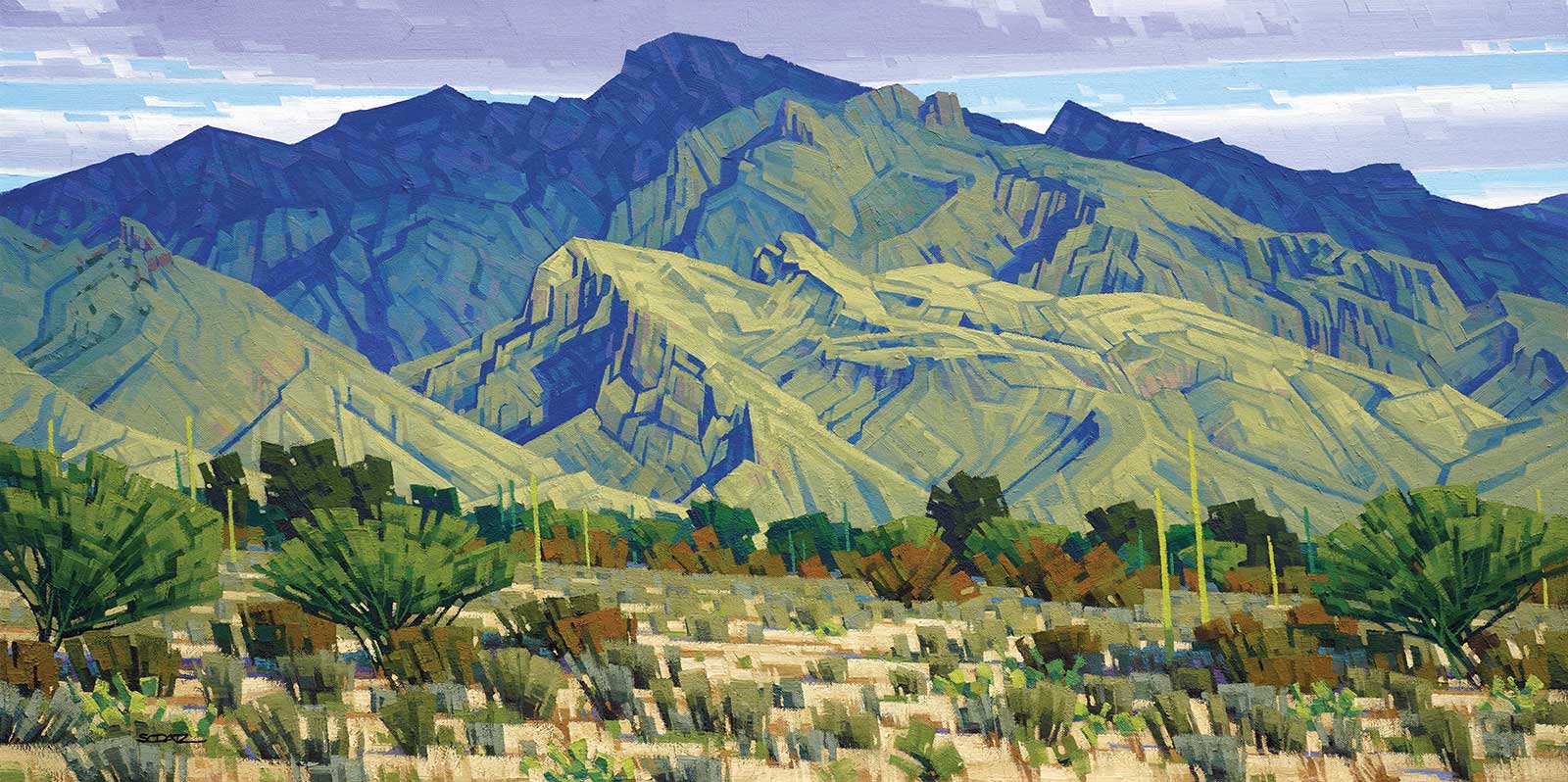
Mark Sublette Medicine Man Gallery, An Austere Beauty, oil, 16 x 32 in., by Stephen C. Datz.
Artist Liam Matthew Dye’s newest works, Superstitions and Vestiges, are meditations on Arizona’s rugged mesa cliffs—less about place as geography and more about place as feeling. Influenced by time, color and form, the paintings distill fleeting moments into layered, enduring impressions of brushwork and color.
Superstitions draws from a sudden, visceral encounter with the Superstition Mountains. “I’ve really been wanting to capture the Superstition Mountains in a way that has not been done before. One day driving back to our house from horseback riding my wife and I pulled off the side of the road and I shot some photos of these massive clouds crashing together. Light [was] piercing down on the south side of the mountain, and it was like lightning hit me. I knew I had the painting,” says Dye. “Vestiges was more of a meditation on references of the Vermilion Cliffs I had taken years ago on a backpacking trip. I really wanted this painting to convey that sense of light disappearing on the side of the cliffs. That time of day where colors bleed together, violets into greens, greens into red. I actually don’t remember much of anything from that trip other than a brief moment watching this light on the side of the cliffs. That stuck with me.”
Erika Victor is the newest addition to the Medicine Man Gallery family of represented artists. Her recent painting of the Sierra Nevadas wrapped in storm clouds, titled Among the Giants, is a testament to her ability to communicate the drama of her chosen subject matter. Another painting with everything an artist looks for in a successful landscape is Howard Post’s Five of the Ranch Remuda. The sense of scale present in the relationship between land and sky, paired with Post’s iconic color palette make for a truly awesome sight. The painting An Austere Beauty by Stephen C. Datz shows Arizona’s signature Sky Islands juxtaposed against a lowland environment dressed in Sonoran Desert flora. The piece manages to harmonize effortlessly in spite of its complexity.
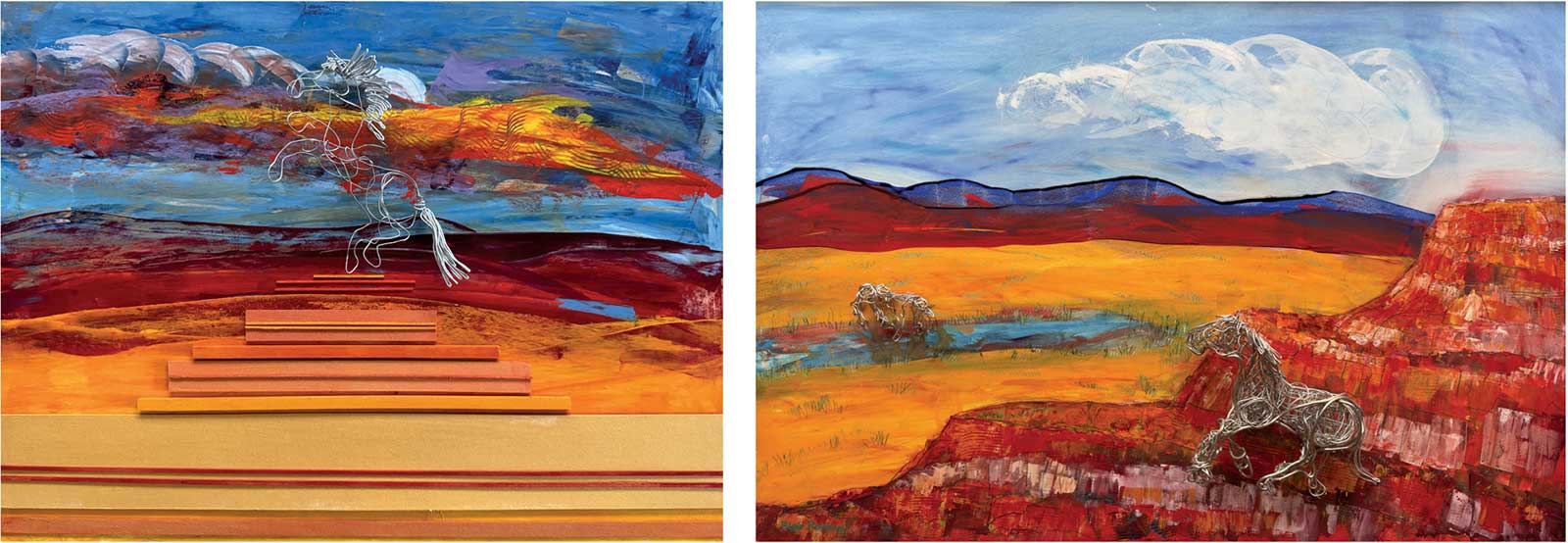
Bottom: Blair Robbins, Horse of the Open Sky, watercolor on cradled wood panel with accents of balsa wood, steel and aluminum wire, 18 x 24 x 3 ⅜ in. Blair Robbins, Still Waters of the Desert Heart, watercolor on Aquabord with accents of steel and aluminum wires, hardwire cloth and graphite markings, 24 x 36 x 4½ in.
Santa Fe-based mixed media artist Blair Robbins, represented by Acosta Strong Fine Art, is currently focusing on contemporary watercolor paintings of Western landscapes accented by wire sculpture. “My creative journey is inspired by my years traveling the West as an award-winning filmmaker and cinematographer to capture landscape stories. How I see landscapes is shaped not only by my visual perceptions of line, form and color, but also by my studies in geology that opened my eyes to stories held in the landscapes,” says the artist. “My landscape paintings evoke change, and the heightened colors reflect my deep passion and emotional connection to the earth. In my new series of watercolor plus wire, I accent landscapes with wire sculpture, primarily of wild horses. For me, as an Osage, landscapes offer solace, and their vastness in the West sparks a feeling of freedom.”
Robbins continues, “The Western landscape genre has many facets. When a collector connects with a landscape artwork, the seed may be conscious or subconscious. Because Western landscapes are diverse both in presence and story, many of them icons, the genre is ripe for discovery. Creating a bond with Western landscape art can bring comfort, reflection and inspiration to one’s life by its very presence.” —
Featured Artists & Galleries
Naomi Brown
www.naomibrownart.com
Arturo Chávez
www.arturochavez.com
Liam Matthew Dye
(330) 607-9203
www.liammatthew.com
liammatthewdye@gmail.com
Gallery Wild
80 W. Broadway, Jackson, WY
(307) 203-2322, info@gallerywild.com
www.gallerywild.com
Maia Chávez Larkin
www.maiachavezlarkin.com
IG: maiachavezlarkin
Legacy Gallery
7178 Main Street, Scottsdale, AZ 85251
(480) 945-1113
www.legacygallery.com
Manitou Galleries
123 W. Palace Avenue, Santa Fe, NM 87501
(505) 986-0440
www.legacygallery.com
Mark Sublette Medicine Man Gallery
6872 E. Sunrise Drive, Suite 130 Tucson, AZ 85750
(520) 722-7798
www.medicinemangallery.com
Darcie Peet
www.darciepeet.com
FB: darciepeet
Blair Robbins
blair@blairrobbins.com
IG: blairrobbinsart
Powered by Froala Editor


