Early descriptions of the landscape of the American West were usually from the journals and notes of settlers and explorers. The descriptive and illustrative journals of the 1804-1806 Lewis and Clark Expedition from the Mississippi to the Pacific and back, documented the geography, natural resources and the Native American tribes encountered along the way.
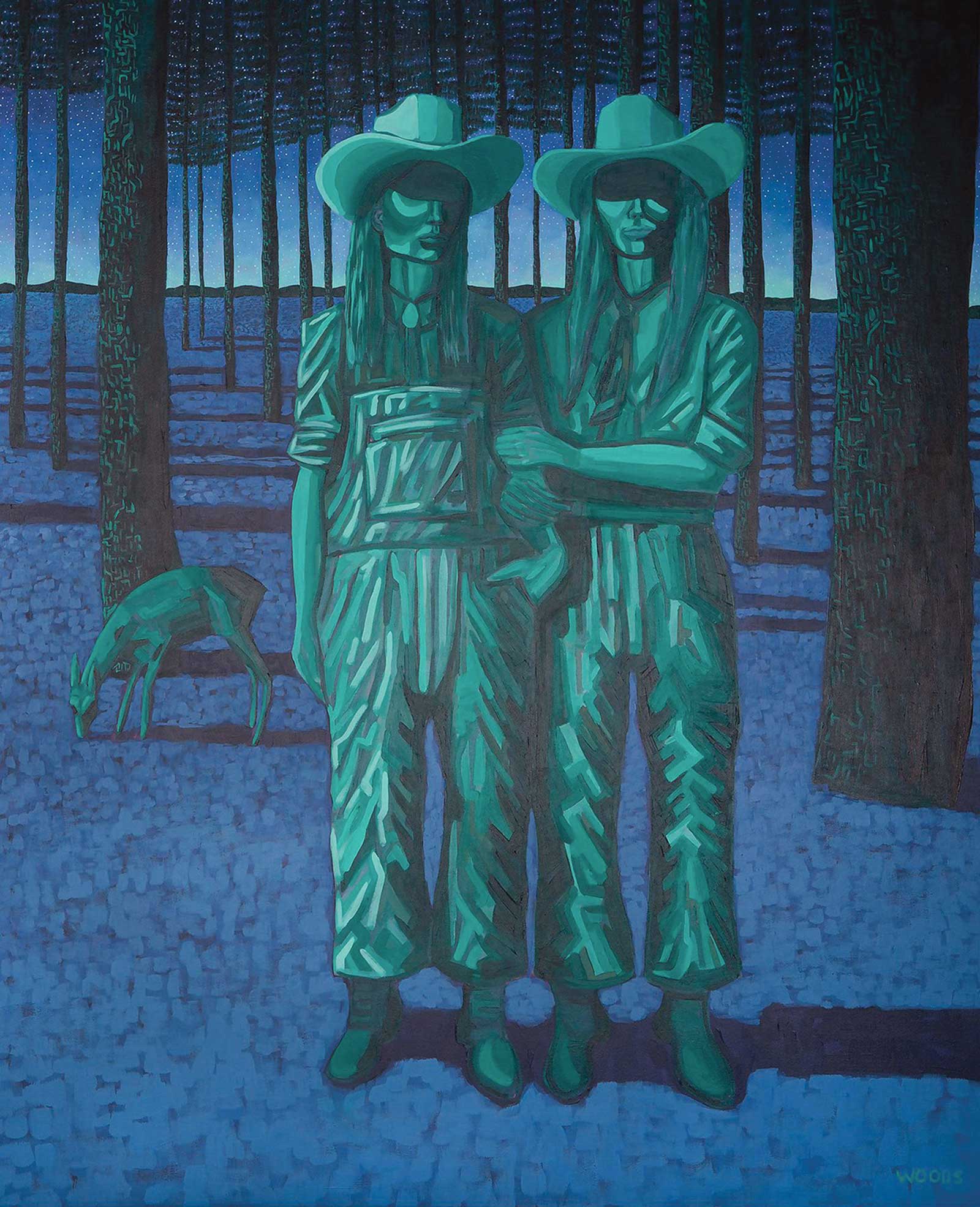
Camille Woods, To Have and To Hold, 2024, acrylic on canvas. Courtesy of Commerce Gallery. © Camille Woods.
Among the first painters to document or interpret the Western landscape was Albert Bierstadt (1830-1902) whose grand, monumental paintings were often criticized for their idealization and inventiveness. His work also promoted the concept of Manifest Destiny in which the civilized culture of the east was divinely ordained to expand to the west.
The Amon Carter Museum of American Art in Fort Worth, Texas, presents New Horizons: The Western Landscape, featuring the work of 14 contemporary artists. The exhibition opens January 17 and continues through May 24.
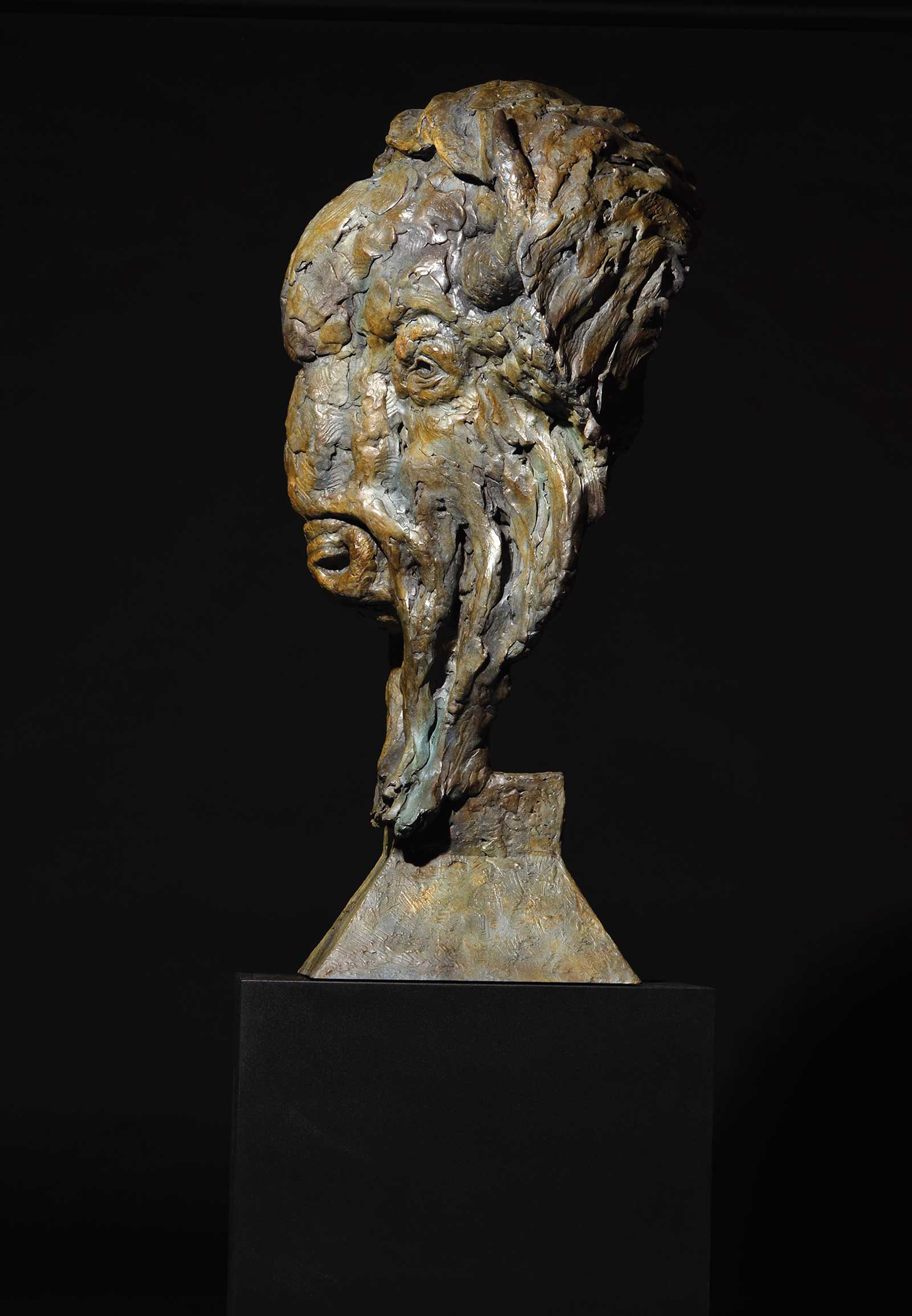
Mick Doellinger, American Icon, 2020, bronze. Courtesy of the artist, © DOELLINGER.
The museum explains that “the exhibition explores how artists working today are redefining the visual language of the West, challenging long-standing perspectives and expanding on the stories the region can tell.” The artists include Tony Abeyta, Bale Creek Allen, Sarah Ayala, Mick Doellinger, Craig George, Tiffany Huff, Dean Mitchell, Winter Rusiloski, Michael Scott, Don Stinson, Kay WalkingStick, Z.Z. Wei, Camille Woods and Steven Yazzie.
Kay WalkingStick (Cherokee) reminisces, “I was not raised as an Indian. I’ve never pretended that I was. I was raised in a white Protestant environment. I’m an American who happens to be part Indian and part Scotch Irish. My mother, who had an aphorism for everything, would tell me, ‘Stand up straight! You’re a Cherokee.’”
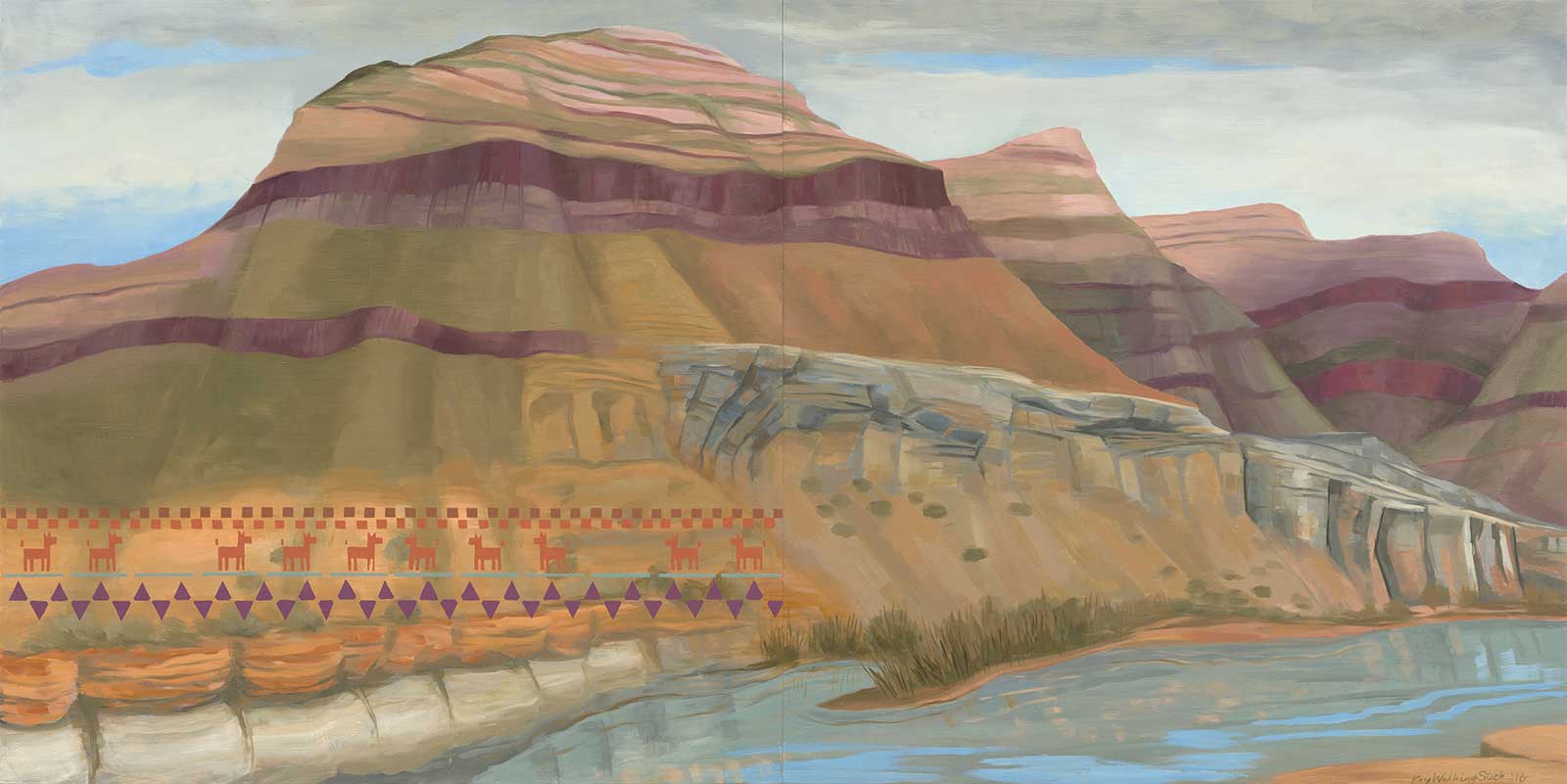
Kay WalkingStick (Cherokee), Salt River Canyon, 2016, oil on wood panels. William P Healey. © Kay WalkingStick. Photo by JSP Art Photography.
Her paintings of the Western landscape are true to their locations and are recognizable. She makes sketches and takes notes and photographs before returning to her studio to paint. In Salt River Canyon, 2016, as well as other of her landscapes, she has floated a stencil of an Indigenous design across the left panel of the diptych. She speaks of the stencil in a similar painting. “If I had painted it across the whole painting it would have acted as a barrier. The viewer is still invited into the space.”
The pattern band floats over the landscape with no impact on it, just as Native peoples live lightly on the land. Whereas the large, majestic landscapes by American and European artists in the 19th century showed the land ripe for exploitation. WalkingStick reminds us that Native peoples have been part of that land for generations, believing it was given to them by the Great Spirit to cultivate and to cherish.
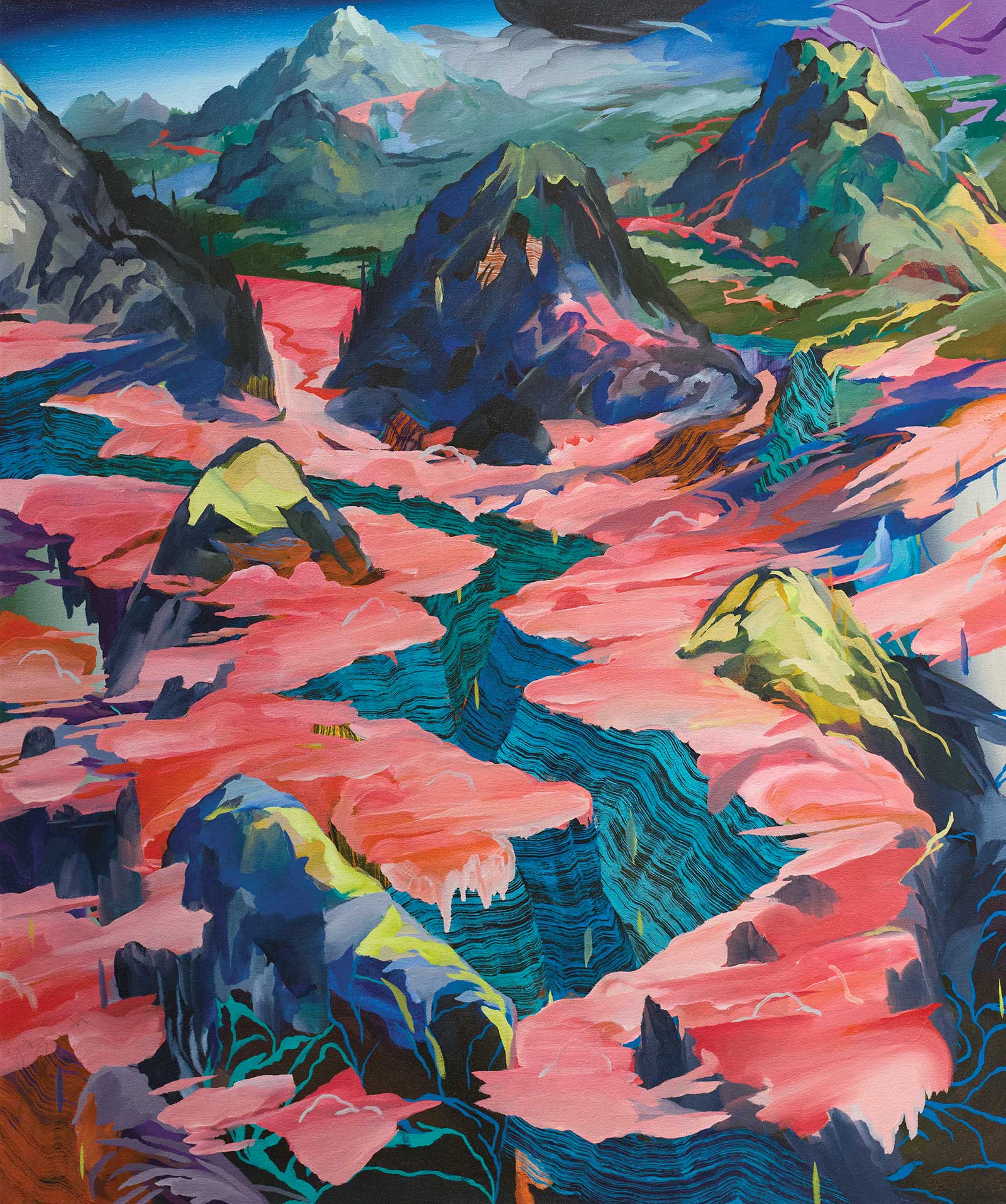
Steven Yazzie, Motifs in Pink, 2024, oil on canvas, Private Collection. © Steven Yazzie.
Tiffany Huff paints in West Texas. She says, “There is something mystical about this region where open eyes and an open heart discover a deeper connection to the natural world and to oneself. I am endlessly inspired by the story the land holds and remain passionate about conveying the essence of this scenery.” Of her painting Cosmic Repose, she remarks, “Painted from memory and imagination, Cosmic Repose reflects on the vastness of place, conjuring the quiet power of standing before datura beneath twilight skies. A meditation on stillness—a moment suspended between waking and dreaming, life and mystery.”
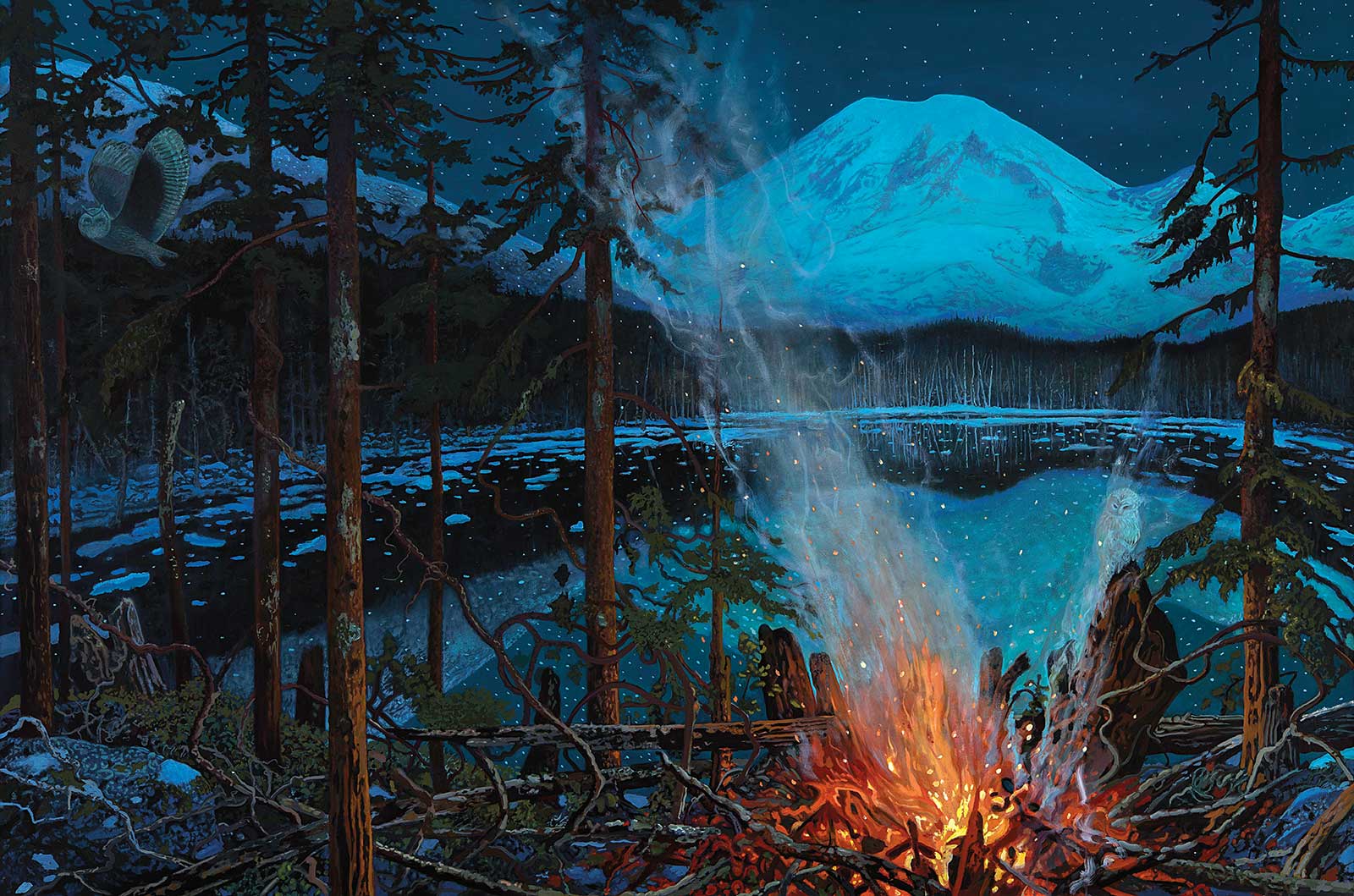
Michael Scott, Ghost Owls at Mt. Ranier, 2016-19, oil on linen panel. Courtesy of EVOKE Contemporary, Santa Fe, NM. © Michael Scott.
Michael Scott hales from Cincinnati and now lives in Santa Fe, New Mexico. Commenting on his painting Ghost Owls at Mt. Ranier, 2016-19, he says, “The occasion for a fireside reverie provides opportunity for meaning and contemplation. This painting addresses just that with its on-looking owls, one representing the fire as motion or sudden change, its characteristics display rapid transformation speeding up the passage of time. The other owl, sitting in silence, slows down time and represents thoughts embed in geological histories, linking the fire’s hearth to the volcano of Rainier. Certainly, the life of the logs before the viewer trigger thoughts of purpose, however its combustion is far more than the physical change evolving. The logs also represent thoughts of life’s renewal, how living matter is transformed and how we as humans participate in that transformation. Within that association, both owls become a metaphor for us…Mt. Rainier is our country’s fifth national park and can teach us many things, in particular, how to respect the land and the role of stewardship around the world. Numerous Indigenous tribes have been in this region for generations and their goal as well mine is to keep it protected for many generations to come.”
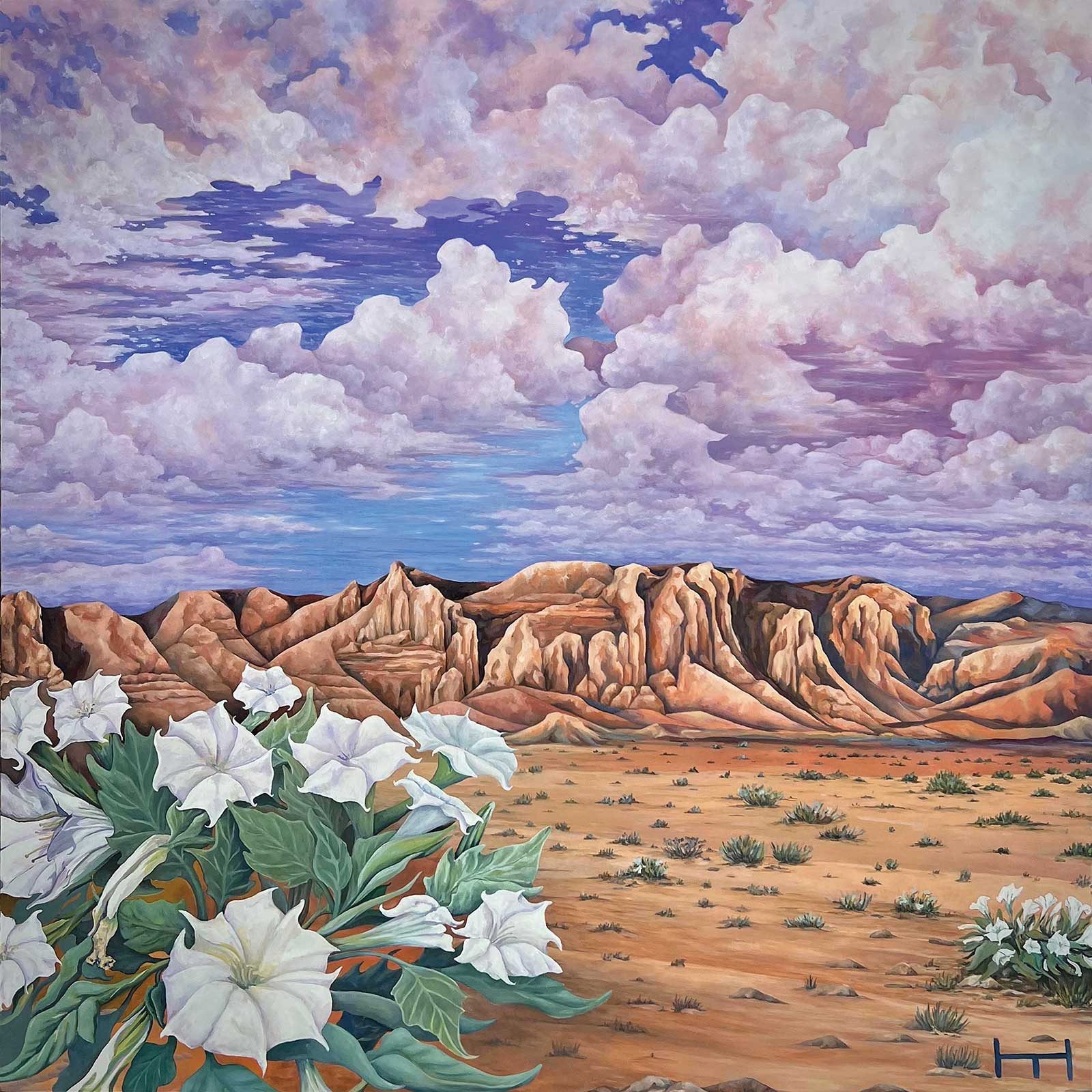
Tiffany Huff, Cosmic Repose, 2025, oil on wood panel. Courtesy of Commerce Gallery. © Tiffany Huff.
The exhibition continues the Carter’s longstanding engagement with the American West. It explains, “The exhibition reflects on the enduring symbolism of the American West, while highlighting how innovative contemporary artists are reshaping its meaning. Drawing from diverse cultural and personal experiences, the featured artists explore themes of identity, memory, climate and place situated in the scenery of the West. Their work provides a juxtaposition from the visual traditions rooted in Anglo-Romantic ideals and instead presents the contemporary West as a living, evolving terrain shaped by a wide spectrum of perspectives.” —
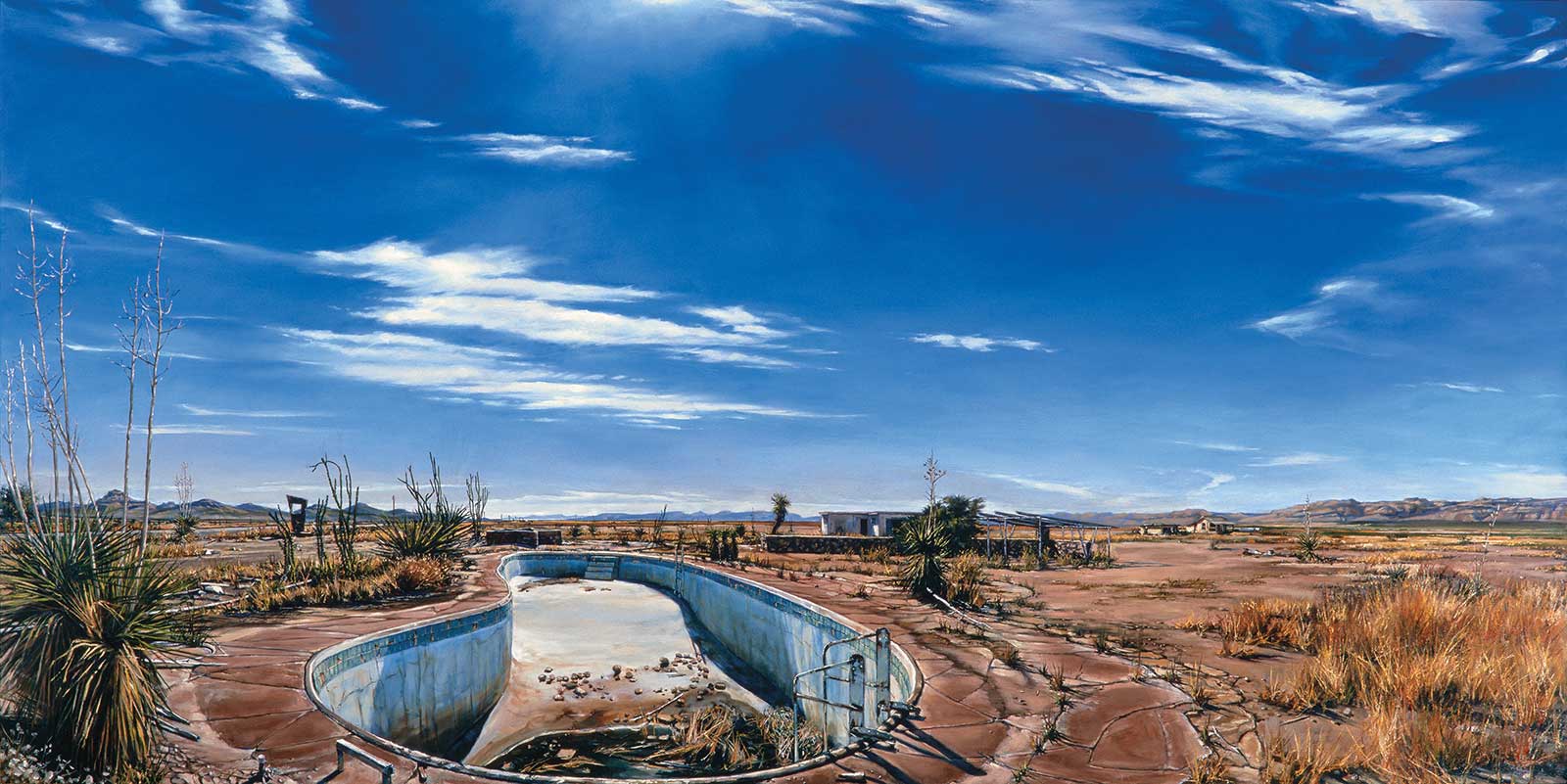
Don Stinson, Lone Star and Pool: Lobos, Texas, 2000, oil on wood panel. Don Stinson, Artist. © Don Stinson, Artist.
New Horizons: The Western Landscape
January 17-May 24, 2026Amon Carter Museum of American Art
3501 Camp Bowie Boulevard, Fort Worth, TX 76107
(817) 738-1933, www.cartermuseum.org
Powered by Froala Editor


