A famous axiom says that every story about a man is also a story about the man’s father.
Consider the work of Lincoln Borglum, a relatively unknown sculptor from the mid-20th century. Lincoln was destined to be an engineer, and yet he ventured into the Black Hills of South Dakota in 1933. He was there to work for his father, sculptor Gutzon Borglum, who was creating one of the most famous works of colossal art on the planet, the mountain-sized heads of four American presidents carved into granite—Mount Rushmore. Gutzon worked on the project from 1927 until his death in 1941. Although, the monument was largely completed at the time of Gutzon’s death, Lincoln stepped up to close the project out and then serve as Mount Rushmore’s first superintendent.
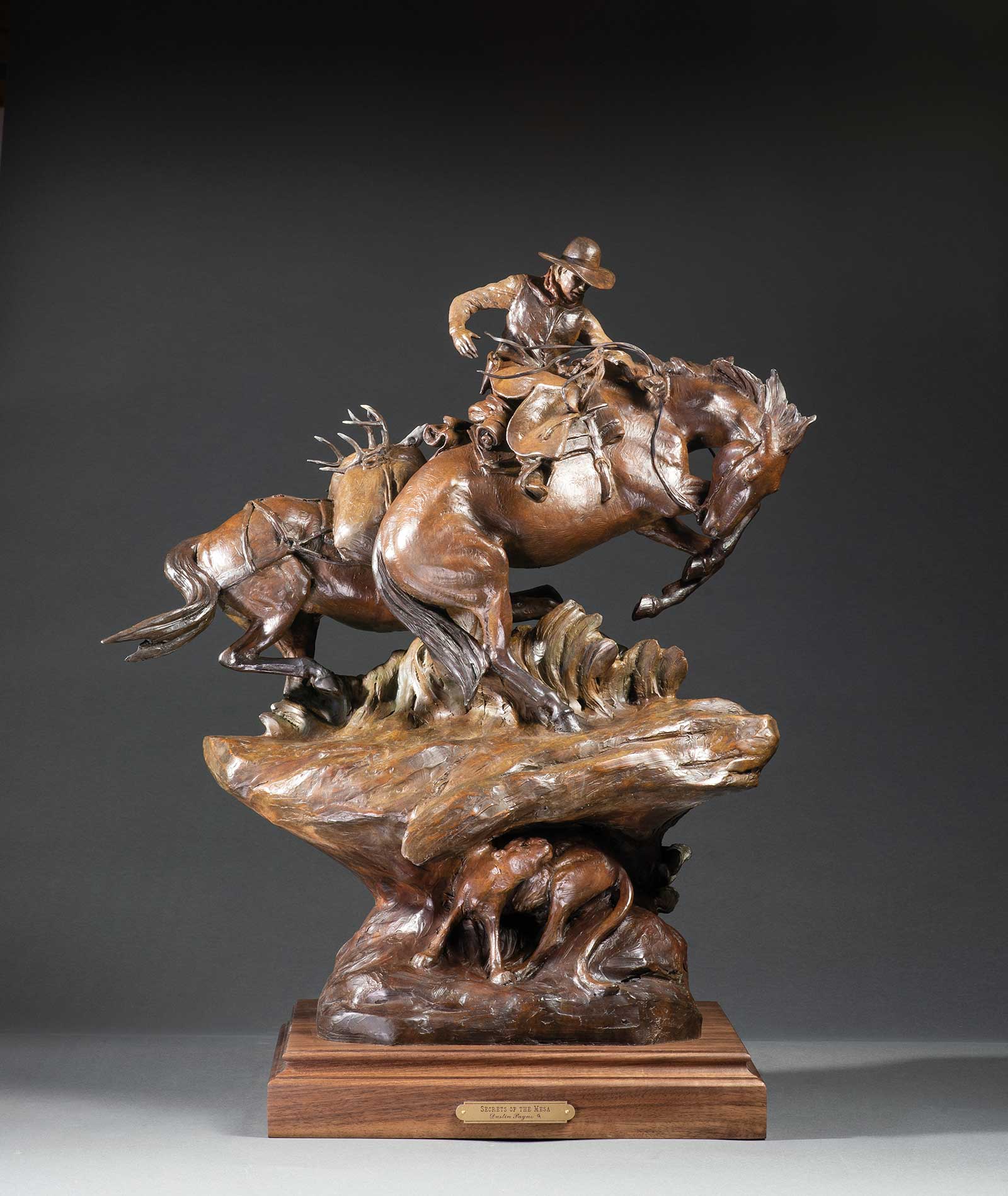
Secrets of the Mesa, bronze, 27 x 21 x 12 in.
When Wyoming sculptor Dustin Payne created his work What Man Can Conceive, showing two tiny figures standing on a rocky outcropping below Abraham’s Lincoln’s head on Mount Rushmore, he was telling a story about the grandness of the monument and its seemingly impossible existence. And yet, it was also a story about fathers and sons: the two figures are Gutzon and Lincoln Borglum. The bronze work won the top prize, the museum purchase award, at Night of Artists at the Briscoe Western Art Museum in March.
“I kind of had to step out of the box and take a chance for that one. I didn’t know what to expect, but I knew there was a chance people would think I had lost my mind,” the sculptor says. “But that’s the story of Mount Rushmore. My kids and their generation might think things like this have always existed, but when it was created no one had seen anything like it. It had never been attempted at that scale. And there in the middle of it all was Borglum and his son. It’s an interesting story. Lincoln was the peacekeeper. He didn’t have the ego of his father and because of that he was a large part of why the monument was completed. It was a family affair, and Lincoln was there seeing his father’s work through.”
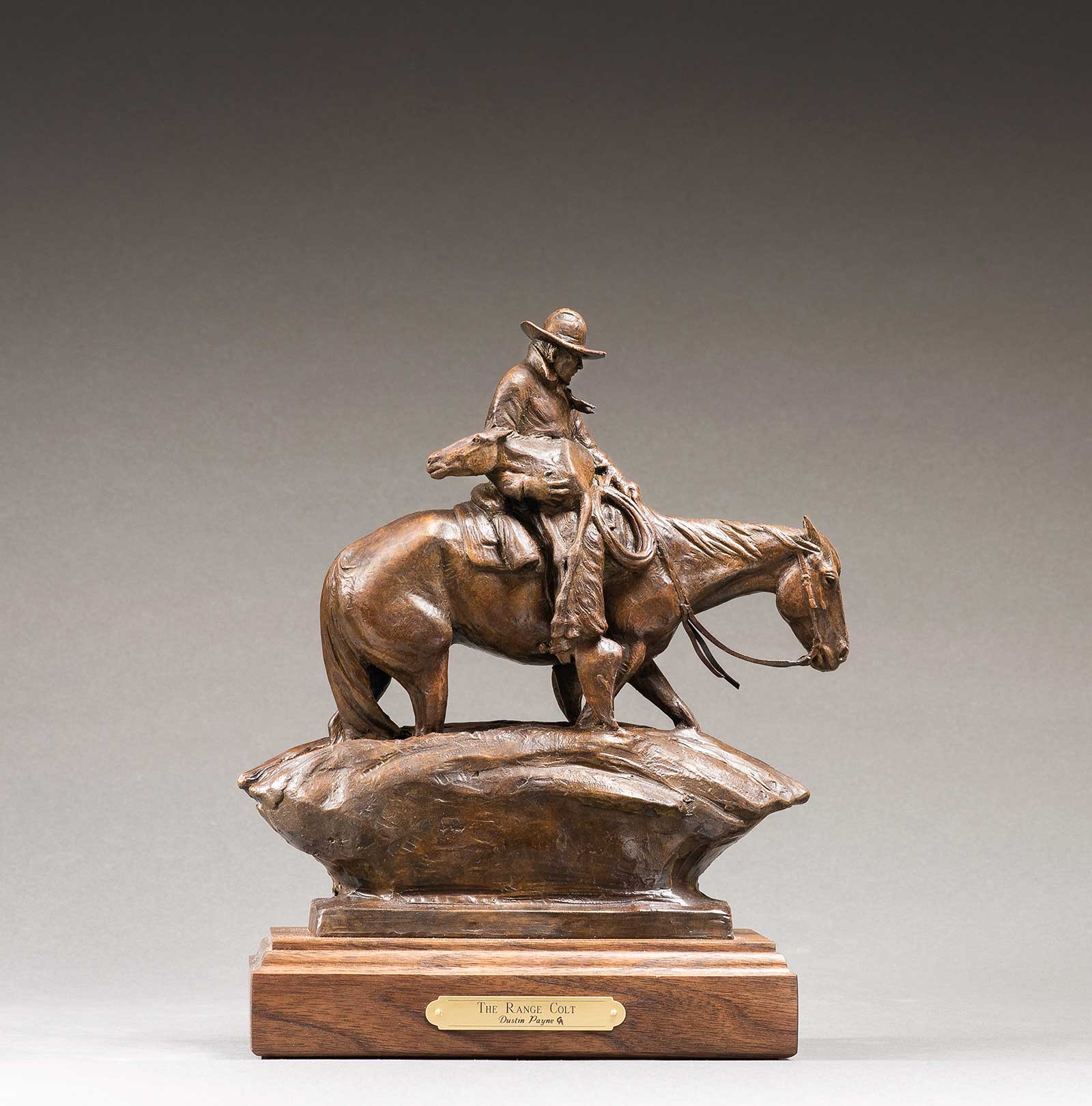
The Range Colt, bronze, 11½ x 10 x 5 in.
Payne is intimately aware of these father-son dynamics. His father is Vic Payne, and his grandfather is Ken Payne. All sculptors, the three generations of artists represent a long and distinguished legacy within Western sculpture. Vic, who is still active, lives and works in Wyoming; Ken died in 2012 after a celebrated 40-year career. Dustin may have struggled early in his art journey to emerge from the shadows of his father and grandfather—“I had big shoes to fill,” he says—but within the last decade he’s stood out as a fascinating sculptor with a unique voice and an unmatched eye for Western authenticity. And he’s hit a number of significant milestones in a short period of time, including induction into the Cowboy Artists of America in 2017, a string of major monument commissions, gold medals and top honors at numerous shows, gallery representation all around the country and the recent museum purchase award at the Briscoe. Dustin Payne has proven he’s a force to be reckoned with.
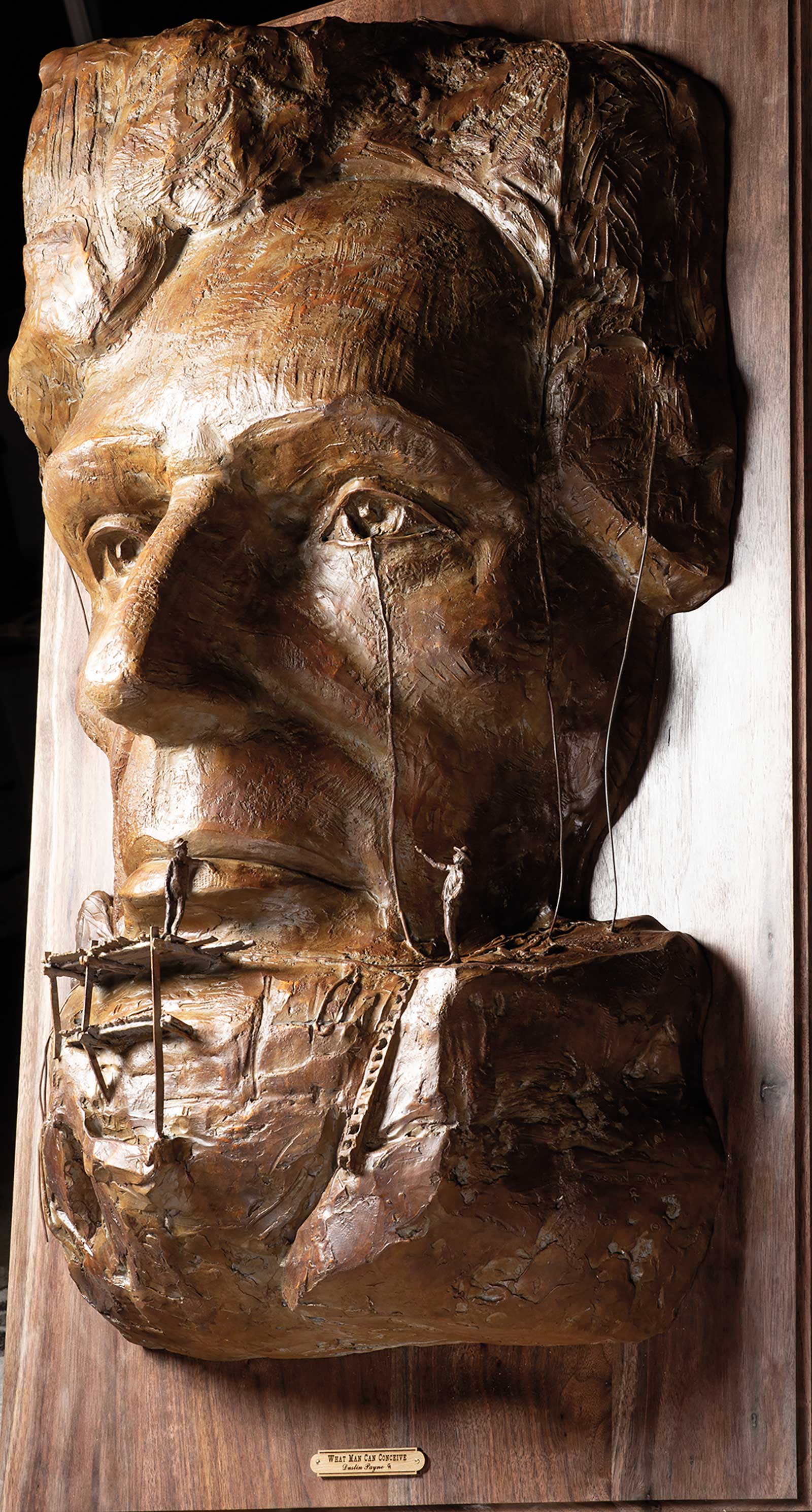
What Man Can Conceive, bronze, 37 x 20 x 10 in.
The path to where he is today is unique, and yet it will also be vaguely familiar to others who were raised within a Western lifestyle. Dustin spent a lot of time growing up on ranches, including his family’s southern New Mexico ranch, where he learned the ropes. Literally. “If you spent enough time at a place like that, you learned to rope. Eventually you’d go into town and rope for fun. That was like your golf game—it was what we grew up living to do,” Payne says, adding that he rode and roped throughout his teen years. He never planned on pursuing it professionally, only because he dreamed of becoming an airline pilot. At 16 years old he was learning to fly and striving for the various ratings that are required to move through private and then commercial aviation. After a hard hit from a saddle bronc, Payne suffered a medical emergency that would make attaining a pilot’s license nearly impossible. “After that, I went back to the second thing I knew, which was the art business.”
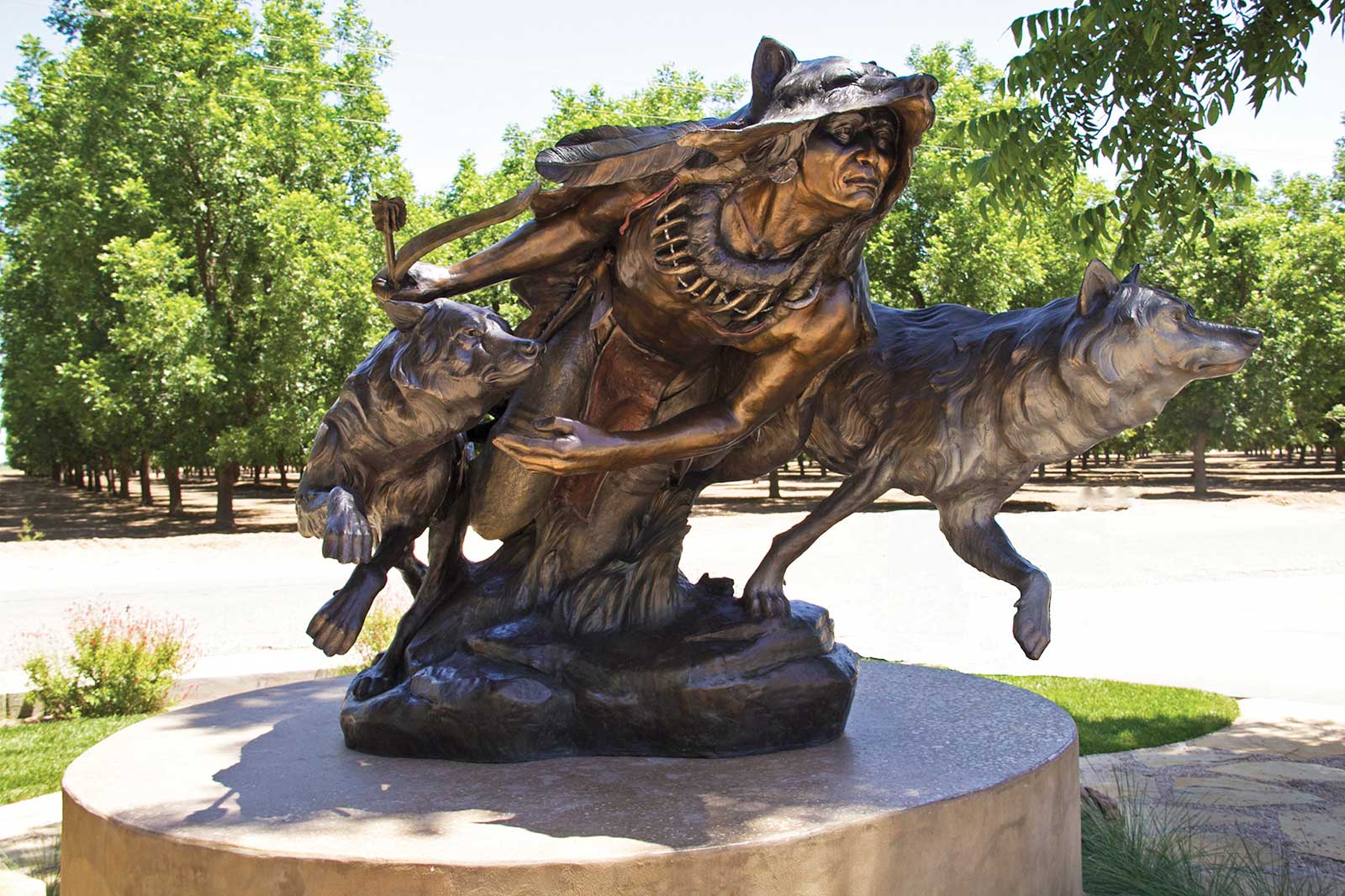
Prairie Allies, bronze, lifesize
While he started to mess around with clay, he was also managing a gallery in Jackson Hole, Wyoming. (The Paynes have a long history in the gallery business, including with Mountain Trails Galleries and Santa Fe Trails Fine Art.) Soon after he married his wife, Tammy, who helps him with his studio today. “I enjoyed working with clay, but we had two sculptors in the family already, so I thought I would try painting. Before I knew it, I was on a plane to Oregon to study with Scott Christensen, and then later Jim Wilcox in Jackson. Painting didn’t take the way I thought it would, so I went right back to sculpting,” Payne says. “At the time I was at what was then called Mountain Trails Gallery in Santa Fe. I had made a bronze and I think I sold about 50 of them that one summer. For a 20-year-old kid, that was good money. It sealed the deal. I knew I had to go my own way and get serious. That was when I knew what way I was going.”
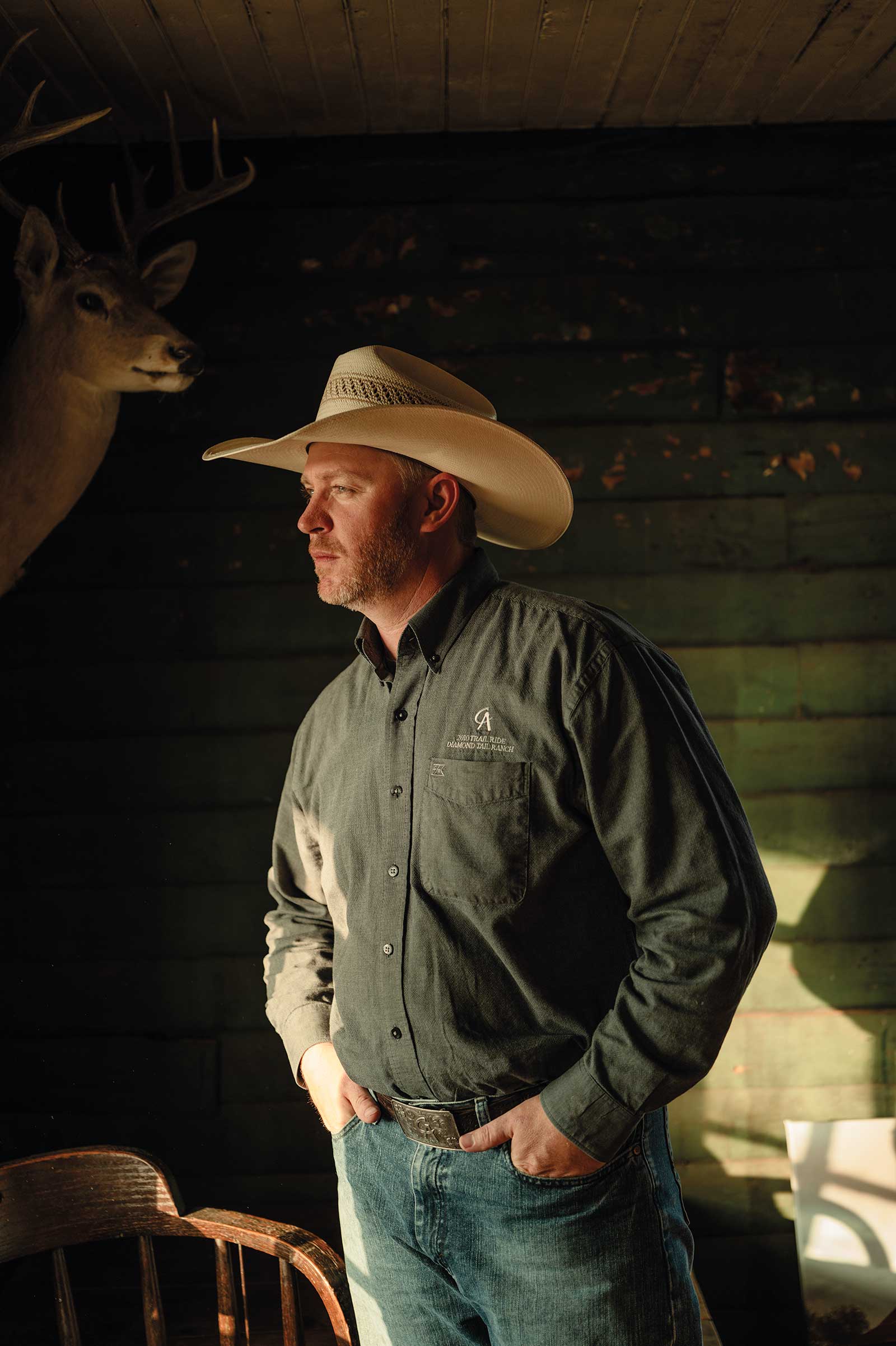
Dustin Payne during the Cowboy Artists of America trail ride in Texas, March 2025. Photo by Ben Christensen.
Proving further that fathers and sons have intertwining stories, 20 years later Payne was watching his sons play baseball competitively, up to 100 games a year. “One day my son, he may have been a sophomore at the time, he walked up and handed me his glove and bat. He says, ‘I’m done. I want to do rodeo next year.’ And that’s how we ended up back at the rodeos,” Payne says. If each person needs to find their own path, on their own timeline, the Payne family makes for a great case study in this phenomenon.
These days Payne lives in Cody, Wyoming, though he’s in the middle of a move to Texas. His boys are now young men and off on their own paths, so he and Tammy don’t feel bound to one place, although they have roots in Wyoming, New Mexico and Texas. His clays, both the regular-sized pieces and the monuments, are continuously developing. Key to his success, at least in Payne’s eyes, is the authenticity of his subjects. “It’s always about authenticity,” he says. “I don’t ever want an old cowboy or an old rancher to come in and tell me I did something wrong. And the older I get, the more important those qualities of my work become for me. Hundreds of years from now, who knows what will be around, but I bet you sculptures will last. And there’s a good chance that sculptures will document our culture.”
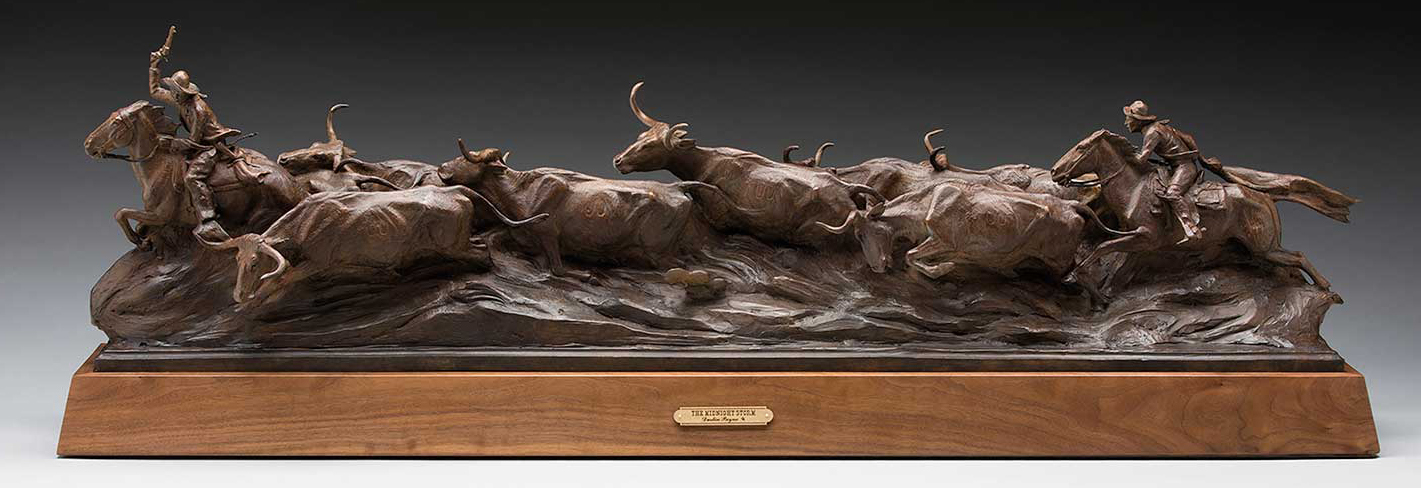
The Midnight Storm, bronze, 47 x 15 x 11 in.
And although his work is very realistic and representational, it has some unique modern qualities that push it into exciting directions. Certainly, What Man Can Conceive is in that group, but so are sculptures such as The Midnight Storm, Dodge City and The Range Colt, all of which allow dust, tall grass and sagebrush, and the kinetic motion of action, to merge on an almost abstract level with the subjects. Other pieces are exciting in terms of pose and posture, as is the case for Comanche Ways, with a rider hanging precariously from the neck of his horse, and the monument Prairie Allies, with its Native American subject leaning forward as if launching off the stone pedestal.
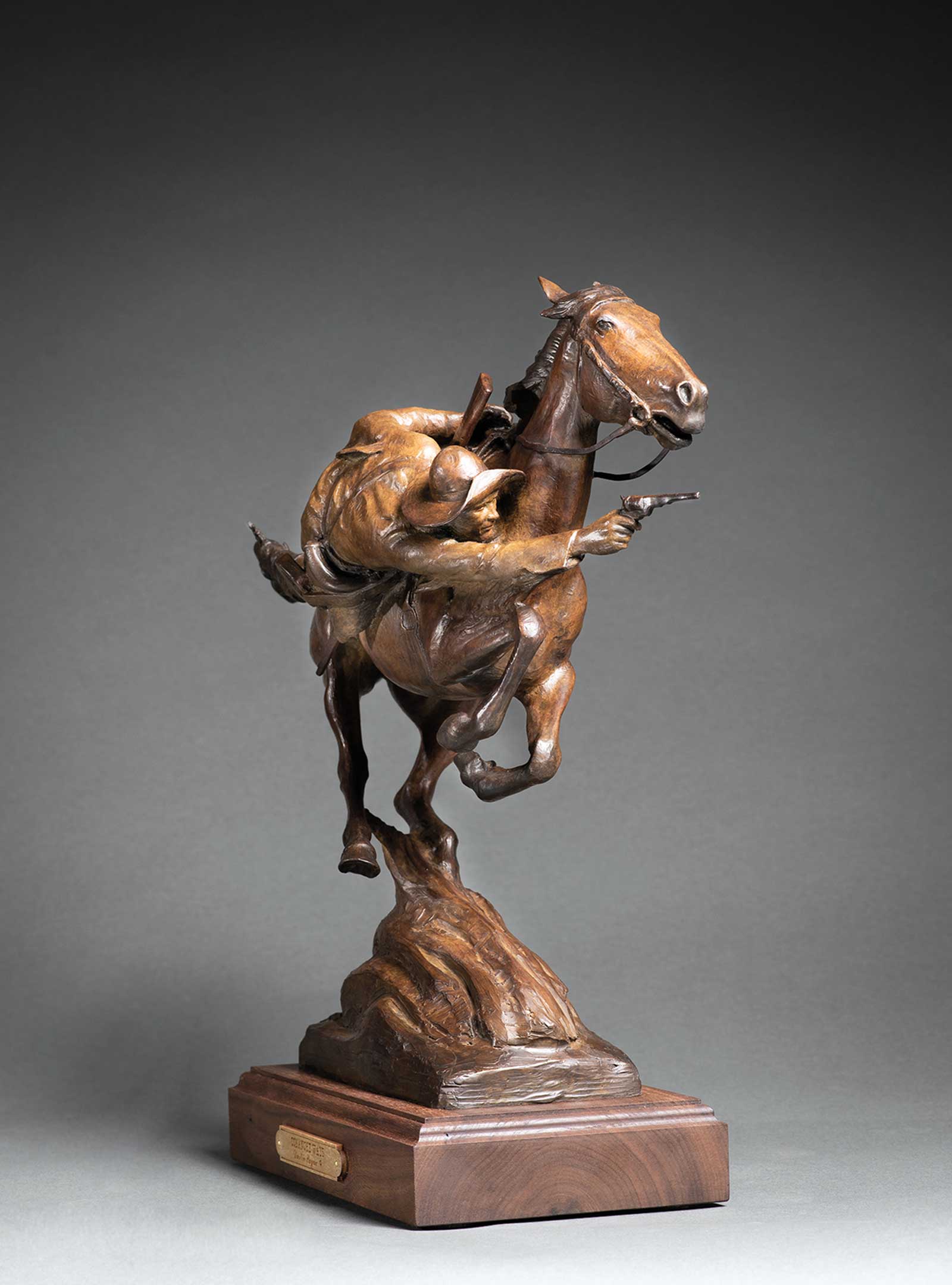
Comanche Ways, bronze, 16 x 18 x 7 in.
Payne has profound respect for these subjects, so much that he borrows a phrase from a different time period. “Go back to that Greatest Generation, which were the people who fought in World War II and then also earlier in World War I. Those guys grew up idolizing the West either from their history or from movies and television. If you look at what America came through, it’s the story of the West and the American cowboy that is the reason we got through it all,” he says. “The Greatest Generation wanted to be good, and they wanted to be strong because others had been there before them.”
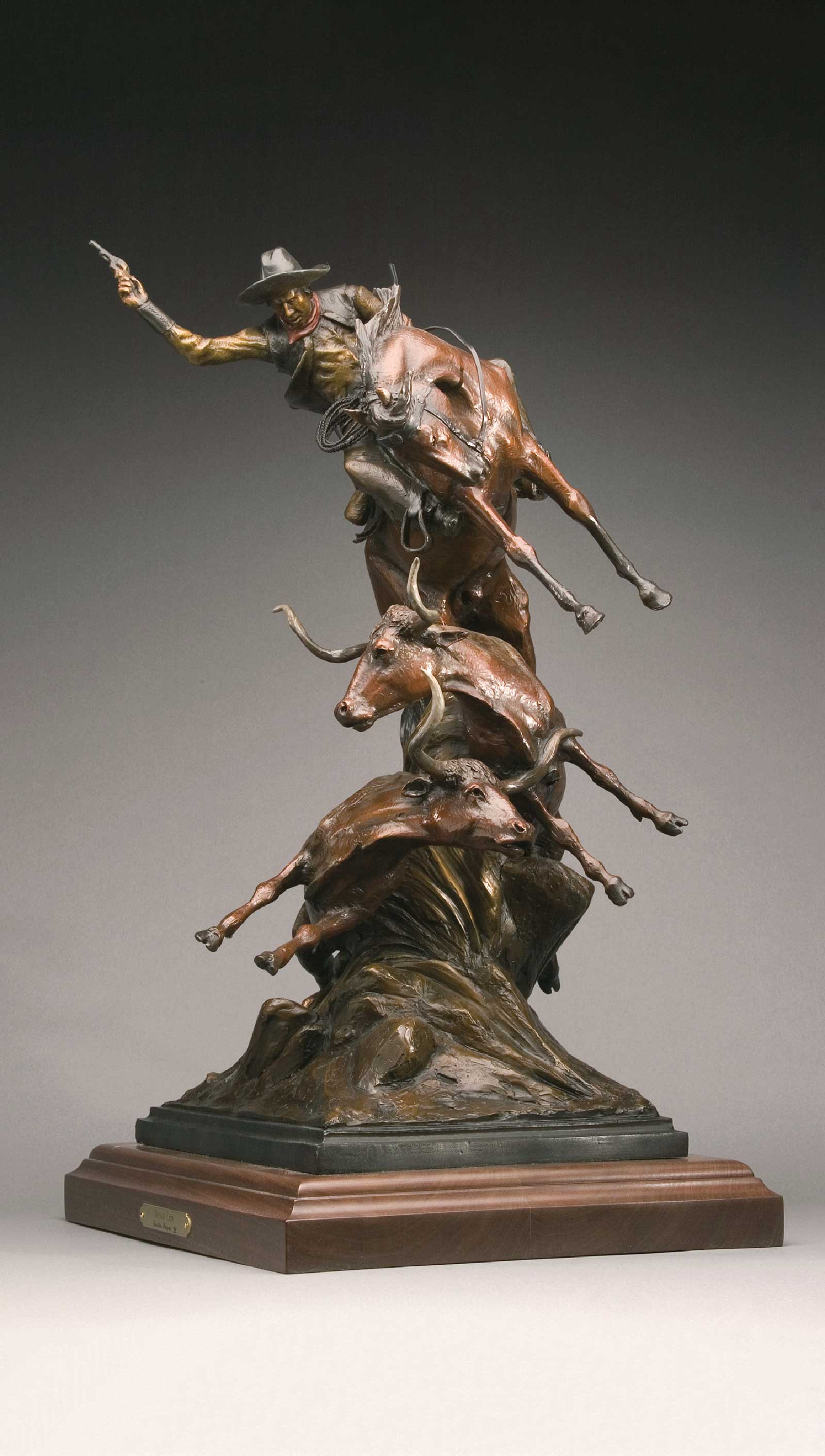
Dodge City, bronze, 24 x 12½ x 10½ in.
These ideas about the mythology of heroism, fathers and sons, the heritage of the American West and other larger, more abstract themes resonate with Payne in his studio, both practically with his subjects as well philosophically about who he is as an artist. They are also ideas that ring true for painter and sculptor John Coleman, which is how Payne ended up in one of his sculpture workshops.
“Dustin comes from a great lineage—from Ken Payne, his grandfather, to Vic Payne, his father. They are all artists, dealers and have worked for successful galleries. I think what Dustin has done is refined the evolution of a dynasty of sculptors,” Coleman says. “And he’s likely the best of the bunch. He’s very serious about getting better, and that makes him a good student because he doesn’t let ego get in the way of anything. He’s also insightful, more so than other sculptors of his generation. I’m continuously impressed with his attitude and his work. We’re kindred spirits, even though he’s a young guy and I’m not. I like where he’s going.”
A lot of people are liking the direction Dustin Payne is headed. It’s evident in his sales at shows and galleries, his awards and his monument commissions. It’s all validation for the artist, and yet it’s also something more.
“Anytime I can make something about the American West, that’s what I want to be doing,” he says. “There are still stories to be told.” —
See More: www.dustinpayne.com
Powered by Froala Editor


