Marsden Hartley (1877-1943) was born in Maine and became a peripatetic painter, traveling the world, moving in the circles of the international avant-garde, but regularly returning to Maine.
The exhibition Marsden Hartley: Adventurer in the Arts was developed by the Vilcek Foundation in collaboration with the Bates College Museum of Art’s Marsden Hartley Memorial Collection. It opens at the New Mexico Museum of Art in Santa Fe, April 5 and continues through July 25.
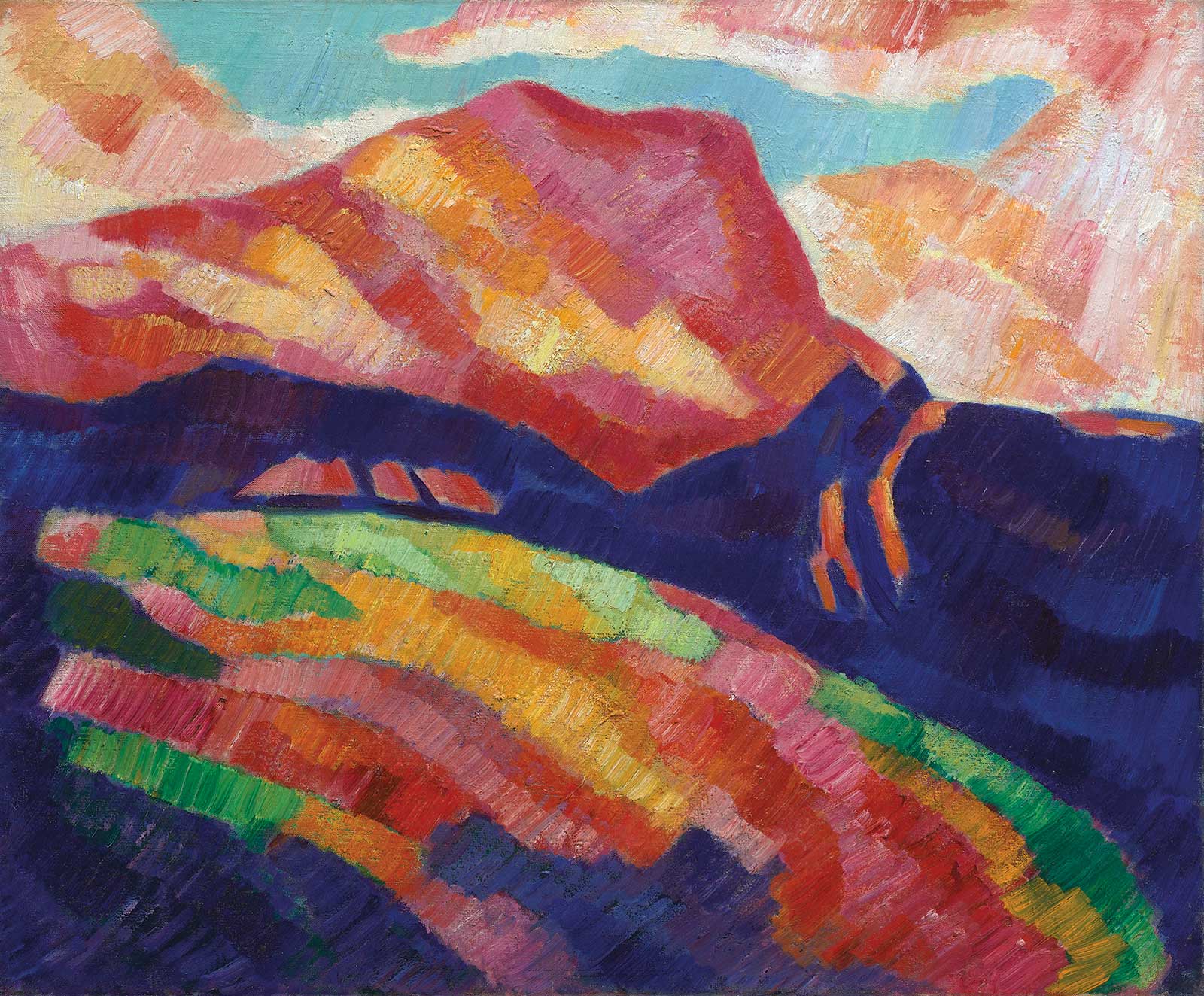
Mont Sainte-Victoire, ca. 1927, oil on canvas, 20 x 24 in. The Jan T. and Marica Vilcek Collection. Promised gift to the Vilcek Foundation, 2007.06.01.
The museum notes, “Artworks from the Vilcek and Bates collections will be exhibited alongside a selection of Hartley’s personal effects—mementos from his travels, snapshots, and keepsakes. The remarkable assemblage adds intimacy and depth, as well as a deeper understanding of his art, life, and wanderlust. The exhibition also features three important paintings by Hartley in the collection of the New Mexico Museum of Art.”
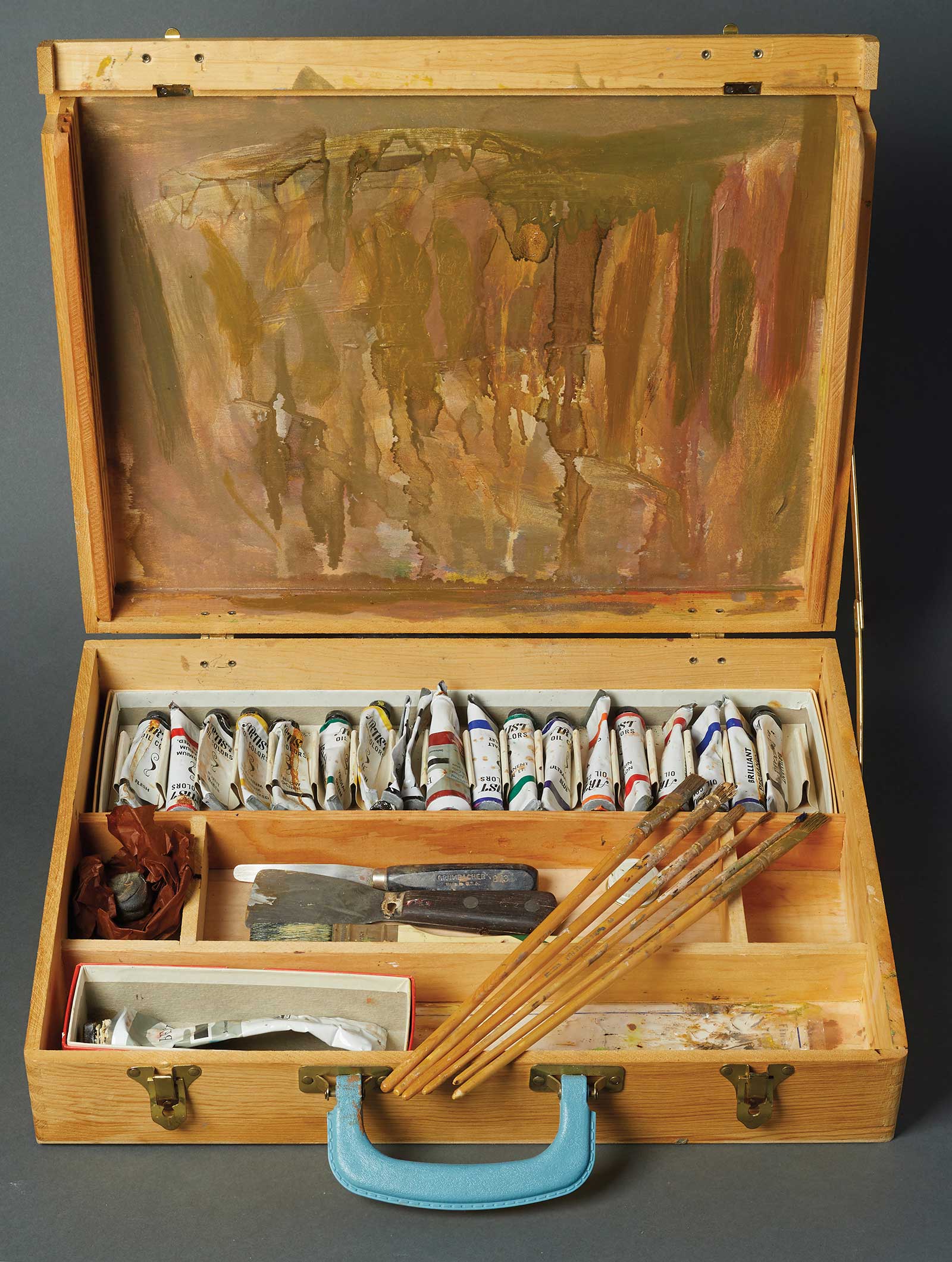
Paint box, wood with oil paint, brushes, pallet knives, graphite, charcoal, gum eraser, tissue, metal, paper and plastic, 4 x 17 x 13½ in. Bates College Museum of Art, Marsden Hartley Memorial Collection. Gift of Miss Chenoweth Hall, 1968.7.6.
Hartley received a scholarship to study at the Cleveland Museum of Art which, in turn, awarded him a stipend to study for five years in New York. In 1889 to 1890 he studied with William Merritt Chase at the New York School of Art and later studied at the National Academy of Design from 1900 to 1904. He also came under the influence of avant-garde artists from Europe, notably Cézanne, whose work was becoming known there.
Following successful exhibitions in 1909 and 1912 at Alfred Stieglitz’s 291 Gallery he was able to travel to Europe. His restlessness brought him back to New York and again back to Europe, with stints in Bermuda, Mexico and Nova Scotia.
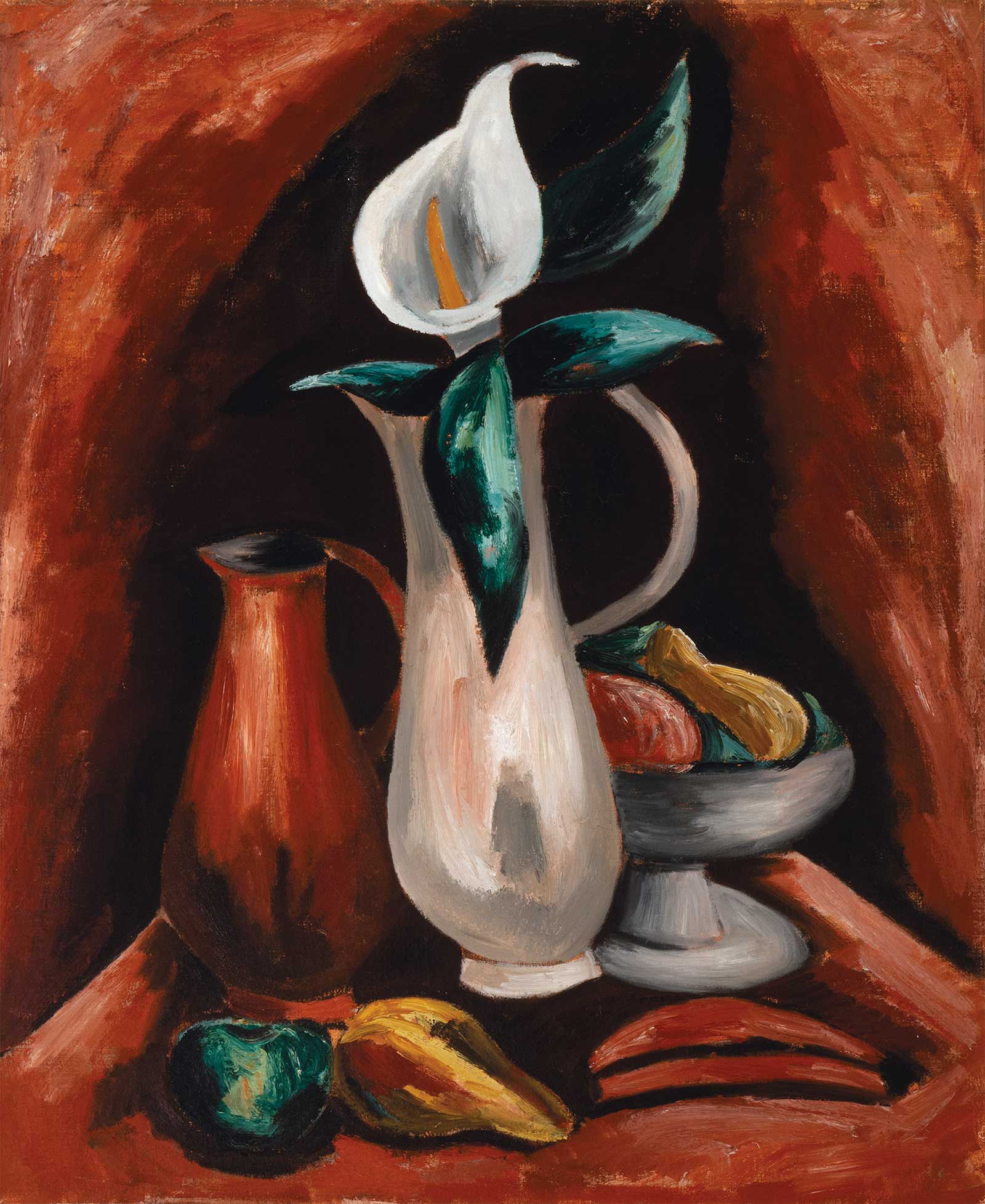
Still Life, 1922, oil on canvas, 27½ x 21½ in. Collection of the New Mexico Museum of Art. Bequest of the Rebecca Salsbury James Estate, 1968 (2286.23P). Photo by Cameron Gay.
A rare early painting, Sundown, Kezar Lake, July 14, 1910, displays an impressionistic use of color that was uniquely his own. Bates College notes, “Hartley immersed himself in nature, allowing his painting to be tutored by it unencumbered by external influences.”
Painting in Berlin in 1915, Hartley produced his Amerika series. Schiff, 1915, had never been shown in the United States until Marsden Hartley: Adventurer in the Arts first opened at the Bates College Museum of Art in 2021.
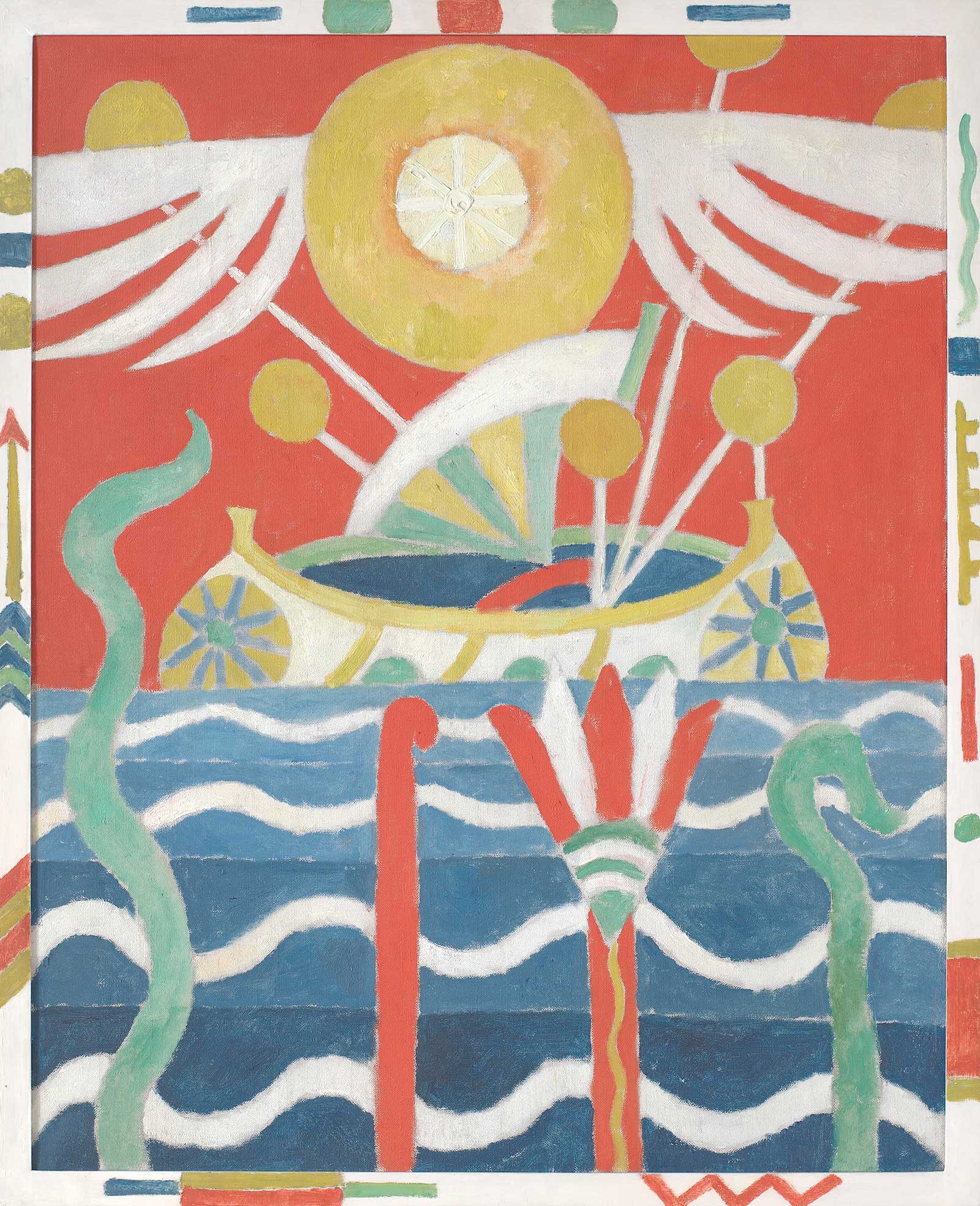
Schiff, 1915, oil on canvas with painted frame, 39¾ x 311/8 in. The Jan T. and Marica Vilcek Collection. Promised gift to the Vilcek Foundation, 2015.05.01.
Rick Kinsel, president of the Vilcek Foundation, describes Hartley as “a trailblazing American multiculturalist.” Schiff incorporates Native American and other cultural motifs. Some scholars suggest that the “schiff” (boat) is a Chippewa canoe. Kinsel suggests it could be the solar ship of the ancient Egyptian sun god Ra, backed up by the red zig zag on the lower right, the Egyptian hieroglyph for water.
In 1918, Hartley was invited to Taos, New Mexico, by the art patron Mable Dodge Luhan and went there with the purpose of developing modern American art, independent of European influences. He continued to work on the pastels and experiments in oil that he produced in Taos when he returned to New York in 1919. When he returned, yet again, to Europe, he worked on his New Mexico Recollections series while living in Berlin.
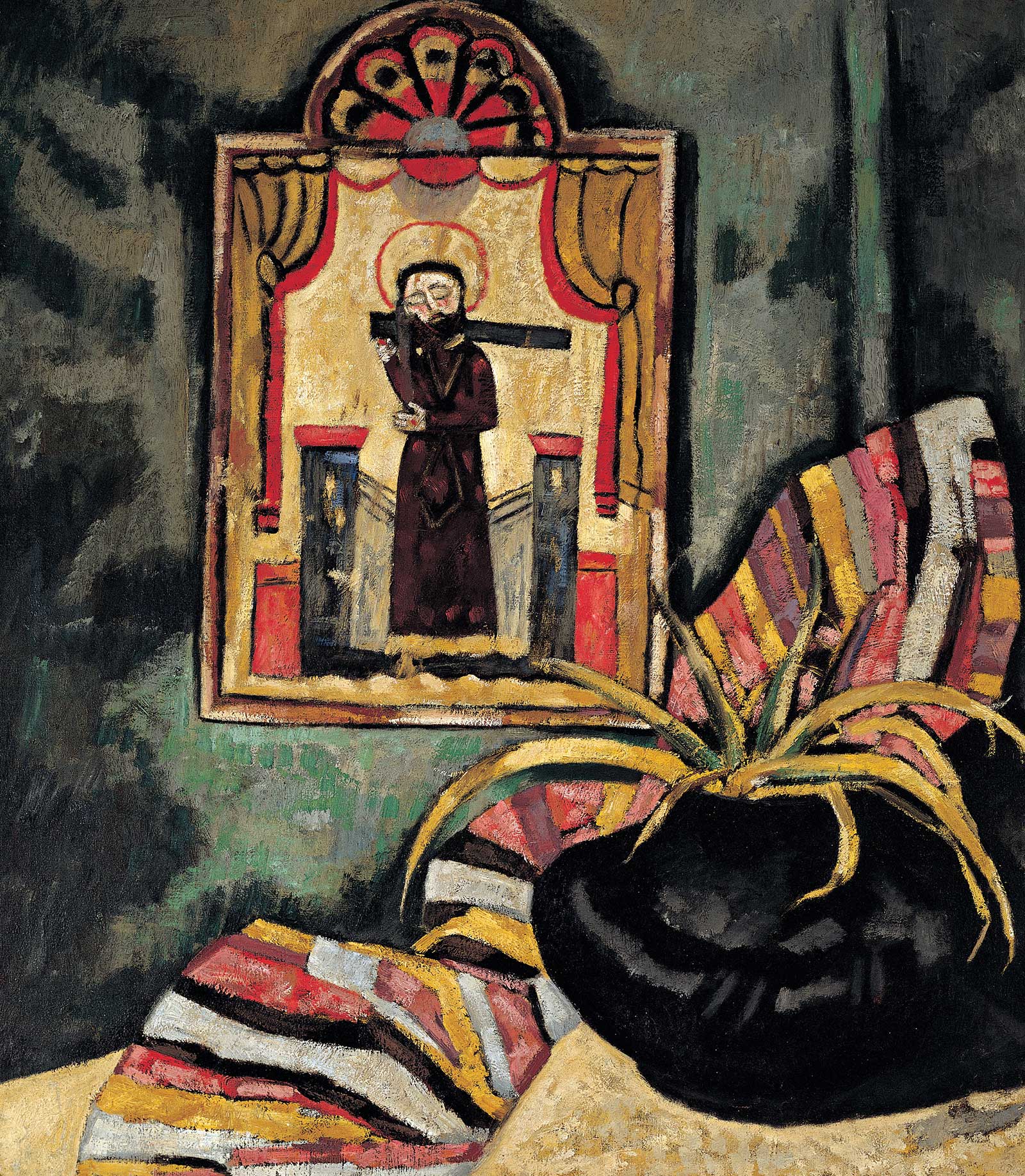
El Santo, 1919, oil on canvas, 36 x 32 in. Collection of the New Mexico Museum of Art. Gift of the artist, 1919 (523.23P).
The somber palette and lack of detail in New Mexico Recollection #14, circa 1923, are typical of the series. After arriving in New Mexico, he wrote, “There is nothing in conventional esthetics that will express the red deposits, the mesas, and the Canyon of the Rio Grande.”
Vibrant color appears in his Mont Sainte-Victoire,circa 1927, a tribute to Cézanne, who often painted the mountain near his home in southern France. Hartley pays homage to Cézanne without slavishly imitating him. The scholar of American modernism, William Agee, wrote of Hartley’s paintings, “They are, to be sure, an act of homage, but the results are startling. The touch is rougher, the image more condensed, the contrasts often sharper than those found in Cézanne; but finally it is the range of hue and the range of light effects that makes these works so original and such marvels of the art of painting.”
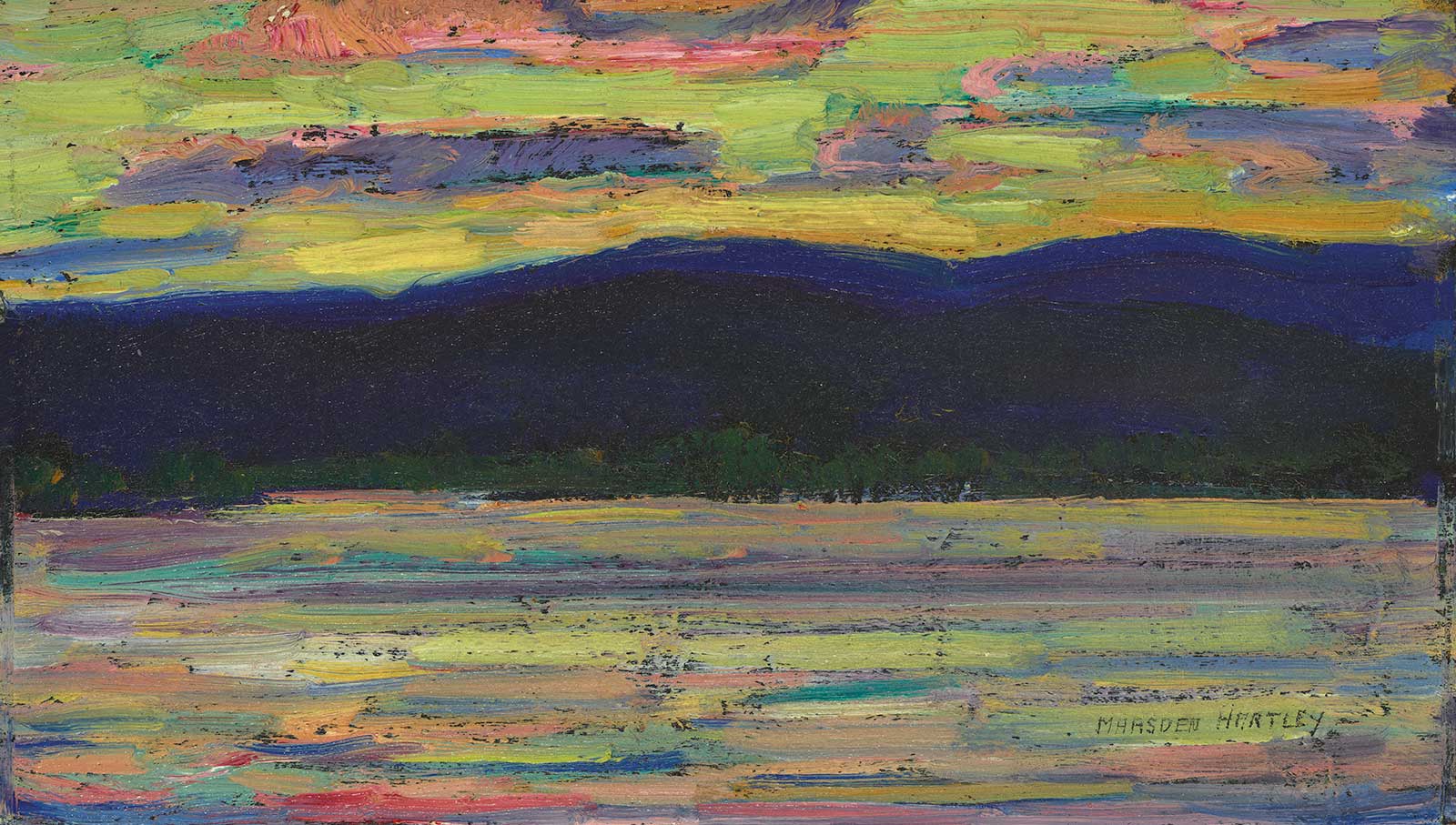
Sundown, Kezar Lake, July 14, 1910, oil on panel, 5¾ x 93/8 in. Bates College Museum of Art, Marsden Hartley Memorial Collection. Gift of Norma Berger, 1955.1.101.
In the preface to the exhibition catalog, Jan and Marica Vilcek write, “It’s hard to fathom that works as diverse as Mont Sainte-Victoire and Schiff were painted by the hand of the same artist.
“Among all the American modernists we have collected, Hartley stands out not only for the diversity, beauty, spirituality, and mystery of his work, but also for his openness to other cultures and ways of life.” —
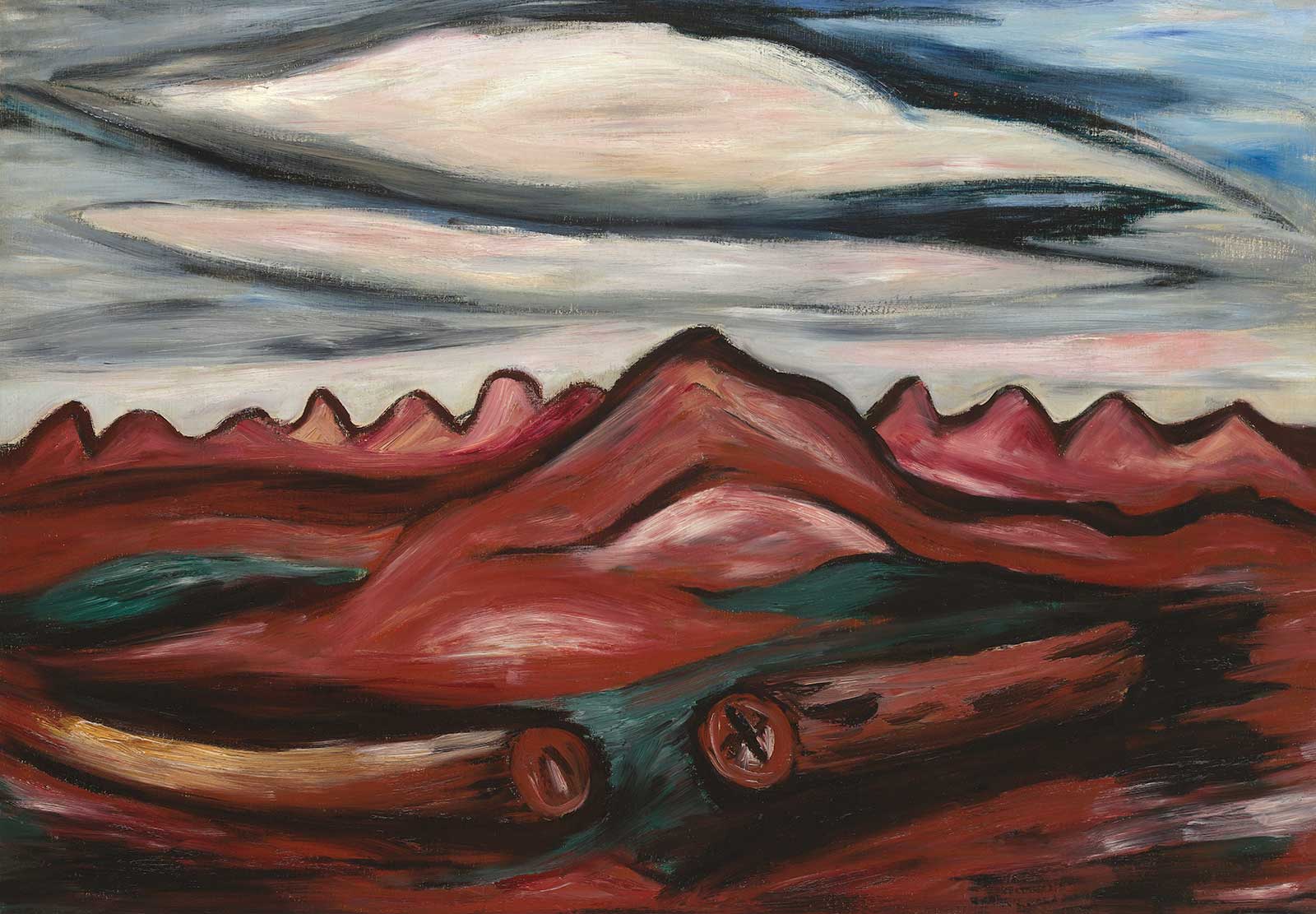
New Mexico Recollection #14, ca. 1923, oil on canvas, 30 x 40 in. The Jan T. and Marica Vilcek Collection. Promised gift to the Vilcek Foundation, 2009.01.01.
Marsden Hartley: Adventurer in the Arts
April 5-July 25, 2025New Mexico Museum of Art
107 W. Palace Avenue, Santa Fe, NM 87501
(505) 476-5063, www.nmartmuseum.org
Powered by Froala Editor


