For the next five years, the BYU Museum of Art will present Crossing the Divide,a substantial showcase that will serve as a reinstallation of the museum’s permanent American art collection. The exhibition will feature 120 works in total, including 86 paintings and 34 works on paper.
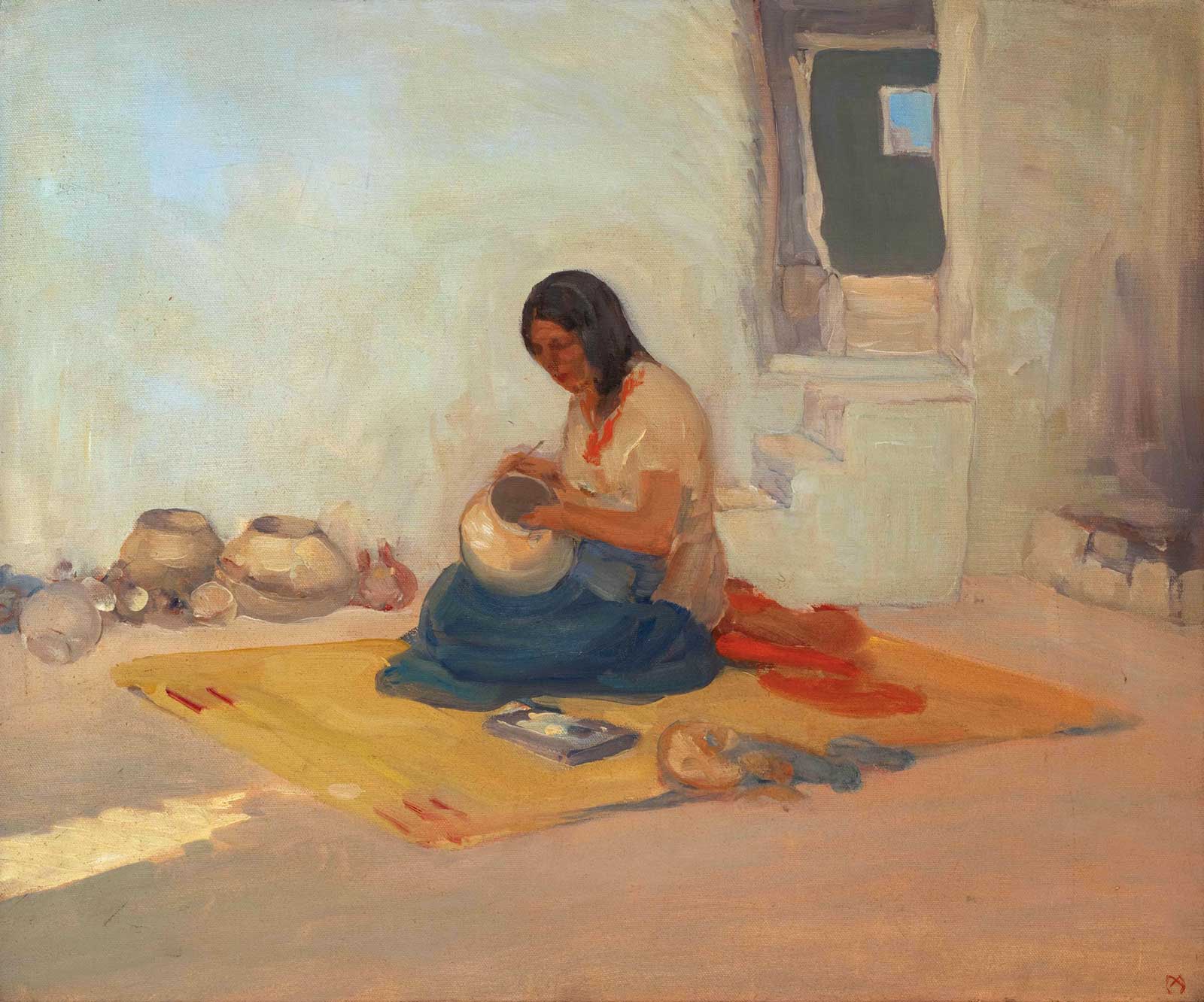
Xavier Martinez (1869-1943), Woman with Pots, ca.1930, oil on canvas, 205/16 x 2311/16 in. Brigham Young University Museum of Art, 1973.
“We wanted to highlight many of the artists and artworks for which we are known, alongside lesser-known and never-exhibited works,” explains American art curator Isaac King, who co-curated alongside Miri Kim. “For this iteration, we moved away from attempting a chronological survey of American art to focus on the diverse geographies, perspectives, lives and histories that are woven across the territorial boundaries of the United States. Each thematic section of the exhibition explores some of the distinct ways artists grappled with, and sometime overlooked, aspects of their own place in space and time.”
Significant Western works are also prominently featured, such as Maynard Dixon’s oil painting High in the Morning, 1933. “Dixon’s works are featured in a sub-section dealing with the different artists’ approaches to the Western landscape,” says King. High in the Morningis displayed alongside Western artists Mabel Pearl Frazer and John Stansfield, as well as a sculptural work by the Japanese ceramicist Ban Kajitani, that was inspired by the desert canyons of southern Utah…Two of [Dixon’s] figural works illustrate the economic difficulties of the Great Depression.”
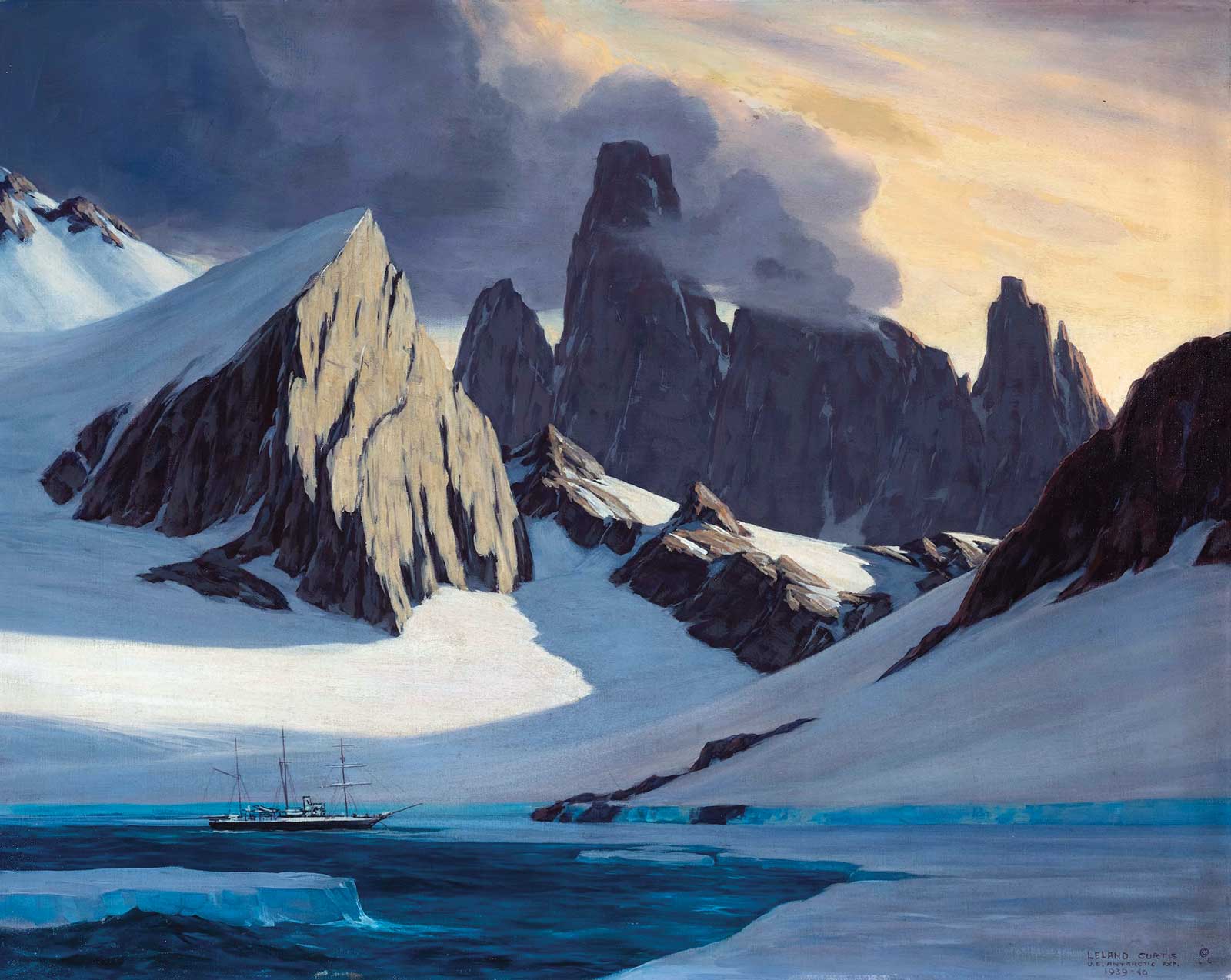
Leland Curtis (1897-1989), Neny Fjord Palmersland USS Bear, ca.1930, oil on canvas, 31 x 37¾ in. Brigham Young University Museum of Art, 1977.
On High in the Morning, the museum notes: “In the summer of 1933, Dixon spent two months painting his way across southwestern Utah alongside his wife, the eminent photographer, Dorothea Lange. Of all the works resulting from that trip, High in the Morning is arguably the most dramatic. This painting is carefully framed to showcase two of Zion National Park’s most majestic rock formations, with the serpentine ridge of Angel’s Landing rising to eclipse The Great White Throne. Morning shadows still drape across sheer red cliffs, lending an unexpectedly cool palette to the work.”
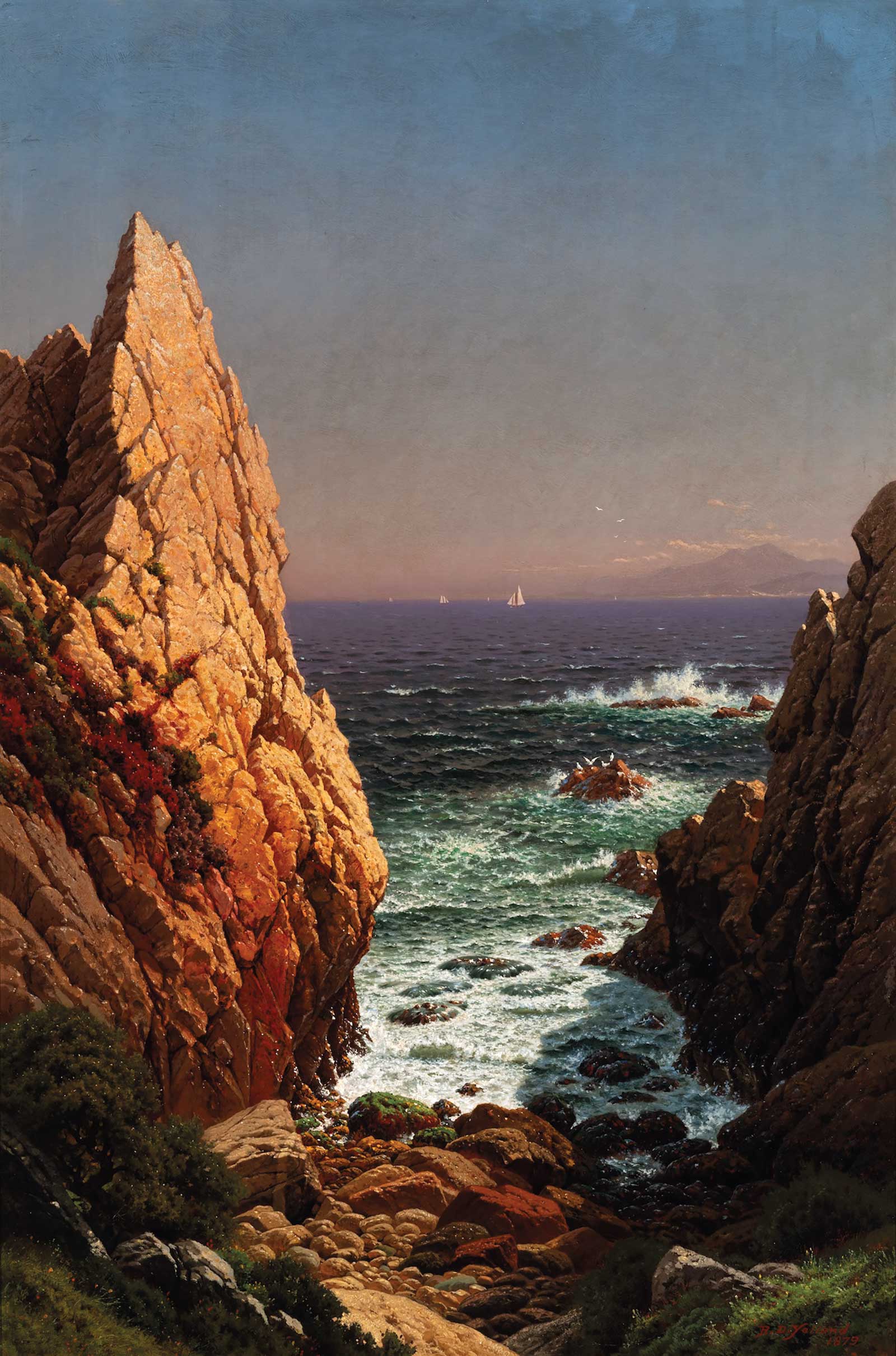
Raymond Dabb Yelland (1848-1900), View of Monterey Bay, 1879, oil on canvas, 5315/16 x 36 in. Brigham Young University Museum of Art, gift of S.L. Wright, 1973.
Another Western highlight is the painting Woman with Pots, circa 1930, by Xavier Tizoc Martinez. “Sitting on a rug, a woman concentrates on painting a pot, her stone palette next to her and an array of pots lined up against the wall,” a label at the museum reads. “Martinez depicted this woman as a creator first and foremost, focused on using the artistic techniques of her culture. Martinez himself embraced his Indigenous heritage in his life and art, despite receiving racist treatment while practicing in the United States.”
It’s also noted that Martinez traveled to Mexico and the American Southwest in 1905, alongside Dixon, giving rise to the thought that Woman with Potswas inspired by this journey, and served as an homage to Indigenous creation.
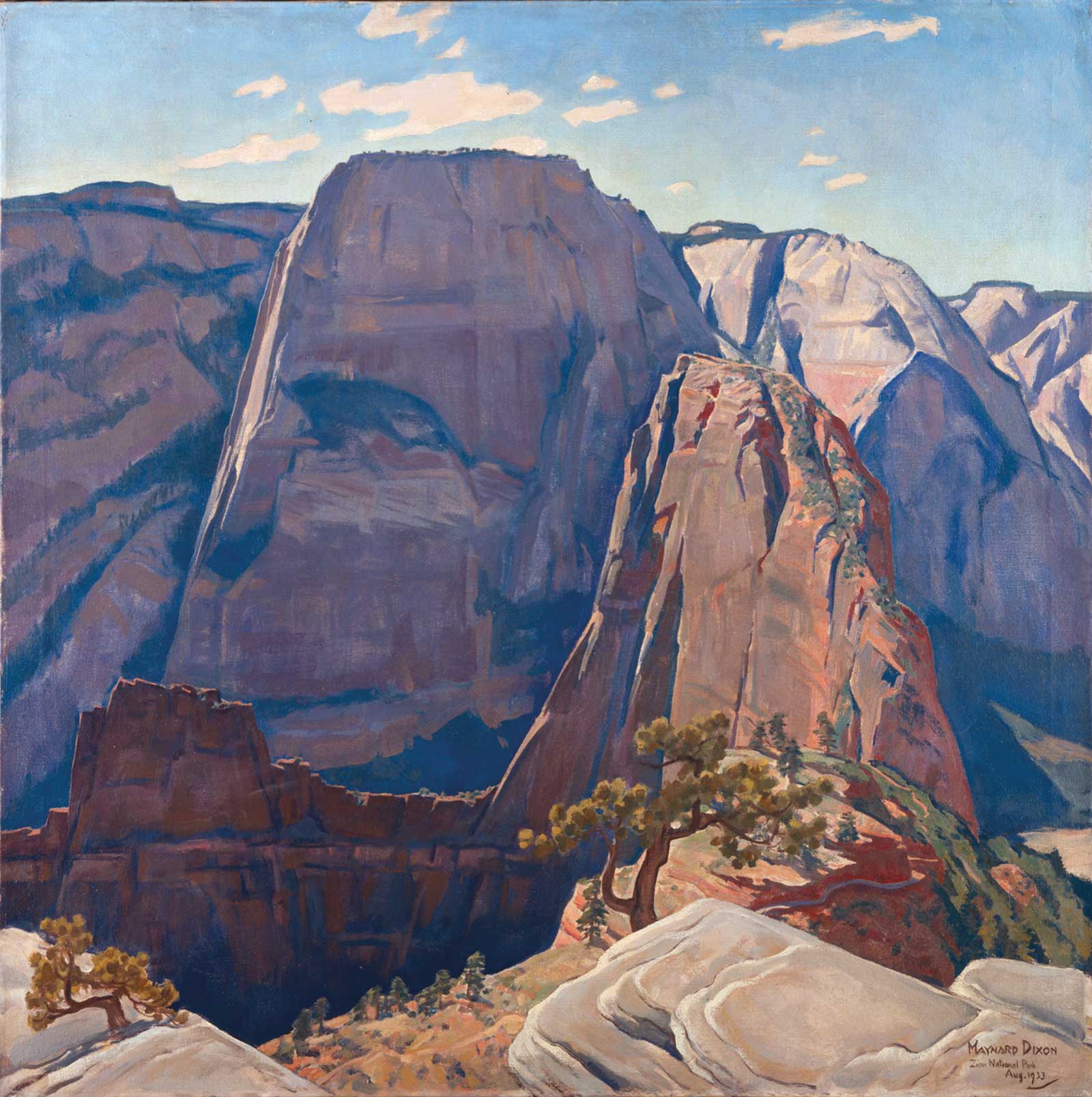
Maynard Dixon (1875-1946), High in the Morning, 1933, oil on canvas, 40¼ x 40¼ in. Brigham Young University Museum of Art, 1937.
Overall, King’s hope for the exhibition is that it “sufficiently highlights the breadth of voices and themes that are contained in the museum’s collection,” he says. “As we move forward, it is a priority for us to extend the range of conversations facilitated in the museum. This exhibition proposes that difficult and even contradictory views can be generative, painting a fuller picture of the United States and its histories.
The exhibition is currently on view, running through 2029. The 34 works on paper will cycle through five rotations throughout the five-year run of the show. —
Crossing the Divide: American Art from the Permanent Collection
Through September 2029
BYU Museum of Art
North Campus Drive, Provo, UT 84602
(801) 422-8287, moa.byu.edu
Powered by Froala Editor


