With design, color and the California desert in mind, Eric Merrell features a stellar display of paintings for his show The Land Remains, hosted at Maxwell Alexander Gallery in Pasadena, California. Merrell admits to not highlighting any specific theme but rather, attempts to show how amazing and unique the desert is. “[It is] something worth protecting,” he says, adding that it’s also about a “sense of play.”
Merrell also paints the California desert most often since it’s the closest to him “and has so many unique and quiet places,” he adds. “Over the past few years, I’ve been digging into themes of water, transportation and extraction in the West, but these new pieces for the show avoid the ever-present human element in the landscape as a way to refocus on the land itself. Since we now know these aren’t empty wastelands but complex ecosystems, how does that change what we make of them?”
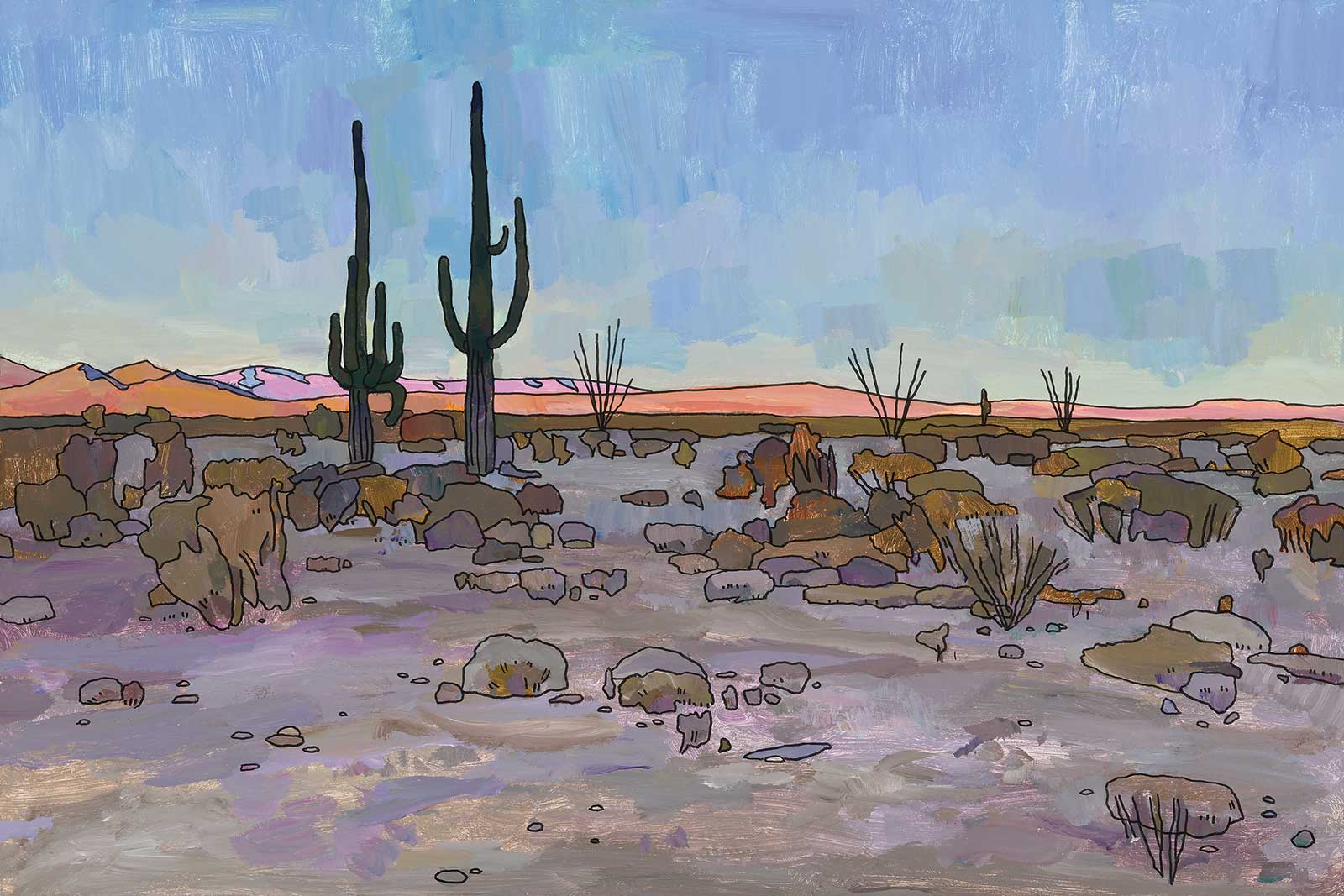
East of Why, acrylic and archival ink, 16 x 24 in.
In nearly 10 paintings, Merrell depicts some favorite California locales, mixed in with Arizona landscapes as well. In East of Why, we find a classic scene depicting the Arizona desert, executed in the artist’s distinct style. “I saw this [view] on my return from a solo trip to Tucson in 2018,” says Merrell. “My check engine light came on after I left Tucson, [and] it ended up not being a bad place to stop for a little bit and reflect. I find landscapes interesting as self-portraits—the depiction of a place becomes inseparable from the person observing and immersed in the place…”
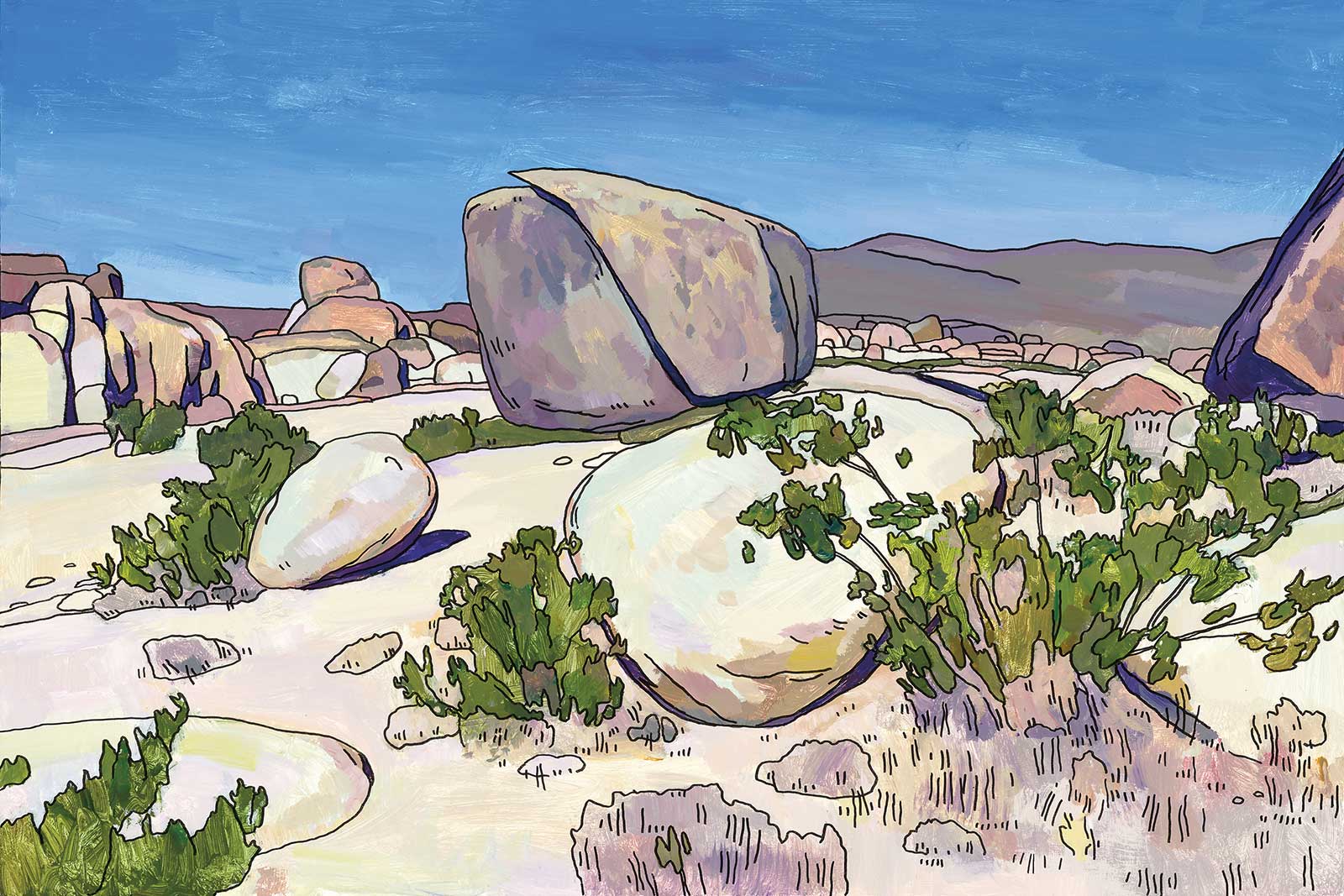
Split Rock, acrylic and archival ink, 16 x 24 in.
Merrell says that the most notable part for viewers will be the inclusion of linework, “which might be akin to overlaying my sketchbook drawings onto some of my oil paintings,” he says. “Perhaps it highlights a little more of what I’m thinking about while working—delineating edges with line, rather than solely by color shifts [found] in my oil paintings.”
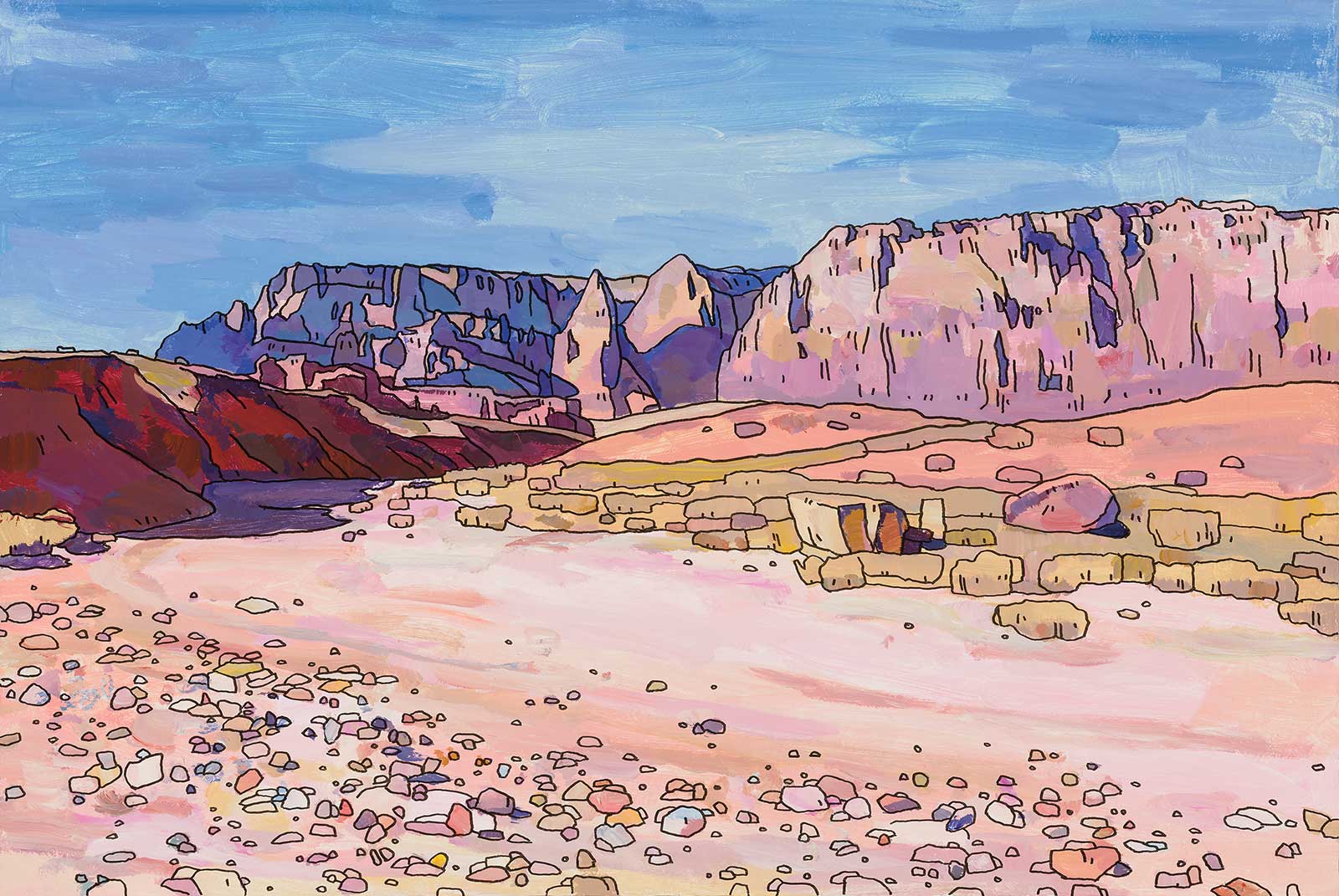
Cathedral Rock, acrylic and archival ink, 16 x 24 in.
He also adds that while he normally works in oil and watercolor, he switched mediums to acrylic for this particular show to accommodate drawing with archival ink. “For viewers who know my oil painting, these will have some elements of familiarity, but they’re also circling back to my school days. I was experimenting with all sorts of mediums: printmaking, zines, etc., and I started doing some two-dimensional and three-dimensional work based on simple shapes of color while incorporating line. The acrylic is handled a lot like I would oil—scumbling, loose brushstrokes—but this time with more sophisticated color…”
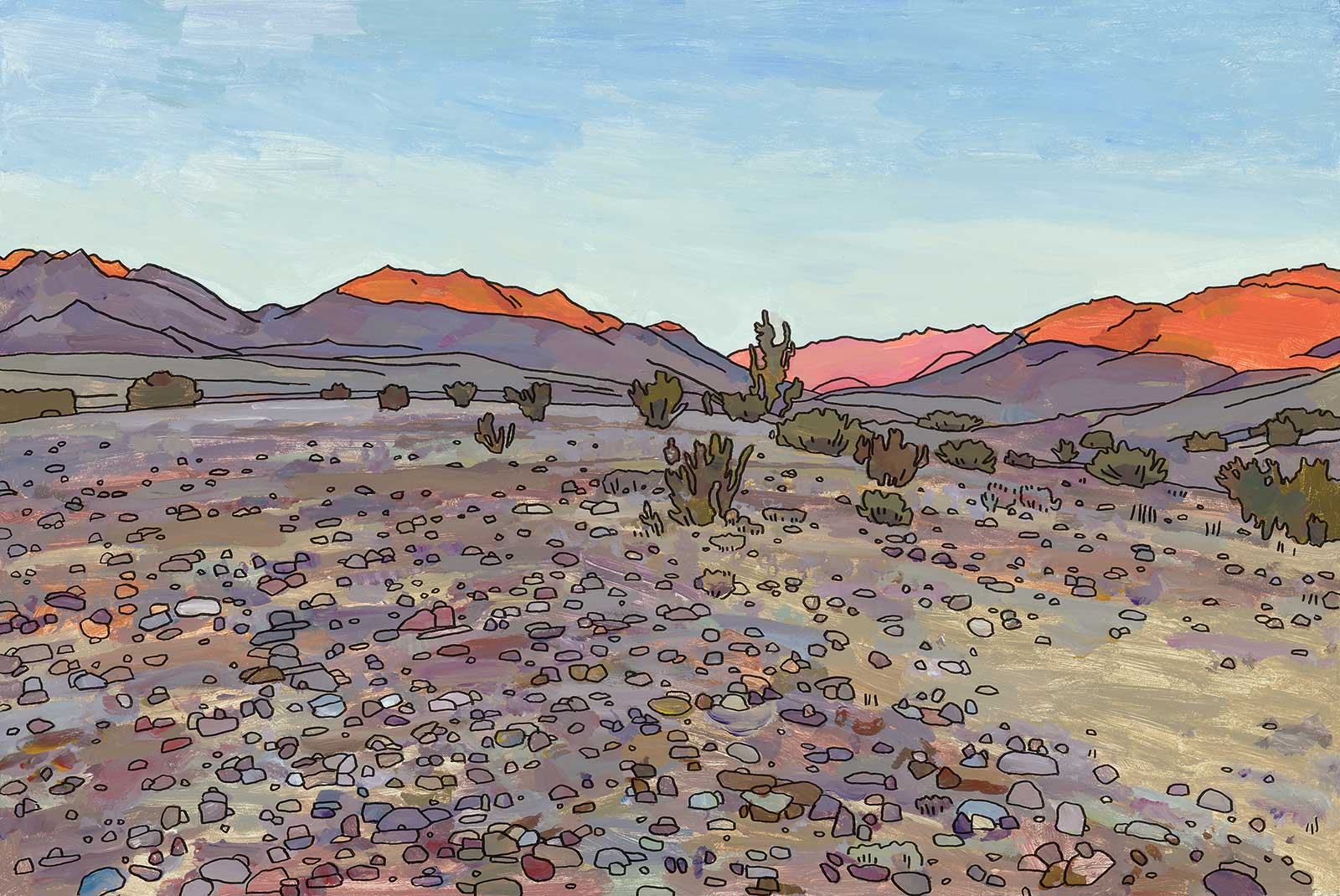
Corn Springs, acrylic and archival ink, 16 x 24 in.
Merrell feels that each painting is a chance for him to grow artistically, which is why he chooses different mediums and new ways of experimenting. “It’s how I ended up painting the desert in the first place—as a challenge to learn better color without leaning on value a lot,” he says. “Can I create depth and space without strong light and dark contrasts? There’s sure a lot of that kind of depth in the desert.” This can be found in other show pieces like Split Rock in Joshua Tree National Park near a trailhead and day-use area. “I love the enormity and mass and split of the boulder,” says Merrell. “They’re so evocative of those parts of the Mojave Desert.”
View these desert beauties and so much more at Maxwell Alexander Gallery from June 8 through 22. —
Maxwell Alexander Gallery 1300 N. Lake Avenue, Pasadena, CA, (213) 275-1060, www.maxwellalexandergallery.com
Powered by Froala Editor


