In the broadest sense, art of the American West is diverse, going well beyond the traditions of painting and sculpture. It embraces expressions found in Indigenous pottery, jewelry and weavings. It welcomes the creative products of photographers, furniture makers and clothiers. Today’s saddle makers, braiders and bit and spur makers, especially through the Traditional Cowboy Arts Association (TCAA), have brought their work to a new high in artistic but functional creations. Speaking with members of this group in recent years, it was easy to detect a deep appreciation for the accomplishments of a significant predecessor: Edward H. Bohlin (1895-1980).
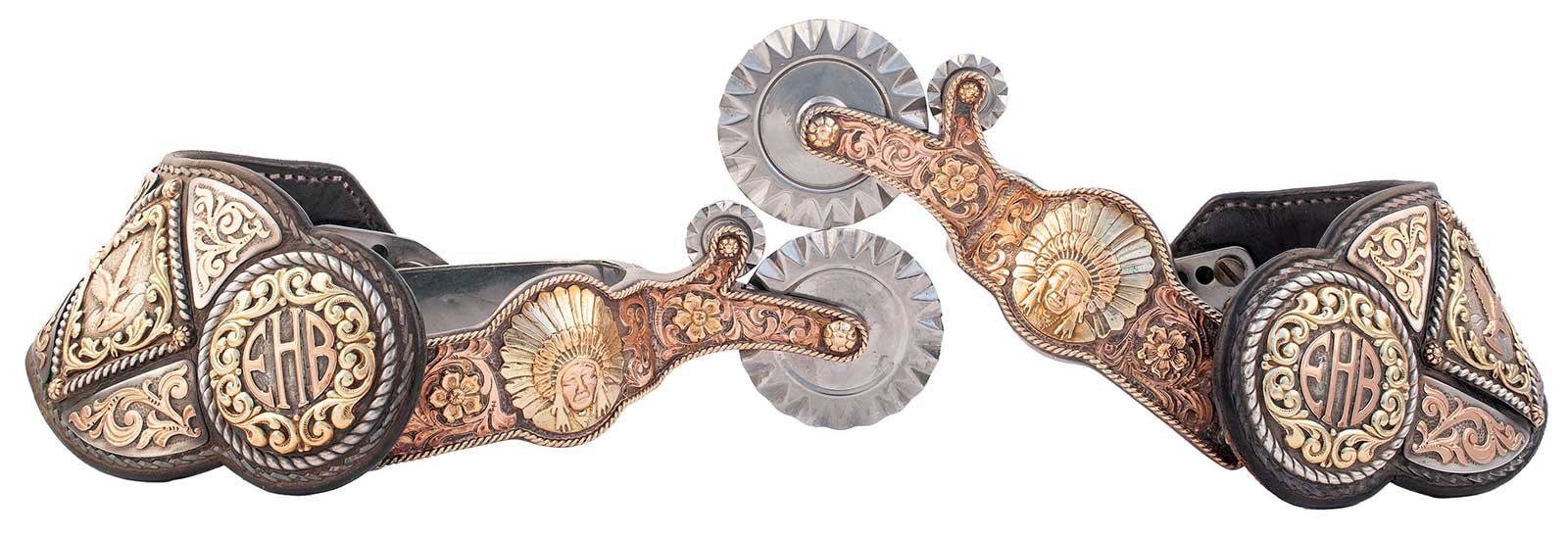 Edward H. Bohlin’s personal spurs, ca. 1940. Courtesy Brian Lebel’s Old West Events and Morphy Auctions.
Inspired by Buffalo Bill Cody’s Wild West Show, teenaged immigrant Ed Bohlin followed his imagination from Sweden to the United States and by 1912 was punching cattle in Montana. A few years later he landed in Cody, Wyoming, where he drove a stagecoach, did ranch work and started a family. He began to teach himself to make leather and silver goods, opening a leather shop in Cody, where he produced roughly hammered silver buckles and tooled leather cowboy gear. A combative temperament landed him in trouble. With the death of his wife from influenza and failure of a second marriage, he left the area, performing rope tricks with a traveling Wild West show headed to the West Coast.
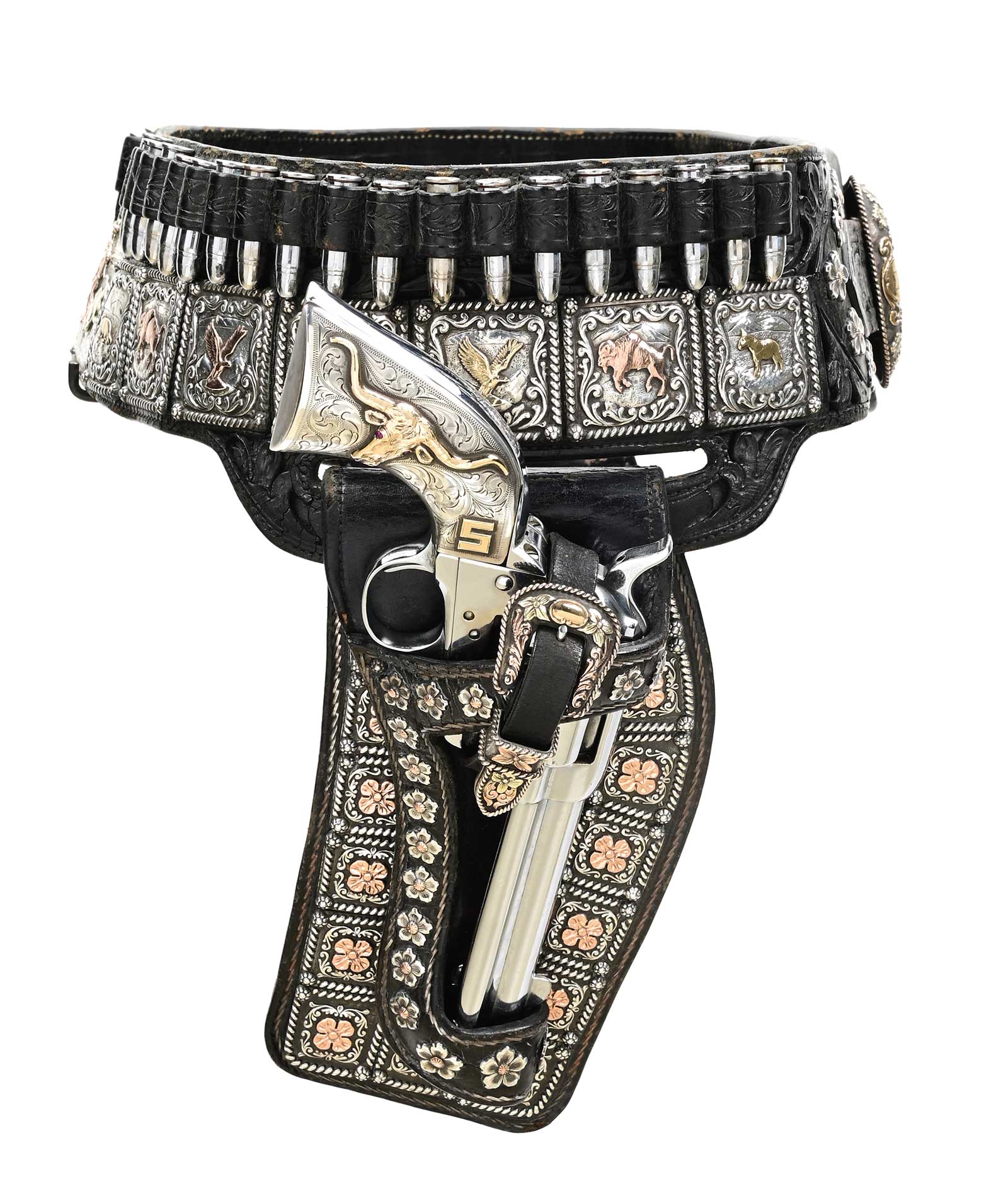
Edward H. Bohlin (1895-1980), Ray “Crash” Corrigan (1902-1976) double gunbelt and Colt revolver made by Bohlin. Available at Brian Lebel’s Santa Fe Old West Show & Auction. Estimate: $20/30,000
Legend has it that during the show’s appearance at the Pantages Theater in Los Angeles, Bohlin was approached by silent film cowboy Tom Mix, who wanted to purchase the calf-skin jacket right off Bohlin’s back. Others soon recognized the flare in the Swede’s manner and the things he made. In short order he found success creating tooled-leather and silver-mounted gear for stars like Mix, William S. Hart, Buck Jones, Colonel Tim McCoy and many others. In 1922 he opened the Hollywood Novelty Leather Shop and scratched out a living, picking up contracts to make leather outfits and harness for decidedly un-Western films such as The Ten Commandments (1923) and Ben-Hur (1926). In 1926, Bohlin formally organized in Hollywood as Edward H. Bohlin, Inc. The shop periodically moved over the next 14 years and the founder skillfully promoted his wares through lavishly illustrated catalogs and developed some of the most enduring designs for Western-styled buckles, saddles and accessories. His Hollywood associations expanded so that buckles, spurs, saddles, gun belts, jewelry and other items were purchased by Jackie Cooper, Clark Gable, John Wayne, Barbara Stanwyck, Clara Bow (the “It Girl”), Gary Cooper and dozens more. With the proliferation of low-budget Western films and the coming of television, a flock of other performers took on the accessories of the Bohlin shop. Hopalong Cassidy (William Boyd), the Lone Ranger (Clayton Moore), Roy Rogers, the Cisco Kid (Duncan Renaldo), Pancho (Leo Carrillo) and more adopted Bohlin gear for both performances and for personal wear. One of the most elegant saddles, with matching gunbelt, guns, holsters and spurs, was shown off by proud owner Ray “Crash” Corrigan in a series of films co-starring John Wayne and others.
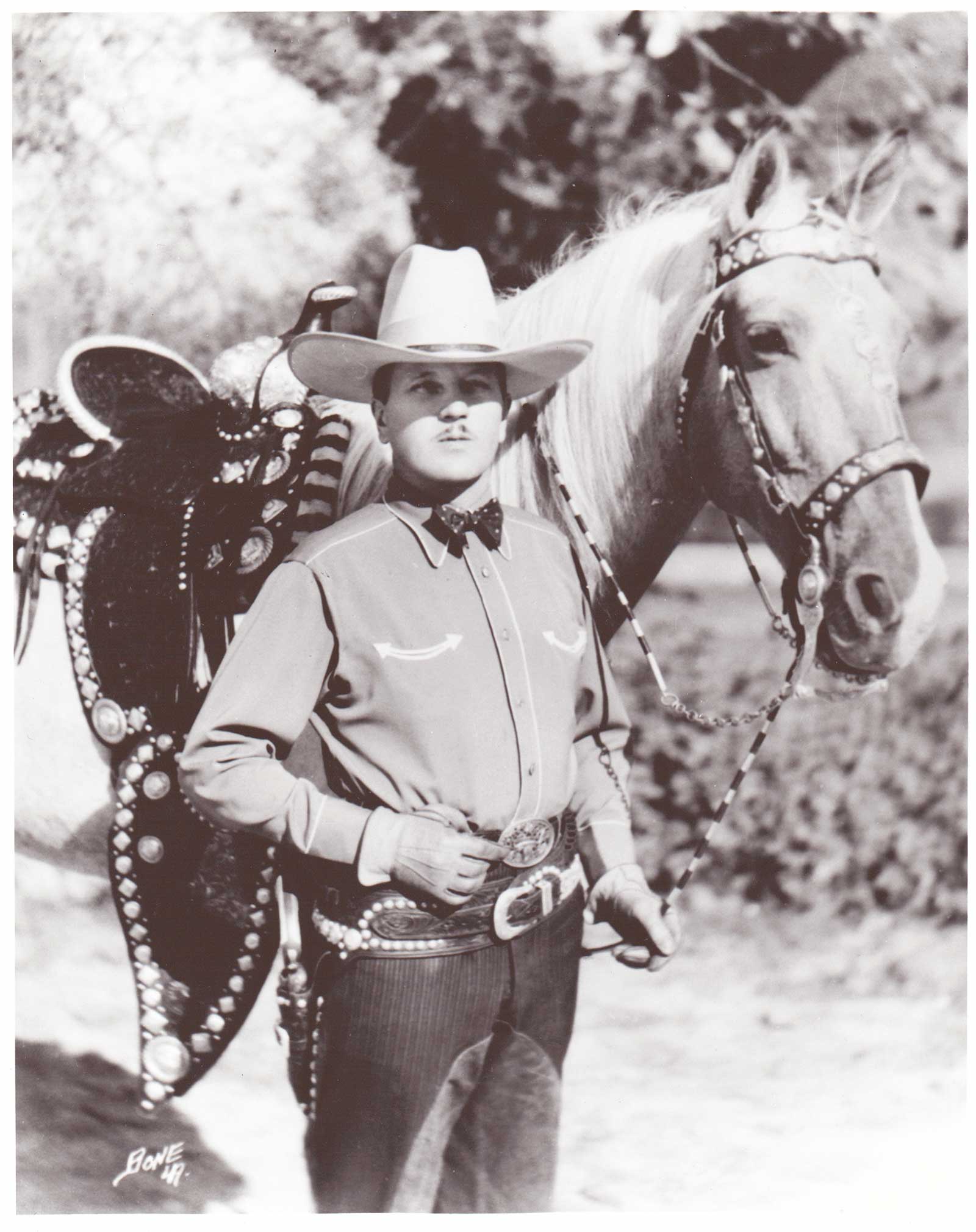
Edward H. Bohlin, horse and gear, circa 1930s. Courtesy James H. Nottage.
Throughout this era, Bohlin’s personal skills as a silversmith advanced and his designs dominated the world of Western buckles, spurs and other fittings. He also expanded to employ other artists, especially accomplished silversmiths, many of them otherwise unknown today. Traditional bit and spur makers, including Mike Morales and Carolos Figueroa, worked with him in the 1920s. During the Great Depression, John Pritchard began creating a famous saddle for banker Isaias William “Marco” Hellman featuring many silver plates with hand-chased images of California missions. When Pritchard died, silversmith and diemaker Phillip Fredholm completed the work. Among the most talented silver artists employed at one time in the firm was Clemens Friedell, an Austrian educated artist and accomplished smith at Gorham Manufacturing Company in Rhode Island. In addition, Dan Smed, son of a famed Chicago silversmith, Peer Smed, studied at the Art Students League in New York City and moved from there to join Bohlin for a period beginning in 1939. Their flowing art nouveau-styled silver elements distinguished the most accomplished products from the shop.
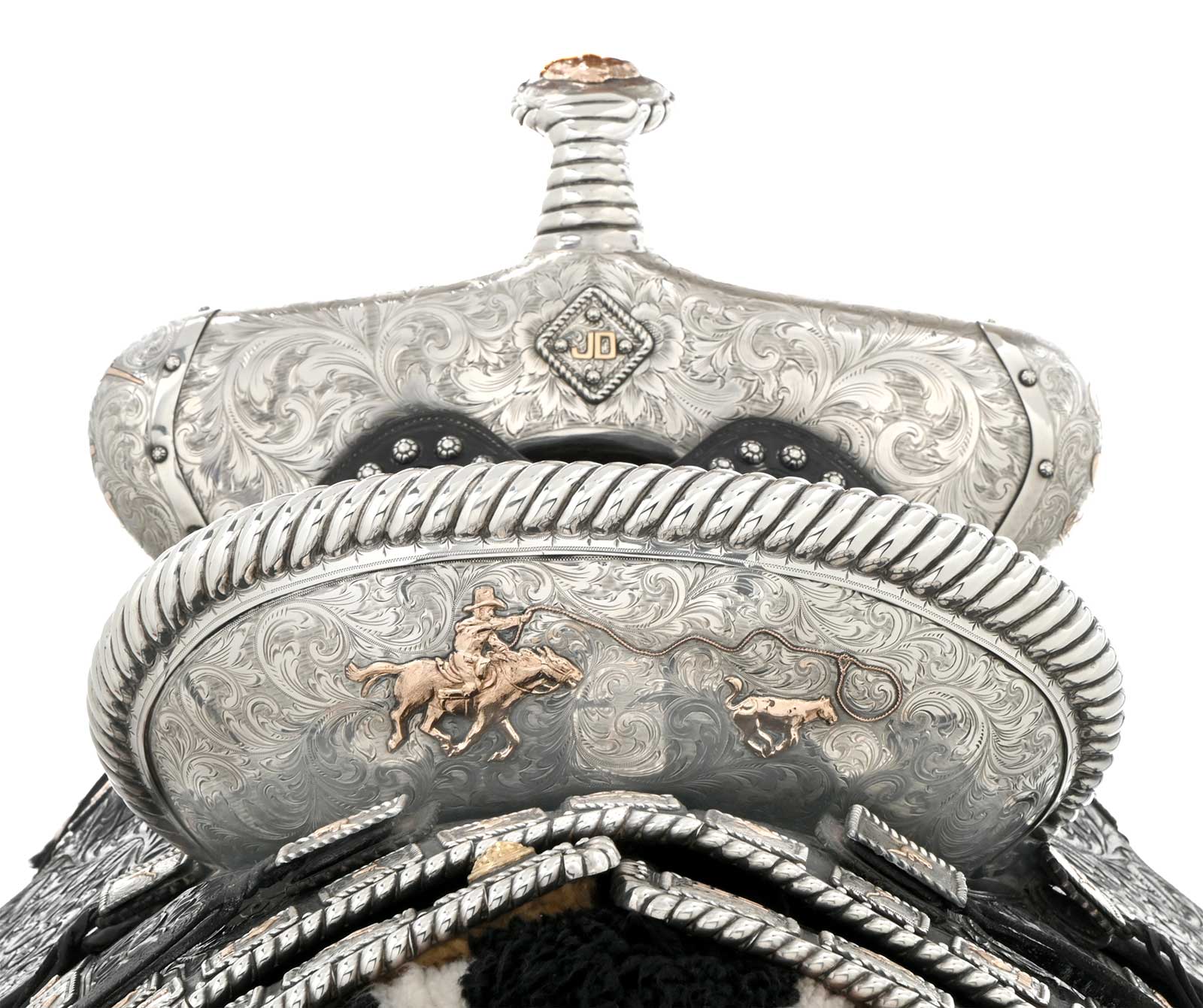
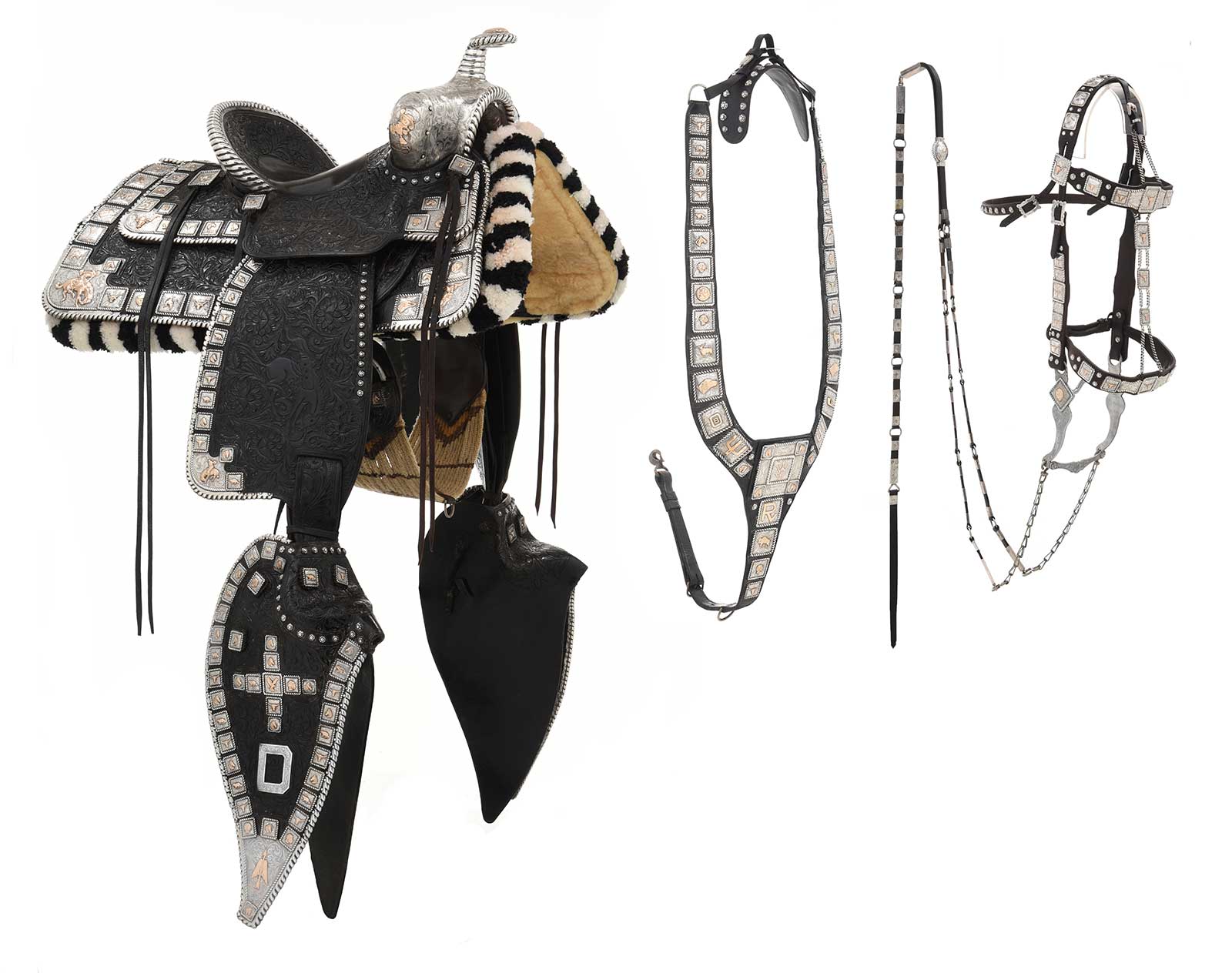
Edward H. Bohlin (1895-1980), Justin Dart’s Famous Edward H. Bohlin “Mickey Mouse” Saddle and Gear. Available at Brian Lebel’s Santa Fe Old West Show & Auction. Estimate: $125/150,000
Bohlin’s store was a gathering place for real cowboys and rodeo stars as well as the pretend variety. One popular rodeo cowboy was Don Nesbitt (1907-1988), a champion cowboy and livestock contractor who excelled in bull dogging as implied by his Bohlin tie bar. Cowboy detective Charlie Siringo and artists Charlie Russell and Frank Tenney Johnson were among the many authors and artists who associated with Bohlin and his products.
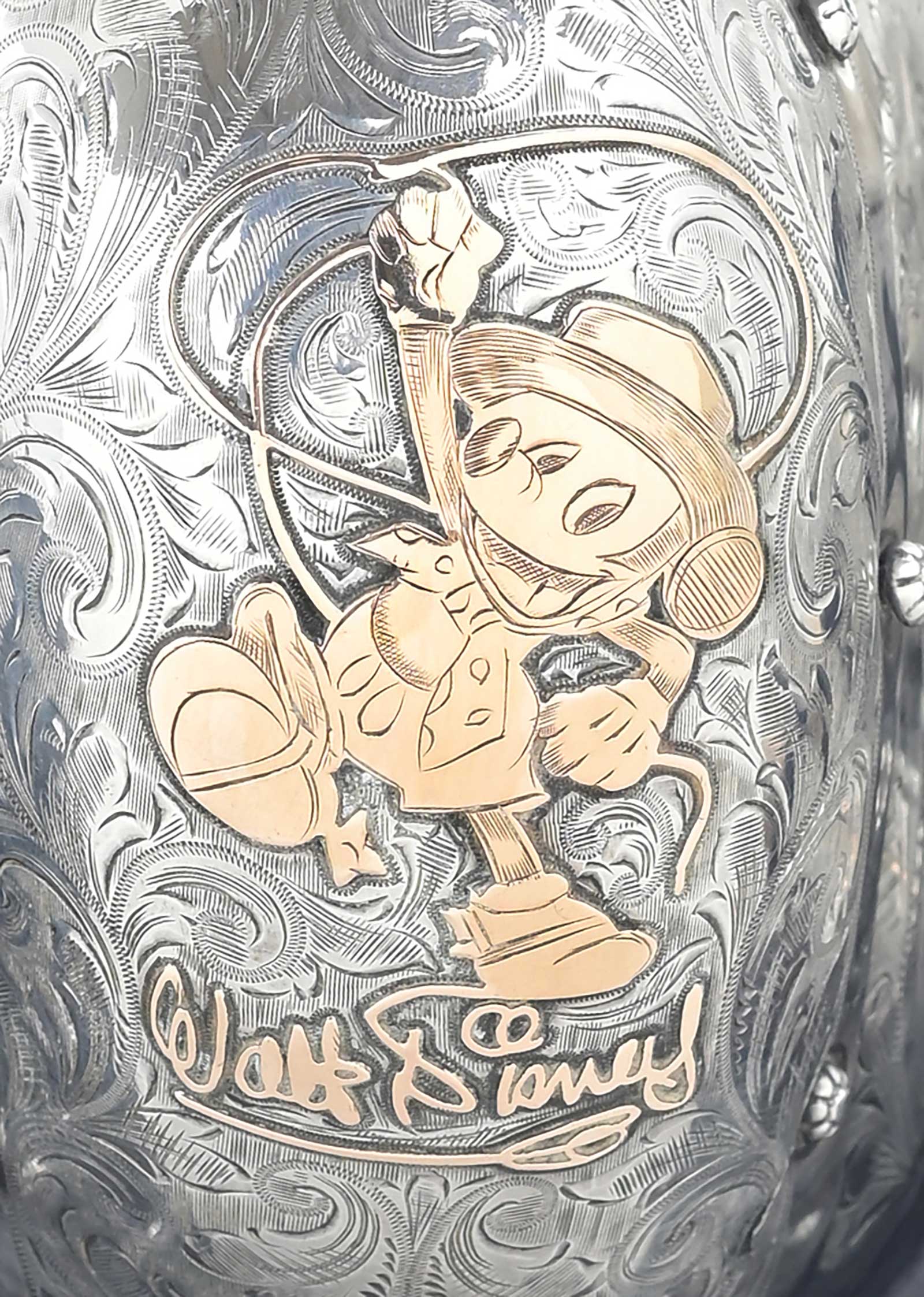 Ultimately, Bohlin created thousands of saddles and counted corporate leaders among his most important customers. Chewing gum magnate P. K. Wrigley and his family was chief among these, but Justin W. Dart also deserves special mention. With family connections and business acumen he led Walgreens and then Rexall Drugs, Tupperware, Duracell, Kraft Inc. and others. He helped guide the political fortunes of a young actor named Ronald Reagan, becoming a member of the president’s “kitchen cabinet.” As if to underscore his stature, Dart’s Bohlin saddle acknowledged connections with Walt Disney himself, featuring Disney’s signature and the figure of Mickey Mouse in gold on the swells.
Other societal leaders rode Bohlin saddles, especially in the annual Rose Parade, while associating with each other in exclusive equestrian groups. A major collector of Bohlin goods was Jack Kreindler, founder of the 21 Club in New York where he exhibited his collection of Frederic Remington paintings. Other Western art collectors devoted to Bohlin included Sid Richardson, Amon Carter and Gene Autry. Royalty, including the Emperor of Japan, and South American oil magnates expressed their Western tastes with the best of silver-mounted Bohlin gear. One South American client even had a saddle mounted all in gold.
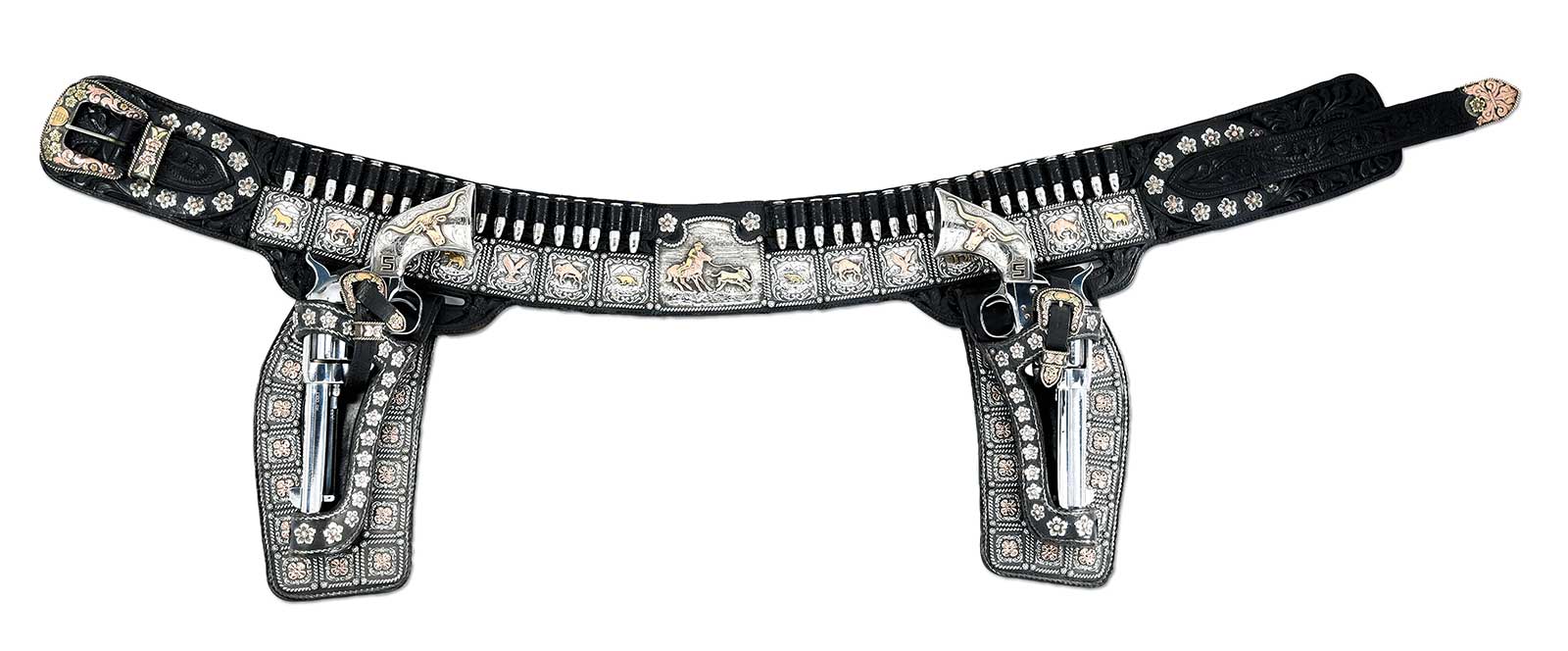
Edward H. Bohlin’s personal gunbelt, ca. 1940. Courtesy Brian Lebel’s Old West Events and Morphy Auctions.
Bohlin himself collected Western art by Ed Borein, Joe De Yong, Kathryn Leighton and Harry Jackson and drew inspiration from Charlie Russell in creating Indian buffalo hunt and wildlife scenes for gold and silver panels on special order products including his own personal saddle, holsters, spurs and other gear. As business declined for him in the 1960s, Bohlin took up sculpting. With Russell as inspiration, he created bronze sculptures of wildlife. At the request of humorist Will Rogers’ son, Jimmy, Bohlin repaired and then cast an edition of Russell’s plaster model for a sculpture of his horse Red Bird.
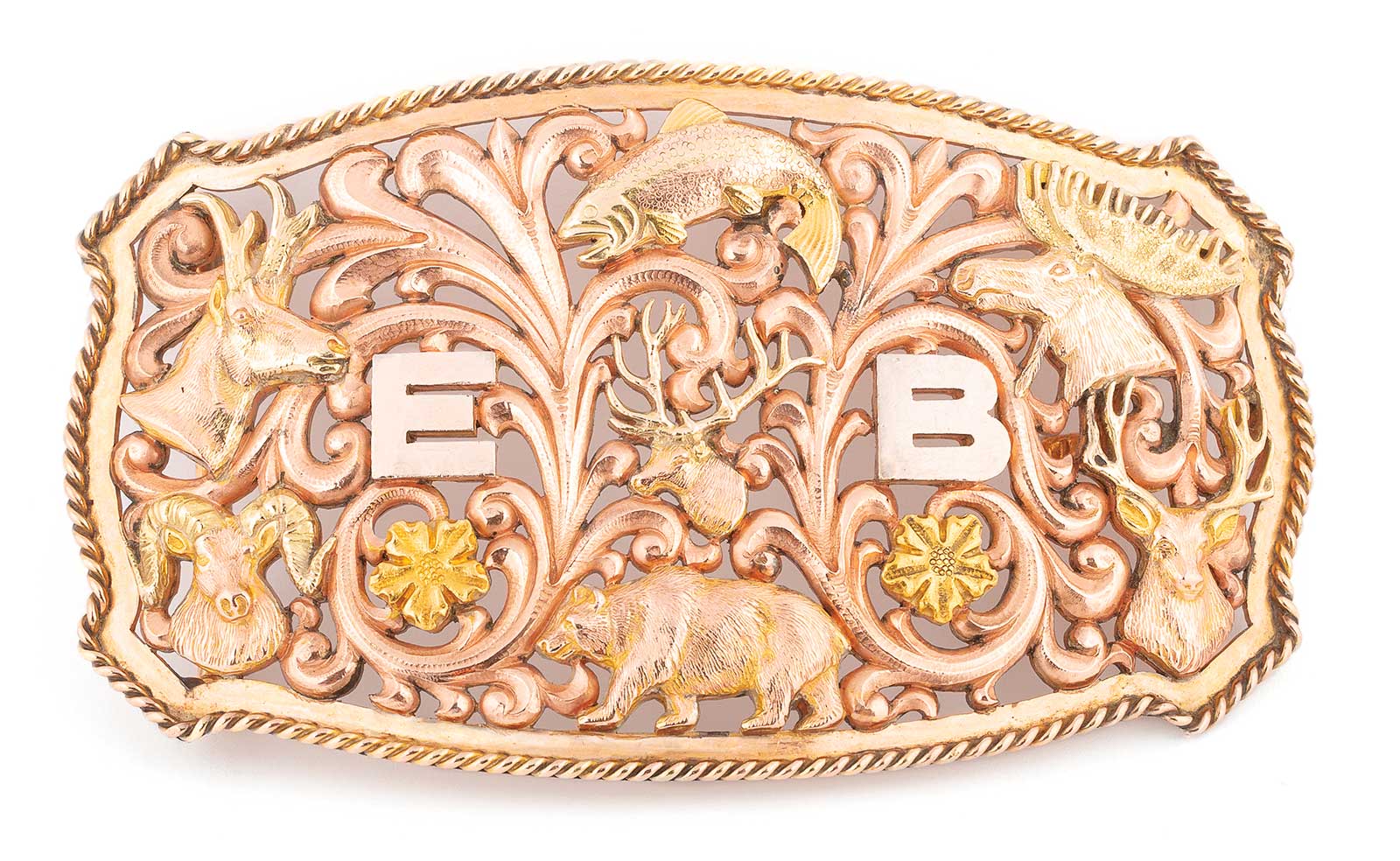
Edward H. Bohlin’s personal belt buckle, 1940s. Courtesy Brian Lebel’s Old West Events and Morphy Auctions.
“It’s the High-Class Merchandise That Really Counts.”
This motto guided the Edward H. Bohlin Co. for most of its history. Other factors, however, provide clues as to why Bohlin goods have an enduring appeal. What makes any art form or art creator of lasting note? It is said that good art captures the imagination and Bohlin’s work accomplishes this with its sheer beauty and ties to Hollywood heroes and romanticized cowboys, Indians and Western wildlife. An appreciation for his products is supported by its inclusion in museums such as the Autry Museum of the American West, Buffalo Bill Center of the West, the Sid Richardson Collection, the National Cowboy & Western Heritage Museum and others. Bohlin masterpieces including his personal saddle, spurs, gunbelt and other accessories have been exhibited at the Montreal World’s Fair, before the King of Sweden, and by the Metropolitan Museum of Art. The best works include masterful chasing and repousse work. If the auction market is any indication of excellence, Bohlin’s personal spurs and gunbelt fetched respectable world record-setting six-figure prices at sales in 2022 and 2024.
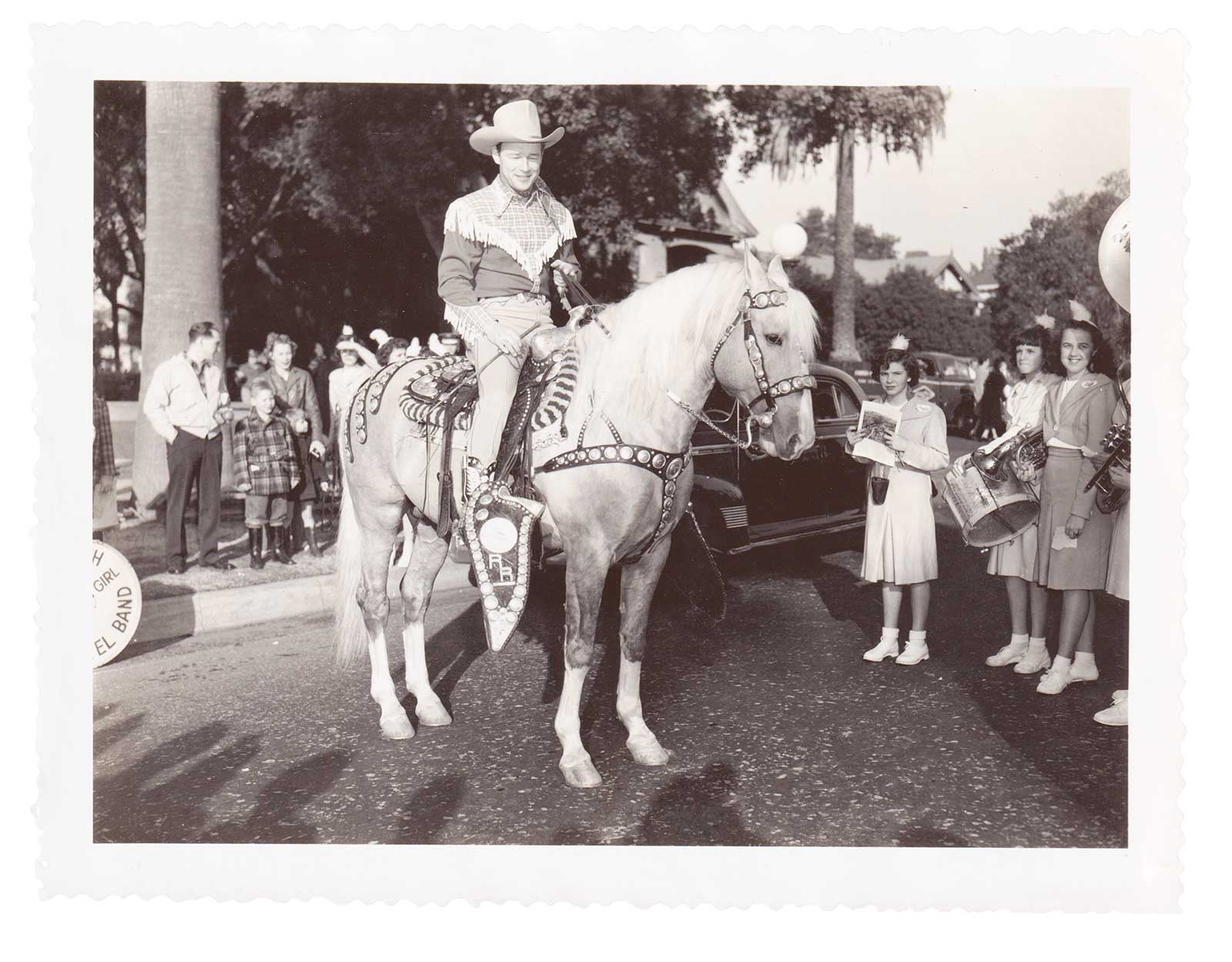
King of the Cowboys, Roy Rogers (1911-1998) on his palomino Trigger, decked out in Bohlin gear, 1950s. Courtesy James H. Nottage.
The impact of Bohlin can be further measured by the degree to which it inspires other artists today, and by the fact that Bohlin’s innovative designs, some of them now more than 100 years old, have created an iconic visual language that is inexplicably tied to the West and its arts. In his own time, Bohlin was an innovator and his products have an air of tradition. Fortunately, the Bohlin Company thrives today from headquarters in Dallas. They produce traditional pieces, as well as innovative new products. It has been written that a respectable cowboy is loyal and “rides for the brand.” So, too, the Bohlin Company is all about loyalty to the quality and nature of the original brand.
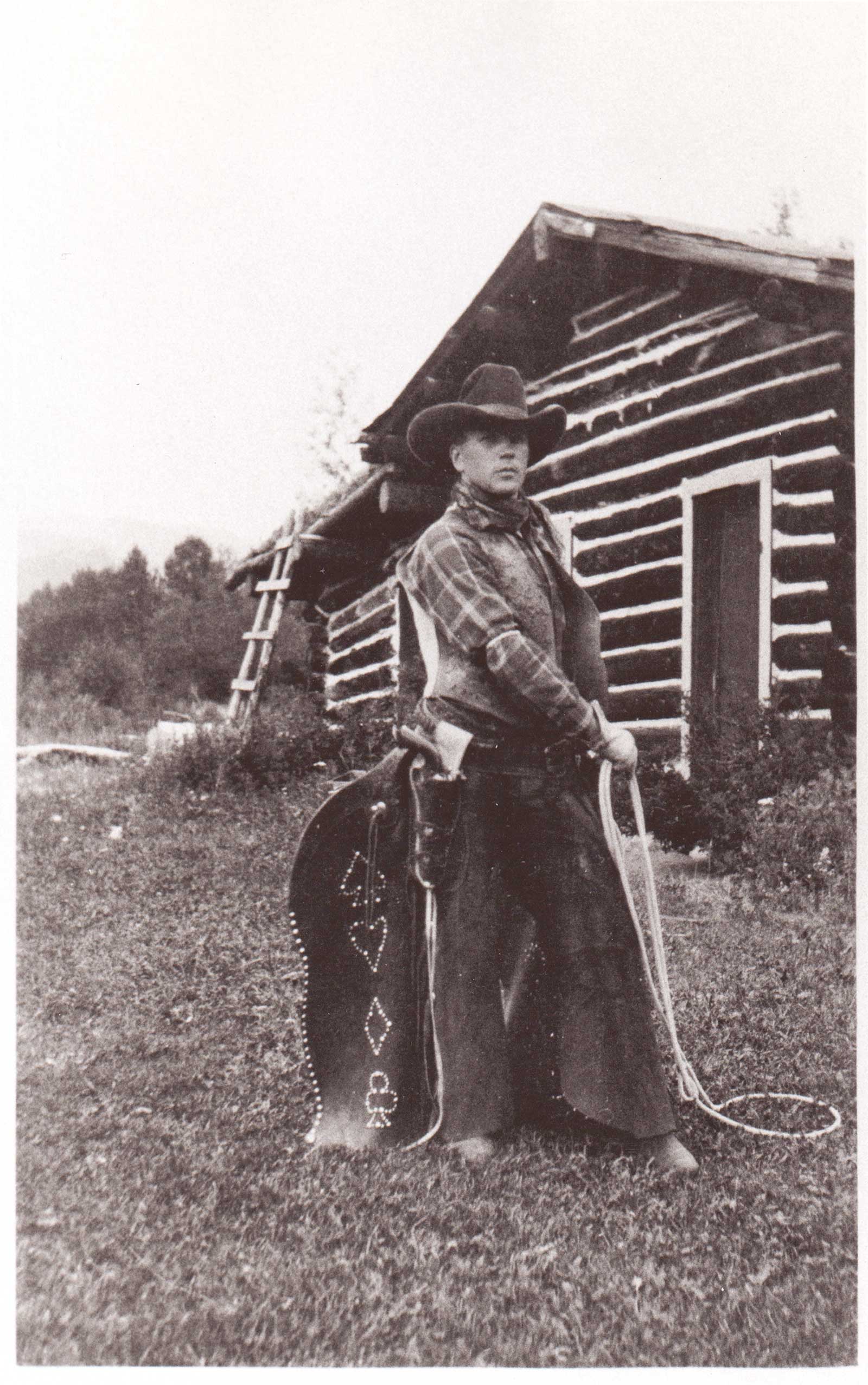
Edward H. Bohlin in Cody, Wyoming, circa 1920, as a working cowboy. Courtesy James H. Nottage.
+++
James H. Nottage is Chief Curator Emeritus of the Eiteljorg Museum of American Indians and Western Art in Indianapolis. He is the author or editor of many publications on Western art and history including Saddlemaker to the Stars: The Leather and Silver Art of Edward H. Bohlin (University of Washington Press, 1996). He holds degrees from the University of Wyoming and the State University of New York and in “retirement” continues to research and write on the history of the West and especially his home state of Wyoming.
Powered by Froala Editor


