Dialing in from Grass Valley, a Sierra foothill town where California’s hippies and cowboys collide, Alex Ziv curses his shoddy Zoom connection. Rural Wi-Fi is one tradeoff the artist made leaving the city for this, until recently, snow-burdened corner of the world. A tatted-up, bearded 30-something, Ziv sits in a lofty studio strewn with Navajo textiles, Western shirts, old toys, retro tattoo art and ephemera from across the ages.
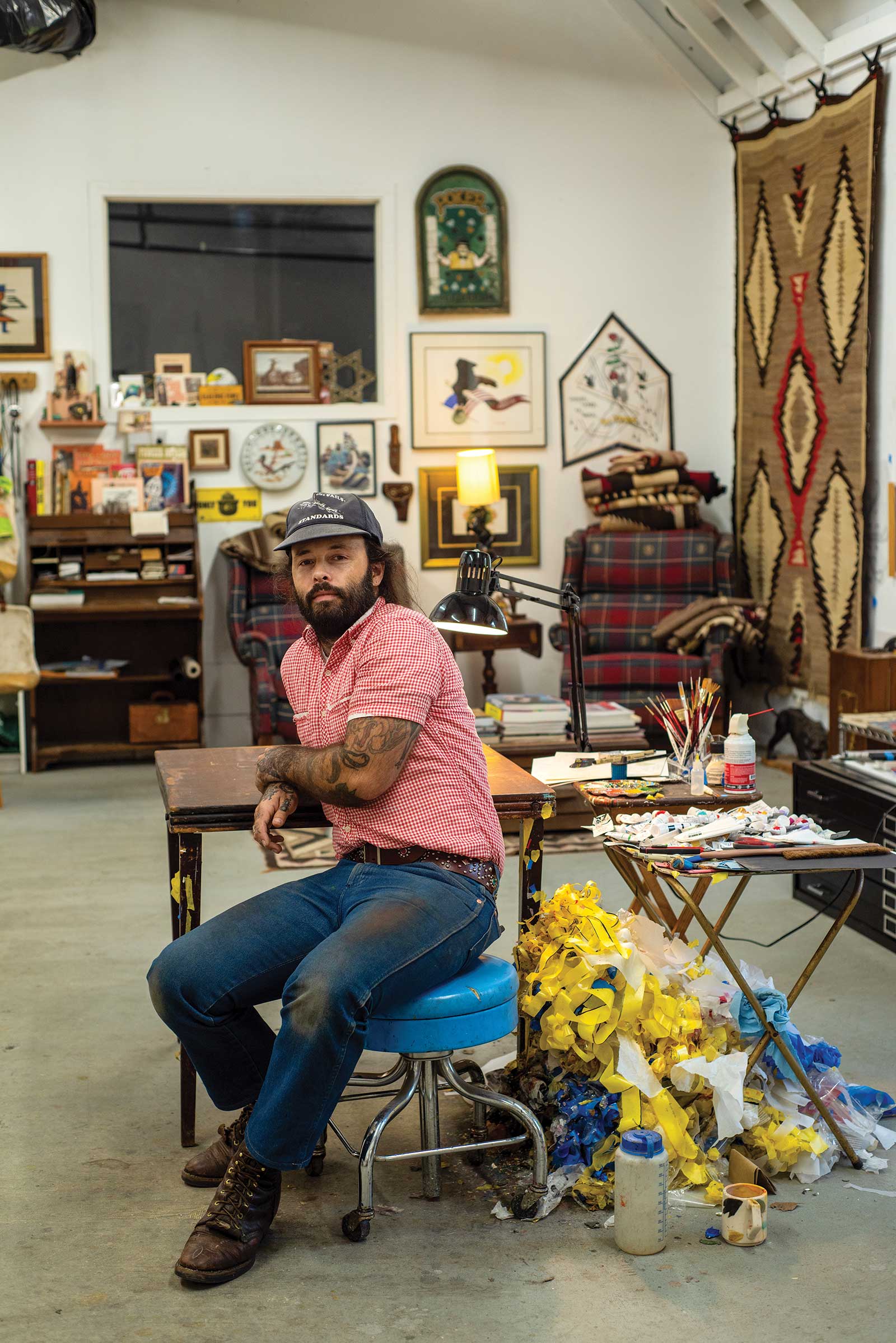
Alex Ziv in his California studio. Courtesy the artist.
As a collector of kitsch, he definitely has an aesthetic. These objects and ideas often make their way into his practice, although in altered forms. His art is a mashup of motifs lifted from his travels through the Southwest and his own take on life in the 21st century. An amalgam of corporate logos, pop culture references, ancient art forms and yesterday’s headlines, his paintings are beautiful, tense and as contradictory as America itself.
On the call, Ziv riffs like someone who doesn’t get to talk about art very often. He spits the well-read, rapid-fire philosophies of a voracious cultural observer, aware that he’s caught in the crosshairs of a trigger-happy society. He, and artists like him, are flanked by other people’s ideas of what should and should not be allowed, yet Ziv still seems to find his line.
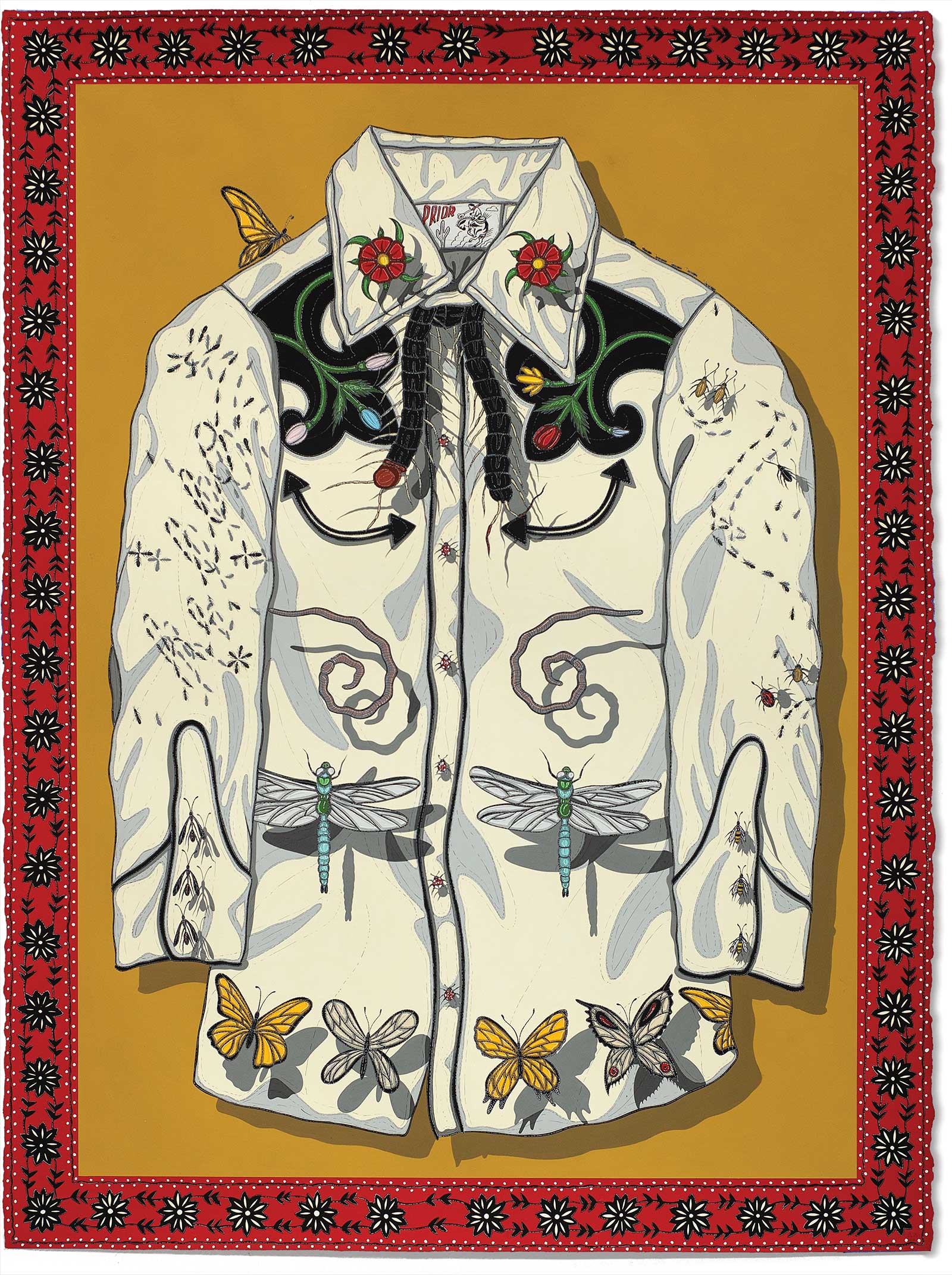
The Landscape No One Sees, gouache on paper, 30 x 22”
Using gouache, an old designer’s medium that gives his work an ultra-flat finish, Ziv turns out paintings that are crisp, graphic and damn-near perfect in execution. Miles of masking tape and tracing paper celebrate his manual drafting practice in an arena where silkscreen or a digital medium could also get the job done. Up close, his paintings do not appear to be overworked or labored—the only sign of struggle, an existential one.
Born and raised in San Francisco, Ziv stuck around his hometown for undergrad and graduate degrees from the San Francisco Art Institute. As some of the last students to walk the now-defunct university’s halls, Ziv joins SFAI classmates Mario Ayala and Henry Gunderson in a yet-to-be-defined art movement marked by complex paintings layered with symbolism and saturated color. Annie Leibovitz, Kehinde Wiley and a host of pathbreaking artists from the beat and Bay Area figurative movements also learned their craft at the historic school.
The Junkyard King on Rattlesnake Road, gouache on paper, 30 x 22”
In contrast to San Francisco’s more traditional art academies, SFAI helped students hone in on an “individualist idea” within their work, Ziv tells us. “Hey, you do what you wanna do and we’re just gonna teach you how to do it better,” he says of the school’s flexible curriculum and instructors like the late Fred Martin, who taught well into his 80s. Martin introduced him to the work of Albuquerque-born artist Robert Williams, founder of Juxtapoz Magazine and pioneer of lowbrow art. “He knew exactly what I wanted and who I needed to look at,” says Ziv.
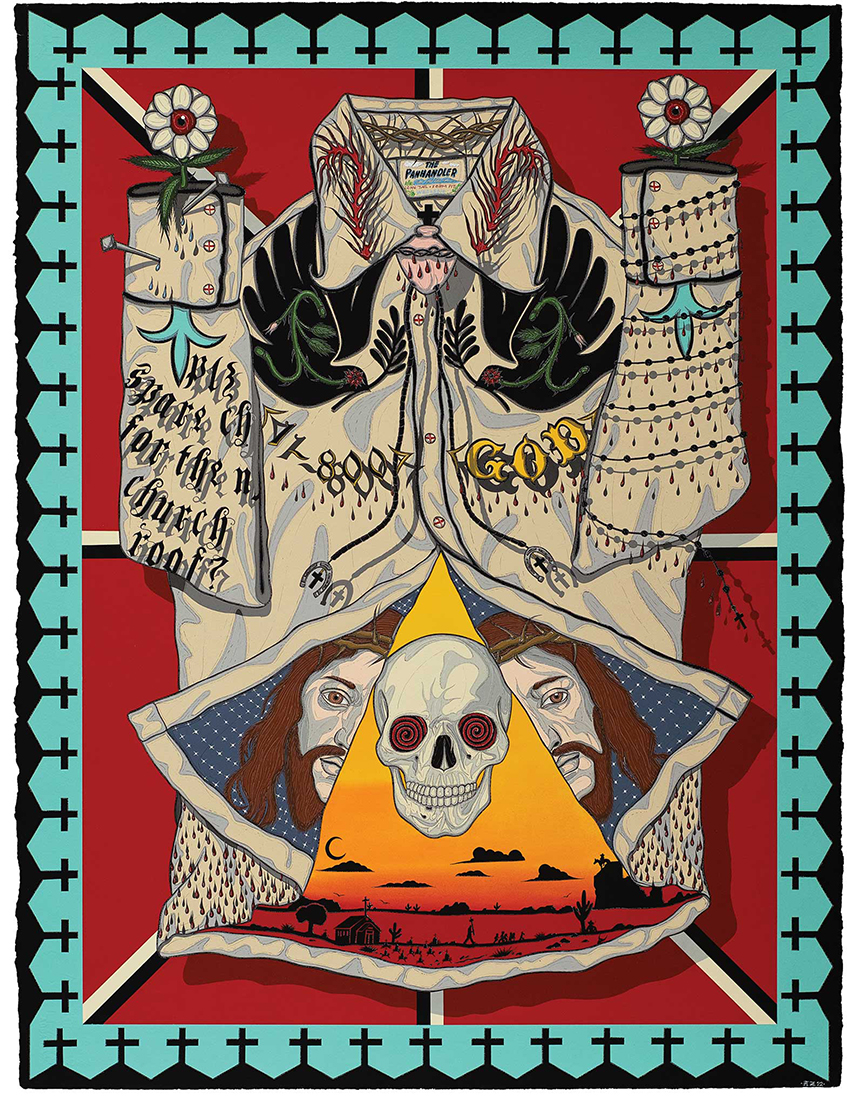
A Knock on the Door from Jesus, gouache on paper, 30 x 22”
Another instructor, printmaker Paul Mullowney, challenged Ziv’s ideas of what could be considered fine art. Mullowney had worked with Don Ed Hardy, another SFAI alum, and opened Ziv’s eyes to finding inspiration outside of the approved channels. “You can still make fine art work with a tattoo influence, which is something that was always kind of disregarded as a sub-fine art form,” says Ziv. “Different times now—I mean, Ed Hardy’s done a major museum retrospective. There are tattoo artists showing in some of the biggest art galleries in the world now.”
In his 2014 show Decoding the Urban Cowboy (League Gallery, Berkeley) and his 2017 show CutAway(s)(Hashimoto Contemporary, San Francisco), Ziv was already synthesizing his interest in apparel, motorcycles and Americana. At the time he was also working at the Museum of Craft and Design, which got him “turned on to other forms of making besides just painting and drawing,” says Ziv.
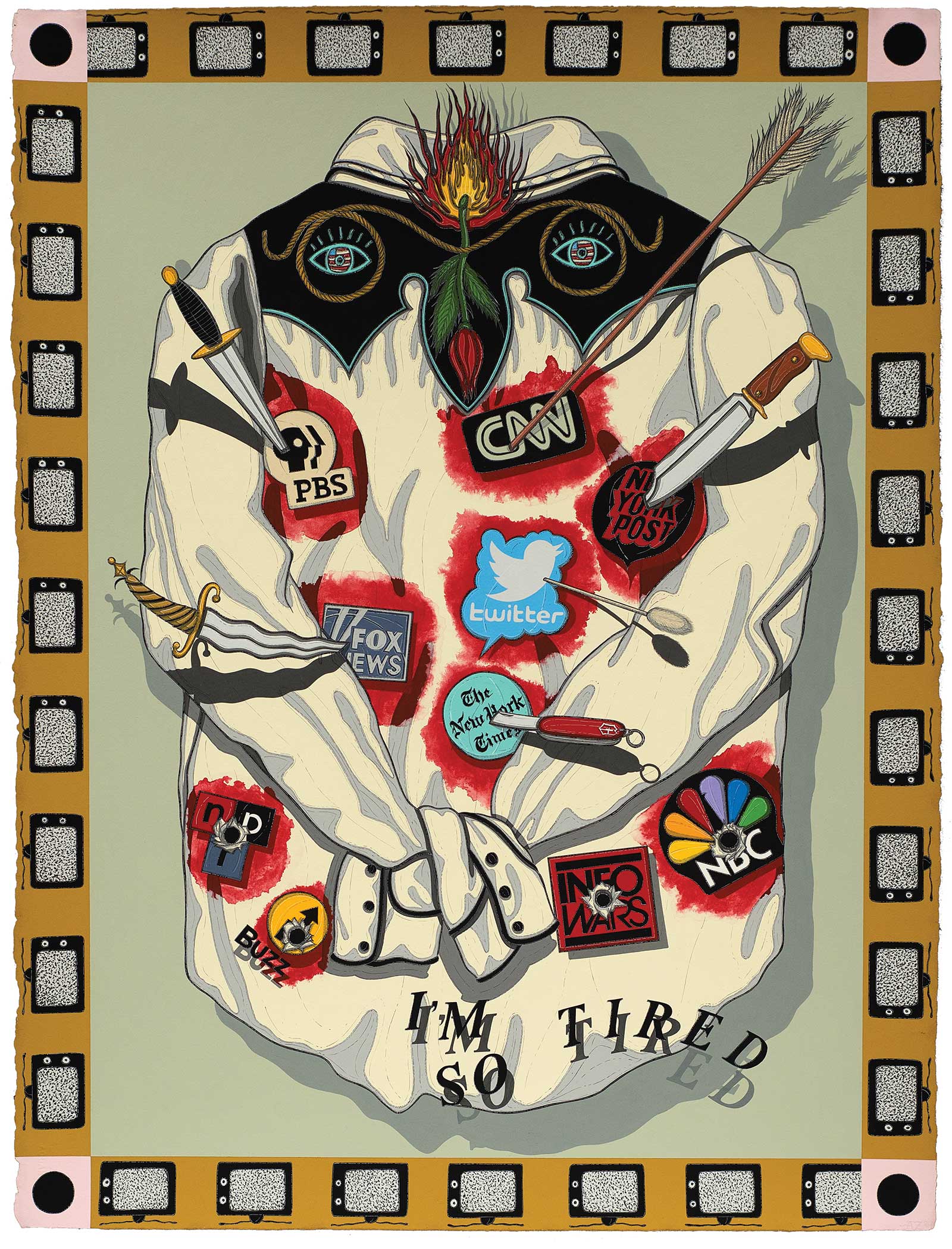
Till There’s No Feelings Left, gouache on paper, 30 x 22”
Following a year-long sabbatical road-tripping around the American West, Ziv returned to Hashimoto Contemporary with Wherever I May Roam, a two-man show that brought his fascination with traditional Southwest art forms front and center. “Once I got down into the Southwest it was highly intoxicating,” he remembers. “It was such an amazing place. I loved the landscape, I loved the culture there. It had this effortless respect for age that I thought was super romantic. It’s not a completely pleasant history there. It’s complex, but I was attracted to it because it was complex, you know? Nothing amazing is simple.”
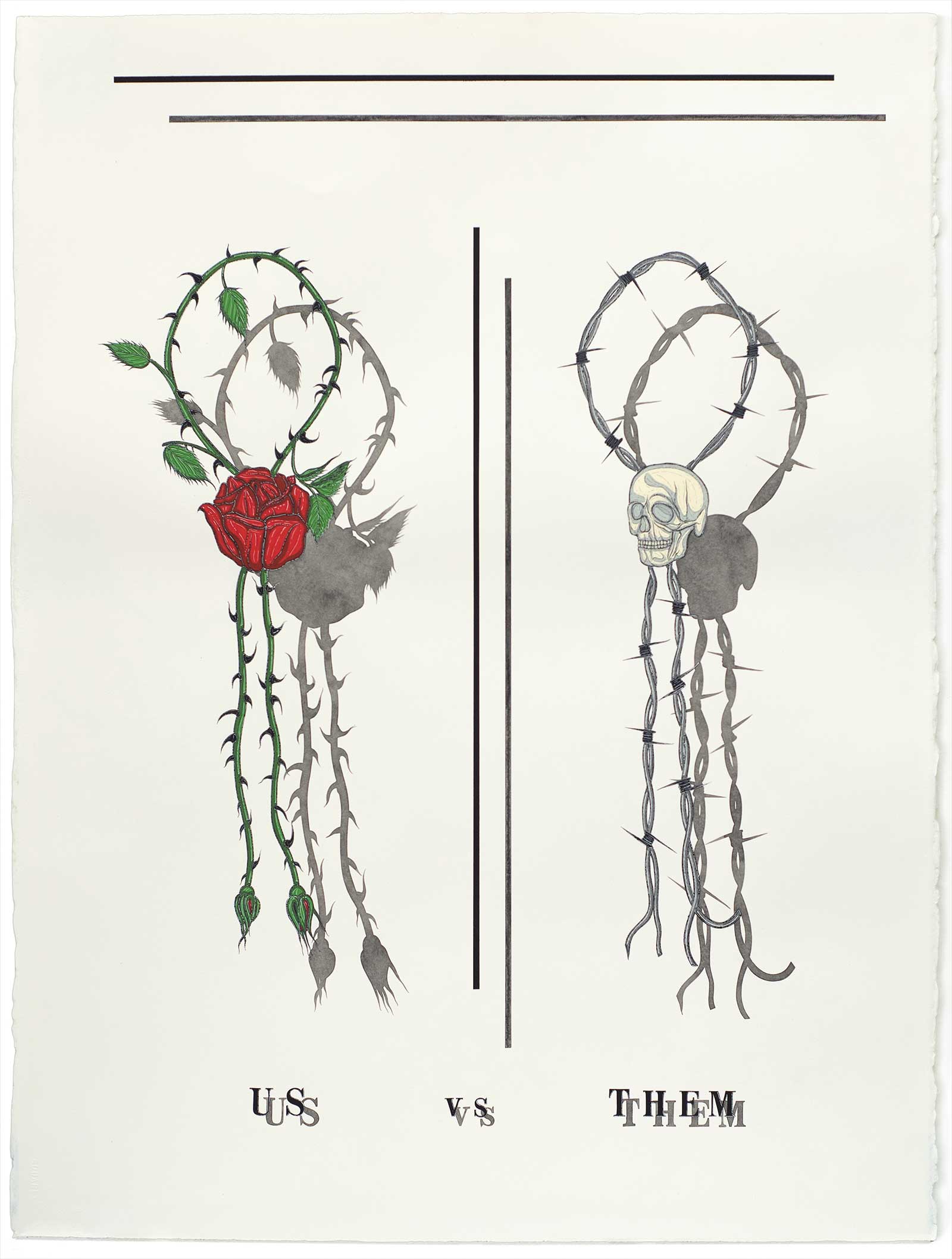
Us vs. Them, gouache on paper, 30 x 22"
His work, incorporating graphic elements like bolo ties, jewelry, arrowheads and pueblo pottery, has been met with mixed reviews. “What’s appreciation and what’s appropriation? There’s a huge spectrum of opinion and that’s OK. I think that’s up to each individual person. It deserves homage and I feel like it deserves to be made about, but how do you make about it in the right way?” he asks. “What would I do? What would I make? How would I be a part of that landscape?” He wonders where he’d fit in if he lived in the region himself. “Not just the physical landscape, but the artistic landscape. How do you inject yourself into that canon of artists, in that history?”
Ziv’s latest work shifts focus from icons of the Southwest to more directly personal themes of current events and cultural identity. Religion, media, politics—nothing is off the table if it drives meaningful conversation. “I am really interested in how the Western art world can get involved in issues that usually it takes a step back from,” says Ziv. “There’s a lot of issues today that are not comfortable or fun to talk about. Honestly, it’s probably easier to cancel someone than to have a debate.”
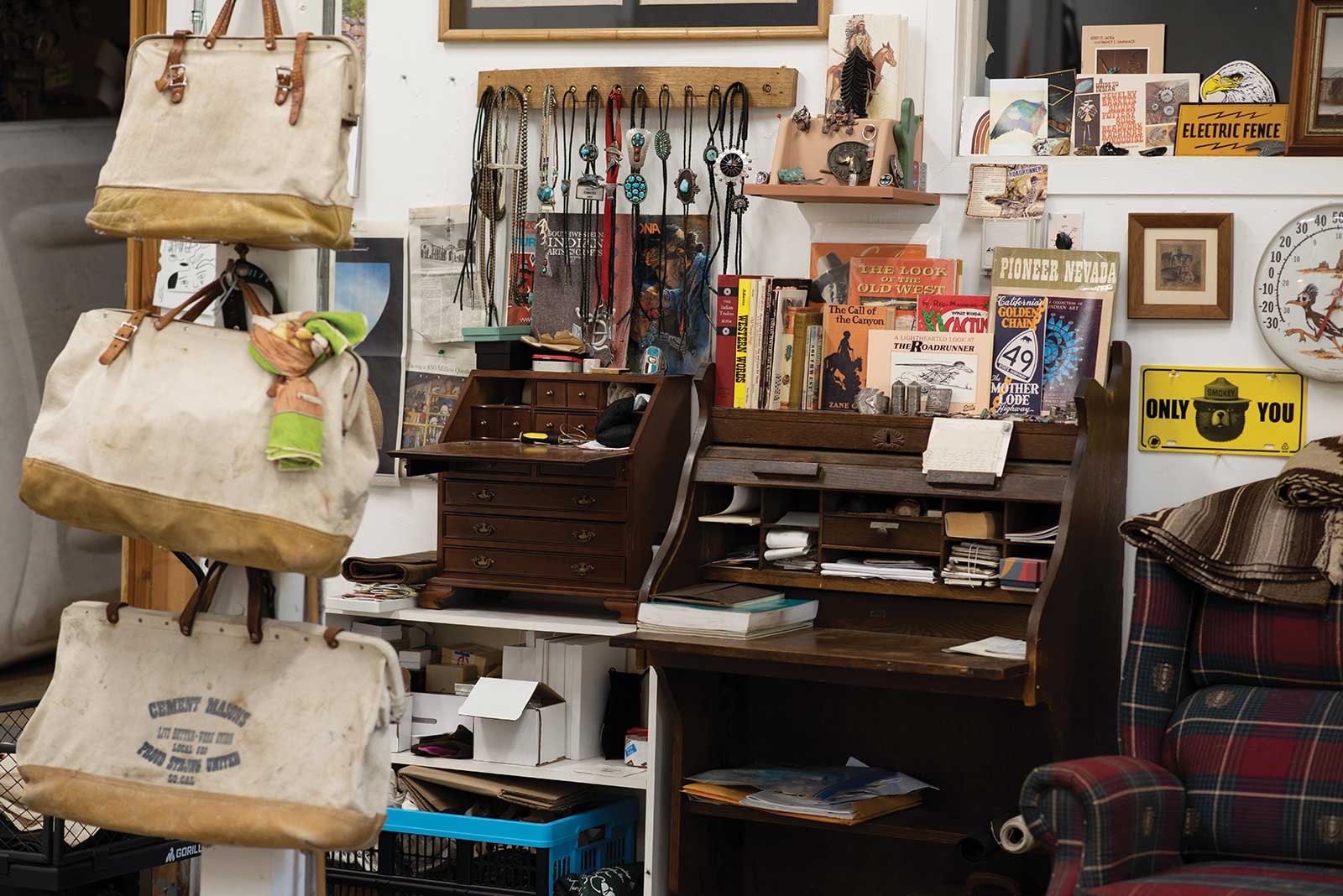
Books, art objects and other items in the studio of Alex Ziv. Courtesy the artist.
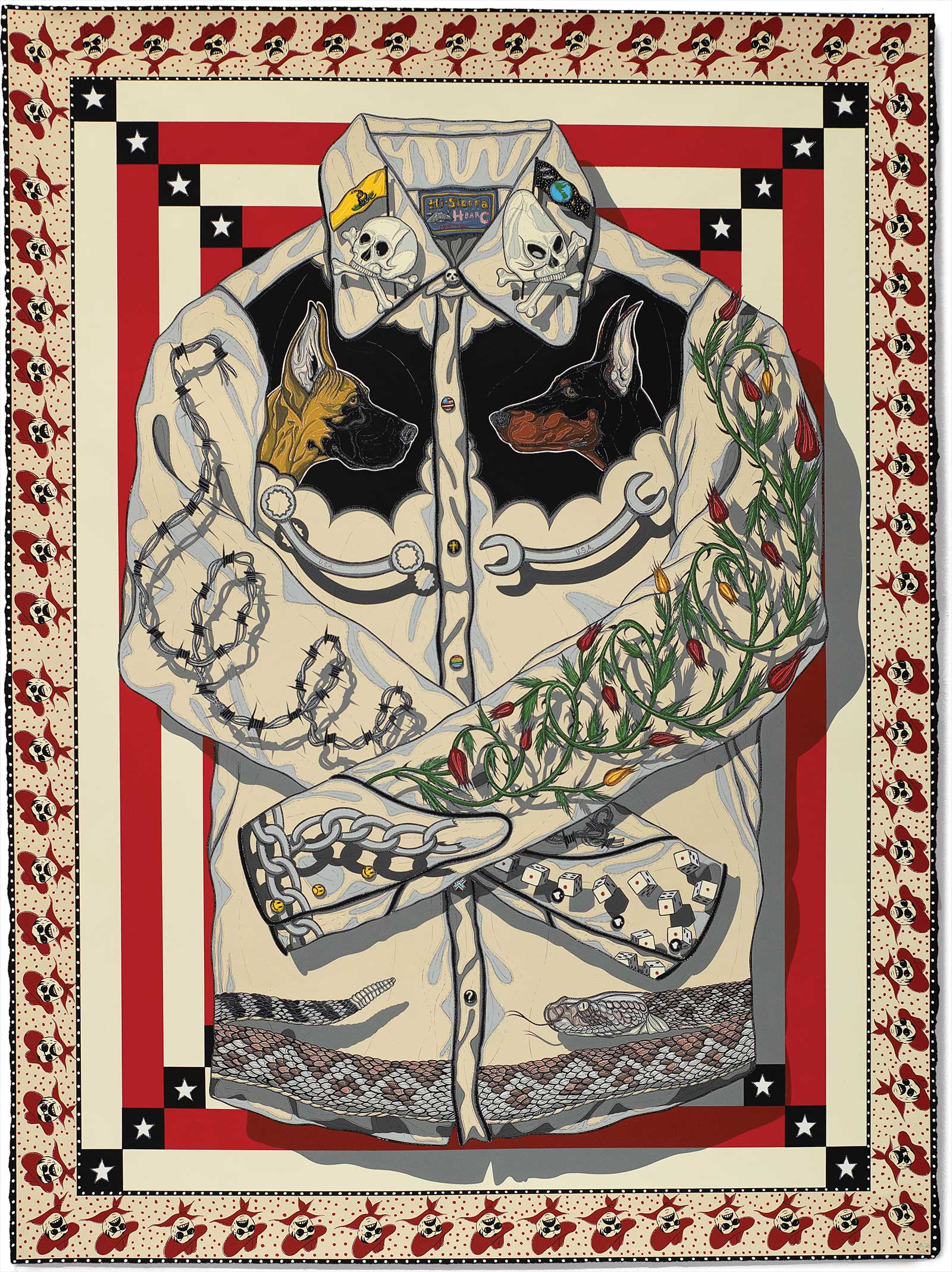
From Them, To Us, a self-portrait in the form of a Western shirt, Ziv addresses his Jewish heritage alongside personal interests and outsider themes. “It really feels like an American identity. You know, there’s no polite disagreement or agree to disagree,” says Ziv. “It’s ‘you’re wrong.’ That’s just how it is. It’s black and white. There’s no gray area anymore.” Another painting from Ziv’s Western shirt series, Till There’s No Feelings Left, equilaterally skewers news organizations with the text “I’m so tired,” which sums up the artist’s frustration with mass media of all stripes.
As an artist, Ziv feels a responsibility to paint the things the United States is dealing with in 2023. “I would never in a million years tell someone else how to live their life and do their thing,” he says. “But I consider myself to be a contemporary artist that is hugely inspired by the Western art world. And so, being a contemporary artist and looking at possibly contentious issues and bringing it into the Western sphere is really important.”
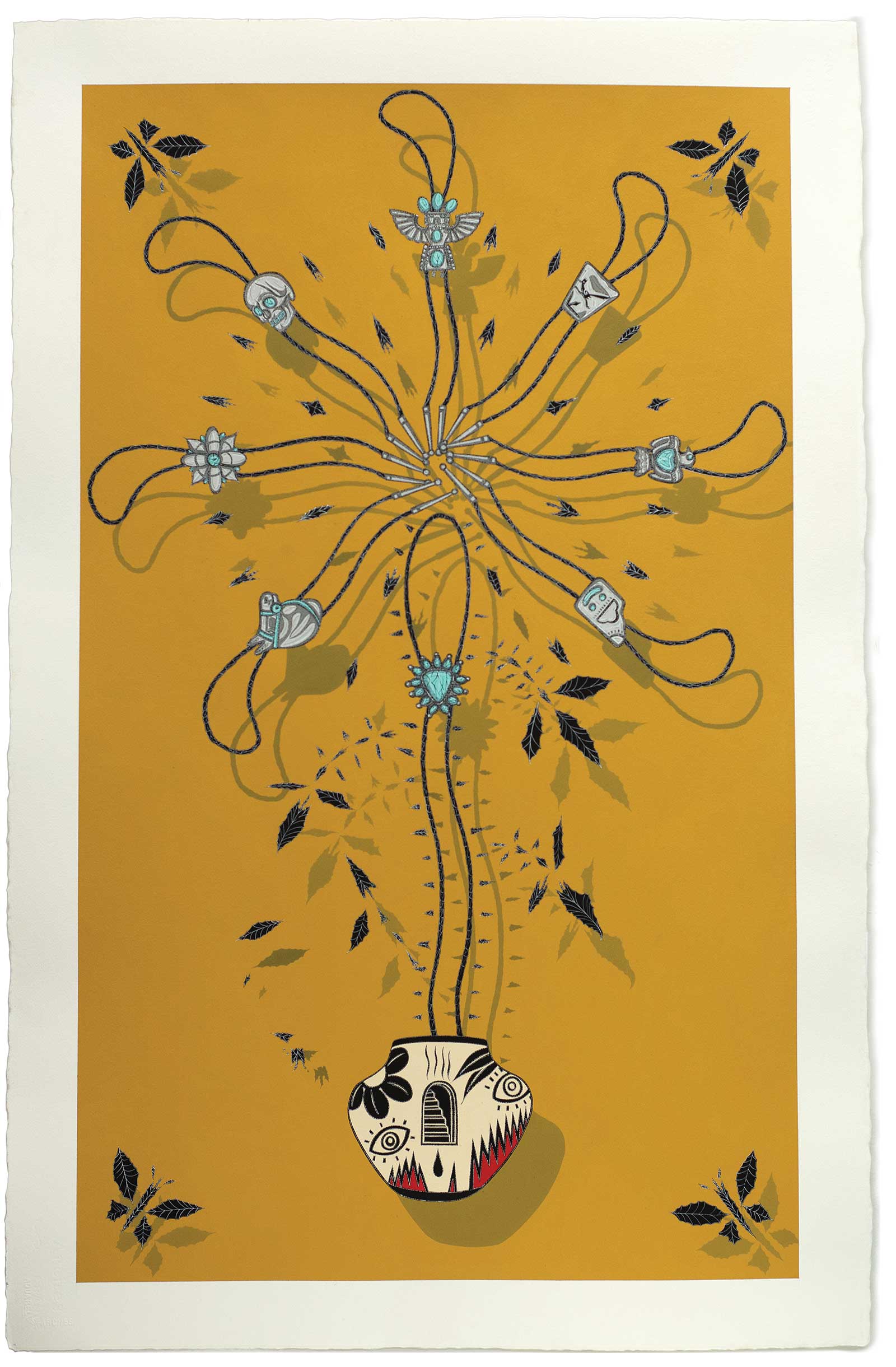
A Journey to the Center, gouache on paper, 40 x 22½"
He continues: “Maybe people will get really upset when they see my work. And maybe they’ll be like, this is not Western art,” he wonders. “My question would be, well, what is Western art? It’s not just landscapes. It’s not just cowboy forms and figures. It’s poetry. It’s identity. It’s culture. It’s opinion. It’s politics. It’s lifestyle. It is a myriad of things. So yeah, I think I just focus on the things maybe that are a little bit less seen than a landscape.
“I have a huge amount of respect for a lot of the artists that are out there because technically they can do things that I’ve never been able to do,” Ziv adds. “There are artists who are constantly finding amazing technical ways to explore something that’s been explored in the past. But I just want to see really sharp, poignant issues being addressed. Art should be progressing in all different senses.”
You can learn more about Alex Ziv’s art practice at Hashimoto Contemporary and his website www.alexanderziv.com. —
Powered by Froala Editor