Gerry Metz(1943-2018) was raised and educated in Chicago and, before devoting himself to fine art painting at the age of 30, he was a commercial artist. He lived in Scottsdale, Arizona, and Jackson, Wyoming, researching the lives of pioneers, Native Americans, fur trappers and cowboys of the 19th-century. For about eight years he traced the route of the Lewis and Clark Expedition, using their journals, and produced a series of paintings about the expedition.
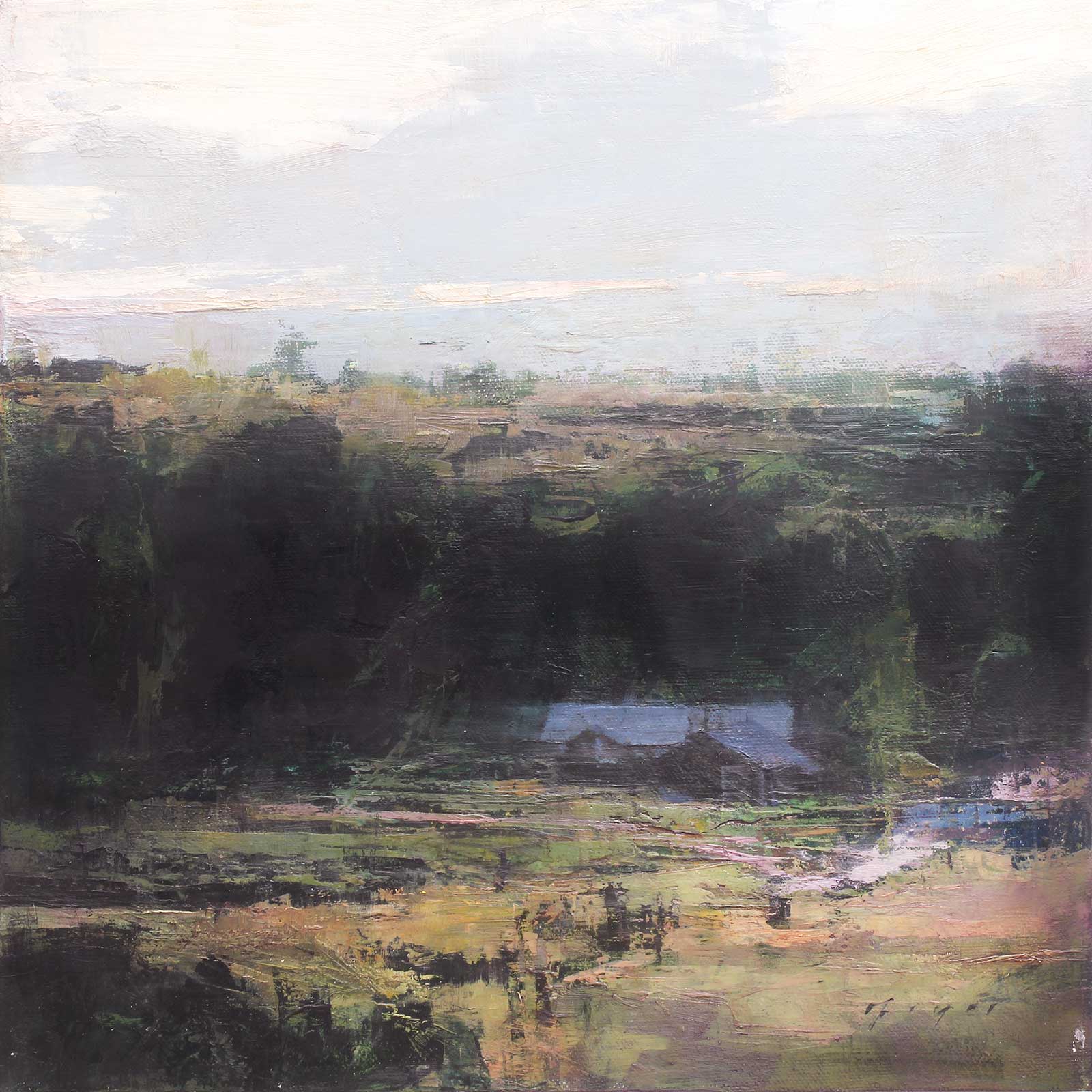 Meyer Gallery, Farm in the Shadows, oil, 12 x 12", by Douglas Fryer.
His painting, Rainy Day Chores, depicts cowboys at work, regardless of the weather. Wearing yellow slickers, they leave the warmth and shelter of their cabin to do their work. Charlie Russell often painted cowboys on horseback with their slickers rolled up inside out and tied behind their saddles—a practical arrangement for the cowboy and a compositional element for the artist.
The development of slickers began in coastal Scotland with coats made of linen sailcloth coated in linseed oil from the manufacture of the cloth. As the coating aged it became yellow. Yellow, as a by-product, made fishermen more visible. A number of manufacturers worked on perfecting the slicker, including Abner Tower in the United States, whose Fish brand pommel slickers covered the cowboy from in front of the pommel to his ankles.
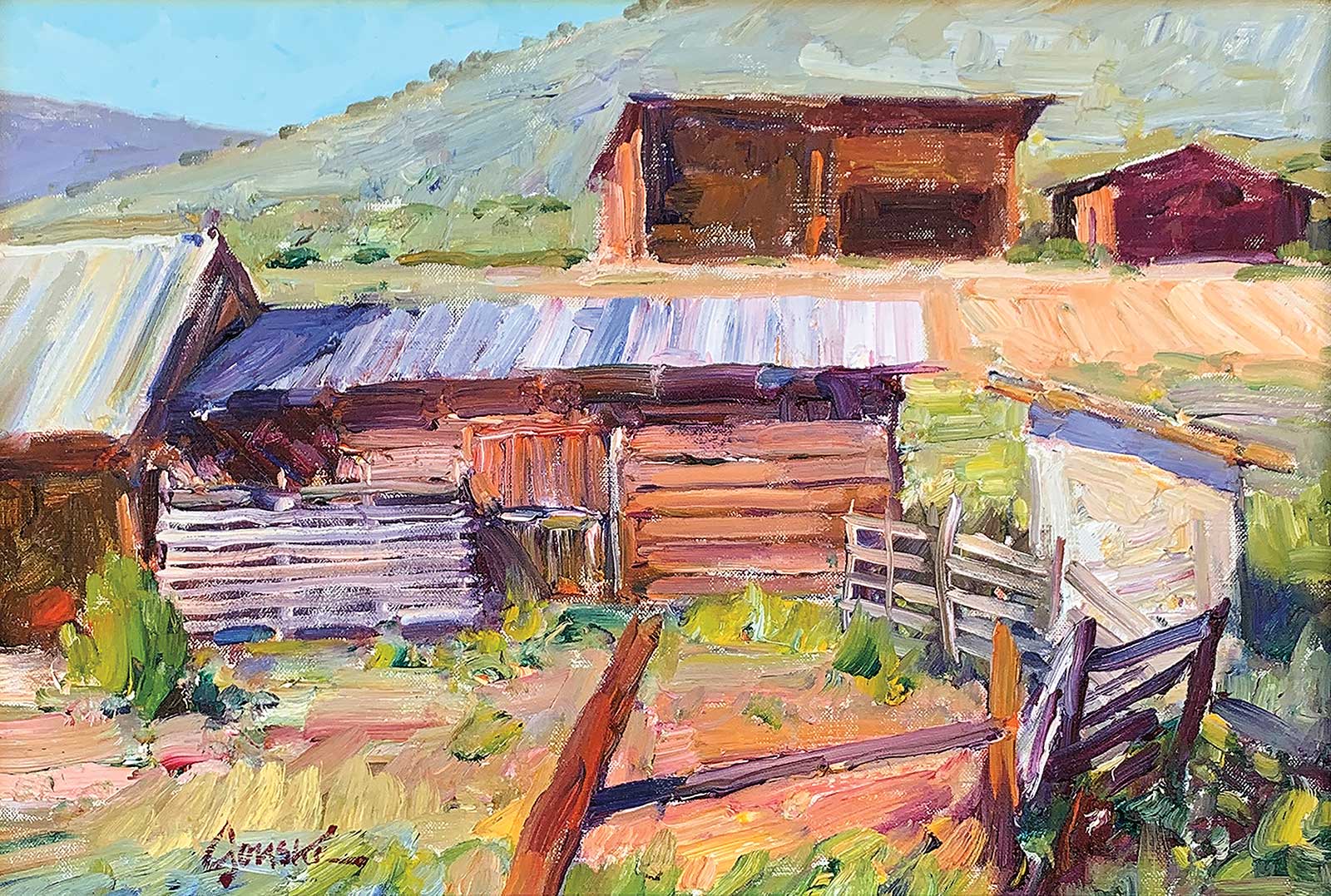
Claggett/Rey Gallery, Colorado Ranch, oil, 14 x 20", by Walt Gonske.
Douglas Fryer’s Ranch in the Shadows depicts a ranch protected by a shelterbelt made of trees and shrubs shielding the buildings from prevailing winds and to trap snow. The buildings are sited to catch cooling breezes in the summer.
Fryer quotes Andrew Wyeth who said, “One’s art goes as far and as deep as one’s love goes.” His love for his subjects animates his paintings, which are often a brief and peripheral impression of a scene, details softened into the application of paint as paint itself, suggesting the tangible materiality of the subject. He comments that skill alone is not enough in making an object of art. An artist needs to be aware of the ancient Greek aphorism, “Know thyself.” Deep emotion, feelings and foundational values allow artists to express meaning in their work.
Walt Gonske was a commercial illustrator before moving to Taos, New Mexico, in 1972. He interprets the intense colors and light of northern New Mexico in his work. “Each stroke of paint carries emotion and power,” he says. “I work in a loose, painterly style in part because I want the viewer to see the process and not hide it behind ‘finish’... My best work comes when I’m able to give up control, to trust my impulses. Then the painting takes on a life of its own. When I don’t know what is going to happen next, the process becomes full of surprise and wonder.”
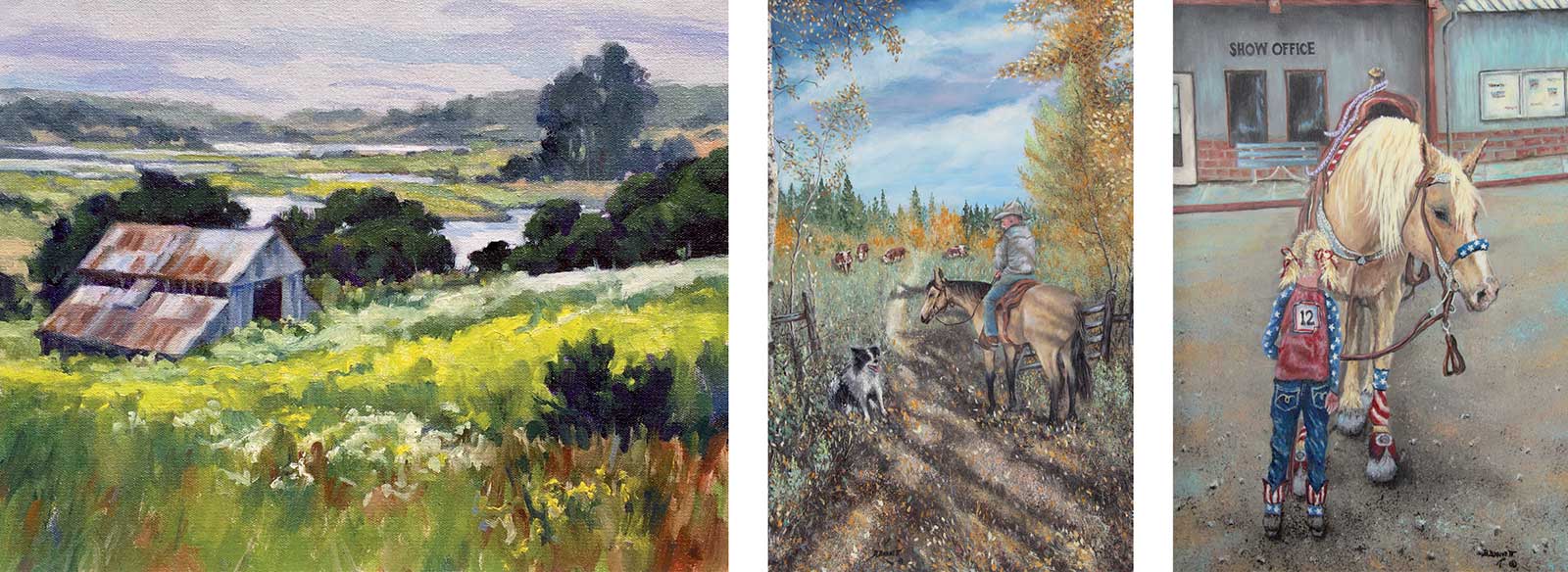
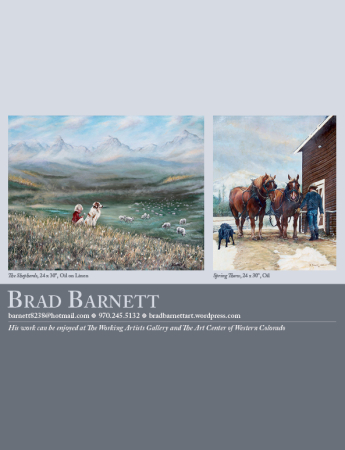
Julia Munger Seelos, Elkhorn Flower Carpet, oil, 11 x 14” ; Brad Barnett, Bring ‘Em Home, oil on linen, 36 x 24”; Brad Barnett, It’s Showtime, Goldie!, oil on linen, 24 x 18”
His painterly images, such as Colorado Ranch, capture the summer heat and structures that have survived seasons of heat, cold and wet, continuing to serve their purpose.
Within the pages of this special section, explore more works of art that depict work and life on the ranch.
Artists John Fawcett, Grant Redden and Rick Terry are represented by Legacy Galleryin Scottsdale, Arizona, and each create works of art that capture ranching life. Fawcett has spent his life studying and gaining inspiration from his subjects. He began his study of the interactions between people and animals first as a practicing veterinarian for 20 years, and then as a full-time artist. Redden grew up on a ranch in Wyoming, another place of the glory of the “Old West.” His ability to capture the old school cowboy can transport you back in time. Terry became interested in bronze sculpture while visiting galleries in Jackson Hole, Wyoming. Back in the mid 1970s his work was in ceramic clay and fired at a local pottery shop. He wanted to expand his art into bronze, and after working many years as a roughneck in Montana and Wyoming, he eventually went back to school to master his craft.
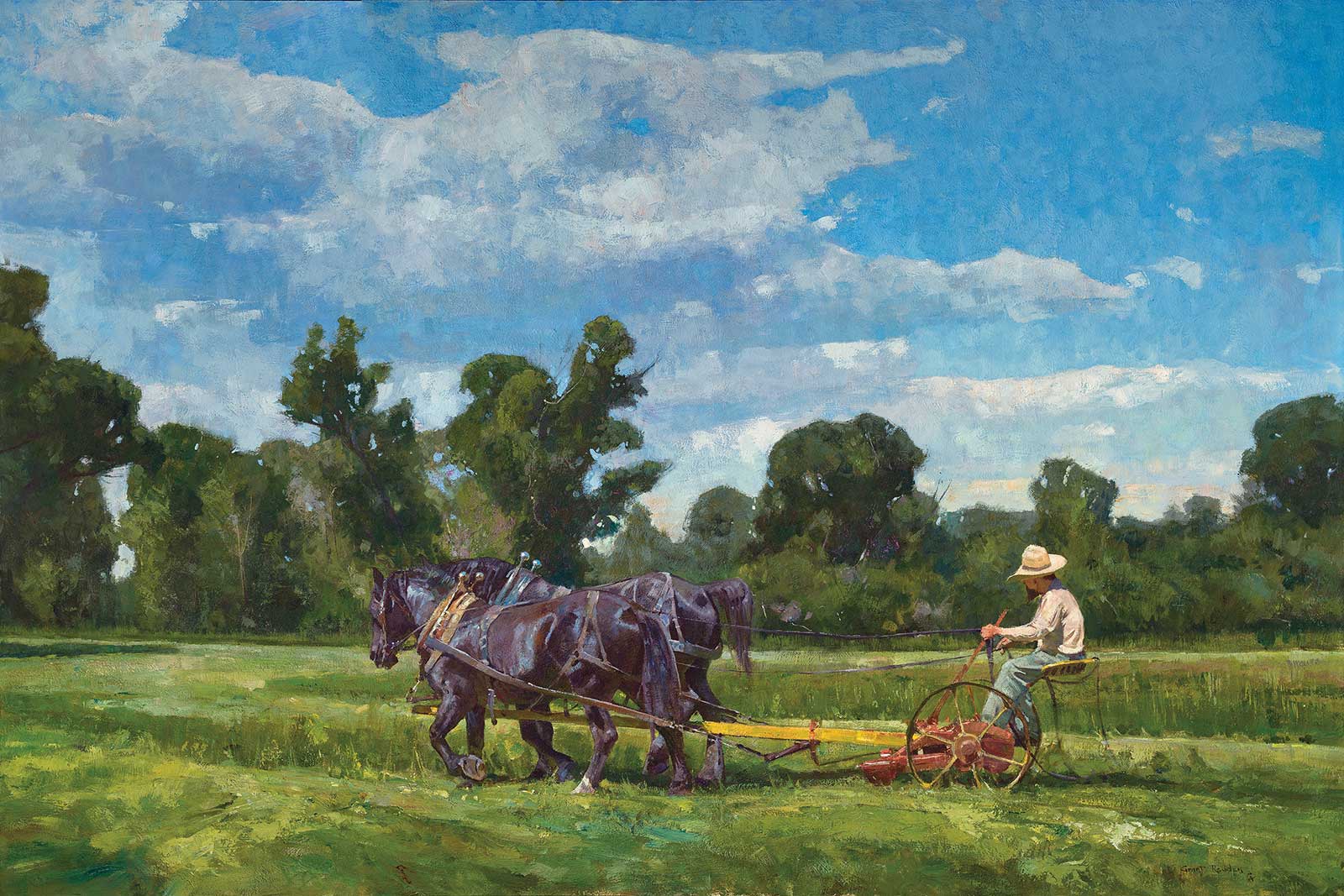
Legacy Gallery, Mowing Hay, oil, 40 x 60", by Grant Redden.
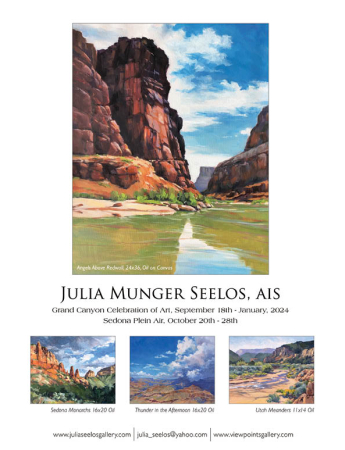
Julia Munger Seelos grew up in northern Kentucky, where her love of rural farms and ranches blossomed. She enjoyed drawing old barns and tractors with their rich history, hoping her art would tell their stories. Her work takes you to a simpler time, evoking our Western heritage. That love of rustic Americana comes through in her vibrant paintings, often painted on location, in plein air. This fall, she can be found again at the Celebration of Art at the Grand Canyon and the Sedona Plein Air Festival in Arizona.
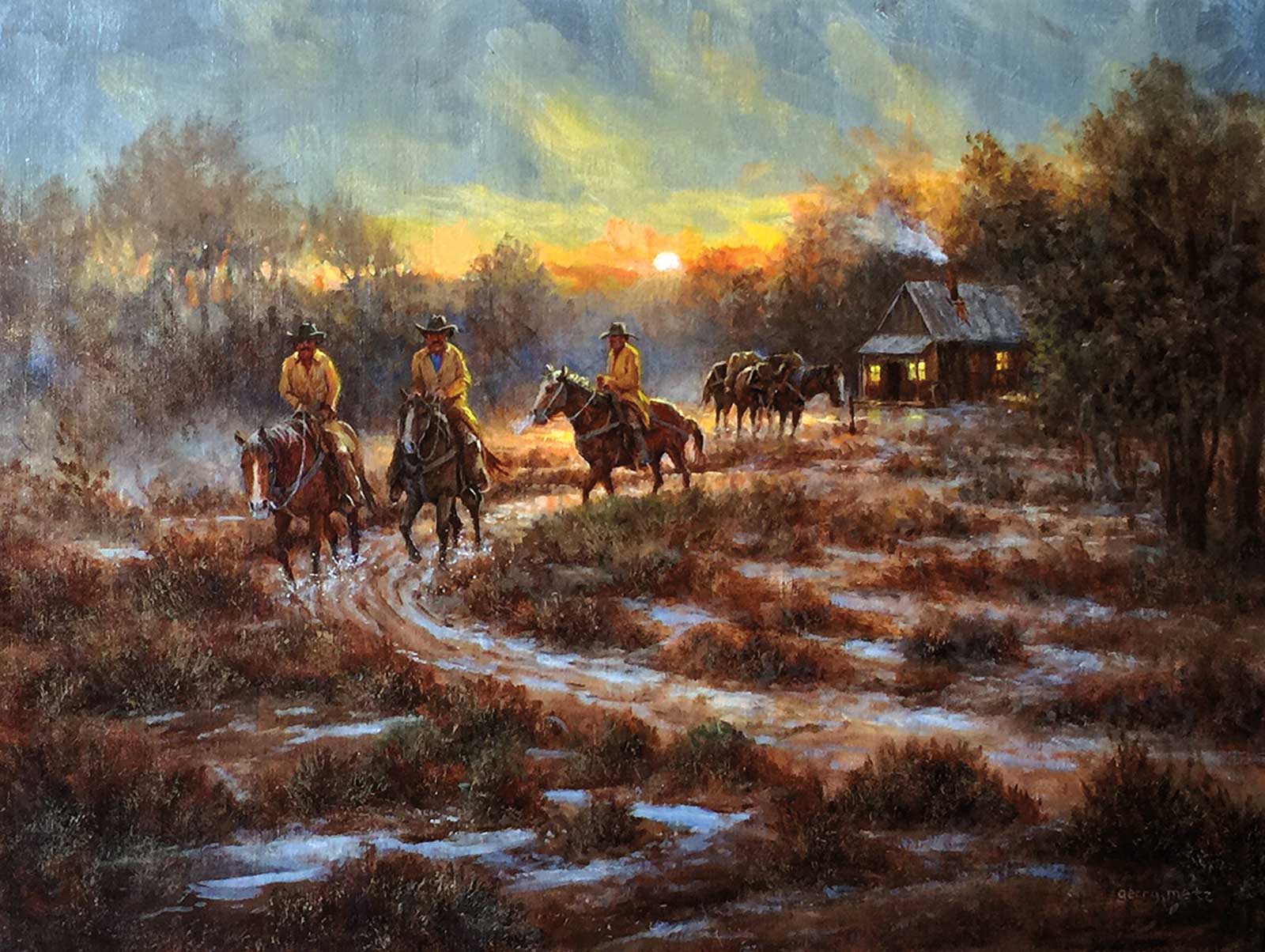
Mountain Trails Gallery, Rainy Day Chores, oil, 18 x 24", by Gerry Metz (1943-2018).
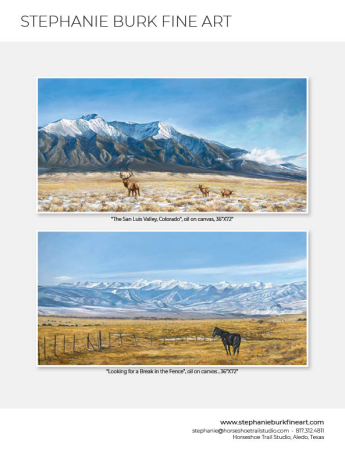
Artist Stephanie Burk works in both oil and acrylic. “In art, as well as life, I have learned to hold my mind constantly open to the possibility of sharp curves in the road—expect the unexpected. Often we think nothing changes, and then everything does…Between our homes in Texas and Colorado I find source material to paint splendor, wonder and beauty. At twilight, the hour when day dissolves into darkness or majestic and sweepingly intimate mountains at dawn, or beautiful faces in creation, I hope collectors will be absorbed into the space, quietly soak up the beauty and find an unexpected moment to exhale,” she says. Burk lives and paints in Aledo, Texas, on the western edge of Tarrant County, and in the San Luis Valley in Southern Colorado. She is an associate member of Women Artists of the West, and she owns and operates Horseshoe Trail Studio in Aledo.
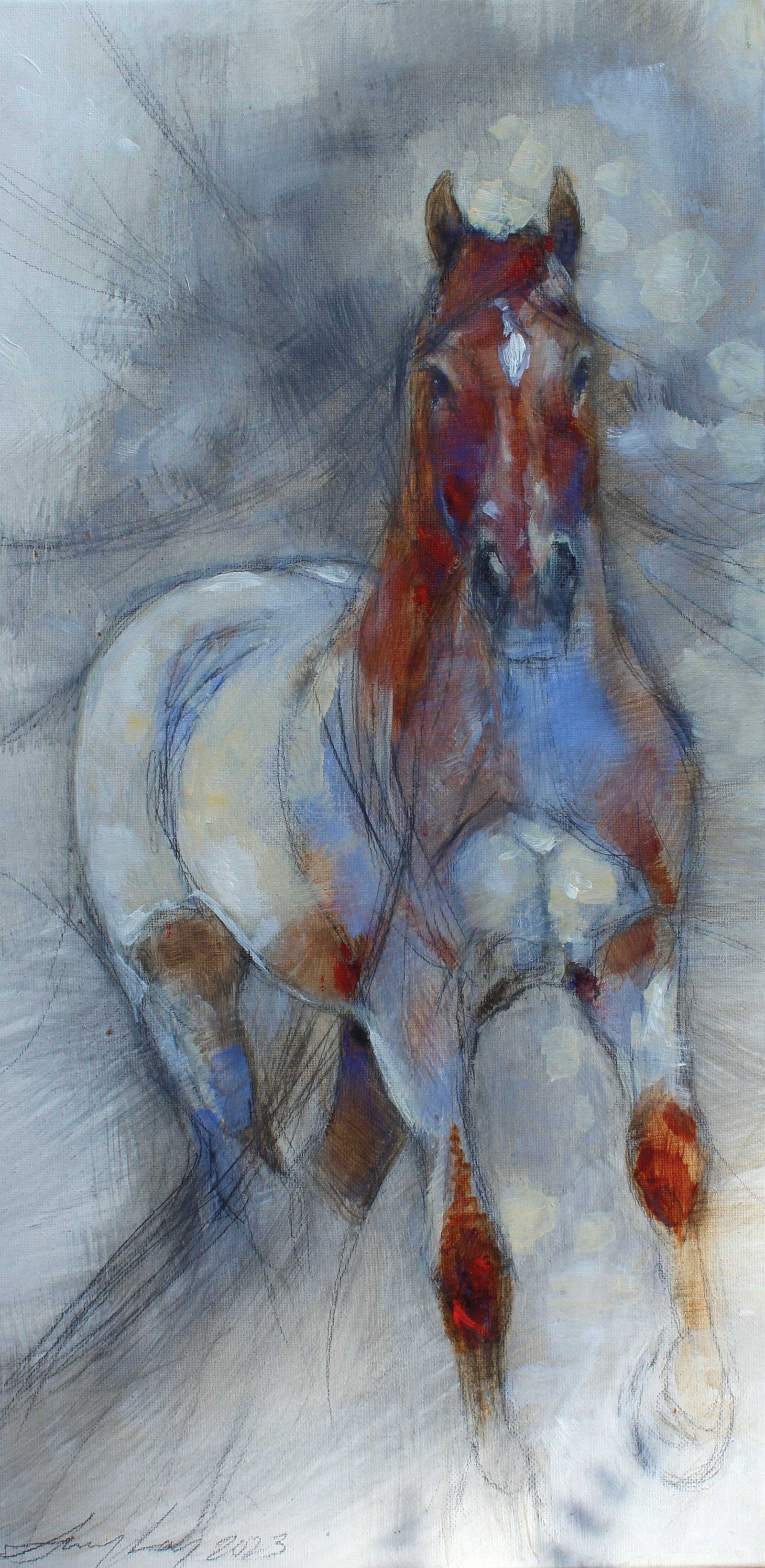
Manitou Galleries, Confidence, oil, 20 x 10”, by Amy Lay.
Celebrating all that the West has to offer is Manitou Galleries in Santa Fe, New Mexico. “Cattle ranching has had roots in New Mexico dating back to the 1500s when Spanish settlers came to the region, and the livestock industry has remained one of the largest in the nation ever since,” notes associate director Cyndi Hall. “The artists represented in the images provided have direct ties to ranching and often discuss how the lifestyle has affected their choice of imagery and composition. The horse and cattle are a familiar image in ranching art because of their connection to the job itself, the love of the animal and the full-circle interrelatedness of the cowboy and the animals that provide food and income for their family.”
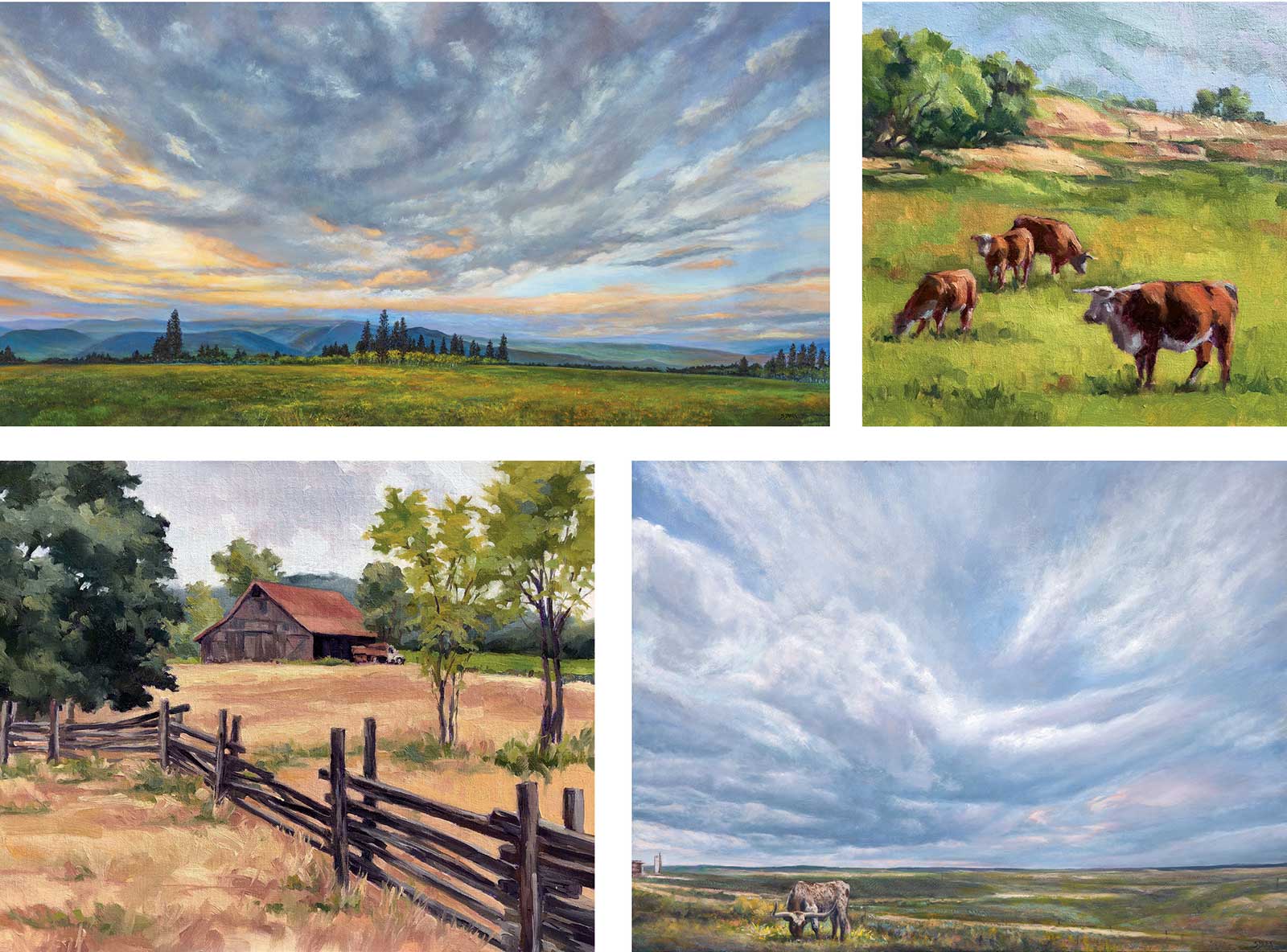
Top: Stephanie Burk, Golden Hour over the San Luis Valley, acrylic on canvas, 36 x 72”; Julia Munger Seelos, Lunchtime, oil, 12 x 12”. Bottom: Julia Munger Seelos, Broken Fences, oil, 16 x 20”; Stephanie Burk, Texas Sun, oil on canvas, 36 x 48”
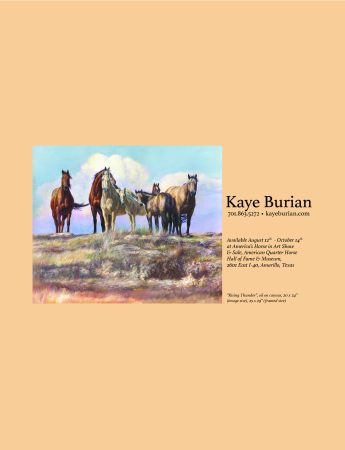
In Kaye Burian’s Rising Thunder, seven horses stand in the wind, each seeming to peer directly at the viewer. “I was able to be at the Madler Quarter Horse Ranch to view their mares and colts. To be able to spend time among the horses gives me a better understanding of their conformation and behavior,” Burian says of the piece. “Our horses on our ranch also lend to appreciation of these beautiful animals, which I try to capture for others to enjoy as well.” She adds that “artists need to know the subject matter they paint in order to portray it correctly and with feeling to the collector.”
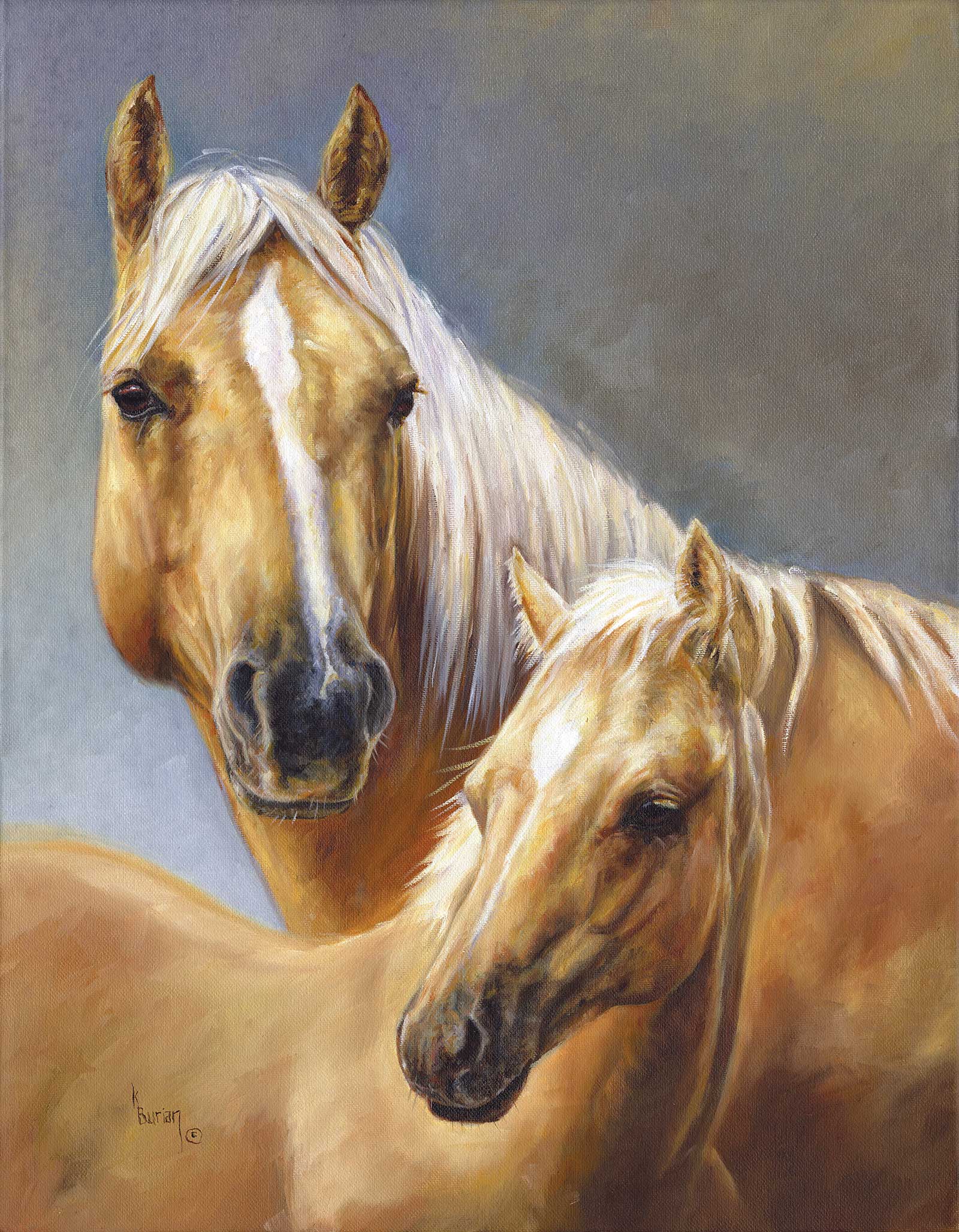
Kaye Burian, Mom’s Love, oil on canvas, 18 x 14”
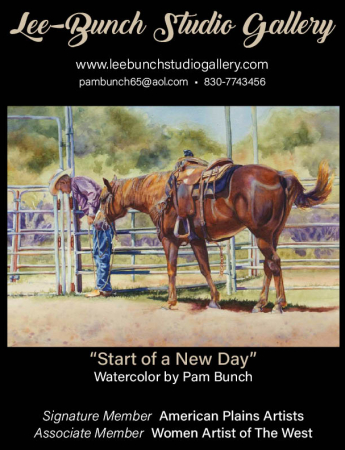
Pam Bunch of Lee-Bunch Studio Gallery has a passion for the West that includes horses, cowboys and Native Americans. And her heritage of Texas ranching is incorporated into all of her watercolor and oil paintings. Bunch’s favorite medium is watercolor due to its challenges, and oil for its forgiveness. Her realistic yet somewhat impressionistic style along with her use of color, lights, darks and shadows captures the essence of the moment, never to be forgotten. She feels as though she has captured a part of history and that history is part of everyone’s heritage, whether it is a ranch or farm scene or even a landscape. The artist, who is a signature member of APA and an associate member of WAOW, hopes her paintings will evoke feelings of the “good ole days.”
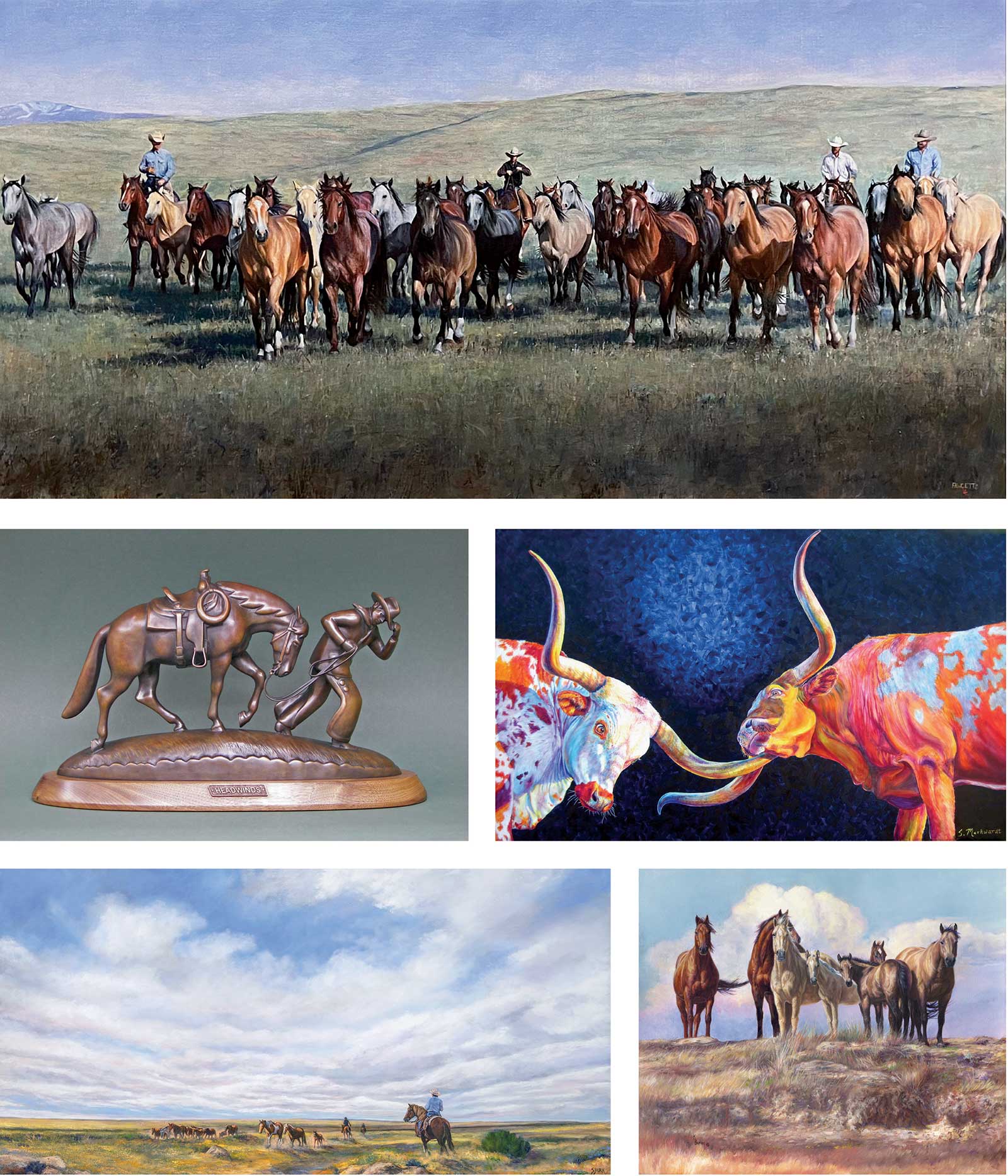
Top: Legacy Gallery, The Remuda, oil, 20 x 40”, by John Fawcett. Center: Legacy Gallery, Headwinds, bronze, ed. of 10, 20 x 12 x 6”, by Rick Terry; Manitou Galleries, Point Taken, oil, 36 x 60”, by Sharon Markwardt. Bottom: Stephanie Burk, Headed Home, oil on canvas, 36 x 72”; Kaye Burian, Rising Thunder, oil on canvas, 20 x 24”
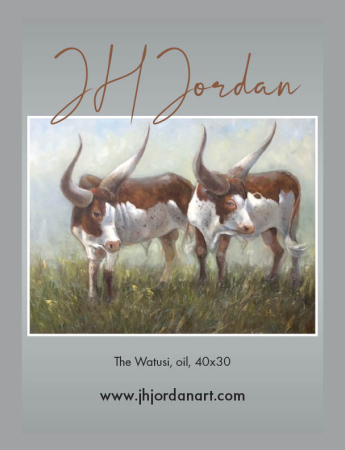
Judith H. Jordan begins her paintings by considering her composition—looking for related shapes and the ways they may fit together in the painting. “Quite often, I may find a [new] subject matter when I’m not really looking for one. I may see a face, landscape or an animal that intrigues me, and I know I must put it on canvas,” she says. “I don’t think the artist really knows when a painting is finished. There is always a desire to keep working to better the painting…An artist often paints his or her emotions and follows through with their desire to create a painting. However, the most rewarding aspect of the work is when someone feels the same emotions from the paintings that I do.”
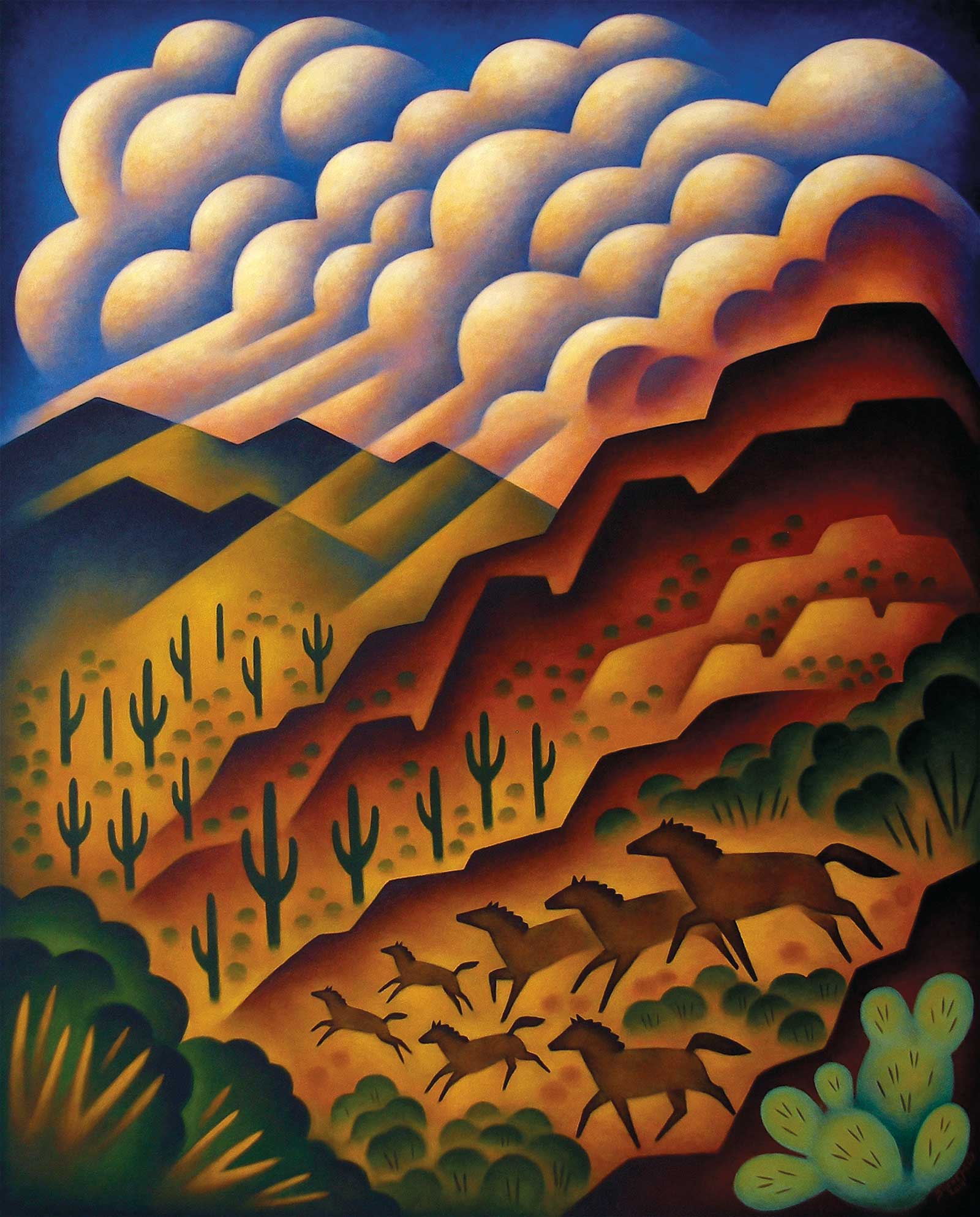
Manitou Galleries, Desert Herd, acrylic on panel, 44½ x 36”, by Sushe Felix.
Raised in Northern Indiana, Brad Barnett spent much of his childhood outdoors, hunting and fishing. After earning a degree in wildlife biology at the University of Montana, he became hooked on the West. Now, living near Grand Junction, adjacent to the Colorado National Monument, nature continues to inspire his art. His oil paintings reflect both his Midwest upbringing and his love for the Western way of life. His work has been shown at events throughout the West.
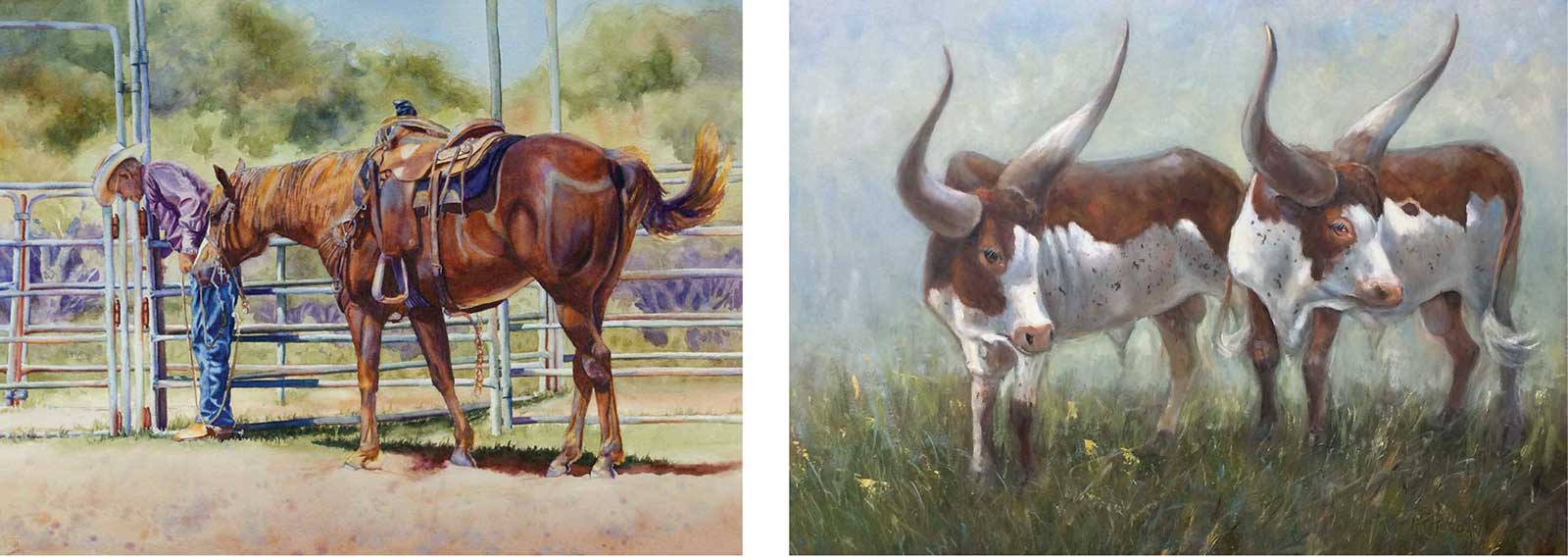
Lee-Bunch Studio Gallery, Break Time, watercolor, by Pam Bunch; Judith H. Jordan, The Watusi, oil, 30 x 40”
Featured Artists & Galleries
Brad Barnett
(970) 245-5132
barnett8238@hotmail.com
www.bradbarnettart.wordpress.com
Claggett/Rey Gallery
216 Main Street, Suite C-100
Edwards, CO 81632
(970) 476-9350
www.claggettrey.com
Judith H. Jordan
(256) 252-4492
gallery@centurylink.net
Julia Munger Seelos
Represented by Viewpoints Gallery, Los Altos, CA
www.juliaseelosgallery.com
Kaye Burian
980 119th Avenue SW, Manning, ND 58642
(701) 863-5272
www.kayeburian.com
Lee-Bunch Studio Gallery
100 W. Greenwood, Del Rio, TX 78840
(830) 774-3456
pambunch65@aol.com
www.leebunchstudiogallery.com
Legacy Gallery
7178 Main Street, Scottsdale, AZ 85251
(480) 945-1113
www.legacygallery.com
Manitou Galleries
123 West Palace Avenue, Santa Fe, NM 87501
(505) 986-0440
www.manitougalleries.com
Meyer Gallery
225 Canyon Road #14, Santa Fe, NM 87501
www.meyergalleries.com
Mountain Trails Gallery
Park City, UT
www.mountaintrailsgalleries.com
Jackson, WY
www.mtntrails.net
Stephanie Burk
440 Horseshoe Trail, Aledo, TX 76008
(817) 312-4811
stephanie@horseshoetrailstudio.com
www.stephanieburkfineart.com
Powered by Froala Editor