There is a strong argument to be made that the culture and landscape of New Mexico has a magical, enchanting quality. Visitors are transfixed by the unique beauty of regions like Taos and Santa Fe—also capturing the hearts and minds of many artists who made entire careers out of depicting New Mexico scenery.
Artists like Joseph Henry Sharp and Ernest L. Blumenschein were so taken with the town of Taos that an entire school of painting was born, the renowned Taos Society of Artists. The group was officially founded in 1915, and the six founding members prolifically thrived off the seductive energy of Taos and the Southwest. They produced astonishing images of Native Americans, the desert landscape and Western lifestyle and culture.
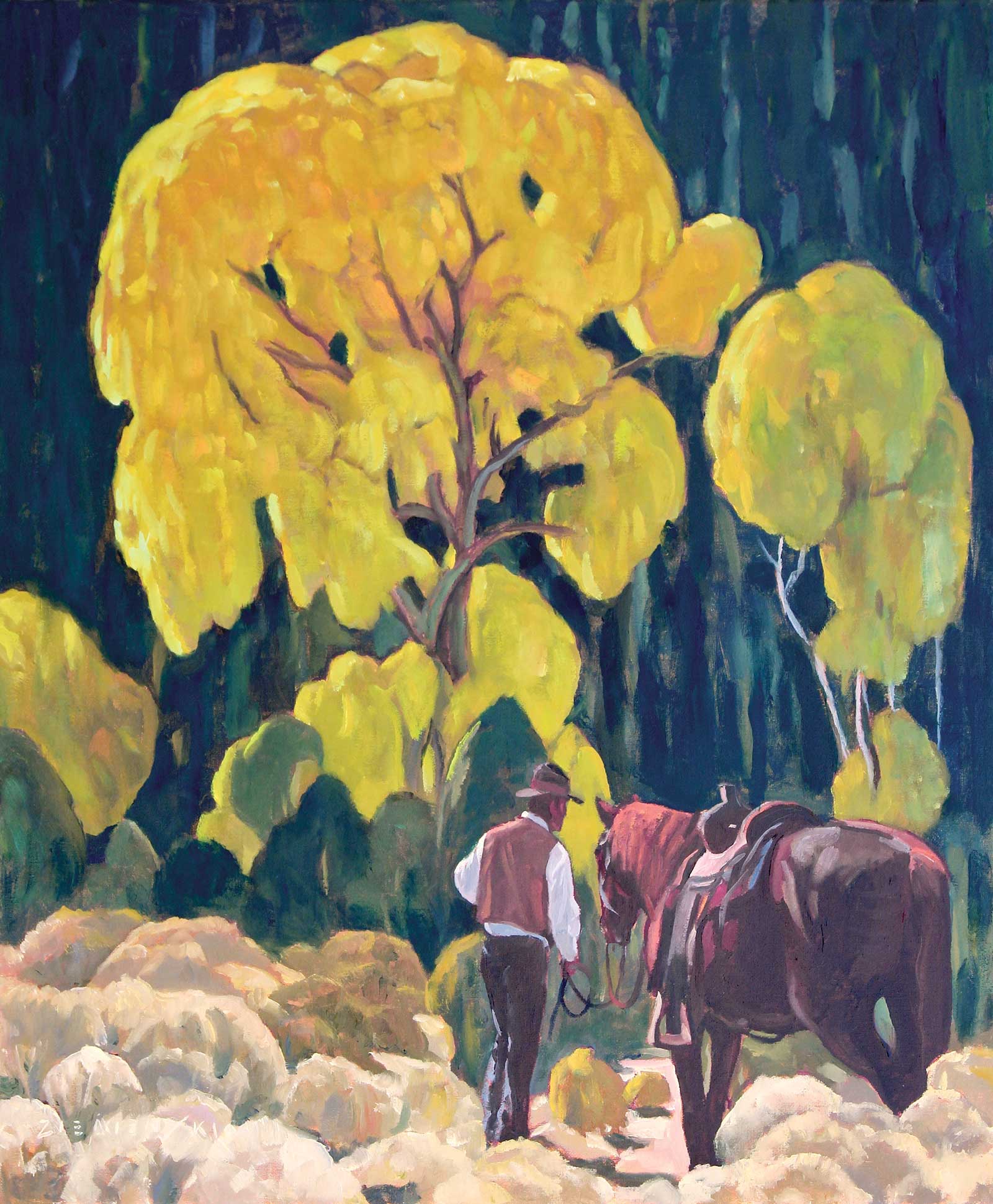 Dennis Ziemienski, Autumn Dusk (after Dunton’s painting October Gold), oil on canvas, 24 x 20”
 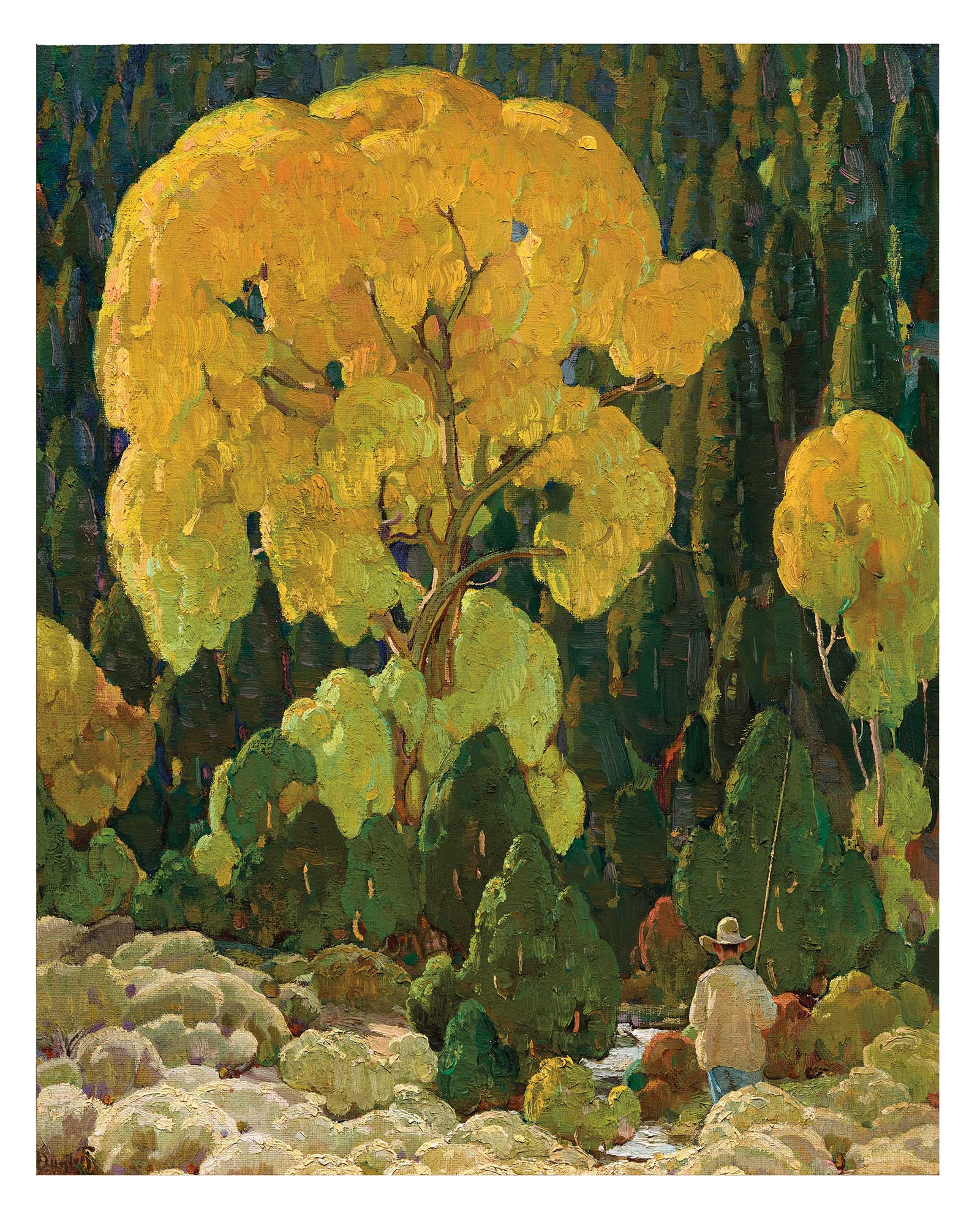 William Herbert “Buck” Dunton (1878-1936), October Gold, ca. 1930, oil on canvas, 20 x 16"Today, Taos and Santa Fe, among other regions, have grown to be magnificent art destinations that include art colonies, galleries and museums. Galleries like Blue Rain Gallery, perfectly situated in the Railyard district in Santa Fe, can’t help but feel “nostalgic about being a part of this long-established art destination,” says Denise Phetteplace, Blue Rain’s executive director. “We get to enjoy the benefits of being such a great location, and it really goes back to the founding members of the TSA. They helped bring awareness to this part of the country and perpetuate this idea of the West as a culturally rich, beautiful, untouched place.”
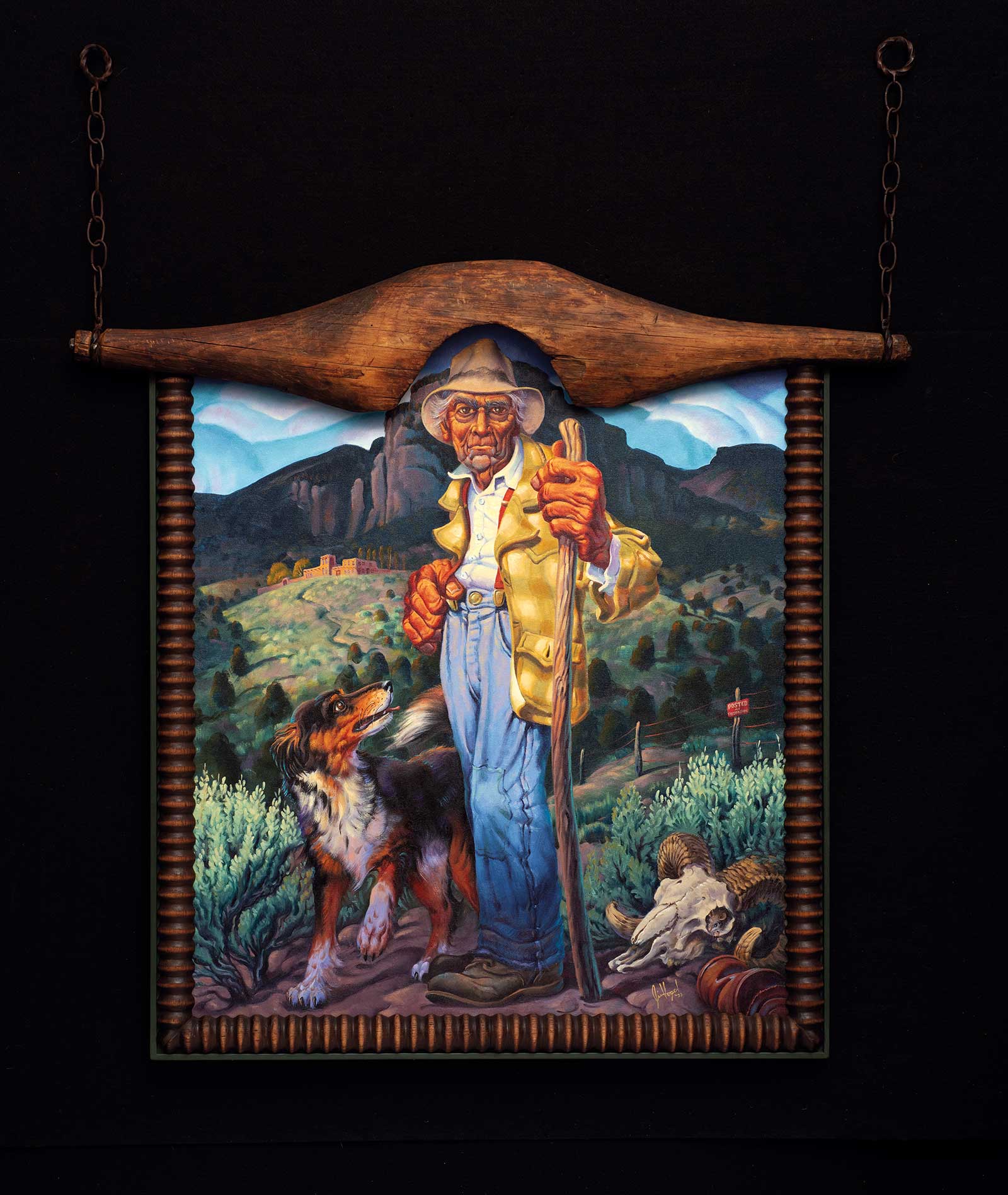 Jim Vogel, Pastor Sin Cabras (after Dunton’s painting Pastor de Cabras, Neo Mexicano), oil on canvas panel with antique yoke frame, 39 x 36½”
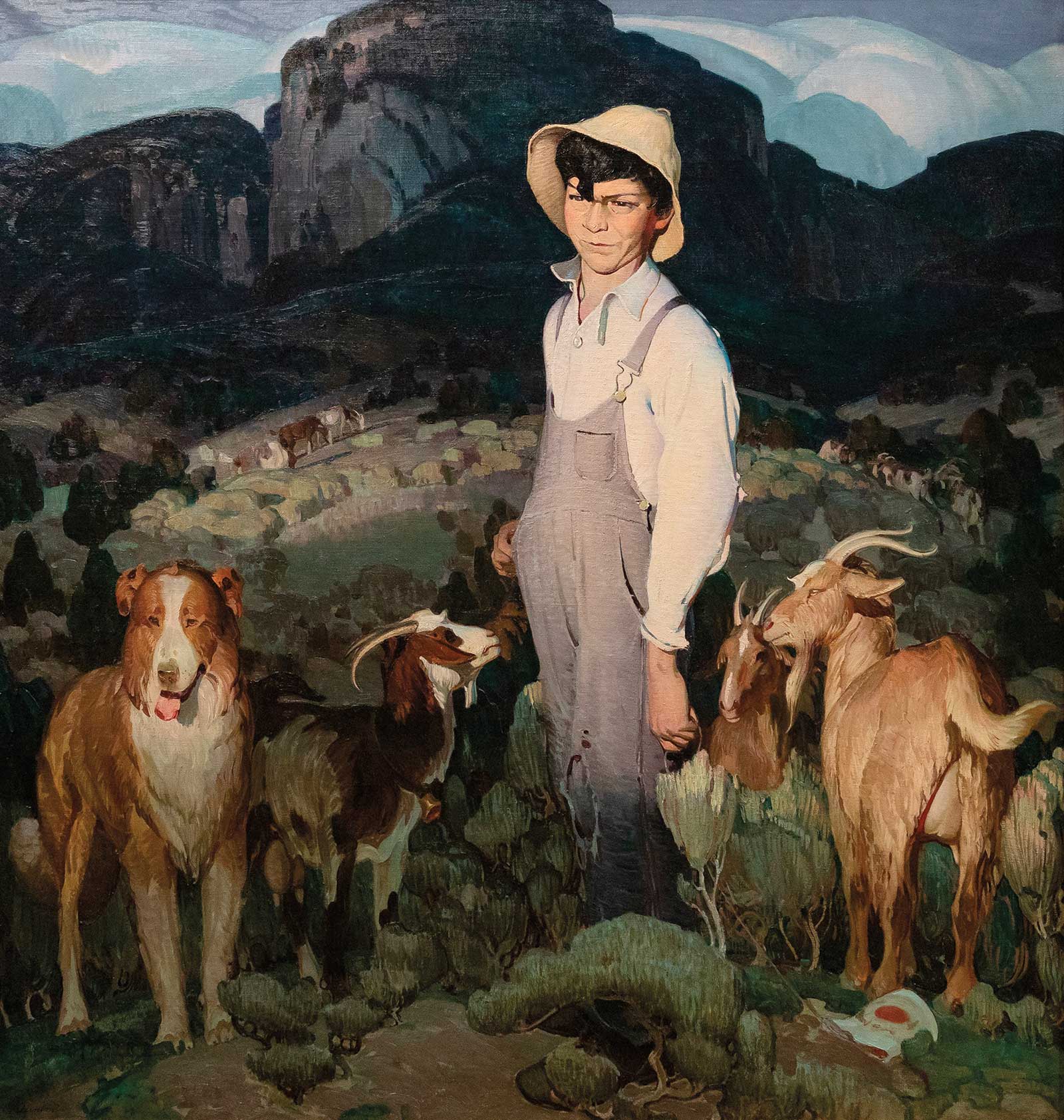 William Herbert “Buck” Dunton (1878-1936), Pastor de Cabras, Neo Mexicano (New Mexican Goat Herder), 1926, oil on canvas, 50 x 52"
Blue Rain has found a way to honor these founding artists in their annual showcase the Taos Six Collection,with this year’s exhibition highlighting TSA member William Herbert “Buck” Dunton (1878-1936). The artist's paintings, known for their romantic depictions of the American West, hunters on horseback, animals and the rugged landscape, are reimagined in the work of 15 Blue Rain artists.“Our stable of artists were able to identify a piece of Dunton’s work that spoke to them personally, and we asked them to challenge themselves by standing outside the box of their normal subject matter—to come through with their own interpretations,” says Phetteplace. “People have been honoring different works of art throughout art history. There are plenty of examples of painters creating new pieces based on famous work. I wanted this project to be a continuation of that concept, and I feel like the challenge for our artists really does lie in how they’re going to take a master work [of Dunton’s] that has been sanctioned by the art world for over a hundred years, adored and collected, and make it new and really own it.”
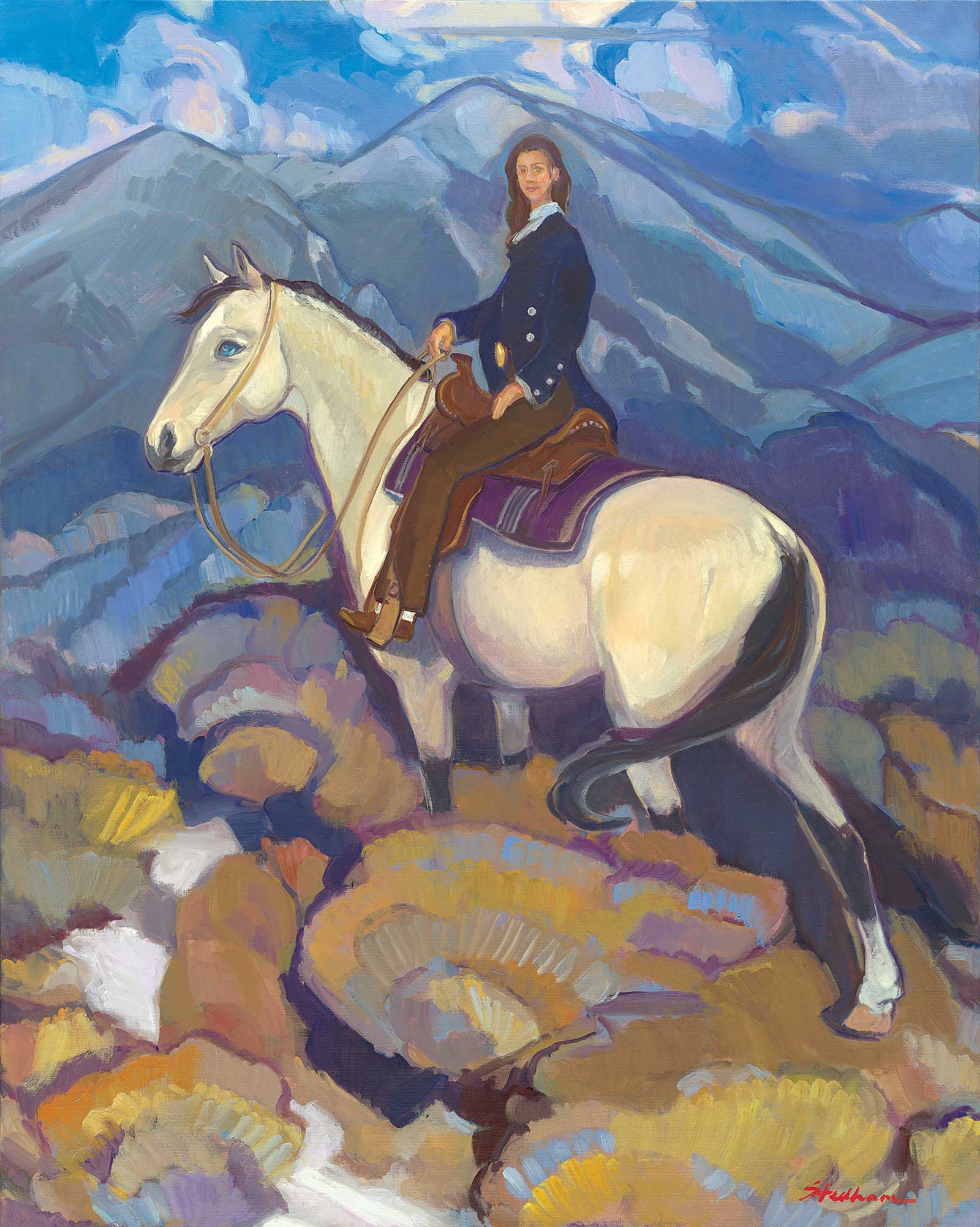
Kathryn Stedham, The Artist on Horse Named Lark (after Dunton’s painting The Horse Rustler), oil on Belgian linen, 30 x 24”
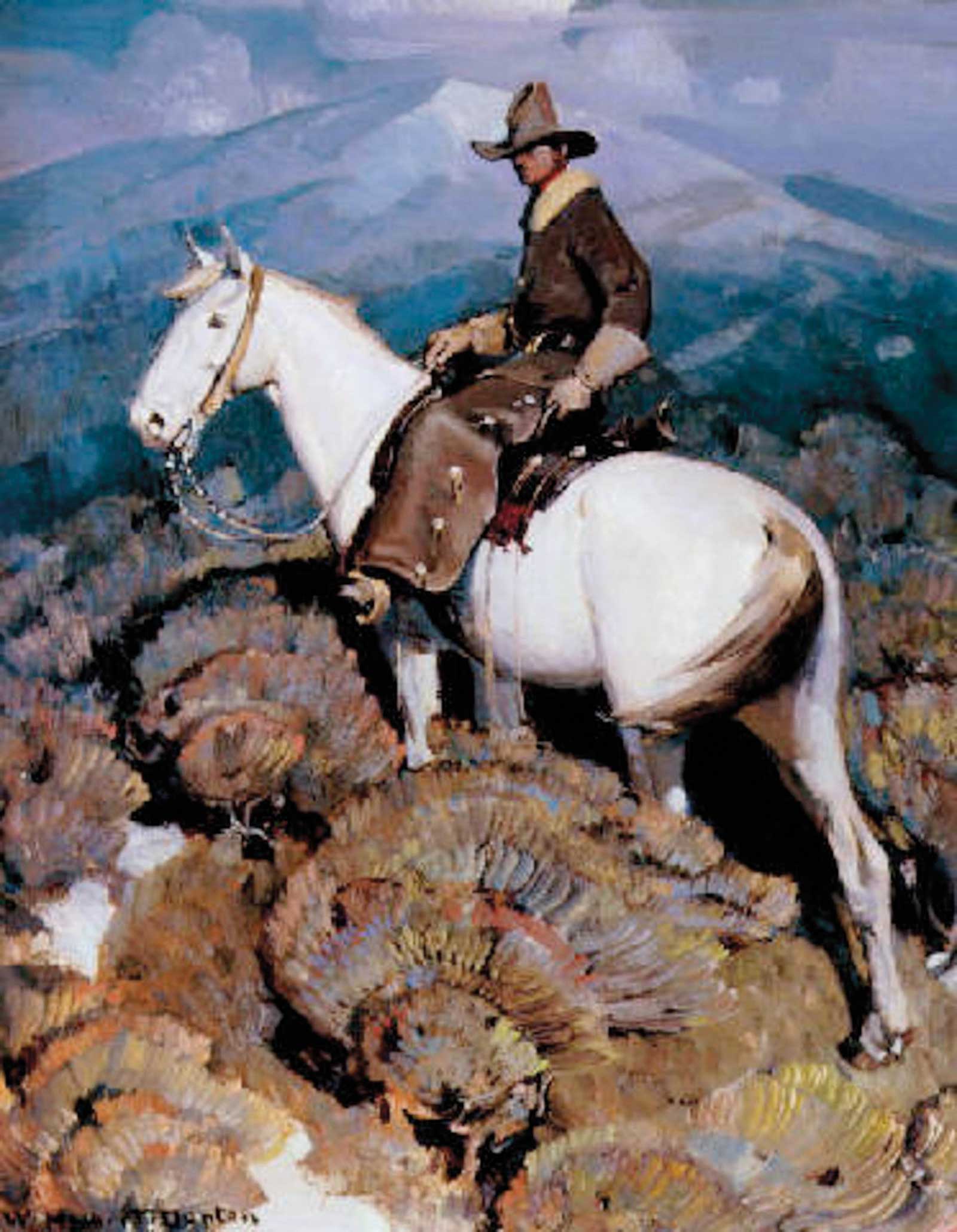
William Herbert “Buck” Dunton (1878-1936), The Horse Rustler, oil on canvas, 20 x 16"
Artist Robin Jones, for example, chose Dunton’s Follering the Tracks, from around 1929, as inspiration for her oil and white gold leaf painting Do Not Fear the Path. “I chose this piece because I loved the bond between human and horse, the simplicity of the composition, and honestly, I’d never done a horse painting before and wanted the challenge!” Says Jones. “I started with the idea of interpreting Dunton’s piece using a contemporary lens—replacing the older man with a young girl who would have an air of bravery and determination. I also wanted to keep some of the landscape in Dunton’s painting but make it more of an abstract, minimal and just the main shapes.”
Artist Kathryn Stedham also chose a horse piece of Dunton’s for interpretation, a work titled The Horse Rustler, showing a cowboy on horseback among colorful, desert brush. “Dunton is easily one of my favorite Taos Society painters,” Stedham remarks. “I feel we share a similar ethos, both as painters and for our deep connection to the natural world. The most difficult part of creating my piece was selecting a single Dunton painting from his lifetime of brilliant works.”
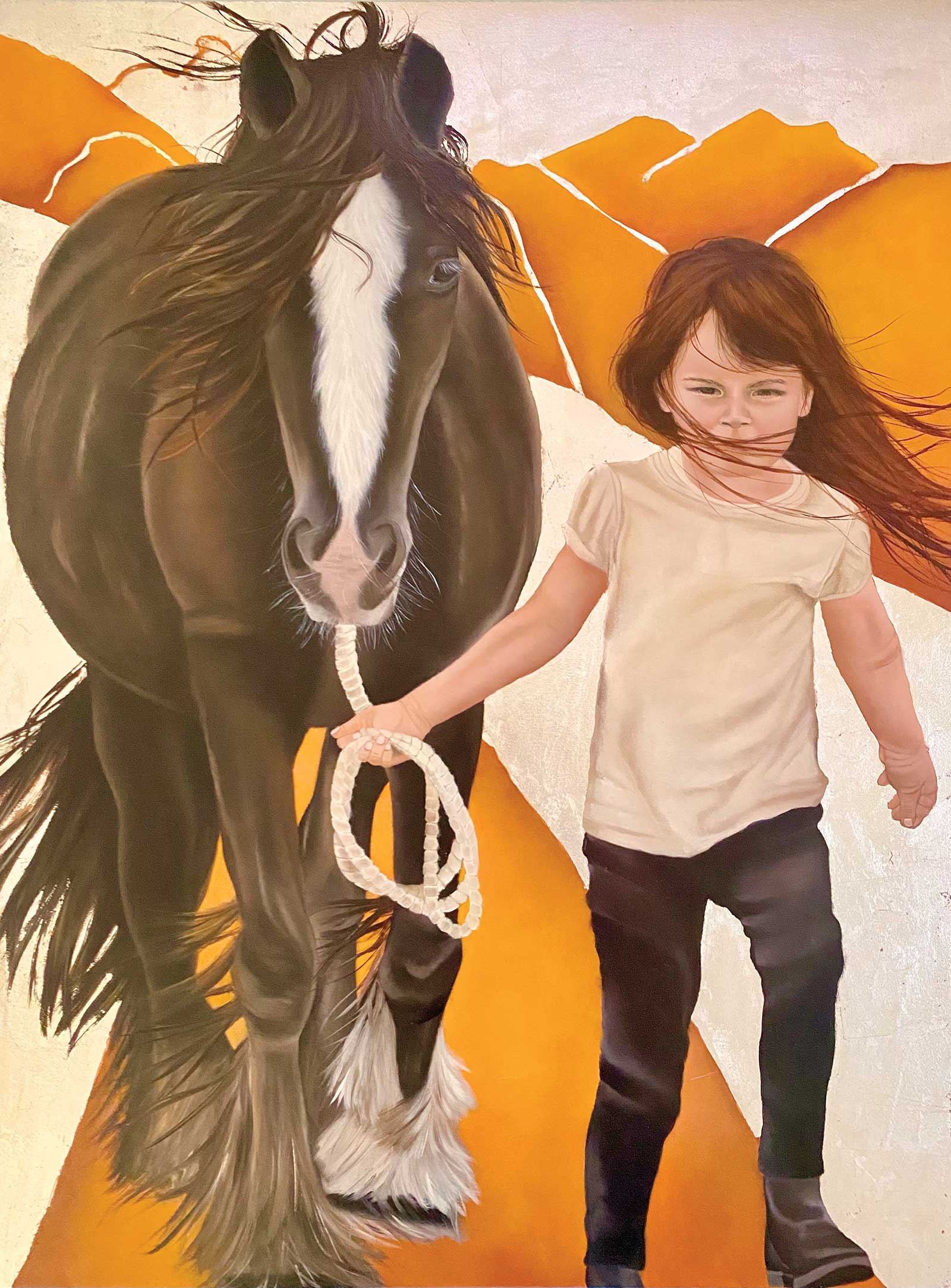
Robin Jones, Do Not Fear the Path (after Dunton’s painting Follering the Tracks), oil and white gold leaf on aluminum panel, 24 x 18”
She continues to explain that “the key elements that spoke to me in Dunton’s The Horse Rustler, were the strong portrait of horse and rider, juxtaposed against Cézanne-esque distant hills. I decided it would be fun to use his basic composition and paint myself riding my favorite horse, Lark of Trinity Ranch. I kept most of Dunton’s modernist look while painting the various forms and vegetation in my painting, but substituted Pueblo Peak in Taos as an identifiable backdrop for the figures. I also painted myself in contemporary clothing to reflect the current times.”
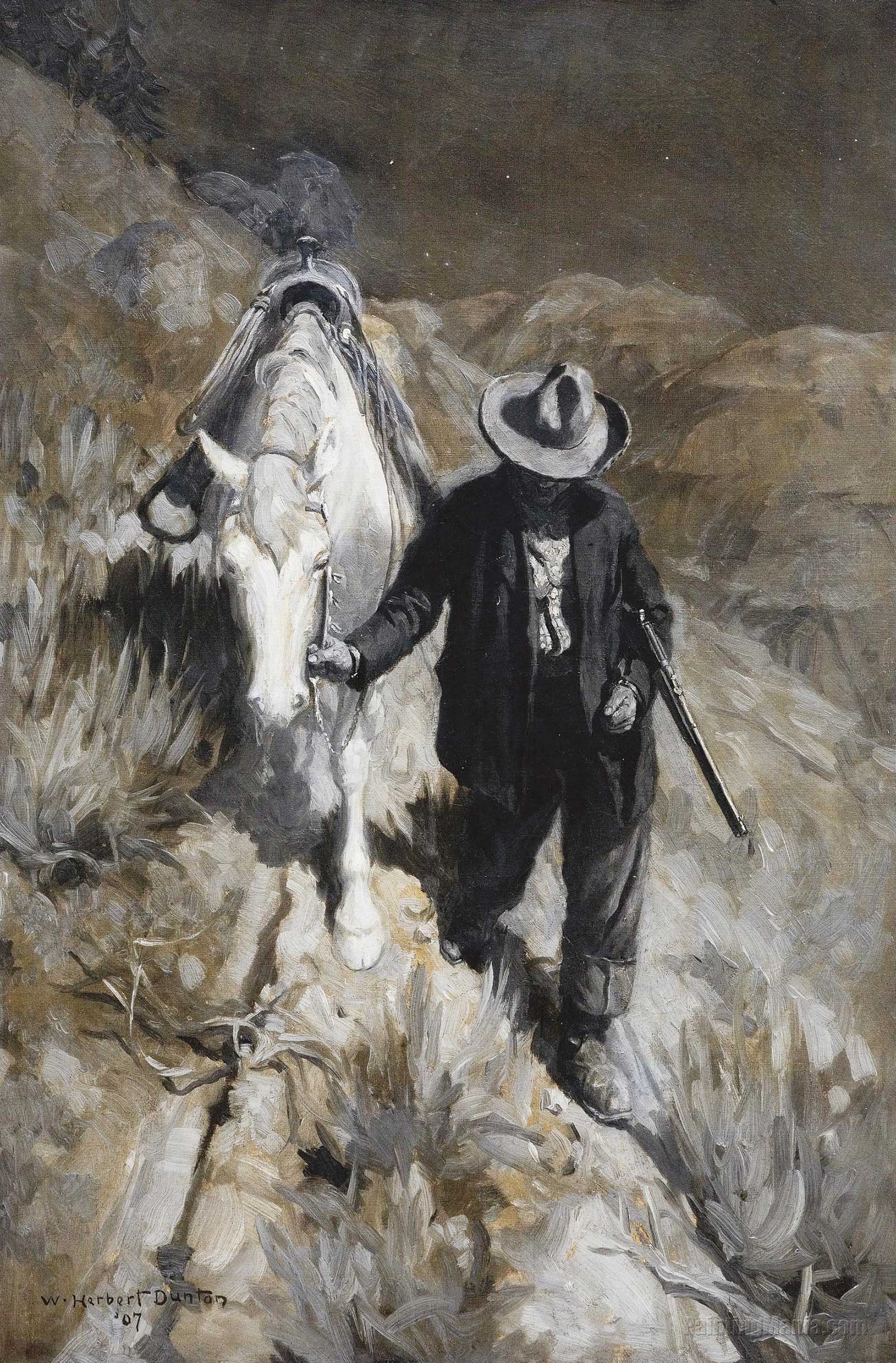
William Herbert “Buck” Dunton (1878-1936), Follering the Tracks, ca. 1929, oil on canvas
For Dennis Ziemienski, Dunton’s striking piece October Gold, from around 1930, depicting a forested landscape with a figure walking toward a giant yellow and gold tree, “is one of his strongest compositions,” he says. “I could hardly resist emulating this masterpiece for Autumn Dusk. I like putting figures in my paintings, so I have a rider leading his horse into the iridescent woods, but those tree shapes are key. Dunton’s work reflects an interpretation of nature that I find appealing. His style is based on nature, but natural shapes—mountains, cliffs, clouds, water, vegetation and even figures—sometimes are reconfigured, so as to create visual magic and depth of the imagery without complete abstraction. I always use this technique in creating my compositions as well.”
Viewers can see a different trajectory in Jim Vogel’s rendition of Dunton’s piece Pastor de Cabras, Neo Mexicano,1926. “The subject is something of a deviation from his usual cowboys, sportsmen and wildlife imagery he’s most remembered for,” Vogel explains. “The young shepherd with his troubled gaze confronts the viewer as an intruder, questioning who could have the gall to bother him and his charges. I reimagined him many decades later in the same familiar environment but under very different circumstances; his herd long gone, his last of a long line of herding dogs at his side (modeled this time after our Aussie/heeler mix Kahlua) and his once-open grazing range fenced off and posted, his herd replaced by the pueblo-style hacienda second home… Most importantly, for me, is the way Dunton mastered the dramatic light of New Mexico, manipulating it to the best advantage in his paintings. This singular talent of his always inspires me.”
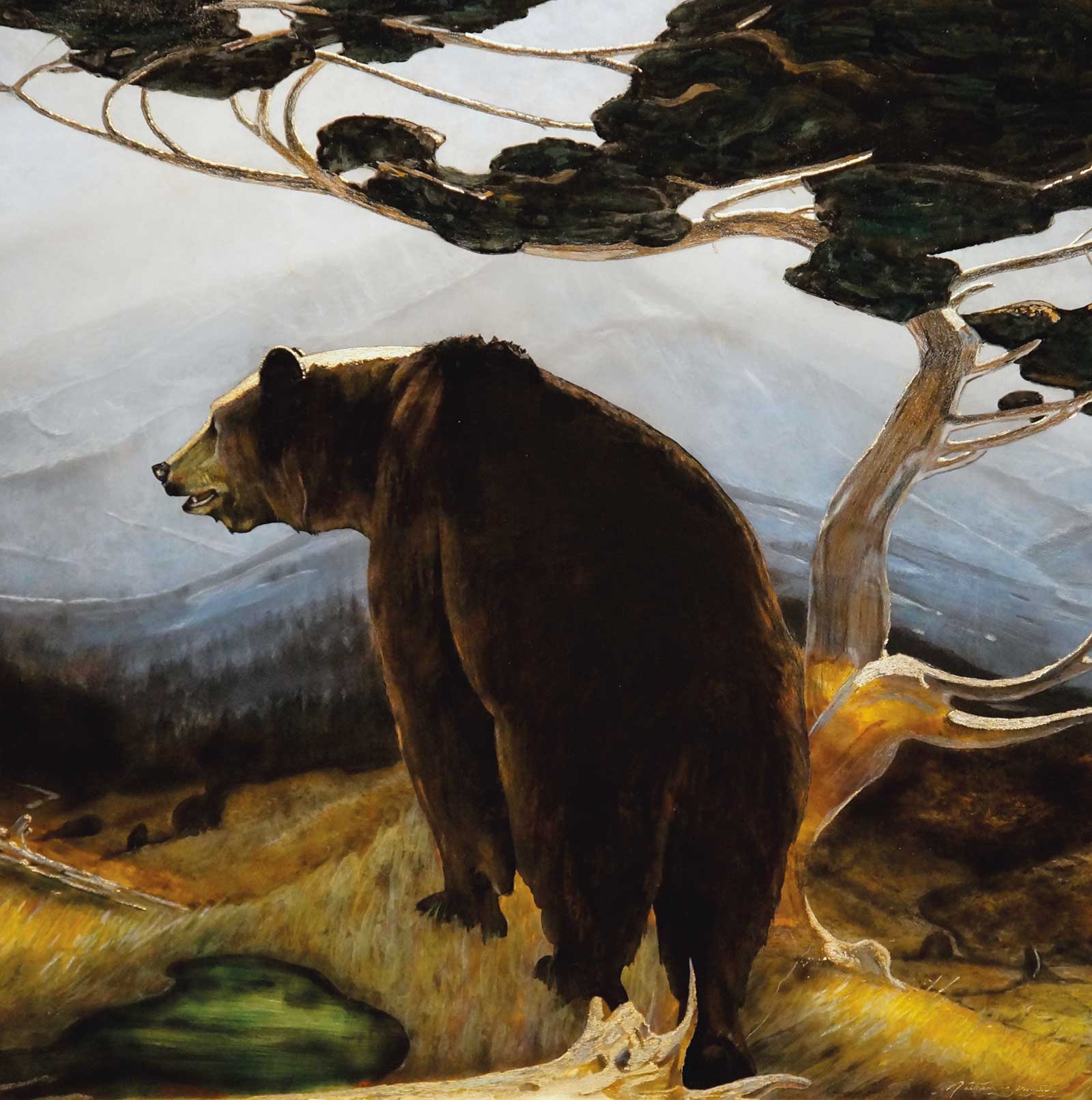
Nathan Bennett, On Top (after Dunton’s painting Timberline), patinas on bronze, 24 x 24”
In yet another rare depiction, we see a bear cozying up next to a tree, and set against a mountainous background in Dunton’s Timberline, 1932, reimagined by Nathan Bennett in On Top. “When I start a painting for one of the Taos Six shows, I dive into the artist’s body of work,” says Bennett. “I look through every image available and choose the painting that speaks to me. Then I try to determine if I can translate it into a patina painting. I like to recreate the original as close as I can, using hot process patina. It’s fun for me to see how close I can get, using my limited palette, without trying to be perfect.”
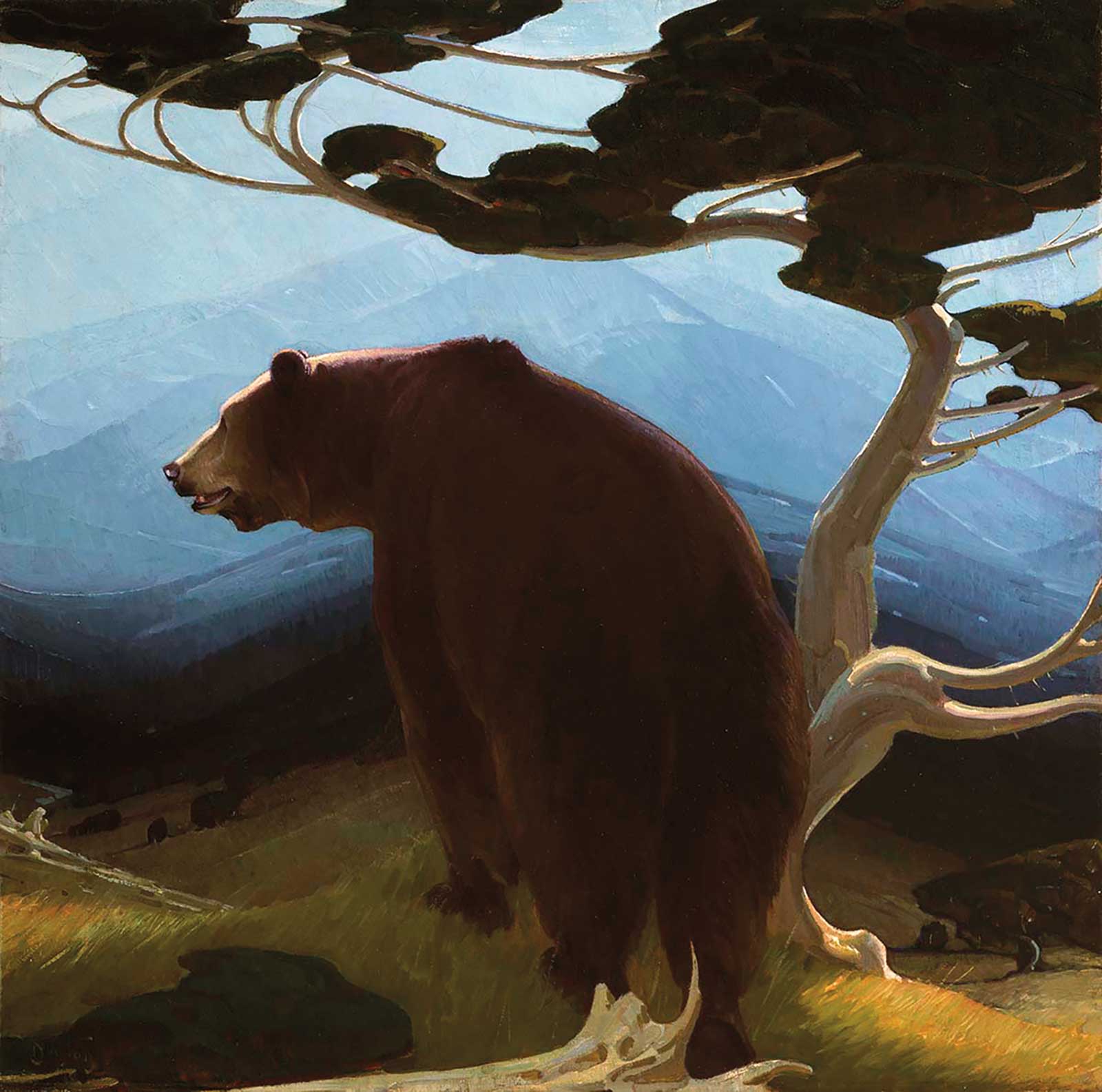
William Herbert “Buck” Dunton (1878-1936), Timberline, 1932, oil on canvas, 30 x 30"
Bennett continues to note that Dunton is one his favorite of the Taos six. “[His] story of moving out to the West to follow his passion embodies the whole spirit of the West and the arts, and is incredibly inspiring to me,” he says. “I had a wonderful time getting to know him through my own process of making art.”
Overall, Phetteplace hopes that viewers will come away from the exhibition with an appreciation for the participating artists taking a creative leap, along with seeing the historical value and a newfound feeling of relevancy. The exhibition, running from April 28 through May 20, will include Dunton stock card images next to the reimagined works by the 15 Blue Rain Gallery artists. —
Taos Six Collection: An Homage to W. Herbert Dunton
April 28-May 20, 2023
Blue Rain Gallery, 544 S. Guadalupe Street, Santa Fe, NM 87501
(505) 954-9902, www.blueraingallery.com
Powered by Froala Editor