The War Partyis both a complex and, in a somewhat surprisingly subtle way, it is also an important work of art with its composition personally selected and carefully crafted by Charles Marion Russell. It provides more useful insights about Russell’s creative artistic process than one might initially surmise. As an oil on canvas at 22 by 36 inches, its size is consistent with early Russell special works of that era. Because it relates to the tensions emerging from the pressures of Manifest Destiny, it strongly confirms Russell’s willingness to forthrightly depict a challenging image involving the Native American perspective on immigrant incursions and Western settlement.
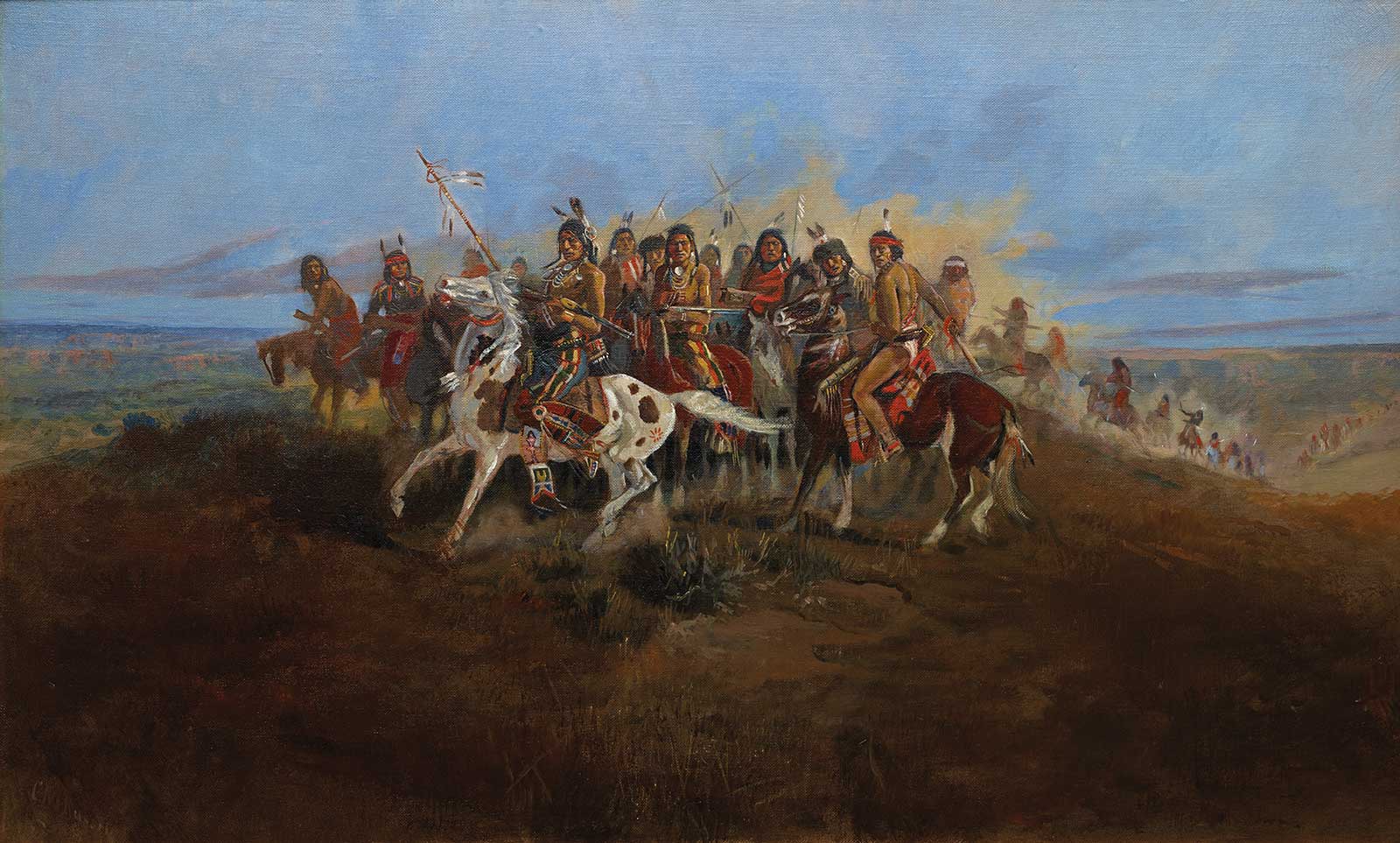
Figure 1
Charles M. Russell (1864-1926), The War Party, ca. 1896, oil on canvas, 22 1⁄8 x 36”. Featured for sale at The Russell, March 14-16, 2024, Great Falls, Montana.
Most interestingly, in the century and a quarter since its creation, it seems to be among only a handful of Russell paintings to have virtually circled the globe. During its ownership by the Armand Hammer Foundation, as well as its successor, the Armand Hammer Museum, its exhibition history includes some two dozen-plus events. Fifteen of these included appearances in noteworthy museums and galleries all across the United States. Almost, another dozen included six different displays across Russia, as well as ones in China, Yugoslavia, Hungary, Czechoslovakia and Israel. In sum, it is difficult to identify another major Russell work with a more far-ranging, even peripatetic travel experience for its exhibitions.
This painting is also important because it tells us much about how Russell’s confidence is building early after his marriage to Nancy Russell, as he takes on the challenges of depicting an image of eye-catching magnitude with such a variety of mounted Native Americans. In this case, Blackfeet warriors led by a lance-bearing chief on a cleverly distinguished appaloosa horse are dramatically converging atop a hill. That feature provides a wide view of a caringly positioned Montana landscape. A sense of action occurs as more than a dozen individually differentiated figures first come together in the hilltop foreground. This event is then amplified by the rising dust cloud backdrop created by the rest of the band’s arrival. In addition, the overall significant size of the party of braves is underscored by the still trailing arrival of even more figures coming up in the painting’s right center.
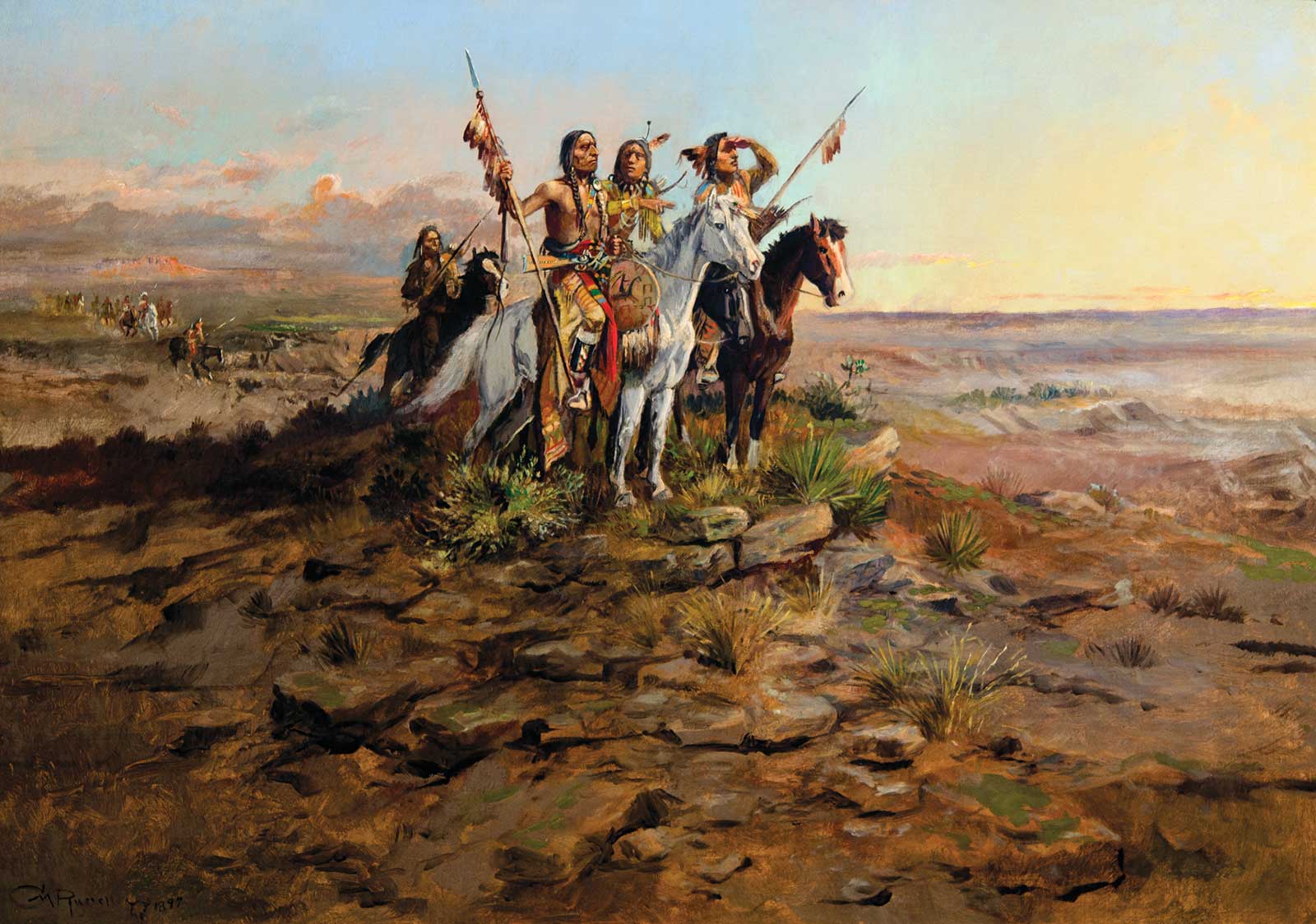
Figure 2
Charles M. Russell (1864-1926), The Approach of the White Men, 1897, oil on canvas, 24 x 34”
The sparse, dark foreground tends to concentrate the viewer’s eye on the mounted leaders of this band of Blackfeet. The eggshell-blue sky signals this to be in the heart of 19th-century Big Sky Montana. On the center left of the composition, there is the hint of a deeper valley, which invites viewer curiosity about the likely rugged landscape in the valley below.
In sum, this very thoughtfully composed Russell image strongly foreshadows numerous artistic techniques that will also show up in Russell’s soon-to-emerge next decade’s round of increasingly effective masterworks that each continue to facilitate viewer engagement. Among others, good examples include The Holdup (1899), The Horse Thieves (1901), The Broken Rope (1904) and Smoking Them Out (1906), as well as Trouble Hunters(1910).
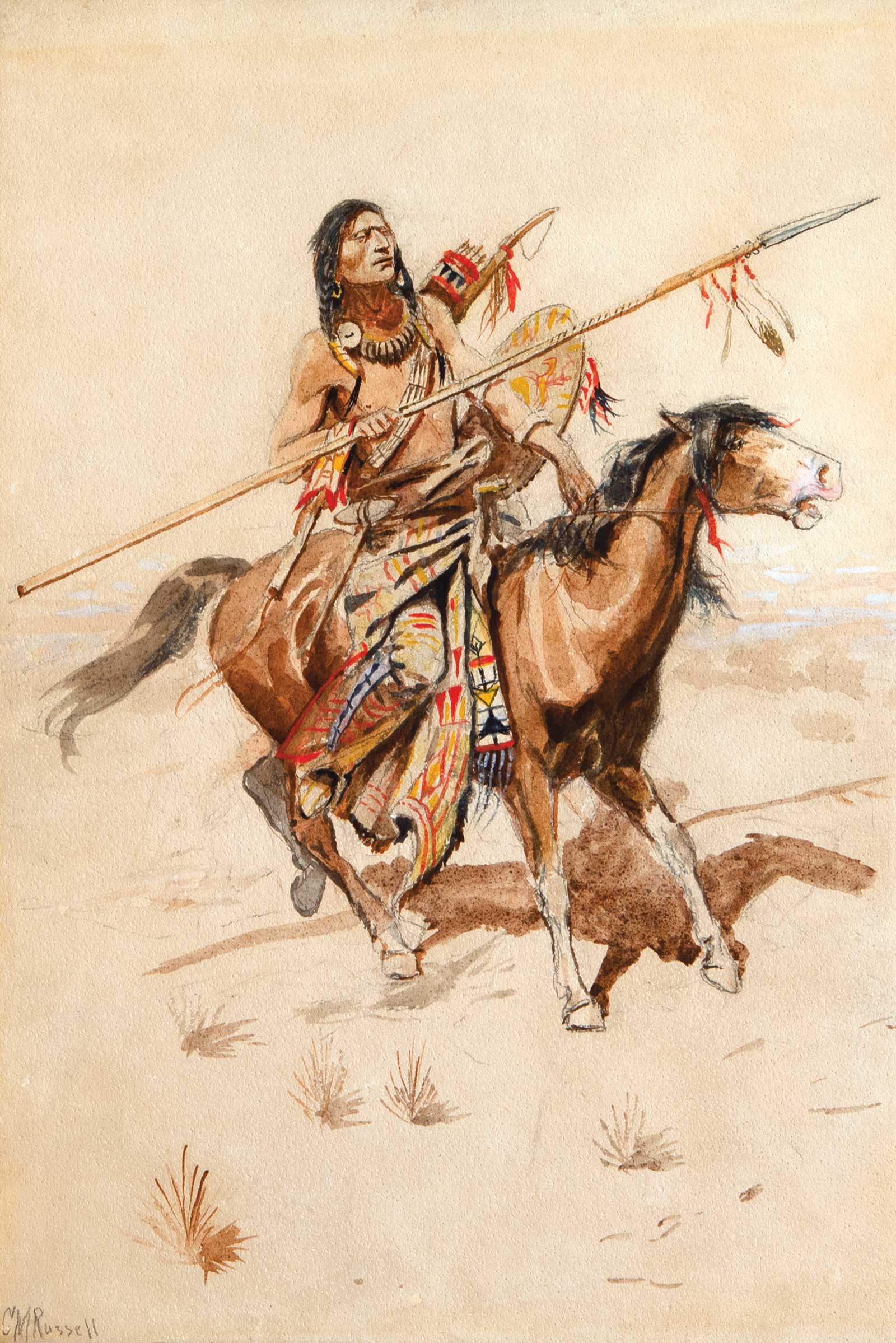
Figure 3
Charles M. Russell (1864-1926), On the Warpath, 1892, watercolor on paper, 15½ x 10½”
War Party was executed circa 1896. Thus, it was likely created in either the same year or possibly less than a year after his marriage to the hard-driving Nancy Cooper (Russell). Accordingly, this was also no more than several or so years following Russell’s 1894 engagement by U.S. Army officer John H. Beacom to create a series of seven images illustrating Beacom’s book about a Blackfeet folklore tale. That publication describes how Indians came to “live on the flesh of the buffalo.” It is titled How the Buffalo Lost His Crown. This was Russell’s first significant commission for illustrating a book. Many more would follow. In this case, the story ultimately proved to be a likely factor contributing to the artist’s rapidly growing understanding of and deepening empathy for the challenges then facing the Native Americans. All this was occurring as the wave of Manifest Destiny was propagating itself across the West.
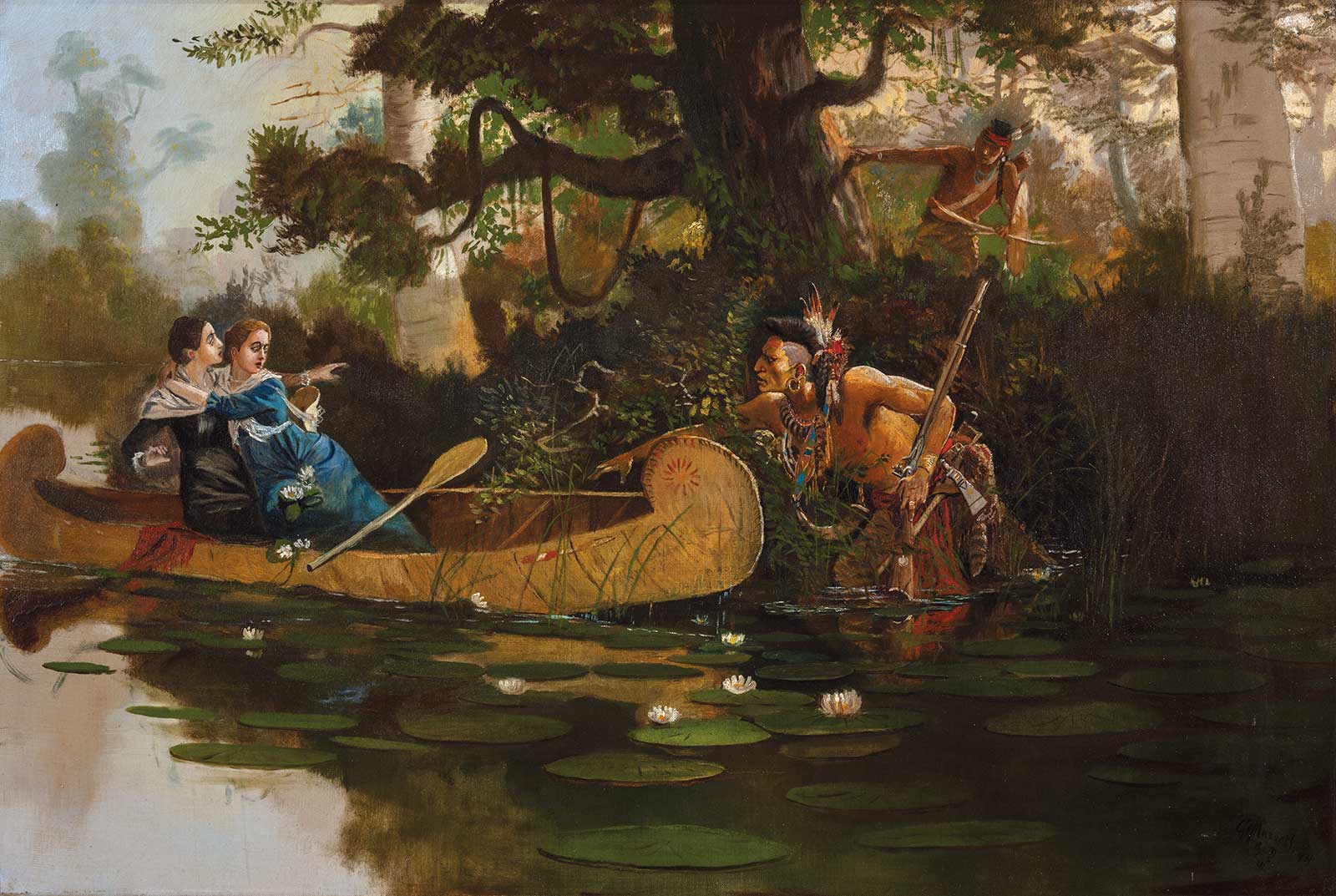
Figure 4
Charles M. Russell (1864-1926), The Capture of Laura Edgar, 1894, oil on canvas, 23¼ x 353/8”
As a result, the artist came into ever-closer alignment through his deepening appreciation for the Blackfeet Indian’s views about their confrontations with new settlers pursuing westward expansion. Russell’s sensitivity to these issues is also evident in at least two other paintings (one an oil and the other a watercolor) that he completed in that period. The Approach of White Men (1897) and On the Warpath (1892) are shown in figures 2 and 3, each of which also demonstrate Russell’s willingness to address the Native American concerns involving rising tensions across the Montana landscape.
However, for The War Party, Russell’s much-elevated sense of antagonistic human confrontation in this composition goes well beyond what we see in his other contemporaneous works. These last few end-of-the-19th-century years were also financially challenging for the newly married Russell couple. They lived in a modest cabin behind the home of Russell’s saddle maker, Ben Roberts, in the Village of Cascade just 26 miles west of Great Falls. Charlie sometimes fondly referred to it as a shack. Nancy Russell makes clear in her biography of Charlie titled Back-Tracking in Memory: The Life of Charles M. Russell, Artist,they were struggling to make ends meet as she touchingly recalls: “There was little chance to get orders for pictures in such a small town [as Cascade], so we moved to [the newly electrified and bustling, but barely a decade old city of] Great Falls [in September 1897] where Charlie could meet a few travelers and get an occasional order. Charles Schatzlein of Butte, Montana, was a good friend. He had an art [and painting supply] store and gave Charlie a good many orders, making it possible for us to pay our house rent and food, but Charlie said the grazing wasn’t so good.
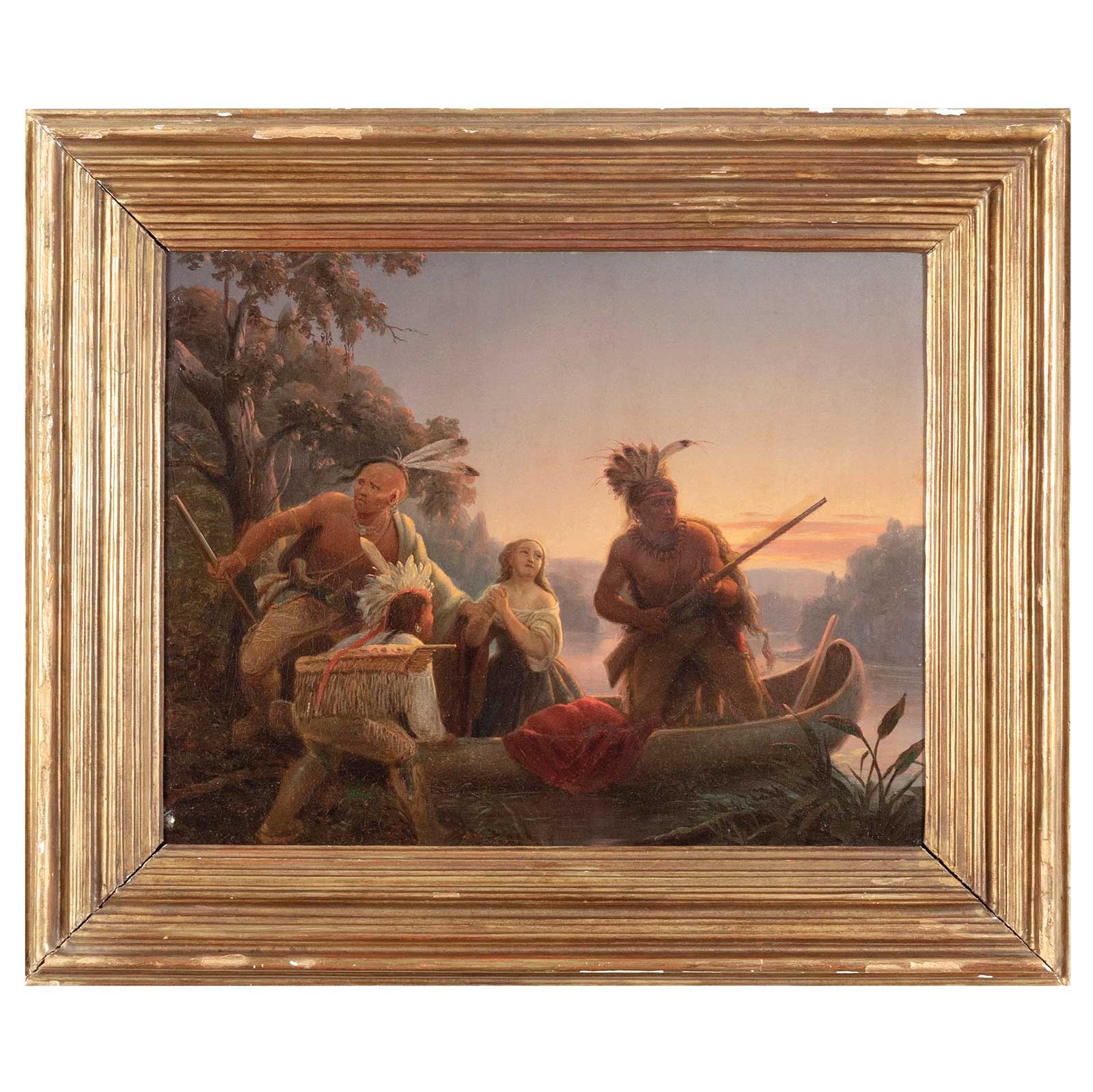
Figure 5
Charles Wimar (1828-1862), The Abduction of Daniel Boone’s Daughter by the Indian, ca. 1853, oil on canvas, 15½ x 18¾”
During one visit to our house, Mr. Schatzlein said, “Do you know, Russell, you don’t ask enough for your pictures. That last bunch you sent me I sold one for enough to pay for six. I am paying your price, but it’s not enough. I think your wife should take hold of that end of the game and help you out.”
From that time on, the prices of Charlie’s work began to advance until it was possible for us to live a little more comfortably.”
Over time, no doubt with Charles Schatzlein’s continuing encouragement and assistance, Nancy became, in effect, the chief marketing officer for the Charles M. Russell art enterprise. She was a quick study. Nevertheless, that still required the effective selection (presumably sometimes jointly) by this aspiring couple of appropriate compositional subjects. In his earlier periods and phases of professional development (before marrying Nancy), Charlie typically would rely for his subject matter on using his personally recalled, decade-plus experiences as an open-range cowboy. These memories provided numerous opportunities to capture and depict: 1) Humorous events (i.e., The Tenderfoot); 2) cowboy action/entertainment (Roping a Wolf); and 3) many aspects of plains Indian culture (various buffalo hunts and stories about nomadic tipi camp life such as Indian Women Moving Camp). Because of the implicit (as well as explicit) intense animosity evident in the image for The War Party and the size and overall complexity of this painting’s configuration, one is left to wonder: what could possibly have motivated Russell to pursue this subject involving an almost uniquely large band of armed Indian braves as a matter for his artistic focus at that particular time?
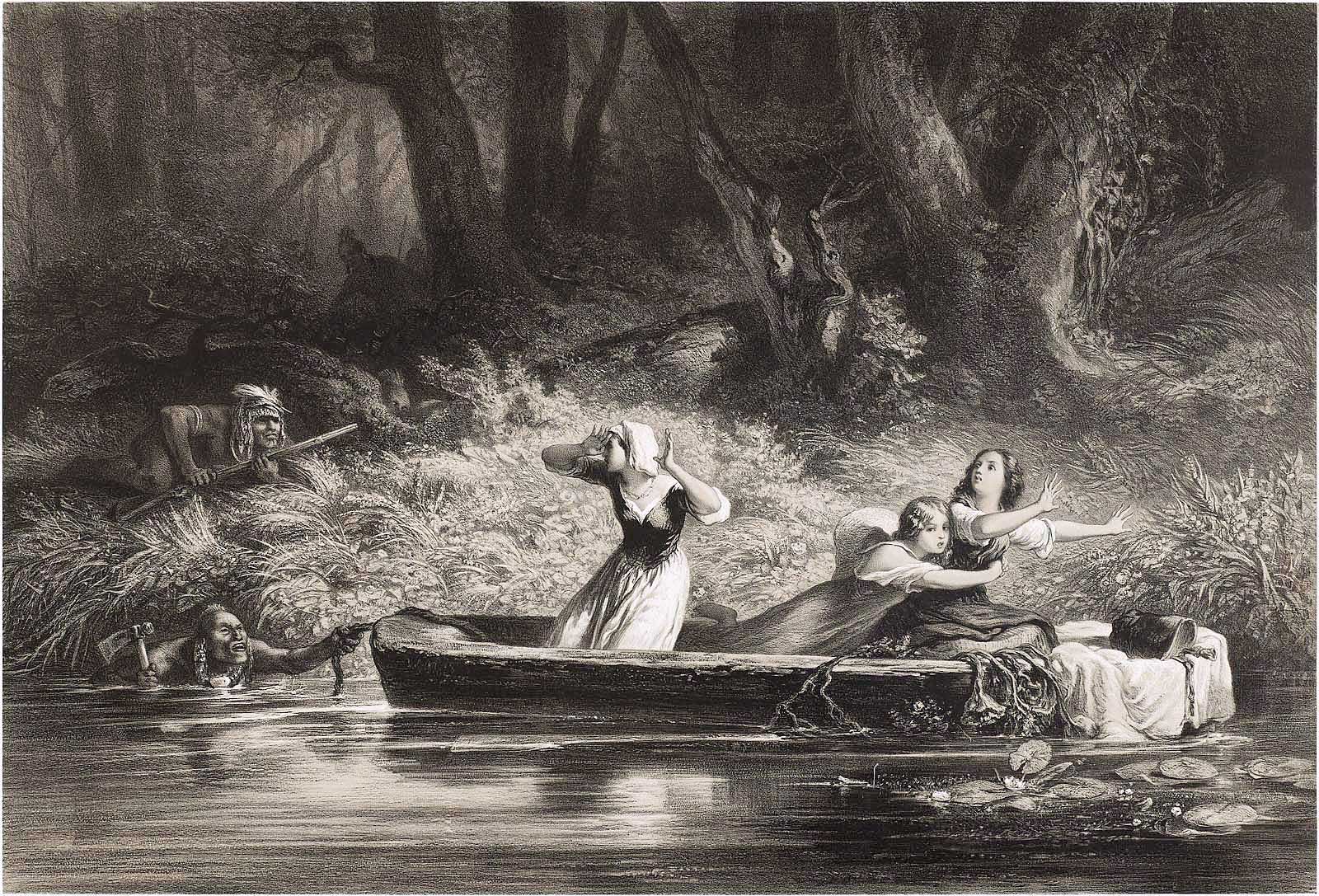
Figure 6
Karl Bodmer (1809-1893) and Jean-François Millet (1814-1875), Capture of the Daughters of Daniel Boone and James Calloway, 1851, lithograph with tint stone on off-white wove paper, 14¼ x 211/8”
By the late 1890s, Custer’s wipeout of the 7th Cavalry at the Little Big Horn had occurred over two decades earlier. It was a fading (or even faded) memory. Most of the Northern Plains tribes had by this time now been removed to reservations with only limited ability to pose sustainable threats to new incoming settlers. The Wounded Knee Massacre had also already occurred in late 1890, with notable public anguish across the nation regarding the atrocious deeds by the U.S. Army troops involved.
On Page 101 in Back-Tracking in Memory, Nancy tells us that shortly after moving from Cascade to Great Falls, Charlie painted a large 6-by-4-foot canvas titled The Trapper’s Last Stand. For this, Russell received $105. Subsequently, in the appendix to Nancy’s C.M. Russell biography, we learn that the first purchaser sold “raffle” tickets each for one dollar. The winning ticket for that event went to a banker who resold the painting to another banker for $5,000. This was not a insignificant price for a work of art in late 19th-century America! It would be roughly equivalent to $150,000 a century later.
Could the interest of apparently 100-plus raffle ticket buyers have played a reinforcing role in Russell’s deciding to paint The War Party? Possibly, yes, and maybe it is even especially likely given Nancy’s well-attuned “market value” mindset. In any case, Nancy was there to observe the actual market event and at least factor it into her future transaction judgments on pricing Charlie’s art. The record is clear as she did this many times in subsequent years.
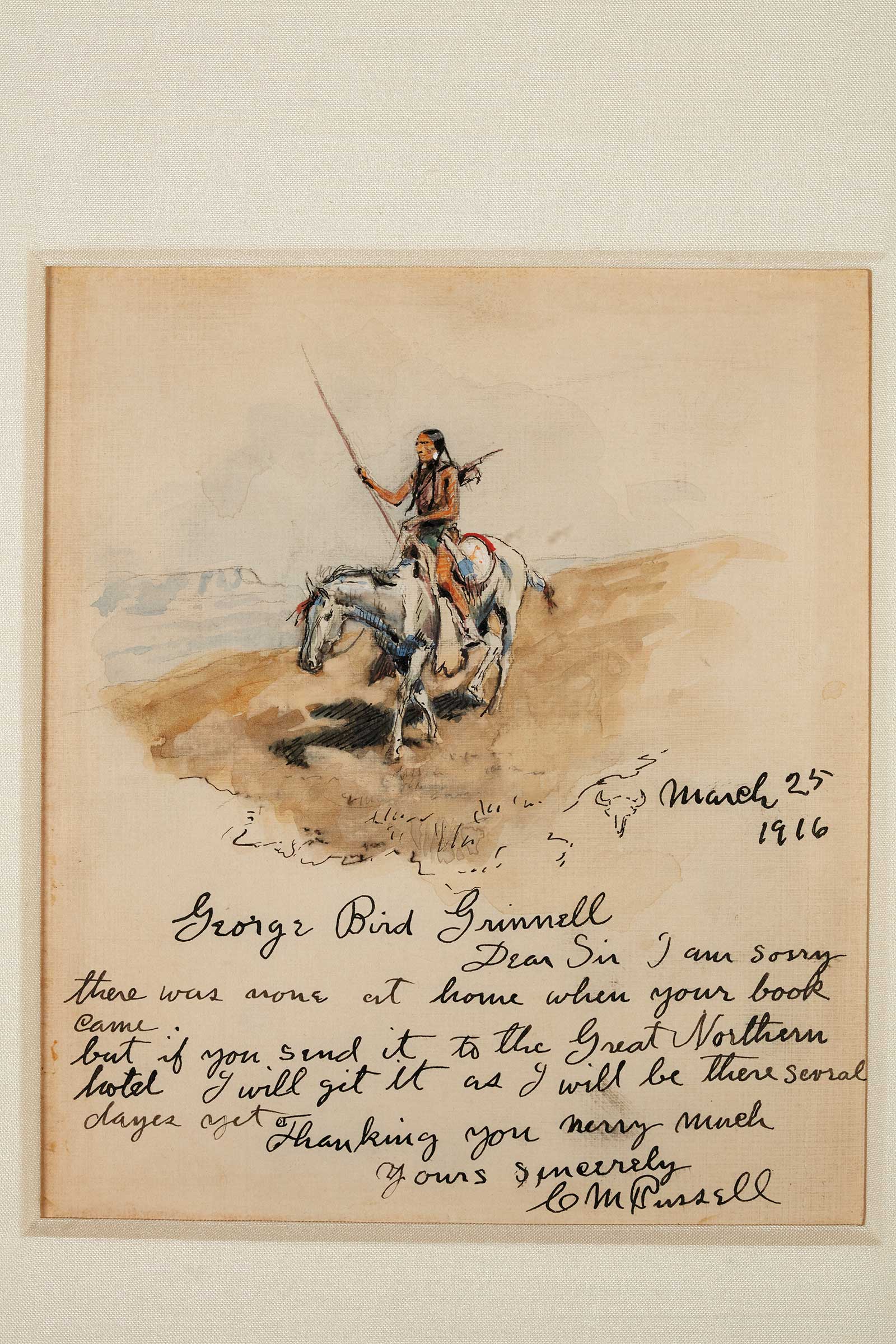
Figure 7
Charles M. Russell (1864-1926), Letter to George Bird Grinnell, 1916, ink and watercolor on paper
It is noteworthy that, over the last two decades of the 19th century, other Indian interactions in Western America were making national news that may have also motivated Russell’s decision to execute The War Party. As a result, it comes across as intentionally and ferociously threatening. Yet, at the same time, it is also perhaps the artist’s implicitly admiring statement about the legendary warlike and courageous nature of the Blackfeet Indian tribe.
Elsewhere, in Arizona in the latter two decades of the 19th century, the Apache Indians were proving to be among the last strong holdouts by refusing to peacefully accept relocation to a sedate, reservation-based existence. Mike Leach and Buddy Levy have detailed in a recent book, Geronimo-Leadership Strategies of an American Warrior, how this leader of the Chiricahua Apache Tribe was essentially the single most prominent Native American chief in the mid-1880s, still free and fiercely fighting for his tribes’ freedom.
As the noted historian S.C. Gwynne, author of Empire of the Summer Moon has observed about this more recent book, “Geronimo is a wonderful study of character and power: getting it, wielding it, keeping it.” Gwynne’s Summer Moonaccount describes in detail the Cynthia-Ann Parker legend stemming from her kidnapping by Comanches at the age of 9 years old.
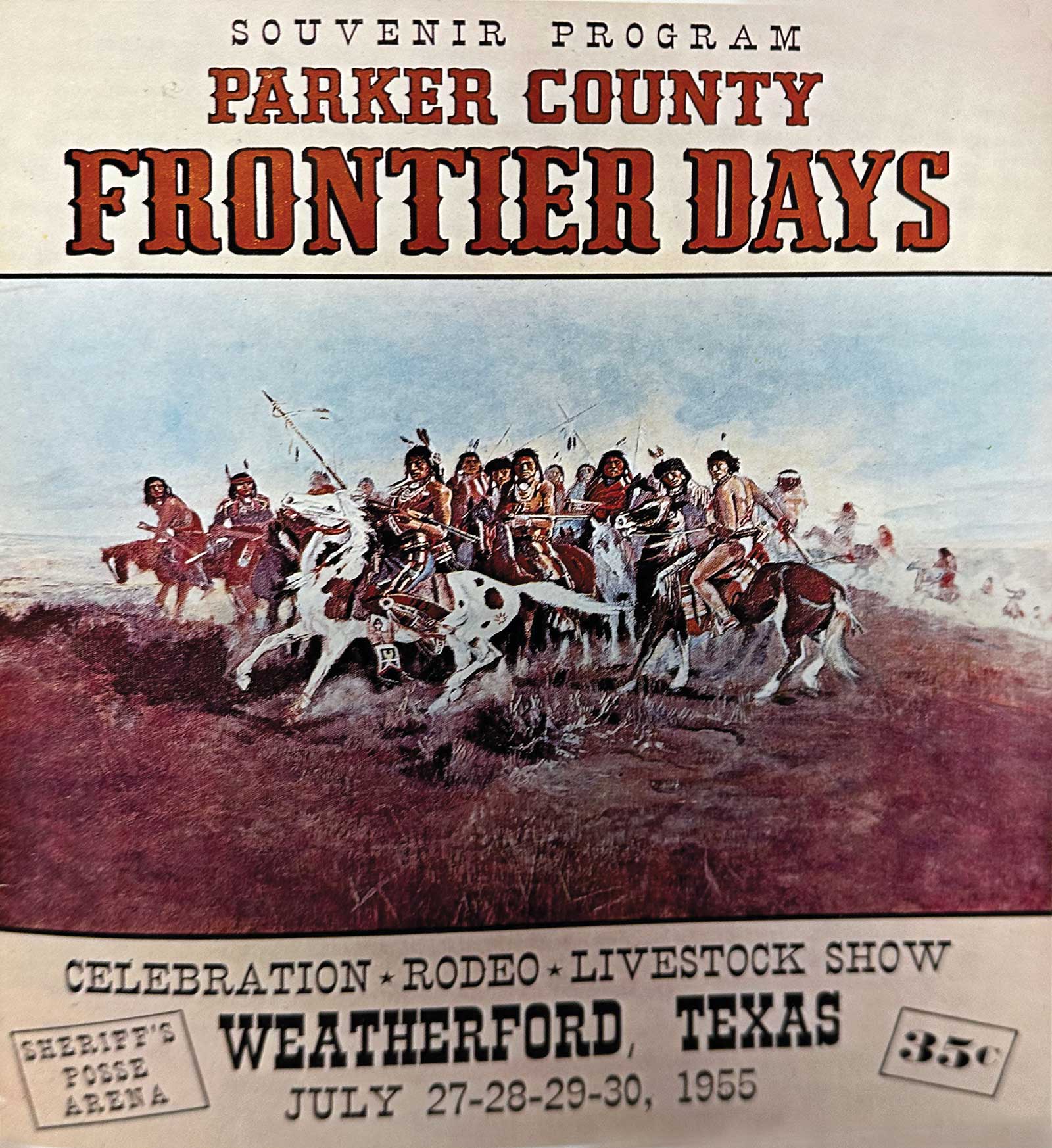
Figure 8
Souvenir program of the 1955 Parker County Frontier Days Celebration Rodeo Livestock Show with Charles M. Russell’s The War Party on the cover.
Gwynne’s own book was a finalist candidate for the Pulitzer Prize in 2010. That story began to unfold in 1836, almost three decades before Charlie Russell was born. However, Cynthia Ann’s multi-decade period of Comanche acculturation ultimately resulted in a fiercely reluctant return to the surviving remnants of her white Texas family. This all became evident over a quarter century later in the middle of the Civil War. That was an ongoing publicly resonating tale of wide and regional, even near national, news just as Charlie was growing up in St. Louis. So, there is some reason to believe, or at least surmise, that Charlie had a degree of awareness of Parker’s capture and long captivity following, as well as possible knowledge about another story about an analogously famous “war party” Indian, the legendary leader Geronimo.
This admittedly speculative conclusion is further reinforced by Russell’s almost explicit evidence of awareness of the story about the abduction of Daniel Boone’s daughter by Indians a half century earlier. A strikingly close facsimile image of which is evident in Russell’s completing his 1894 composition titled The Capture of Laura Edgar (see Figure 4). That painting seems likely inspired by two similar earlier works depicting the Boone daughter’s kidnapping. These were artistically executed by Carl Wimar and Karl Bodmer. Thus, Figures 5 and 6, compared to Figure 4, provide good reason to believe that Russell had previous familiarity with that story. Total or absolute proof of this conclusion is not possible. However, the evidence of Russell’s attention to Indian and white settler interactions does seem to be particularly noteworthy here.
Furthermore, there is also the fact of Cynthia-Ann’s having had conceived with her Comanche Chief husband, Peta Nocona, a “mixed-breed” son named Quanah Parker. He ultimately became high-ranking and thoughtfully sensitive among the last leaders of the Comanches. S.C. Gwynne aptly describes that process as the final period of unfettered activity by arguably “the Most POWERFUL INDIAN Tribe in American history.”
Charlie Russell may have had intriguing additional motivation for the Quanah Parker story also to resonate. Russell himself had an uncle, George Bent, who was also of mixed heritage. With both a Cheyenne mother and a white father, George was the son of Charlie’s legendary great uncle William Bent (Russell’s grandmother’s brother). George’s mother, Owl Woman, was the daughter of White Thunder, widely considered the Cheyenne tribe’s most revered holy man. In fact, he was the tribe’s “Keeper of the Sacred Medicine Arrows.” George Bent was an important and, by some measures, a critical firsthand source for George Bird Grinnell’s book The Fighting Cheyennes. At the ghastly Sand Creek Massacre in Colorado in 1864, George Bent was personally present and became a wounded survivor. That devastating example of a white betrayal event occupies the entire 14th chapter of George Bird Grinnell’s book. Given Charlie Russell’s personal acquaintance with Grinnell, it is possible that Charlie Russell would be aware of this fact.
From the mid-1880s to well into the next decade, Geronimo’s exploits waging guerilla warfare in Arizona also became widespread national news. Therefore, it should not be surprising that Charlie Russell would have had the opportunity to become well informed about the Apache successes in challenging the U.S. Army’s ability to keep Geronimo and his warriors confined on reservations, especially including at San Carlos in Arizona. In the Great Falls Tribune, from the late 1880s to 1896, there were more than a dozen reported incidents of Geronimo’s escapes, marauding attacks and other aggressive, even traumatically violent raids by Geronimo in Arizona. Thus, Charlie’s ability to follow Geronimo’s nationally reported exploits was readily available just down the street at his hometown newspaper.
Another reason to suspect that Russell might be paying attention to the news involves the successes of generals George Crook and Nelson Miles in dealing with the Sioux Indians on the northern plains in the early 1880s. Following those campaigns, these military leaders were subsequently relocated and reassigned to deal with the Chiricahua Apaches in Arizona. Russell’s awareness of and interest in General Nelson A. Miles’s activities in Montana prior to being reassigned to Arizona is at least suggested by his painting in Montana of Indians on a Bluff Surveying General Miles Troops (1889), 23 by 35½ inches, now in the collection of the Buffalo Bill Historical Center in Cody, Wyoming, a gift of William Weiss.
A final reason that Russell would have been motivated to follow what was happening with the Apaches in Arizona was that his high-profile fellow contemporary peer Western artist Federic Remington was engaged with the U.S. Army there observing and reporting for publication on the Apache campaigns. Interestingly, in that period, Remington executed the painting titled Pursuing Geronimo.
All in all, for Charlie Russell, there were many reasons described here to be either already somewhat informed or at least curious about the subject matter leading up to the creation of The War Party. Accordingly, it should not be surprising that the artist would be motivated to develop a composition such as shown here. It then becomes clear that the selected theme is not nearly as unusual as it might initially appear. In fact, for such a composition to be one of Russell’s earliest and most focused works completed on a relatively large oil seems almost likely now as his career was unfolding. This conclusion is further reinforced by the work being a potentially valuable canvas for Nancy to become motivated to sell at a good price, which, given the foregoing considerations, seems almost inevitable and perhaps even predestined or preordained!
It is interesting to note one final and perhaps only mildly coincidental linkage between C.M. Russell’s War Party masterwork and the previously described Cynthia Ann Parker legendary story prevailing in Texas. In their 1971 impressively comprehensive Bibliography of the Published Works of Charles M. Russell, published by the University of Nebraska Press, Karl Yost and Frederic G. Renner identified a published image titled War Party #3. It is a very close counterpart to Russell’s War Party image. On page 185, Item #85 describes what likely seems to be the licensed use of the War Party image as the featured cover of the 1955 Parker County Frontier Days Celebration Rodeo Livestock Show that occurred in Weatherford, Texas, from July 27 to 30 of that year. Opposite page 186 is the image shown here as Figure 8.
By Gwynne’s account, after Cynthia Ann was “recaptured” (or freed) from Comanche control during the Battle of Pease River and because both of her parents had passed, her uncle Isaac decided to take her back home with him to Birdville (now Haltom City), Texas. “On the way, they passed through Weatherford—the seat of Parker County, where the worst of Peta Nocona’s raids had taken place—and then stopped in Fort Worth, where Cynthia Ann became an instant celebrity.” Gwynne’s full and sensitively delivered account of Cynthia Ann’s exceedingly difficult reintroduction into “white civilization” after almost a quarter century of Comanche acculturation, was probably an important factor contributing to the book’s candidacy as a finalist for the Pulitzer Prize. In turn, the War Party’s selection for the rodeo souvenir program’s cover also speaks directly to how and why this Russell masterwork has proven to be still so resonant in Texas history almost three decades after the artist’s death and almost 70 years after the painting’s creation. —
Images courtesy Thomas A. Petrie and C.M. Russell Museum
Powered by Froala Editor