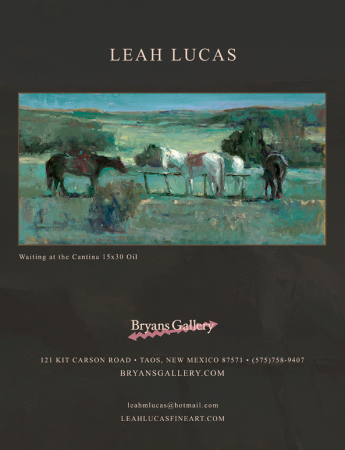
When we think of horses and the West, we most often think of bucking broncos, old Western shootouts, cattle drives and other rough and tumble activities. But just as the cowboy needs some R&R, sleep in the bunk house or beer and cards in the cantina, horses need a change of pace, some maintenance and some rest.
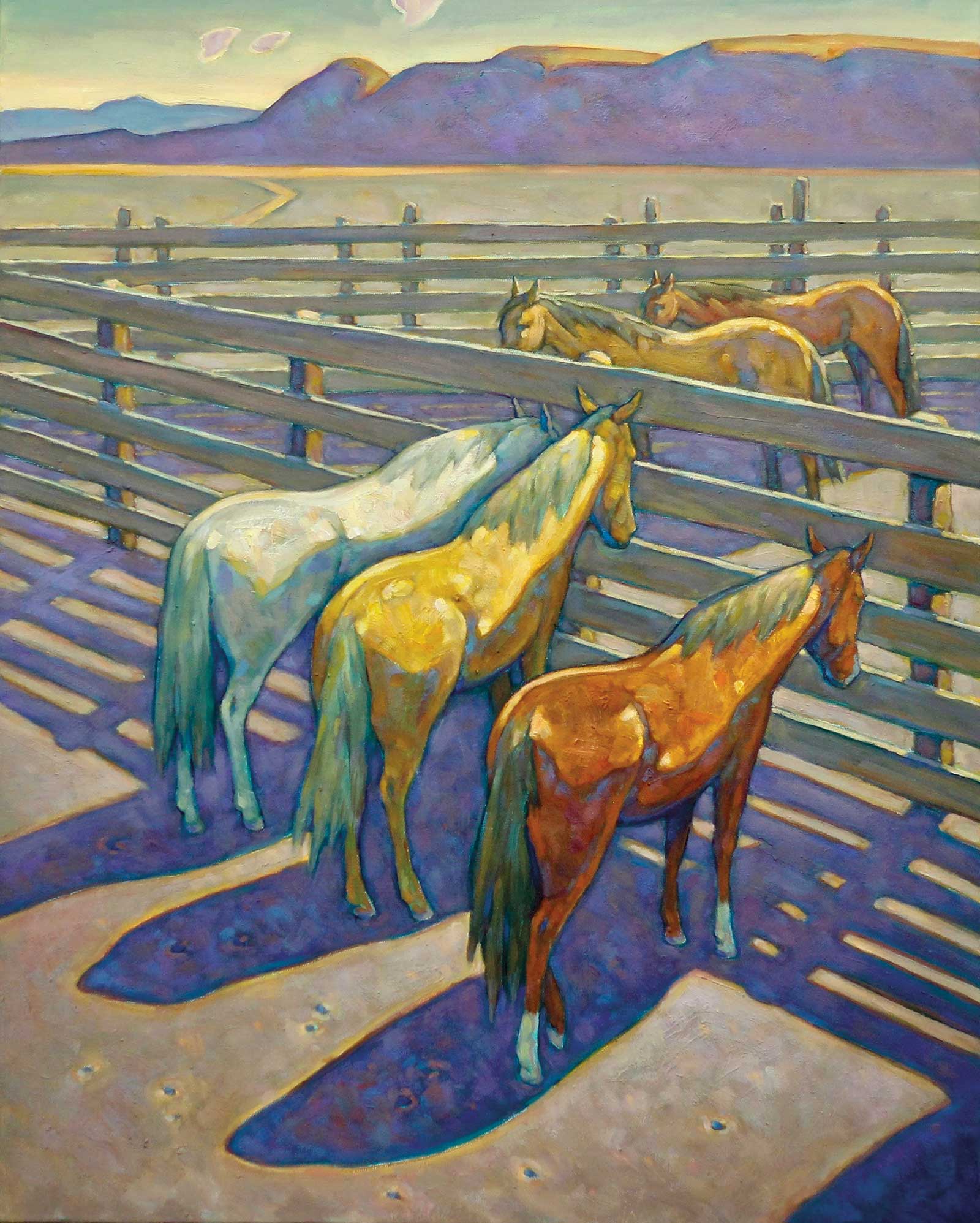
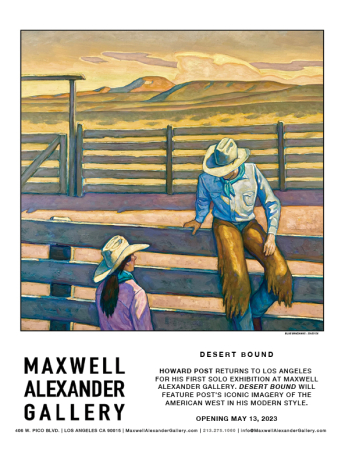
Mark Sublette Medicine Man Gallery, Three Mares, oil, 30 x 24”, by Howard Post.
Howard Post was raised on a ranch in Arizona, became a cowboy, competed in rodeos, received his MFA and worked as a commercial artist before dedicating his life to portraying ranch life in his oil and pastel paintings. Often, his horses and riders are taking a break. A unique aspect of his art is views of daily life and work on the ranch from a high perspective, emphasizing the forms of buildings and animals with his characteristically contemporary impressionist style. His early career as a commercial artist brings a sense of form and design to his work. In Three Mares, the sun sets at the end of a long hot day, casting the distant hills into shadow and casting the shadows of horses and corrals on the ground. The penumbra outlining the shadows suggests the heat of the day.
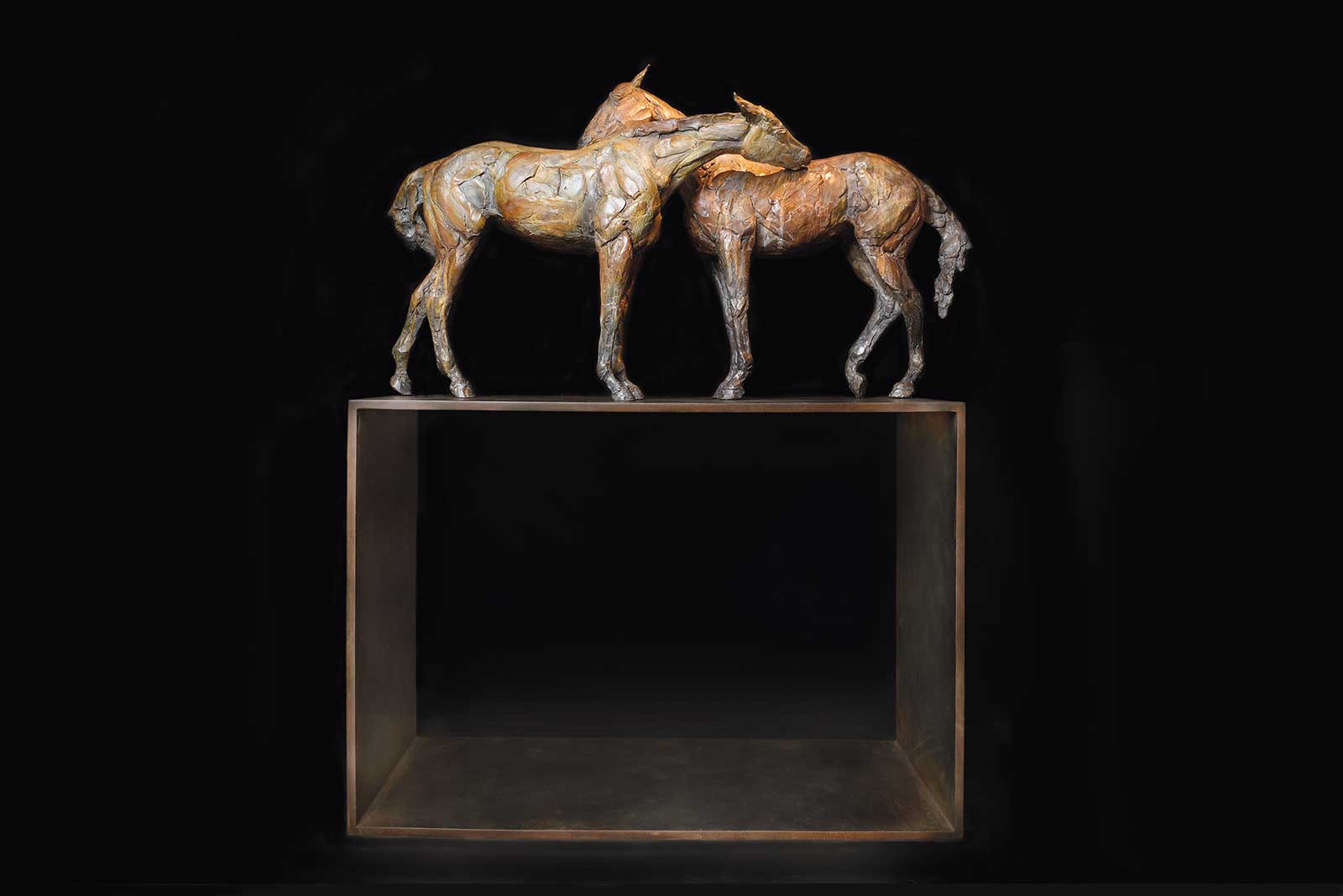
Gallery MAR, Mutual, bronze with steel base, ed. of 21, 63 x 53 x 18”, by Stephanie Revennaugh.
Just as our cars need an oil change or new tires, horses need to have their hooves shaved and their shoes replaced—often every four to six weeks. Proper shoeing helps protect their hooves, provides improved traction and can correct any problems with the horse’s balance. A key element of the procedure is the farrier’s positioning of himself and the horse that assures the comfort and safety of both.
There is an old proverb, “For Want of a Nail”:
For want of a nail the shoe was lost.
For want of a shoe the horse was lost.
For want of a horse the rider was lost.
For want of a rider the message was lost.
For want of a message the battle was lost.
For want of a battle the kingdom was lost.
And all for the want of a horseshoe nail.
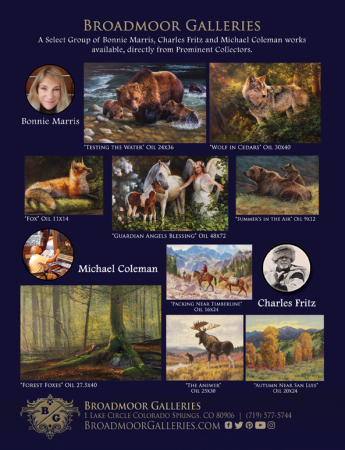
In Mikel Donahue’s mixed media drawing, For Want of a Nail, the farrier, trusty tool box by his side, replaces the missing nail. Donahue is a member of Cowboy Artists of America whose mission is, “To authentically preserve and perpetuate the culture of Western life in fine art.”
Donahue learned about ranch life from his grandfather who had a ranch in Oklahoma and took him to the Gilcrease Museum in Tulsa and what was then the National Cowboy Hall of Fame in Oklahoma City.
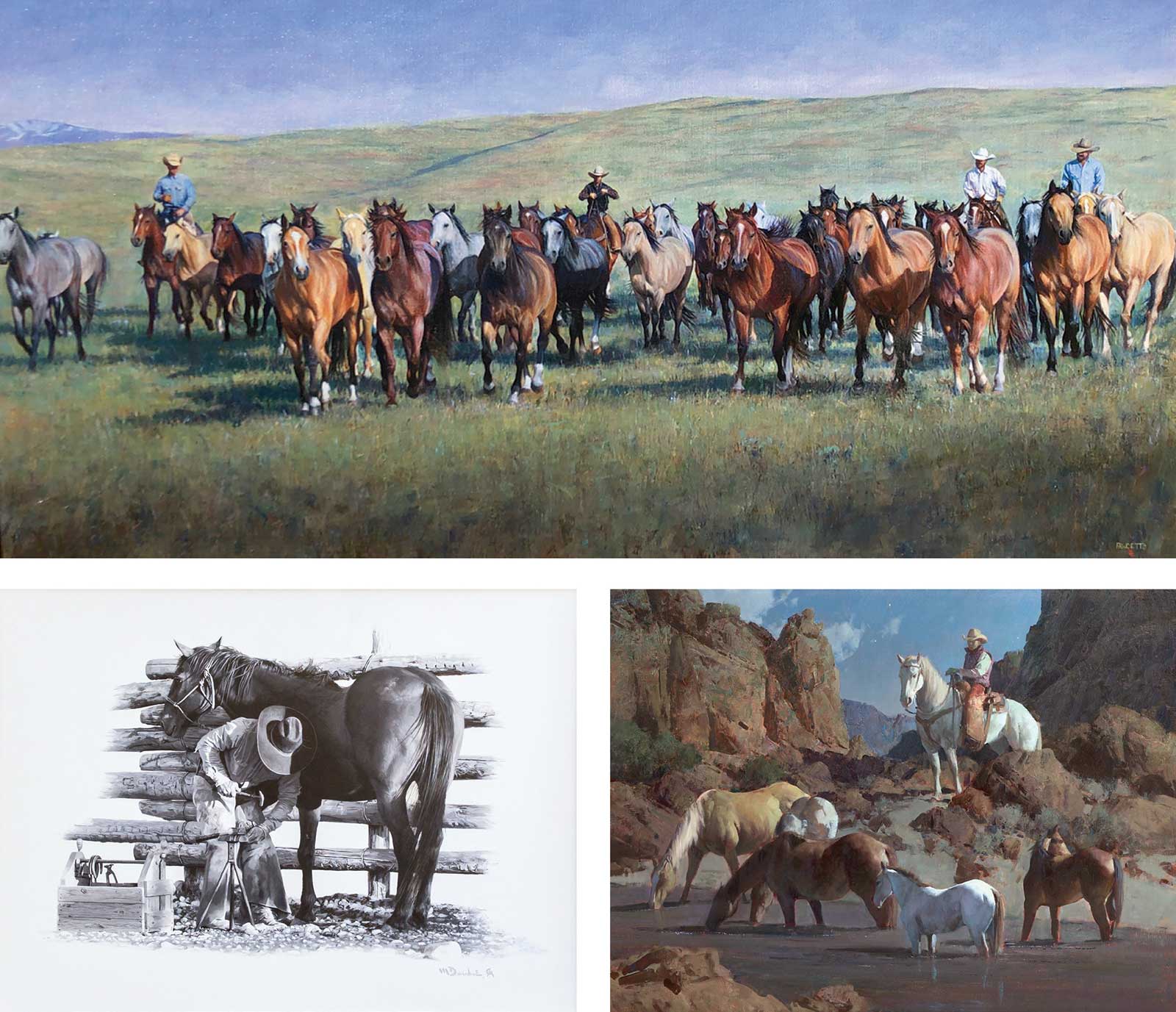
Top: Legacy Gallery, The Remuda, oil, 20 x 40”, by John Fawcett. Bottom: Broadmoor Galleries, For Want of a Nail, mixed media on board, 16½ x 22”, by Mikel Donahue; Legacy Gallery, Rugged Oasis, oil, 30 x 40”, by Bill Anton.
In her sculpture Mutual, Stephanie Revennaugh depicts two horses in a “you scratch my back and I’ll scratch yours” moment. Described officially as epimeletic behavior, horses bond by mutually grooming each other, nibbling and rubbing against their withers and along their bodies.
Thomas Cushman, owner of Gallery MAR in Carmel-by-the-Sea, California, comments, “Stephanie’s sculptures are a traditional subject done in a very contemporary way—the texture, the roughness of the bronze, the way you can almost see her fingers in the texture, the beautiful, complex patina work, yet the horse musculature and gestures are absolutely accurate. Then there is the very sharp and smooth base—a perfect combo.”
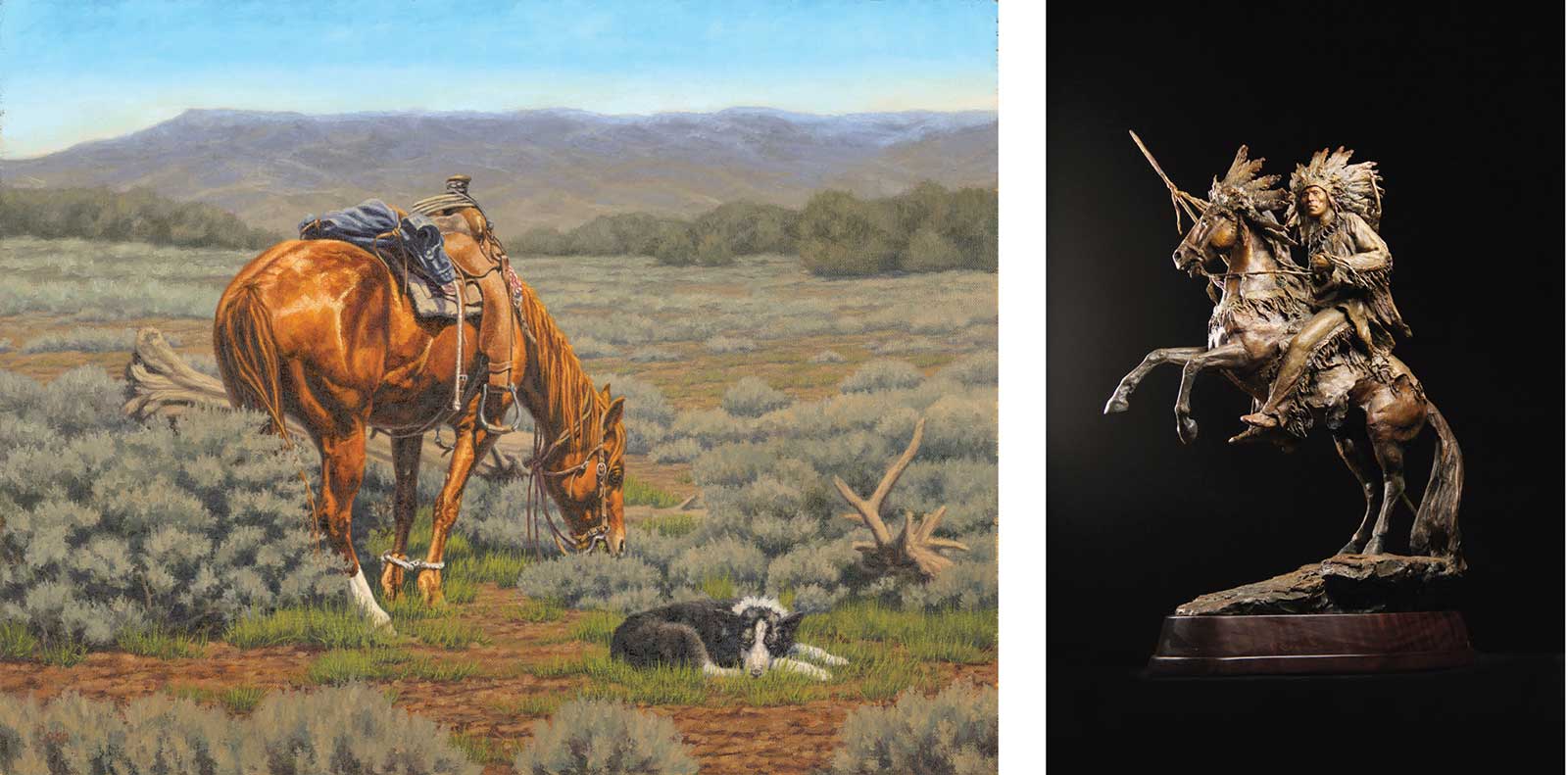
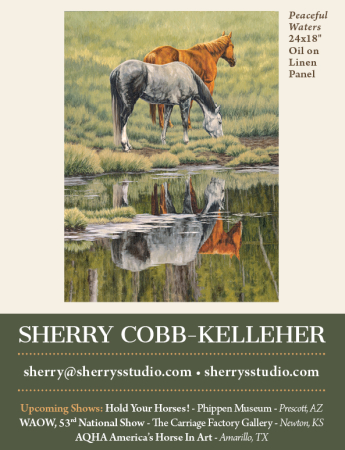
Sherry Cobb-Kelleher, Lunch And A Nap, oil on linen panel, 14 x 18”; Legacy Gallery, He Who Jumps Over Everyone, bronze, ed. 2 of 9, 50”, by John Coleman.
The sculptor says, “I model the horse because its form has been imprinted into my consciousness through long hours of interaction, focused observation and drawing. While I am fascinated with the beauty and elegance of equine design, it is the sensitive spirit of the horse which invites exploration of more abstract deeper meanings.”
Horses are deeply intertwined with the history and continuing lifestyle of the West. For both Western art collectors and equine aficionados alike, the following pages highlight yet more depictions of this widely respected animal.
“The horse has been symbolic in cultural imagery since the dawn of time,” says Cyndi Hall, associate director of Manitou Galleries in Santa Fe, New Mexico. “Our artists celebrate the spirit, power and freedom of the horse as they are known to them personally. Ethelinda grew up riding her horses daily, often bareback on the beaches of Hawaii. When she discusses the horses in her paintings, her face brightens and it reminds you of someone talking about an old friend. Amy Lay has lived her life in the West and paints her horses to show them naturally. The viewer can feel the wind blow in their manes. Liz Wolf shows us ourselves in the horse. We feel our similar personality traits, our expressions, and the attachment to another sentient being.”
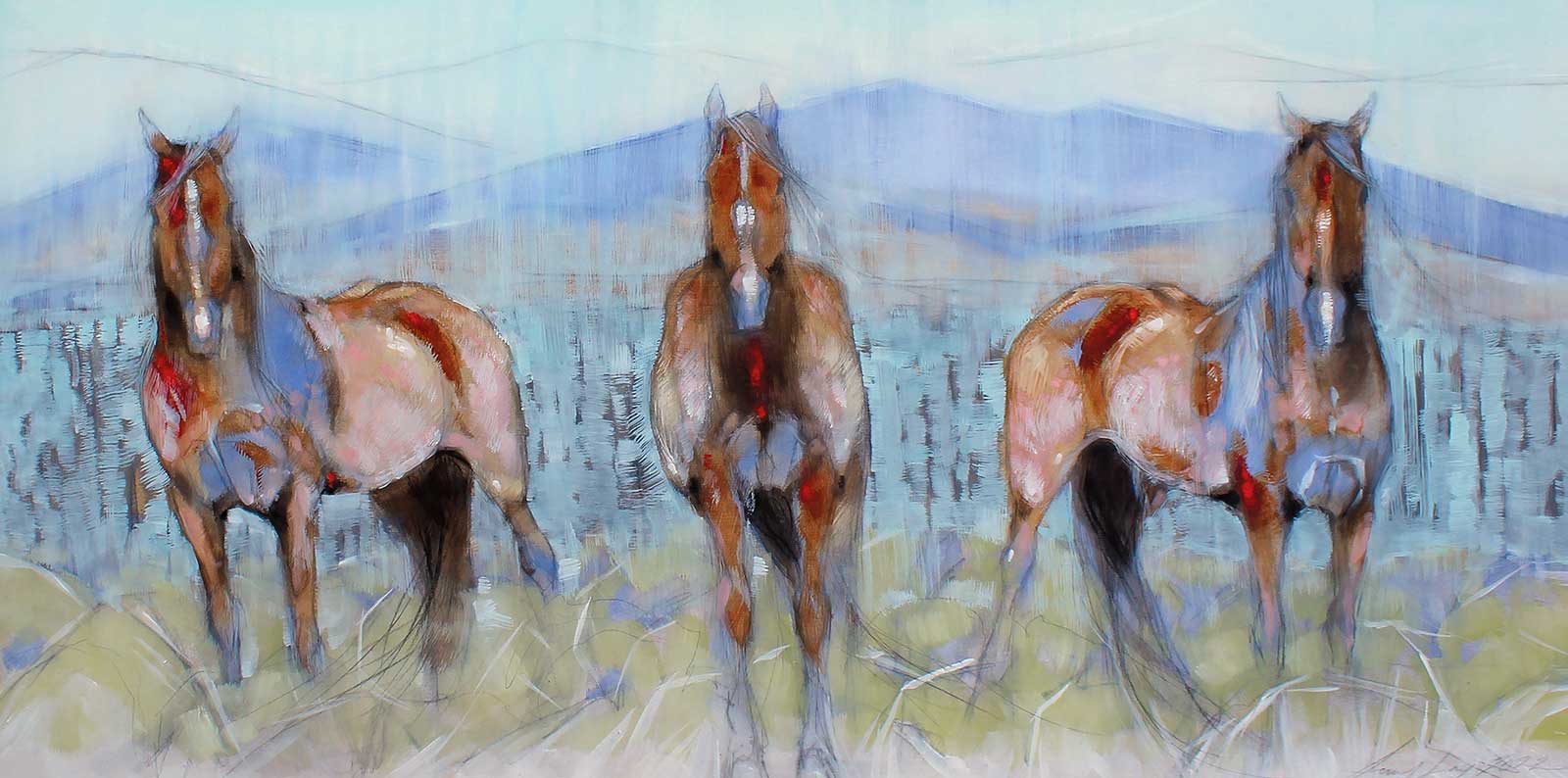
Manitou Galleries, Horsepower, oil, 24” x 48”, by Amy Lay.
The artistic inspiration of Sherry Cobb-Kelleher comes from a lifetime of experiences on the ranch, where the everyday chores can catch the sunlight just right or the expression in the eye of an animal captures her attention. “So many times we get caught in the rush of life and neglect to see the blessings right in front of us. I try to capture those moments in my paintings. One of my favorite comments from a collector is, ‘Your work makes me smile.’ If I can bring a smile to someone’s face, I’ve done my job for the day!”
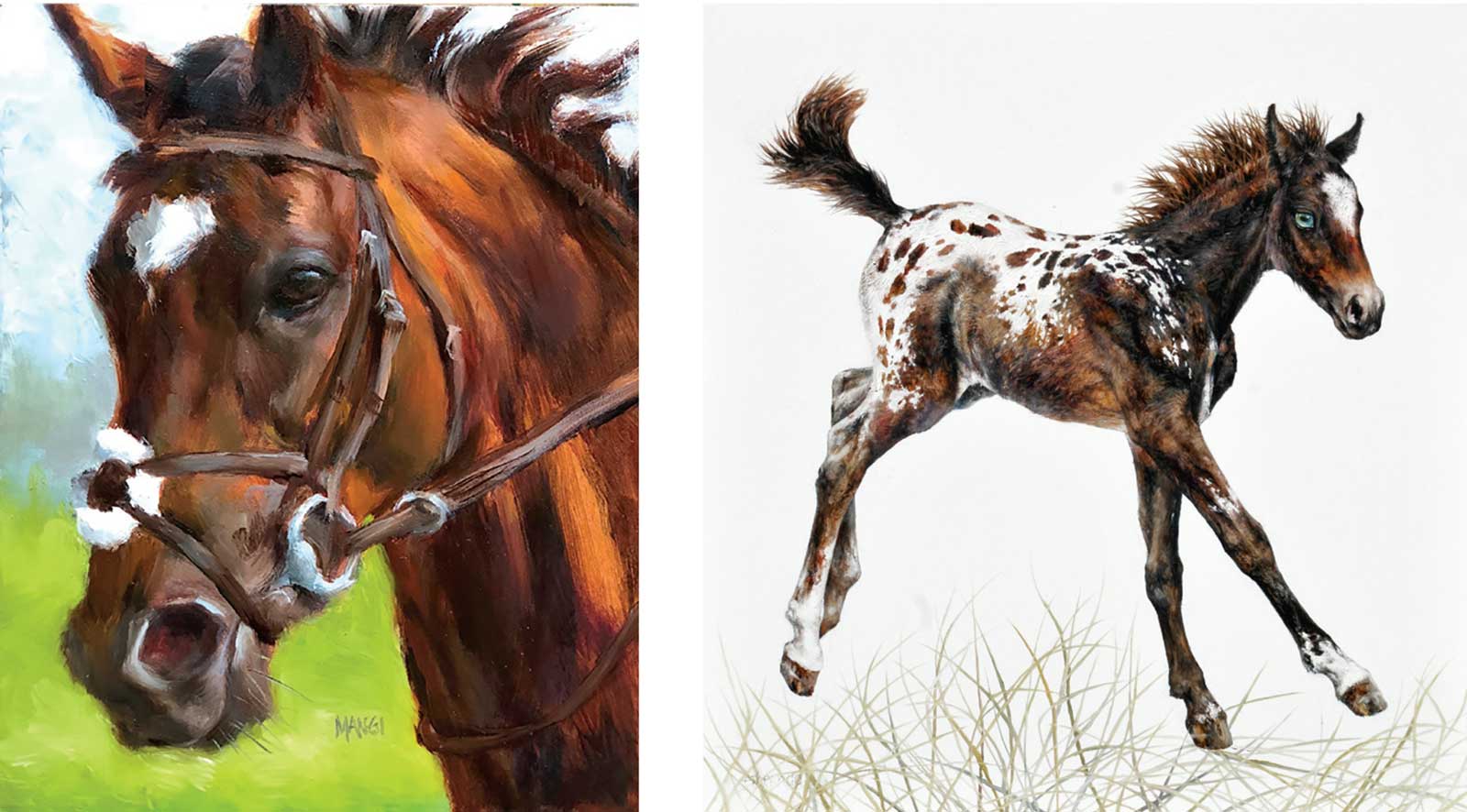
Johanne Mangi, Breezin, oil on panel, 12 x 9” ; Manitou Galleries, Pepsi - Appaloosa Foal, oil, 48 x 46”, by Ethelinda.
Western artists John Coleman, Bill Anton and John Fawcett are each represented by Legacy Gallery in Scottsdale, Arizona. Coleman grew up interested in art and history, and had a special fascination for Western movies. At age 20, he moved to Prescott, Arizona, where he found source material for his fascination with the cowboy mentality of early Arizona and with Native American culture. And of course, there was no Western art without the horse. After seeing the American West for the first time as a 7-year-old, Anton vowed to return for good someday. The cowboy way of life is what Anton focused his works on, and a cowboy always needs a horse. Fawcett has spent his life studying and gaining inspiration from his subjects. He began his study of the interactions between people and animals first as a practicing veterinarian for 20 years, and then as a full-time artist.
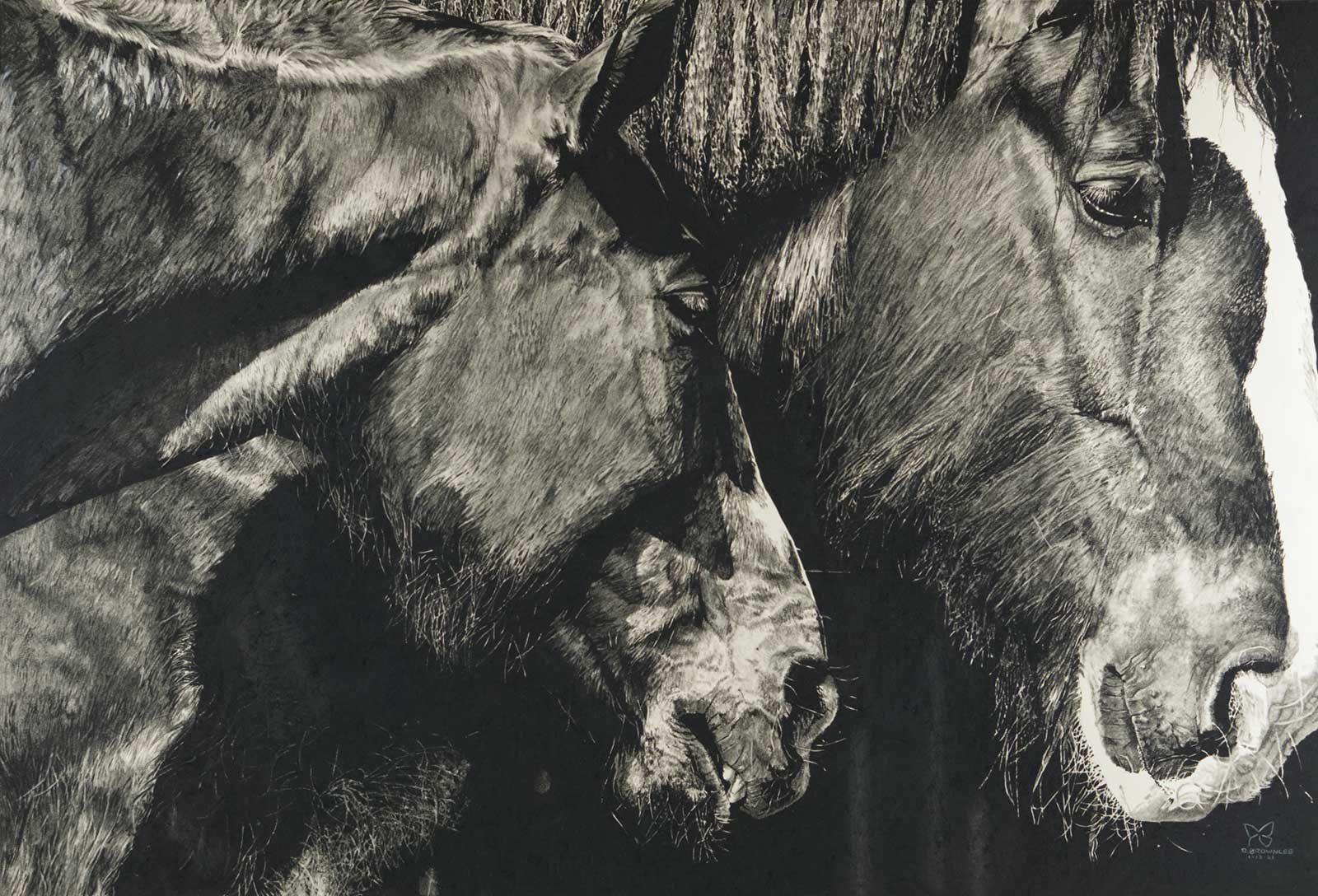
Rachel Brownlee, Old Fathers, charcoal, 22 x 30”
“Any advancement I’ve achieved has been through my association with painting groups, some well known such as Richard Schmid’s Putney Painters, and others with historic meaning like Brush & Palette,” says artist Johanne Mangi. Her passion is painting canines and horses, and in 2008, she began pursuing drawing and painting professionally. “Immersive workshops have been a wonderful resource in my ongoing education as well as the generous support and instruction by artists like Richard Schmid, Nancy Guzik, Sherrie McGraw and David Leffel. They literally changed my life,” she says. “Horses have always been a heart-stopping passion and growing up in Upstate New York gave me plenty of opportunity to be around them.”
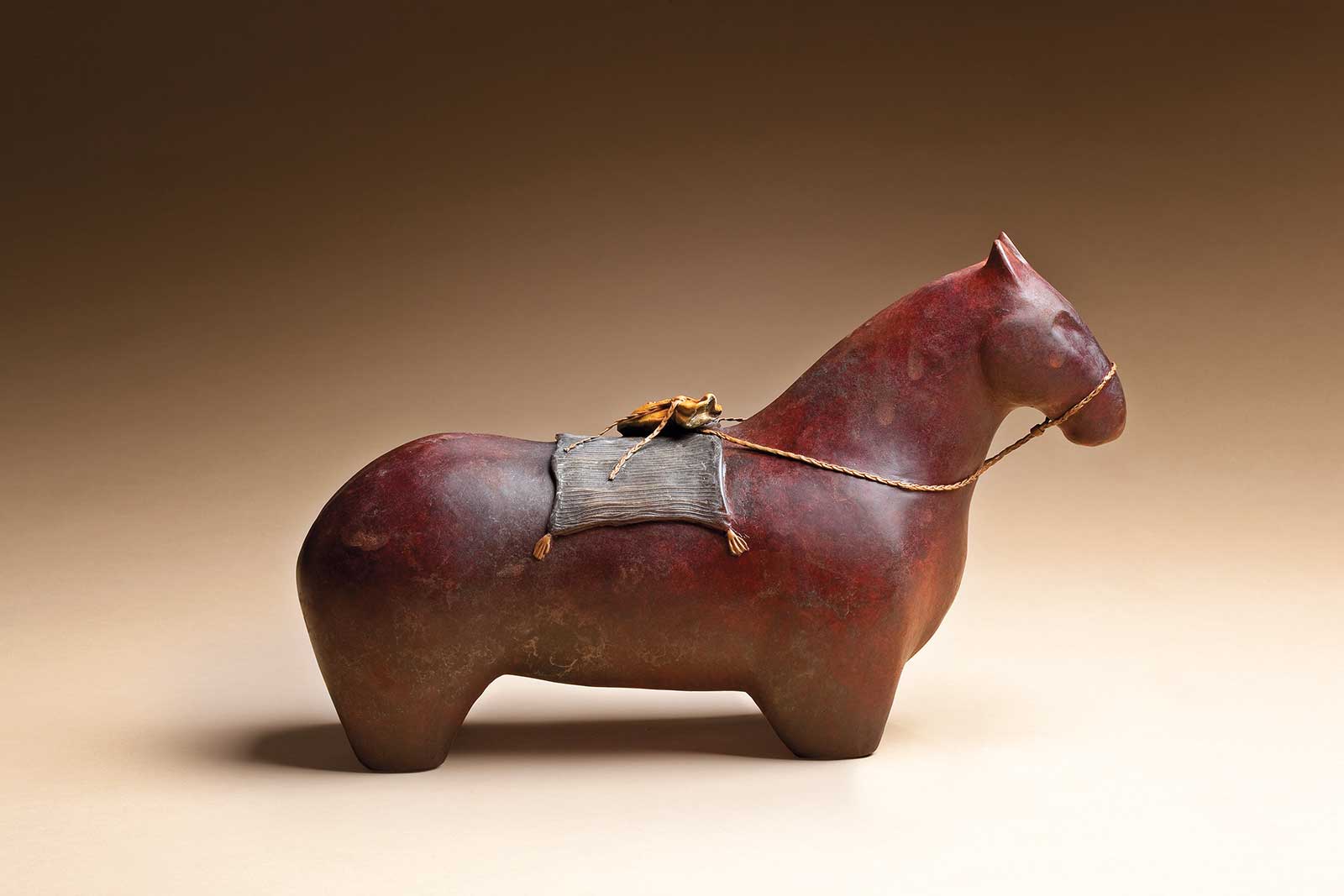
Manitou Galleries, Horse Medicine, bronze, ed. of 25, 9¾ x 5 x 16”, by Liz Wolf.
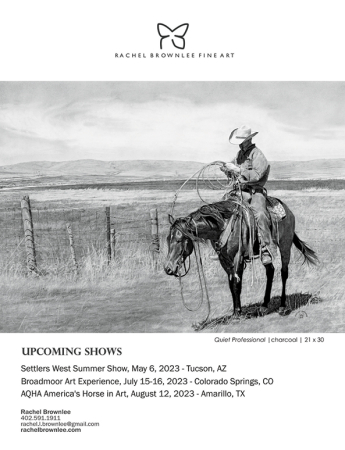
Rachel Brownlee grew up only drawing horses, and that passion has never left her. While she loves portraits and landscapes, “the power and the heart of horses has always captured my pencil.” Brownlee draws from her experiences on the ranch and from those of her neighbors. “I bought my own horse when I was 13 years old. Blue Chilly Bars and I learned a lot from each other and rode a lot of miles together,” says the artist. “She was the subject of many of my first drawings. She taught me all the body language and communication that a young horse teaches to an inexperienced rider. I use all of those lessons in my artwork today.”
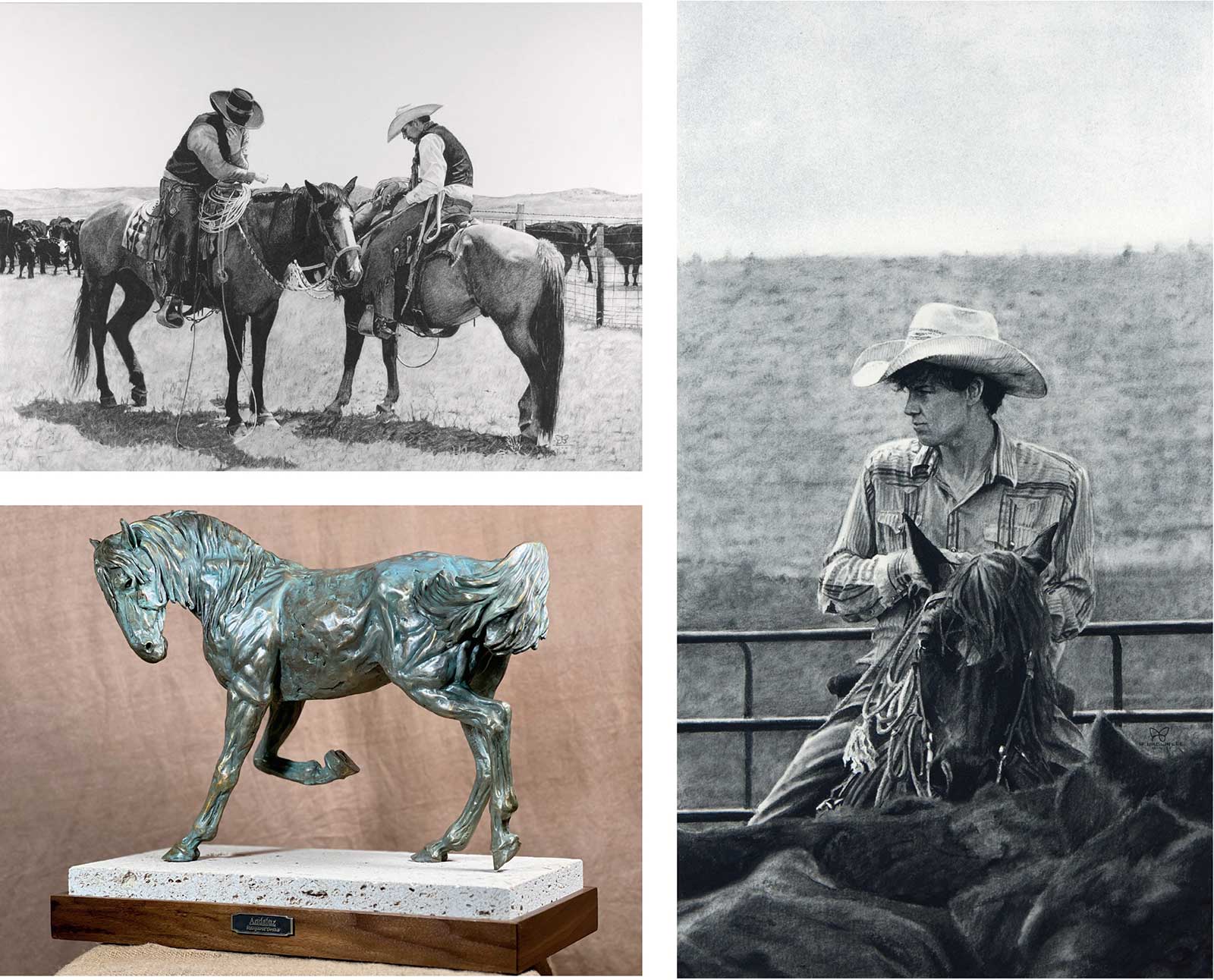
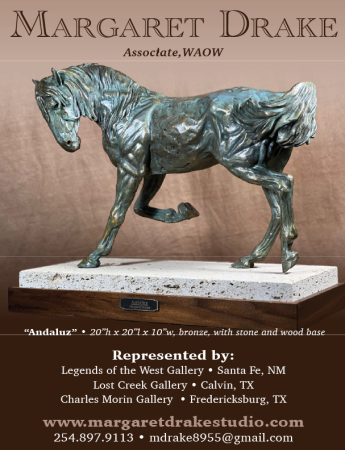
Top: Rachel Brownlee, Good Conversation, charcoal, 27 x 20”. Bottom: Margaret Drake, Andaluz, bronze, with stone and wood base, 20 x 20 x 10”; Rachel Brownlee, Eight Days, charcoal, 14 x 8”
Margaret Drake is represented by Legends of the West Gallery in Santa Fe, New Mexico; Lost Creek Gallery in Calvin, Texas; and Charles Morin Gallery Fredericksburg, Texas. “My upbringing in the extreme northwestern corner of Colorado where ranch life was prevalent influenced me immensely,” she says. “My years spent grooming, riding and caring for my horses was time well spent, as I now am aware of the anatomy of a horse based on that experience…With my work, I want people to smile and feel good when they see it. I want them to appreciate the detail and the accuracy of the subject that I’m portraying.” —
Featured Artists & Galleries
Broadmoor Galleries
1 Lake Circle, Colorado Springs, CO 80906
www.broadmoorgalleries.com
Gallery MAR
436 Main Street, Park City, UT 84060
(435) 649-3001, www.gallerymar.com
Johanne Mangi
(203) 215-5255
www.johannemangi.com
mangifineart@johannemangi.com
Legacy Gallery
7178 Main Street, Scottsdale, AZ 85251
(480) 945-1113, www.legacygallery.com
Manitou Galleries
123 West Palace Avenue, Santa Fe, NM 87501
(505) 986-0440, www.manitougalleries.com
Margaret Drake
(254) 897-9113
mdrake8955@gmail.com
www.margaretdrakestudio.com
Mark Sublette Medicine Man Gallery
6872 E. Sunrise Drive, Suite 130, Tucson, AZ 85750
(800) 422-9382, www.medicinemangallery.com
Rachel Brownlee
(402) 591-1911
rachel.l.brownlee@gmail.com
www.rachelbrownlee.com
Sherry Cobb-Kelleher
(970) 261-3396
sherry@sherrysstudio.com
www.sherrysstudio.com
Powered by Froala Editor