Renowned illustrator N.C. Wyeth, who travelled far and wide in the course of a highly successful career, once remarked on the need for artists to return to their roots. By Wyeth’s reckoning, the most authentic paintings were created by artists who possessed an inextricable connection to the very land and people that they depicted on canvas. In order to realize the full potential of expression, Wyeth once explained that the artist eventually had to return “to the soil he was born on, no matter where it is…There is something in his bones that comes right out of the soil he grew up on—something that gives him a power and contract communion with life which no other place gives him.”
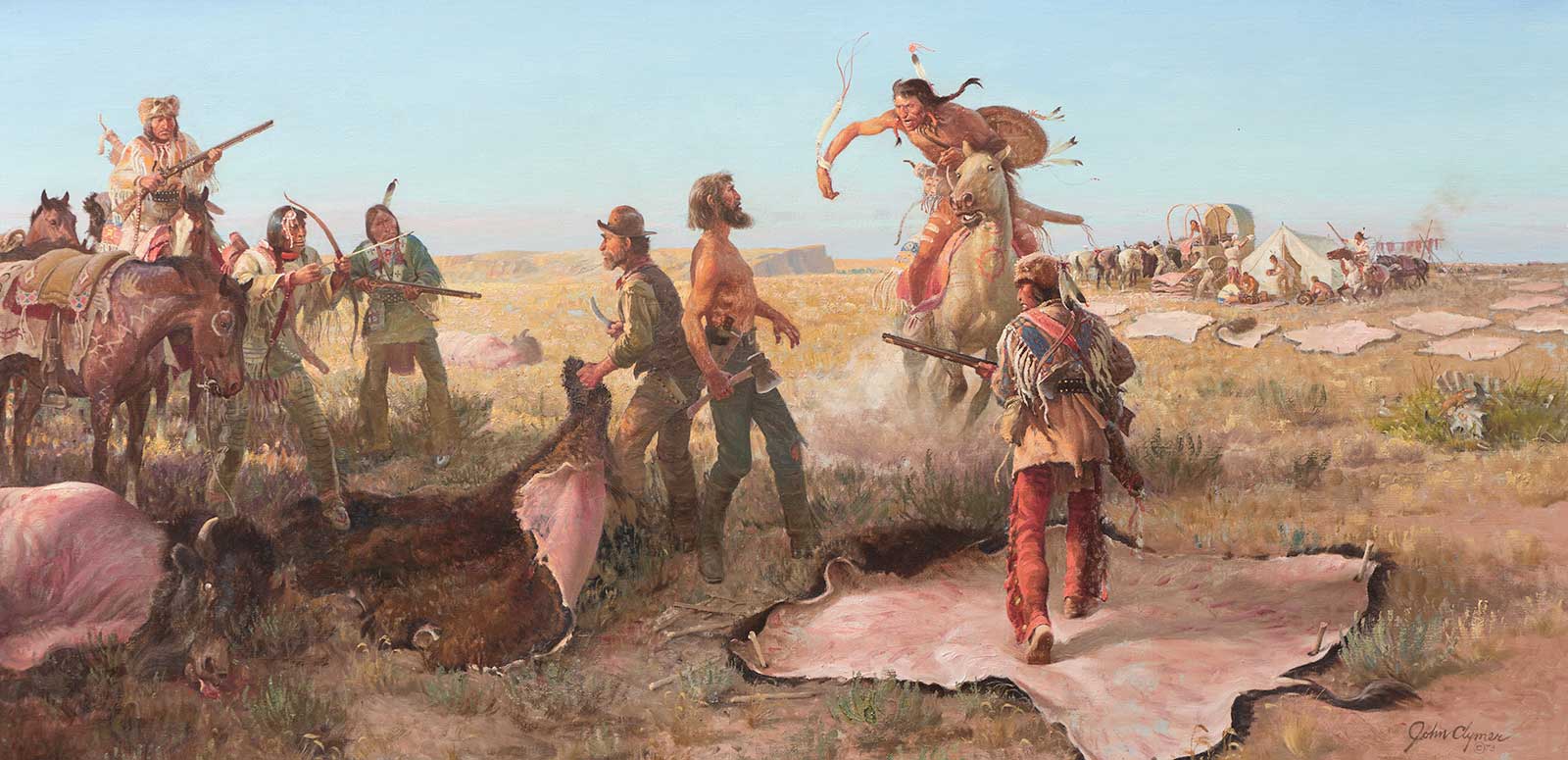
We Take All, oil on canvas, 24 x 48”. Available at the Jackson Hole Art Auction. Estimate: $100/200,000
In the Western art world, few artists have exemplified the indefinable creative connection to the land quite like John Clymer. Born in Ellensburg, Washington, in 1907, Clymer’s formative years were typical for an adolescent in the early-20th century, and included small schools, Presbyterian church services and a good dose of the outdoors. His childhood predilection for camping, fishing, hunting and sketching would contribute to his development as an artist.
Even in his formative years, Clymer was intent on living in land he loved, and came to the realization that if he became an artist he could, as he recalled, “make a living, and settle where I want.” His initial art training consisted of little more than a correspondence course, but as a high school junior he sold his first illustrations to, appropriately enough, Colt Firearms.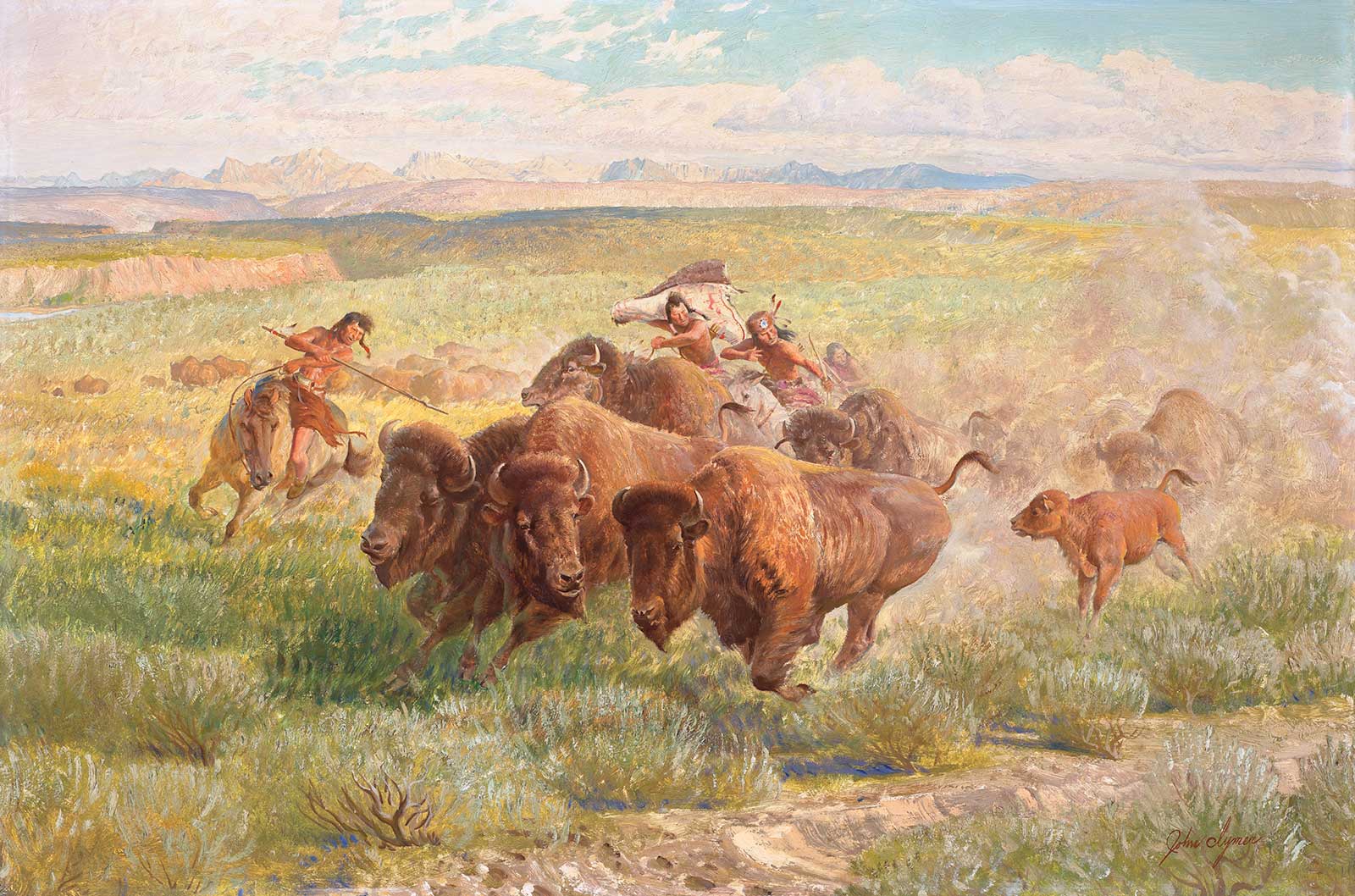
Buffalo Hunt, oil on canvas, 20 x 30”. Available at the Jackson Hole Art Auction. Estimate: $100/200,000
Not unlike many aspiring painters, Clymer carved out a living in the world of illustration. A circuitous career path eventually landed him steady employment in the New York market, where he regularly produced paintings for the nation’s biggest mass-market publications, including The Saturday Evening Post, National Home Monthly and Field & Stream. Along with Norman Rockwell, Clymer was one of the Post’s most popular illustrators, eventually painting about 80 covers for the magazine.
Despite success on the East Coast, Clymer’s heart remained in the West. The Clymer family, including his wife Doris and the couple’s two children, regularly took Western vacations during the summer months, immersing themselves in the natural grandeur of the West and gathering ideas for future paintings. While he continued his illustration work, Clymer began selling paintings, primarily wildlife pieces, at New York City’s Grand Central Art Galleries.
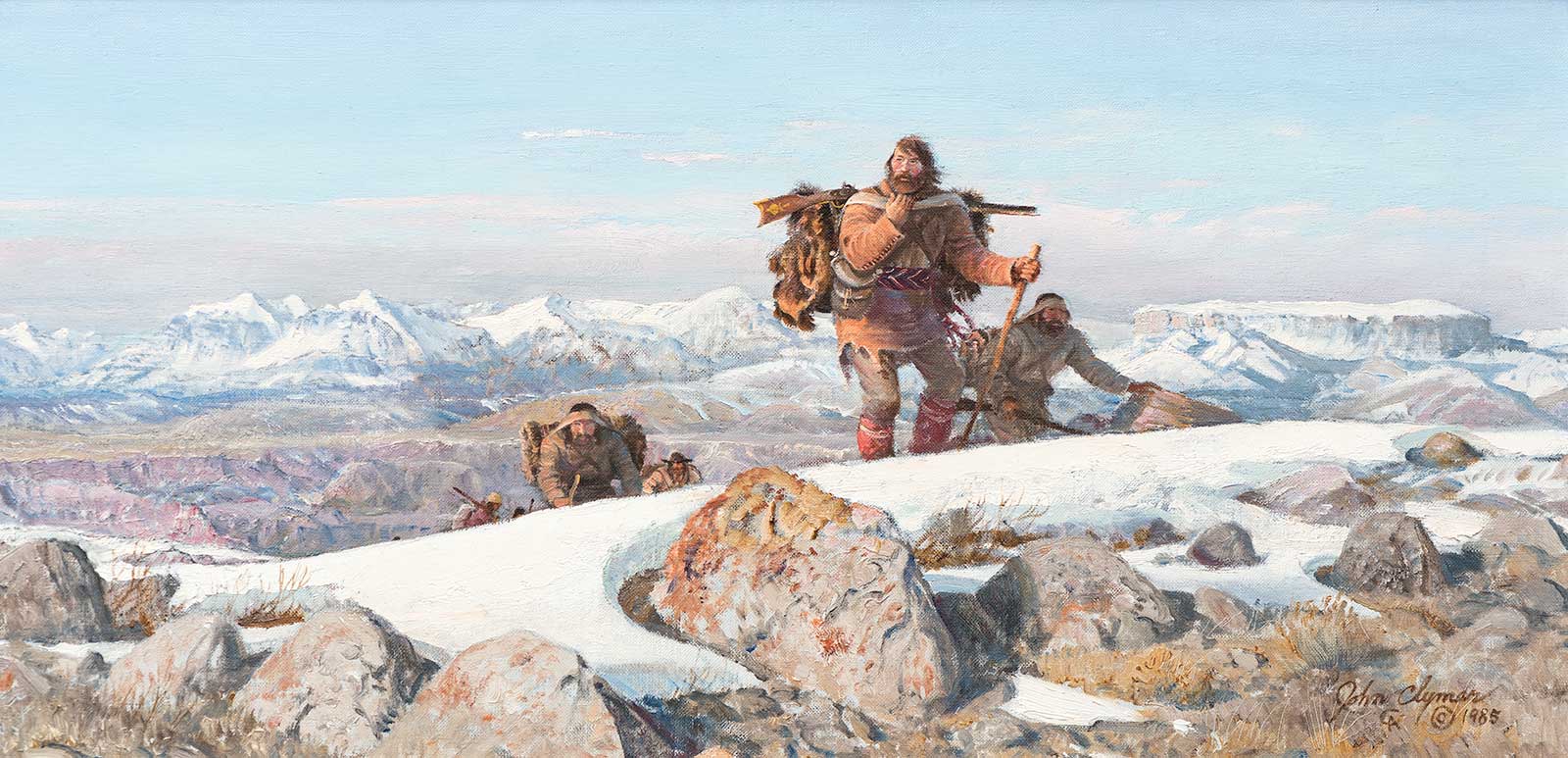
High Crossing, oil on board, 12 x 24”. Available at the Jackson Hole Art Auction. Estimate: $70/100,000
But following a summer trip up the Missouri in 1966, a river rich in the lore of Native Americans, Lewis and Clark, and the fur trade, Clymer, as he remembered, was “inspired to do a number of historical paintings.” Once placed on the walls of Grand Central Galleries, they sold quickly and collectors were requesting more of the same. “I was so pleased by this response,” Clymer said, “that from that time on I painted more and more history and fewer animals.”
By 1970, Clymer was determined to give up illustration for good, focus on fine art, and return to his roots. To go home. To go West. But for Clymer, the “West” meant colder climes and lofty peaks. “Some people like to go to the Southwest,” he would later explain, “but that didn’t appeal to me at all. All I ever wanted was to go North or to the mountains.” Determined to make the break from illustration permanent and focus on historical art, the Clymers pulled up stakes in Connecticut and settled in Wyoming’s Jackson Hole on the Eastern slope of the Tetons.
In addition to the area’s natural beauty and proximity to the Jackson art scene, the Clymers had another reason for selecting the Tetons as home, explains Christine Mollring, who represented Clymer at Trailside Galleries for nearly two decades. Clymer, who hoped to chronicle the early West, strategically selected Wyoming as a locale rich in the very history that he hoped to preserve on canvas. The region is home to the headwaters of storied rivers—the Yellowstone, Green, Wind and Snake—that served as crucial transportation routes during the heyday of the Rocky Mountain fur trade.
Clymer chose not to live near the big cities and interstates of the 20th century, but the riverine highways of the frontier. For the succeeding two decades, his partnership with the land and its history would result in a remarkable visual chronicle of an era that largely vanished before the advent of photography. From his home in Jackson Hole, Clymer explored the surrounding region, seeking and sketching specific locales to serve as the backdrop to his paintings. “Being on the spot where an event occurred is much different than just reading about it,” Clymer once said. “Going and seeing the actual places makes history come alive for me.”
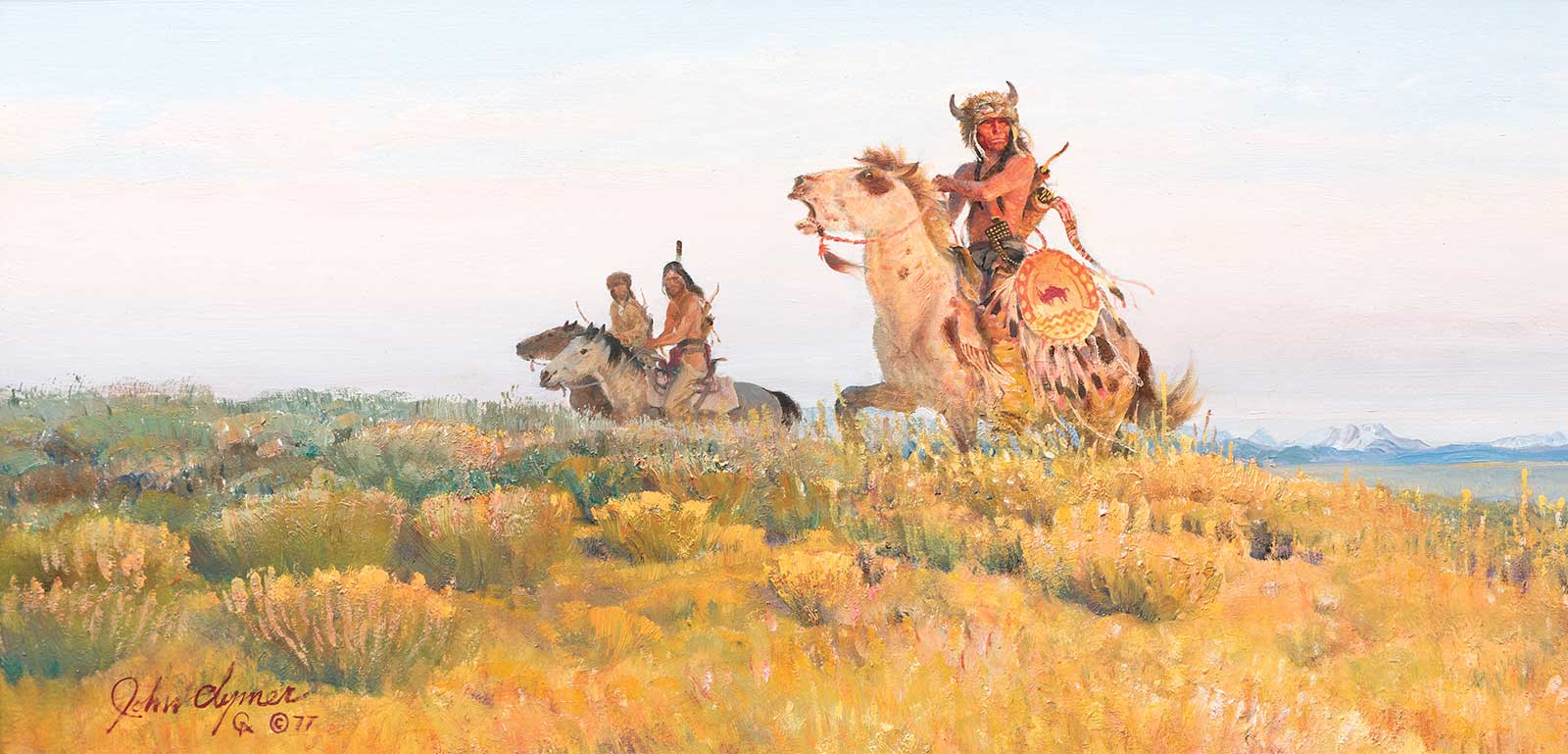
Buffalo Scouts, oil on board, 10 x 20”. Available at the Jackson Hole Art Auction. Estimate: $60/90,000
In his work, Clymer didn’t just strive for a general impression of the West, but for historical accuracy at a precise locale. In that endeavor, he was ably supported by his wife, a painstaking researcher who delved into primary documents, located artifacts in museum collections and pinpointed geographic landmarks that are preserved in Clymer’s work. The Clymer’s marriage was, in fact, a creative partnership proving the old adage that behind every great man there is a woman. “Doris was the most important part of his career,” Christine Mollring says.
Although he did resort to the modern reference method of photography, Clymer gravitated to traditional methods and a tactile connection to the land. When on location at a site he intended to paint, Clymer quickly rendered oil studies on 8-by-10-inch Masonite panels. From these unrefined field studies, he would later create his epic studio paintings. At the very heart of Clymer’s work is the land. The mountains, plains and river bottoms of America’s high country. The land where he was born, labored as a young man, and flourished as a mature artist.
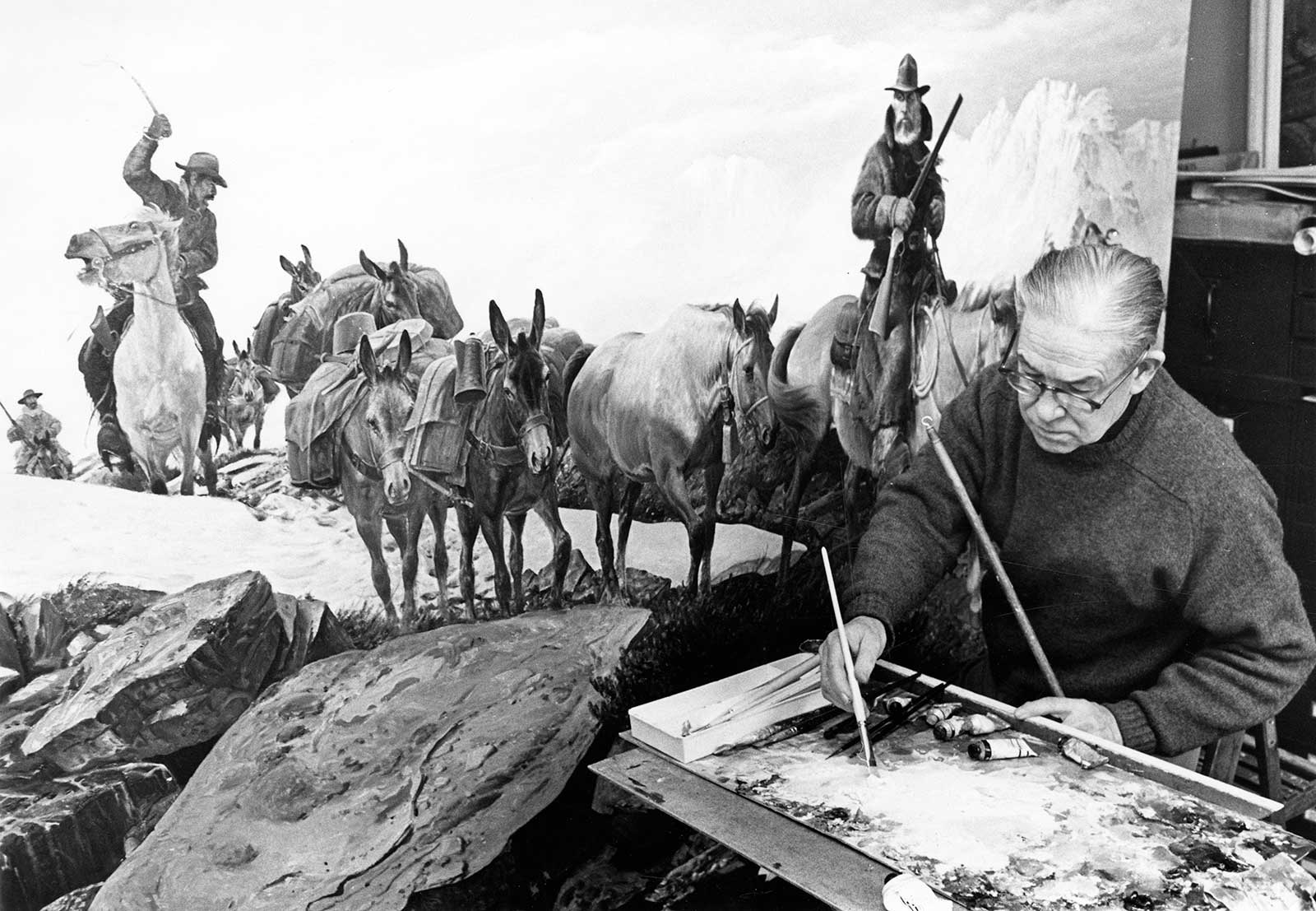
John Clymer in his studio in Bridgewater, Connecticut, in 1970. On his easel is The Gold Train, one of three paintings the Olin Corporation commissioned for the Whitney Gallery of Western Art at the Buffalo Bill Historical Center. Photo courtesy of the Buffalo Bill Center of the West, Cody, Wyoming; McCracken Research Library; MS 020 Winchester Repeating Arms Company; P.20.4499.1.
Clymer’s magnificent landscapes are populated with authentic portrayals of the men and women who loved, and often struggled for, the American West; Native tribes that called it home from time immemorial; mountain men who came in search of fur and fortune; and settlers looking for a brighter future. Although Clymer was adept at rendering pastoral scenes, he’s perhaps most renowned for his ability to capture sweeping action, whether he depicted mountain men riding hell-for-leather into a rendezvous or the Sioux leader Crazy Horse thundering into battle.
That depiction of the past was likewise the result of lengthy study. Clymer’s notebooks were filled with diminutive reference sketches—“doodles” as he modestly likened them—of original artifacts as rich and varied as the frontier itself: feathered headdresses, rifles, powder horns, steel traps. He ultimately collected hundreds of artifacts himself, which surrounded him in the studio and served as ready reference material. The more that an artists’ subject matter “becomes a part of him,” Clymer once said, “the better he can paint it.”
Clymer’s devotion to historical accuracy imparted to his work an unmistakable authenticity. Historical artist H. David Wright, widely regarded as an authority on the material culture of the frontier, points out that Clymer succeeded in capturing the essence of his subject matter. “John was one of my favorite artists,” says Wright. “To me his work had the best feel for the western fur trade era of any Western artist. His guys looked rough and fit the image.” Clymer’s success, Wright says, “was well deserved.”
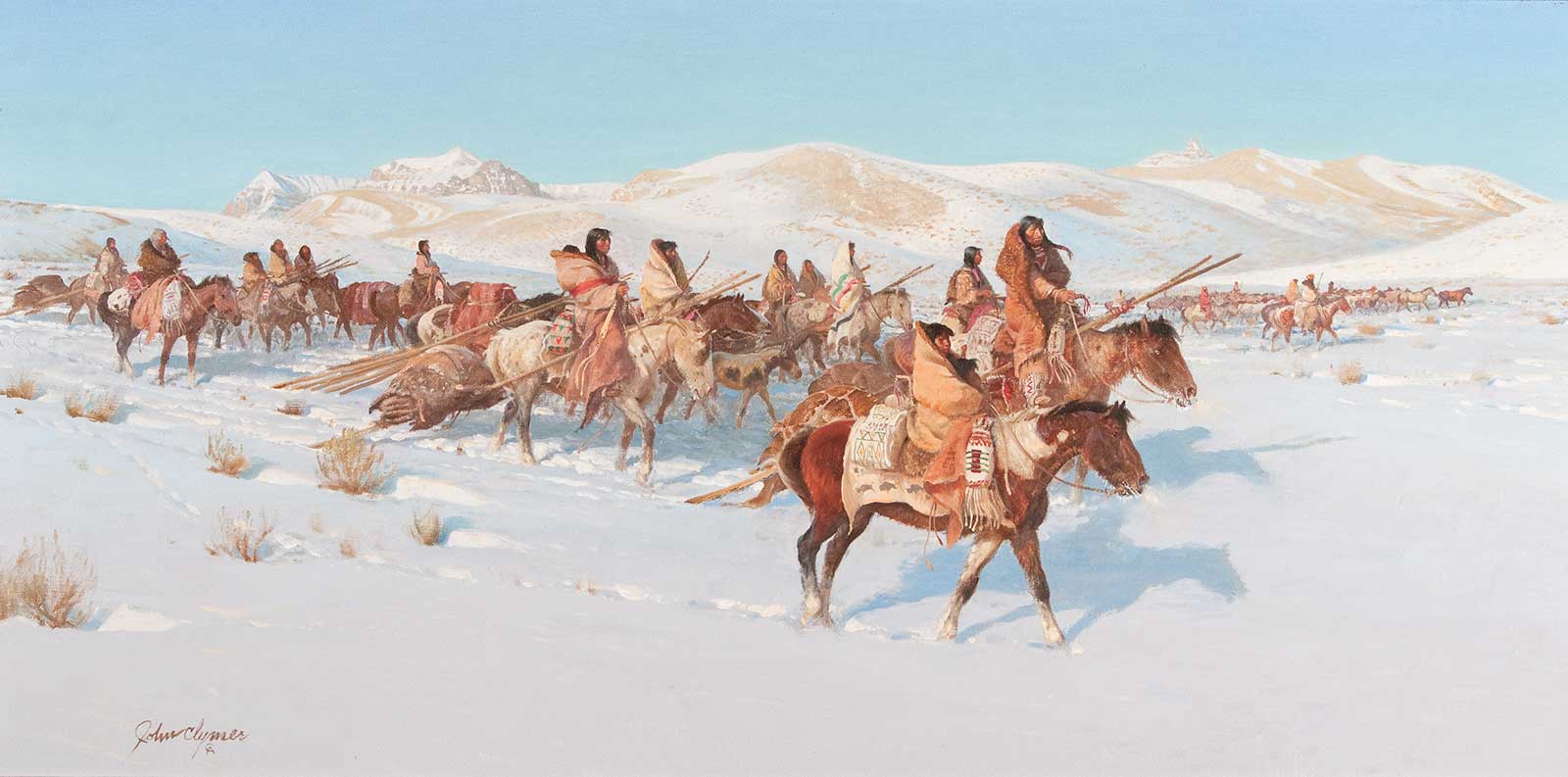
Moving Camp, 1972, oil on canvas, 20 x 40”. Sold at the 2016 Jackson Hole Art Auction. Estimate: $150/250,000 SOLD: $380,250
His success as an artist, however, was the result of more than his historical knowledge. Clymer’s expert draftsmanship, compositional vision and outright skill with a brush resulted in a realistic and inspiring look at the panoramic grandeur of the American West. Clymer’s goal, as he put it, was to take the viewer “to an actual place and make them feel that they were really there.”
At that task he succeeded handily, and collectors responded in kind. During his lifetime, Clymer’s artistic output could barely keep up with demand. The scarcity of his paintings ensured that his work didn’t last long on gallery walls, and also inspired cordial, if fierce, competition between two of Clymer’s most dedicated collectors, Arizona businessman Eddie Basha and German entrepreneur Erivan Haub.
A continuing enthusiasm for Clymer’s work has been readily apparent at recent auctions. His work has regularly fetched well into the six figures, but a burgeoning interest in his work has ensured that his paintings are enjoying broader success at East Coast venues. Sotheby’s American art auction on December 11, 2020, was an outright blockbuster. Clymer’s swirling masterpiece Attack, depicting a wagon train ambush at Idaho’s Massacre Rocks, gaveled in at $879,100, far outpacing initial estimates and smashing his previous auction record.
Truly great artists are known to produce paintings that can’t be mistaken for someone else’s work, a feat that John Clymer accomplished. He was a highly successful master of his craft who nonetheless remained unassuming, garnering both professional and personal respect from his peers. Despite reaching the pinnacle of his profession, John Clymer remained the humble young man from Ellensburg.
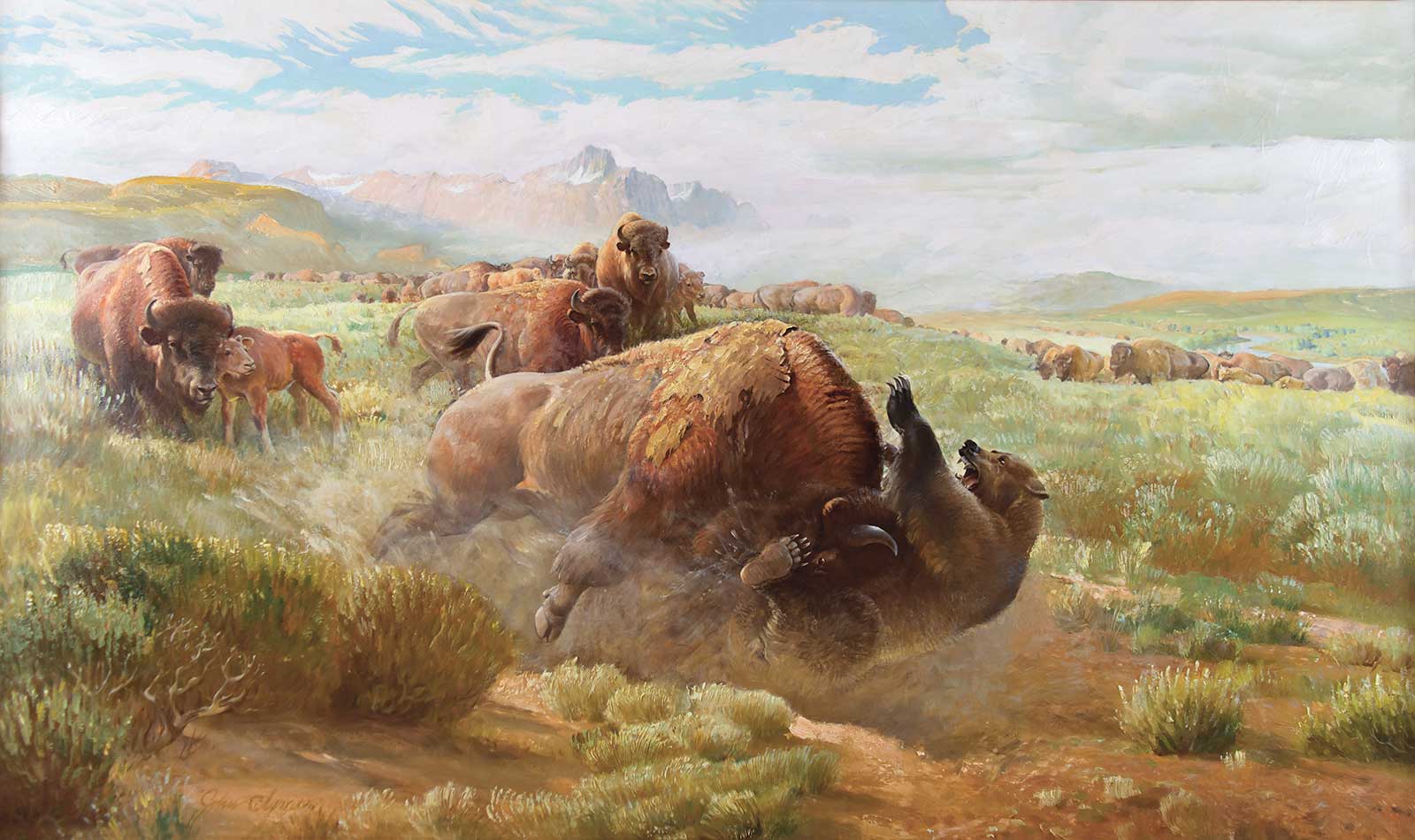
Territorial Dispute, oil on board, 24 x 40”. Sold at the 2018 Jackson Hole Art Auction. Estimate: $150/250,000 SOLD: $339,000
Clymer bequeathed the Western art world a remarkable body of work, but also a warm legacy of personal dignity. Christine Mollring, Clymer’s longtime gallery representative and family friend, fondly recalls that “he was very modest, and all the other artists just adored him.” At his heart, says Mollring, “John was a very kind and gentle man.”
Joshua Shepherd, a sculptor and author, has created more than 25 public monuments. His articles, with a special focus on American history and the early frontier, have appeared in publications including Military Heritage, Journal of the American Revolution, Civil War Quarterly, Muzzleloader and Military History Quarterly.
Powered by Froala Editor