Many adjectives are certainly appropriate when it comes to the West—majestic, sacred, enduring, vibrant—but the one that stuck was revealing: the Wild West.
Whether it was war parties from opposing tribes long before European settlers began trekking through the frontier, competing cowboys fighting over the open range, bandits and outlaws taking what they wanted with force, or marshals and deputies defending their towns and territories, danger was baked into the DNA of the Old West. It was those real-life people, places and events—Deadwood, Dodge City, the O.K. Corral, Billy the Kid—that inspired early artists, which inspired Hollywood, which inspired new generations of artists. Today, those thrills are almost part of the myth of the American West, and yet they are based on the wildest of truths. 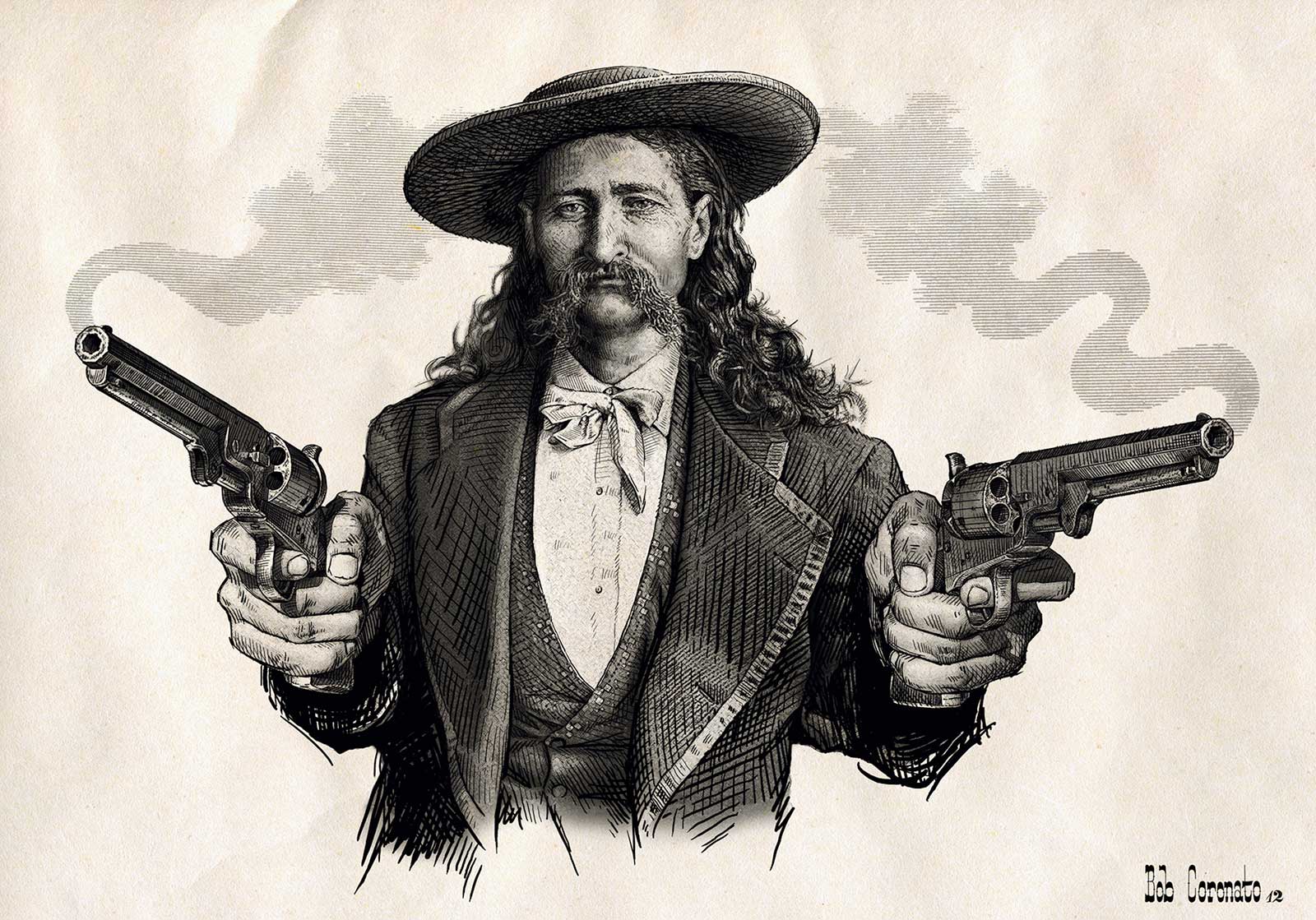 Legacy Gallery, Wild Bill, Deadwood, 1876, etching, 10 x 14", by Bob Coronato.
One of the great artists who has painted the excitement, danger and violence that runs through the Old West is Andy Thomas, whose paintings of gunfights, canyon shoot-outs and outlaws riding into ambushes are some of the most recognizable action paintings being made today. “I think ‘Wild West’ scenes have stirred emotions in people since people have been writing, painting and filming the West,” Thomas says. “For me, these scenes remind me of why I was enamored with the West as a small boy. Painting scenes with dynamic action is fun as an artist.”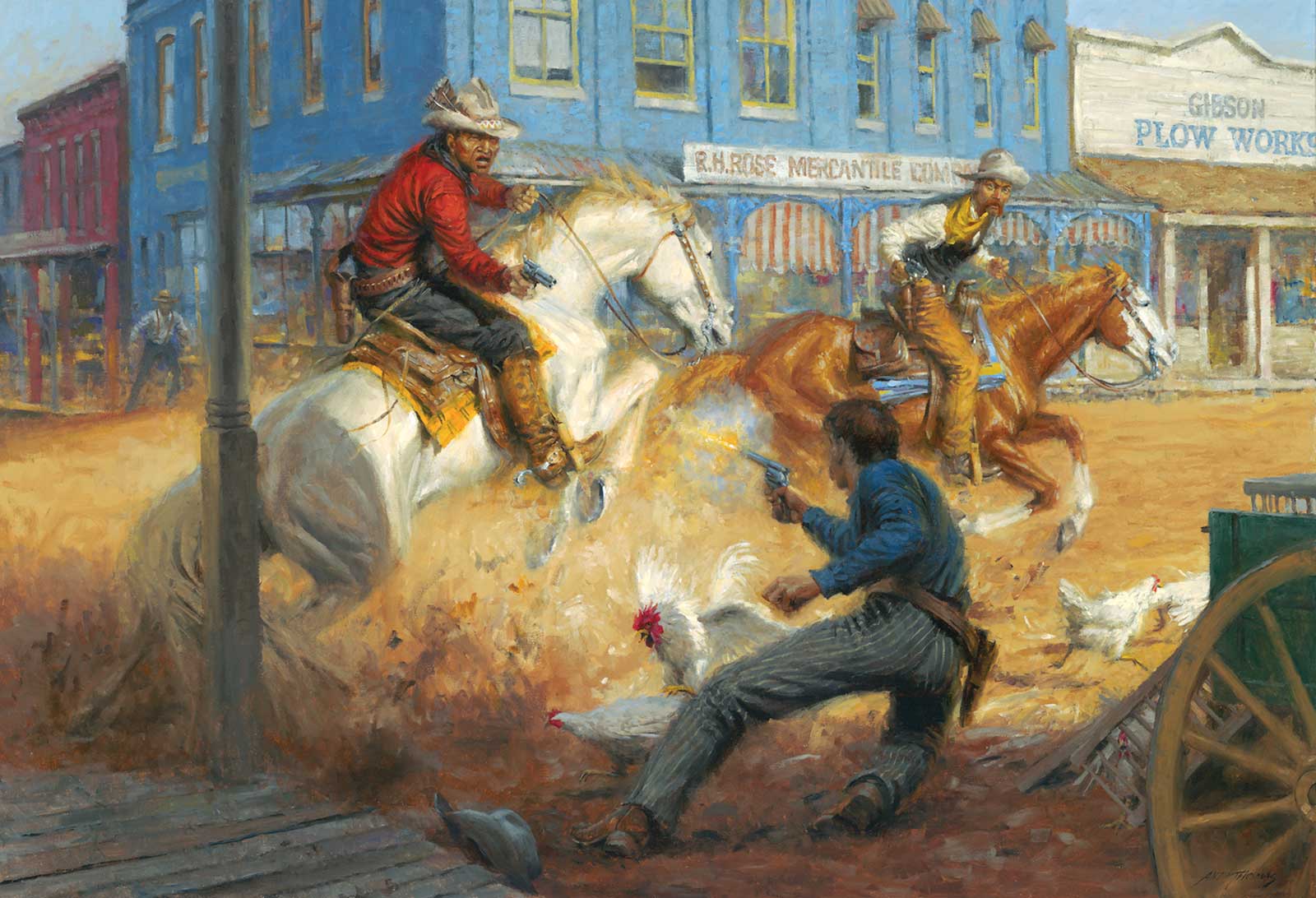 Andy Thomas, Jake’s Mistake, oil on canvas, 29 x 42"
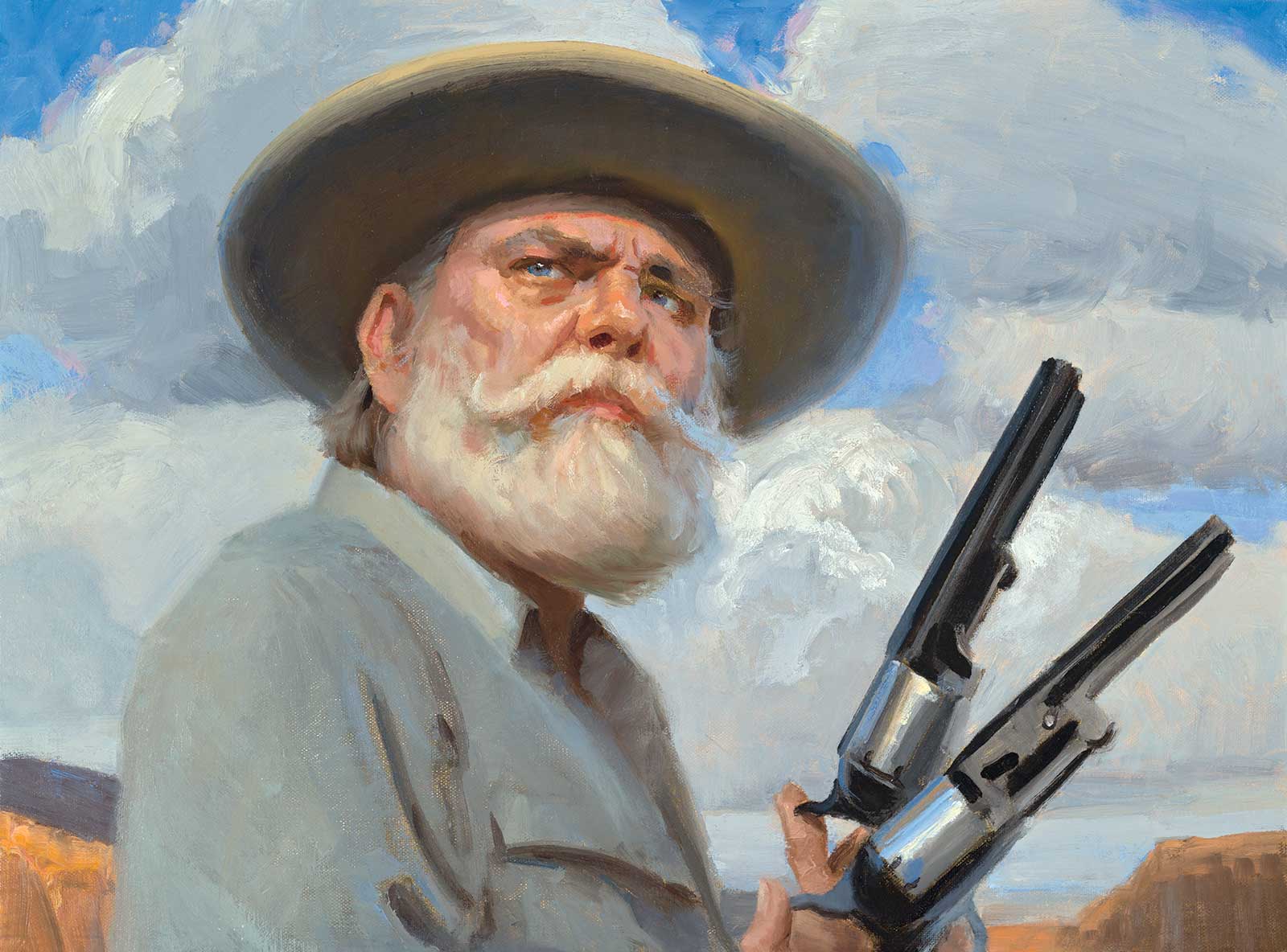 InSight Gallery, Bein’ Followed, oil, 12 x 16", by Tony Pro.
In Thomas’ recent work Jake’s Mistake, he paints a colorful daytime scene with two riders exchanging fire with an outgunned figure diving into the dirt. Though the painting doesn’t tell us the complete story, a narrative materiliazes when considering who Jake may be and what his mistake might have been. The work suggests death is a split second away, which adds to the tension and drama.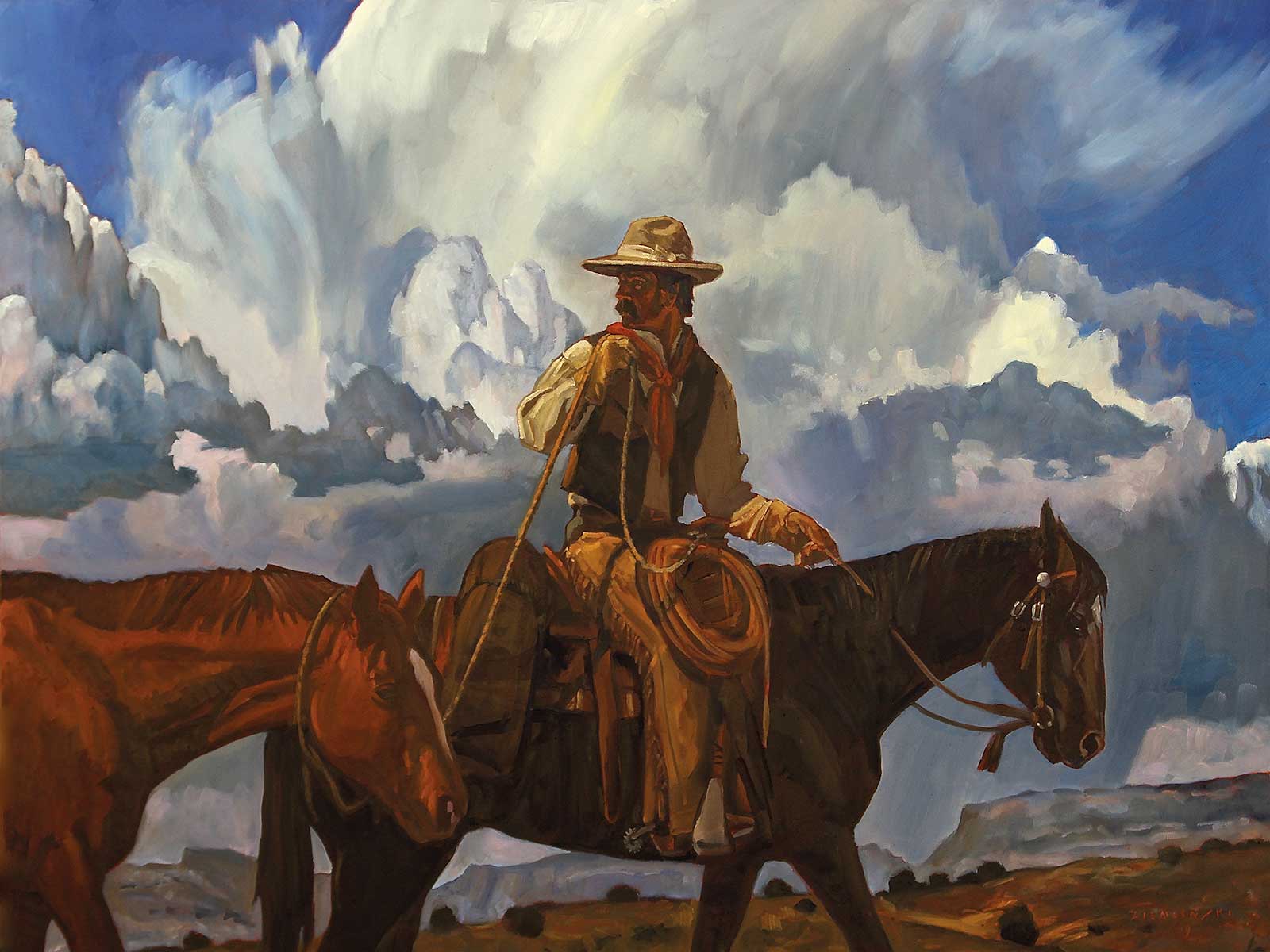 Mark Sublette Medicine Man Gallery, The Horse Thief, oil on canvas, 36 x48", by Dennis Ziemienski.
Thomas’ paintings call out to some of the artwork that came out of the early and mid-20th century, particularly the work of the pulp illustrators who were creating work for men’s adventure magazines, paperbacks or early comic books. Heritage Auctions’ holds semi-regular illustration art sales and many of these pulp works turn up, and almost all of them are high-action Wild West paintings that play off the cinematic qualities of good versus evil that has permeated the Old West for more than a century. In Heritage’s October illustration sale, several Victor Prezio works will be available, including Morning Shootout, which shows a gunfight on top of a ridge at sunset. Like Thomas’ Jake, not everyone is coming out of this work alive. 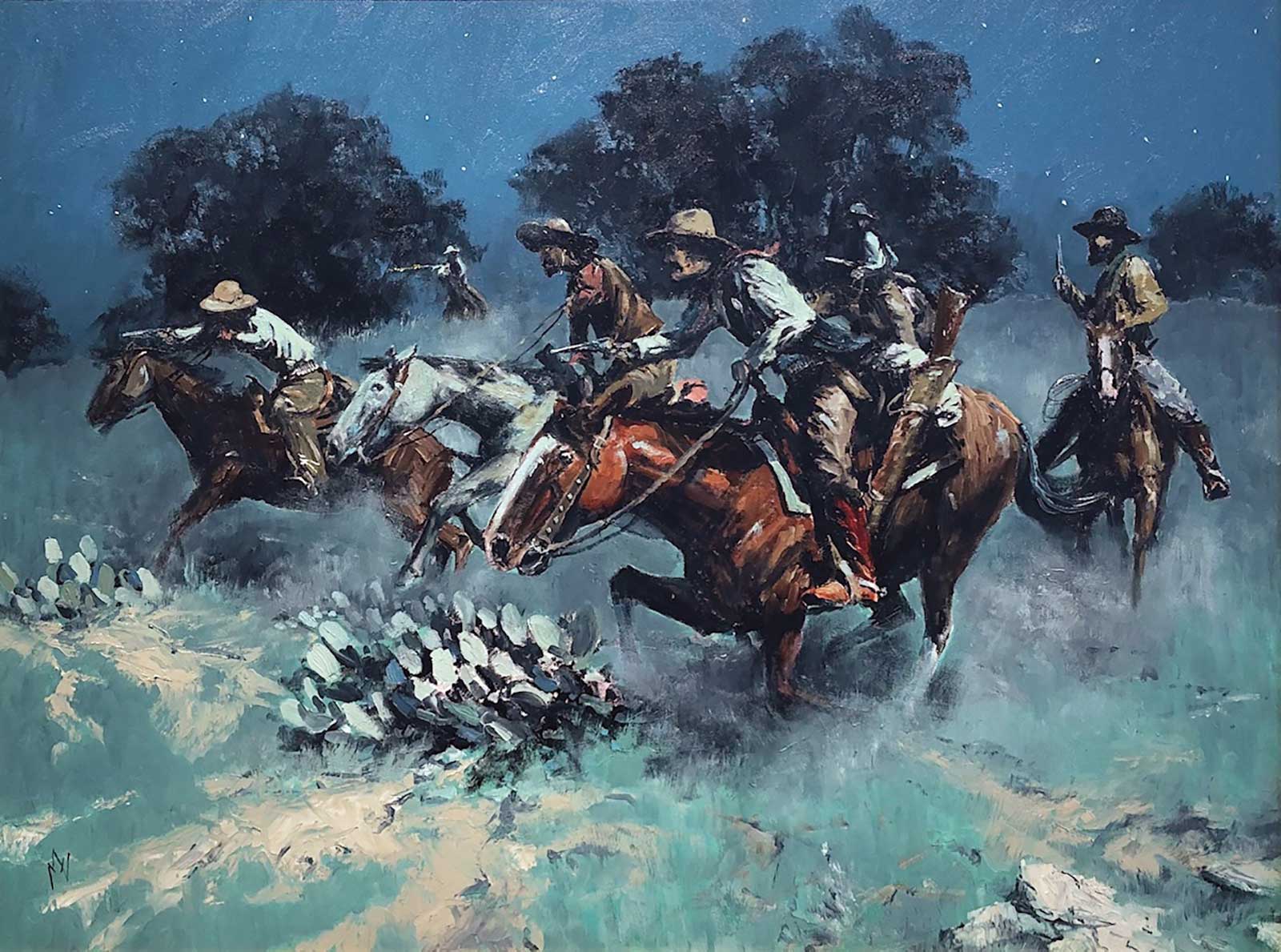 InSight Gallery, Rangers Command a Comanche Moon, oil, 30 x 40", by Michael Ome Untiedt.
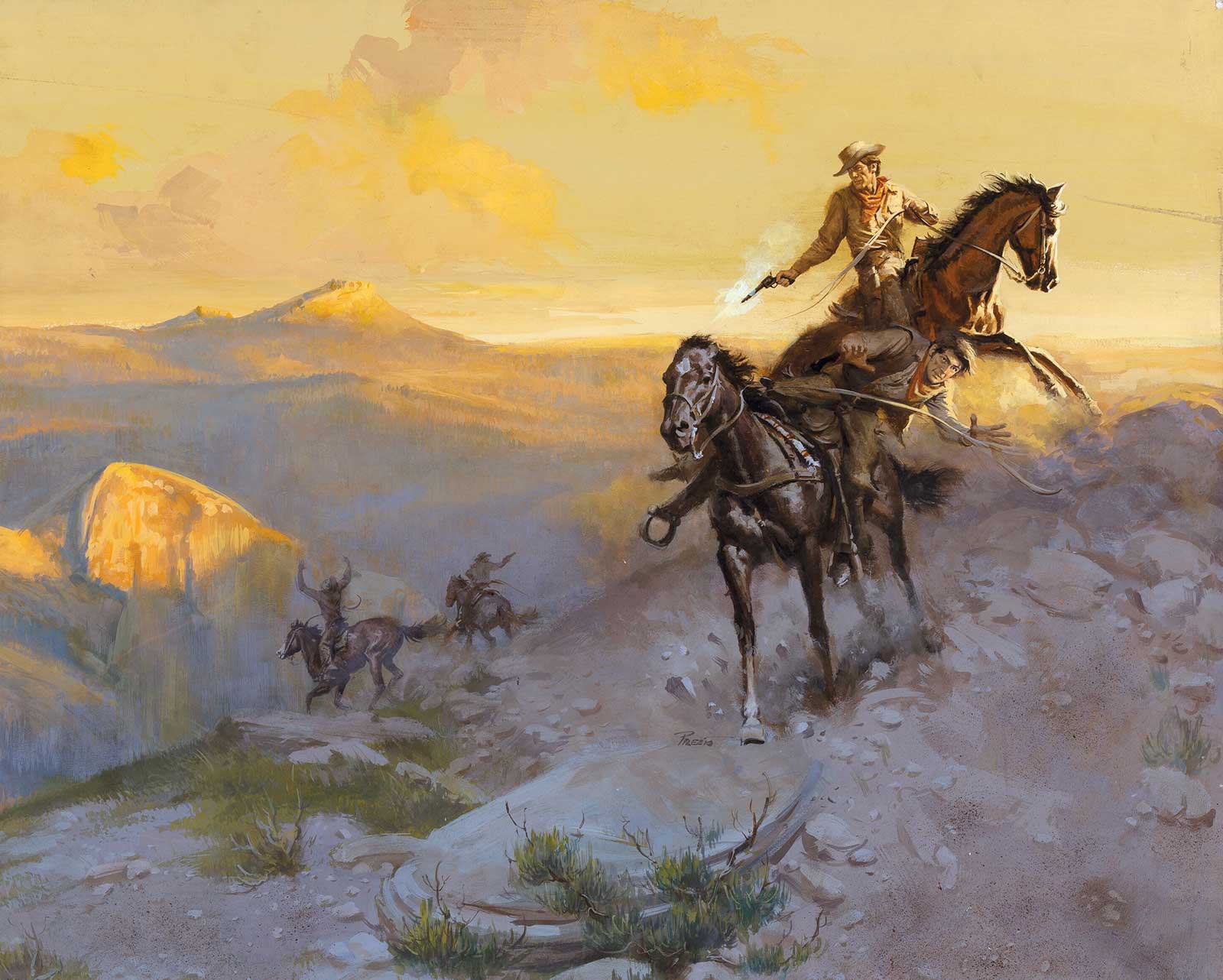 Heritage Auctions, Morning Shootout, gouache on board, 24 x 30", by Victor Prezio (1924-1976).
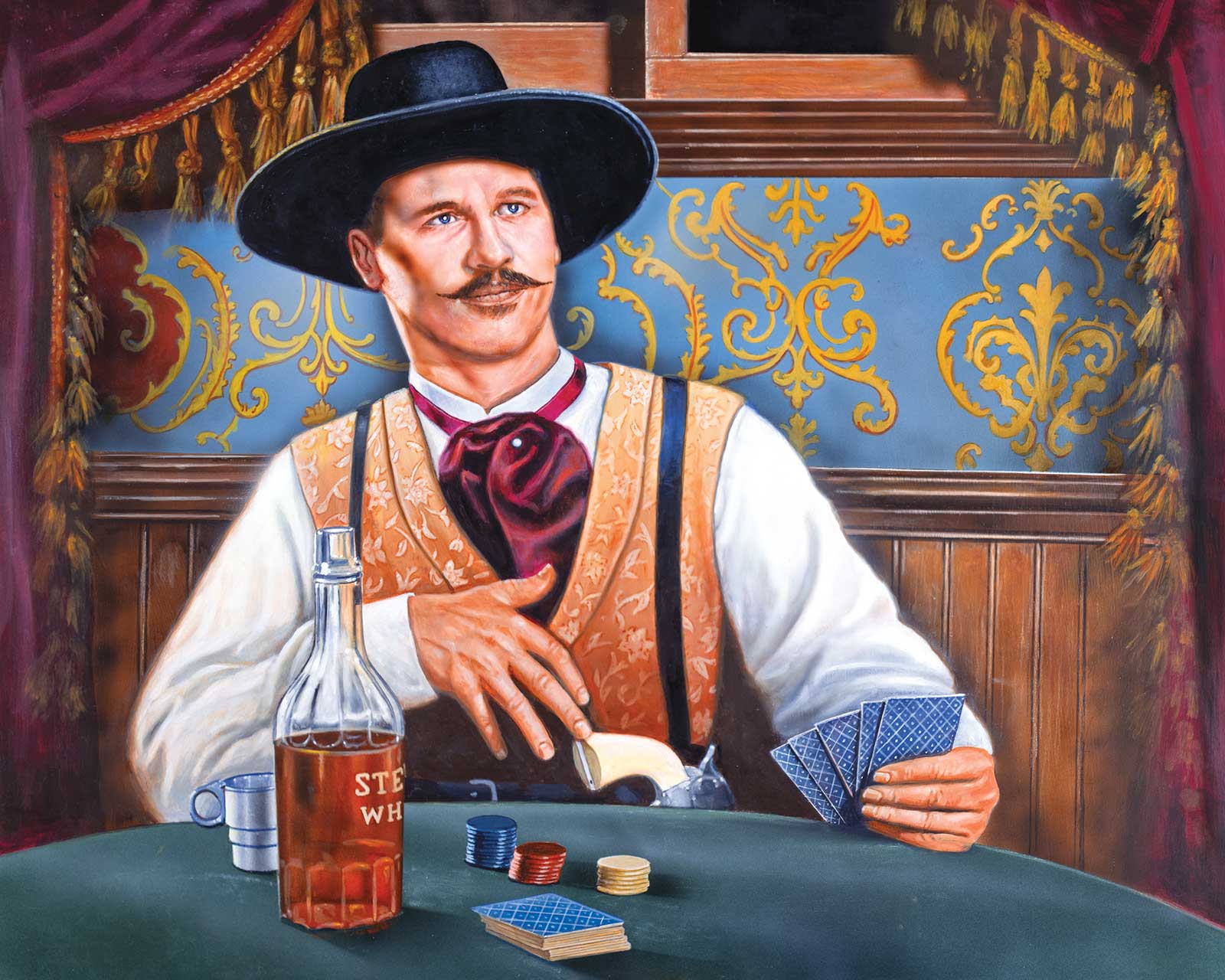 Jerry Crandall, Isn’t That a Daisy?, oil, 24 x 30"
At Legacy Gallery in Scottsdale, Arizona, there are several artists who have turned to real-life events to inspire their art. For instance, Rick Terry looked to the iconic Gunfight at the O.K. Corral for his popular bronzes, many of which feature stylized figures with lanky arms and legs. The bronze has detail in the guns, the coats and even in the faces, but it also works as a silhouette as four figures, one of them Wyatt Earp, line up with their weapons as they prepare to make history. Bob Coronato, also shown at Legacy, bring the authentic West to his work of Wild Bill Hickock, one of the most famous Western figures to be mythologized by history. In Coronato’s work, Wild Bill’s dual pistols exhale smoke, possibly after dispatching an outlaw or gunfighter.
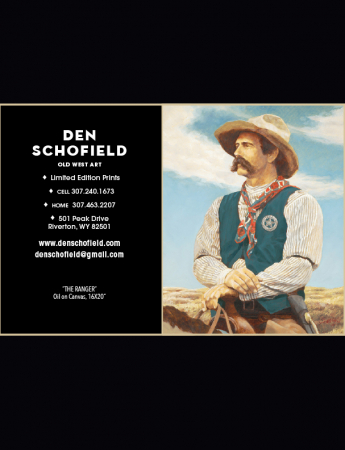
InSight Gallery in Fredericksburg, Texas, shows the work of Tony Pro, who has painted several pieces that speak to the inherent danger that existed in the lawless territories in the frontier. The gallery also shows the work of Michael Ome Untiedt, an artist who has found a way to capture the movement and kinetic energy that comes with riders and horses barreling out of a painting. In Rangers Command a Comanche Moon, Untiedt uses only the moon to illuminate his subjects. “The full moon conveys a lot of imagery and symbolism to we humans, perhaps because it helps illuminate the unseeable night,” he says. “Comanche raiders used the illumination of a full moon to guide their raids across the southern plains, so much so that the warm weather full moons were known as Comanche Moons. For 40 years, the Frontier Battalions of the Texas Rangers fought these marauding raiders, gaining the upper hand with the invention of the Colt revolver which enabled them to shoot numerous times without reloading and to fire accurately from a moving horse.” 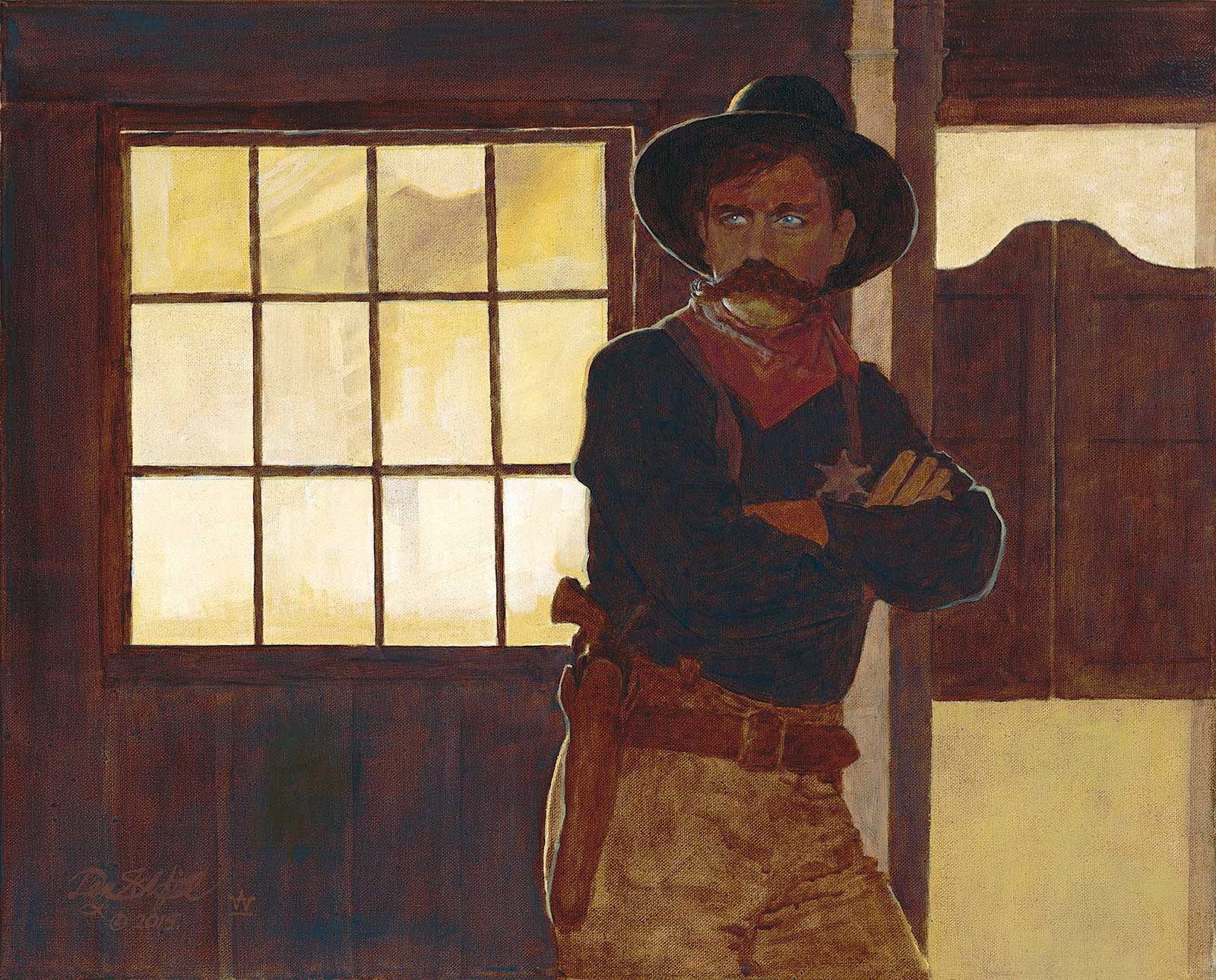 Den Schofield, Keeper of the Peace, oil on canvas, 16 x 20"
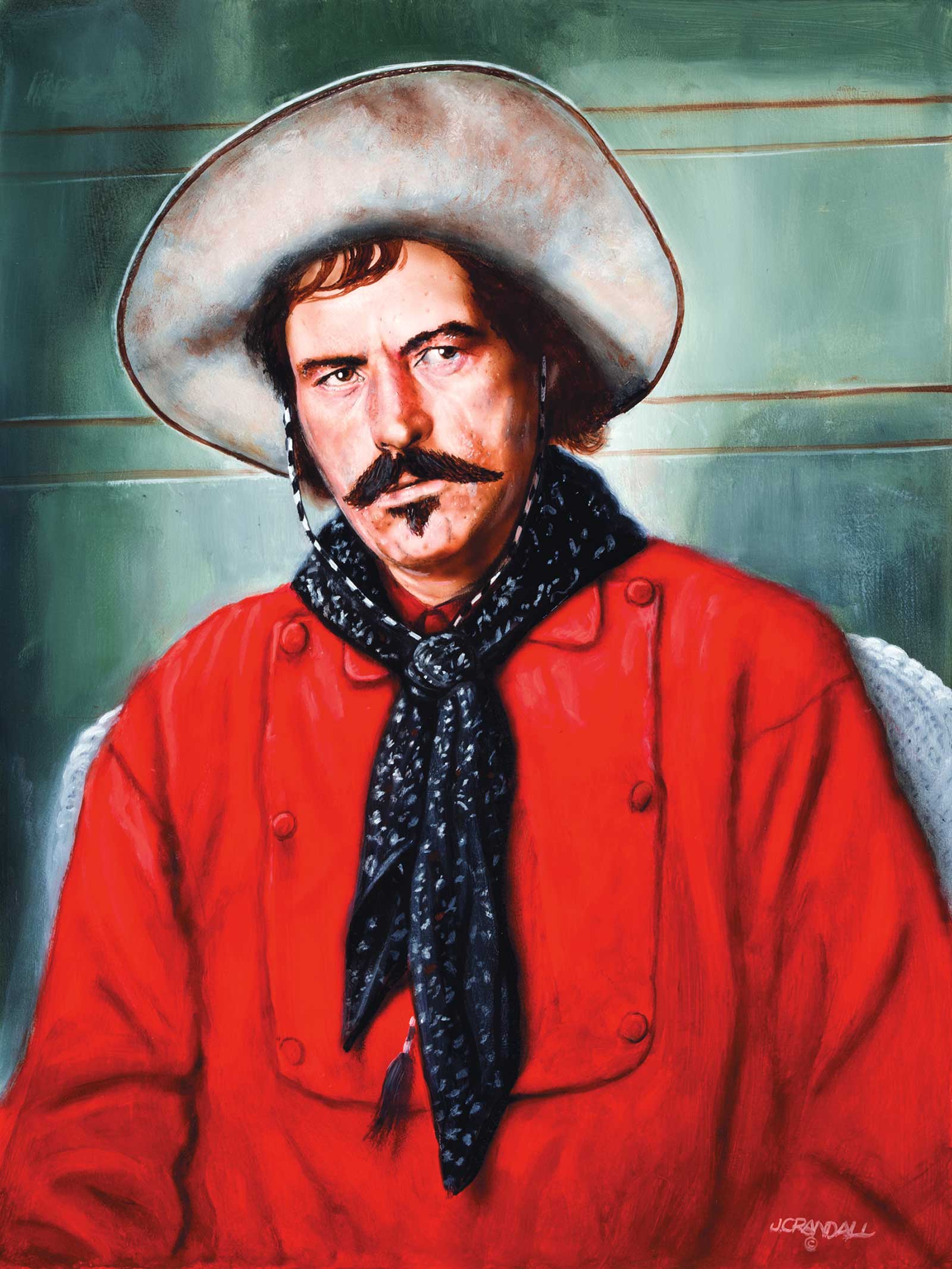 Jerry Crandall, Tombstone’s Curly Bill, oil, 24 x 18”
At Mark Sublette Medicine Man Gallery in Tucson, Arizona, an artist like Dennis Ziemienski gets a lot of mileage out of these dramatic stories of heroes and villains, and sometimes the gray area that separates them. In The Horse Thief, he shows a figure committing a crime, but it is one of quiet purpose—no guns required—as he rides away with at least one horse under a magnificently cloudy sky.
In Den Schofield’s The Texian, the artist paints an imposing figure with his gun drawn. The violence has not yet happened, though it could be just seconds away. “He is defending himself against possible renegades approaching,” Schofield says. “They are bent on murdering the drovers and stealing the cattle. This was a problem in the years following the Civil War.” A student of history, Schofield turns as much to great Western painters like Frederic Remington and N.C. Wyeth as he does to early 20th-century impressionism.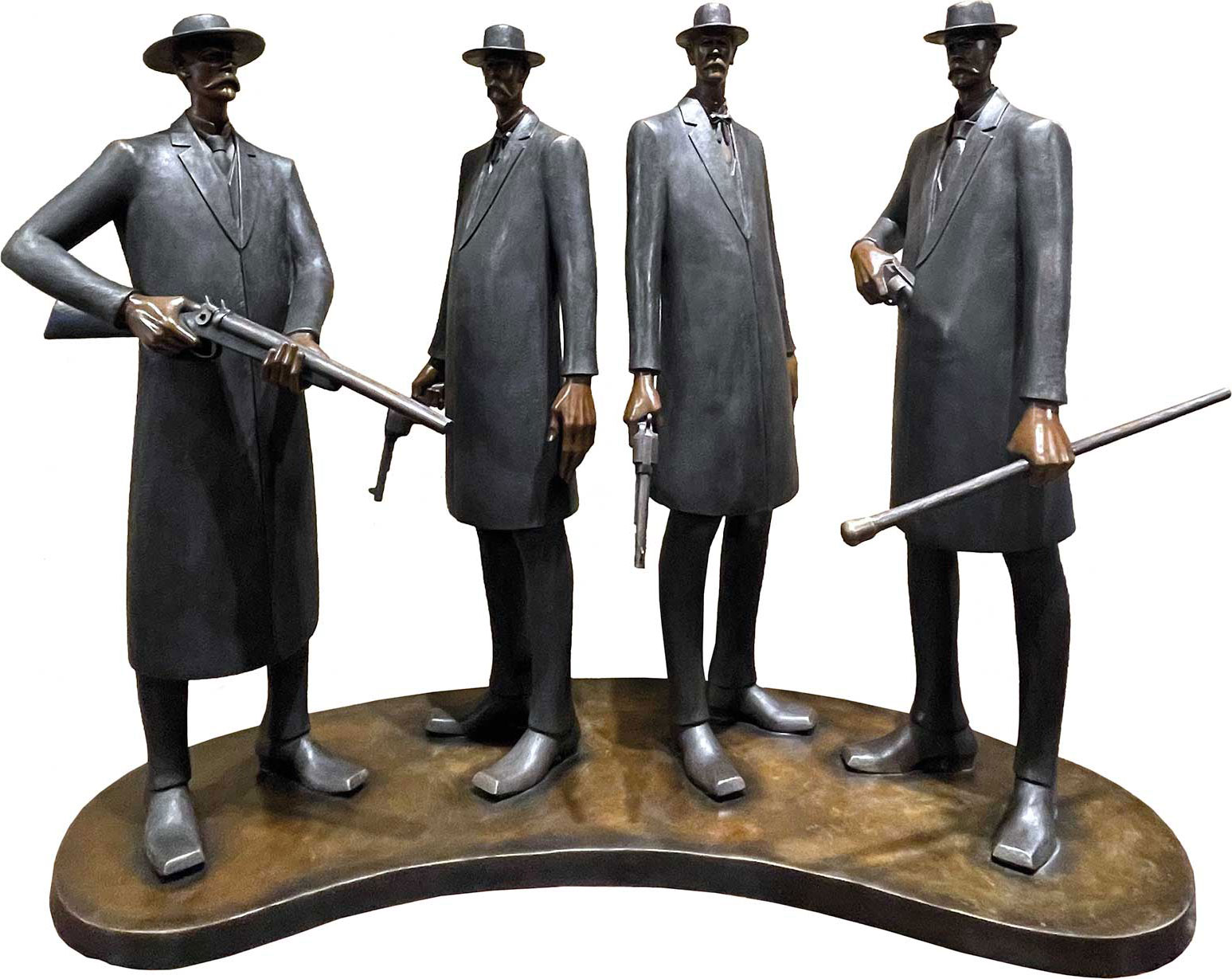 Legacy Gallery, O.K. Corral, bronze, 40½ x 16", by Rick Terry.
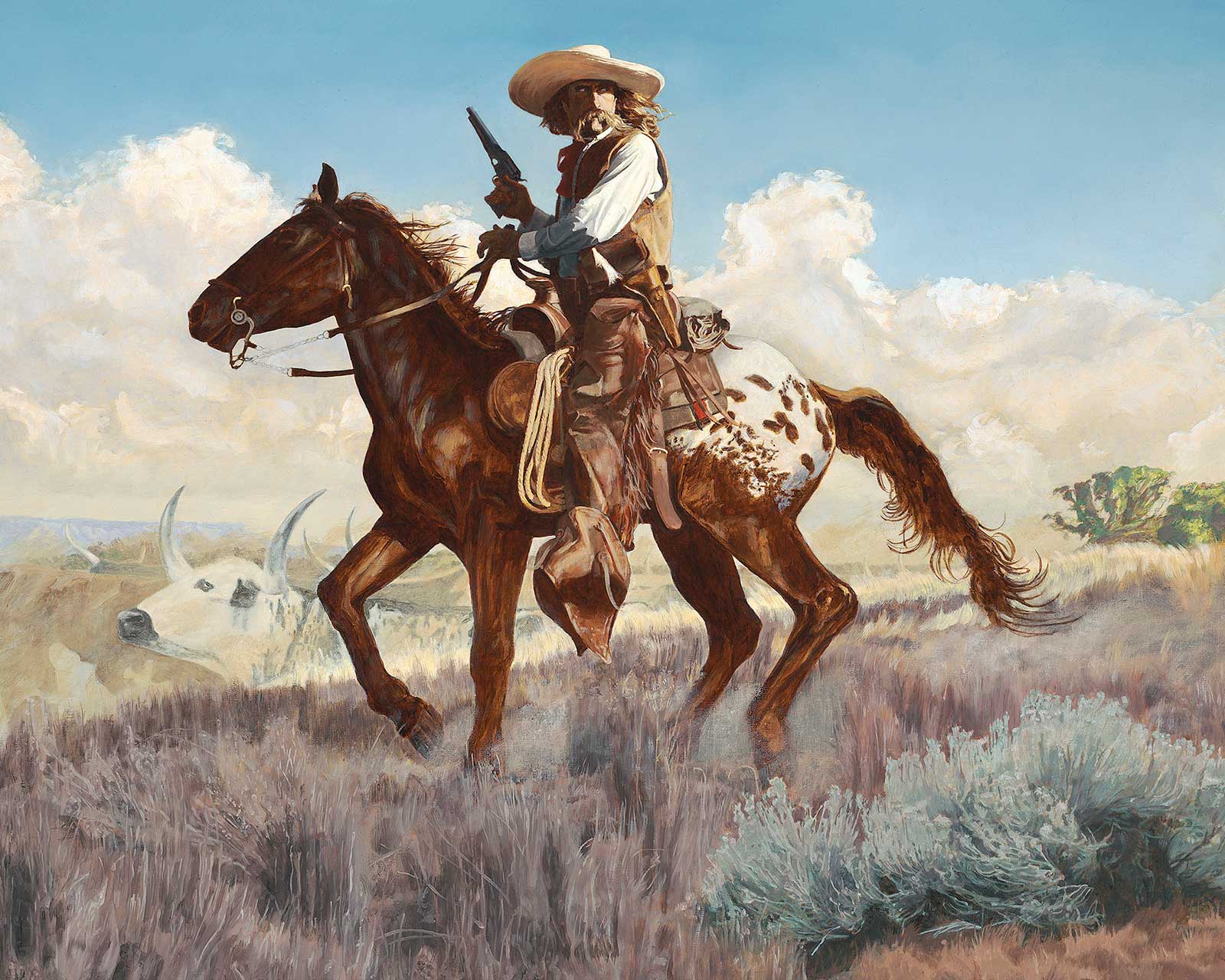 Den Schofield, The Texian, oil on canvas, 24 x 30"
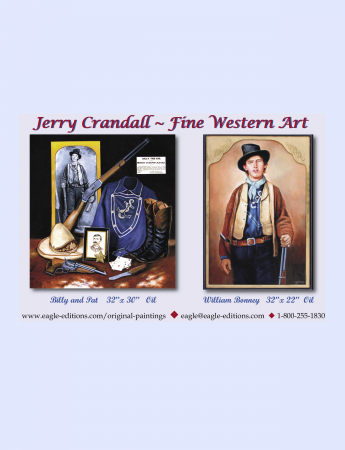
Painter Jerry Crandall also turns to history, by way of Hollywood. In several of his newest works, he paints characters directly from a 1993 Western classic, Tombstone, including characters portrayed by actors Powers Booth and Val Kilmer. Of course these are performances by actors, but the film is grounded in fact, which inspires Crandall’s paintings. “By studying and researching pre-1900 Western people and events, I am constantly formulating paintings that not only tell stories but capture the essence of notable personalities. I enjoy bringing the Old West to life through my artwork. A technically well executed piece that tells a story and is historically accurate is my goal for each painting,” he says. “It is important that we preserve the Old West from the smallest events to the more well-known, so that we don’t forget our heritage, which no other one country in the world can claim. Collectors of historical pieces are celebrating America’s unique past.” —
Featured Artists & Galleries
Jerry Crandall
(800) 255-1830, www.eagle-editions.com
eagle@eagle-editions.com
Heritage Auctions
2801 W. Airport Freeway, Dallas, TX 75261
(214) 528-3500, www.ha.com
InSight Gallery
214 W. Main Street, Fredericksburg, TX 78624
(830) 997-9920, www.insightgallery.com
Legacy Gallery
7178 Main Street, Scottsdale, AZ 85251
(480) 945-1113, www.legacygallery.com
Mark Sublette
Medicine Man Gallery
6872 E. Sunrise Drive, Suite 130, Tucson, AZ 85750,
(520) 722-7798, www.medicinemangallery.com
Den Schofield
Riverton, WY, (307) 240-1673
www.denschofield.com, denschofield@gmail.com
Andy Thomas
www.andythomas.com
Powered by Froala Editor