
Chiura Obata (1885-1975) emigrated to San Francisco when he was 17. He worked as a domestic helper and took classes in English and art. He had begun training in the Japanese art of sumi-e painting when he was 7, learning to create subtle tones with his brush and black ink. After the 1906 San Francisco earthquake, he sat outside with his sketchbook and produced illustrations for Japanese newspapers.
He experienced anti-Asian sentiment firsthand when he was attacked by a group of construction workers while painting on a street in San Francisco. In 1942, his career teaching art at UC Berkeley was interrupted when, after the bombing of Pearl Harbor, he, his wife and three of their children were incarcerated along with about 120,000 other Japanese-Americans. Within a month of his arrival at Tanforan, a center near Berkeley, he had received permission to set up an art school. After being transferred to the Topaz War Relocation Center in the desert of Utah, he set up another school.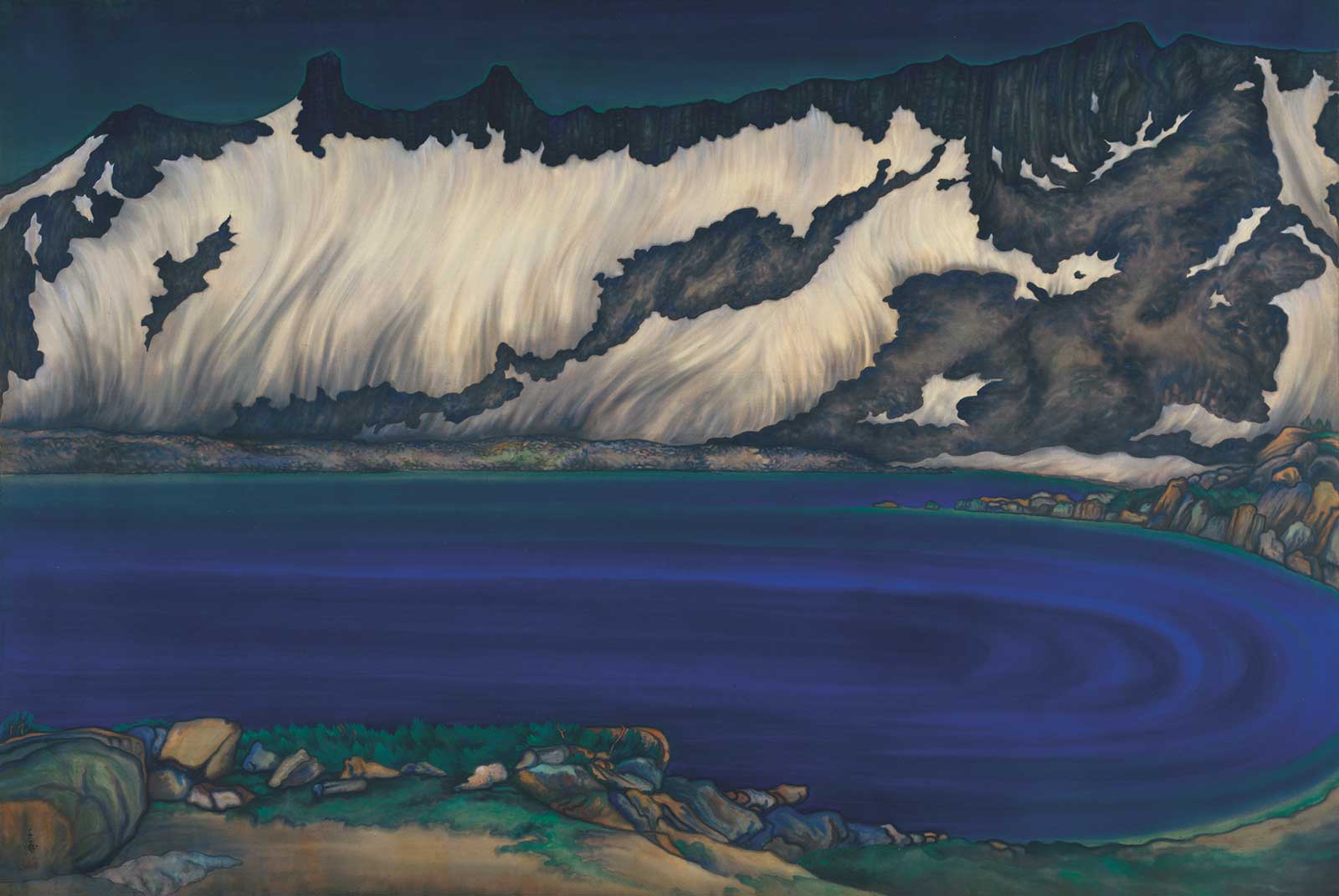 Lake Basin in the High Sierra, ca. 1930, ink and color on silk mounted on paper, 69½ x 102½”. Fine Arts Museums of San Francisco, Museum purchase, Dr. Leland A. and Gladys K. Barber Fund, 2000.71.1.
In 1943, he addressed the students. “Have we noticed the beautiful mountains surrounding us that have existed for thousands of years? They show heaven and earth their greatness. They can’t be moved no matter how many people try. The sun and the moon have been shining for tens of thousands of years blessing the world. The mountains, moon, and sun never try to explain. When dark clouds hide the sun the clouds will shine with the golden color of the sunlight. At night they will be blessed by the moonlight decorating their edges with a silver line. We only hope that our art school will follow the teachings of this Great Nature and that it will strengthen itself to endure like the mountains, and like the sun and the moon, emit its own light.”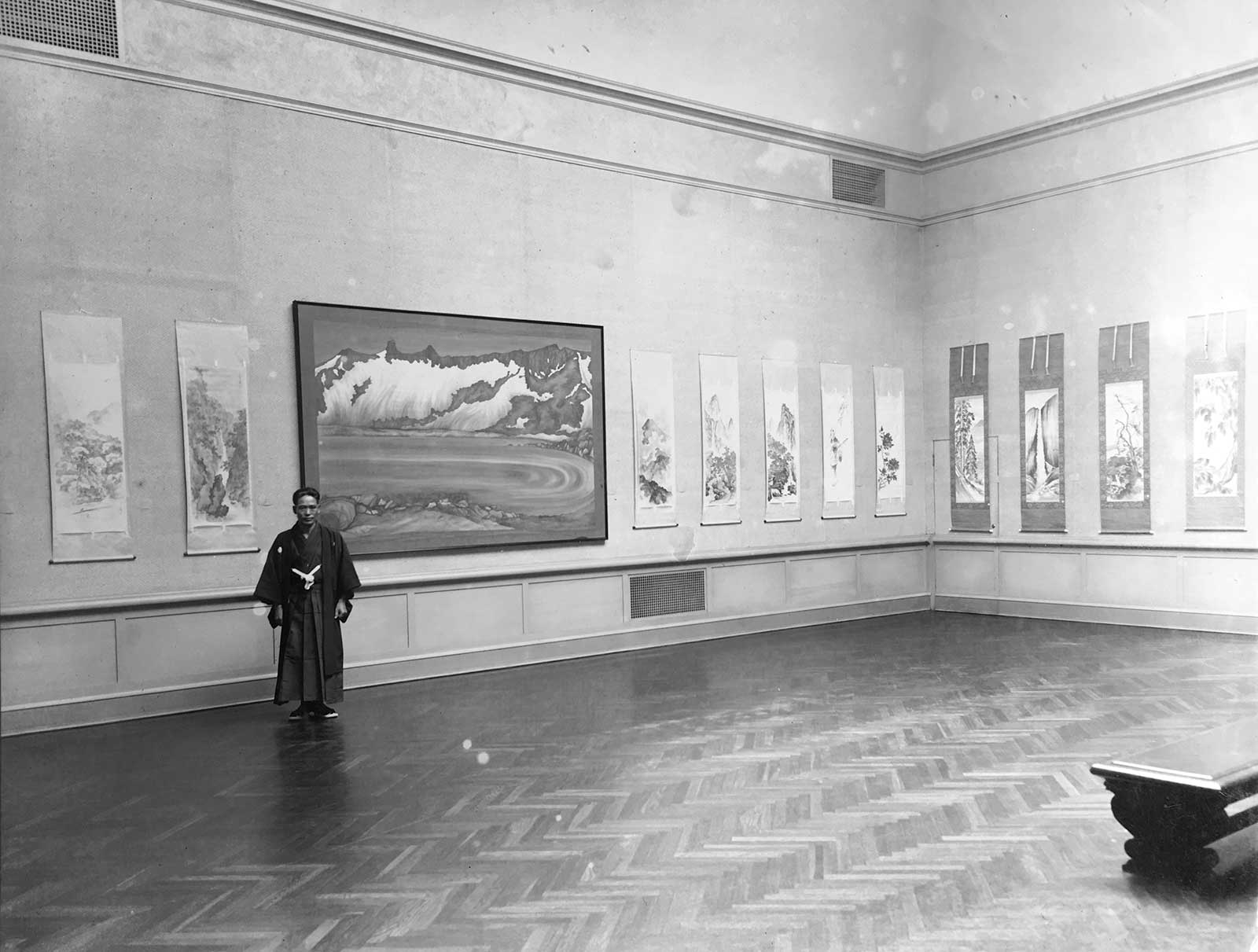 Chiura Obata at his exhibition of paintings by Rokuichi and Chiura Obata at the California Palace of Legion of Honor, 1931. Courtesy of the Obata Family.
Great Nature was Obata’s focus. An idea he had brought from Japan, had seen enforced by the power of the San Francisco earthquake, his experience of the varied California landscape and by his first visit to Yosemite in 1927. Yosemite was “the greatest harvest for my whole life and future in painting,” he said. He also noted, “I felt keenly that the education of children was not in school but in letting them contact great nature such as this.”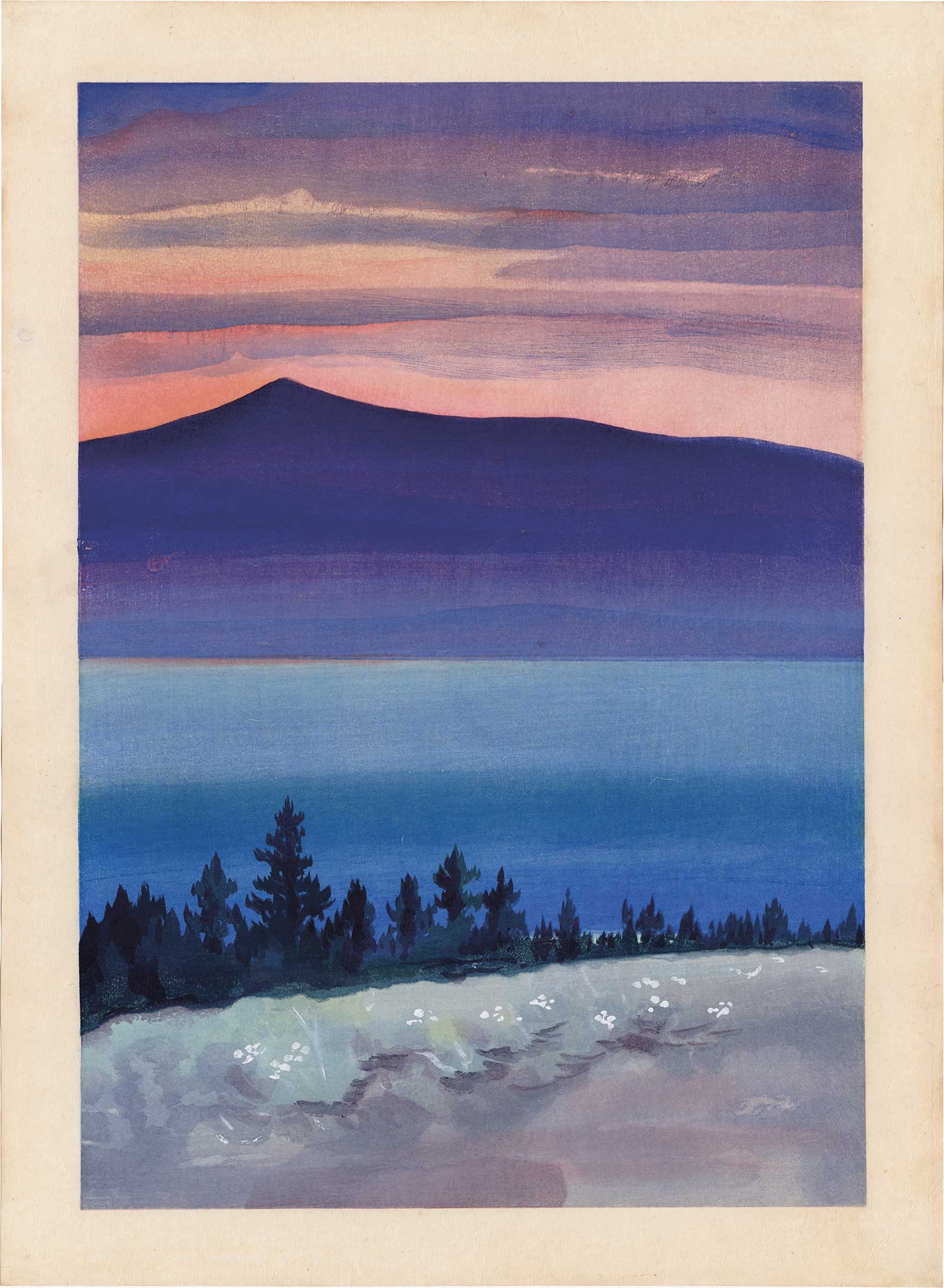 Evening Glow at Mono Lake, from Mono Mills, 1930, color woodcut on paper, 15¾ x 10⅞”. Private Collection, Courtesy Egenolf Gallery Fine Japanese Prints, Burbank, CA.
In 1928, after the death of his father, he returned to Japan, taking a selection of his California watercolors with him. He engaged the Takamizawa Print Works to produce a limited-edition set of woodblock prints of 35 of his watercolors. Takamizawa employed more than 32 carvers and 40 printers for 18 months to produce prints of such extraordinary quality they are almost indistinguishable from the original paintings.
Lake Basin in the High Sierra, 1930, is in the final portfolio, the World Landscape Series. The print is the result of 107 separate impressions. Obata wrote, “For just two months in the year the nameless lake nestling at the foot of Johnson Peak in the High Sierra comes to life from its winter slumber. Rocks and five-needle pines along the shore cling to each other tightly. Countless streams run down the frozen mountainside, lending a sublime melody. Man’s very soul and body seem to melt away into the singular silence and tranquility of the surrounding air.”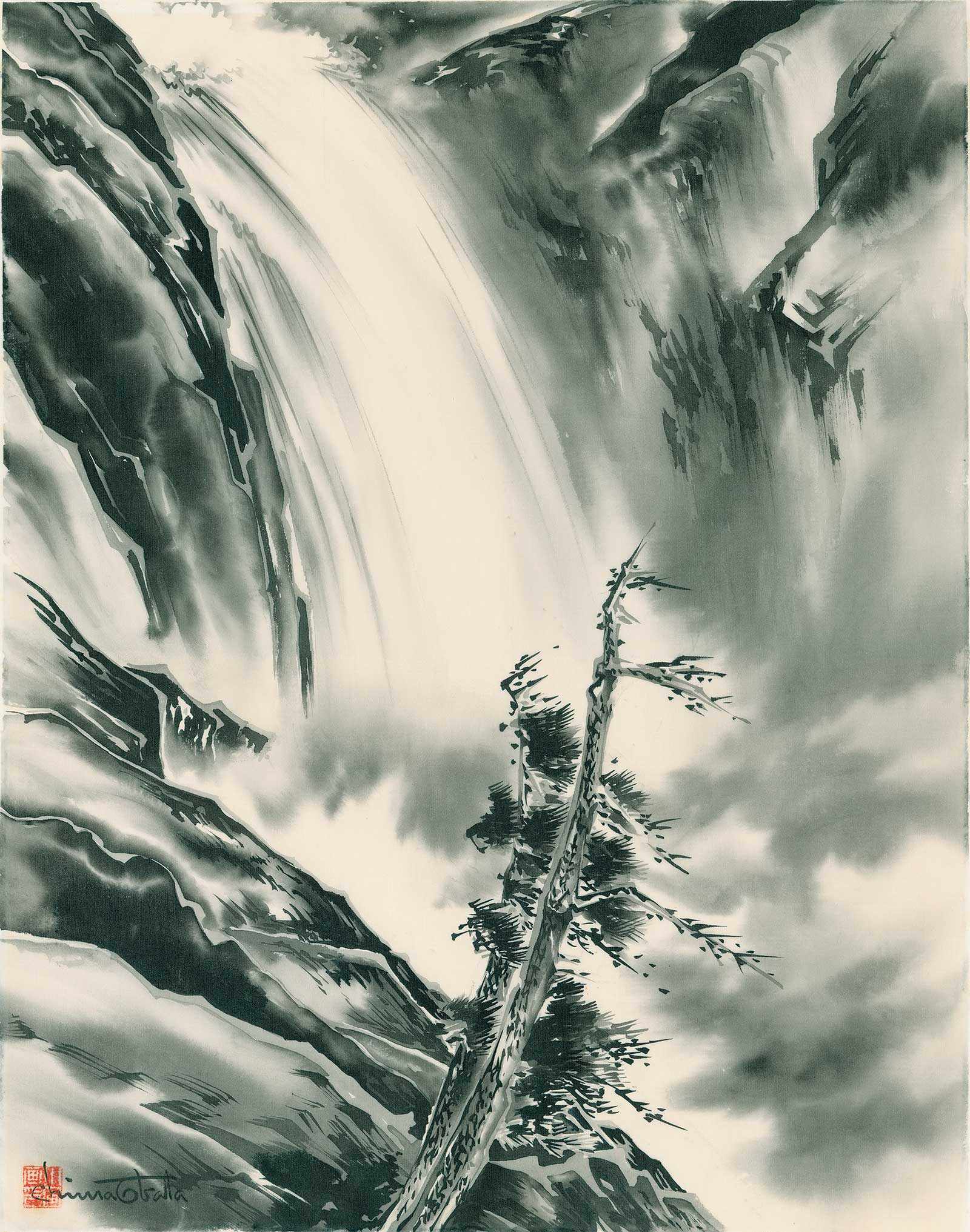 Waterfall, Yosemite, ca. 1940s, painting on silk, 19½ x 15½”. Courtesy Egenolf Gallery Fine Japanese Prints, Burbank, CA.
He also produced a 69½-by-102½-inch painting of the same scene, incorporating nature itself in the work, with ground lapis lazuli in the water and malachite in the green foliage.
Of Evening Glow at Mono Lake, from Mono Mills, he wrote, “The last glow of the dying day enfolds the storied Mono Lake and its surroundings with mysterious tints and hues.” The Chiura Obata Great Nature Memorial Highway now runs nearby.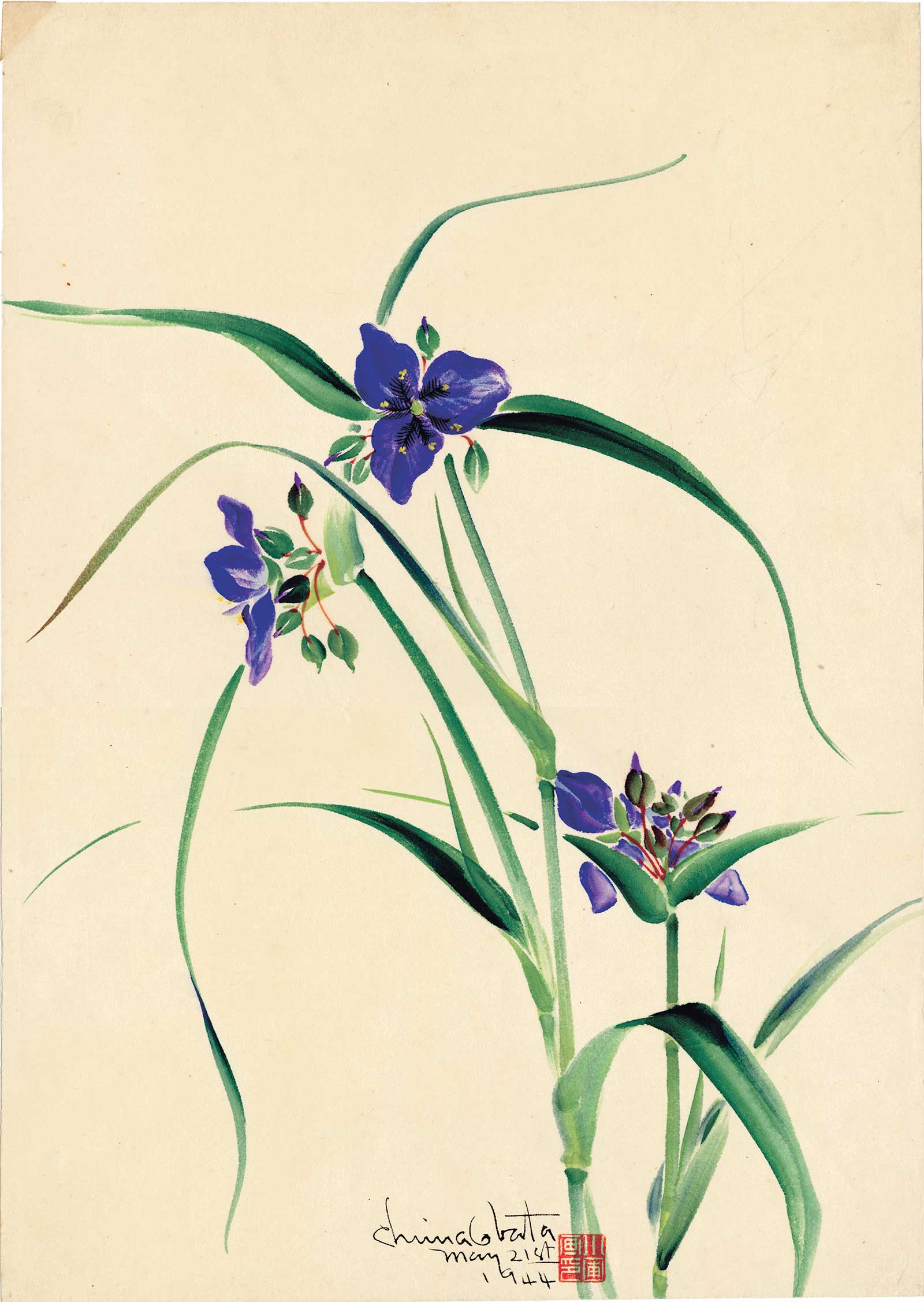 Purple Spiderwort Flowers, May 21st, 1944, watercolor, 18⅓ x 13”. Courtesy Egenolf Gallery Fine Japanese Prints, Burbank, CA.
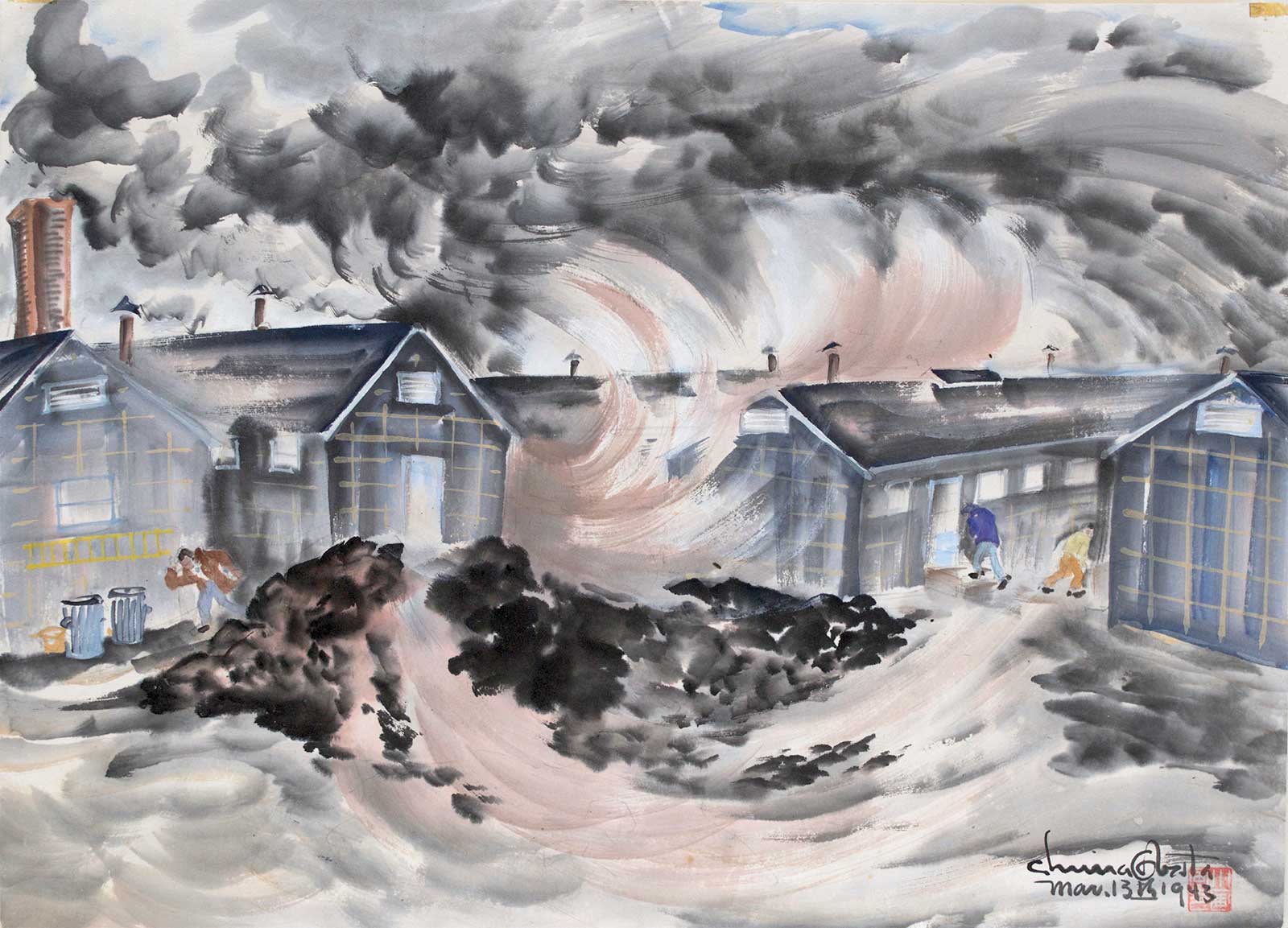 Dust Storm, Topaz, March 13, 1943, watercolor on paper, 14¼ x 19¼”. Private collection.
Throughout his career Obata used the sumi-e techniques he learned as boy. Waterfall, Yosemite, ca. 1940s, masterfully captures the solidity of the rocks, the flowing water and the mist.
Obata’s wife, Haruko Kohashi (1892-1989), was a well-known ikebana artist and he often painted her floral arrangements. He wrote to her from Yosemite, “I picked some wildflowers by the rocks and under the trees around camp and I’m sending them to the children. Tell them not to spoil them. I was very sorry to pick them. Each grass and each flower had long persevered under more than 10 feet of snow, until, at last, in the spring they had grown into flowers. But I will send them since I wanted to show them to you.” His watercolor, Purple Spiderwort Flowers, May 21st, 1944, is an example of his many flower paintings.
Always inspired by his adopted home he wrote, “I dedicate my paintings, first, to the grand nature of California, which, over the long years, in sad as well as in delightful times, has always given me great lessons, comfort, and nourishment. Second, to the people who share the same thoughts, as though drawing water from one river under one tree.
“My paintings, created by the humble brush of a mediocre man, are nothing but expressions of my wholehearted praise and gratitude.” —
Powered by Froala Editor