Because of the enormous success that he has enjoyed over the past number of years, just about everyone who is involved with Western art has become familiar with Kyle Polzin’s magnificent and highly desired still life paintings of saddles, spurs, vintage guns, blankets, flowers and various types of cowboy and Native American apparel.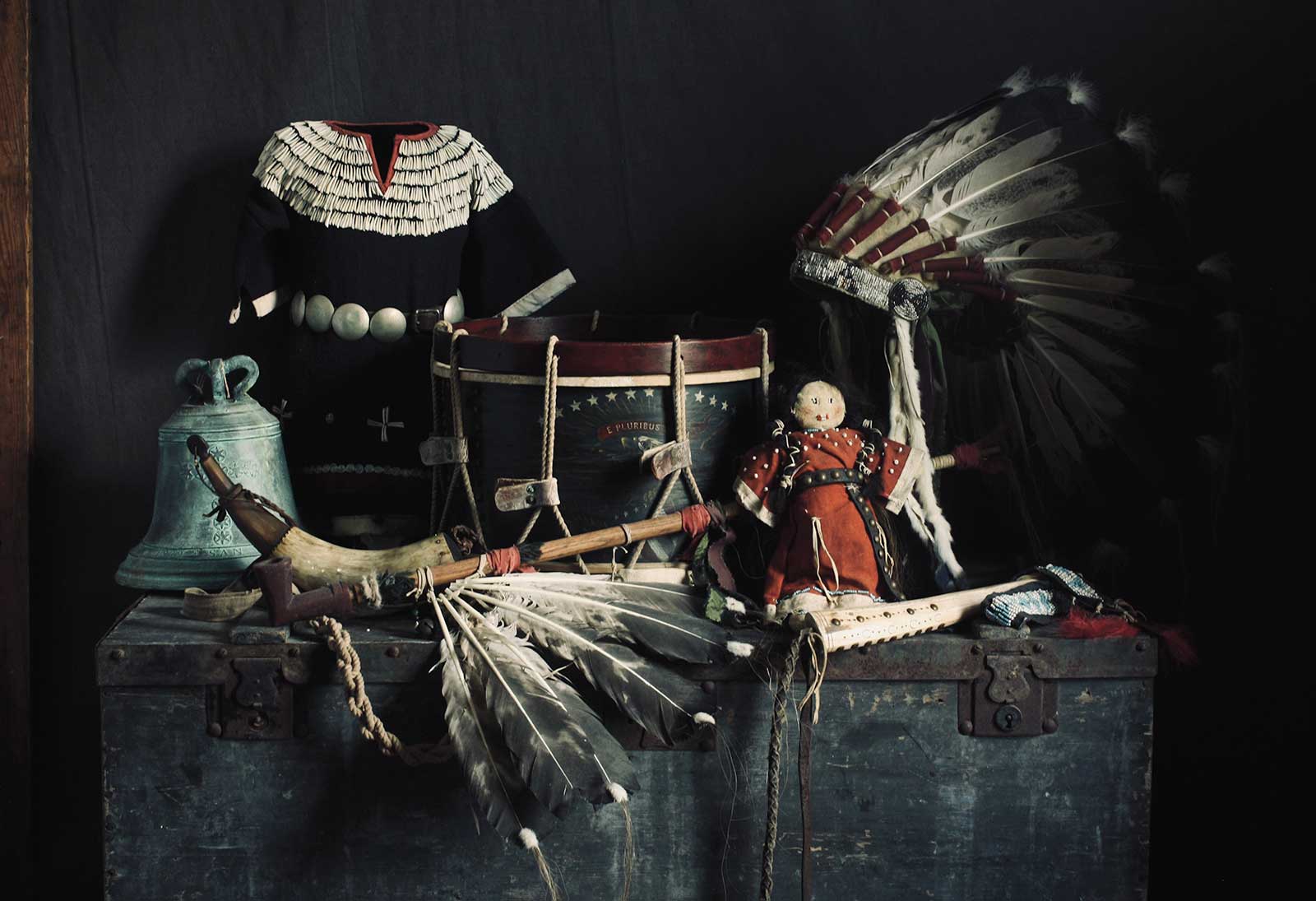 Still life subjects arranged in the studio of painter Kyle Polzin. With the exception of the trunk, Polzin crafted each of the items in this photo.
However, in spite of his great popularity as a fine artist, what many collectors may not know is that, in addition to being a talented artist who masterfully reproduces those objects in his paintings, Polzin is also a very skilled artisan who often will actually take the time to “design and craft” some of those objects if he doesn’t already have what he needs for the subject of his next painting.
From my conversations with Polzin, I have learned that he has always had an innate curiosity about things that are old and nostalgic. And since both of his grandfathers were carpenters and one grandmother was a skilled seamstress, he always found himself, as a child, making many different things and enjoying the process of seeing his creations come together. So as time progressed, Polzin was naturally able to utilize those crafting skills that he learned in his childhood to augment his painting style.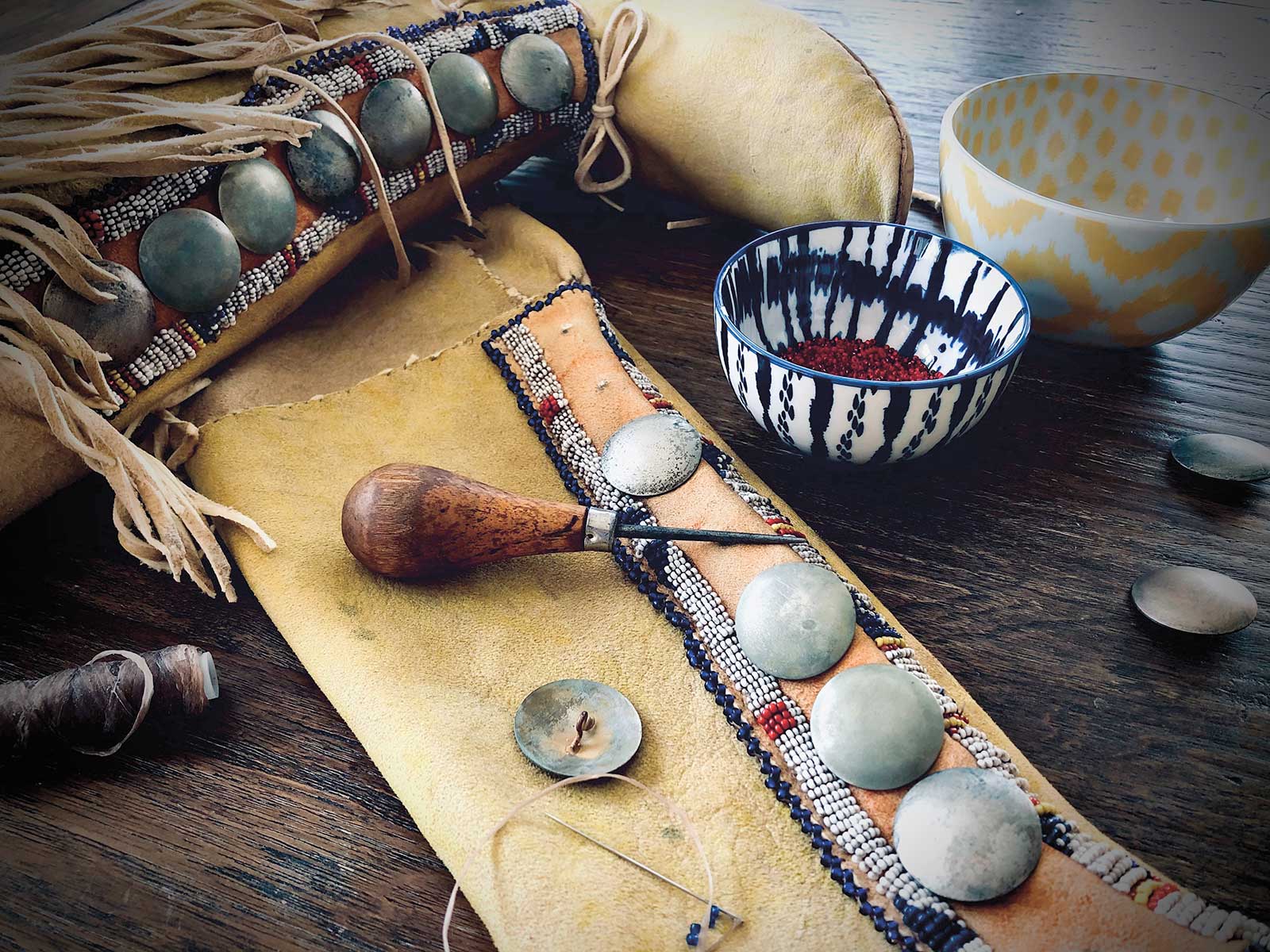 To make a more compelling painting, Polzin will often make his items so he can paint them from life in the studio. For these moccasins, Polzin meticulously recreated authentic beading for the subject.
And because so many of his paintings contain objects that have been “handmade” by him, I thought it would be both interesting and informative to tell the story about the many unique items that Polzin makes for his paintings—rather than simply telling a story about his exquisite paintings.
Like so many things that happen in life, the artist actually did not start off with a plan to make or fabricate items that he would use in his still life paintings. In a way, it all started by accident years ago when he was showing his young daughter a book that contained photos of Plains Indian dolls that were made of buckskin and buffalo hair. After seeing the photos of all those dolls, he thought that he might like to do a painting which contained a doll that was representative of a Plains Indian doll. But since he couldn’t find exactly what he had in mind, Polzin decided to make by hand a doll that matched what he had envisioned. To create that first doll, he used soft smoked buckskin for the body and he stuffed it with horse hair. He then added buffalo hair braids, he sewed by hand a dress from wool trade cloth, and he accented it with some old brass buttons. Then, to complete his doll, he gave her some eyes and a smile made of tiny glass beads.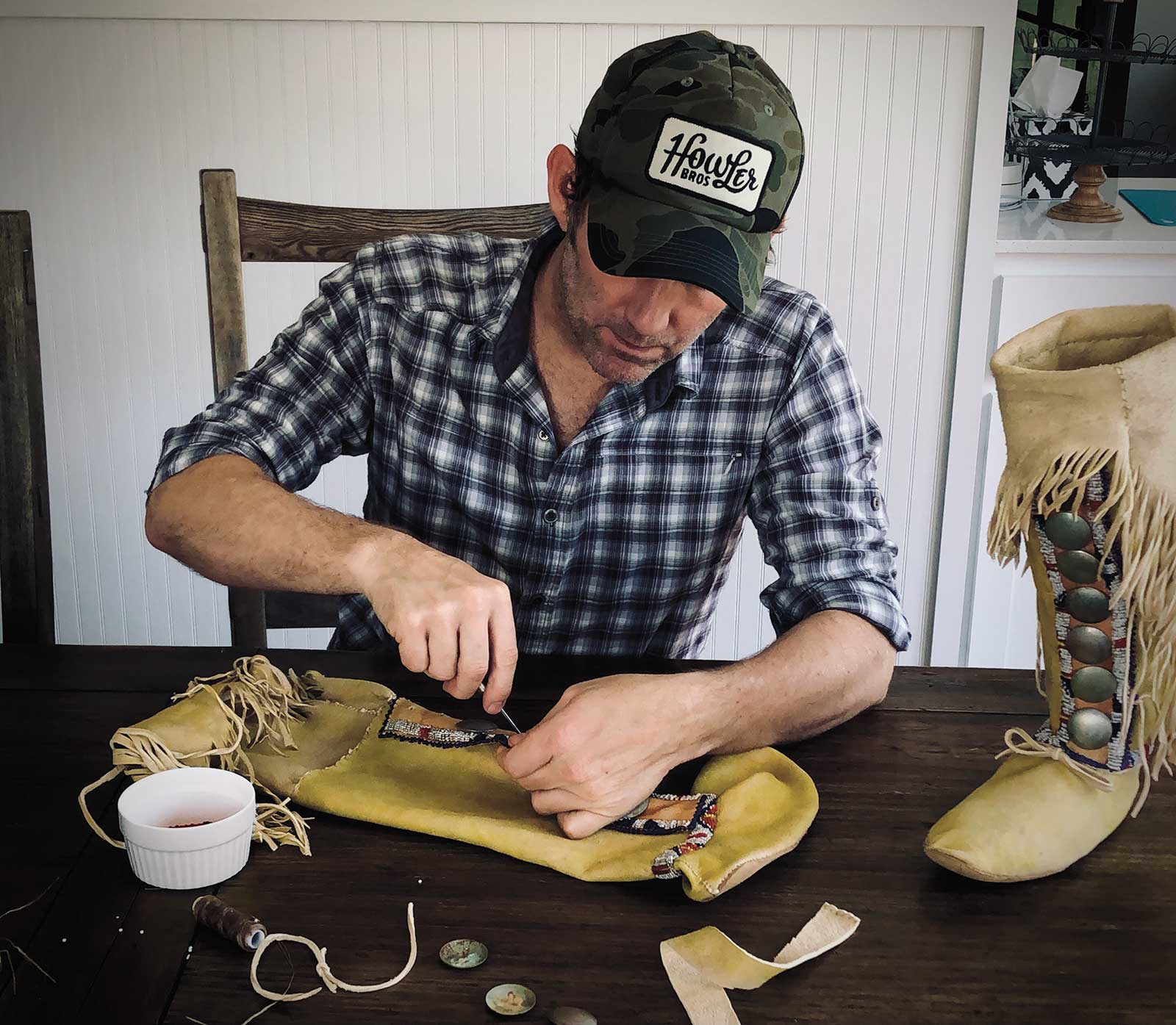 Polzin works on the moccasins at his Texas home, long before he ever goes into the studio to paint them.
Realizing that fabricating many of the objects, which he paints, could be very time consuming and tedious, I asked him why he would take the time to do that. His answer is very enlightening: “Often times, painting ideas come to me after I might see a photo of an object in a book or online, or if I see a scene in a movie, hear a lyric in a song, or see an interesting artifact in a museum. This tends to stir my curiosity and naturally I want to learn as much as I can about the subject. And because of my painting technique, it is very important for my painting process that I have the object, that I am painting, in hand—so that I can move it around to find just the perfect angle and the optimum lighting effect to make it work in my composition. Once I have done all my research and gathered as much knowledge as I can about the subject, I will combine some of the most interesting visual aspects of the subject to craft into the ideal piece for my painting. This allows me to match my original idea for the painting as opposed to limiting my creativity by only working with the item or items that I have access to. Also, before I begin to paint the subject and since I own the object, I can disassemble and manipulate it to work best in my composition. This is something thatI would definitely not be able to do if I were using a very valuable collectible and or an authentic museum piece.”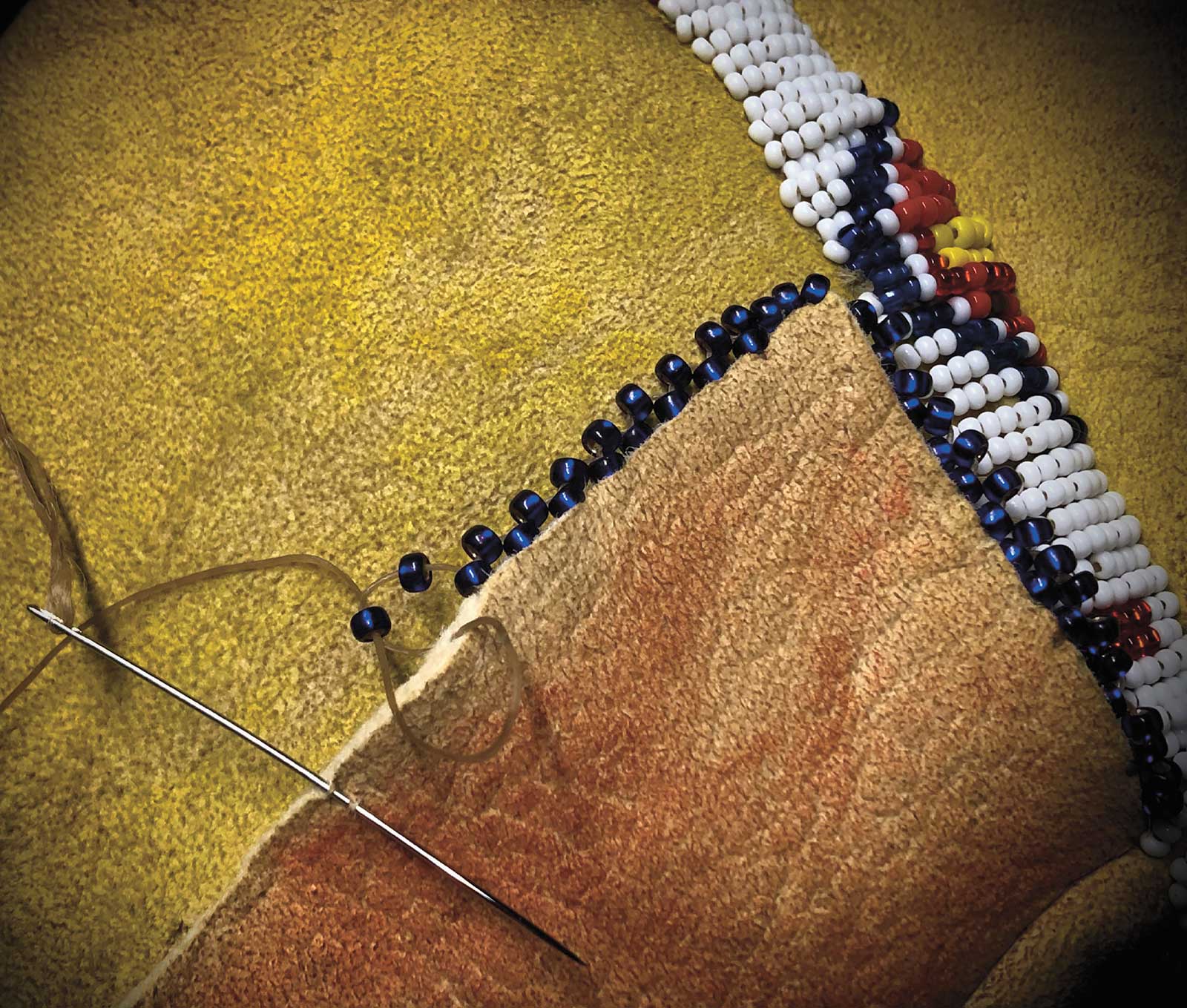 Polzin’s beadwork on the moccasins that will be the subject of In Their Footsteps
Once he finishes making the item that he needs for his painting, Polzin gathers all of the other elements that will be included in the painting’s composition. He then sets up the objects, adds the desired lighting effect to the layout and finally, he takes a series of photographs. Polzin uses those photographs as his main “reference tools” in the painting process and he paints from them (photographs), rather than from the live setup since the colors, the shadows, the lighting effect and the three-dimensional look are constant in the photographs. Whereas, if he painted the composition from life, all of those factors would greatly vary based on the changing light that is in his studio throughout the day and based on where he might be standing when he is painting. And because of those changing factors, he would not be able to achieve the desired effect that makes his paintings stand out from the crowd if he painted his still life compositions from life.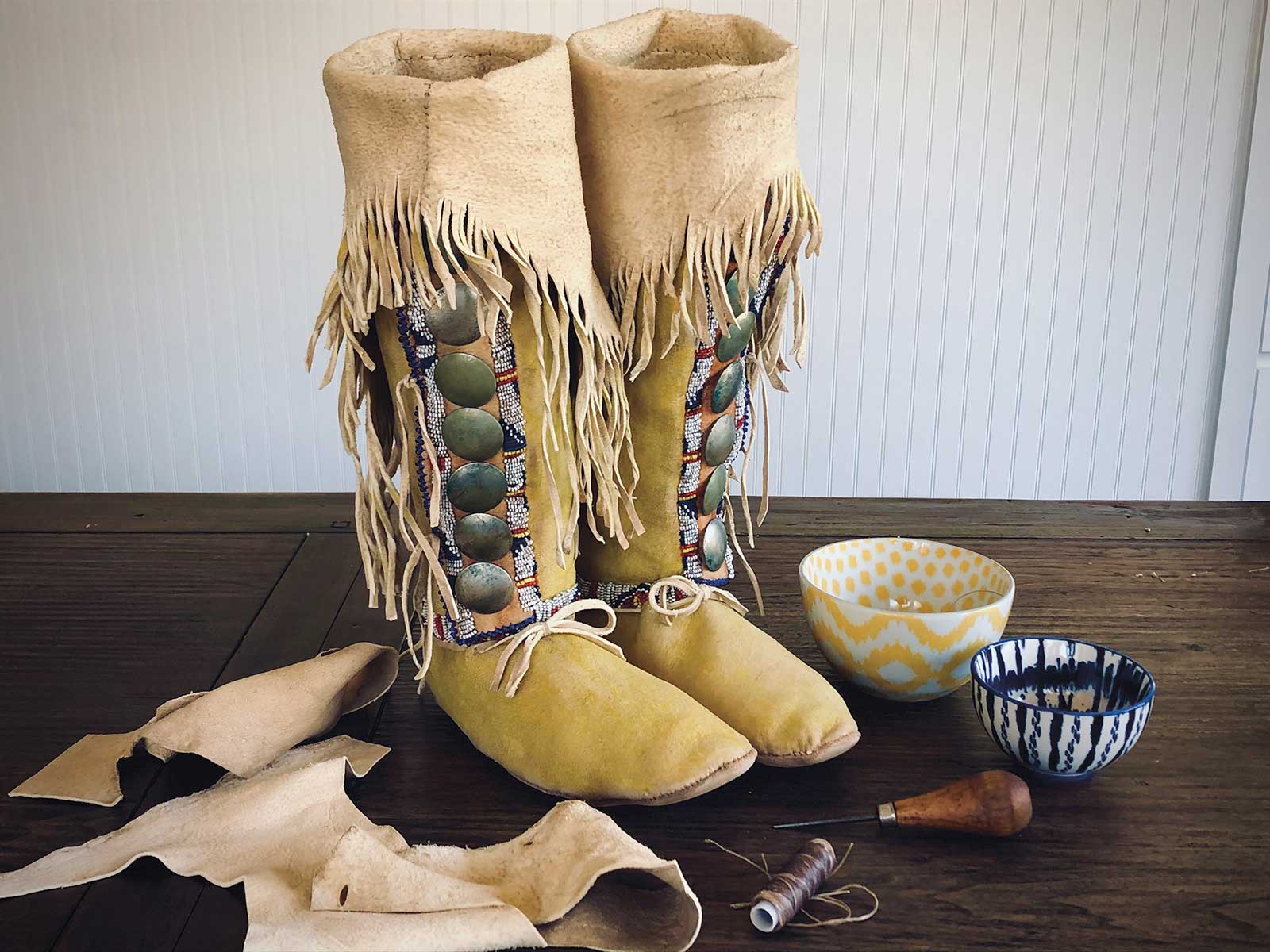 The completed moccasins
Having followed Polzin’s work since he first came on the scene, I was also curious to know which object that he has made by hand over the years was the most complex and took the most time to craft. Not surprisingly, he said that it was the Plains Indian war bonnet that he entirely made from scratch for the painting, Mystic Warrior, and which sold for his existing auction record of $287,000 in 2014.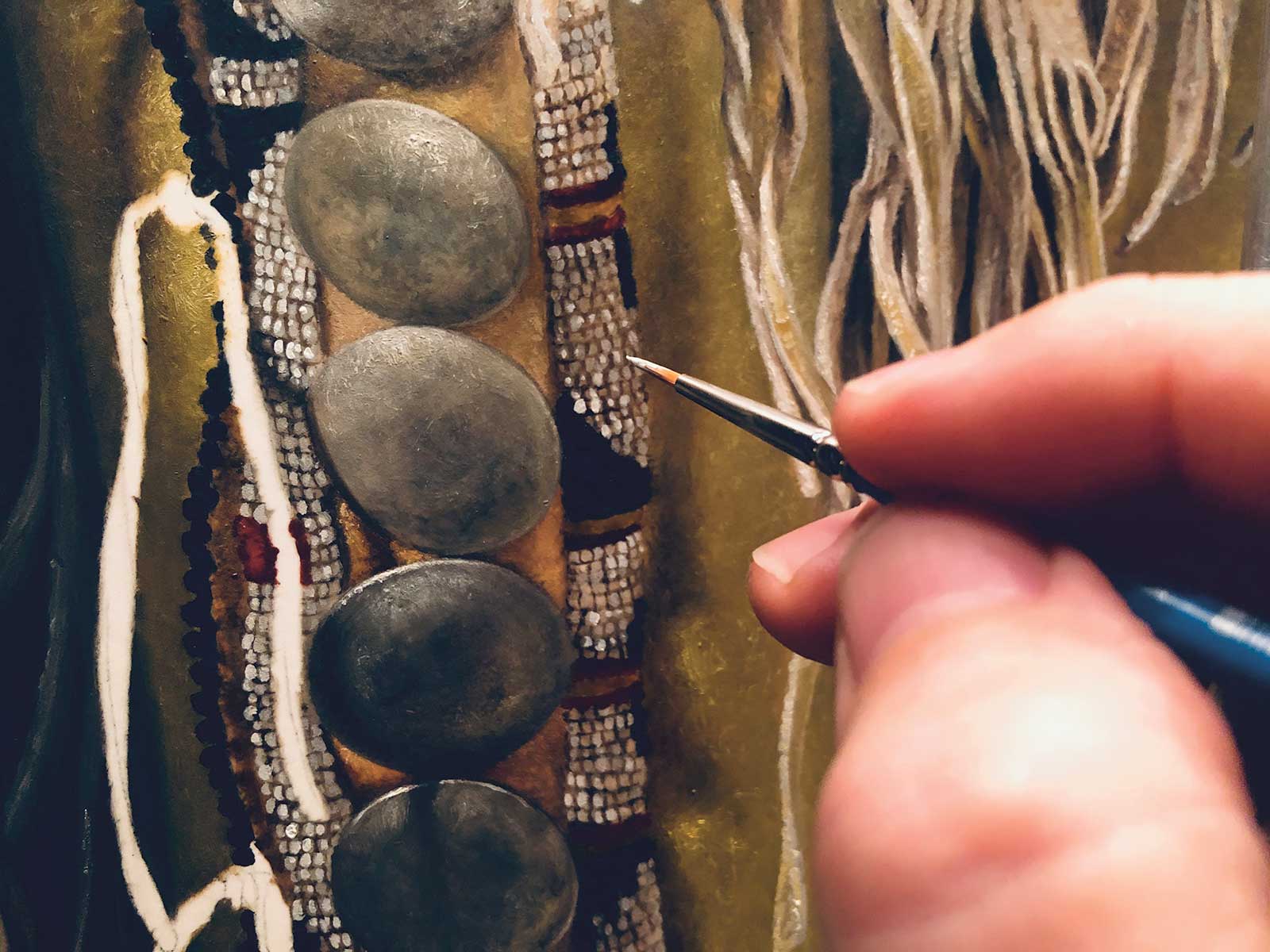 Painting on In Their Footsteps
Through my research for this article,I learned that when Polzin was planning for that painting, someone had offered to loan him an authentic war bonnet, but it didn’t quite match what he envisioned. So he studied how that headdress was made and how other similar headdresses were crafted; and, after studying many different types, he then decided to make his own full length one that exactly matched his idea for the painting. Fortunately, during the process, the artist was able to avail himself of the necessary reference material to make and achieve the desired look of his war bonnet. As he was crafting the subject of Mystic Warrior, he took the time to stain more than 60 turkey feathers to look like authentic eagle feathers. Also, to give the entire headdress an aged patina, he weathered every piece of the bonnet and ruffled all the feathers so that the finished product looked like it had “lived a life” on the plains. In all, Polzin spent one week researching war bonnets and he spent another full week making his version, all before ever starting the painting. And although the entire process was very lengthy, Polzin felt that it was well worth his time because it enabled him to feel a real connection to his subject during the entire painting process. Having seen the painting in person myself, I am sure that anyone else who also had the pleasure of seeing Mystic Warrior in person would agree that it truly is a masterful work of art that accurately and beautifully portrays a Plains Indian war bonnet.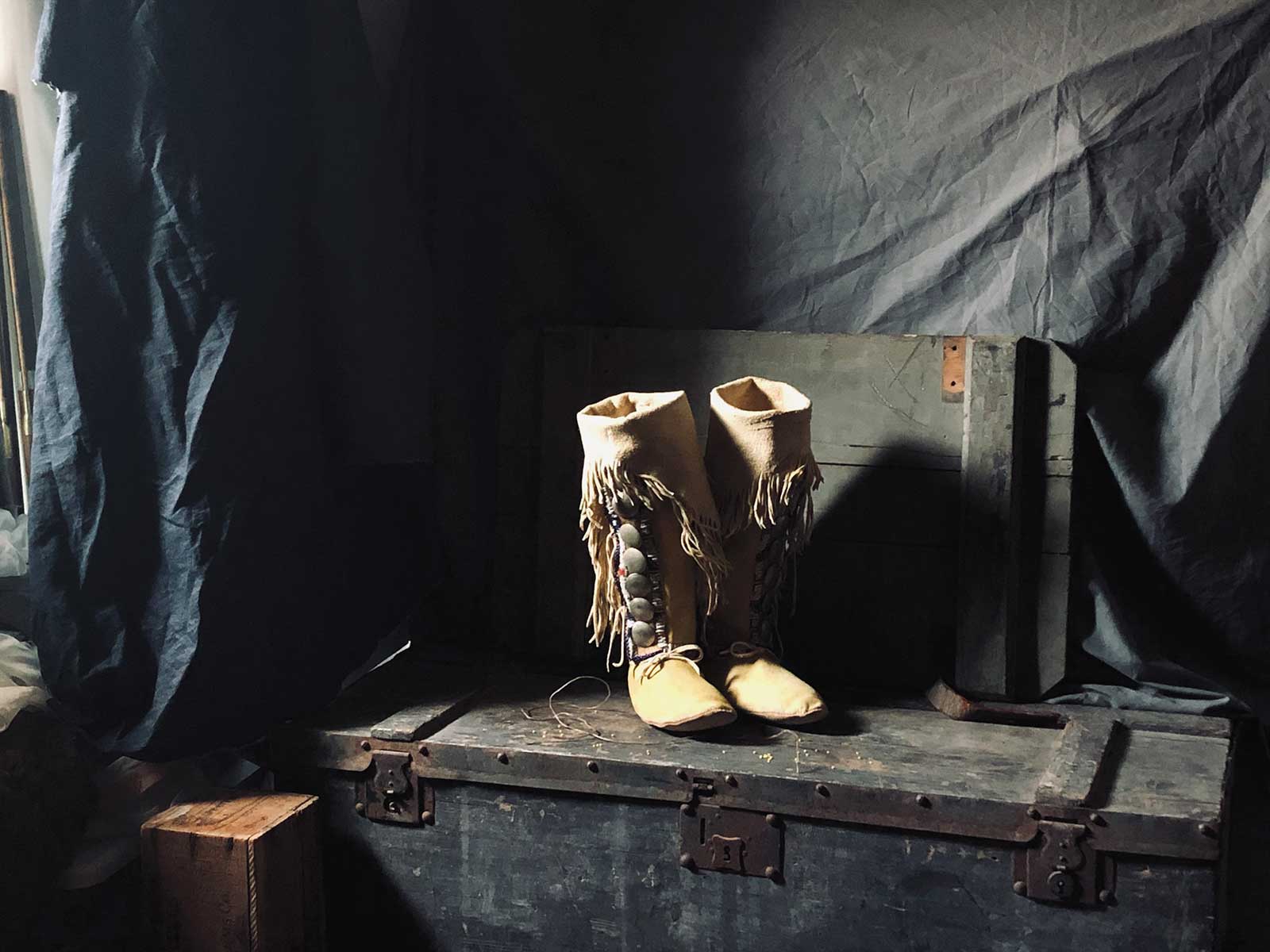 The completed moccasins in the studio and lit for the painting.
Over the years and because of his desire to maintain the accuracy of the subjects that he paints, Polzin has continued to take the time to make numerous items for his exquisite still life works. Some of the subjects that he has made for his paintings include the following items: silk cavalry guidon, saddle bags, Civil War drum, par fleche cases, knife sheath, powder horns, child’s doll, rodeo chaps, mission bell, moccasins, lance, peace pipes
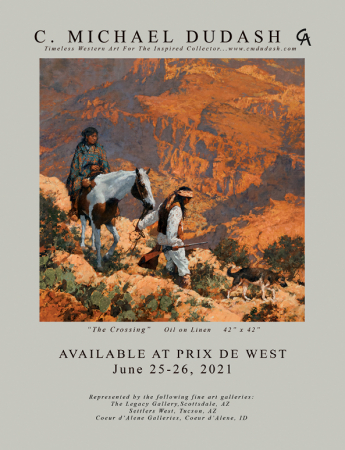
For one of his latest paintings—which will be available at the live auction during this year’s in-person Prix de West on June 26 at the National Cowboy & Western Heritage Museum—Polzin made a pair of adult moccasins that are styled after a pair of Kiowa woman’s high-top moccasins. And in talking with Polzin, I learned that he had never painted moccasins like these before and that he was inspired to paint them because of their ornate and intricate styling.
In order to craft this pair of moccasins, he had to purchase tanned buckskin, silver conchos, colored beads and a pattern that was made to match authentic plains high-top moccasins. However, as might be expected, he ended up making a few minor modifications to the pattern so that he could replicate a pair of moccasins, which he had previously seen while doing his research and because this specific type of high-top moccasins more closely fit his exact vision of moccasins that he wanted to feature in his painting.
After having had the pleasure of following the progression of Polzin’s crafting process and then admiring the completed and exquisitely made pair of custom high-top moccasins, I asked Polzin two questions: What was the most challenging part of making them? And how long did the entire process take you? He smiled and said that “doing the beading work was the most challenging aspect of the project for me and in total, I spent over 30 hours making the moccasins—before I even started the painting.” And for the lucky buyer, these hand-crafted high-top moccasins will be included with Polzin’s painting at the Prix de West’s live auction on the evening of June 26.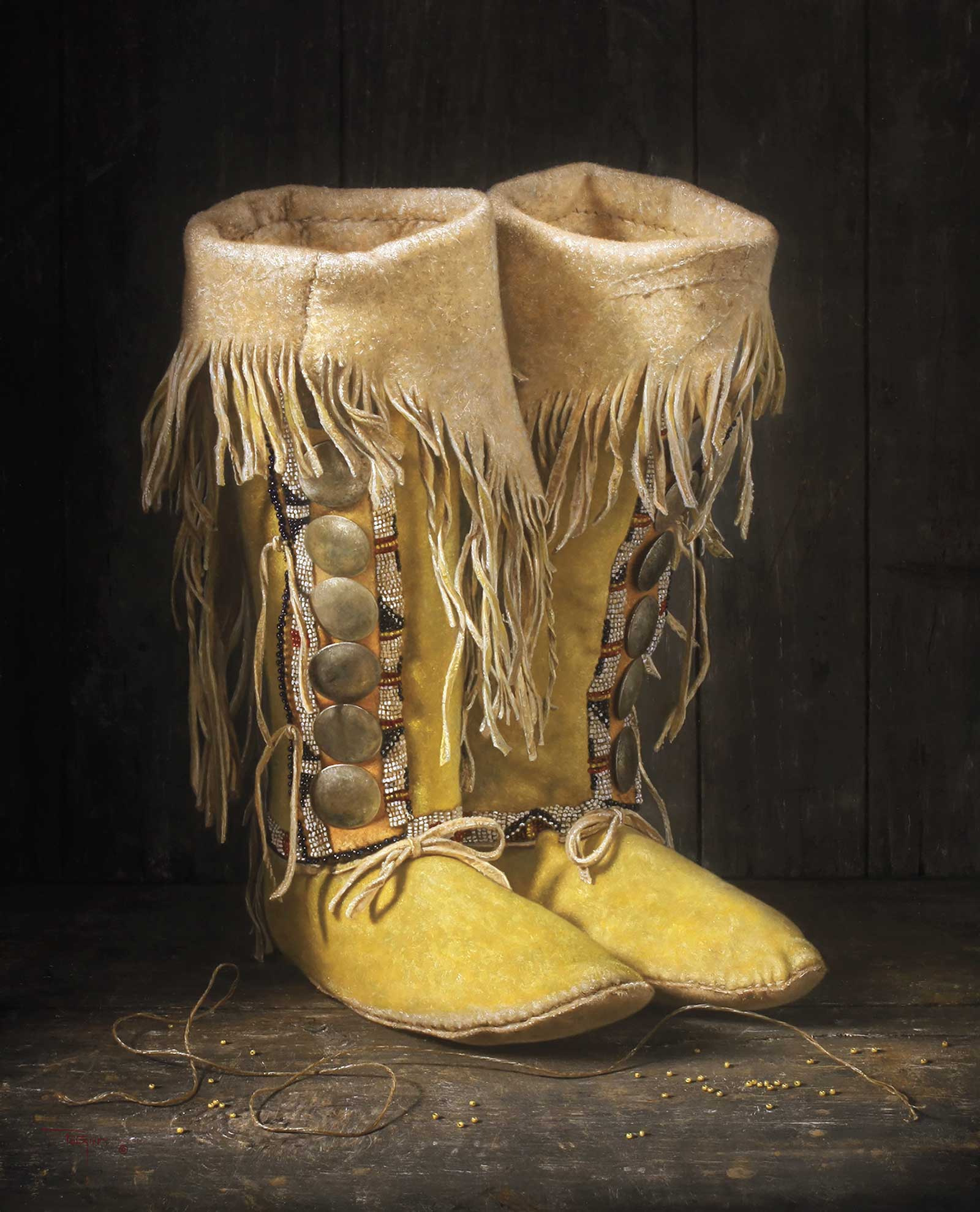 In Their Footsteps, oil on canvas, 24 x 17”. Available at the Prix de West, National Cowboy & Western Heritage Museum, Oklahoma City, OK.
I have been an admirer of Kyle Polzin’s work for more than 12 years. And like everyone else who has seen and admired his paintings at the various shows and auctions over those many years, I had known that he was one of today’s premier still life artists. But now, I know and I truly appreciate the fact that he is also a very highly skilled and dedicated artisan who will go to great lengths to custom make varied and authentic objects for his masterfully created still life paintings that are so highly sought after by most of today’s fine art collectors.
Dan Corazzi is a retired public school superintendent and software company CFO. He is on the board of the National Cowboy & Western Heritage Museum and he is the chairman of the Prix de West Committee in Oklahoma.—
Powered by Froala Editor