It was 1893 when Joseph Henry first ventured into Taos, New Mexico. He and John Hauser, an artist friend from Cincinnati, had rented a wagon in Santa Fe and begun visiting the pueblos. After more than a week on the road and visiting two pueblos prior, they finally rattled into Taos.
“The road was smooth to the mouth of the Rio Grande canyon, but became increasingly rough as the canyon narrowed to almost vertical walls, barren and rocky except for the piñon trees and chamisa bushes,” Forrest Fenn writes in his classic book on Sharp, Teepee Smoke. “After a long, grueling climb out of the canyon, they suddenly saw spread out before them the immense, pale green Taos plain, deeply slashed by the magnificent forge of the Rio Grande. Beautiful Taos Mountain loomed in the distance, and behind it, as if packed in by some giant hand, stood snow-covered peaks—twelve, thirteen, fourteen thousand feet high—dividing the land and extending north for hundreds of miles. It was breathtaking!”
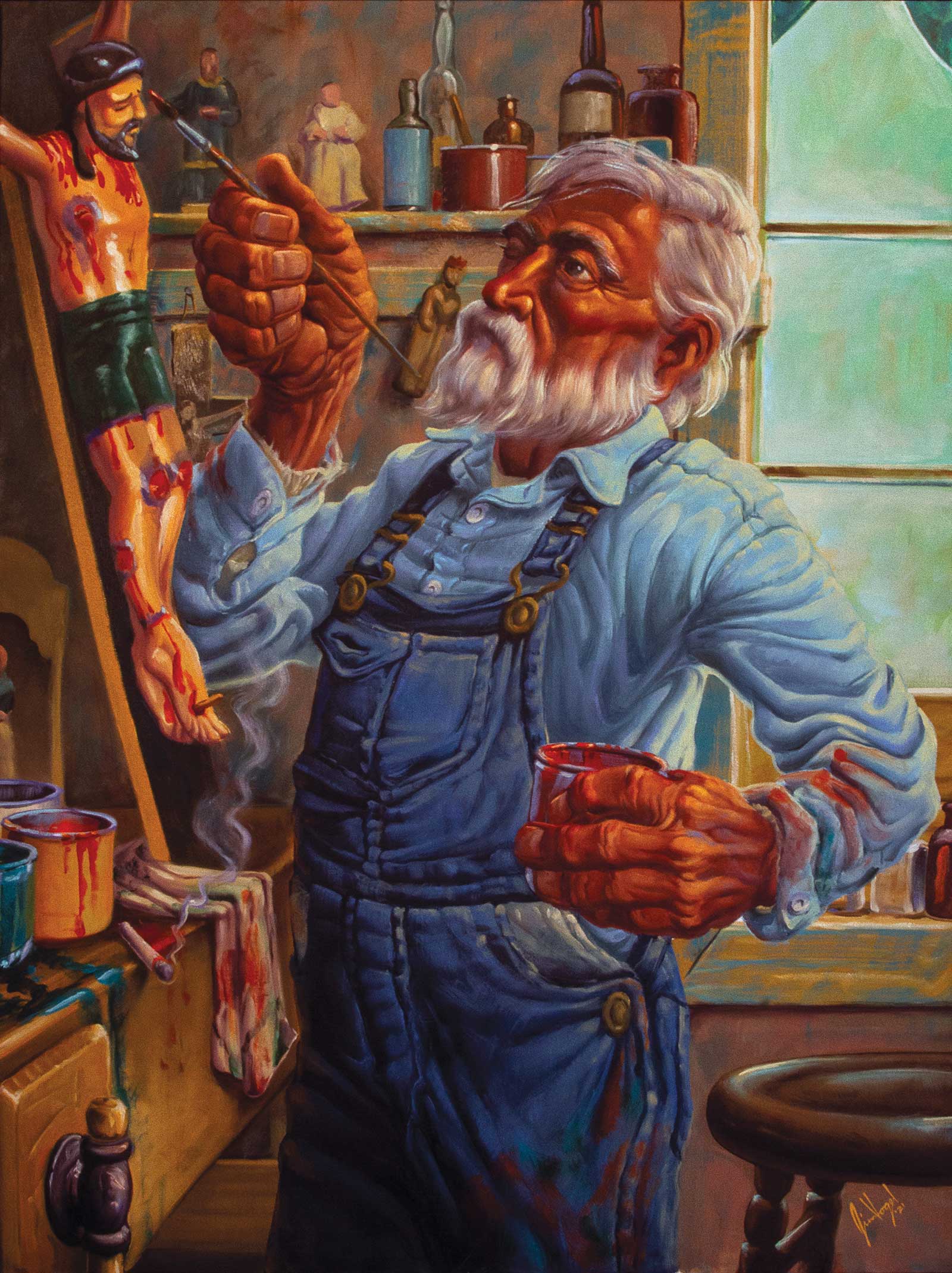 Jim Vogel, Matching the Color of the Sangre de Christo, oil, 32 x 24”
At that moment, history had happened, but it would be crystalized into the record of American art nearly three years later when Sharp was in Paris and he told some artists friends what he had witnessed. As Fenn illuminates in his book, it was at that exact second that the Taos Society of Artists truly began.
On April 30, Blue Rain Gallery will celebrate Sharp with a group exhibition featuring contemporary artists offering their takes on Sharp and his work. Taos Six Collection: An Homage to Joseph Henry Sharp, which runs through May 22, is the second in a series of annual shows hosted by the Santa Fe gallery that will focus on the six Taos Founders.
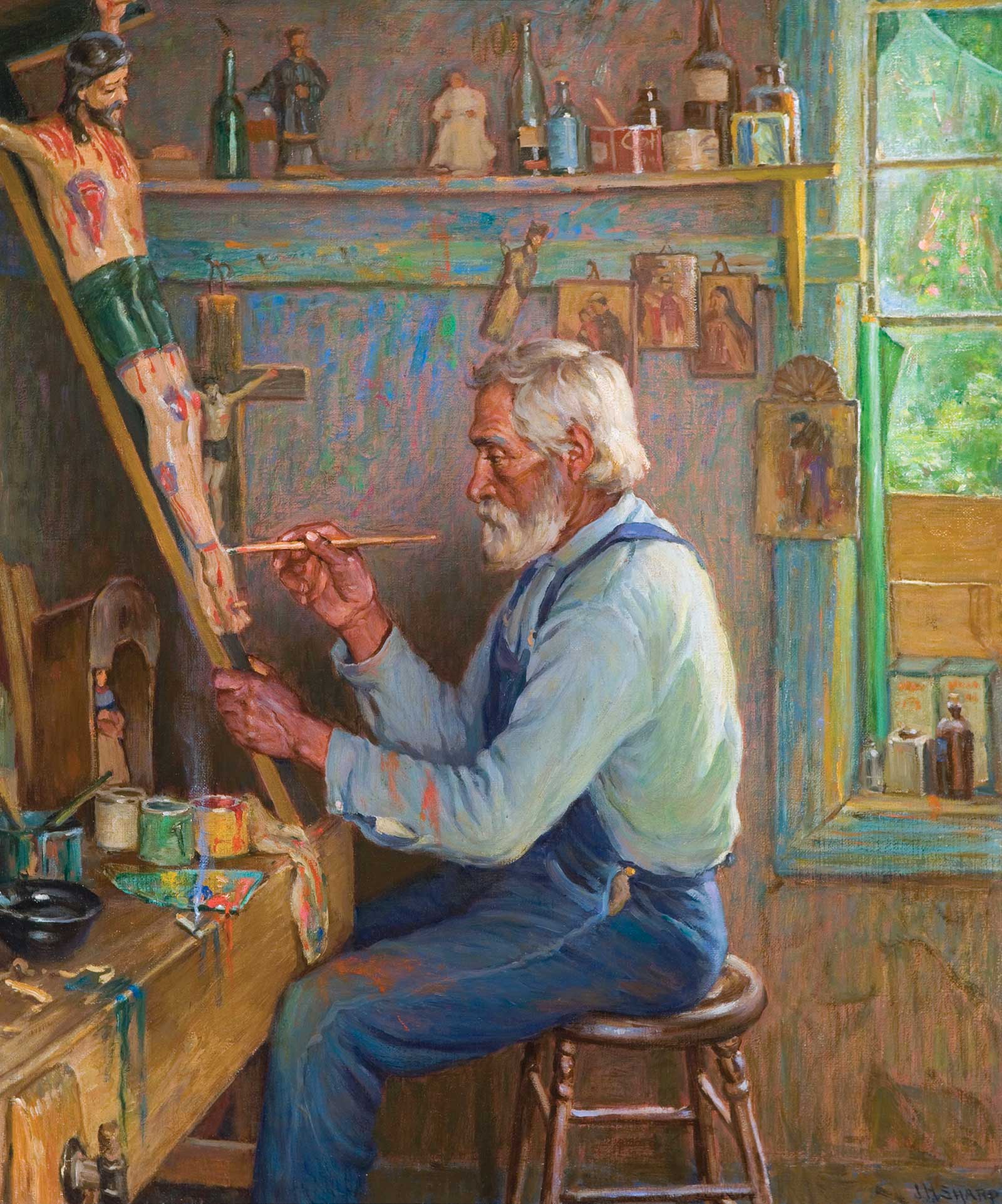 Joseph Henry Sharp (1859-1953), The Old Santos Mender, 1925, oil on canvas, 36¾ x 31¾”. Gilcrease Museum, Tulsa, OK. Gift of Thomas Gilcrease Foundation, 1955.
The 2020 show featured Oscar E. Berninghaus, and starting in 2022 the annual series will continue with Eanger Irving Couse, William Herbert “Buck” Dunton, Ernest L. Blumenschein and finally, in 2025, Bert Geer Phillips.
The Sharp show will feature work from many of the top artists at Blue Rain. One of the artists is Jim Vogel, who was inspired by Sharp’s The Old Santos Mender, a 1925 oil that is now in the collection of the Gilcrease Museum. In Vogel’s work, Matching the Color of the Sangre de Christo, the New Mexico painter heightens the colors, exaggerates the figure and creates a tighter composition. “The Old Santos Mender is the painting that inspired me for my tribute piece. It is one of the few Sharp pieces that reflects the Hispanic culture of New Mexico. These are so often overlooked since he is so well known for his Native American depictions,” Vogel says. “This piece, again, reflects Sharp’s interest in representing interior spaces. Looking at it I am immediately drawn into this viejo’s shop/studio. Sharp’s caring depiction of all the creative clutter struck a chord; I felt that Sharp stood there and felt the reverence of the space. I did not want to just recreate the Sharp painting in my style.
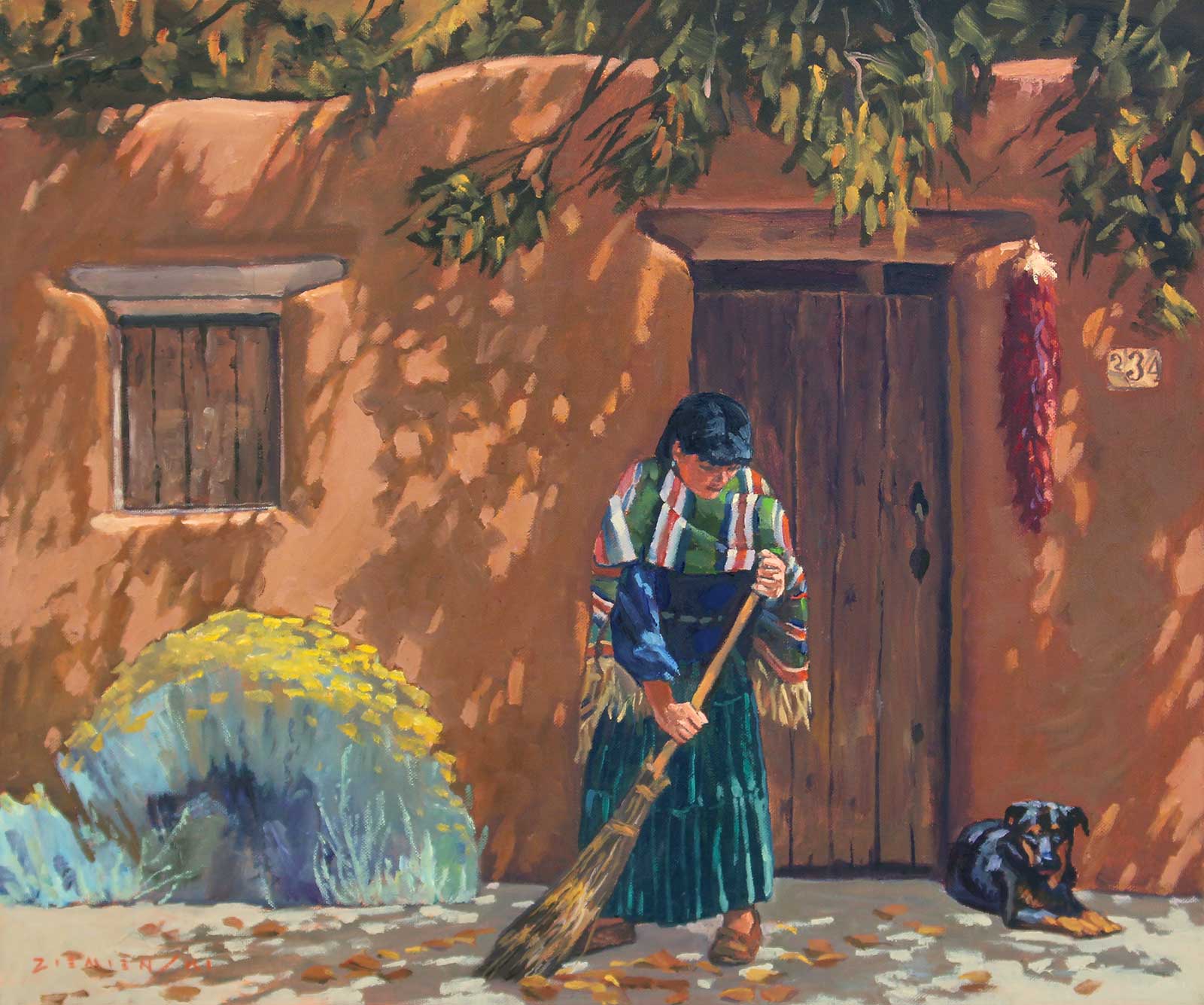 Dennis Ziemienski, Dappled Autumn Light, oil on canvas, 24 x 20”
I wanted to allow the subject to stand, stretch and have a different perspective to his work, maybe he was trying to get that just-right red to match the Sangre de Cristo. I also see this as an homage to the many practicing santeros I am fortunate enough to call my friends.”
For Dennis Ziemienski, he was not inspired by one single work, but numerous Sharp paintings that focused on the delicate sense of light that can be seen in his outdoor work. “Like most of the Taos Society of Artists, Joseph Sharp was charmed by the climate of New Mexico. I, too, found magic in recreating the light that filters through the leaves of trees,” the California painter says. “For my painting Dappled Autumn Light, I was inspired by his fascination with this play of sunlight. My inspiration was Untitled (New Mexico Portrait). Also I’ve given the figure’s serape the colors and pattern used frequently by Sharp.”
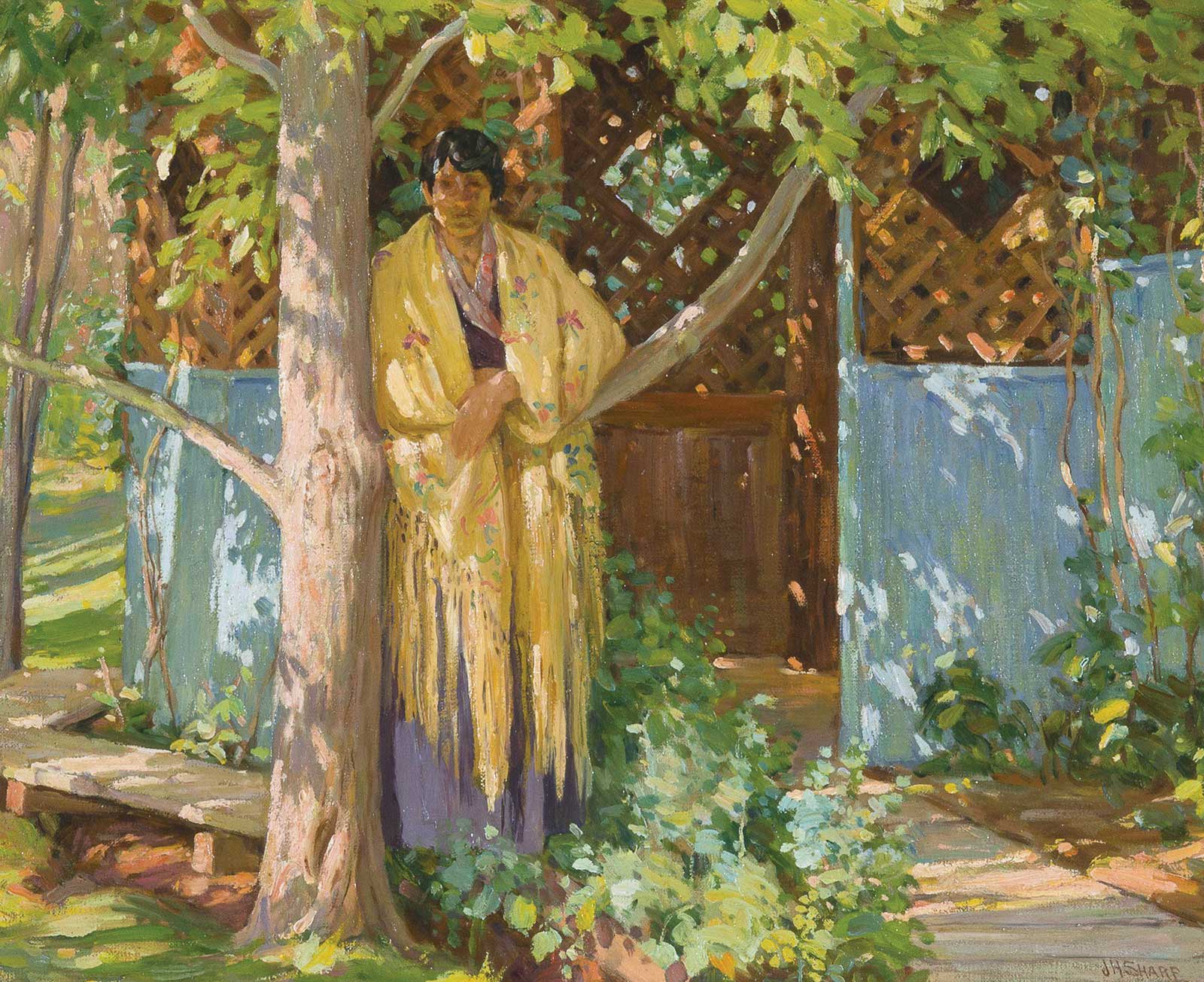 Joseph Henry Sharp (1859-1953), Untitled (New Mexico Portrait), oil on canvas, 16 x 20"
Kathryn Stedham takes on one of Sharp’s most iconic, and tragic, works: the 1914 large-scale oil The Stoic, showing a Native American figure pulling severed pony heads behind him by cords that are pierced through the flesh on his back. There are numerous stories about the work and it’s meaning, sometimes even conflicting stories attributed to Sharp himself. One story is that the figure is showing his bravery by his act. An often repeated second story is even more tragic: the man has lost his son, so to mourn him he kills his son’s horses and drags their heads behind him as an act of grief and sacrifice.
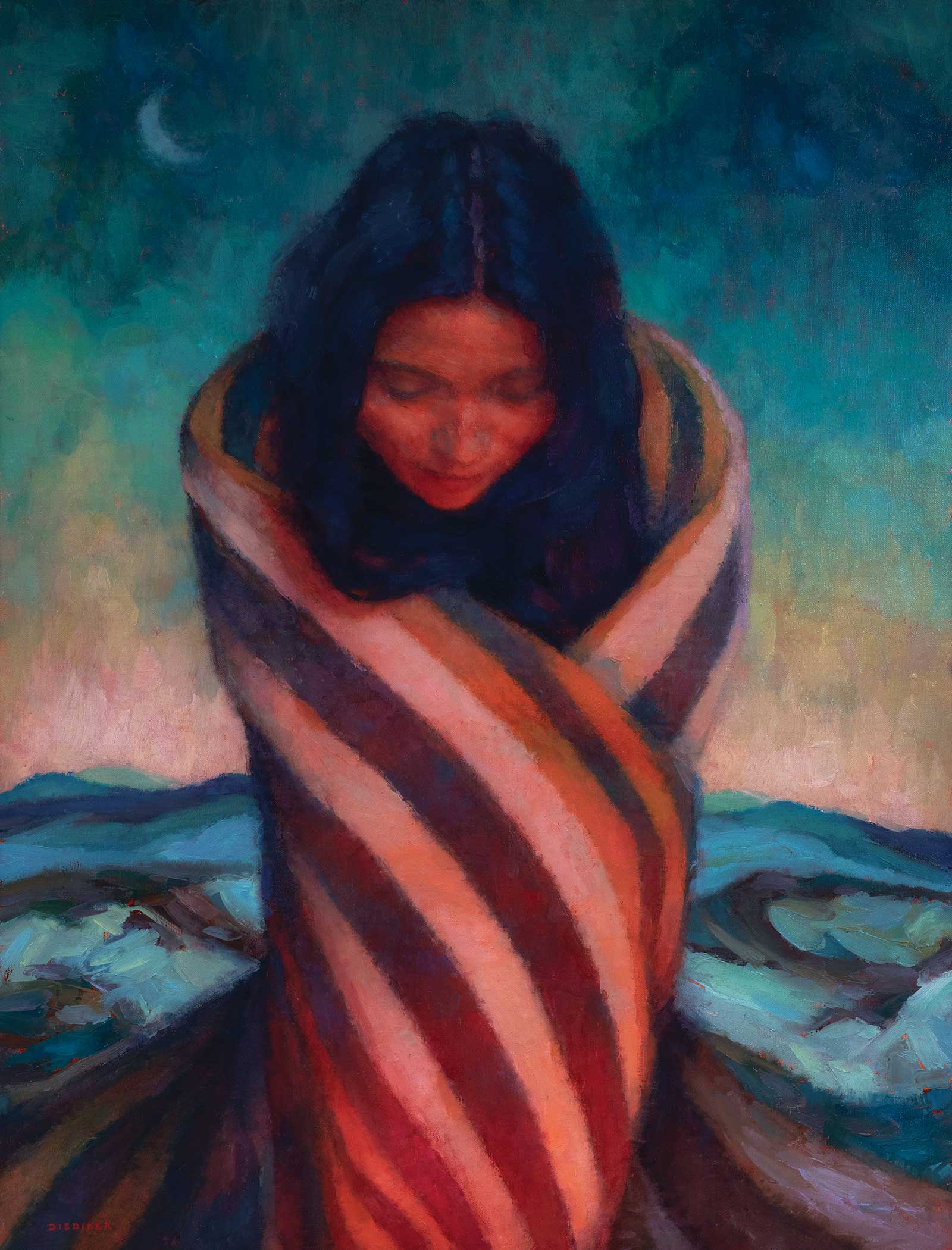 Sean Diediker, Fireside (after Joseph Henry Sharp painting titled “Daylight Firelight”), oil on canvas, 30 x 22½”
“I first saw Sharp’s painting The Stoic at the New Mexico Museum about 10 years ago and it just stopped me on each occasion. What was it about this painting? At first, I felt it must have been its strong narrative content: a Native figure hunched, pierced and dragging his favorite ponies’ heads. Being a horse person, this really spoke to me—I wasn’t repulsed, but rather intrigued. One of the aspects of the painting that I often revisited was the background; I found it rather pastoral given the subject, an illuminated impression of light greens and purples. I came to learn later that the figure actually depicted a Plains Native, rather than the region that I am most familiar,” Stedham says. “In my painting Twilight Stoic I wanted to both honor and understand what Sharp’s piece was about by appropriating what I felt was the important part of his painting: the figure and the pony heads and placing them in one of my landscapes. In his painting, the sun is setting behind the figure and he is heading away from the setting sun, illuminating his back. This was one of the most challenging aspects for my painting, as I shifted this orientation. I painted him into one my New Mexico plein air scenes—of which, I depicted the figure as walking toward the setting sun, thereby backlight. I also placed the figure along the rocky cliff edge but walking towards the light and the source of the river. I also further emphasized the theme of dark to light by painting my background darker than the original painting. It was through my study and contemporary interpretation of Sharp’s painting that I came to realize that his painting, like all great spiritual narratives, is about transcendence. A rising above one’s own circumstances to unite with something greater. And my study of Sharp’s masterwork The Stoic, for me, a worthy journey.”
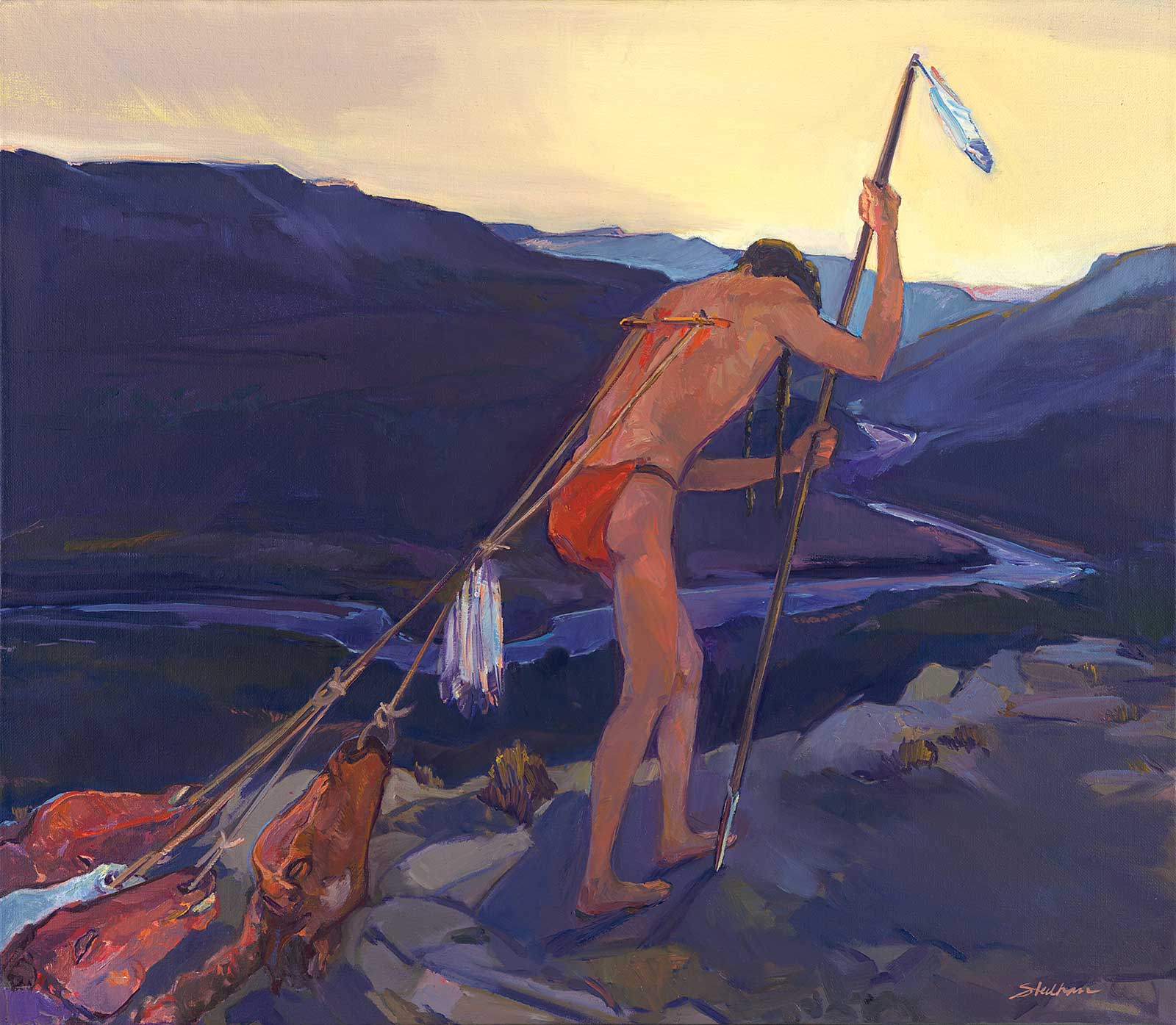 Kathryn Stedham, Twilight Stoic (after Joseph Henry Sharp painting titled “The Stoic”), oil on Belgian linen, 27 x 31”
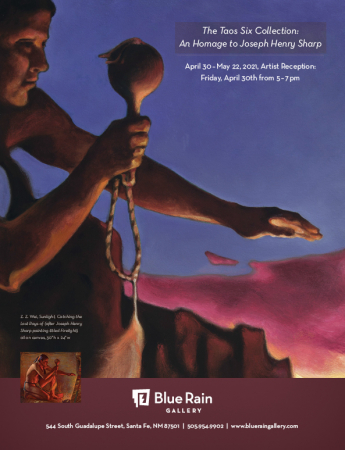
Elswhere in the exhibition is Z.Z. Wei’s Sunlight, Catching the Last Rays of, which is based on a painting titled Firelight. Wei moves the painting outdoors and offers a much tighter crop that accentuates the hands and their movement. “Sharp’s Native American portraits really stood out to me from his long and prolific career; they were the pieces that moved and inspired me the most. Those seemingly ordinary portraits carry a ‘real’ force. Not through any use of realism technique, but in the way the spirit Sharp perceived is passed on to the viewer,” Wei says. “Simplicity and ordinariness are often universal and eternal. In Sharp’s Firelight painting, his use of a common yet culturally significant artifact (rattle) and scene (fire) resonates powerfully with me. Our relationship with nature is not only material but also spiritual. Its dynamics, delicate balance and harmony have always been an essential part of my art. Like Sharp, in my paintings, I use ordinary objects, like cars, roads, plowed fields, barns, etc., as my vocabulary to tell such stories. Adopting from Sharp’s Firelight imagery, I hope this painting depicts the relationship between us, as human beings, and nature in a simple and clear way. It is a tribute not only to Joseph Henry Sharp, but also to this land and its people, and to the Sun, the fire of all fires.”
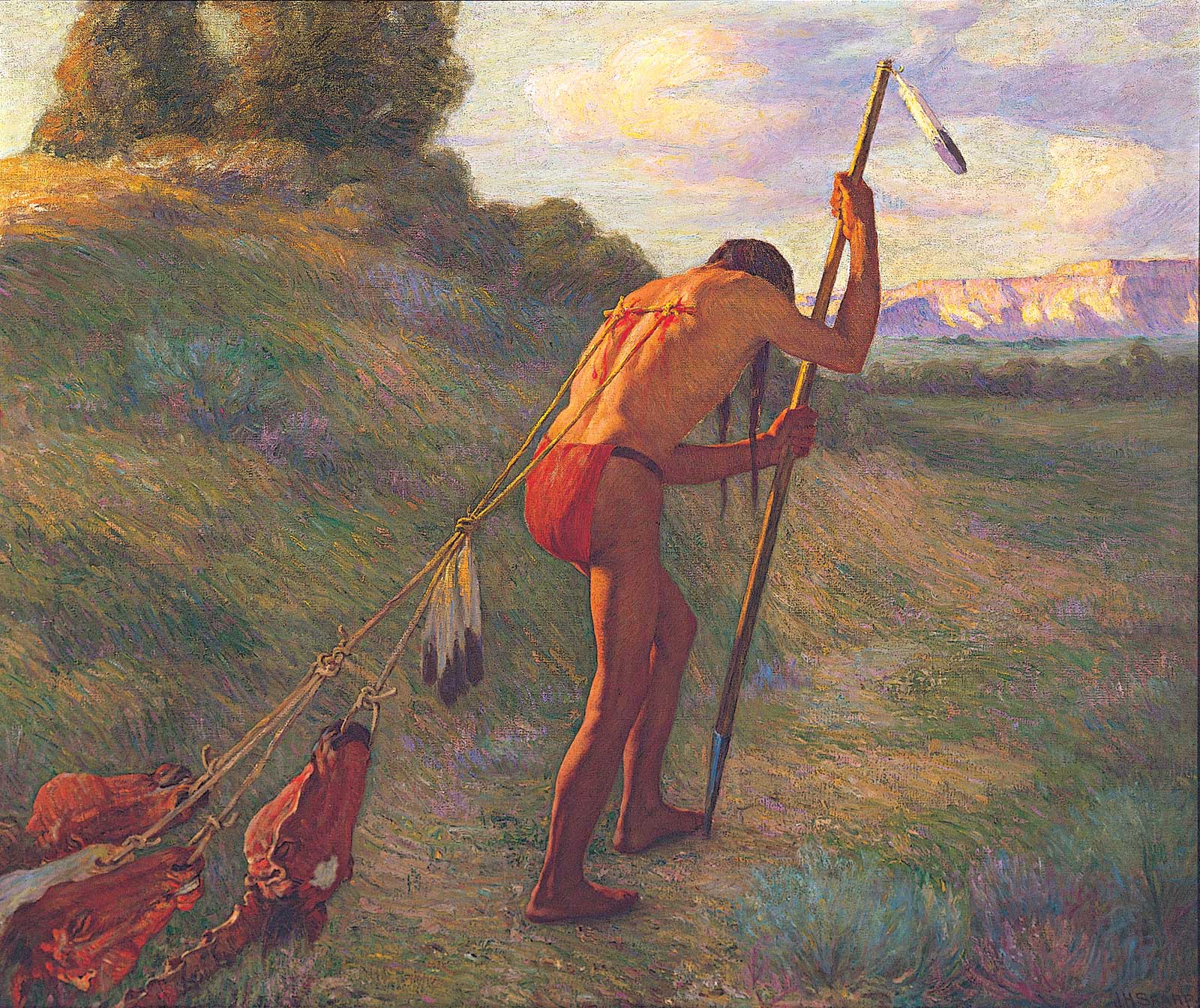 Joseph Henry Sharp (1859-1953), The Stoic, 1914, oil, 53 x 62”. Collection of the Museum of Fine Arts, New Mexico. Gift of the artist, 1917.
Another painting in the show is Sean Diediker’s Fireside, which came from the artist’s love of Sharp’s firelight scenes, of which there were many. “By manipulating the hue of his flesh tones, he evokes that warm, almost hypnotic feeling that can only be achieved when in close proximity of a burning fire. He did this in multiple works and my personal favorites include designs, where you can’t see the primary light source at all, only the implied light,” Diediker says.
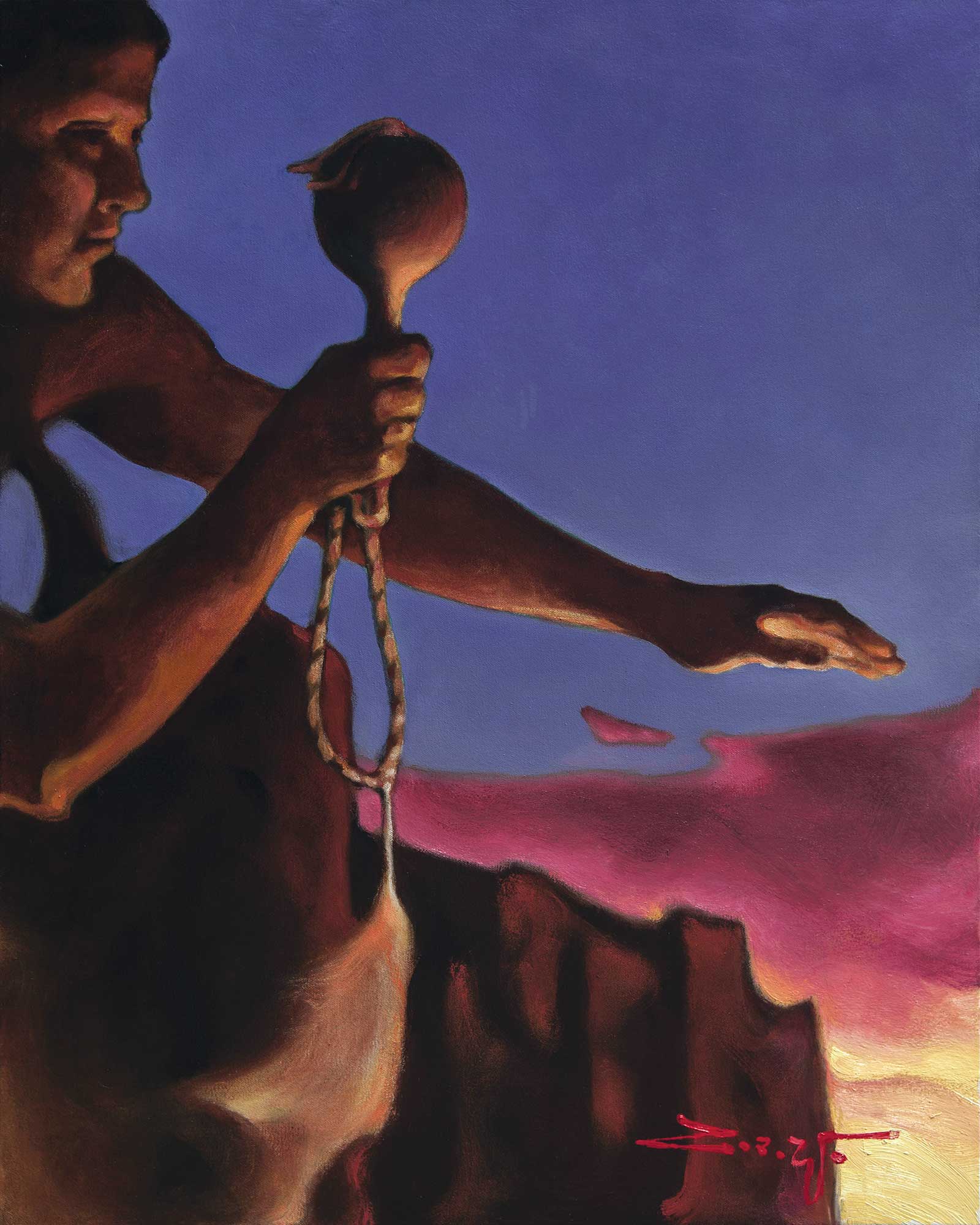 Z.Z. Wei, Sunlight, Catching the Last Rays of (after Joseph Henry Sharp painting titled “Firelight”), oil on canvas, 30 x 24”
“I took inspiration from six of Sharps paintings, all of which apply the above concept. But perhaps his work Daylight and Firelight illustrates it best. Similarly in my own painting Fireside, I excluded the primary light source allowing the stripes of the rug to symbolize flame and bringing more focus to the ensconced subject reverently pondering the source of comfort at her feet.”
Other artists in the show include Brad Overton, Matthew Sievers, Rimi Yang, Erin Currier, Deladier Almeida and many others. Taos Six Collection: An Homage to Joseph Henry Sharp continues through May 22 in Santa Fe.
Taos Six Collection: An Homage to Joseph Henry Sharp
April 30-May 22, 2021
Blue Rain Gallery, 544 S. Guadalupe Street, Santa Fe, NM 87501 (505) 954-9902,
www.blueraingallery.com
Powered by Froala Editor