John and Elizabeth Fawcett lived in a 10-by-12-foot tack room with their three dogs while their Colorado home was being built. Both had spent time in Colorado on vacations and had dreamed of living there and, for John, painting full time. When they began looking for property, they had a wish list: “woods, a creek running through, pasture for horses, a spectacular view, and near a lake for boating and swimming with our dogs.” They found the ideal property and began planning their home.
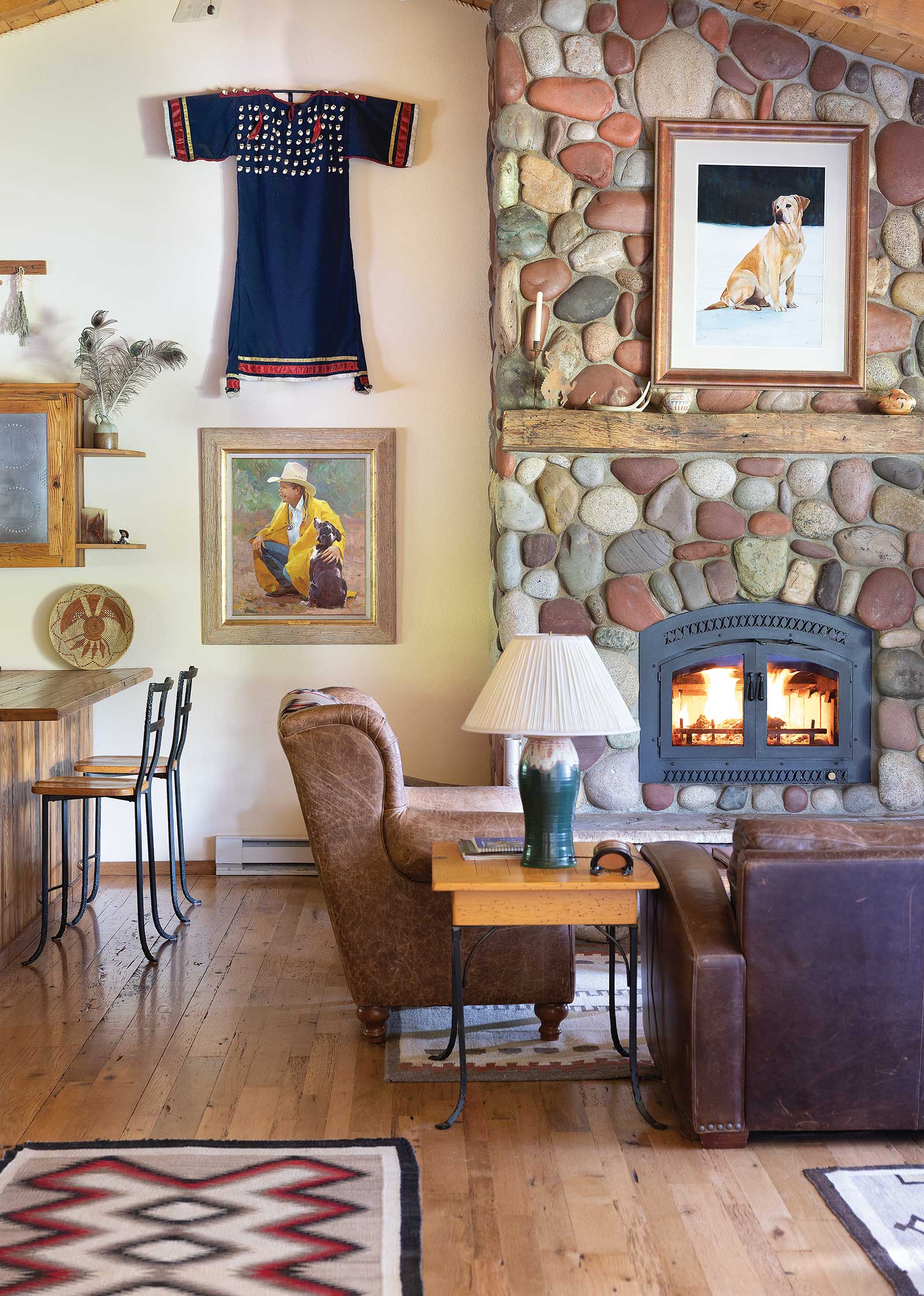 Above the mantel is John Fawcett’s 1998 watercolor, Winter Watch, a portrait of one of the couple’s labradors, Cooper. The Crow Dress with Elk Teeth, 2014, is a reproduction. Beneath it is Healing Hands, 1993, by R.S. Riddick.
They built a barn for their horses first, moved into the tack room and, in 1997, their home was finished. They wanted a log home but one a bit different, so they opted for squared-off logs with dovetail joints, a distinctive aspect of their finished home. “We wanted it to look like an old homestead,” John says. The natural logs are complemented on the interior by reclaimed wormy chestnut from Pennsylvania barns that the couple had shipped out. John’s studio is in a wing of the house and Elizabeth, who does his framing and mats his watercolors, has a studio on the lower level. They also have a home in rural Pennsylvania where John had been a vet. They live there part of the year.
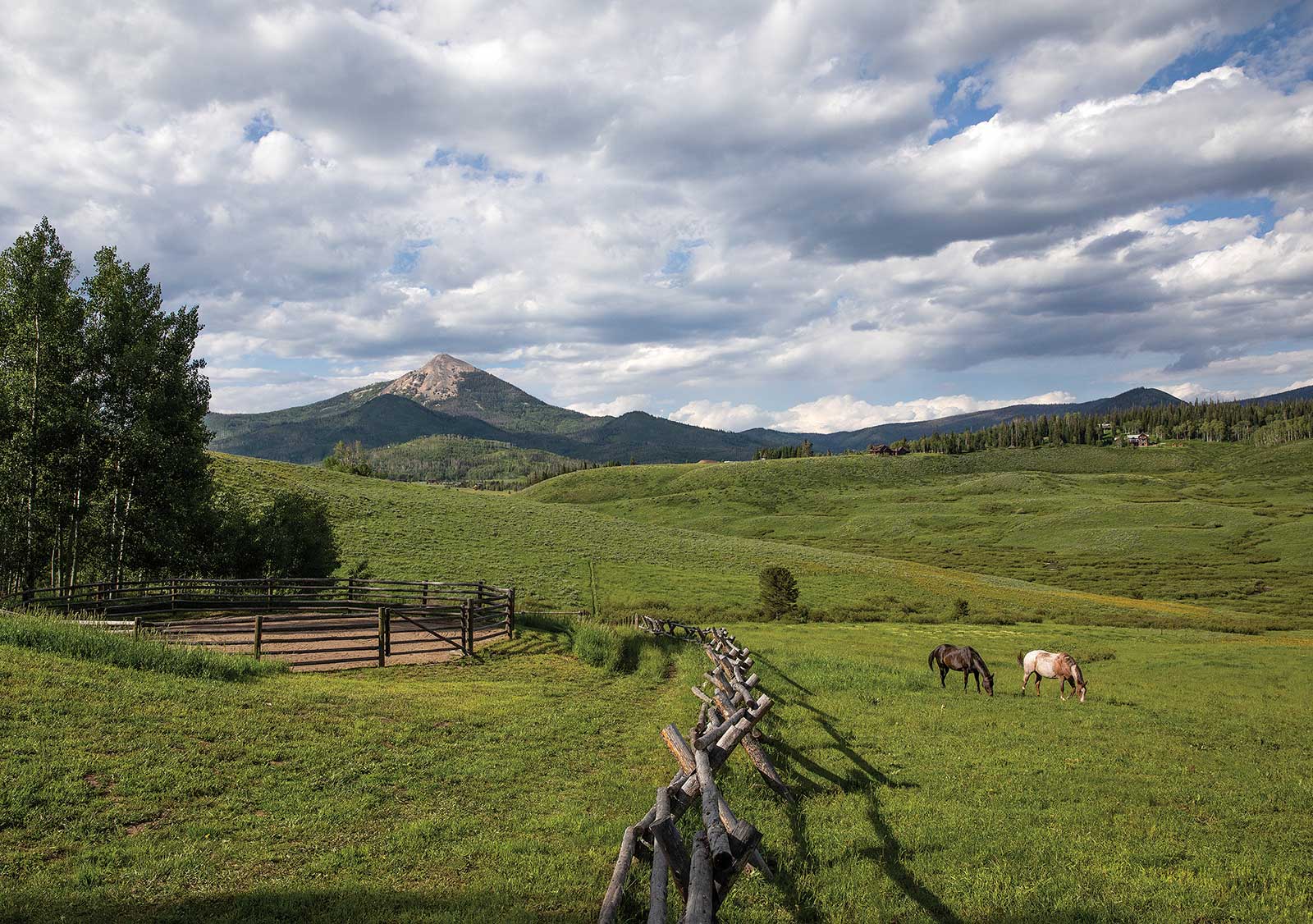 A view of Hahns Peak from the Fawcetts’ home with their two quarter horses, Pepita and Aubrey, in the foreground.
“I had been painting on days off and weekends when I was practicing,” John says. “Many of my artists friends said, ‘You need to do this full time.’ After I sold my practice in 1996, I was able to do that.” His horse paintings are inspired by his vet background and by his and Elizabeth’s experience of riding horseback for fenceless miles from their barn. “It’s a great inspiration every day,” he says.
“Many of the artworks in our collection,” he explains, “I have traded with other artists for my work, including George Hallmark, Heide Presse, Carol Swinney, Michael Albrechtsen, Sandy Scott, Robin Lawes and Nancy Bush. Many of the other pieces were collected from artist friends we have known over the years, and many paintings were done here in the Yampa Valley, so they have sentimental value for us.”
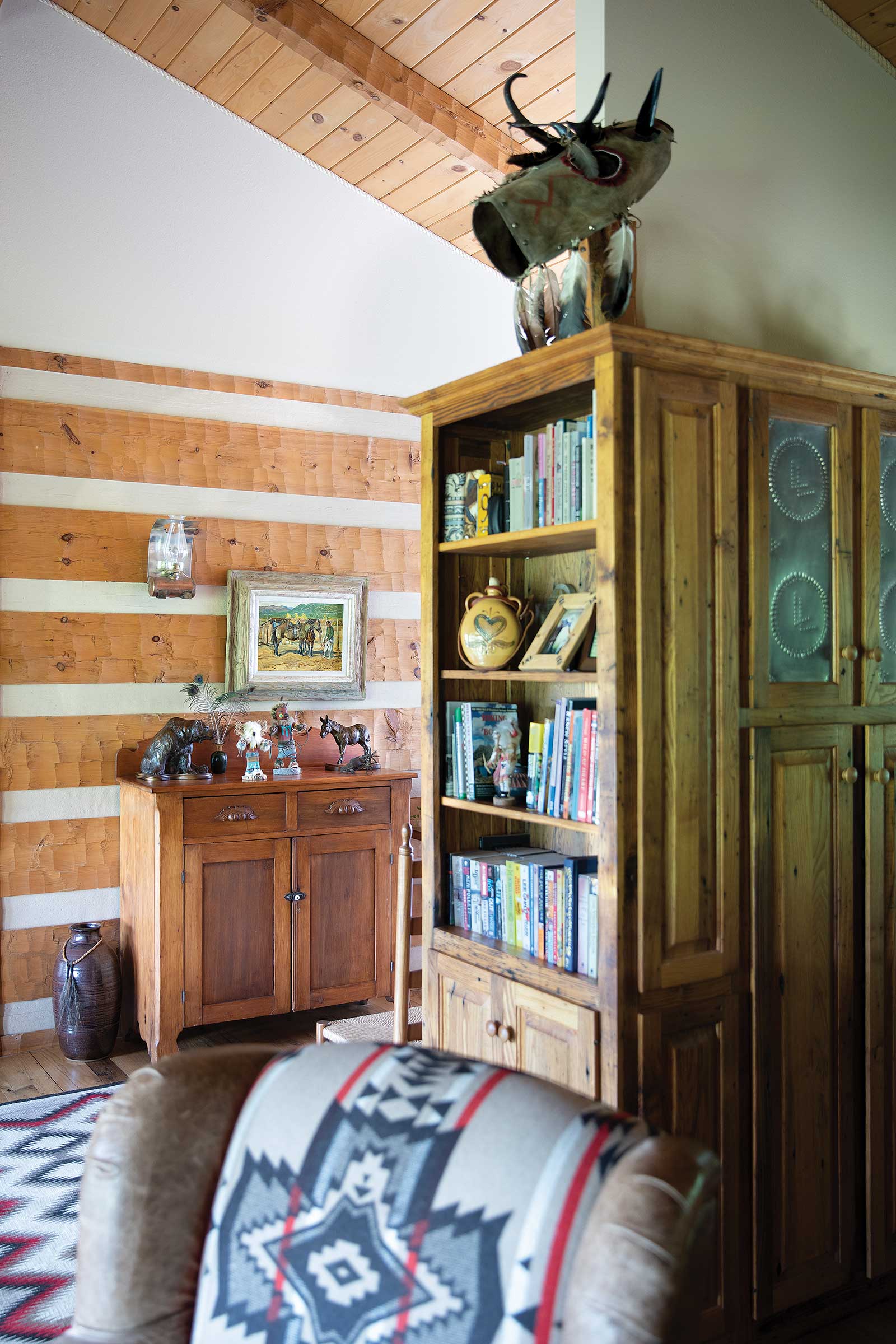 Above the cabinet on the left is Ben Marcus, 1970, oil, by Robert Lougheed (1910-1982). Beneath it are two bronzes, left to right, Big Bruiser by Sandy Scott and Nice Ass by Robin Laws. The Sioux horse mask on top of the chestnut kitchen cabinet is a reproduction.
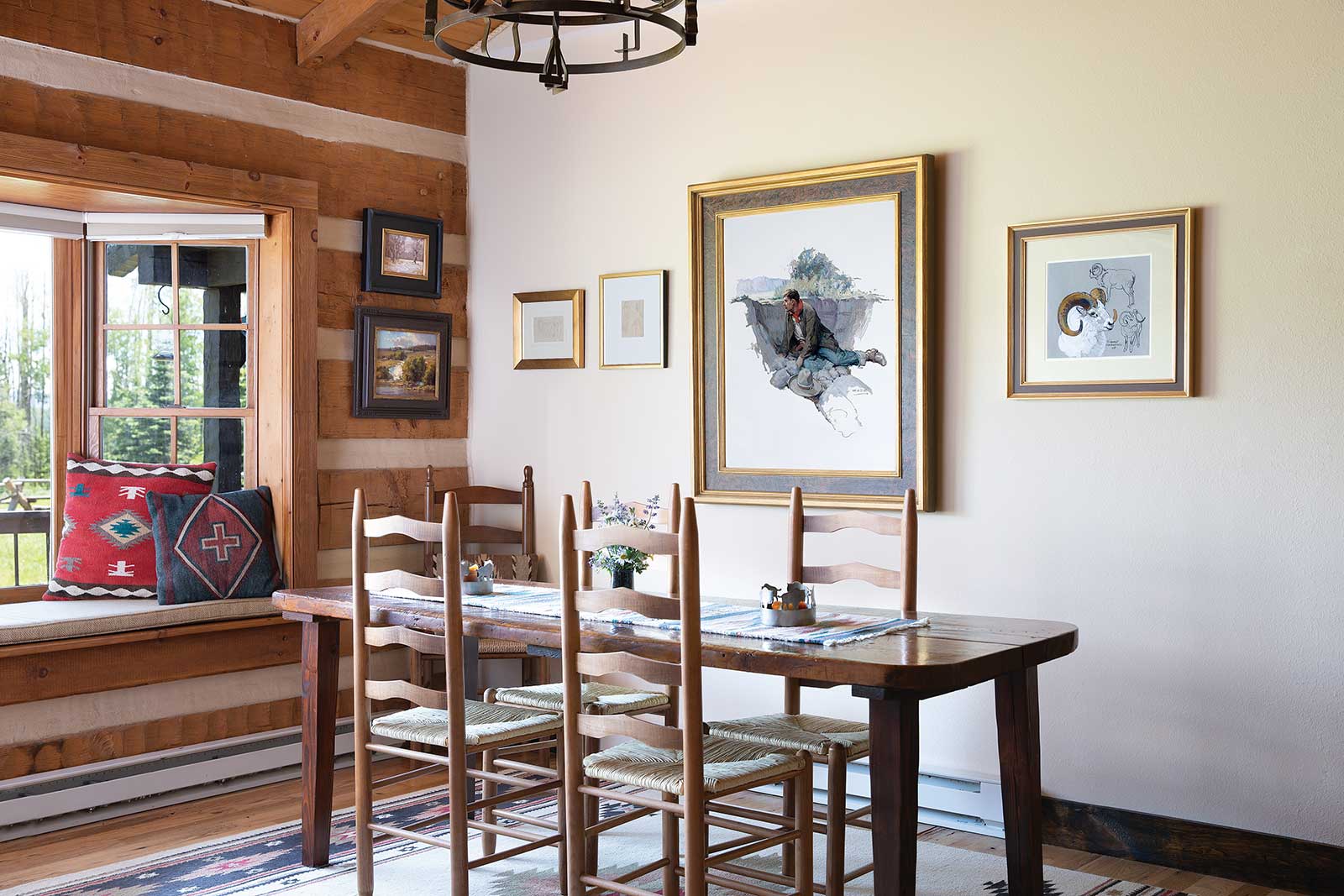
To the right of the bay window in the dining room are, top to bottom, Ski Trail, 2018, oil by Chula Beauregard and Scott Christensen’s October Snow, 2010, oil. On the right wall are, left to right, Mexican Market, 1897, graphite, by Edward Borein (1872-1945); Indian Girl, 1909, graphite, by Maynard Dixon (1875-1946); In the Cutback, 1925, oil, an illustration for the Saturday Evening Post, by W.H.D. Koerner (1878-1938); and Dahl Sheep, 1970, charcoal and gouache, by Robert Lougheed (1910-1982).
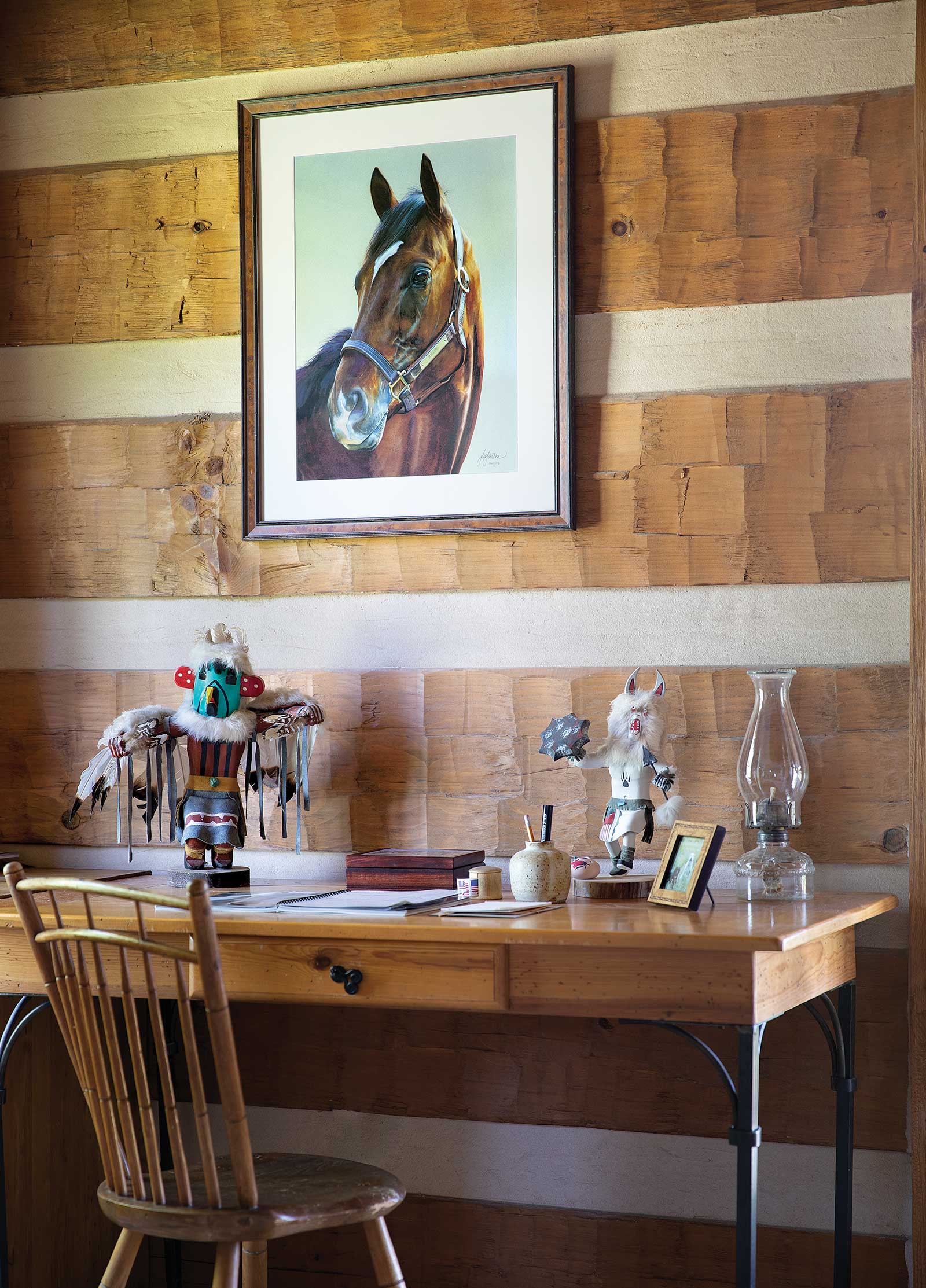
Above the desk is a giclée print of the oil, Barbaro, 2006. John Fawcett painted the Kentucky Derby winner for the owners, Roy and Gretchen Jackson. The katsinam were collected by John’s mother who lived in Arizona.
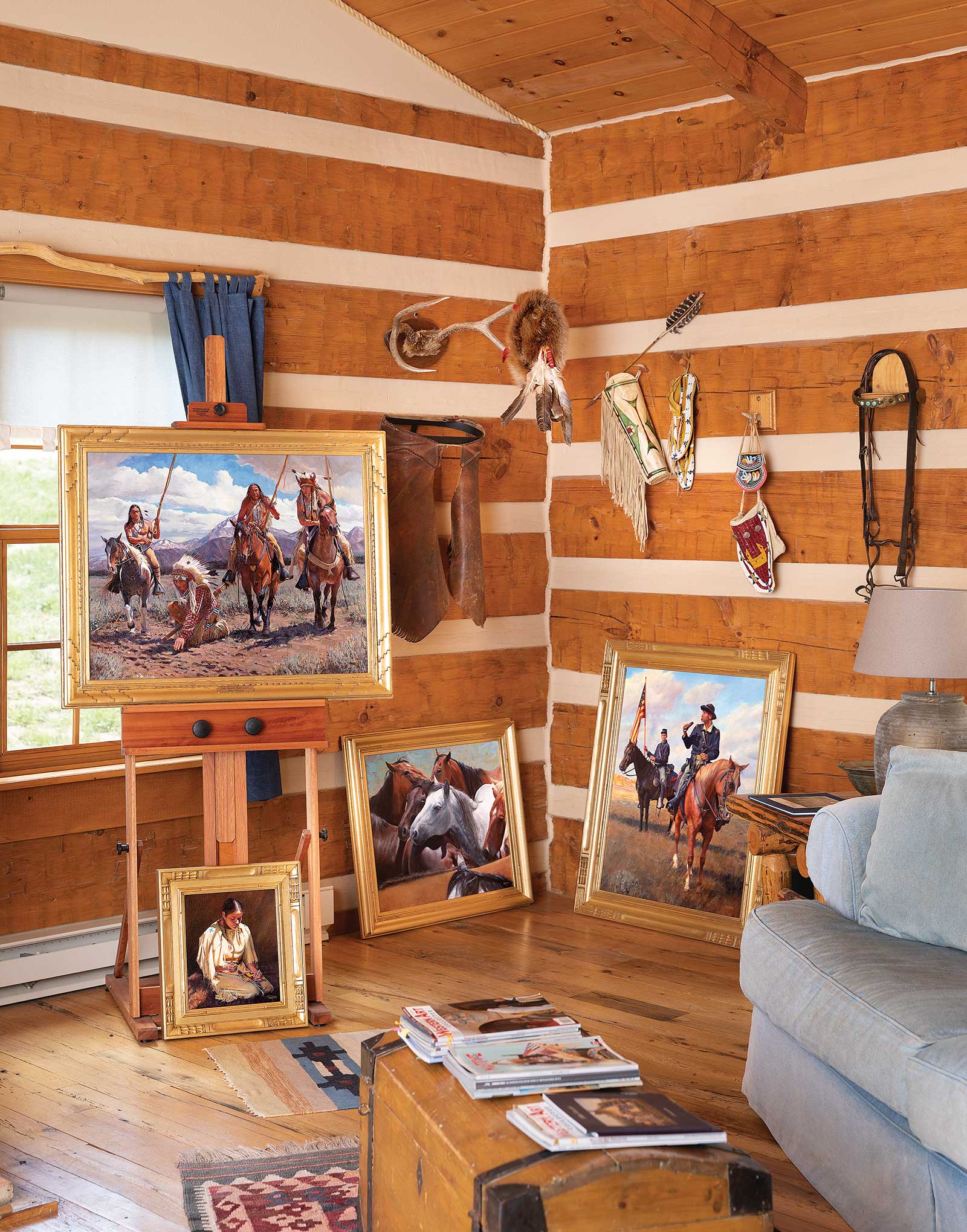
Part of John and Elizabeth’s collection of Native American artifacts and cowboy memorabilia hang in his studio—a quiver, moccasins, parfleches and possible bags, bridles and chinks. On the easel is his The Horse Catchers, 2019, oil. Along the floor, left to right, are Quillwork, Heads Up and Captain Varnum’s Reconnaissance.
The couple became focused on Western art but, at first, were only familiar with the well-known deceased artists. “We started learning about contemporary artists whose work we saw at galleries where I began showing my art,” John explains. “We saw certain artists we really liked and were able to buy smaller, less expensive pieces. As we became more seasoned we learned more about the art and the history of the artists. We became involved with the Steamboat Art Museum and I was later elected to the board of directors. We bought pieces from exhibitions there, mostly people who had painted in the Elk River and Yampa Valley area.
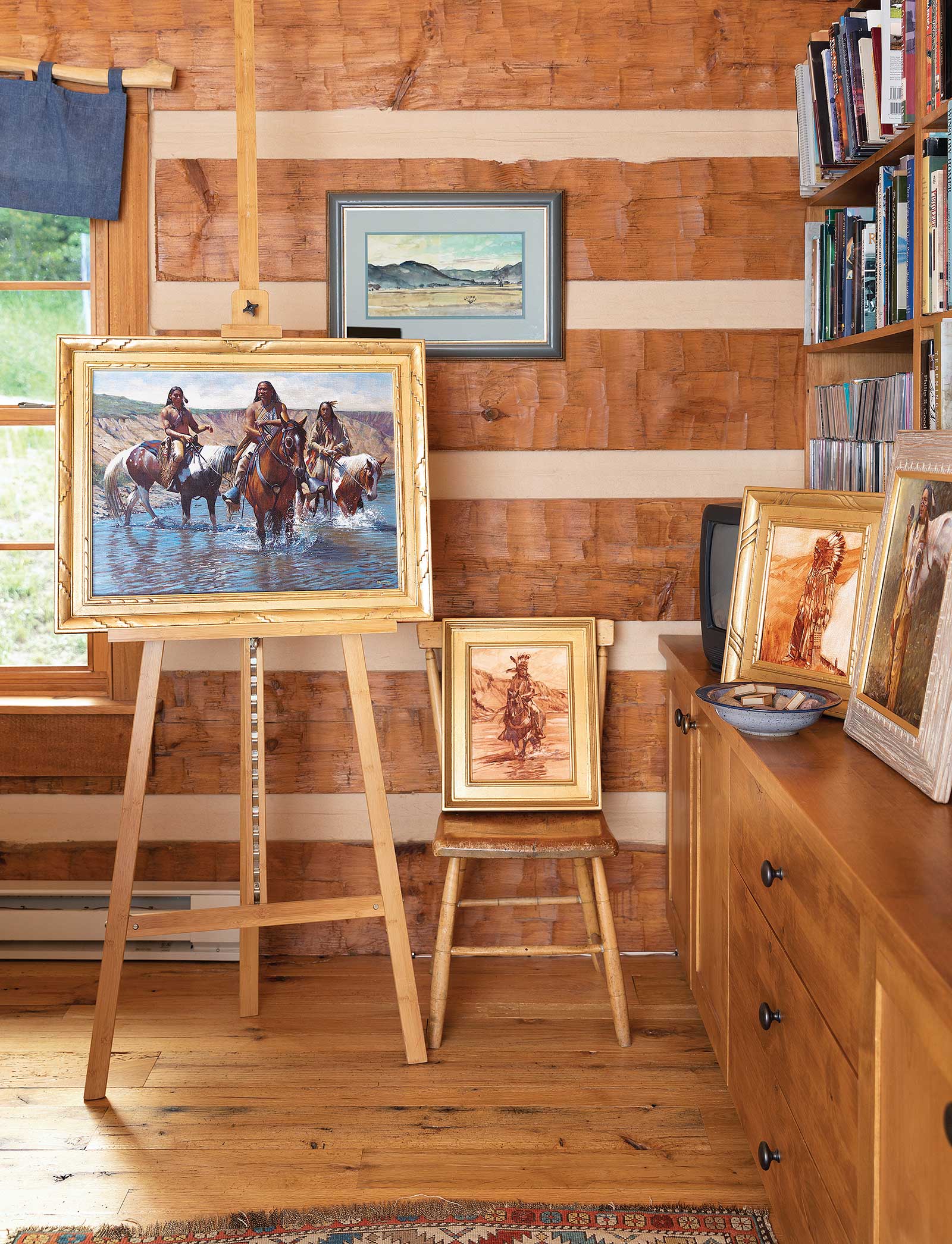 Hanging on the wall of John’s studio is a 1940 watercolor, Desert Landscape, by Peter Hurd. On the easel is John’s Across the Greasy Grass, 2019, oil. To the right are two “block ins,” or grisailles, for oils he is beginning to work on.
“Some of the older pieces were by artists we weren’t familiar with,” he continues. “W.H.D. Koerner’s In the Cutback was found by a friend and is an anniversary present from Elizabeth. It was an illustration done for the Saturday Evening Post in 1925 and we have a copy of the magazine. We love the illustrators of that period like Howard Pyle and N.C. Wyeth. We live near the Brandywine River Museum in Pennsylvania, where I was appointed to the museum committee in 2013. The museum is home to the Wyeth collections and we met Andrew and his son Jamie there.
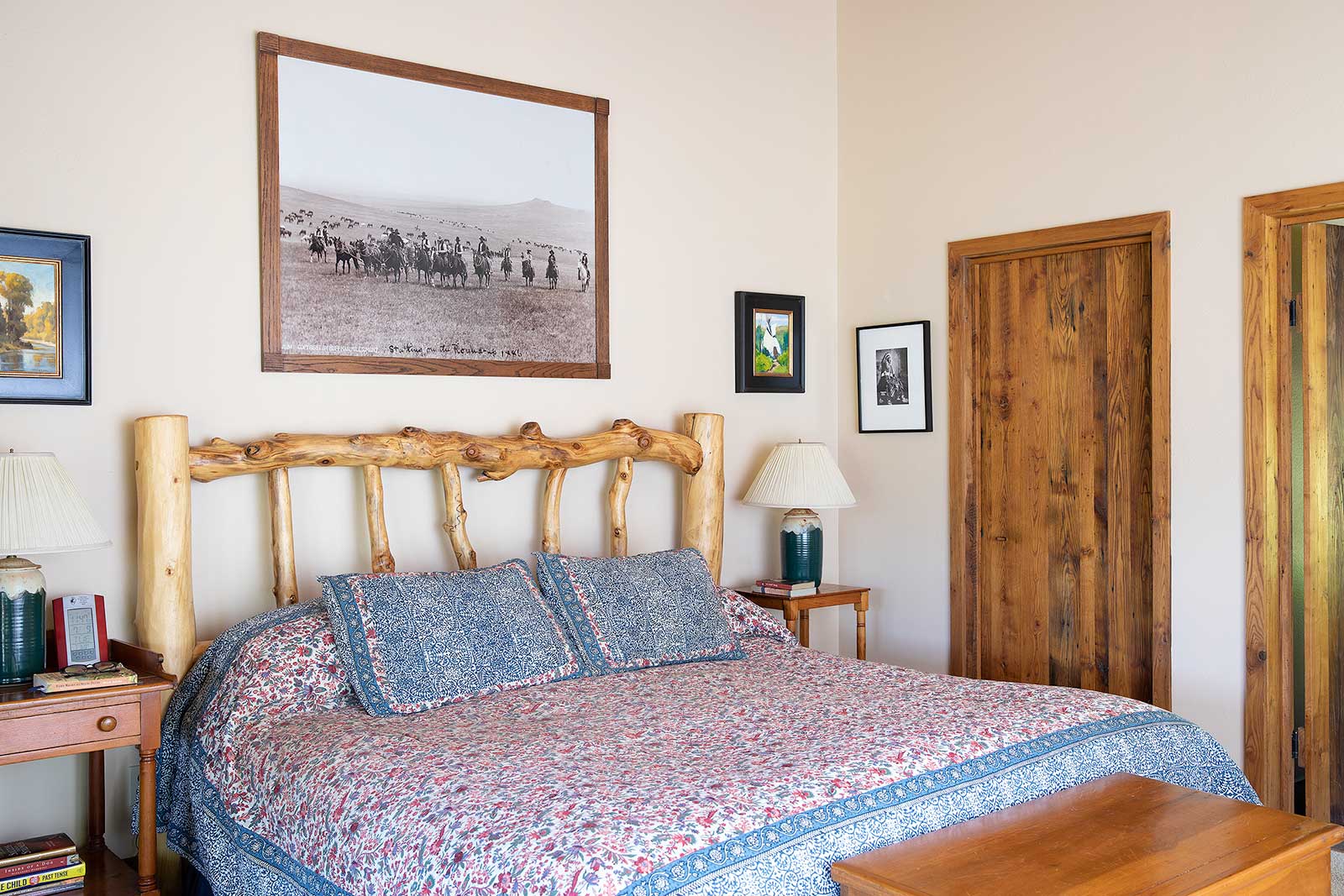 On the left is September on the Elk River, 2017, oil, by Tony Hilscher. Above the bed is Starting on the Roundup, 1886, photograph, by L.A. Huffman (1879-1931). On the right are, left to right, Home Sweet Home, 2016, oil, by Chula Beauregard, and Yellow Hawk, 1886, photograph, by L.A. Huffman.
“We also have a watercolor by Peter Hurd who was married to Henriette Wyeth, N.C. Wyeth’s daughter and Andrew’s sister. We saw it at Medicine Man Gallery in Tucson. You don’t find them very frequently.”
John painted Winter Watch in 1998. “I donated this painting to Canine Companions for Independence for an auction,” he recounts. “They’re a wonderful organization, training and placing dogs in homes of handicapped people. My father was involved in the organization, bought the painting and gave it to us, as it was one of our labradors, Cooper.”
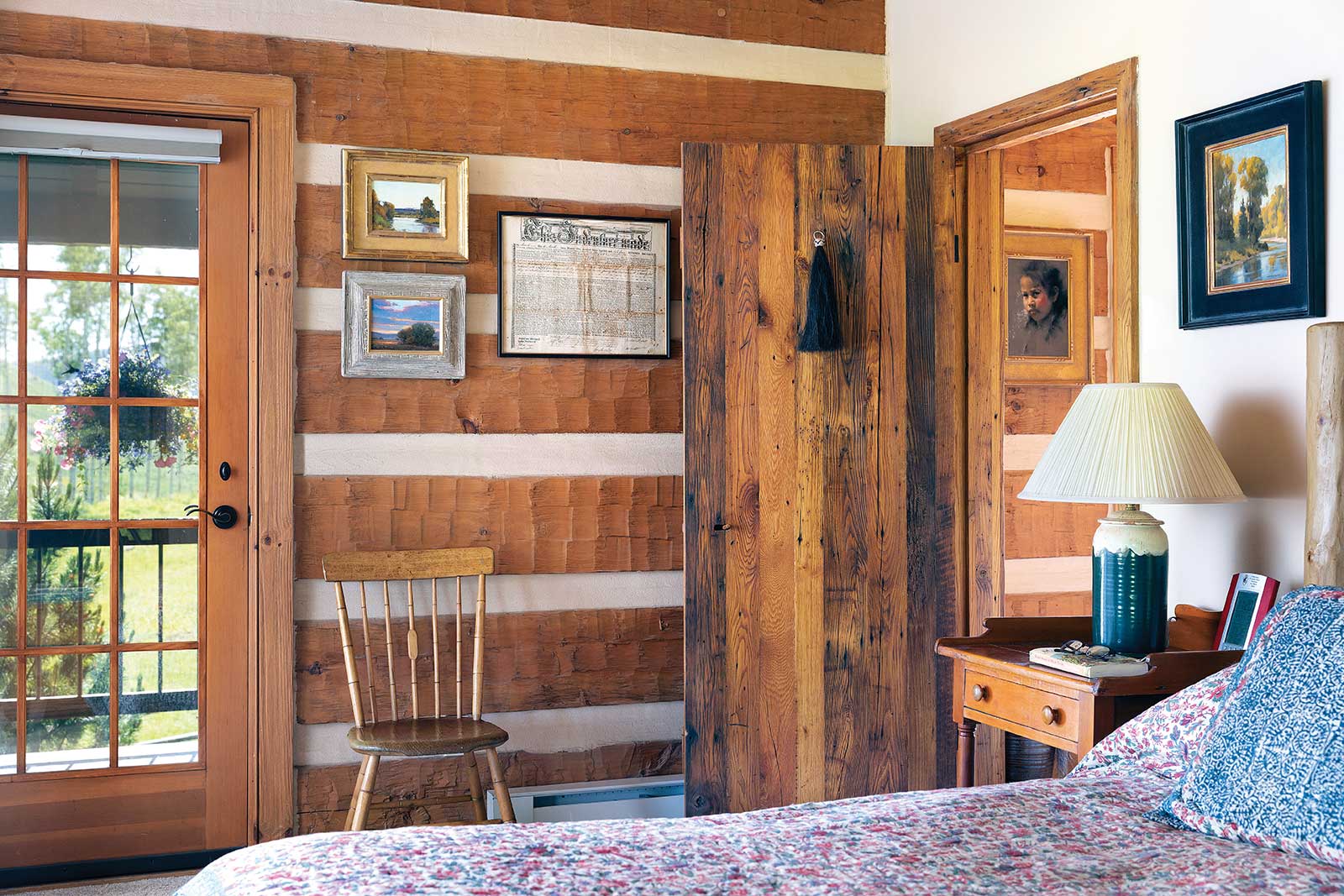 On the left are, top to bottom, Dusk-Elk River, 2014, oil, by Keith Bond, and Blue Clouds, 2005, oil, by Michael Albrechtsen. In the adjoining room is Indian Girl, 1999, pastel, by Bonita Roberts. On the right is September on the Elk River, 2017, oil, by Tony Hilscher.
R.S. Riddick’s Healing Hands was at Settlers West Galleries in Tucson, Arizona. “We met Ron and Natalie early on at the gallery,” John says. “We got to know them and they’ve visited us in Pennsylvania. The painting is of a vet, which is àpropos, and Elizabeth bought it for me as a gift. We came to know the vet who is the subject of the painting.
“It’s fun being an artist and knowing other artists that create work we can have in our home. So many people have said, ‘We like to hear the story behind your piece of art.’ We tell the stories about Native American ceremonies and thoroughbred horses. People like that.”
He continues: “We’re the same way. We recall the stories the artists have told us about their work. We visited the Bell Ranch near Las Vegas, New Mexico, where Lougheed painted and looking at his paintings brings up memories of our being in those areas…The art is alive in that it can be in the same place for a number of years and we might pass it 20 times a day. Every time the light hits it differently or your mood is different you see something new in the painting or the sculpture—something you’ve never seen before. Looking at the art every day gives us so much joy. Hopefully people get that from my art as well.”
Powered by Froala Editor