Growing up on a ranch in Southern New Mexico, we ran cattle along the fertile ranch land bordering the fabled Pecos River. My family migrated to New Mexico from Texas in covered wagons establishing ranches in the shadow of the Capitan Mountains before the days of free-range grazing ended. As a child, my grandfather would often read me stories out of True West Magazine while roasting peanuts on his old Beckwith wood stove. He shared tales about the fearless Comanche, the Alamo, the famed Goodnight-Loving Trail and Billy the Kid, often filling in details about our own family in the process. This was a wonderful gift, and I believe the Lord meant for me to use it to enrich the lives of others. Looking back, I realize these fireside chats turned me into a storyteller as well. Today I put brush to canvas to tell my tales.
Western historical work has become my passion, and each year I devote time to create one or two major works dedicated to the history of the West. Subjects like the Pueblo Revolt, Coronado’s Quest, Lewis & Clark, the Alamo, the Fetterman Massacre, the Second Battle of Adobe Walls and the Battle of the Little Big Horn are some of the subjects I’ve pursued. The Goodnight-Loving Trail is another. It marked the birth of the American cowboy, and I soon realized that this was the essence of my heritage. Over time I pursued a series of paintings in order to fully develop the subject.
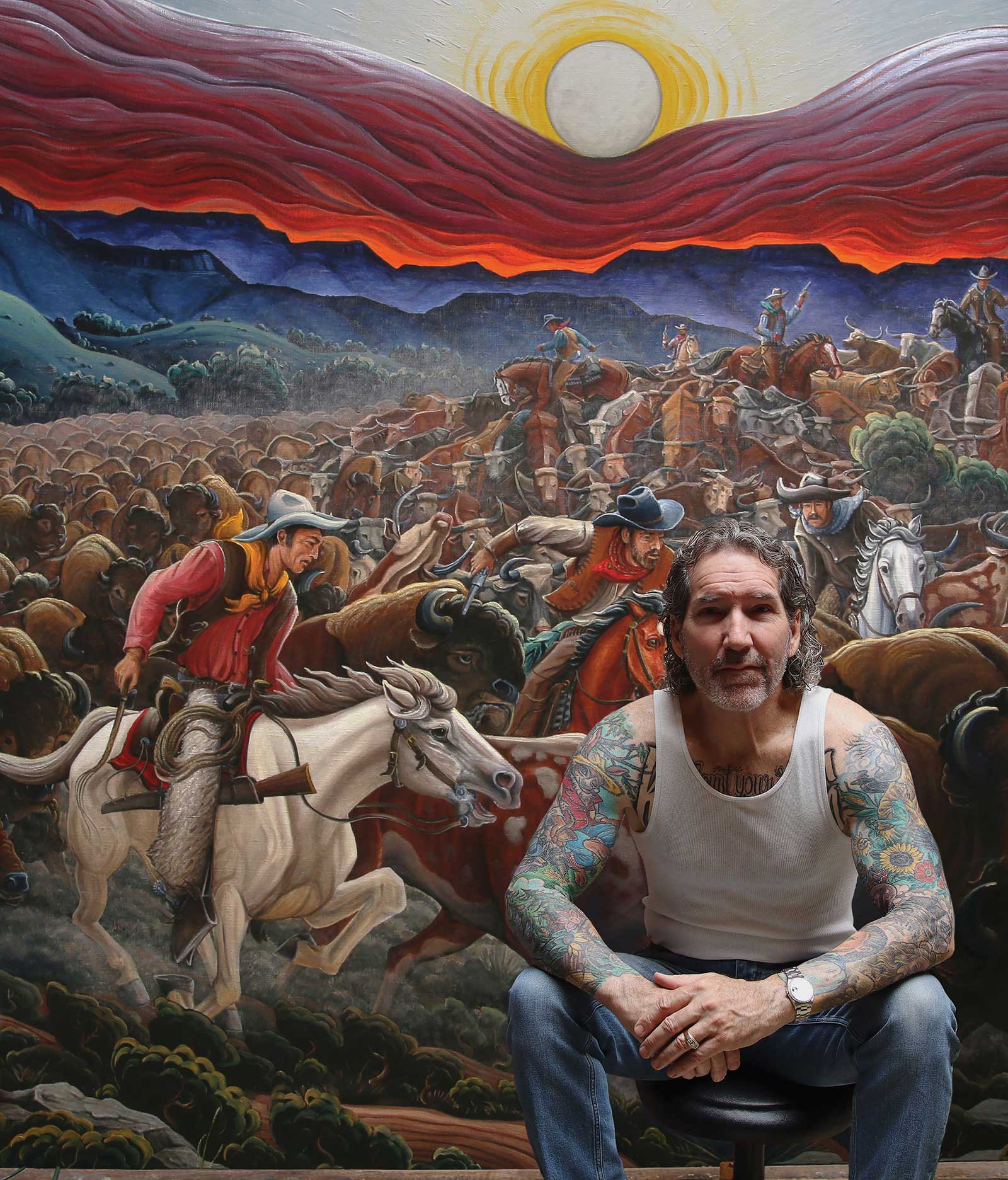 Kim Wiggins in front of Stampede – 1866 in his studio in Roswell, New Mexico. Photo courtesy Eden Wiggins.
The Goodnight-Loving Trail Series began in 2011 when the Roswell Museum and Art Center Foundation commissioned me to paint Cattle Kings of the Pecos, an oil measuring
72 by 96 inches. The setting for this major work featured a close-up of Charles Goodnight, John Chisum and Oliver Loving at an overlook above the Pecos River called Comanche Hill. They are watching their vast sea of longhorns crossing the iconic river in 1866 (near modern-day Roswell, New Mexico). Just behind the key figures are rolling hills flowing into a distant valley where Chisum would soon establish his headquarters at South Spring Ranch in 1874.
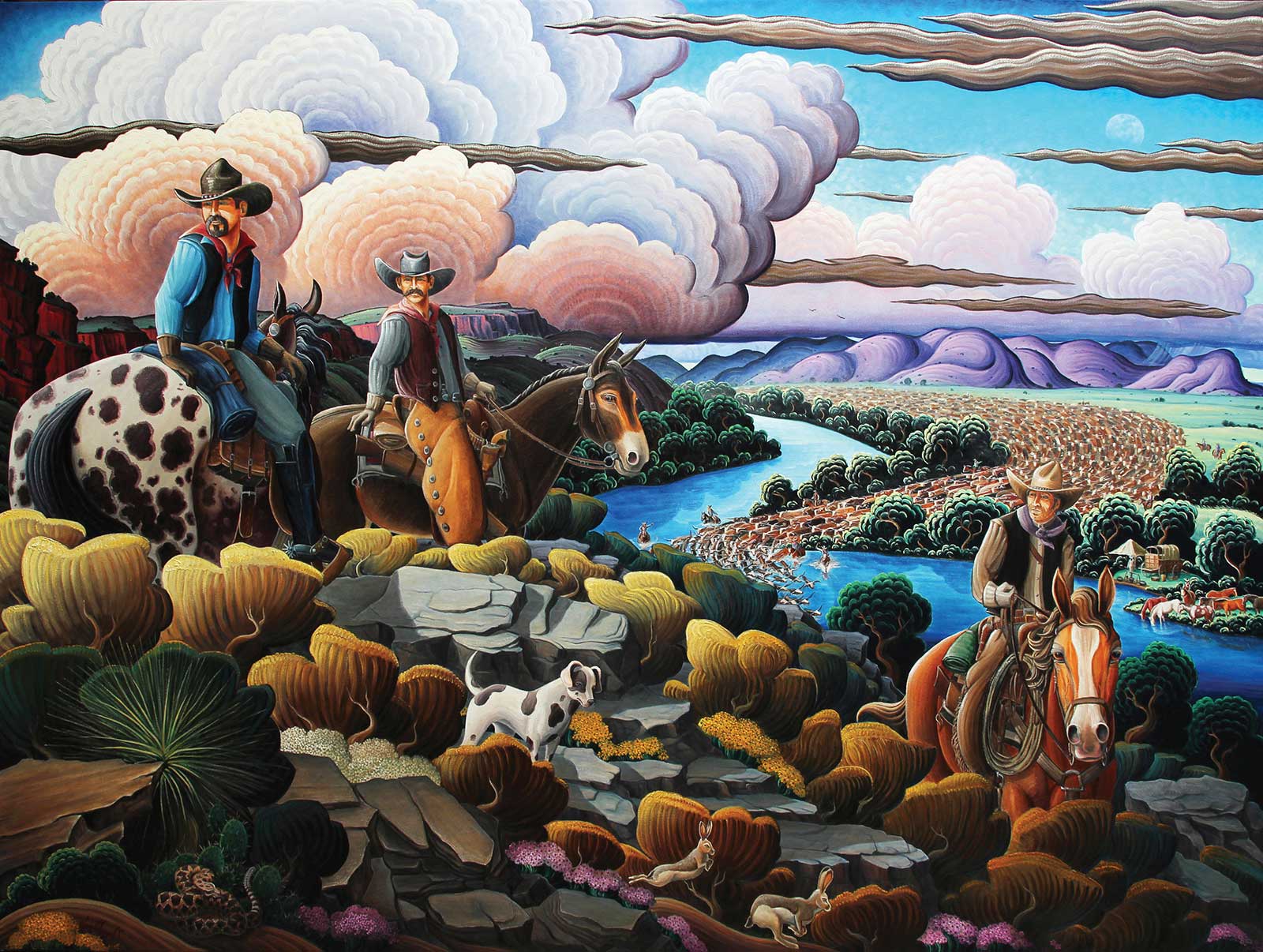 Cattle Kings of the Pecos, 2012, oil, 72 x 96”
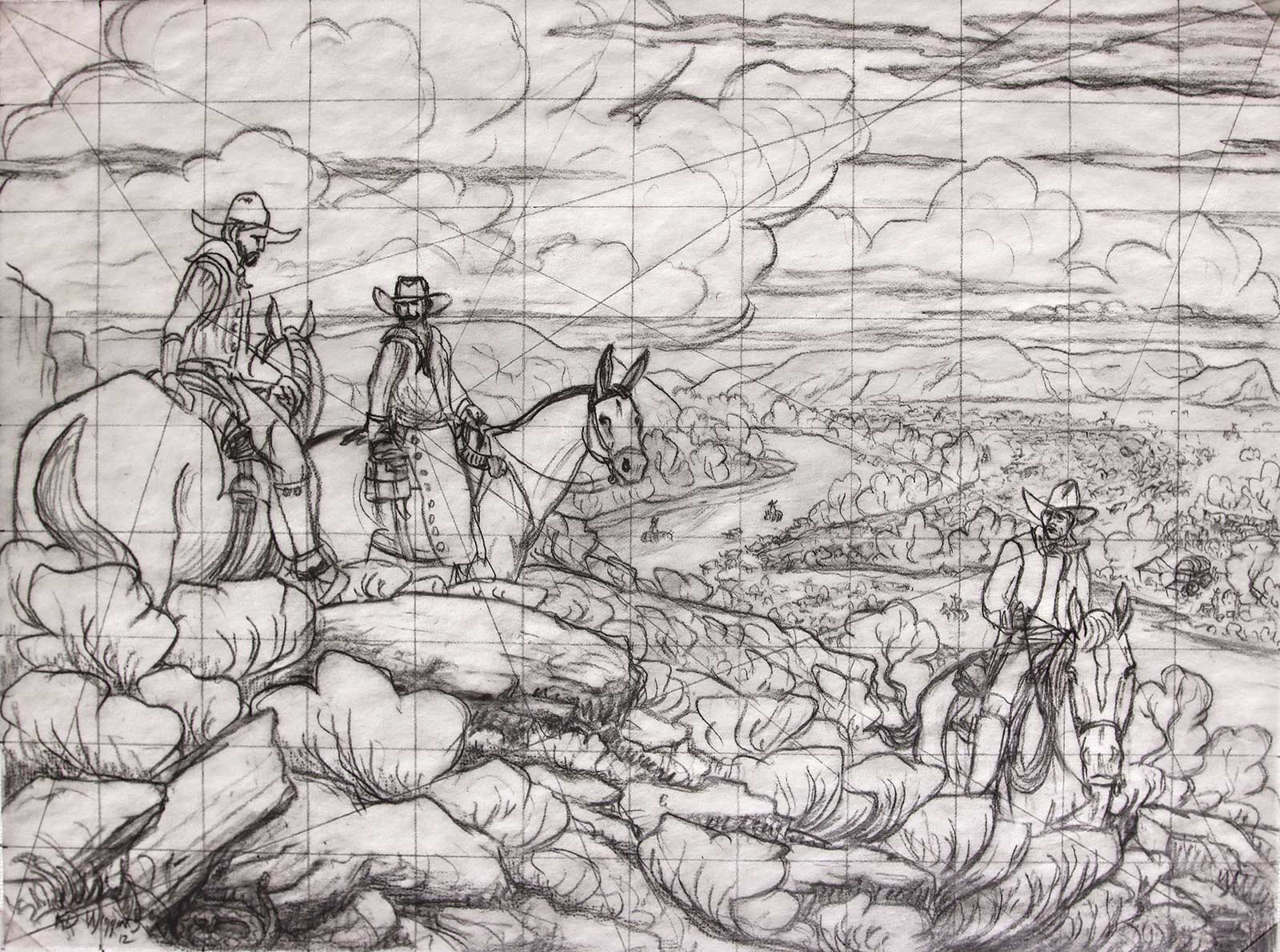 Cattle Kings of the Pecos sketch, graphite, 9 x 12”
I began the commission after creating a 9-by-12-inch graphite sketch for approval. Here is the background on the series: The birth of the truly, great American cattle drives began in August of 1866. This was the second drive to New Mexico Territory for Goodnight and Loving but the most noted by historians of the West due to the massive size of the herd. It began with Chisum astride his famous mule with pistol strapped over his saddle horn. Some 3,000 head of cattle were heading from Fort Belknap, Texas, to Fort Stanton in New Mexico Territory. One-thousand head of longhorns belonged to Chisum and 2,000 belonged to Goodnight and Loving. Chisum had secured a contract with a New York firm to supply some 10,000 head to the military over the next year at 8 cents a pound. This was the first delivery of beef to this isolated military reservation. Ironically, this would be the only cattle drive the three cattle kings would take together. The cattle drive followed the earlier Goodnight-Loving route passing through Southwest Texas to Horsehead Crossing and then up the Pecos River through what would one day be the Carlsbad and Roswell area and on up to the Bosque Redondo Reservation just south of Fort Sumner. All the cattle were sold but 8,000 head of Goodnight-Loving cattle. Loving then took these cattle north through Raton and sold them to a mining company in Colorado, thus establishing the cornerstone for the northern route of the Goodnight-Loving Trail. Goodnight had already returned to Texas to secure the next herd of cattle. This third cattle drive would head out in the fall of 1867. As fate would have it, Oliver Loving would die at Fort Sumner on this drive after being severely wounded in a Comanche Indian attack just south of modern-day Carlsbad, New Mexico. Although he survived the Indian attack he later contracted and died from gangrene after making it back to Ft. Sumner for medical care. His memory would be immortalized when Chisum, Goodnight and some 20 Jinglebob and Goodnight cowboys carried his coffin back down the hazard-stricken cattle trail for burial at his home in Weatherford, Texas. The Lonesome Dove series by Larry McMurtry is loosely based on this historical account.
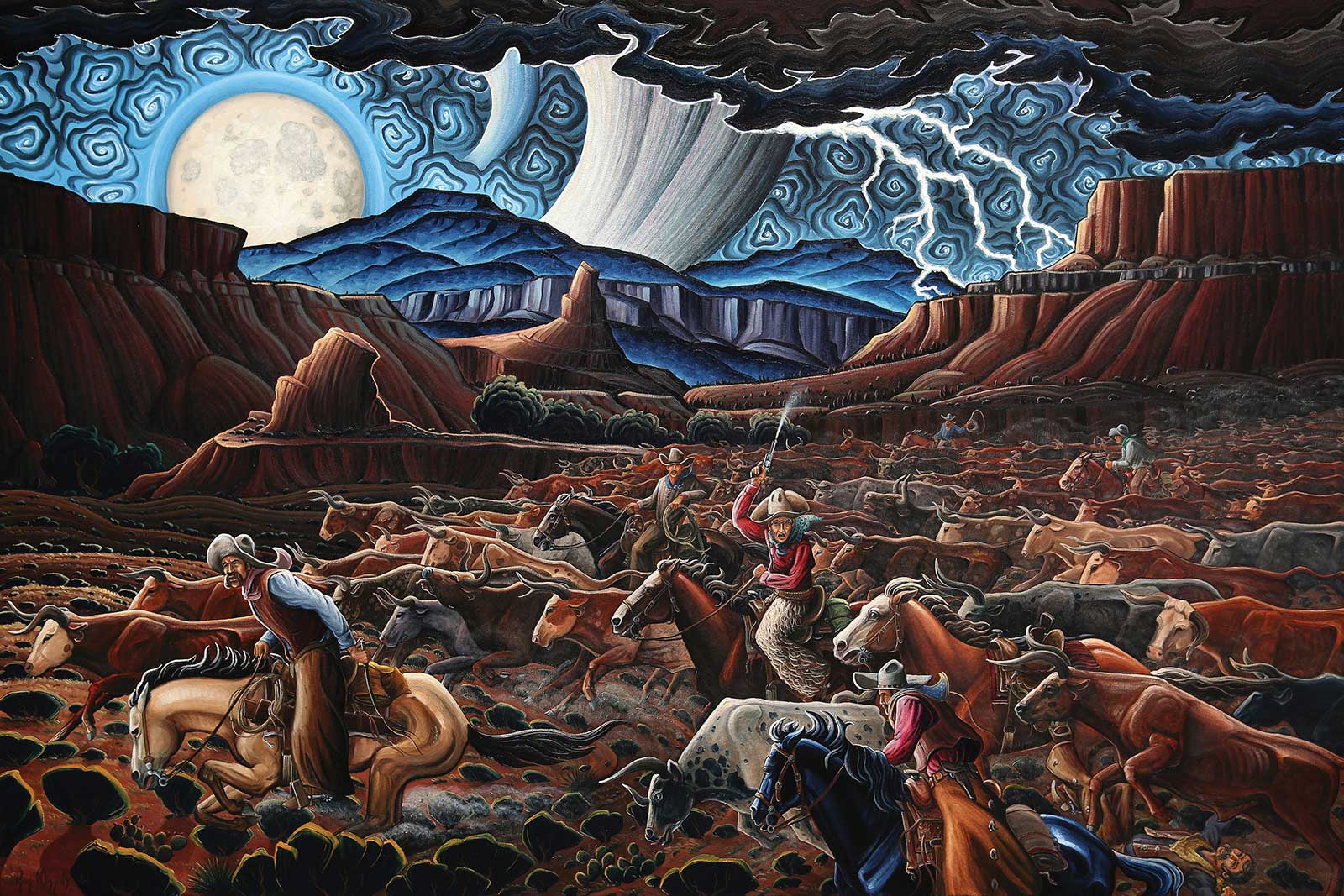 Stampede at Castle Gap, 2017, oil, 40 x 60”
The second painting in the series is Stampede – 1866, an oil measuring 48 by 60 inches from 2015. This work was based on an event documented in the 1936 book Charles Goodnight, Cowman & Plainsman by J. Evetts Haley. The Goodnight biography states, “The steers had been stampeding, running enough to be nervous and difficult to handle. Fall had come and the buffalo migration was on. The trail outfit intersected the course of the buffalo headed southeast while the steers were pointing southwest. This column of migratory flesh reached for miles…Goodnight thought he had room and time to pass. He was about halfway by when the buffaloes stampeded and came south on the run. He and his men tried to turn them, but they might as well have attempted to turn the wind, for they cut the herd of cattle in two near the middle, and those snuffy old steers went crazy as these black apparitions burst among them…For three quarters of an hour the buffalo herd poured between them, the ground seeming to tremble and quake with their rush; a sensation accentuated by the illusory vibrations of the sound waves.” This massive stampede of buffalo and longhorns marks a unique event in the history of the American West. In many ways this marked a symbolic collision with destiny. Soon the enormous herds of buffalo would be hunted out and replaced with cattle to feed a hungry and ever-expanding nation.
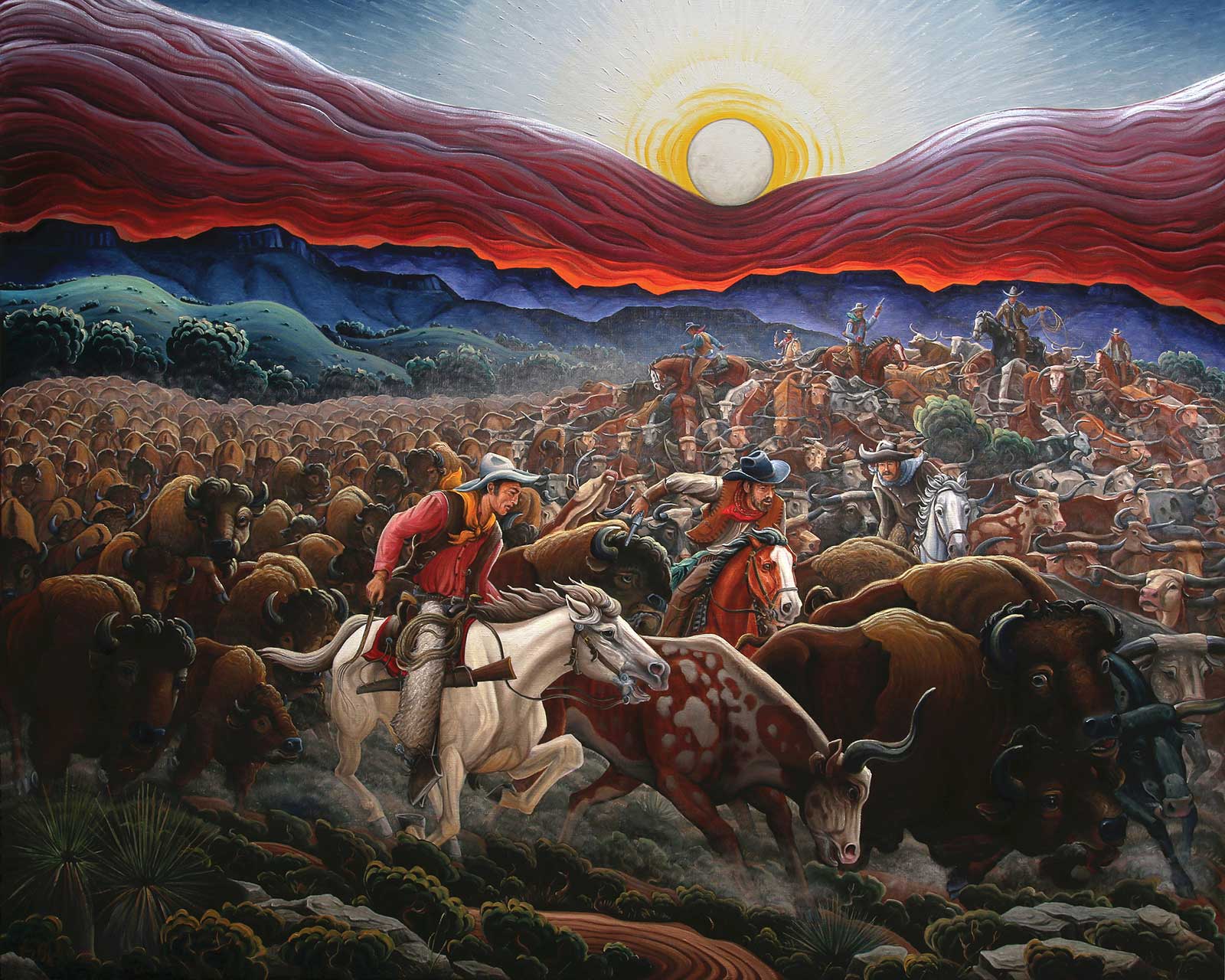 Stampede – 1866, 2015, oil, 48 x 60”
Stampede at Castle Gap, a 40-by-60-inch oil from 2017, is the third painting in the series and the only night scene. The cattlemen faced dire circumstances as they drove some 3,000 head of cattle straight through 80 miles of the dry Texas desert in quest for water. After the first restless night with no water they determined it best to push the herd straight through, night and day, until they reached water. “About two o’clock in the morning they came to Castle Canon from which a gentle, damp breeze was blowing,” Haley writes in Charles Goodnight, Cowman and Plainsman. “Thinking they smelled water, the cattle stampeded down it. Goodnight riding wildly in the darkness ahead, succeeded in holding the leaders until the rest of the herd came up…This was the third day the cattle had had no water, and they became crazed and almost unmanageable. As soon as they smelled the cool air, they became wild for water, and when they reached the river those behind pushed the ones in the lead right on across before they had time to stop and drink…They crossed in such volume and force that they impeded the current, and the water was halfway up the bank in a perfect flood.”
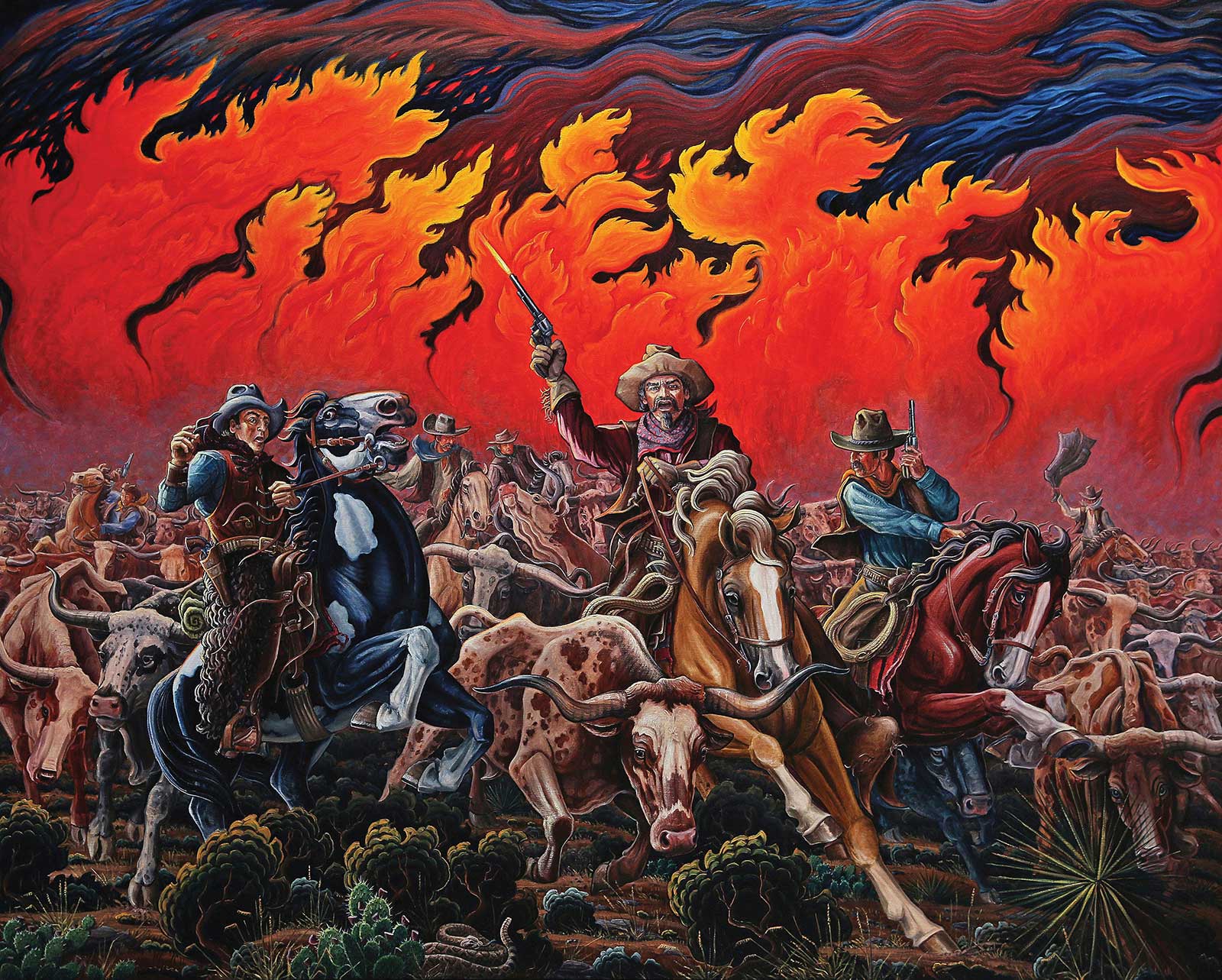 Fleeing Hell’s Fury - Range Fire, 2019, oil, 48 x 60”
Big Medicine, a 48-by-72-inch oil from 2018, is the next painting in the series. This is the only work not featuring the cattlemen. The Comanche were considered the finest horsemen in the world and the most powerful of the Plains Indian culture. Their exploits on horseback are legendary making them master of the Southern Plains for nearly 200 years. This painting focuses on the reason Chisum, Goodnight and Loving found it necessary to totally bypass the Western Plains of Texas. The fearsome Comanche nation forced them to establish a route deep into South Texas on their trek to New Mexico Territory and Colorado. The Goodnight-Loving Trail would be the only cattle trail in American history that started out by heading South toward Mexico.
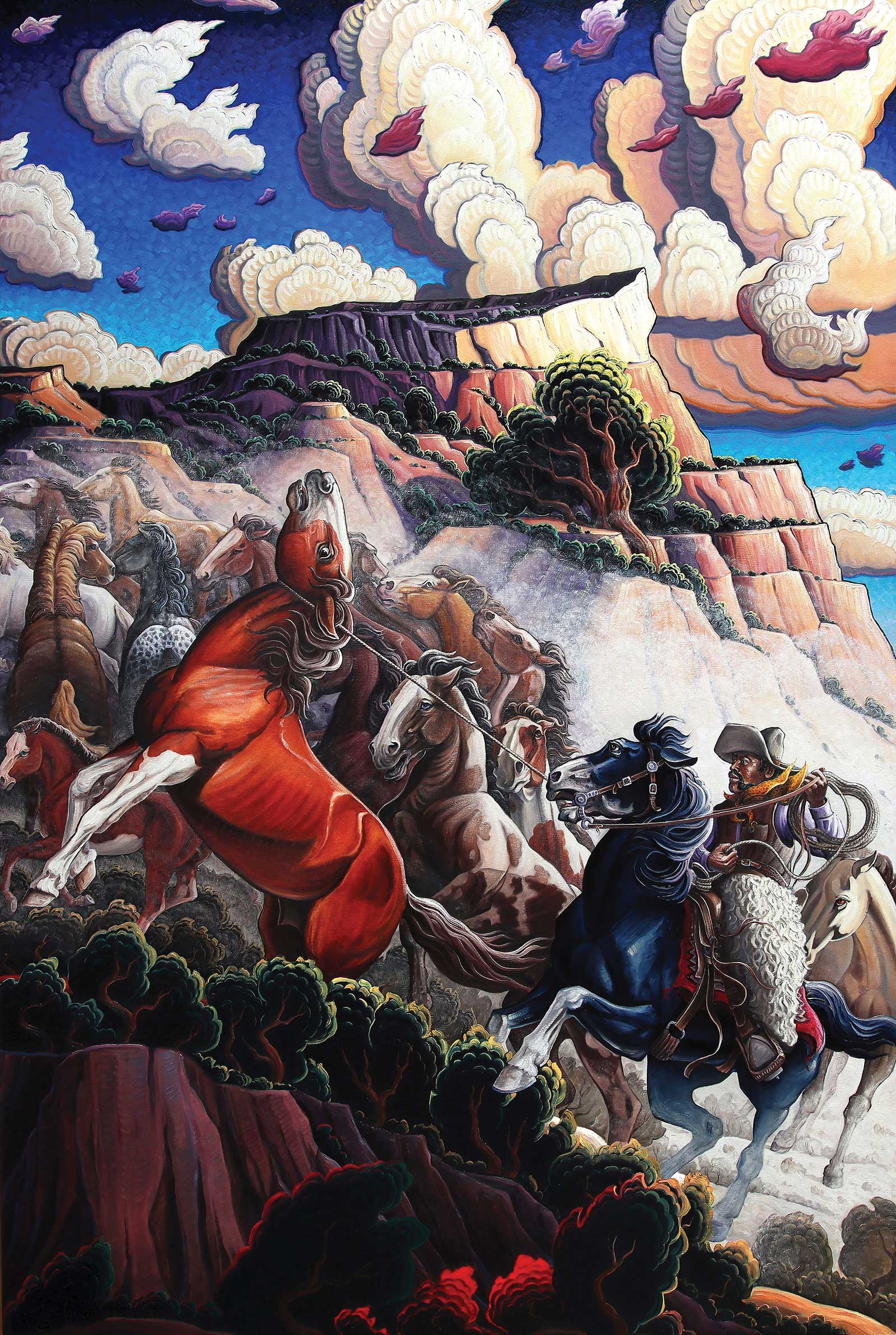 Frank Chisum - Wild West Icon, 2020, oil, 60 x 40”
Fleeing Hell’s Fury - Range Fire, a 2019 oil measuring 48 by 60 inches, is the fifth painting in the series and the most symbolic work. The cowboy has become a time-honored hero representing the bravery, passion and undaunted courage that tamed the Wild West. As with many of my works, I sought to reference meaning behind the image on multiple levels. Key aspects of this painting focus on the influence of the three major icons of Western Art—Charles M. Russell, Frederic Remington and William R. Leigh—and their impact on today’s contemporary Western Artists.
The most recent addition to the series is, Frank Chisum - Wild West Icon, an oil from 2020 measuring 60 by 40 inches. He was one of the iconic wranglers listed on the massive 1866-67 cattle drive. The following is an excerpt from True West Magazine by Bob Boze Bell: “Benjamin Franklin Daley was his slave name and he was bought by cattle baron John Chisum in Fort Worth, Texas for $400 and set free. Chisum then offered him a gig as a cowboy riding for the Jingle Bob. He took the name Frank Chisum and he also took to cowboying with a relish. A natural rider and skilled with horses, he was also a dead shot, and acted as John’s bodyguard on many occasions.” Frank stuck with the cattle baron through the infamous Lincoln County War of the late 1870s and later saved his life. He was the wagon master on many of the cattle drives from Texas to New Mexico Territory and beyond. Later in life, Frank Chisum started his own ranch along the Pecos River, becoming another great success story in the untamed American West.
Powered by Froala Editor