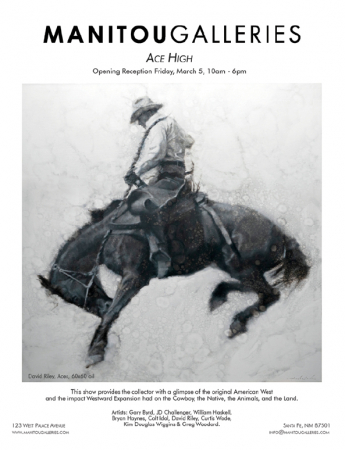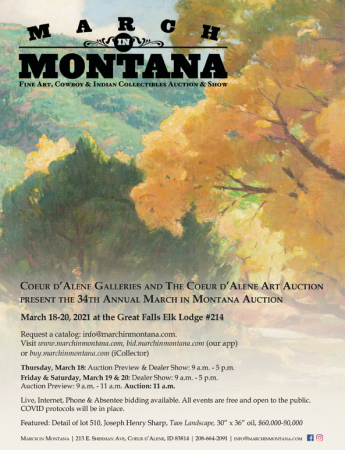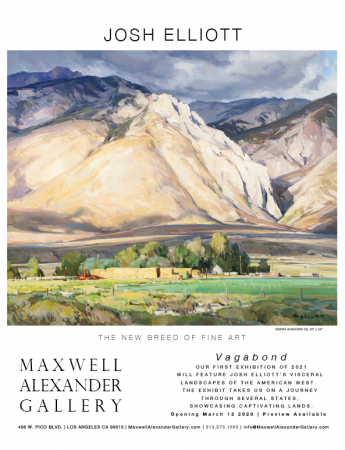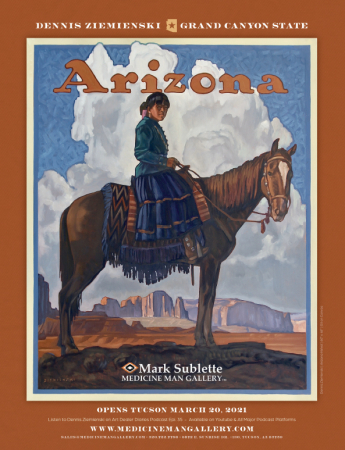
Editor’s Note: This essay appears in the recently released book American Art: Collecting and Connoisseurship, which features writing from experts around the country on topics as wide ranging as the anatomy of an art auction to the historical importance of gold frames. An essay on the Hudson River School artists and this one from Hopkins are the first two chapters of the book.
American art collections without representations of people, places and things west of the Mississippi River, or more accurately the 100th meridian, are literally excluding well over half the country in terms of land area and nearly half the population. This is not to mention the exclusion of references to the historic developments on the frontier that helped create the nation now stretching from sea to shining sea and beyond, to Alaska and Hawaii. While representations of the American West are few and far between in many important public and private collections in the eastern zones of the United States, surprisingly this is sometimes also true for collections in the West. While Western art fans may demonize Eastern scholars and curators for marginalizing Western art and not celebrating its merits, in some ways Western art connoisseurs have helped create the current separate but unequal status for art of the American West. In fact, the term Western art itself, herein referring to art of the American West that depicts typical subjects and landscapes west of the 100th meridian within the continental United States, needs definition so as not to be mistaken for the art of Western civilization.
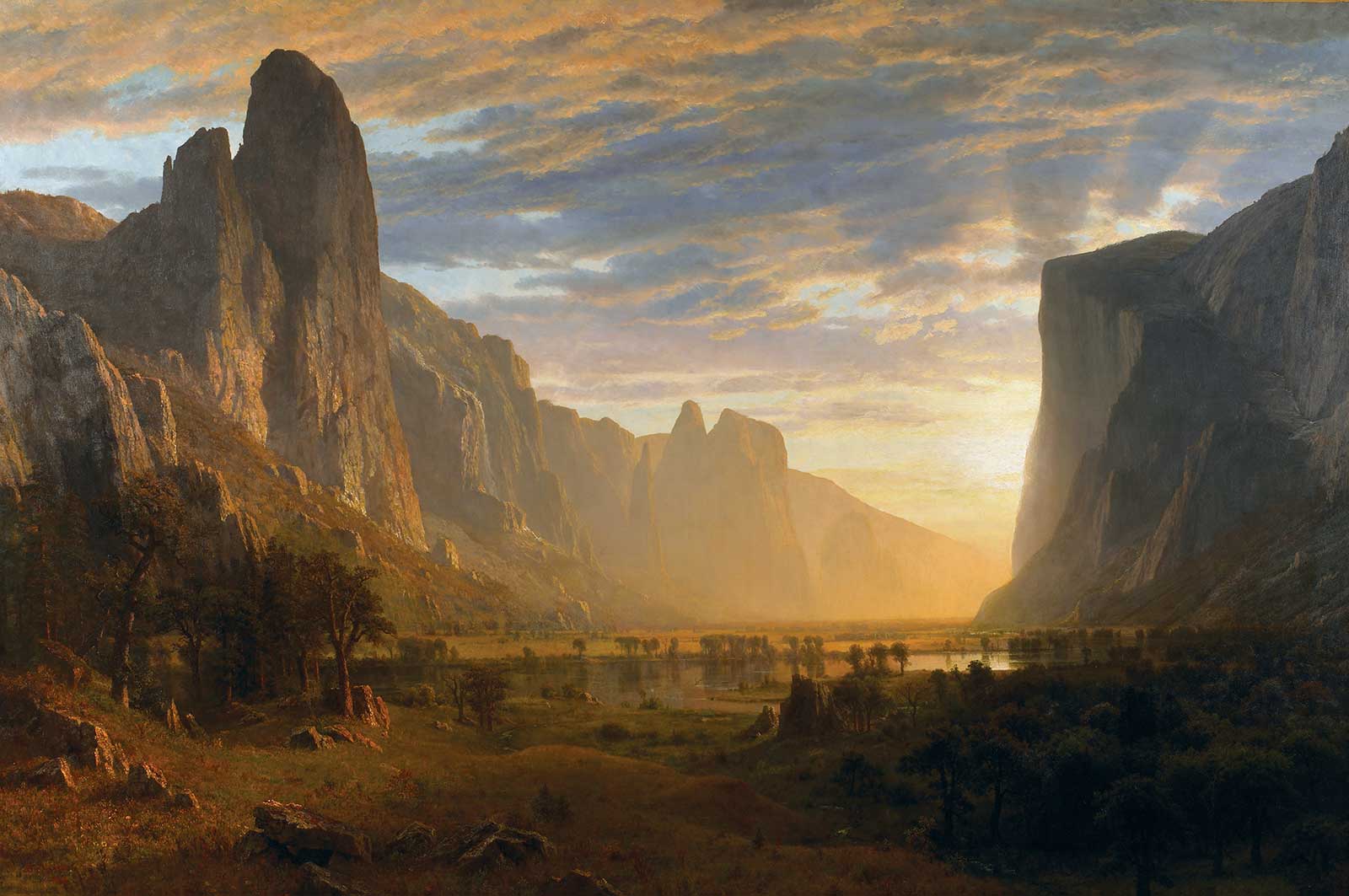 Albert Bierstadt (1830-1902), Looking Down Yosemite Valley, California, 1865, oil on canvas, 64½ x 96½”. Birmingham Museum of Art. Gift of the Birmingham Public Library, 1991.879.
Collectors and museums building and holding significant Western-oriented collections, reacting to real or perceived snubs, have not helped by expanding what may have once been a small fissure into a larger divide, driving a wedge between Western art and images depicting the rest of the country. This has thus created a relatively small but very passionate and resolute collector base for Western art, and a supporting cast of perhaps two dozen important museums with significant portions of their collections focusing exclusively on Western art. Understanding some basic Western history, and the artistic players witnessing the unfolding events, would therefore seem appropriate here.
At one time the West was merely the far side of Plymouth Rock, from the narrow view of the Pilgrims. Meanwhile Spanish explorers and missionaries were roaming the South and Southwest, French trappers were working in the northern Midwest and downriver to New Orleans, the British were still in North America, and Russian explorers were investigating the Pacific coast. It was far from uniform, but incursions into the interior of what would eventually become the contiguous United States came from nearly all sides.
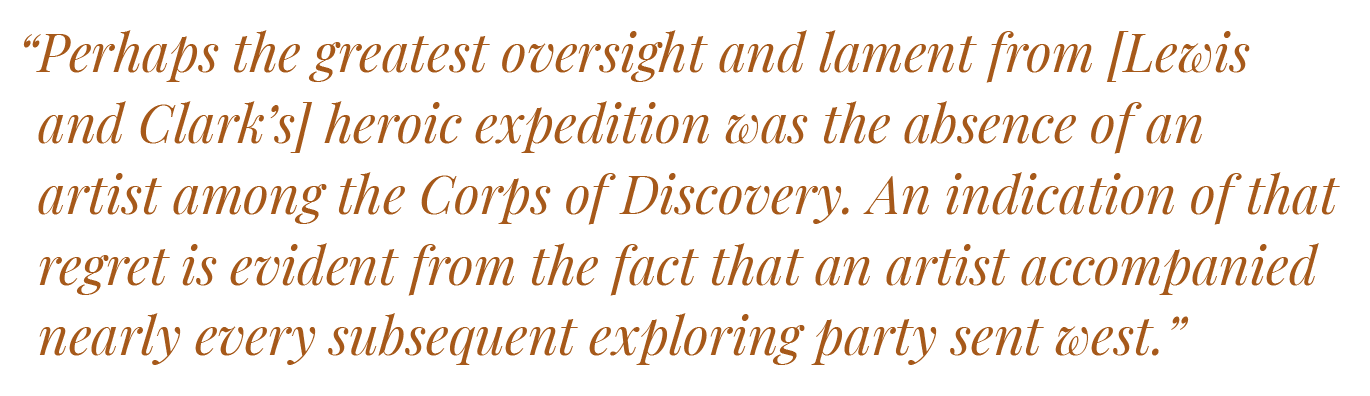
When Thomas Jefferson issued his instructions to Meriwether Lewis and William Clark to find an all-water route across the continent, he also placed significant emphasis on surveying the flora and fauna of the newly purchased Louisiana Territory. Lewis was sent to study with many learned individuals in Philadelphia so that he might be able to make scientific notes, create maps and determine local geology. Perhaps the greatest oversight and lament from that heroic expedition was the absence of an artist among the Corps of Discovery. An indication of that regret is evident from the fact that an artist accompanied nearly every subsequent exploring party sent west.
The work of Thomas Cole and others in establishing the landscape art tradition in America, known as the Hudson River School, would open doors that artists venturing further afield would charge through as they rushed to document the seemingly exotic people and terrain of the West. Much of the earliest art depicting Native Americans or landscapes of the interior could be more accurately classified as frontier art rather than Western, owing to the relatively short distances from the eastern seaboard to where it was created.
The earliest art generally classified as Western is made up almost entirely of images of Native Americans, with limited landscapes in the mix. For our purposes, the first significant body of Western art began to be produced in 1832 when George Catlin made his trip up the Missouri River to paint portraits and scenes of everyday life among Native American tribes in the West. Catlin had painted pictures of Indians on the eastern seaboard and hoped to add many Western tribes to his gallery before their lifestyle was destroyed by America’s westward expansion. It may have been Catlin who first suggested the idea of creating national parks in the West, although he was more interested in fencing in Indians and wildlife to be seen by later generations than in preserving scenic areas. His sentiments, while not in line with today’s thinking, were more sympathetic than those of many of his peers, who subscribed to the theory that the only good Indian was a dead Indian. He would spend the majority of his remaining years recording the lives of many Indian tribes throughout the West.
Another painter who sought to record images of the American Indian for posterity was Karl Bodmer, a Swiss artist who accompanied the German Prince Maximilian on an exploration of the West in 1833. Bodmer was a better artist and more observant than Catlin, rendering greater detail in most of his paintings, although he lacked the former artist’s enthusiasm for his project. John Mix Stanley and Alfred Jacob Miller would also contribute to this visual documentation, with Miller providing first-hand artistic accounts of the annual gathering of fur trappers known as “rendezvous.”
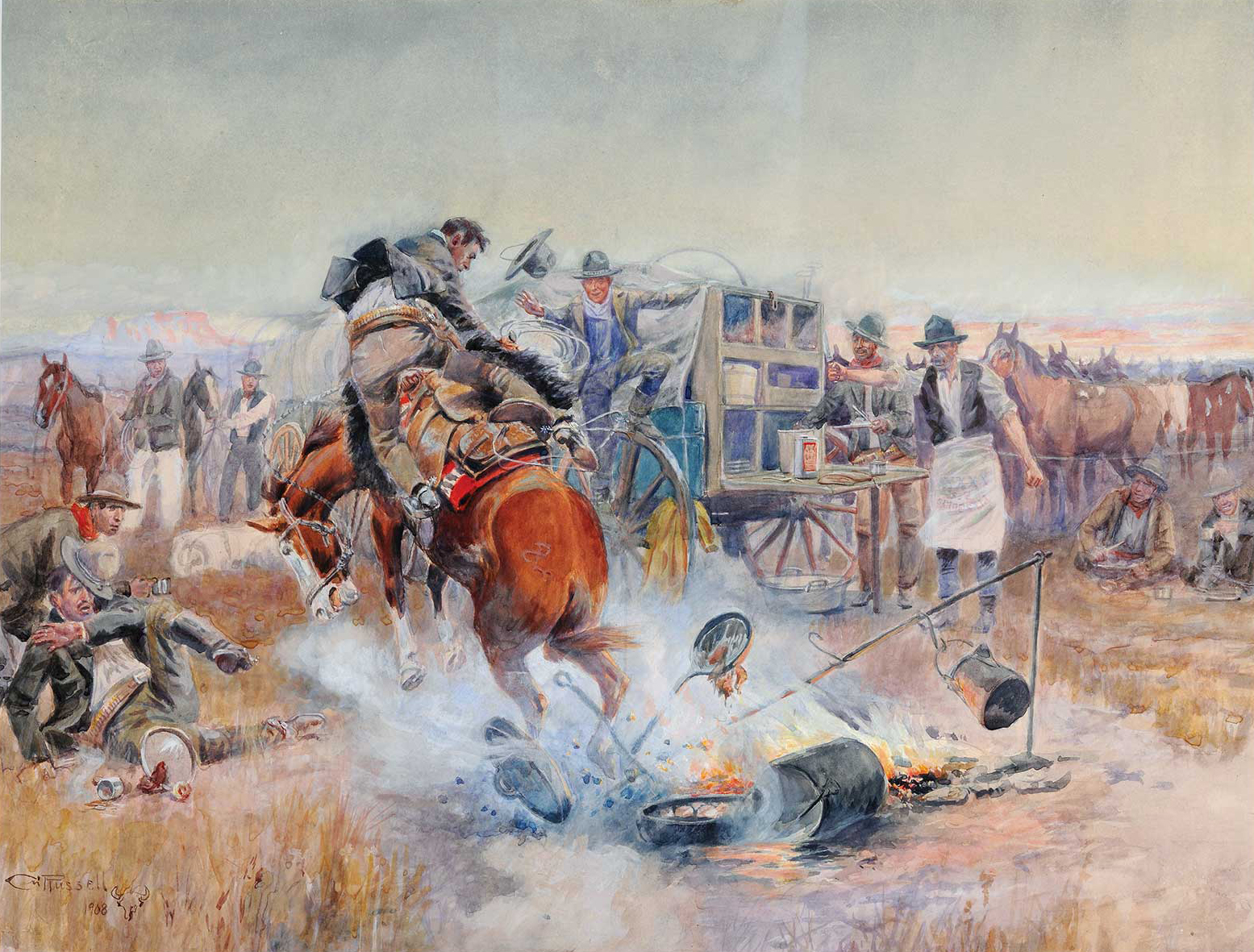 Charles M. Russell (1864-1926), Bronc to Breakfast, 1908, watercolor on paper, 19 x 25¼”. Montana Historical Society, Mackay Collection, X1952.01.06.
Catlin would eventually assemble a gallery of over 500 paintings that he hoped to sell to the United States government, but when they refused he took the show on the road, setting up viewings in England and Europe where people paid admission, and he tried to sell the collection to a foreign government. Luckily this did not come to pass, partly because the French Revolution broke out on the eve of a possible sale to the French government. Eventually these works were donated to the Smithsonian, again luckily, after the great fire that destroyed much of the early collections in 1865. Bodmer’s work would be published in a major set of books penned by Maximilian; much of the original artwork would eventually find its way to the Joslyn Art Museum in Omaha, Nebraska, donated by the Enron Corporation.
Catlin and Bodmer generally portrayed Native Americans as peaceful and noble beings, in marked contrast to images showing them as bloodthirsty savages. As tensions between Indians and settlers increased, conflict on the plains became inevitable and art documenting these battles ensued. As the similarly inevitable conflict between North and South loomed on the figurative horizon, master landscape artists such as Thomas Moran, Albert Bierstadt and others were facing west, painting large dramatic canvases featuring literal horizons. In contrast to the Indian Wars, artists rarely painted Civil War battle scenes, preferring to paint allegorical art that shielded viewers from graphic details, leaving that to the emerging medium of photography. Post-war artists turned their attention squarely to the West, and a healthy rivalry blossomed between Bierstadt and Moran. Bierstadt claimed credit for helping to get the Yosemite Valley set aside as a nature reserve, while Moran could claim much of the credit for Yellowstone becoming our first National Park.
The armed conflicts with the Plains Indians provided American artists with their first hero figure, the U.S. cavalryman in his famous blue uniform. The cavalry of the 1860s through 1880s was made up of a wide array of men, former Civil War soldiers, farm boys, immigrants, former slaves, and those on the run from the law. They were generally forgotten, ill-fed, underpaid and underappreciated, until their worst defeat made them popular martyrs in the collective American mind. This was at the Battle of the Little Bighorn, where Custer and most of his command were wiped out. There have been hundreds of paintings of this battle, most lacking historical detail but still adding to its legend.
Distributed in magazines and as prints, Western art depicting the fabulous and dangerous West became the leading subject in the popular culture of the day. The romanticized West, helped along by writers, singers, Wild West shows and stage actors (later in TV and movies), would become standard fare for nearly 100 years. While the majority of the artists mentioned up to this point do not have enough original work entering the art market to be significantly collectible, vintage prints in a variety of media, including chromolithographs or images specifically printed for books or portfolios, and in some cases hand-colored, are readily available at relatively reasonable prices. Charles Russell and Frederic Remington are the two artists acknowledged as most readily identified with the West. Each had his own style—with its strengths and weaknesses—yet they sought to achieve similar results. They believed that the West of their mature years was not the same as the West of their youth, and they sought to preserve that earlier West through the images they created in paintings and sculpture.
Despite Remington’s death before the age of 50, he and Russell both produced large bodies of work in painting and sculpture. While many of their most important works are certainly in museums, there is plenty of material coming to market each year to generate significant collector interest. There are even a few works that have trickled out of museum collections, often where the leadership has decided to focus on more general American art collecting than a concentration on the West.
Among the strongest performers over the most recent decades within the Western art market have been works by the members of the Taos Society of Artists, particularly the six founding members—J.H. Sharp, E.I. Couse, Bert Phillips, Ernest Blumenschein, Oscar Berninghaus and Herbert Dunton. All from or with ties to the Midwest and having studied in Europe, these artists came to New Mexico in hopes of establishing an American art tradition separate from that of Europe, based on uniquely American subjects—Native Americans of the Taos Pueblo living much as they had for centuries, the organically folded landforms in the area, and the quality of the light some artists compared to that of Giverny, France. Eventually the Taos art colony would attract artists from all over the world including influential Russians like Nicolai Fechin and Leon Gaspard.
The society would have roughly 20 members over its history, whether regular, associate or honorary. With the support of significant patrons and the railroad the group mounted exhibitions of their work in major Eastern and Midwestern museums, while members were also winning important national art contests back East. Just prior to the beginning of the Great Depression the group fell apart, as many artists had achieved significant individual success and to continue the association seemed rather pointless.
Just down the road in Santa Fe, New Mexico, artists were also flocking to town. However, no organization resembling the Taos Society of Artists was ever attempted. Instead Edgar Hewett, head of the New Mexico Art Museum, allowed artists to use its space to show their work and created a strong art tradition for the community. Hewett and the museum also supported a small group of young artists, the Cinco Pintores, that in some ways did emulate the Taos Society: it consisted of Will Shuster, Fremont Ellis, Walter Mruk, Jozef Bakos and Willard Nash, although this group, sometimes derisively described as the “five nuts in the five mud huts,” never attained the status of their Taos brethren. In today’s market, the works of similarly trained, similarly competent artists painting similar subjects associated with the Taos Society bring two to four times the hammer price at auction compared with artists based in Santa Fe. Conversely, Santa Fe has become a dominant city and art market on the American landscape. With a total population of only about 70,000 people, the city supports nearly 250 art galleries, making it America’s third largest art market behind New York and Los Angeles
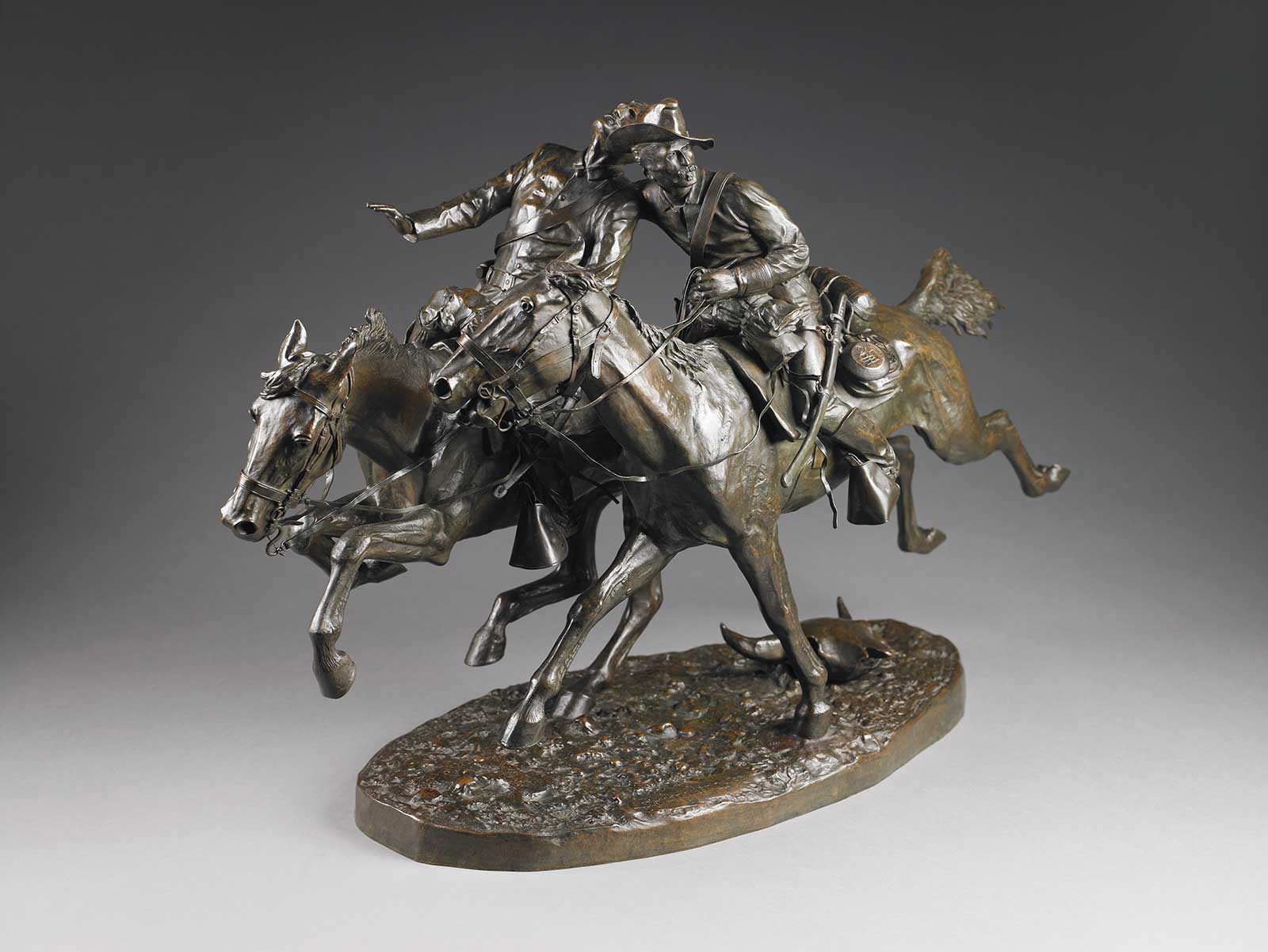 Frederic Remington (1861-1909), My Wounded Bunkie, 1896, Cast A, Henry Bonnard Bronze Company, bronze, 20¾ x 11 x 31”. Birmingham Museum of Art, Gift of Dr. and Mrs. Harold E. Simon, 1973.148.
In attempting to construct a neat and tidy timeline for Western art history, the period bookended by 1930 and the early 1960s proves difficult to define. Despite a profusion of Western movies, and later television programs, surprisingly little fine art of note depicting Western subjects was produced in those years. Because Western American art was generally representational in nature, it was largely ignored while abstract expressionism dominated, especially in the New York art circles following World War II. As the 1960s dawned John F. Kennedy used the phrase “New Frontier” in an election speech, perhaps foreshadowing a renewed interest in both historic and contemporary Western art. In the midst of the Cold War Americans may have identified with the spirit of the Old West and romantically remembered the simpler times depicted in the movies of their youth. The founding of several Western-focused museums and new scholarship in the 1950s fueled new interest in Western art of earlier periods.
However, it was the founding of two very dissimilar organizations in the 1960s that spurred a rebirth in the production, and equally importantly the collecting, of contemporary art depicting Western subjects. While there is sufficient material from a fairly limited number of earlier artists to sustain a healthy secondary market, including many galleries and several major annual auctions, it is in the field of contemporary Western art (meaning art by living artists, or at least artwork produced within the last 50 years) that I believe the best opportunity lies for enjoyment in the process of collecting.
In 1962, the Institute of American Indian Arts (IAIA) was founded in Santa Fe under the jurisdiction of the Federal Bureau of Indian Affairs. In 1965, four artists founded the Cowboy Artists of America (CAA) dedicated to perpetuating the type of art created by Frederic Remington and Charles M. Russell and with the hope of creating a market for their work.
Initially set up as a high school, IAIA is now a four-year college granting degrees in arts disciplines and several other areas. The Institute provides an opportunity for young Native Americans with artistic talent to leave their homes, often on reservations, and live on the Santa Fe campus while attempting to develop a career in art. Instruction in drawing, painting, sculpture, jewelry-making and other specialties is offered along with liberal studies, art history, and encouragement for students to investigate their own family and tribal history. Previous attempts to provide young Native artists with art training were often led by non-Natives who usually had preconceived ideas about what Indian art should be and what subjects were appropriate.
IAIA is primarily led by Natives who have arts and/or business backgrounds. They provide ample art supplies, studio time and reassurance that experimentation is essential in moving art forward. Within a remarkably short period a number of students and faculty members became important leaders in establishing a whole new framework for Indian art, often merging Indian motifs, symbols or spirituality with modern art sensibilities.
Indicators of the impact the Institute has had on American art include a Smithsonian-organized exhibition of work by former instructor Fritz Scholder and former student T.C. Cannon in 1972. The show opened in Washington, D.C., then traveled throughout Europe. In 1992, former instructor Allan Houser received the National Medal of Arts from President George H.W. Bush.
It seems appropriate that artists Charlie Dye, John Hampton, Joe Beeler and George Phippen met in an Arizona saloon to found the CAA. Their intention was to create a social club offering mutual support for artists attempting to make a living creating traditional Western art. Their stated desire was to perpetuate the memory and culture of the Old West as typified by the late Frederic Remington, Charles Russell and others. Members of the Cowboy Artists of America were united in their traditional realism style and their focus primarily on historic Western subjects such as cowboys, Indians or horses. At a time when most gallery walls were filled with minimalism, the Cowboy Artists consciously chose to override conceptualism in favor of traditional depictions of the Old West.
They organized an annual trail ride where they could live the life they painted and sculpted. More importantly, they partnered with the National Cowboy Museum in Oklahoma City to present an annual show where their work was offered for sale. Within a few years the event became a land rush, with patrons jostling to purchase art.
A squabble with the hosting museum led the CAA to move its show to Phoenix, while the Oklahoma museum began a new show and sale, known today as the Prix de West, loosely based on the historic art competitions known as the Rome Prize and the Prix de Rome. In the 1980s through the mid-2000s these two exhibitions/sales, along with other museum and charity sales, annually produced upward of ten million dollars in sales for the artists who participated.
The trails blazed by the artists related to these two now venerable institutions have helped create a healthy contemporary Western art market. Dozens of museums have collected examples by living artists, several regular publications are dedicated to the genre, stand-alone auctions of Western art regularly include contemporary work, and numerous galleries exist in Western art meccas like Scottsdale, Jackson Hole, Santa Fe and beyond. These latter-day trailblazers, particularly the Native artists, have also created a much wider niche for Western art.
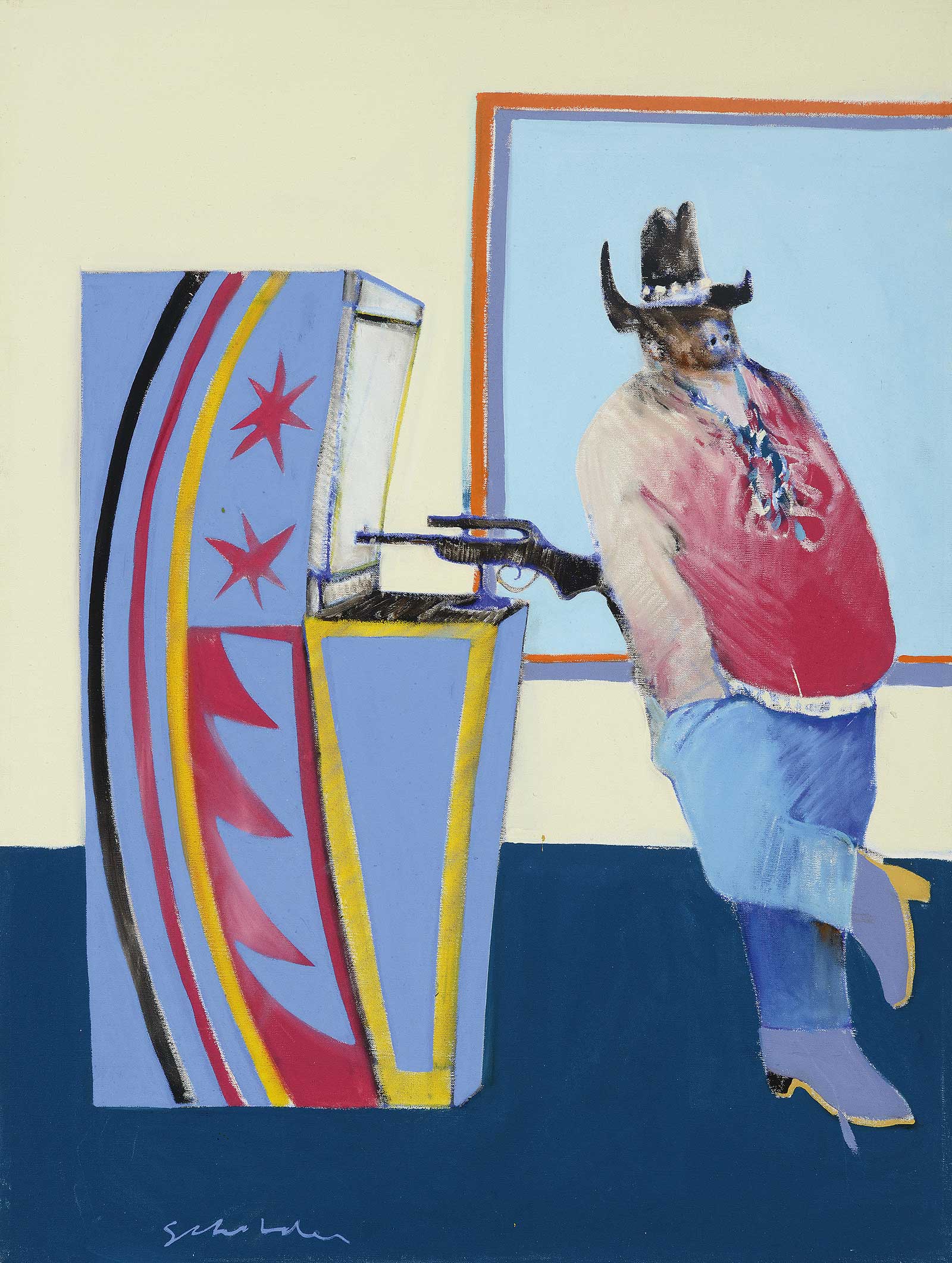 Fritz Scholder (1937-2005), Indian at a Gallup Bus Depot, 1969, oil on canvas, 40 x 30”. Booth Western Art Museum permanent collection, Cartersville, GA, 2013.011.001.
Today artists who create abstract forms, infuse social commentary, appropriate from earlier artists or pop culture, practice photo-realism, and experiment with new materials can all have their work considered Western art, although some might reject the Western art label as passé or limiting. Among those pushing the envelope of the genre are Tom Palmore, Paul Pletka, Thom Ross, Donna Howell-Sickles, Bill Schenck and Theodore Waddell.
While early Western artists were generally not a diverse group, today there is a more representative mix of artists working and receiving recognition in the field. While a significant number of Native artists have achieved status in the past 50 years, it is only in more recent times that large numbers of women, Asian American or African American artists have been seen in major galleries and entering museum collections.
Modern and post-modern art movements from the 1960s such as abstract expressionism and Pop Art have had a lasting effect on art of the West. Theodore Waddell applies the loose, gestural brushwork of the abstract expressionist painters to subjects close to home on his Montana ranch or at home in Idaho. Bill Schenck started using spaghetti Western publicity photos as sources for his Pop Art style while living and working in New York in the 1970s. Schenck’s flattened, almost paint-by-number works blur the lines between high and low art, presenting the cowboy and others as commercial objects.
The artistic responses created between 1830 and 1930 to the vastness, scenic beauty, wildlife and varied peoples of the American West leave a daunting legacy for today’s Western artists to deal with. Mainly narrative, illustrative and meant to be perceived as documentary, the earlier art enlightened and entertained audiences eager to visualize the wonders of the West. In the simplest terms, the enduring traditions established by artists working in the first century of Western art leave today’s artists two basic choices. They can generally follow the durable customs and produce art visually similar to that of preceding generations, or they may reject portions of the convention and infuse aspects of modern or contemporary art in their work. While the treatments may have changed, the Western landscape, cowboys, Native Americans and wildlife are subjects that still inspire artists.
Some artists, going against the traditional narrative grain in Western art, have responded with social commentary embedded in their art. Works by many Native artists ask questions about America’s perceived history versus reality that may not be comfortable for many to answer. Many more women artists have become prominent in the field at this time as well. Anne Coe, for example, portrays the West of today and addresses issues such as land management and urban sprawl. Montana artist Clyde Aspevig has also been involved with the environmental movements developing in the West over recent years, attracting and inspiring artists of the West who are interested in wilderness preservation. As such, he seeks out some of the last truly wild places in the West as subjects in his art. Chuck Forsman takes a clearly critical view of the landscape and its place in today’s modern West by often choosing subjects such as a strip mine.
Some artists also seek out contemporary Westerners as subjects. Before his eyesight deteriorated James Bama painted people he encountered at parades, pow-wows, rodeos or in daily life in the West. One of his most famous paintings depicts a young man in full regalia posed in front of a wall of peeling paint with the faint message “no parking violators towed away” barely visible, asking an important question about the status of Native Americans even today.
The contemporary Western art world is fairly small at the top. While there might be thousands attempting to make at least a portion of their living from creating Western images, the community on top of the figurative mesa numbers less than a few hundred artists. The supporting community includes a few thousand serious collectors, several trade magazines and a shrinking number of major galleries, certainly now well under a hundred. Many of the older members of this community continue to fret about the future of the genre, wondering if those under 50 today will eventually become enamored with Western art as their parents once did after they had raised their kids and become somewhat financially stable. I tend to believe they will, although it will not be through the movies and television shows that lured the previous generations—it will be the sheer power, magnitude and beauty of the West, along with the powerful mythos that still remains.
Whether backpacking through the national parks, learning to ride at a dude ranch, or marveling at landscapes both vast and desolate as well as verdant and breathtaking, the experiences available in the American West are life-changing. I firmly believe younger generations will continue to want vacation homes in the West and to travel the scenic byways to see the sights. For a percentage of those, although who knows how large, these experiences will trigger a latent desire to collect paintings, sculpture and photography relating to these experiences. Thus, the collecting bug will have bitten a new crop. Theoretically, these younger collectors will be more attracted to the more stylized or contemporary (meaning modern leaning) artwork available in the field.
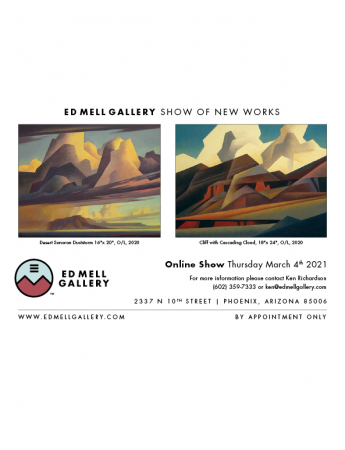
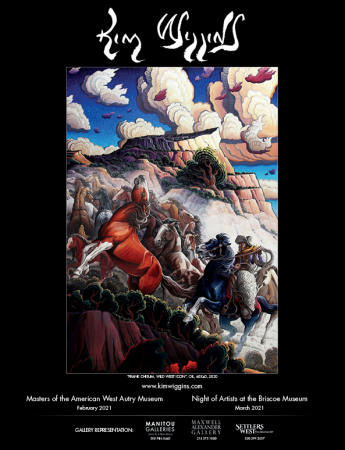
While traditional Western art, commonly representational and narrative in nature, may long remain the mainstream of the genre, artists impacted by modern and post-modern trends in American art have created a significant and growing tributary. In my research, I have run across articles from as early as the 1980s predicting that the more contemporary images, like those produced by Donna Howell-Sickles, Ed Mell, Kim Wiggins, Thom Ross and others, would come to dominate the field within a relatively few years. Nearly forty years have passed since some of those articles were written, and traditional-style Western art is still the mainstream, with more contemporary imagery important but still the smaller tributary, at least for now. Regardless of whether it is traditional or contemporary, imagery of the American West belongs in any significant collection of American art in some form or fashion.
Our collective thoughts about the West, the real place with real history, or the West we construct from our minds, still provide powerful stimuli for new generations of artists. The American West is a unique place; yet it also exists for many as an ideal, fantasy, myth, symbol or a time past. Those willing to confront the enduring traditions are empowered to pick and choose those they wish to align with or reject. Their output provides a constructive framework for us to contemplate the American West anew: its turbulent past, vibrant present and uncertain future.
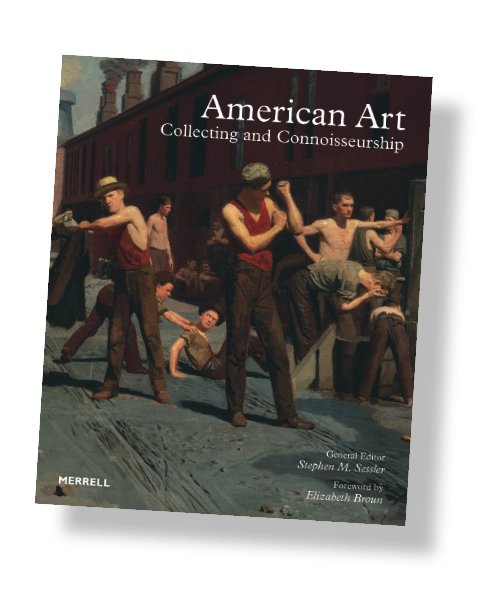
American Art: Collecting and Connoisseurship
General Editor: Stephen M. Sessler
Foreword by Elizabeth Broun
304 pages with 180 illustrations.
Available now from Merrell Publishers, London / New York
www.merrellpublishers.com
Powered by Froala Editor