The English author Robert MacFarlane writes, “At bottom, mountains, like all wildernesses, challenge our complacent conviction—so easy to lapse into—that the world has been made for humans by humans. Most of us exist for most of the time in worlds which are humanly arranged, themed and controlled. One forgets that there are environments which do not respond to the flick of a switch or the twist of a dial, and which have their own rhythms and orders of existence. Mountains correct this amnesia. By speaking of greater forces than we can possibly invoke, and by confronting us with greater spans of time than we can possibly envisage, mountains refute our excessive trust in the man-made. They pose profound questions about our durability and the importance of our schemes. They induce, I suppose, a modesty in us.”
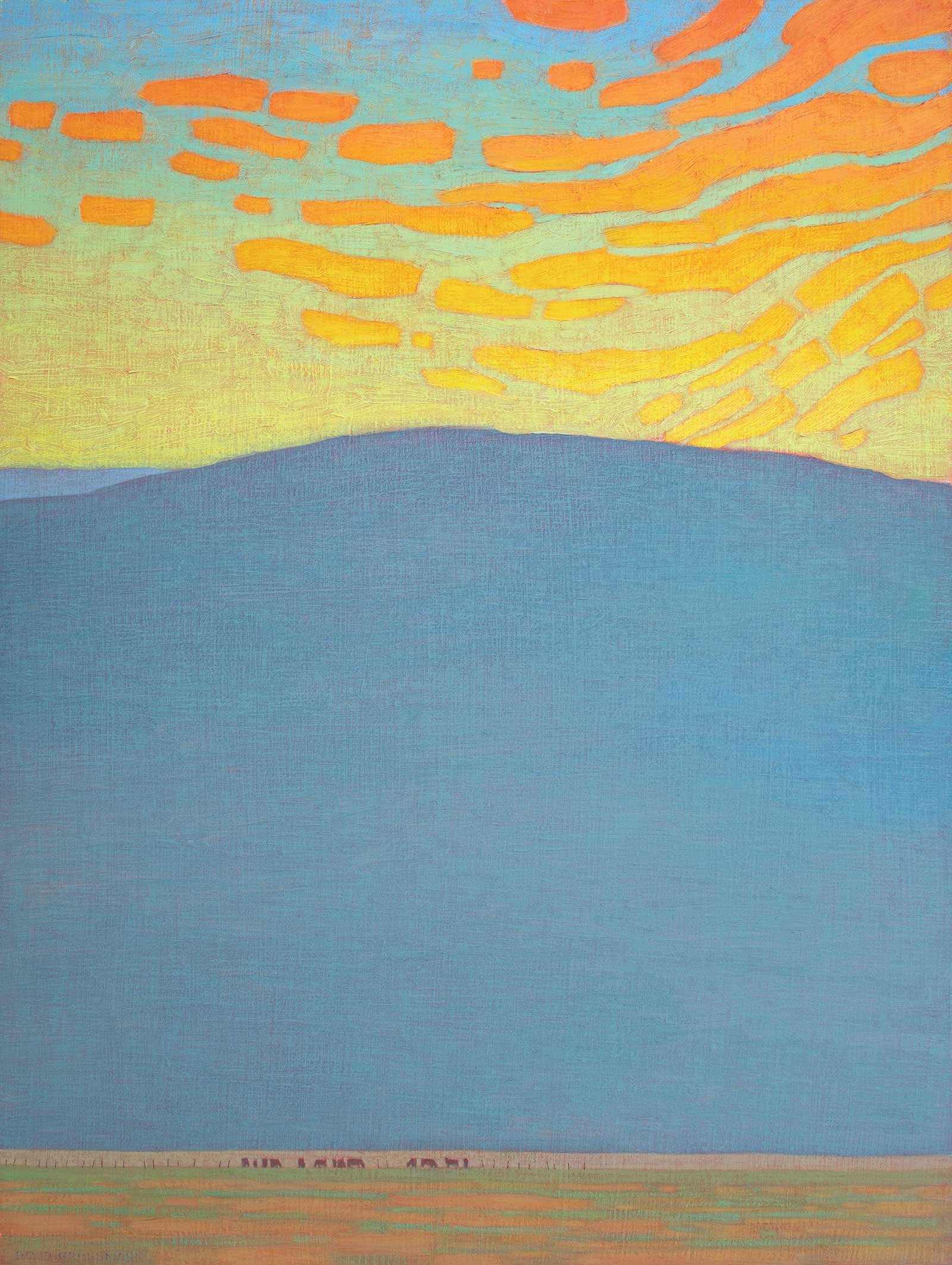 Maxwell Alexander Gallery, Bright Clouds Over Mountain Pasture, oil, 40 x 30”, David Grossmann.
Capulin Volcano, dormant for over 30,000 years and softly eroded, rises imposingly above the Great Plains of northeastern New Mexico. Much of northern New Mexico is dotted with the remains of a violent, geologic past from the vast Valles Caldera to the iconic Shiprock which, like Capulin, juts up from the barren horizontal plain.
Jeff Aeling is attracted to the “vast open plains and then something huge to give scale to it.” His painting Capulin Volcano, NM, is two-thirds sky with clouds taming the vastness. The volcano rises dramatically on the horizon line. There is no evidence of a human presence, the forces that formed the plain and the volcano are present and can almost be felt.
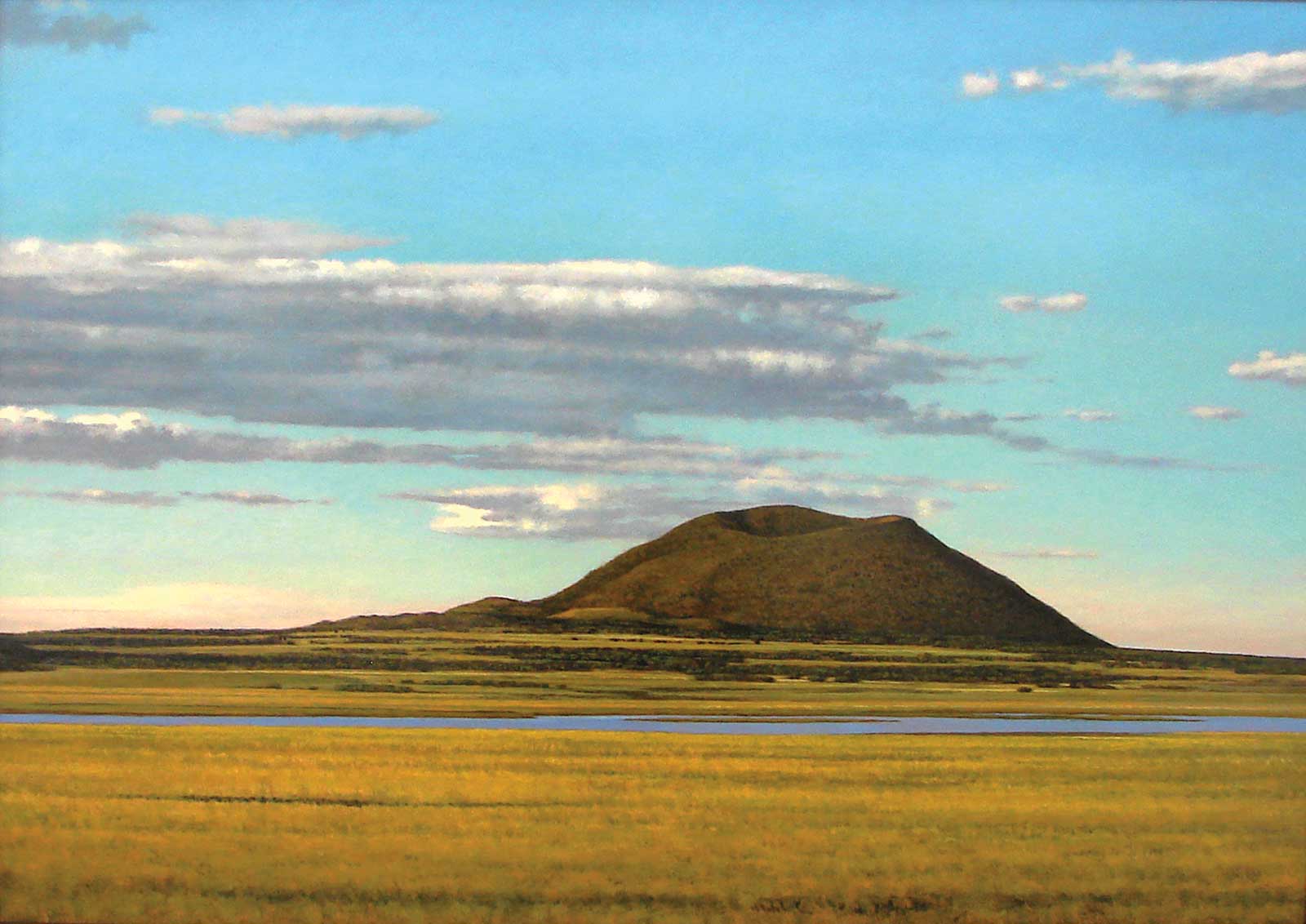 William Havu Gallery, Capulin Volcano, NM, oil on panel, 43 x 57”, by Jeff Aeling.
Aeling develops his paintings from photographs taken in the field. He says, “To compose a painting outdoors would be an anachronism because it no longer corresponds to the way that we actually see things. Experience itself largely conforms to the pictures we take of it, affecting perception and memory; we in fact process our surroundings through the lens of photography.”
David Grossmann’s painting is also of clouds and mountain. The mountain becomes a giant form silhouetted against the bright sky and clouds, given scale by the almost imperceptible herd of cattle. The taming of the landscape is evident not only in the presence of the cattle but in the even less perceptible vertical fence posts delineating the pasture. A painting with little detail tells a real story.
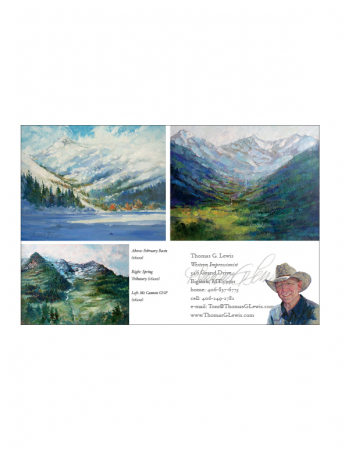
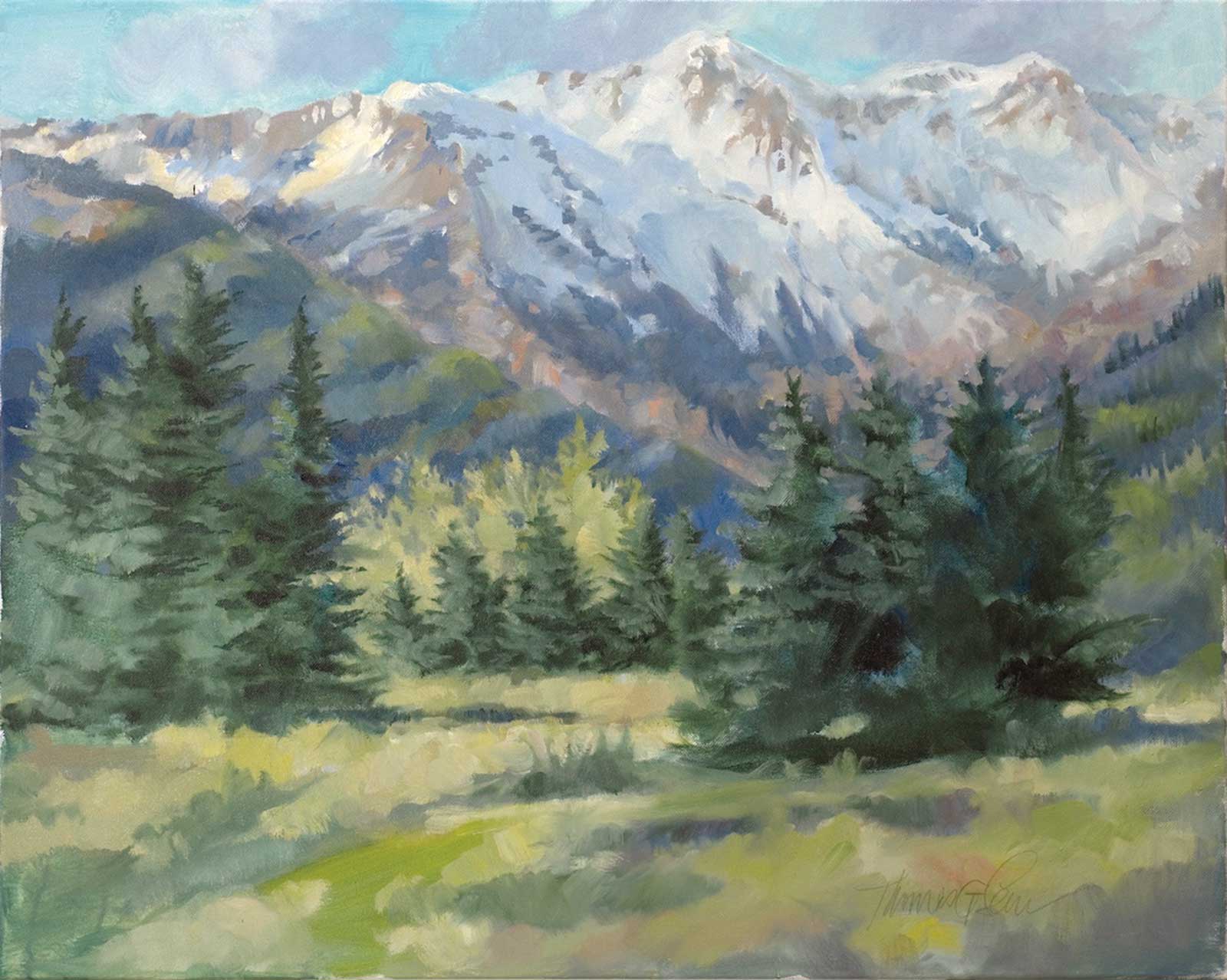 Thomas G. Lewis, Macdonald Creek from Going to the Sun, oil on canvas, 16 x 20”
He explains, “The idea for this painting came as I was driving through the valley near my home. I wanted to capture the brightly swirling patterns of clouds against the green sky. In this composition I focused on how the sky patterns echo in the colors of the grass, and I emphasized the shape of the mountain as a quiet, solid space between the rhythms of the sky and the pasture.”
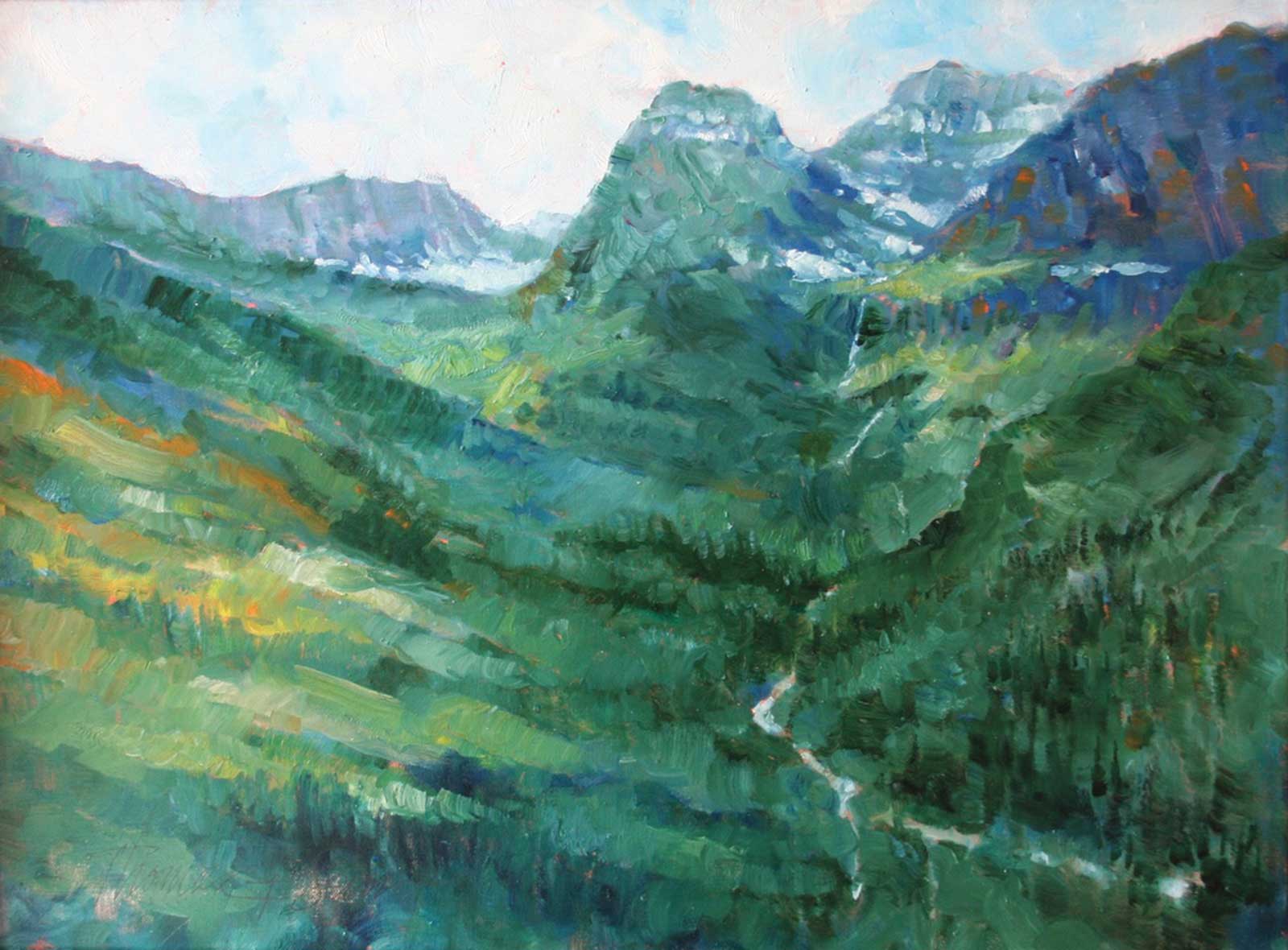 Thomas G. Lewis, Spring is here, oil on canvas, 24 x 30”
Grossmann creates sketches of ephemeral moments while out in the field. “When I work in my studio,” he says, “I gather ideas from these sketches, combining them and overlaying them with imagination and memory in a much more deliberate and time-consuming process. It is a balance between the deliberate and the spontaneous that points me back to that tension between the fleeting and the longing for permanence.”
Mountains inspire awe and wonder to almost all who behold them. The magnetic pull artists feel toward these earthly giants has resulted in countless gorgeous renditions of our planet’s geologic forms. Read on to see more depictions of mountains as interpreted through the eyes of other artists.
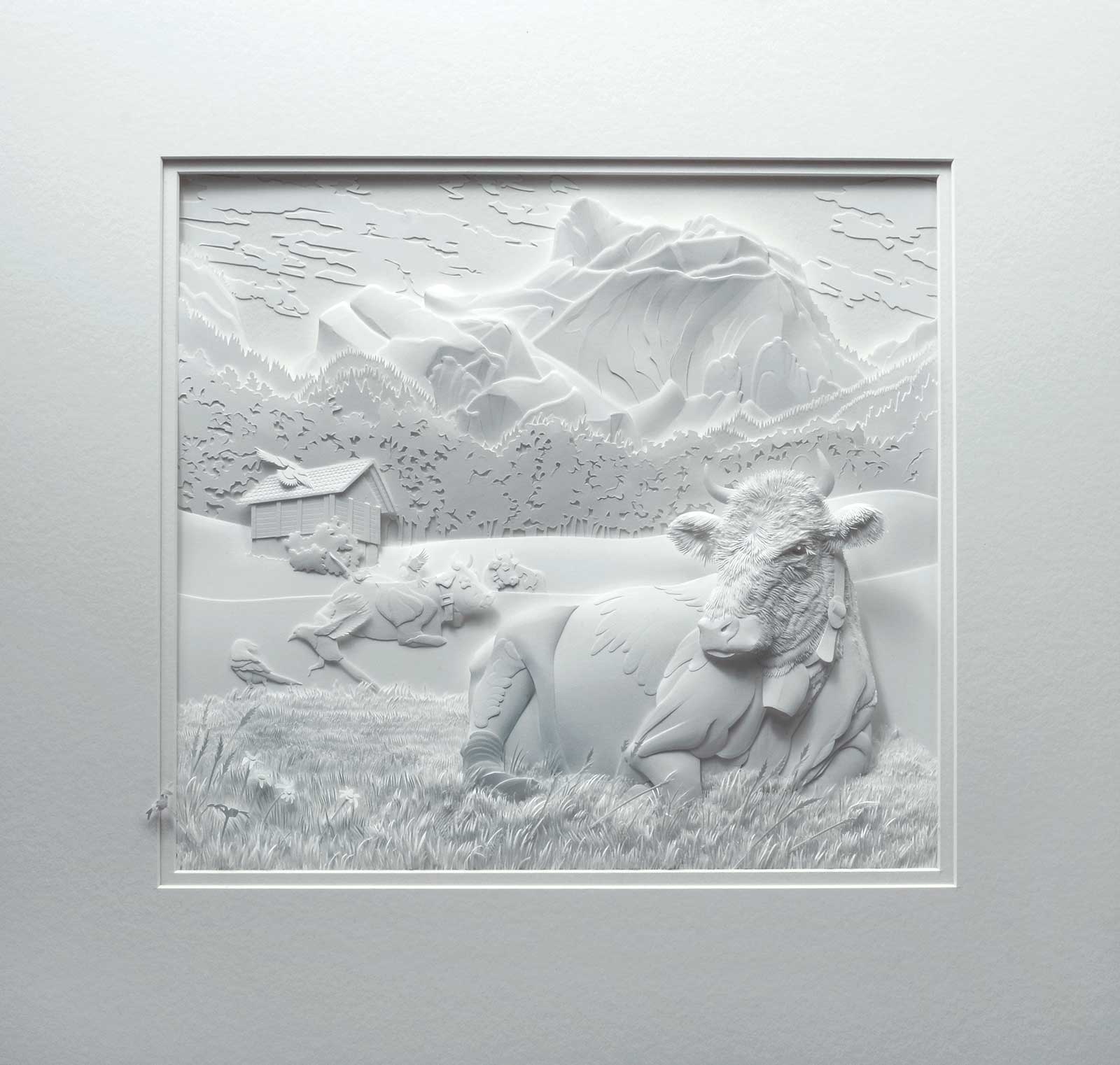 Calvin Nicholls, Kandersteg Summer, paper, 20 x 20 x 2”
An avid lover of the beauty inherent in the outdoors and the natural world, Thomas G. Lewis paints the American Western landscape—where Western skies meet the earth, and natural and man-made features join the two. Lewis was raised on the Navajo Indian Reservation and several cattle ranches in Colorado and New Mexico. Having resided in the Southwest for some six decades, he now calls Montana home and has become intimately acquainted with the American West’s picturesque landscape and heritage. “This experience is expressed in scenes of the Southwestern desert and Northwestern mountain landscapes. My experiences are communicated through sure, confident brushstrokes, sometimes sparing, other times rich glazes and overlays of color upon color. At times fearlessly dark, other times bright and luminous, yet always resulting in works of unparalleled charm and delight,” says Lewis. “Passionate brush strokes that capture a moment, a mood, or suggest a glimpse of a familiar memory provoking working ranch hands and mountain wildlife.”
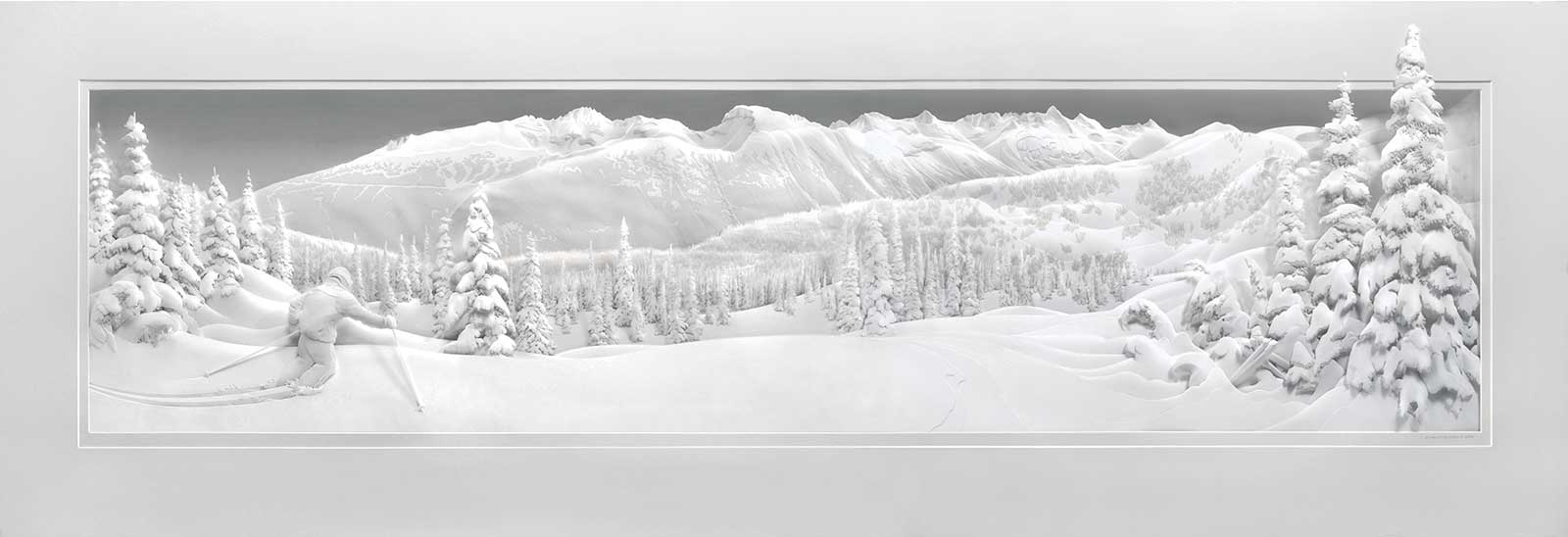 Calvin Nicholls, Firstracks, paper, 27 x 77 x 3”
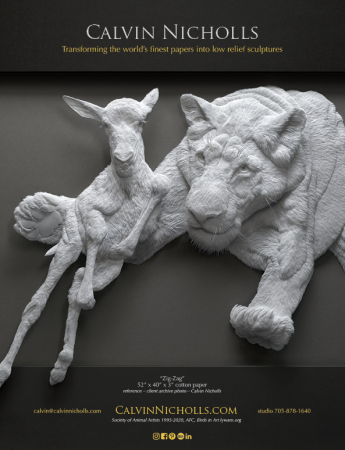
Calvin Nicholls meticulously cuts paper to create his wildlife and landscape paper sculptures. Among these are mountainous winter scenes, a dynamic variety of animals, and at times the human figure. He describes his introduction to the art world in his youth: “My parents introduced me to the art of Canada’s Group of Seven when I was a teenager...The effect was long lasting as I saw the influence of A.J. Casson and Lawren Harris in my schoolbook doodles and even today in my layouts and preliminary drawings.” He continues, “Although soft and pliable, the structure, weight and grain of the papers I use dictate very specific limitations within which I must work. Scoring and tooling techniques offer some extension of these limits as
I emboss, curl and impose shape to depict each component. Clusters of jagged peaks thrusting through windblown snow and low-hanging clouds offer a challenge in the simplification of form and great reward when the light is just right as I strive to capture the texture and detail in subtle highlight and shadow.”
Featured Artists & Galleries
Calvin Nicholls
(705) 878-1640,
calvin@calvinnicholls.com
www.calvinnicholls.com
Maxwell Alexander Gallery
406 W. Pico Boulevard, Los Angeles,
CA 90015, (213) 275-1060
www.maxwellalexandergallery.com
Thomas G. Lewis
546 Grand Drive, Bigfork, MT 59911
(406) 837-6775, (406) 249-2782
tom@thomasglewis.com
www.thomasglewis.com
William Havu Gallery
1040 Cherokee Street, Denver CO
(303) 893-2360, info@williamhavugallery.com
www.williamhavugallery.com
Powered by Froala Editor