Byron and Keely Lewis built their home in Edinburg, Texas, to house their growing collection of the art of the American West. They worked with Hugo and Ceci Salinas of SuperBoy Design & Construction to create a home that reflects the traditions of their Mexican border region.
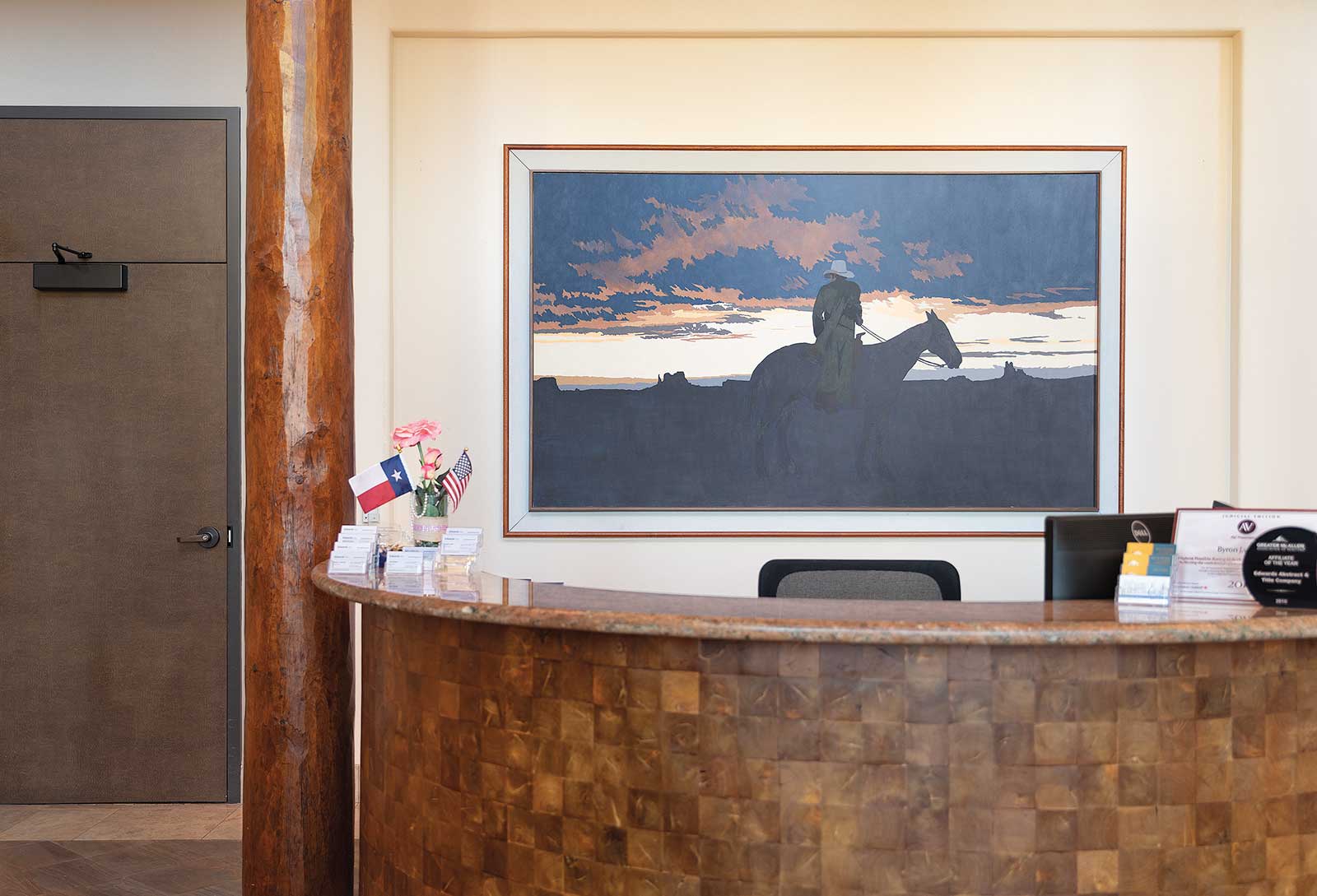 In the main lobby is Billy Schenck’s Dead Horse Mesa (self-portrait), 1977, oil on canvas. The counter is faced in native Rio Grande Valley mesquite.
Byron joined Edwards Abstract and Title Co. in 1999 as an attorney. He purchased the company in 2001 and is now its president and CEO. As president of the Edinburg Chamber of Commerce, he was active in historic preservation and met the architect Teresa Morales Best. He began talking about the need for a new home office for the company which had been expanding into neighboring downtown buildings. She designed a building blending Southwest and desert styles. “I had been designing the building in my head for five years,” Byron says. “I wanted warmth, and unlike our home, I wanted durable aesthetics befitting an office. Reflecting our love of south Texas, I wanted native materials. Terry pulled all of that out of my head.”
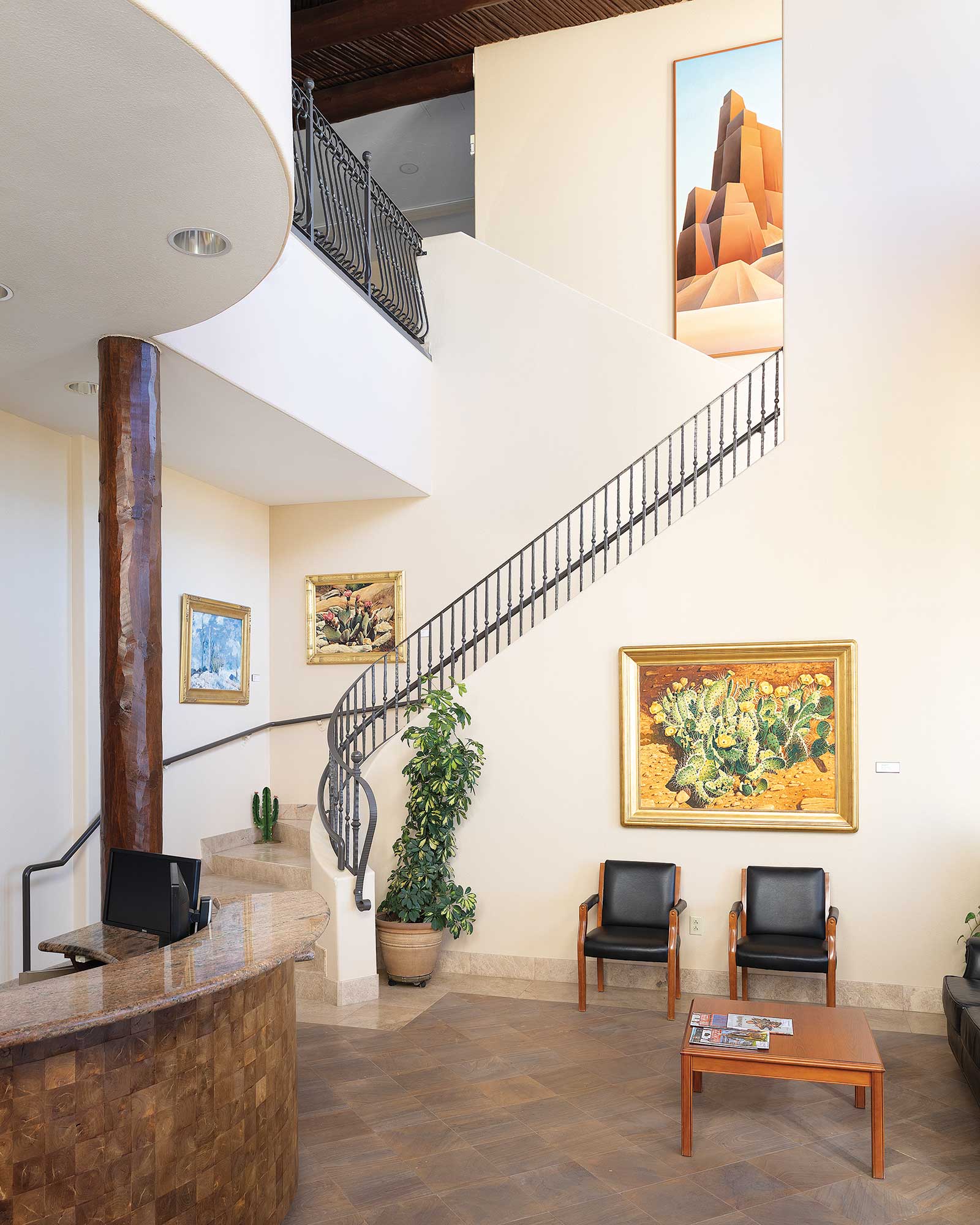 Above the chairs in the lobby is Prickly Pear in the Desert, 1940, oil on board, by Frank Gavencky (1888-1966). Ascending the stairs are, left to right, Cave Creek Arizona, 1945, oil on board, by Lon Megargee (1883-1960); Gavencky’s Strawberry Cactus, 1940, oil on board; and Ed Mell’s Untitled Pillar, 1978, oil on canvas.
The elegant building houses not only the company’s 75 employees but also a portion of the Lewises’ collection. Prominent among the works on display are paintings by Lon Megargee (1883-1960).
“As I started becoming a really serious collector, I wanted to meet the artists and get to know the gallery people,” Byron reminisces. “I had bought Ed Mell’s Southern Arizona Longhorn from Tony Alterman and later met Ed at an opening at Overland Gallery in Scottsdale. We became great friends. One day sitting on the porch sipping whiskey I asked him, ‘Tell me what artists inspire you.’ He told me, ‘Maynard Dixon, Lew Davis, Tom Lea and Lon Megargee.’
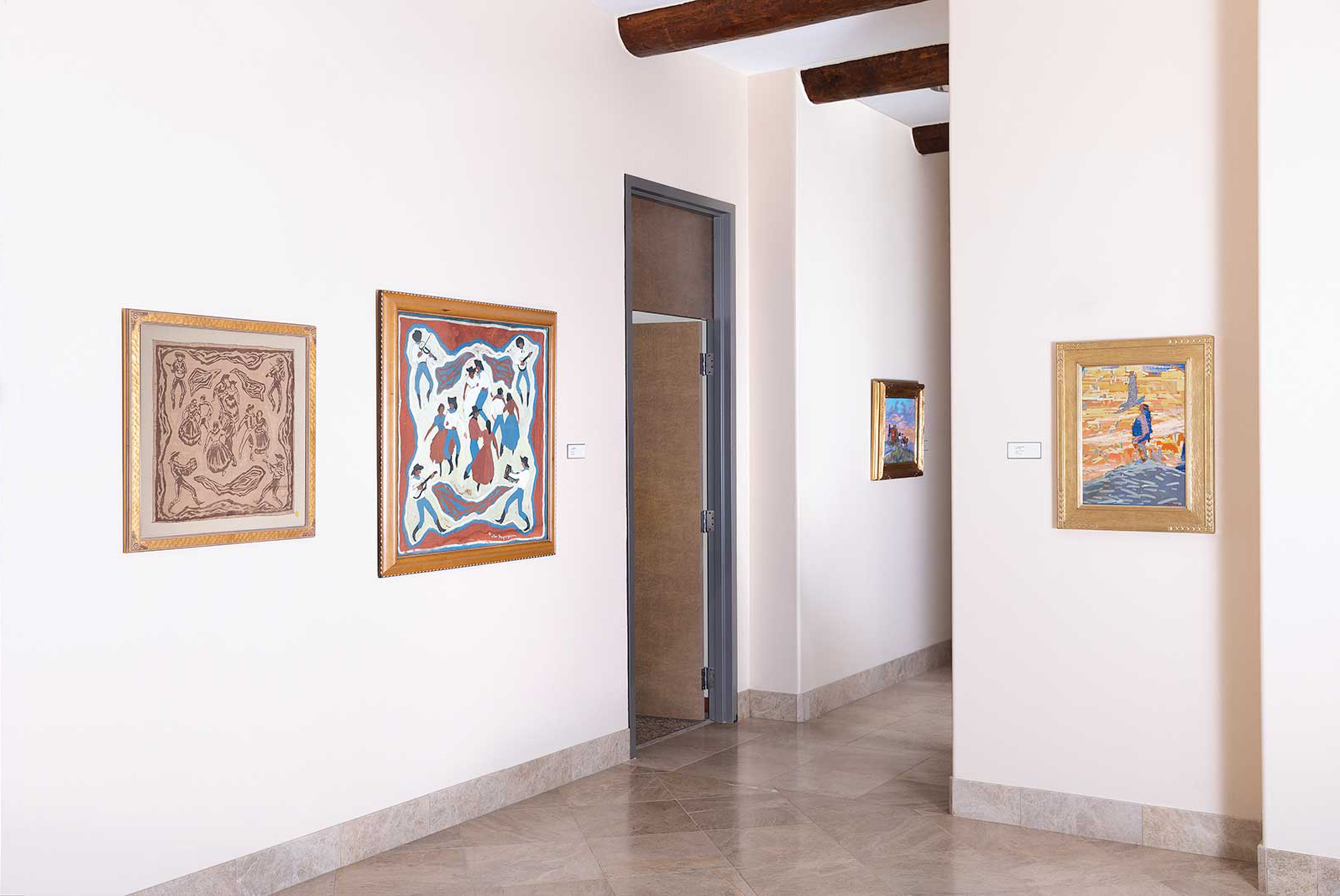 In the hall are Square Dance, circa 1950s, gouache on board, by Lon Megargee (1883-1960), which is reproduced in a wood block print on a silk scarf, circa 1920s or 1930s, on the left. Down the hall is Sunset Skies on the Overland Trail, 1970, oil on board by Marjorie Reed (1915-1996). On the right is Megargee’s Song of the Wind (also titled on verso, The Elemental), 1946, oil on board.
“Maynard Dixon was beyond my reach, but I wanted to have the best paintings of the other three. Standing here in the foyer I can drink in the Lea and the Davis and see the influences on Ed. They help me see the way he sees them. They’re dramatically modern but grounded in a Western tradition.
“I have a comprehensive collection of Megargee’s paintings,” he continues. “In my private conference room I have Oraibi, a plein air painting from 1911. Megargee was a working cowboy and in his free time he painted. Someone saw his work and told him he needed to pursue his art. He sold the governor of Arizona on creating murals for the new state house in 1913-14!
“My dad will be 90 this year and he helped me figure out my attraction to Megargee.” He was born in Philadelphia and had a boyhood dream of being a cowboy. He headed west as a young teenager to work on an uncle’s ranch and, over the years, did it all. He was a cowboy and a rancher and eventually became known as Arizona’s first cowboy artist, living in a way that was larger than life. “He lived a life that intrigues me,” Byron continues.
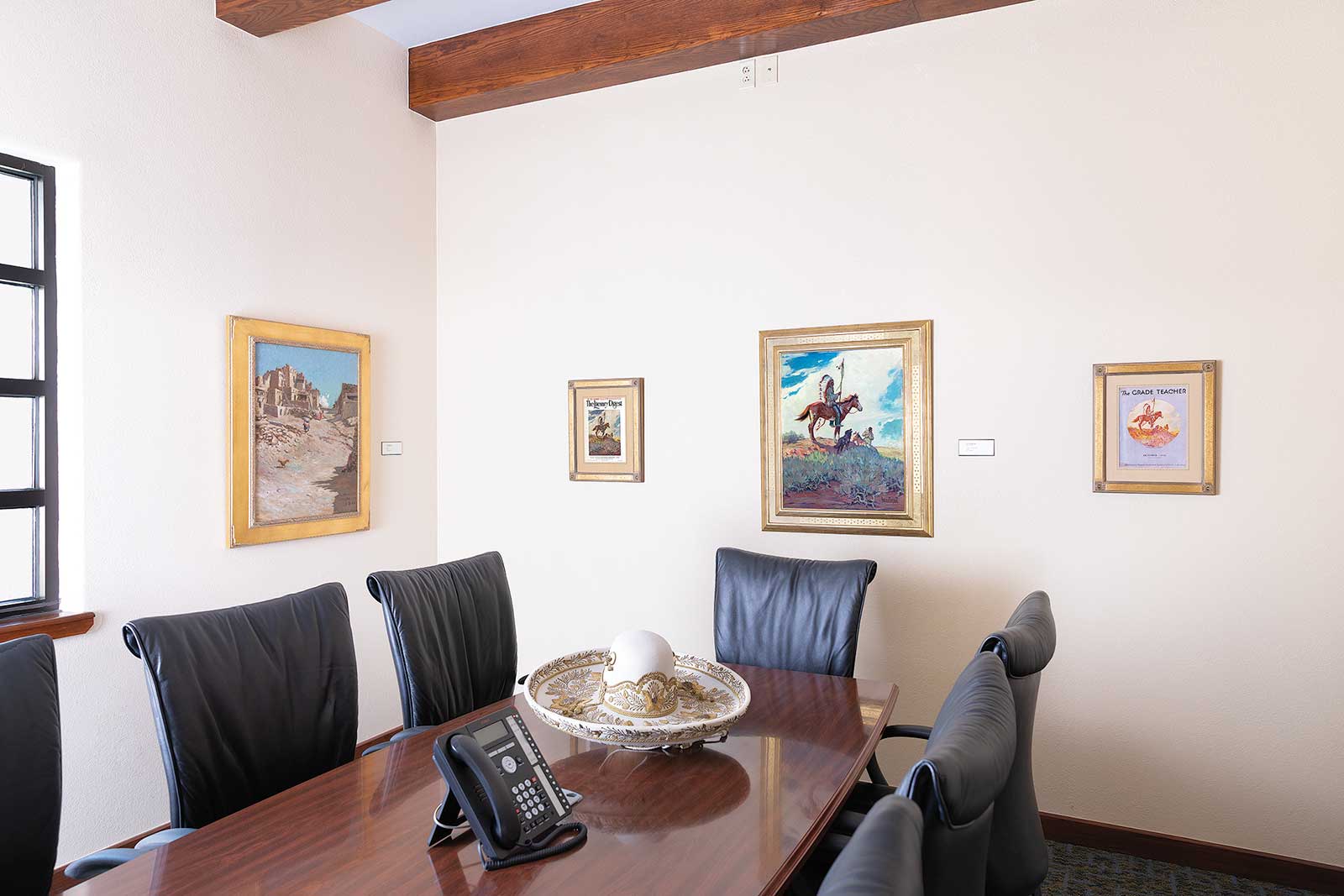 Opposite page: On the left in Byron’s private conference room is Oraibi, 1911, oil on board by Lon Megargee (1883-1960). On the adjoining wall are three additional works by Megargee. In the center is Indian on Horseback, 1924, oil on board, reproduced on the cover of the September 27, 1924, issue of The Literary Digest, left, and the October 1946 issue of The Grade Teacher, right. On the table is the hat Texas Governor Allan Shivers wore in the Brownsville Charro Days.
Among the Lewises’ other artist friends is Mark McDowell. At the Car Rental Center of the Phoenix Sky Harbor Airport, known for its art collection, Byron was attracted to a piece by McDowell. “It was Big Car and Trailer that had been commissioned for the area,” he says. “Keely took a photo of me standing next to it.” They later met McDowell at Cattle Track Arts Compound in Scottsdale, where he has lived and worked for more than 20 years. Earlier residents were Fritz Scholder and Philip C. Curtis. After they became friends, McDowell gave them the study for Big Car and Trailer which now hangs in Byron’s formal office. A larger version of the subject hangs in their home collection. McDowell draws with color pencils on birch wood panels, enjoying, he says “the common everyday nature of the materials”.
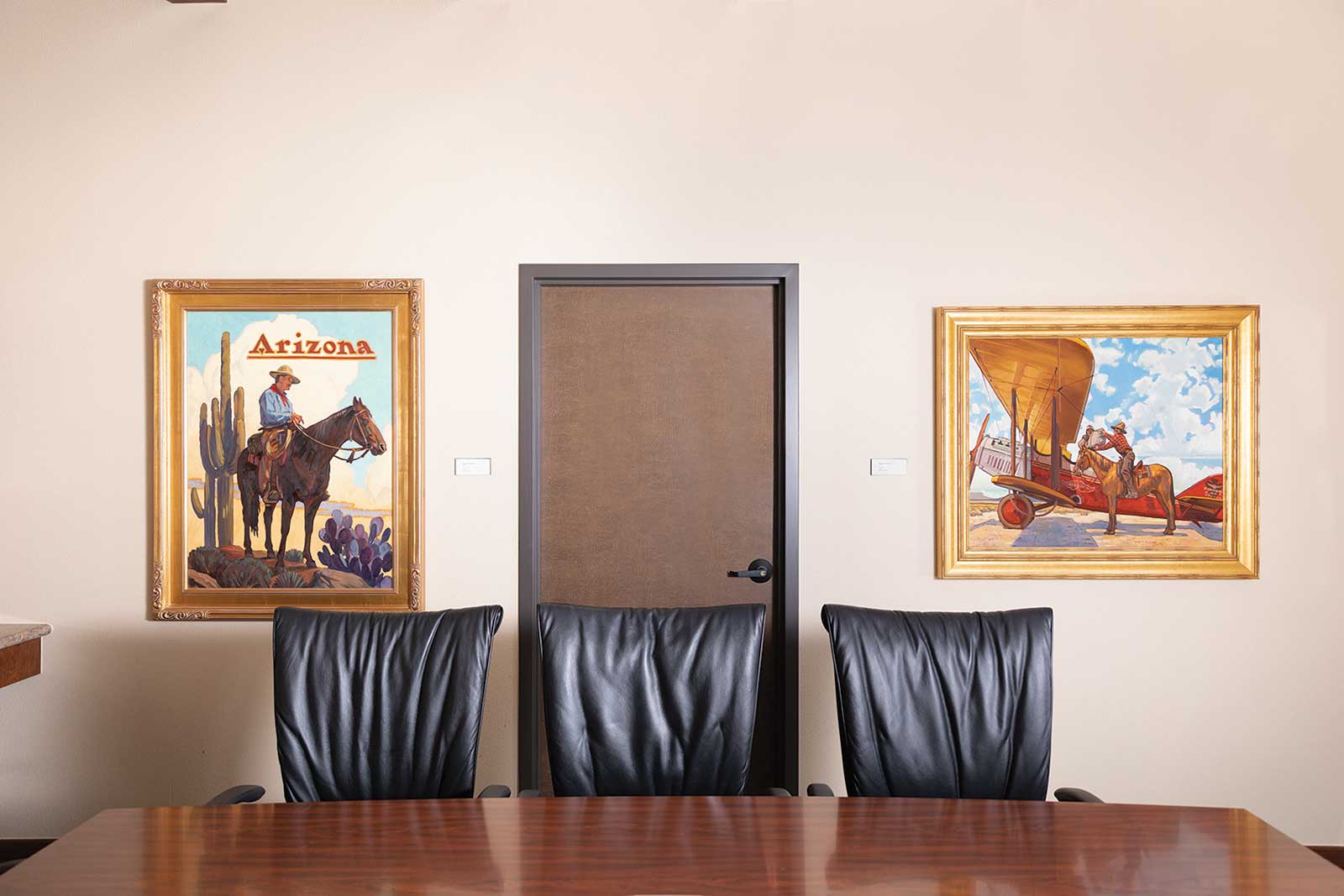 In the escrow conference room are two oil on canvas paintings by Dennis Zeimienski: Arizona, 2006, on the left, and Air Mail, 2010.
Also in Byron’s formal office is a collection of the final edition of The Great Saddles of the West, edition 25 of 25, bronzes by Paul Rossi (1929-2011) assisted by his son Mark. Two of Mark’s own bronze birds are on top of the bookcase housing the saddles. Paul Rossi was director of the Gilcrease Museum. “The saddles have meticulous detail,” Byron observes.
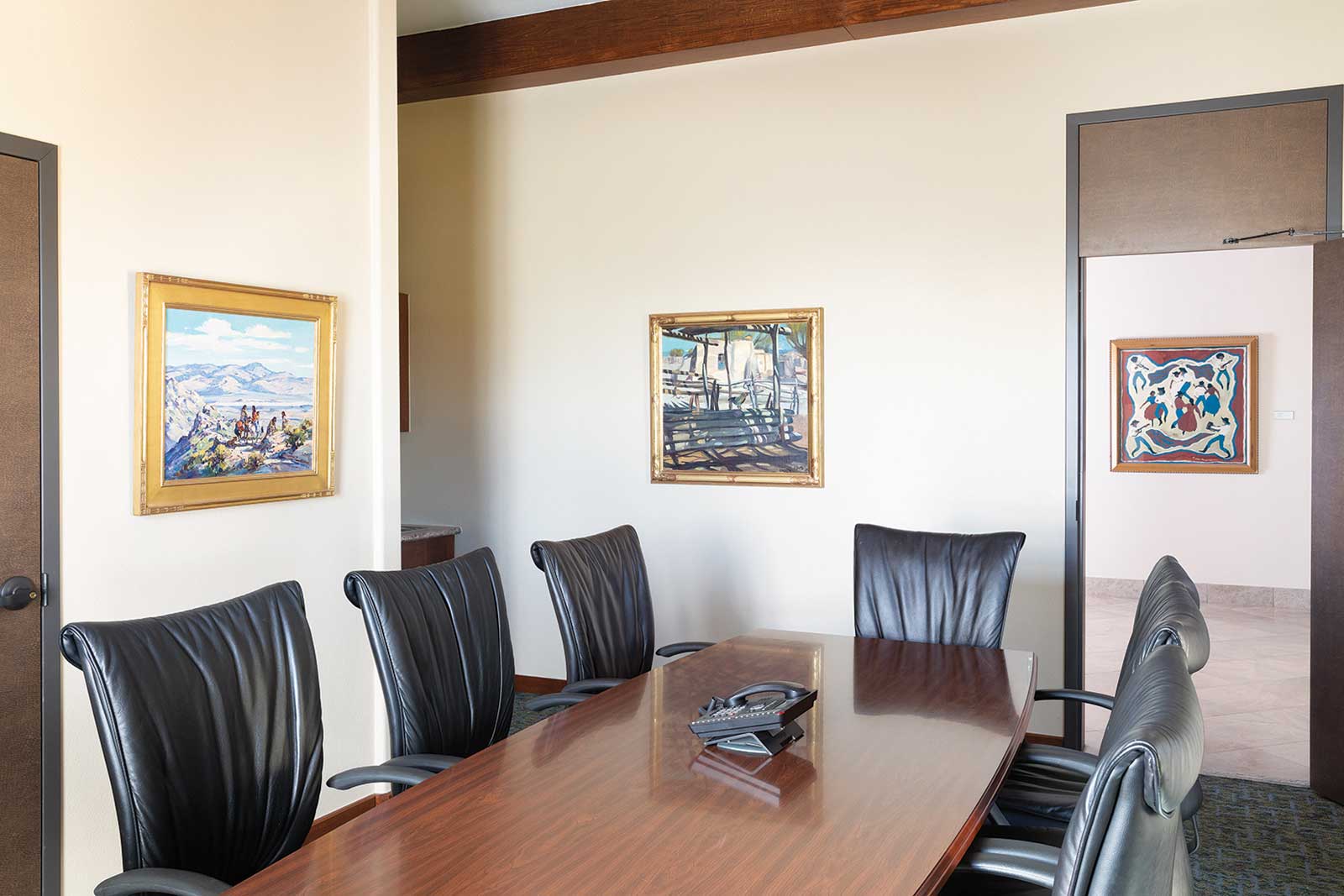 In the legal conference room are, left to right, Indian Friendship Trail, 1954, oil on canvas, by Marjorie Reed (1915-1996); Cochiti Pueblo, 1904, oil on canvas, by Harold Betts (1881-1951); and, in the hall, Square Dance, circa 1950s, gouache on board, by Lon Megargee (1883-1960).
He learned about the frames on Ed Mell’s paintings when Southern Arizona Longhorn arrived from Tony Altermann’s. A forklift had pierced the crate and damaged the frame. Alterman told him that Michael Collier in Tempe, Arizona, has been carving and gilding Mell’s frames for 30 years. Since they met, Byron has commissioned Collier to create frames for paintings in the collection.
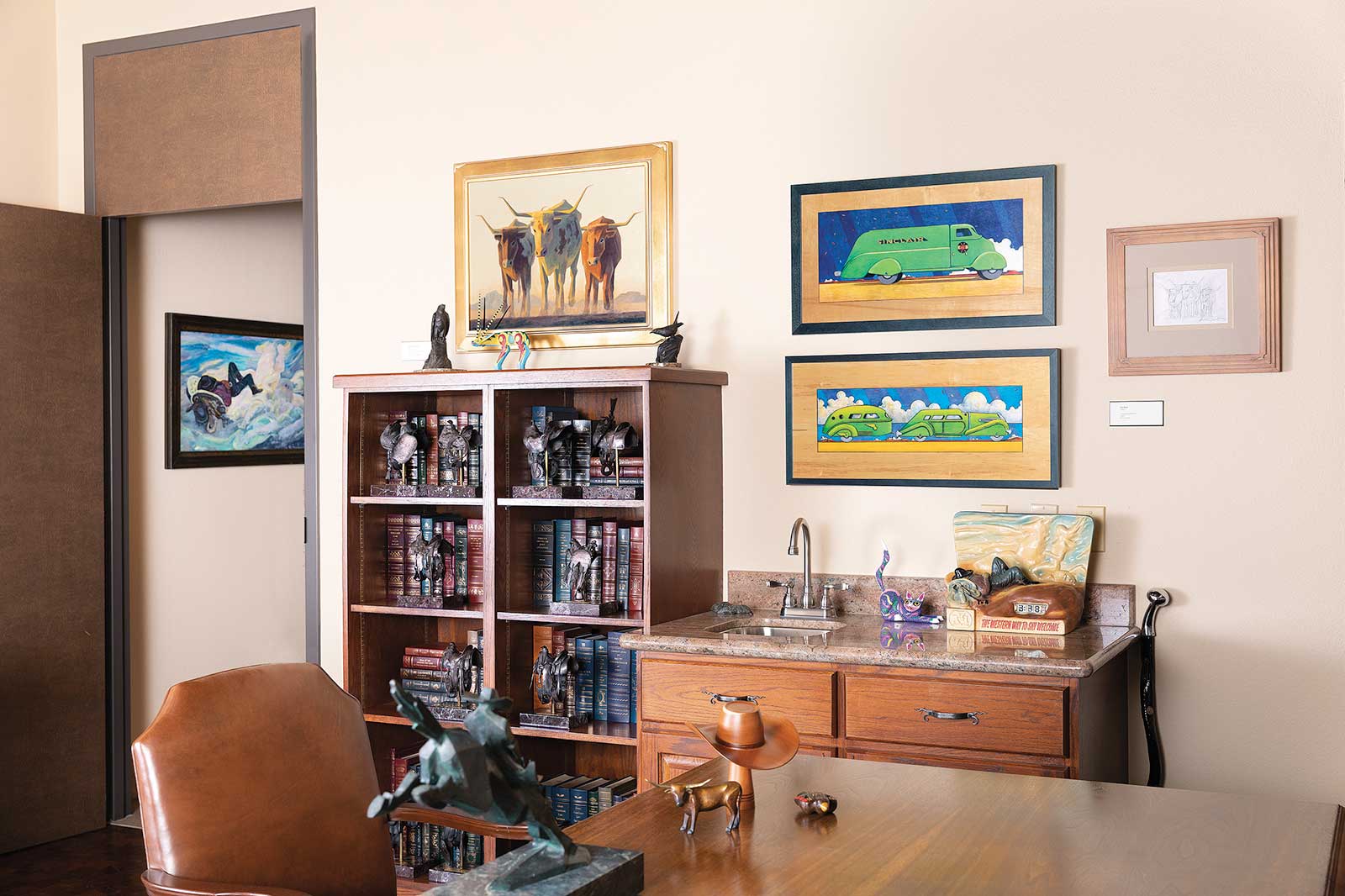 Through the door of Byron’s formal office is Study for A Cowboy’s Dream (For A-1 Brewery), 1948, oil on board by Lon Megargee (1883-1960). Above the bookcase is Ed Mell’s Following the Dust, 2007. Above the bar are, top to bottom, Mark McDowell’s Prismacolor on birch plywood studies for Sinclair Truck, 2007, and Big Car and Trailer, 2006. Next to them is Mell’s graphite study for Following the Dust. On the bar is Megargee's A Cowboy’s Dream, an original A-1 Beer chalk digital clock for cantinas. In the book case are The Great Saddles of the West, 2008, bronzes, by Paul A. Rossi (1929-2011) with his son Mark Rossi. Mark’s bronzes Hawk, left, and Finch, right, are on top of the bookcase. On the desk is Ed Mell’s Diggin’ In, bronze. Next to it is a cowboy hat carved from a single block of cherry by Jerry Smith.
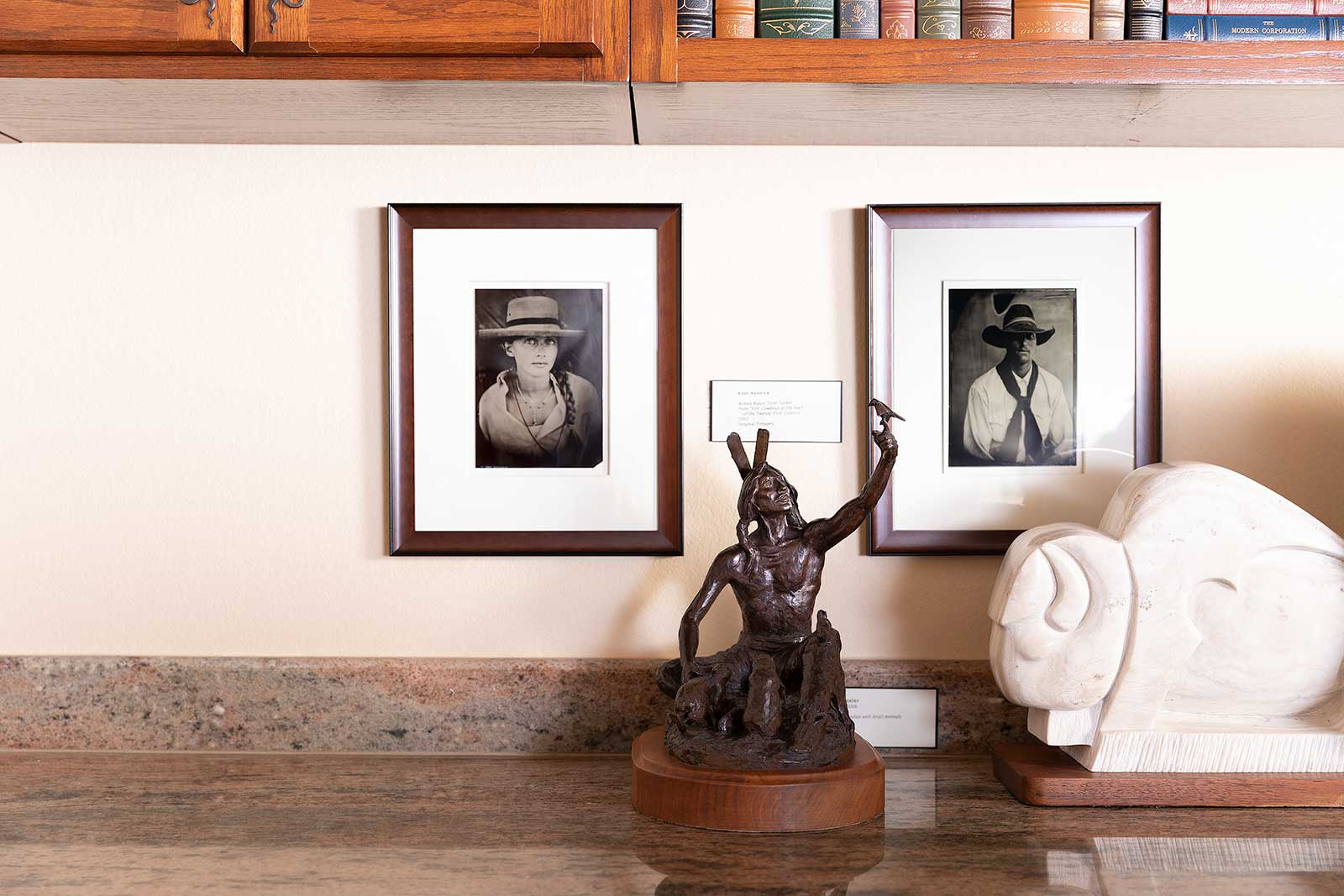 Ashley Riggs, left, and and Tyrel Tucker, right, are original tintypes, 2007, from Robb Kendrick’s Still: Cowboys at the Start of the Twenty-First Century. On the counter are, left to right, Sitting Indian with Small Animals, 1978, bronze, by Joe Beeler (1931-2006), and Buffalo, 2006, alabaster, by Vincent Kaydahzinne (1952-2017), the great, great grandson of Cochise.
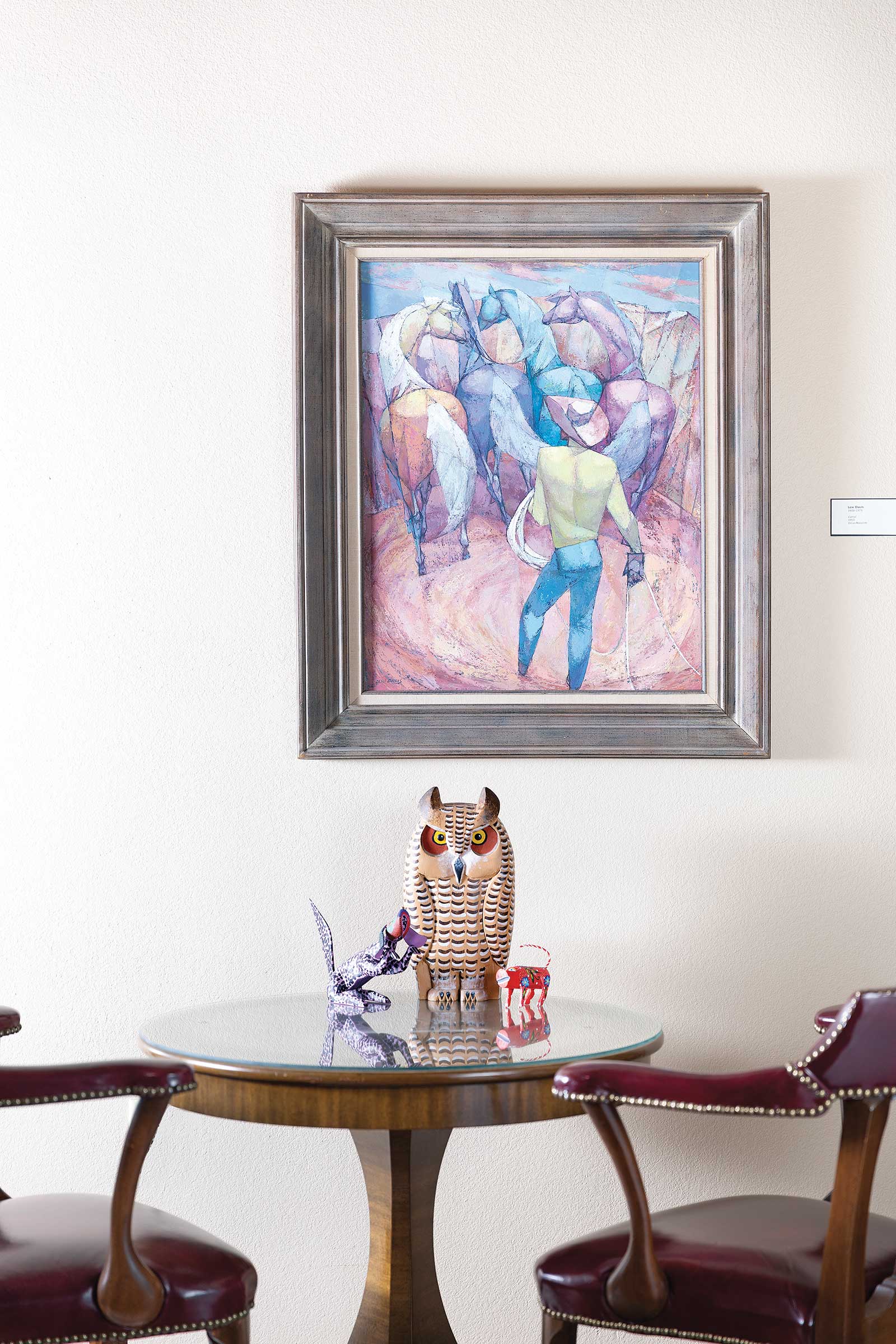 Corral, 1953, oil on Masonite, by Lew Davis (1910-1979) hangs above a folk art carved wood Owl, September 1987, by Ed Hageman and miscellaneous folk art from Oaxaca, Mexico.
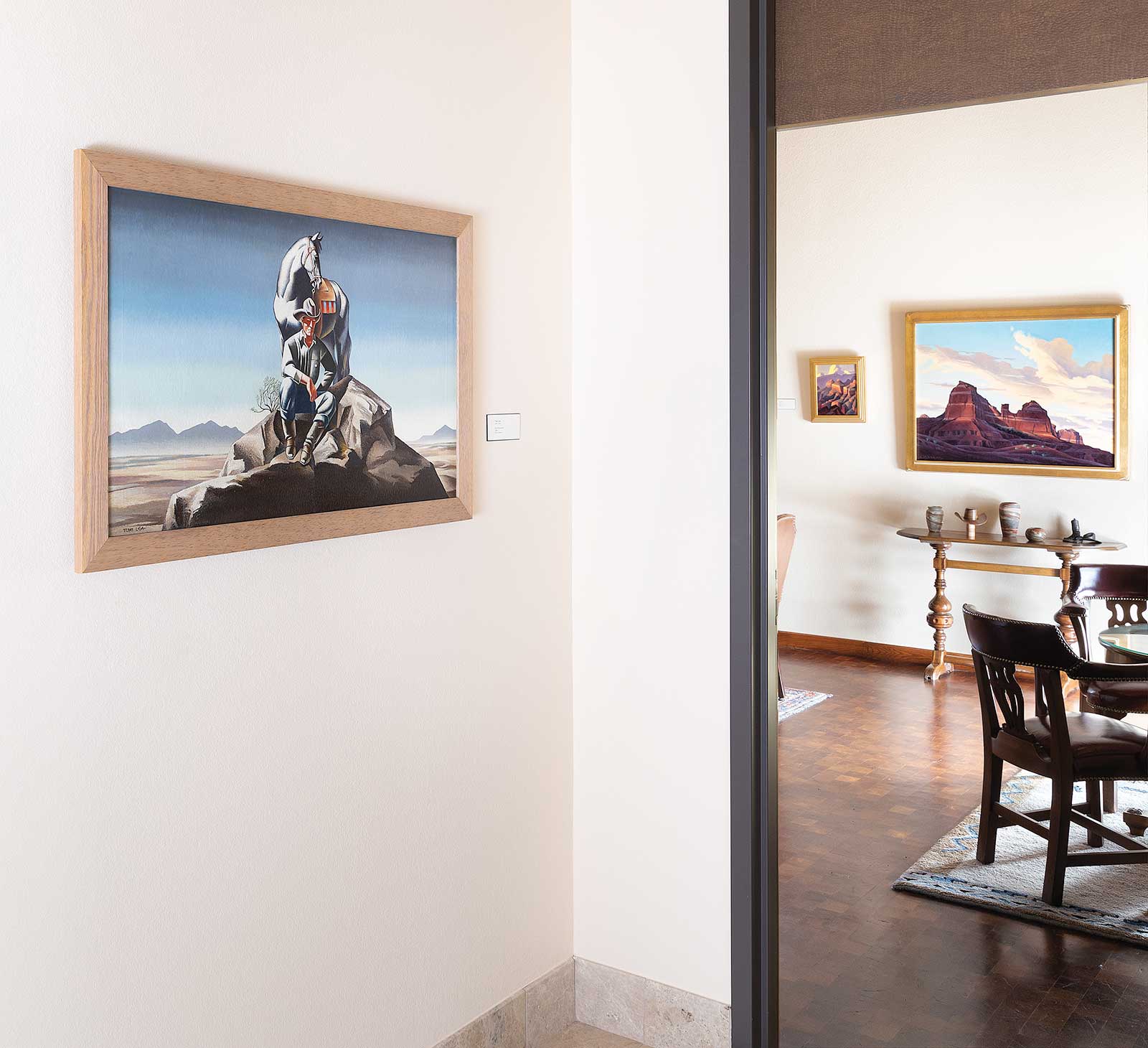 In the foyer between Byron’s working and formal offices, is Rim on the Desert, 1945, oil on canvas, by Tom Lea (1907-2001). In the office are, left to right, Ed Mell’s Broken Wall, 2006, oil on canvas, and his Schnebly Hill Formation, 1986, oil on canvas. Beneath the Mell is a cowboy hat carved from a single block of walnut by Jerry Smith.
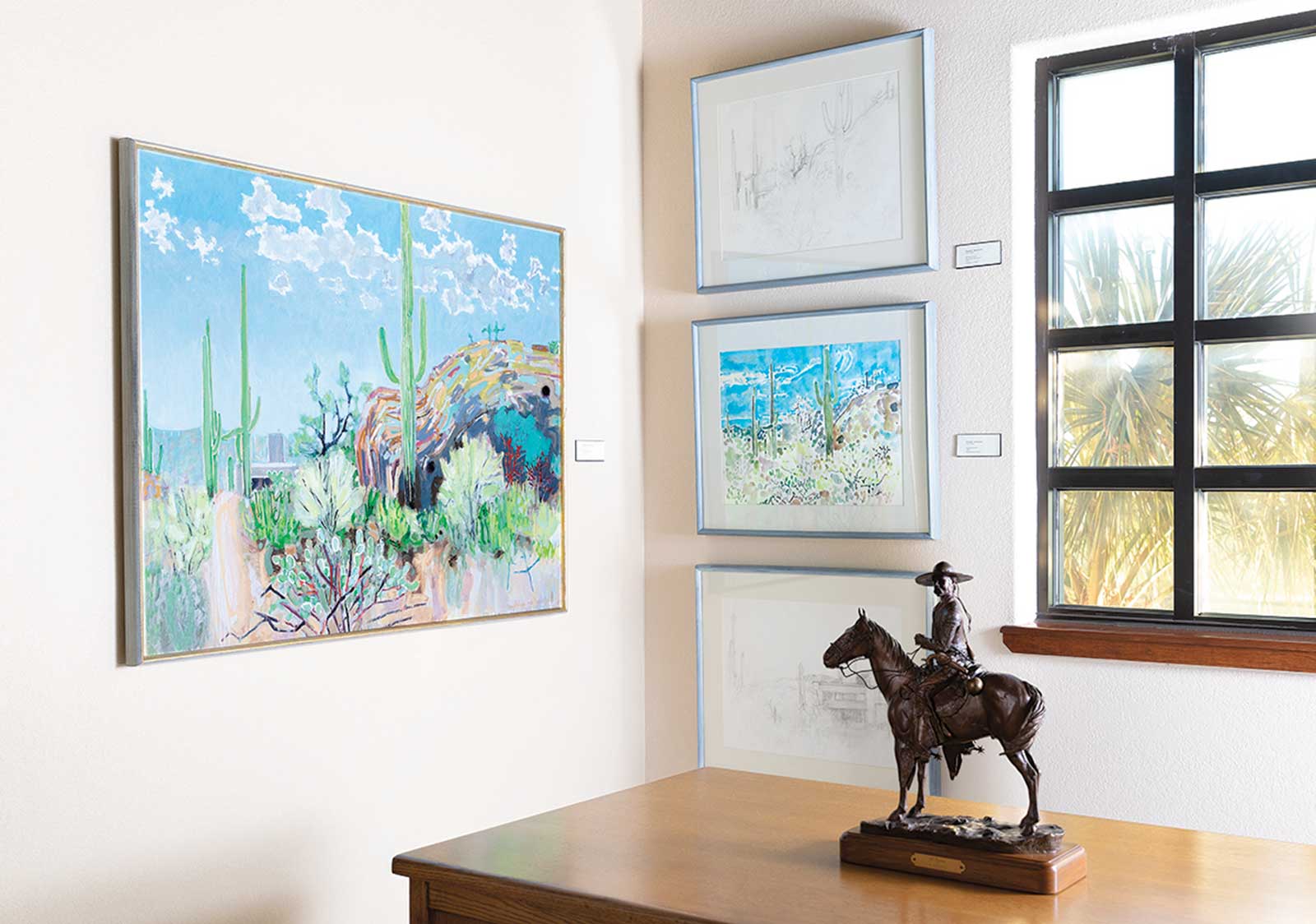 On the left is Blackwell House, 1995-97, oil on linen, by Douglas Denniston (1922-2004). On the right are two graphite on paper studies of Blackwell House, 1995, and a watercolor study, 1995. The sculpture is Armando Hinojosa’s bronze, El Vaquero, a maquette for one of the sculptures in the Tejano Monument at the Texas State Capitol.
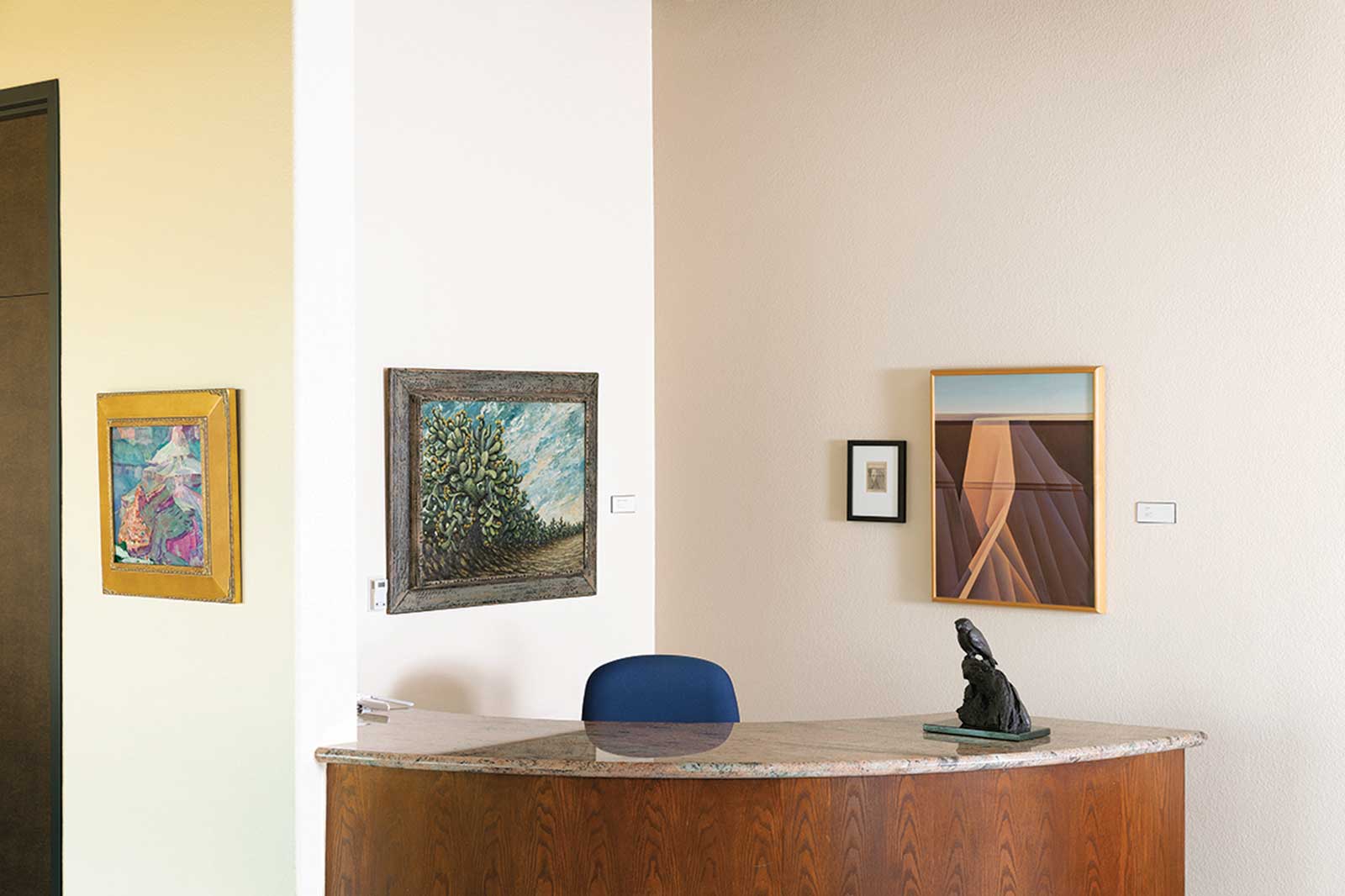 On the left in the reception area is a study for Grand Canyon by Lon Megargee (1883-1960). In the center is Nopalera en Flor, 1950, oil on handmade Celotex board, by Desiderio Xochitiotzin (1922-2007). On the right is Ed Mell’s Canyon Wall, 1978, oil on linen and his graphite on paper study for Canyon Wall, 1978. The sculpture is Kestral Hawk, bronze, by Mark Rossi.
Sitting in his office looking at works by artists who loved the land and animals, Byron recalls, “My parents were sharecroppers. I was aware of the sense of stewardship of the land and the quality of being tender hearted about all living things. Keely is president of Palm Valley Animal Society and as president of the Edinburg Foundation I helped establish the Laurie P. Andrews Center for pet adoption and wellness services.”
“Working here in my office, the art feeds something deep inside.”
Powered by Froala Editor