Collected Thoughts
I think one of the most common questions posed to any collector, especially Western art collectors, is “why did you choose to collect this type of art?” I’m sure the answers vary quite wildly from aesthetics to emotion to perhaps tradition. While I loved the color and emotion of art, my answer to this question has always had something to do with history—and learning from that history.
I’ve always had an intense interest in what went on in bygone eras. Who were the people? What was life like? How did they survive? How did what they did back then affect what we do now? For me, the history of art and the artist have always been just as fascinating as the beauty of the art itself.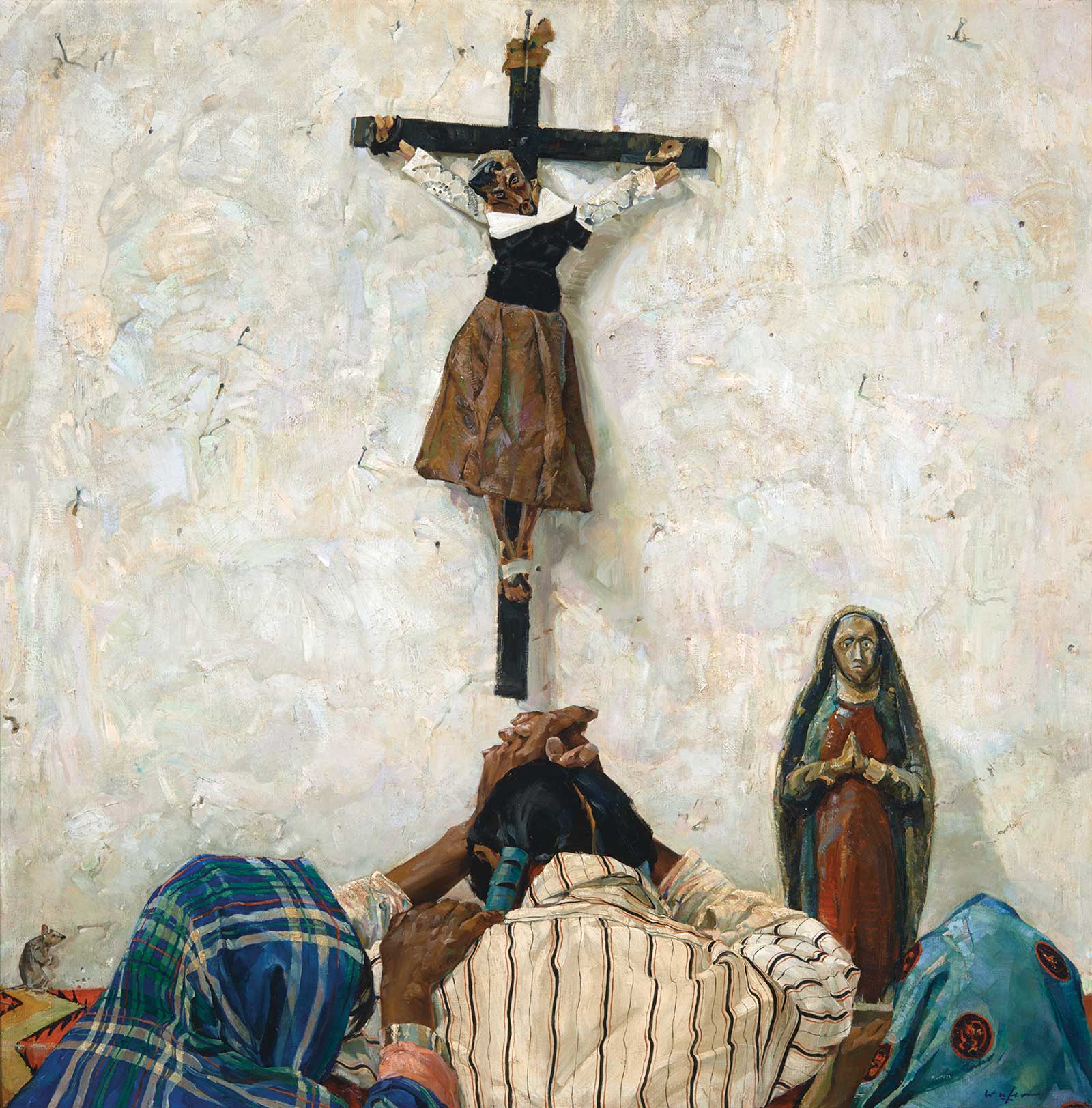 Walter Ufer (1876-1936), Hunger, 1919, oil on canvas, 49½ x 49½”. © Gilcrease Museum. Gift of the Thomas Gilcrease Foundation, 1955. 0137.2196. Courtesy Gilcrease Museum, Tulsa, Oklahoma.
As I stare at a painting, I always want to know two things: What can we learn from this moment? And what message was the artist trying to send us?
That has never been more true than during the past few months. History and the art I collect have truly come alive in the here and now of all of our lives.
All the above seemed to occur to me on a flight home from London in late February. I had been in Europe for the weeks before conducting our typical pre-season training camps; getting the team I run ready for the Tour de France. As the trip came to an end, events and life started to get very tense in Europe.
Coronavirus had arrived.
I was spooked and worried. Not about the dangers of the virus itself, or what it would mean to me, personally, but for what it would mean to our society. I have many friends in China and knew the unfortunate firsthand accounts of the situation there. I knew the coronavirus would be something that would change our lives forever, if it truly arrived in the USA. I was consumed by fear. I felt like it was chasing me across the Atlantic. And it was all
I thought about on the long flight home.
Would life ever be the same again? Would it continue to be a life worth living?
Oddly, however, all of that darkness and fear seemed to lift off my shoulders as I walked through the creaky wooden front door of my cozy old home in Colorado,
I felt safe again. I looked at the uneven and plastered walls of my home filled with colorful and warm images, and felt at ease. The virus wasn’t going to find me here. I was sure. But why?
I didn’t quite understand the fear just leaving. Certainly my home in Colorado was no more of a shield against the coronavirus than an old bandana being used as a face mask with moth holes chewed in the middle. Yet, somehow, I felt safe.
Then it dawned on me: My home, my art, my Navajo blankets, my collection had seen all of this once before. And somewhere in these painted images were the spirits of people who had lived through much worse.
My home was built in 1918, the year of the last true global pandemic, the Spanish Flu. Somehow, during a time where people around the globe were suffering from this illness and the effects it brought, someone had decided to build a home. It was constructed from lumber not needed for the World War 1 effort, and extra labor that could be spared and was still healthy. Someone had built a house for their family in the hardest of times. Somehow, life had gone on.
The walls of my home, still standing, were proof that life had continued in 1918. But it was what hung on these walls that truly made me feel that time in history…My walls covered with art painted during a time we are reliving right now.
I realized that much of what I love in art was born during a pandemic.
Walter Ufer, my favorite artist, and the rest of my beloved Taos founders, had documented, in their brushstrokes and oils, the suffering and the human struggle that came with the Spanish Flu.
Imagine living during this time in history, a World War was still raging overseas, then a global pandemic hits, unchecked, racing through communities. Taos was especially hard hit, as were many places with Native American reservations nearby. Their suffering was doubled down on by the economic conditions that already existed on the reservations and the meager resources leftover after a World War.
I wonder what it must have been like to be Ufer in this time; a socialist and champion of the Native Americans. And a man deeply troubled by depression and alcohol addiction. I can imagine Ufer sitting in his studio trying to create something that could help deliver the message of the pain those in the Taos Pueblo were feeling.
Yet somehow, in the 1918 to 1919 time period, while the Spanish Flu was at its harshest, some of the greatest works of Ufer and other Taos founders were produced. They were magnificent. Most famously, Hunger by Ufer, but also more positive and colorful works, like Their Audience, and Victor Higgins’ Fiesta Day seemed to depict that life was going on, moving forward, despite the war, despite the pandemic.
And art was being made, despite it all.
So, looking around my living room, and looking at my works that were painted around that time, I gleaned a bit of comfort, knowing that these canvases I admire so deeply, were produced in a time quite similar to what we are living in right now.
I wanted to know: What were these artists seeing? What were they feeling? What message were they trying to send forward to the next generation that would encounter such a challenge?
Were they scared? Were they hiding? What were their days like?
What I do know is they were painting. Despite fear, despite death, despite hardship, despite everything being the opposite of the uplifting color of Western art is supposed to be all about. They were painting.
A downtrodden image of a sad Ufer in an even sadder moment in history isn’t what I saw on my walls when I finally sat down to rest after my travels. I saw the greatness of the art produced during such a hard time.
I saw the raw emotion felt coming through the paintings. I saw subtly painted messages of how we need to take human suffering into our hearts, hold it and then push onward with hope.
I saw what art truly is supposed to be: a mirror and an expression of the small moment we are living in. And the beauty of that precise and never to be had again moment.
Maybe it was because of the fear, the pain, the death and the hardship that such passionate and provocative paintings were created? Maybe we, as humans, are at our best during times like this? I think Ufer certainly was.
If these artists made their finest works in the midst of such hardship and hard times, then we can do the same now. We too can make beauty to be admired 100 years from now.
”Hard times create strong men” they say.
And from what I see, hard times also create great art.
...and good country music.
Powered by Froala Editor