The most definitive American art genre is Western art. Among its artists, rare ones are not mere painters or sculptors but myth makers shaping the idea of the American West in the public’s imagination. One that stands above others is Charles M. Russell. Russell in his poem Myth is the Mother of Romancewrote, “Myth is the Mother of Romance and I am her oldest son, Her family is small, just two sons that’s all, Brother Fiction the other one.”
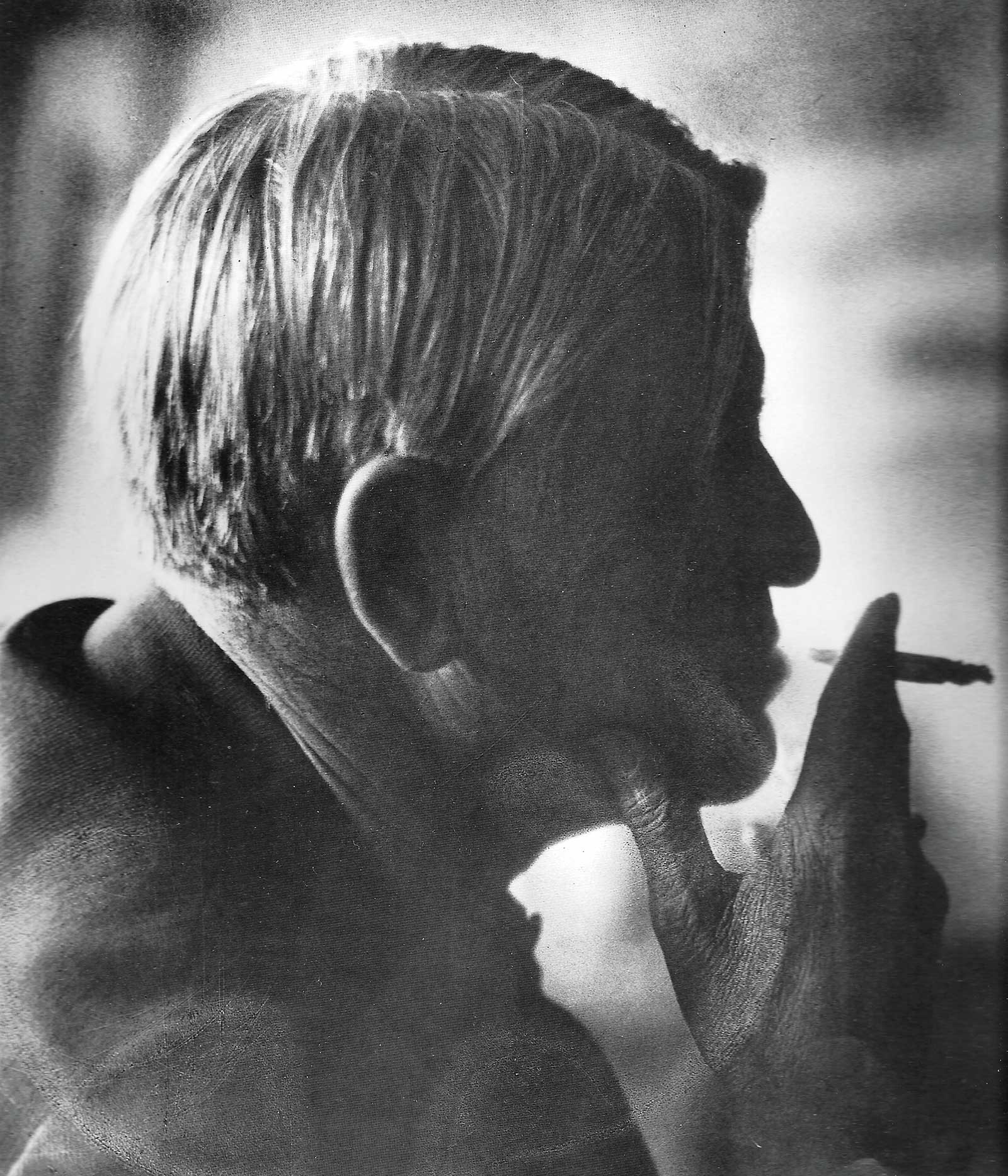
Charlie Russell in Maynard Dixon’s studio, San Francisco, CA. Dorthea Lange photograph, 1924.
Emblematic of why Russell is remembered 100 years after passing and others aren’t is opposing world views. While most artists were people of their time, Russell bucked that trend with his timeless vision of how things should be. The best any visionary can offer is hope. Western American sculpture is but one example. Late in the 19th century, when the West emerged as a popular theme for sculpture, the cowboy atop a bucking horse became symbolic of the Easterner’s view of the West. Frederic Remington’s The Broncho Buster (1895), considered by many the most famous bronze of the West, portrays the region in an elemental struggle for control. Not only is it symbolic of a battle of man against nature, but also white man against Indigenous man. Nothing could stand in the way of Manifest Destiny, the Christian doctrine that God bestowed the West on his chosen people as their new Eden. Later, James Earle Fraser’s bronze, End of the Trail, which debuted at San Francisco’s 1915 Panama-Pacific International Exposition as an 18-foot plaster, showcased the predictable results of the struggle. It was seen at the fair by millions. The white man wins as the defeated Native American, slumped over an exhausted horse, has been conquered. Russell wanted nothing to do with those sentiments.
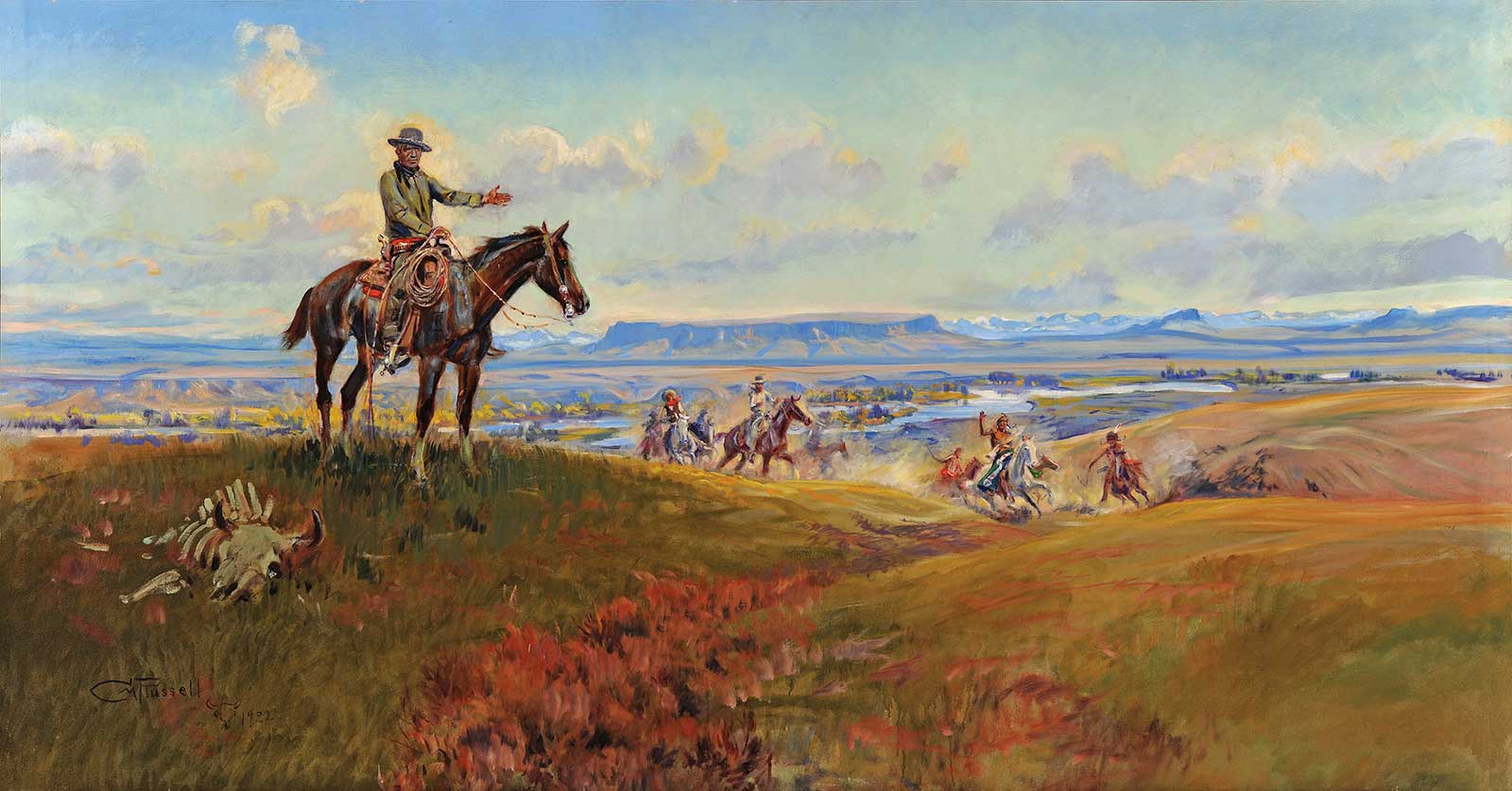
Charles M. Russell (1864-1926), Charles M. Russell and His Friends, 1922, oil on canvas, 42 x 81 in. Montana Historical Society, Helena, Montana. X1962.01.10.
No Western American artist fought back harder against racism, sexism and championed environmentalism more than Russell. He thrived on imagining a time when the land was pristine, women were held in high regard and people of color were the heroes. Paradoxically, the industrialized world championed just the opposite. To many, his life appeared odd—that cowboy hat, that sash, that unruly hair, that folksy talk. He and his art embraced an identity of an exile from a different place and time, which is even more appealing today. In that way, Russell was a visionary who instilled hope in all who saw his art and his heart. For those reasons and much more, he is the most beloved of all the Western American artists. The C.M. Russell Museum in Great Falls, Montana; the Charles M. Russell Center for the Study of Art of the American West at the University of Oklahoma in Norman; the Charles M. Russell Center Series on Art and Photography of the American West (books published by the University of Oklahoma University Press); the Charles M. Russell National Wildlife Refuge in Montana; the Russell Riders; and the Russell Skull Society are a testament to that fact. The Cowboy Artists of America have been called the “Sons of Charlie Russell” by art historian B. Byron Price for good reason.
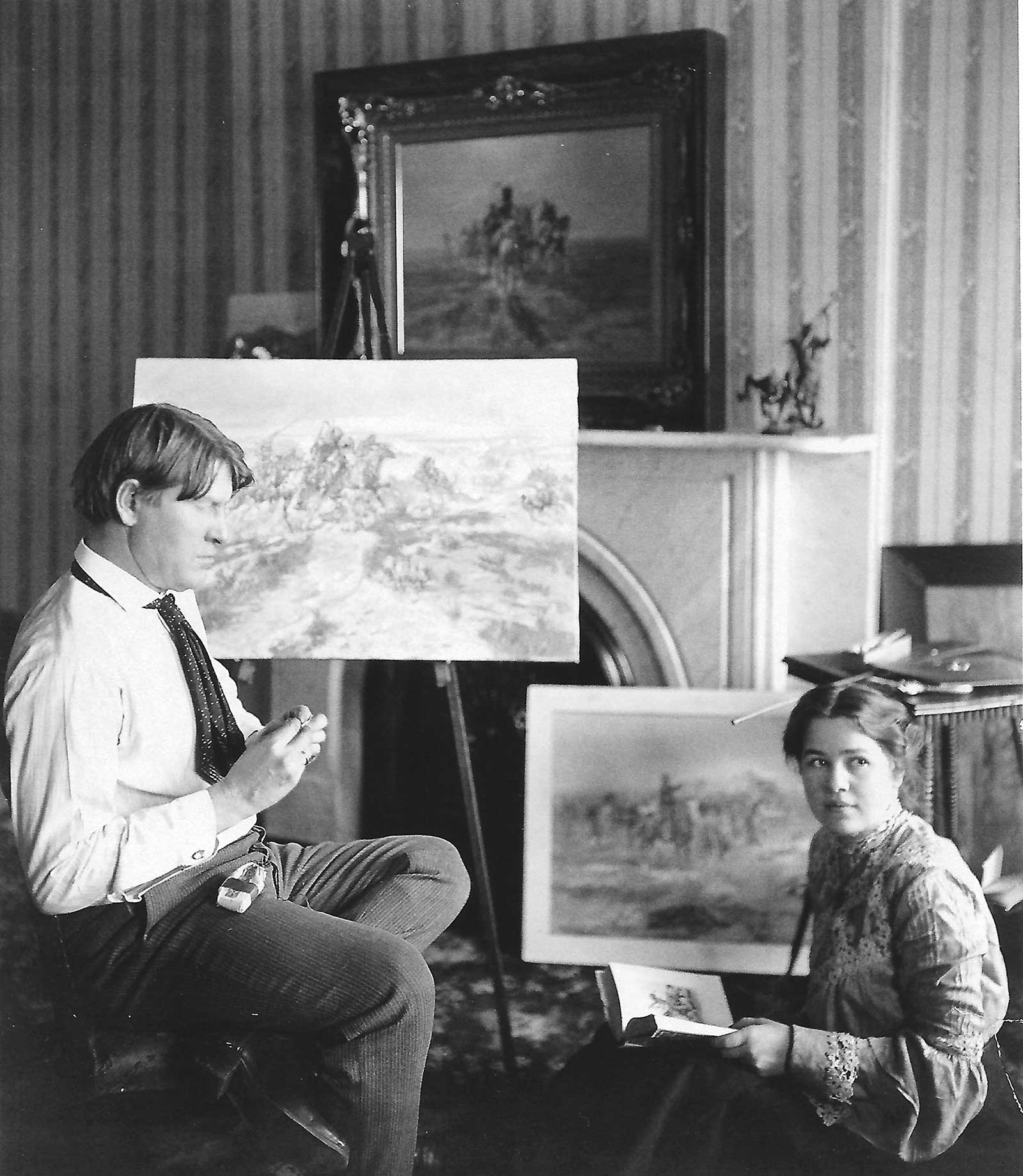
Charlie and Nancy posing in front of some of their art in New York City. Byron Company photograph, February 1905. The clay model of the Scalp Dance is on the mantle.
Russell was a legendary painter, sculptor and author. Ever humble, humorous and self-effacing, as his fame skyrocketed, he never forgot his cowboy friends. The importance of his life and works is that no one has inspired more new generations of artists. Russell lived in the past and his wife Nancy, who was his business manager, lived for the future. How could a self-trained artist living in remote Montana become one of the highest-paid artists in America? It’s quite a story.
Charles Marion Russell was born on March 19, 1864, in St. Louis, Missouri, a bustling gateway to the West of some 200,000 people. The family business, Parker-Russell Mining and Manufacturing Company, extracted the much sought-after Oak Hills’ clay for fire bricks. They would become the largest producer in the country. But Charlie was a restless soul, and like so many other Americans, looked to the American West for his identity.
On a crisp March day in 1880, Russell jumped off the stagecoach in Helena in Montana Territory and took his turn as the latest Easterner seeking Western adventure. Eventually, for 12 years, Russell and his horse Monte were together on the open range mainly nighthawking—somewhat of a lowly cowboy job of watching the horses overnight while the rest of the cowboys slept—until 1893 when Russell began transitioning from cowboy artist to full-time artist. His life changed on September 9, 1896, when he married Nancy Russell, an incredible woman, a survivor and very ambitious. In 1897 the Russells moved into a modest, four-room rental on Seventh Avenue North in booming Great Falls, Montana. The tremendous amount of artwork Russell generated in the next two years was completed in his dining room studio. Nancy was handling all the sales, and Russell stated in 1925, “The worst fight Nancy and I ever had was in 1897 when she asked $75 for a canvas, which I thought was highway robbery—and got it. I was willing to sell it for $5, but she insisted we had to eat.”
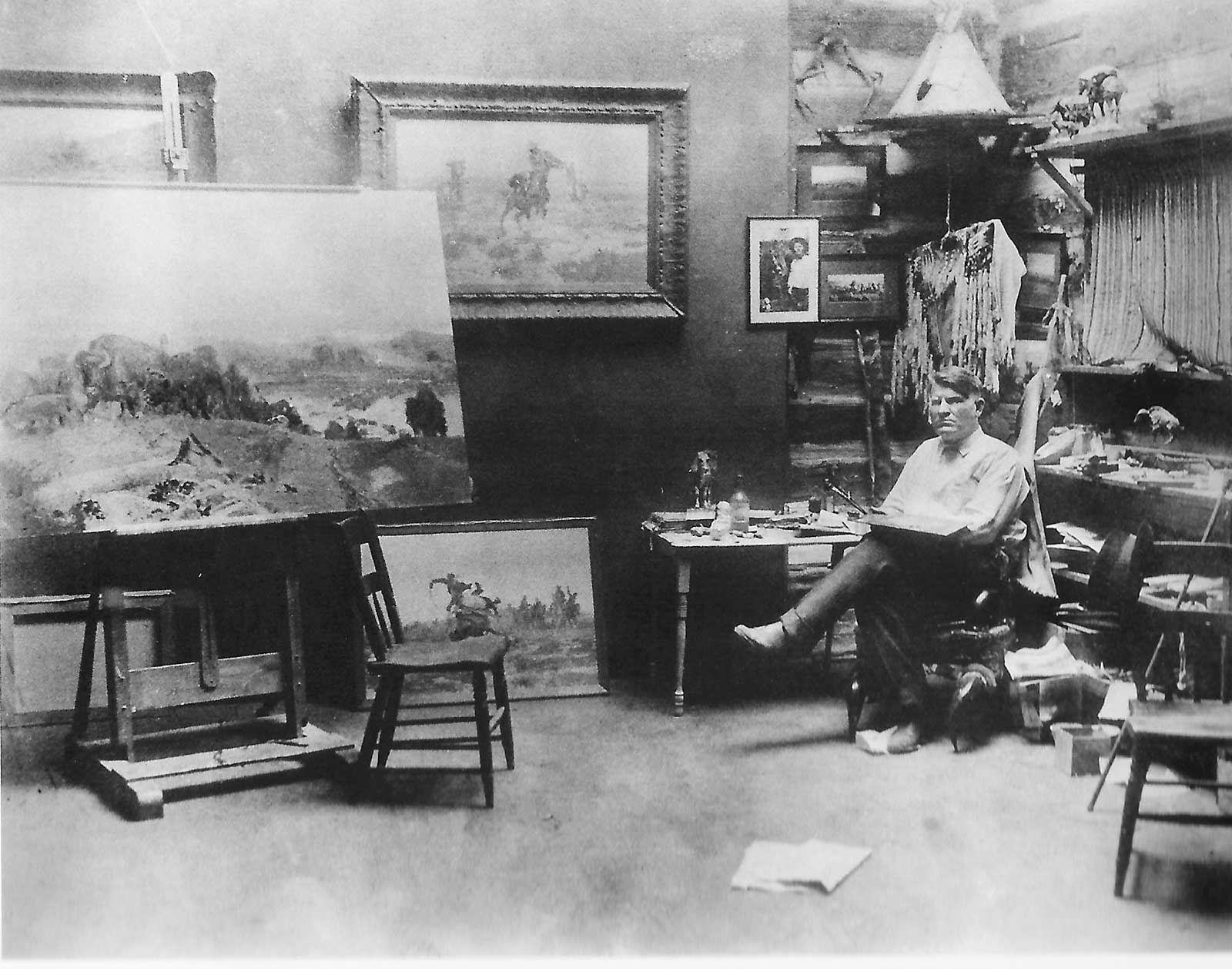
When the Land Belonged to God and Charlie Russell in his log cabin studio, Great Falls, MT. Not dated. Stark photograph, 1914.
For the Russells, their firm foundation would come in the form of a log cabin studio next to their home in Great Falls. The studio was finished in early 1903, and at first, it was more of a storehouse for his collection of Western paraphernalia, but that soon changed, as he fell in love with it. Almost every artwork that Russell completed was finished in his studio, which also served as a gathering place for his friends and admirers. The period from 1906 to 1910 was one of the most productive and enjoyable times of Russell’s life in no small part due to summers spent at Bull Head Lodge, their retreat in Glacier National Park, and the mentoring by artists such as Philip R. Goodwin, who visited him there in 1907 and 1910. Russell’s favorite place in the world was the lodge, a log structure nestled among the cedar, fir and tamarack along the alpine shoreline of beautiful Lake McDonald.
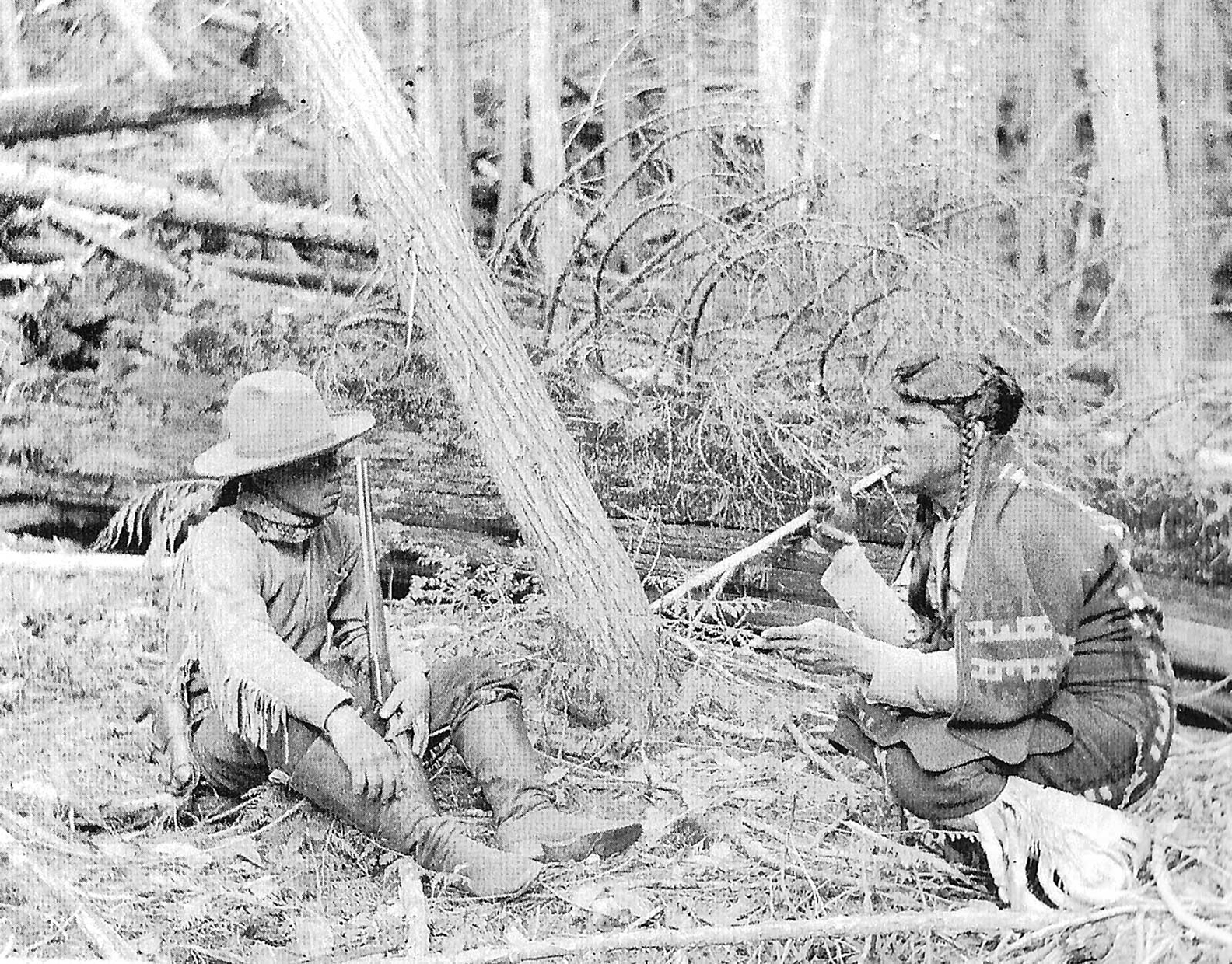
Charlie and famed sporting artist Philip R. Goodwin playing cowboy and Indian. Nancy Russell photograph, Bull Head Lodge, 1907.
The period from 1911 to 1915 was a time of artistic achievement by Russell and promotion by Nancy who was as skilled as any field general with her well-planned exhibitions in America, Canada and England. It would be a grueling pace for the duo, but one that would yield a bountiful harvest of financial and critical success. The cowboy artist was the “West That Had Passed” in solid and photogenic form: strong, handsome, romantic, principled, loyal, productive and real. Nancy’s strategy was the same as any rodeo organizer: open the gates, which she did, and let’r buck, which Russell much obliged. In 1911, Russell met with state officials regarding a massive mural that was planned for the new House of Representatives wing of the capitol. It would be the most important commission of his life. By July 1912, Lewis and Clark Meeting Indians at Ross’ Hole was delivered to the capitol two months ahead of schedule and was instantly hailed as his masterpiece. The Minneapolis Sunday Journal summarized the sentiments around the country and wrote that it was “his best and most finished product.”
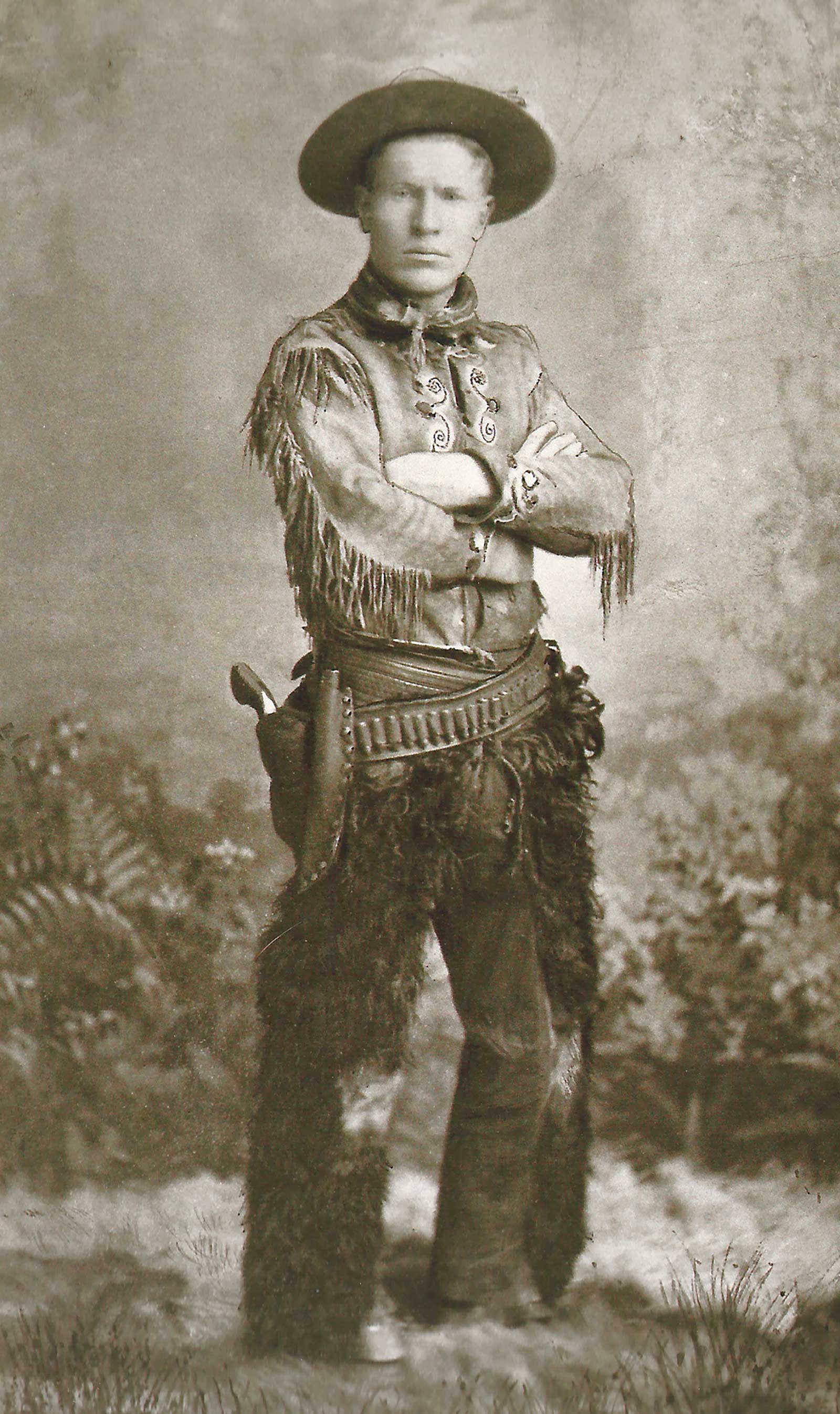
Charles M. Russell assuming the George Armstrong Custer pose, 1883.
When the Russells arrived in California in February 1920 for their first winter there, the film industry employed 10,000 people and was churning out hundreds of movies each year. The Russells were not strangers in paradise. Many of Charlie’s Montana friends had beaten him there. The cowboy artist quickly became enchanted with everything related to silent Westerns made in Hollywood. He was closest with Harry Carey, Willliam S. Hart, Douglas Fairbanks Jr. and Will Rogers.
By the fall of 1925, Charlie was experiencing an increase in choking and dizzy spells from a goiter, an enlarged thyroid gland pressing on his throat caused by a lack of iodine in his diet. The end came at night on October 24, 1926, in Great Falls when he suffered a heart attack. Condolences arrived from all over America. Ed Borein was devastated. His wife later wrote, “Several times last evening I saw tears on his cheeks when he was lying here on the couch pretending to be asleep, and once I heard him say ‘my very best friend.’” Many lionized Russell. “I can think of no man who has filled so large a niche as he in the world of art, and one equally large in the field of history,” George Bird Grinnell commented. Famed Taos artist Joseph Henry Sharp said, “His pictures will remain a record of inestimable value and truth, when all future work of the kind will have to be done from hearsay, literature and photographs.” Author Frank Linderman, who was living in Southern California, wrote Nancy a sympathy card, “There can never be another Charley Russell for the same reason that there can never be another Abe Lincoln.” Will Rogers sent a floral decoration in the shape of a saddle for the funeral. Loyal friend, Cree Young Boy, holding back his emotions, wrote Nancy, “God made our life. We can’t live all the time…He was a good man every place. I sure think of him and feel sorry for him just like my own relation. That’s all I could tell you to day.”
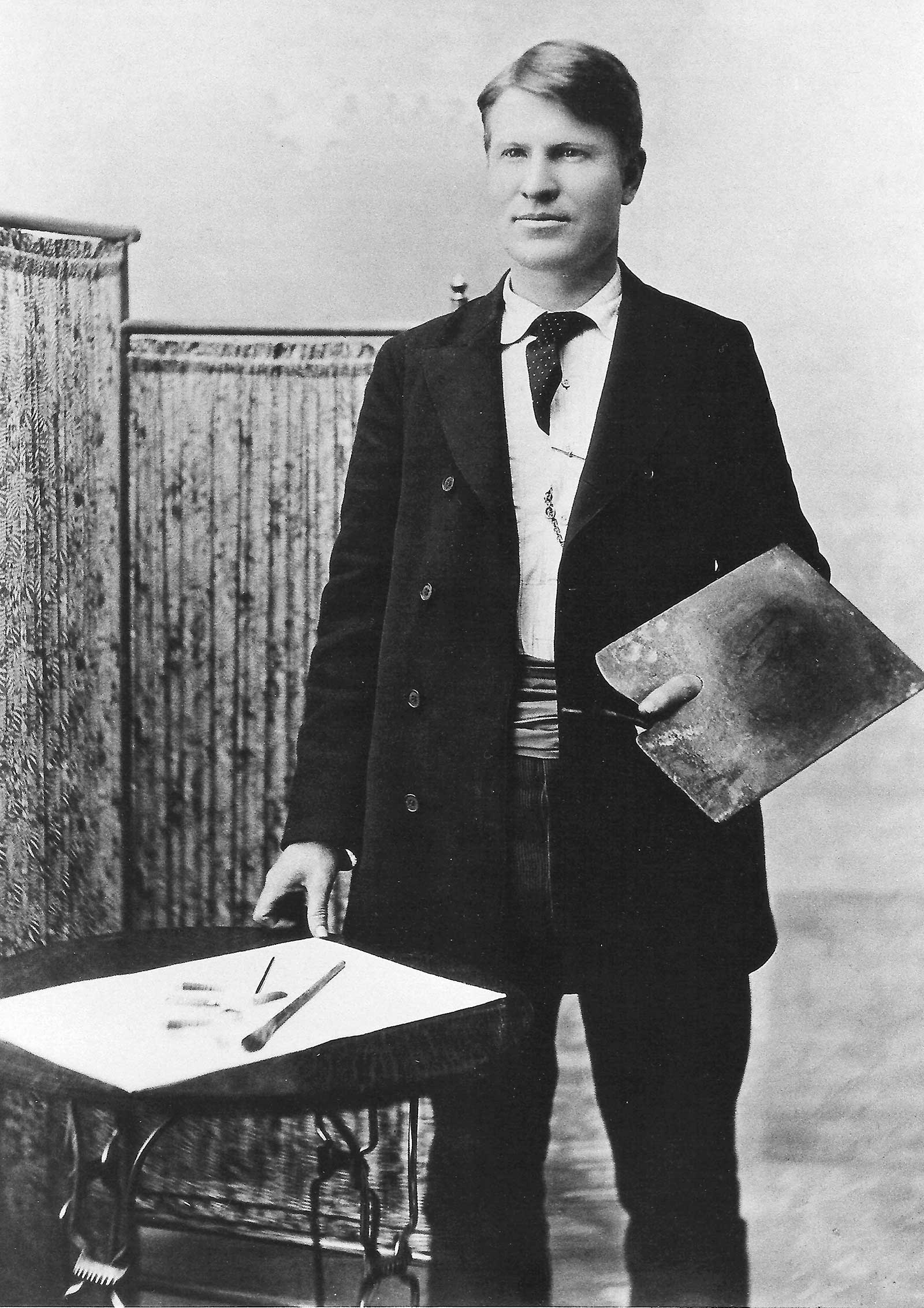
First photograph of Russell as an artist. Elite Studio portrait, Great Falls, MT, early 1890s.
Sixty years later, in 1986 “The Gift,” by famed Western singer and songwriter Ian Tyson, perhaps summarized Russell’s genius the best: “God made Montana for the wild man / For the pagan and the Sioux and the Crow / But he saved his greatest gift for Charlie / Said get her all down before she goes / You gotta get her all down ‘cause she’s bound to go.” —
Dr. Larry Len Peterson has authored numerous books and articles on Russell, including Charles M. Russell, Photographing the Legend: A Biography in Words and Pictures. He is past chairman of the board of the C.M. Russell Museum in Great Falls, Montana.
+++
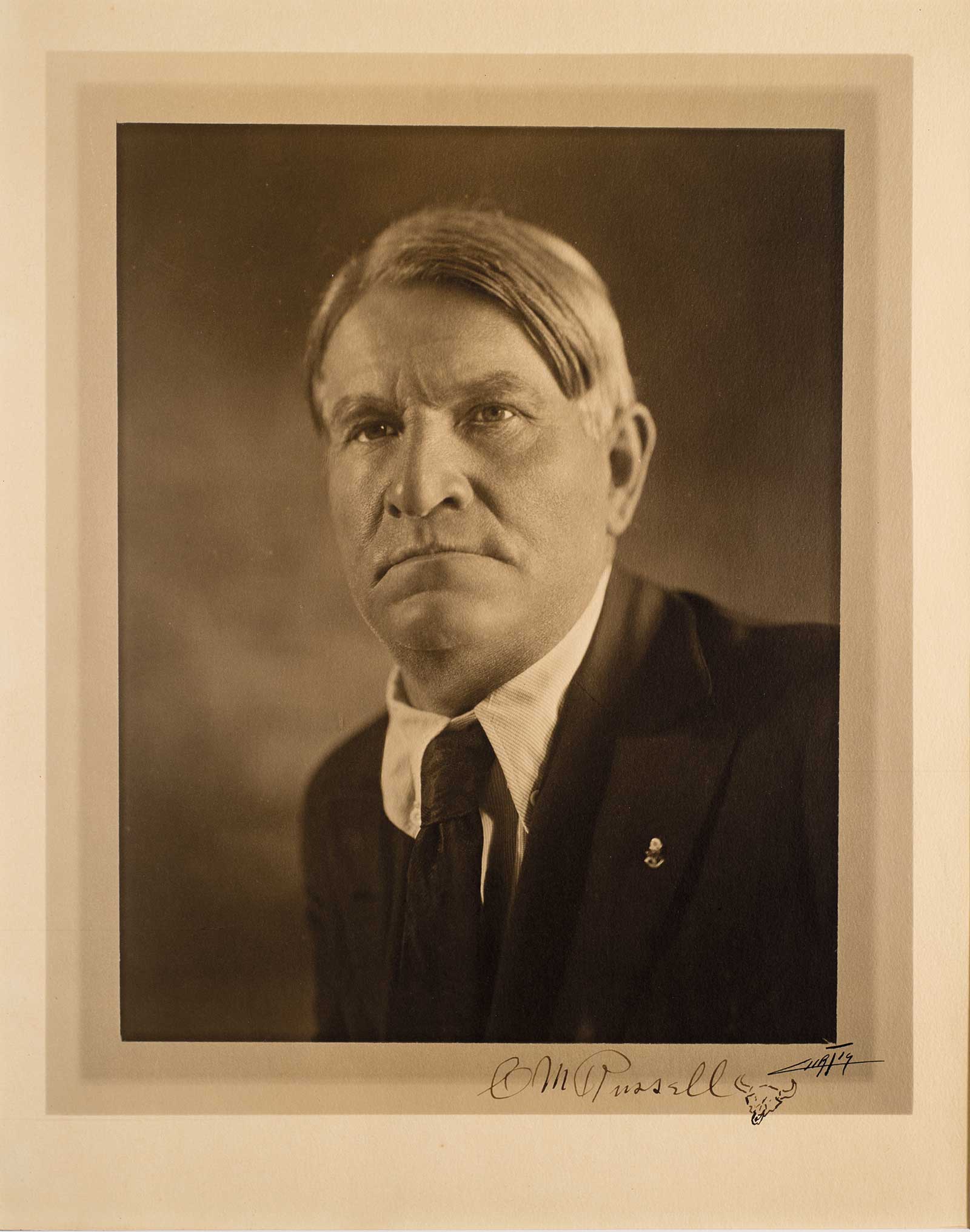
Charles M. Russell, hand-signed by Russell and Curtis. Edward S. Curtis photograph, gelatin silver border print, Curtis Studios, Biltmore Hotel, Los Angeles, CA, 1924, only one known.
All images are from the Big Sky Collection, Larry Len & LeAnne Peterson and reproduced in Charles M. Russell, Photographing the Legend: A Biography in Words and Pictures, Larry Len Peterson, University of Oklahoma Press, 2014. In cooperation with Gilcrease Museum, Tulsa, OK, and C.M. Russell Museum, Great Falls, MT.
Powered by Froala Editor


