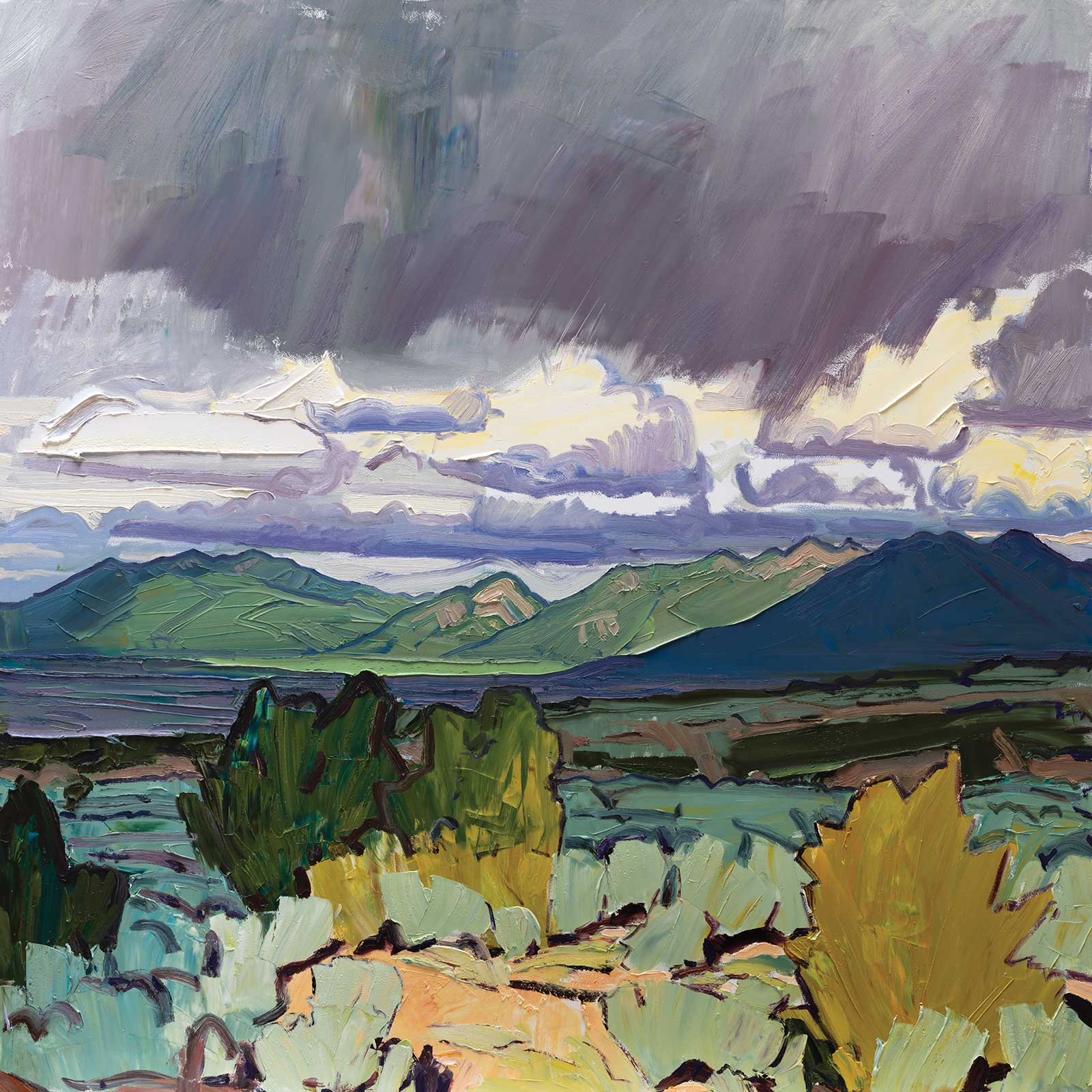
Jivan Lee revels in the viscous qualities of oil paint. In his 12-by-12-inch painting Process #1 - Lightning Squall, the paint itself is as important as the way he uses it to suggest a storm passing over a Northern New Mexico landscape.
“I think of oil paint as a colorful fossil,” he explains. “It’s an amazing technology. I paint with a lot of paint because it offers the opportunity to make a physical impression. It can receive and retain emotional gestural information and allows a physical topographical dimension unlike the flatness of a photograph. I slather a huge chunk of paint in an out-of-control flow state that becomes an accretion on the surface of the painting. A lot of paint allows a deeper mark. In Lightning Squall,the storm moved through with veils of rain. It was super hard to paint transparency with all that paint…Surface texture can add or it can subtract. The fact that paint lives on in a finished work as a dimensional component allows me to convey more information to people.”
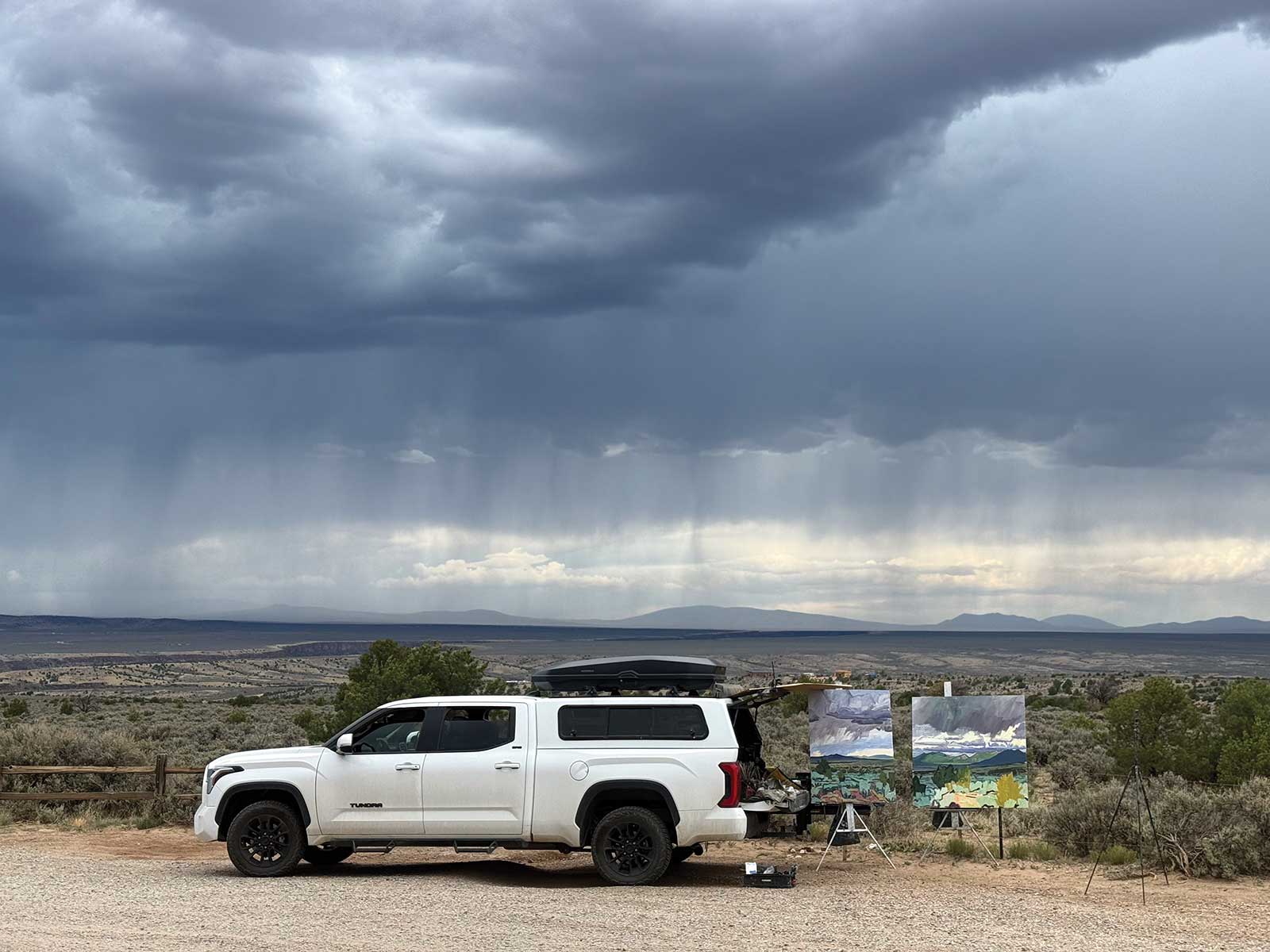
Jivan Lee’s mobile plein air studio.
The world’s oldest oil paintings were discovered in 2008 in caves in the Bamiyan Valley of Afghanistan surrounding the site of monumental stone Buddhas destroyed by the Taliban in 2001. Dating from the mid-7th century, the cave paintings disproved the assumption that oil painting originated in Europe in the 12th century. The binder containing the pigments was poppy seed oil or walnut oil, the same binders in contemporary artists’ paints. The medium in the paint Lee uses is walnut oil.
Lee’s most recent paintings will be shown in the exhibition Upwelling at Altamira Fine Art in Jackson Hole, Wyoming, from October 13 through 24.
The period in which he prepared the work for the exhibition was an unusually stormy one in Northern New Mexico. Painting in plein air he refers to his body “as an instrument through which I get the sensation of a place. What I find most engaging is that I’m steeped in the sensation of the space.” He feels the wind on his body and senses the change in temperature as a storm approaches. “If there’s a storm in the distance, I smell it,” he adds.
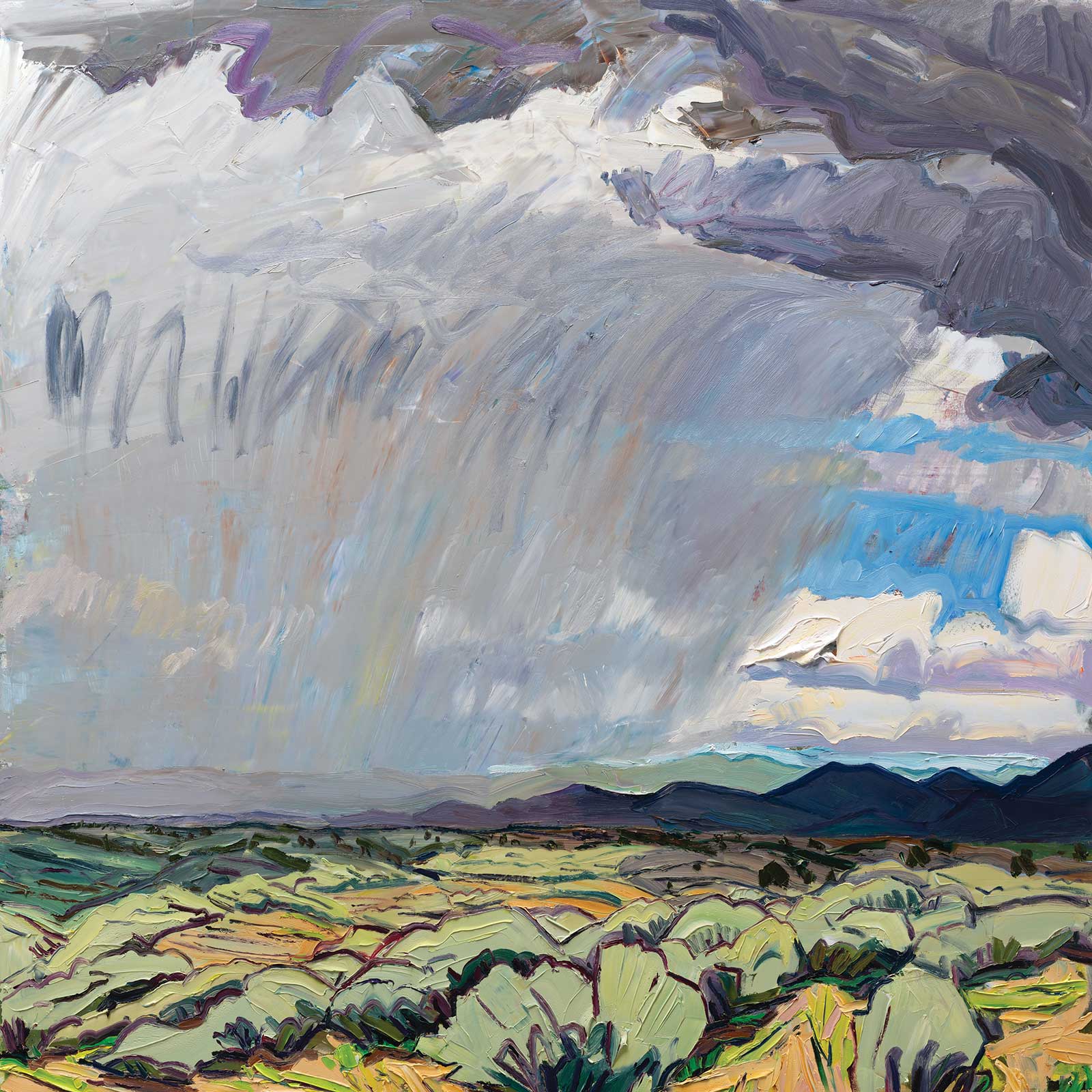
Storms Down #2, oil on panel, 48 x 48 in.
He describes upwelling as “an oceanic phenomenon.” He continues, “I had been struggling with the subverbal sense that this work has had, and ‘upwelling’ felt apropos of a sensation that’s been strong lately. Speaking metaphorically and thinking of the body and our human experience and an ecology of its own that reflects the external landscape: upwelling, then, speaks to a rising up—from deep down in the oceanic/subconscious realm—that is connected to the greater ecological flows, wind and currents and more, above and below the surface of the sea of being.”
Lee comes to painting with a strong scientific background. He skipped his senior year in high school and enrolled in Bard College on the Hudson River in New York. He graduated in 2007 with a bachelor’s degree in biology and a master’s degree in environmental policy. He also studied drawing and painting in Bard’s exceptionally strong division of the arts. He worked on sustainable communities and regenerative agriculture before moving into painting as a career.
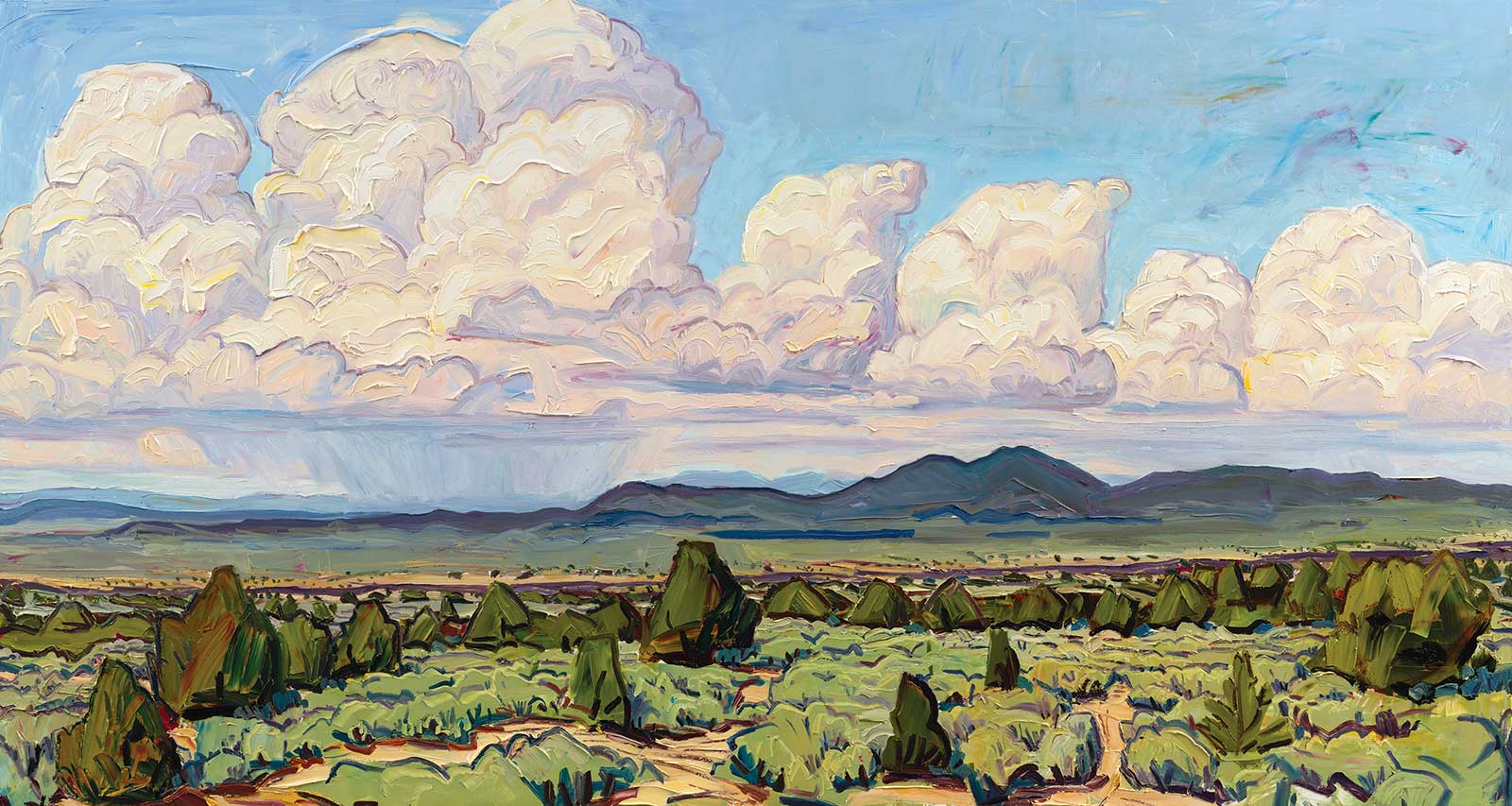
Expansive, oil on panel, 48 x 90 in.
When we first spoke, six years ago, he described his transition to painting full time. “The environmental stuff was part of why I went into painting; something in the art process felt essential and powerful in its potential to directly relate affectively about things that I felt often remained isolated in the conceptual realm in my previous career,” he says. “And now I feel like I needed to find a more direct, tactile, emotional dimension of my relationship to landscape and place, and painting has been a most welcome vessel for this.”
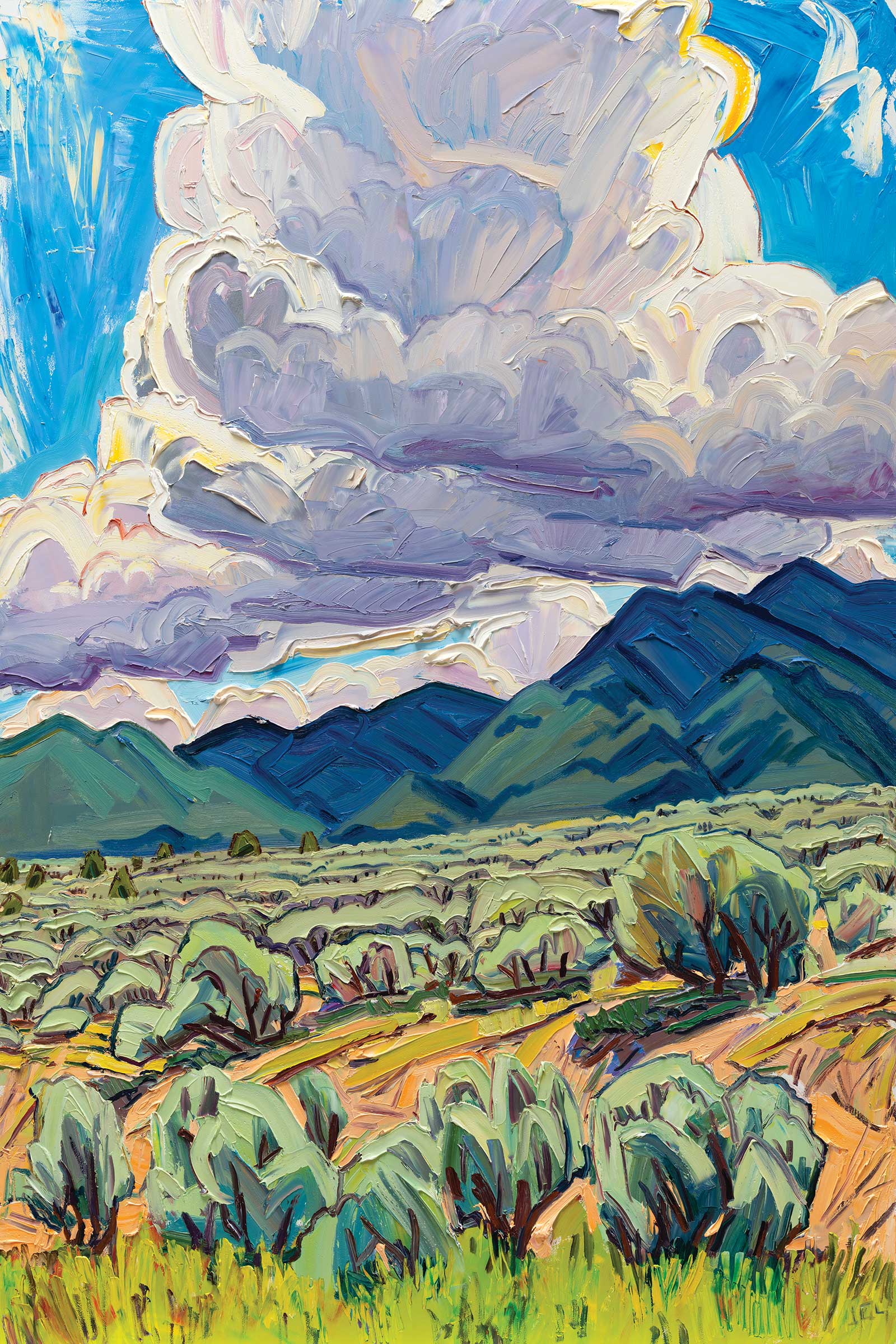
Happy Birthday (42) - Fun, oil on panel, 60 x 40 in.
Having watched his career over these years, it has been interesting to see experiments come and go and his control of the medium of oil paint continue to grow so that he uses it with creative ease. Joseph Santore, one of his teachers at Bard, defined edges in a painting by laying down one color next to another to create form rather than drawing with paint and separating colors with line.
I commented on the 4-foot-square painting Storms Down #2. Recently, he has been experimenting with dark outlines as can be seen on the mountains and on the shrubs in the foreground. “I spent a decade not outlining,” he says. “It’s thrilling letting line be part of the finished work.”
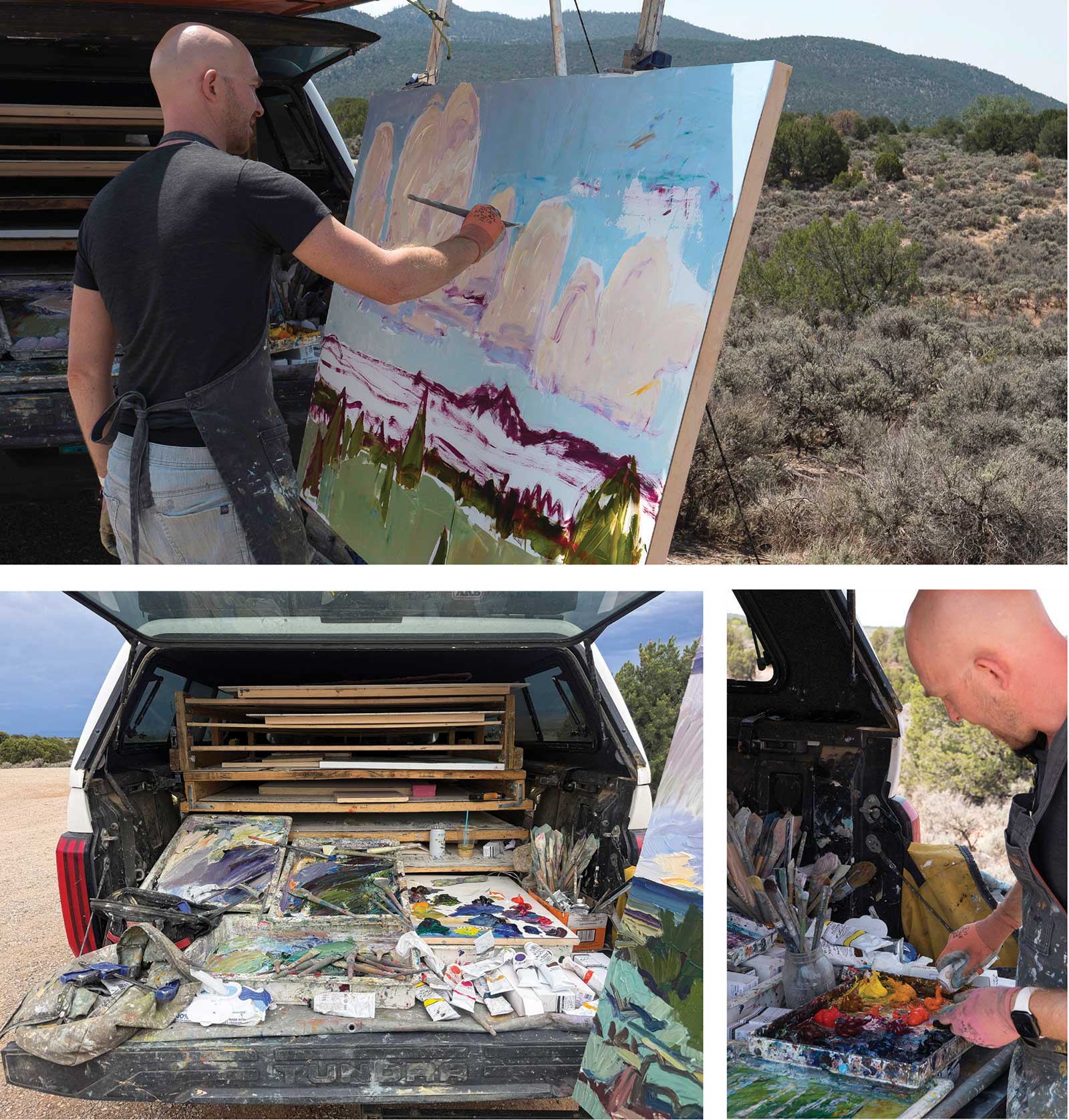
Top: The artist at work on location in New Mexico.
Bottom: Racks, paints, palettes and tools in the back of Jivan Lee’s truck. Mixing paint on the tailgate.
The lines are not black, but rich with color. What we often perceive as black shadows, Lee describes and paints as “brilliantly chromatic.”
“Lately, I’ve wanted to observe and think more about the power of line as a visual tool,” he continues. “I’m not painting reality. I’m painting a painting. Line can break all the rules but painting a dark line around the edge of a cloud, I feel gleeful. There is an intelligence in moments of glee I don’t understand.”
Apparition, oil on panel, 48 x 48 in.
His knowledge of the environment and his response to it is modified by a meditative practice that has taught him non-judgement, the ability to see things without applying labels or preconceptions.
“Being in the landscape,” he explains, “there’s an opportunity to be in the subject, watching as it changes. The landscape is being itself. On any given day I don’t know where I’m going to paint. I don’t know what I’m going to find. I find what is here today.”
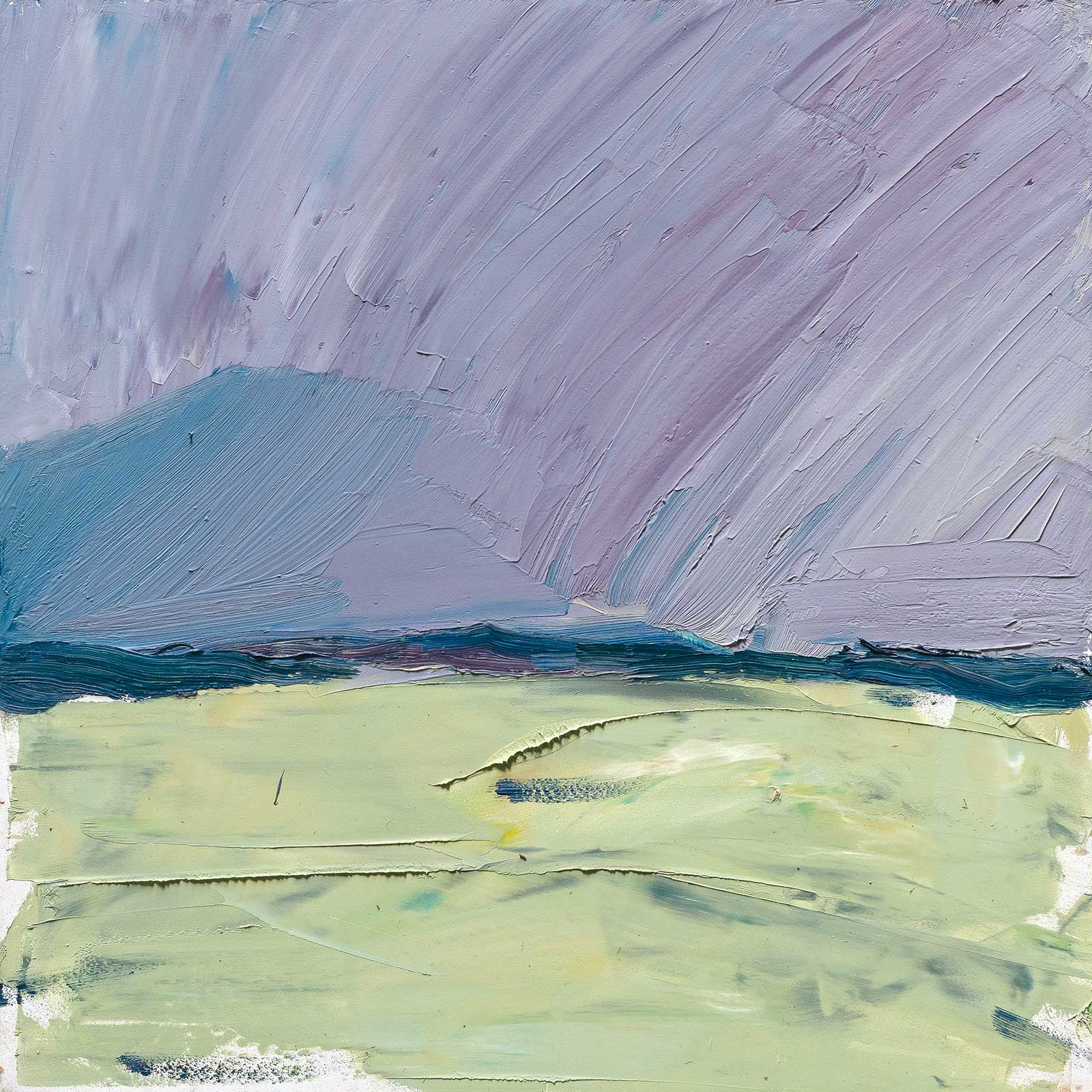
Process #1 – Lightning Squall, oil on panel, 12 x 12 in.
He sets up his studio on location from his truck. “The first thing I do is to take a moment to walk around the site for a while to see it,” he says. “From there I notice sensations across my body—the temperature on my skin, the ground crunching under my feet. The felt sensations bring me into the place. It’s the raw material of the eventual art piece, critical material I can’t skip over. Weather changes so quickly I need to make room for change.” Back in his Taos studio there is time to make changes to the painting to bring it closer to his encounter with the scene.
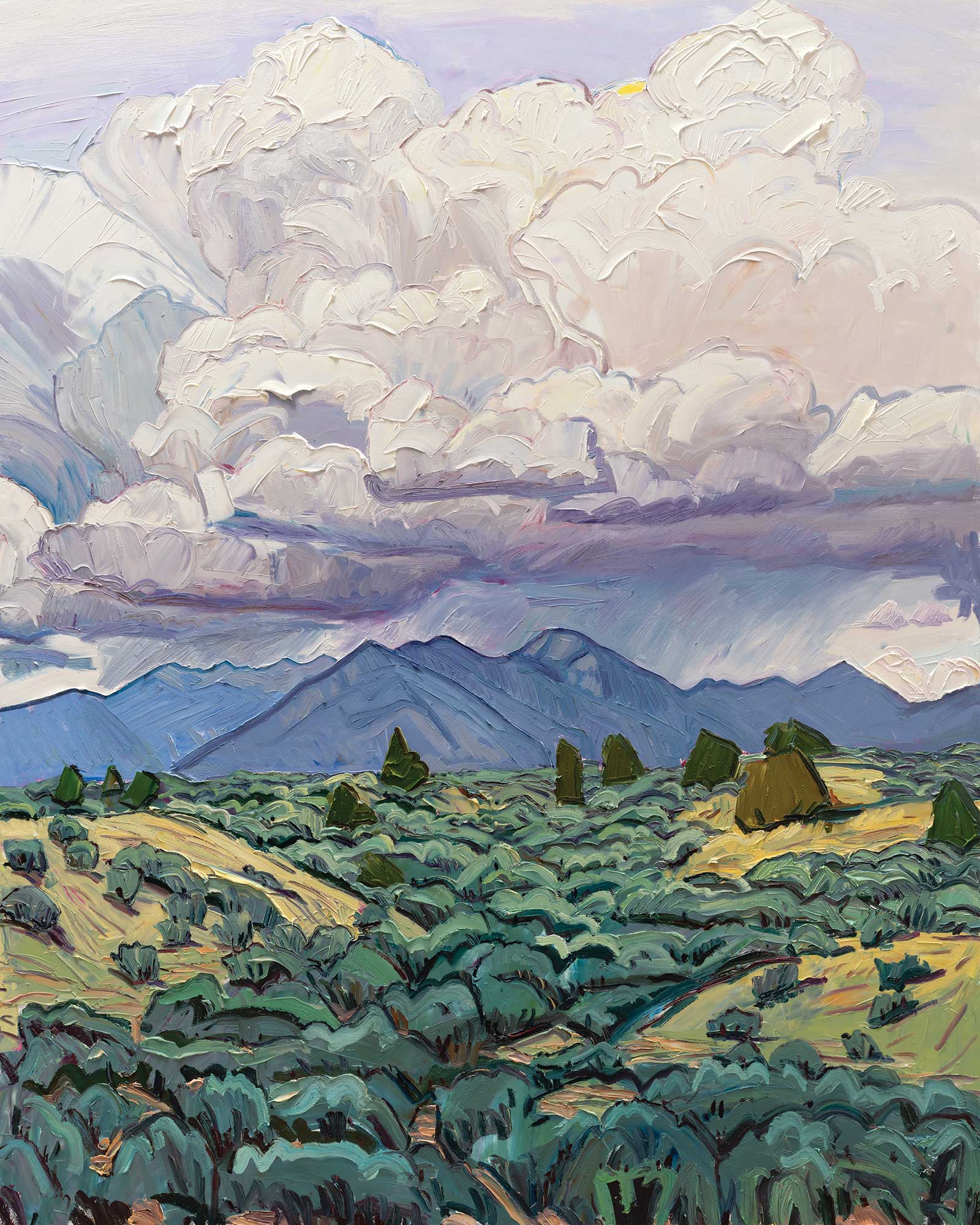
Upwelling, oil on panel, 60 x 48 in.
Through direct observation—experiencing the landscape directly—he produces an image that causes in the viewer a visceral response similar to his lived experience. —
Jivan Lee: Upwelling
October 13-27, 2026
Altamira Fine Art
172 Center Street, Suite 100
Jackson Hole, WY 83001
(307) 739-4700, www.altamiraart.com
+++
Photography by Jason Williams
Powered by Froala Editor


