In 1502, German artist Albrecht Dürer completed a watercolor titled Young Hare. Upon completion, the work on paper remained in the artist’s studio until his death in 1528, after which it went to a private collector and then to Holy Roman Emperor Rudolf II. In 1691, Young Hare,later referred to as one of the most important works in Europe, landed at the Albertina Museum in Vienna, where it lives today, although it is rarely on view due to the delicate condition of a work on paper that is 524 years old.
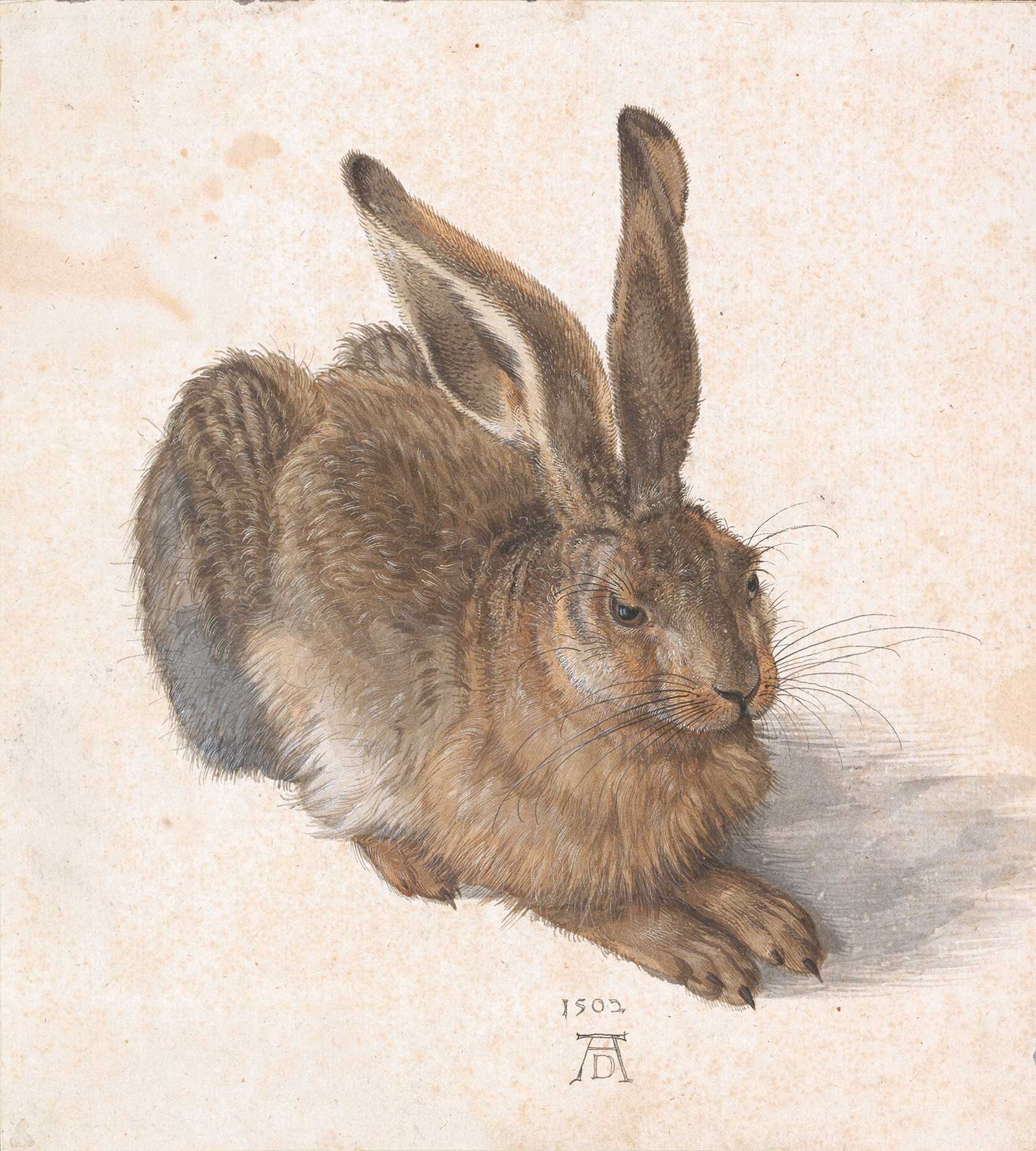 Albrecht Dürer (1471-1528), Young Hare, 1502, watercolor and bodycolor on paper, 10 x 9 in.
Not only does Young Hare predate Western art by centuries, it also predates all of the American art market as we know it today—after all, it was only created 10 years after Christopher Columbus landed on this continent. And yet, as old as it is, Young Hare offers a universal truth about wildlife art: direct observation produces sensitive and realistic depictions of animals. Dürer’s painting is a favorite among wildlife artists, and even though it’s far removed from Western art, it stands as a testament to what is possible when an artist truly looks at an animal and captures its essence in paint.
Many artists have adhered, knowingly or not, to Young Hare’s celebrated lessons. Consider the work of Arthur Fitzwilliam Tait, Bruno Liljefors, John James Audubon, Carl Rungius, Bob Kuhn and others. The genre continues with resounding strength today thanks to new generations of artists that include John Banovich, Kyle Sims, Sandy Scott, Dustin Van Wechel, James Morgan, Ken Carlson, Daniel and Adam Smith, Guy Combes, Mark Kelso, Bonnie Marris and many more. These artists observe wildlife subjects in their natural habitats, sketch them, study them and capture their likeness back in the studio. Observation, like Dürer, is key to their success.
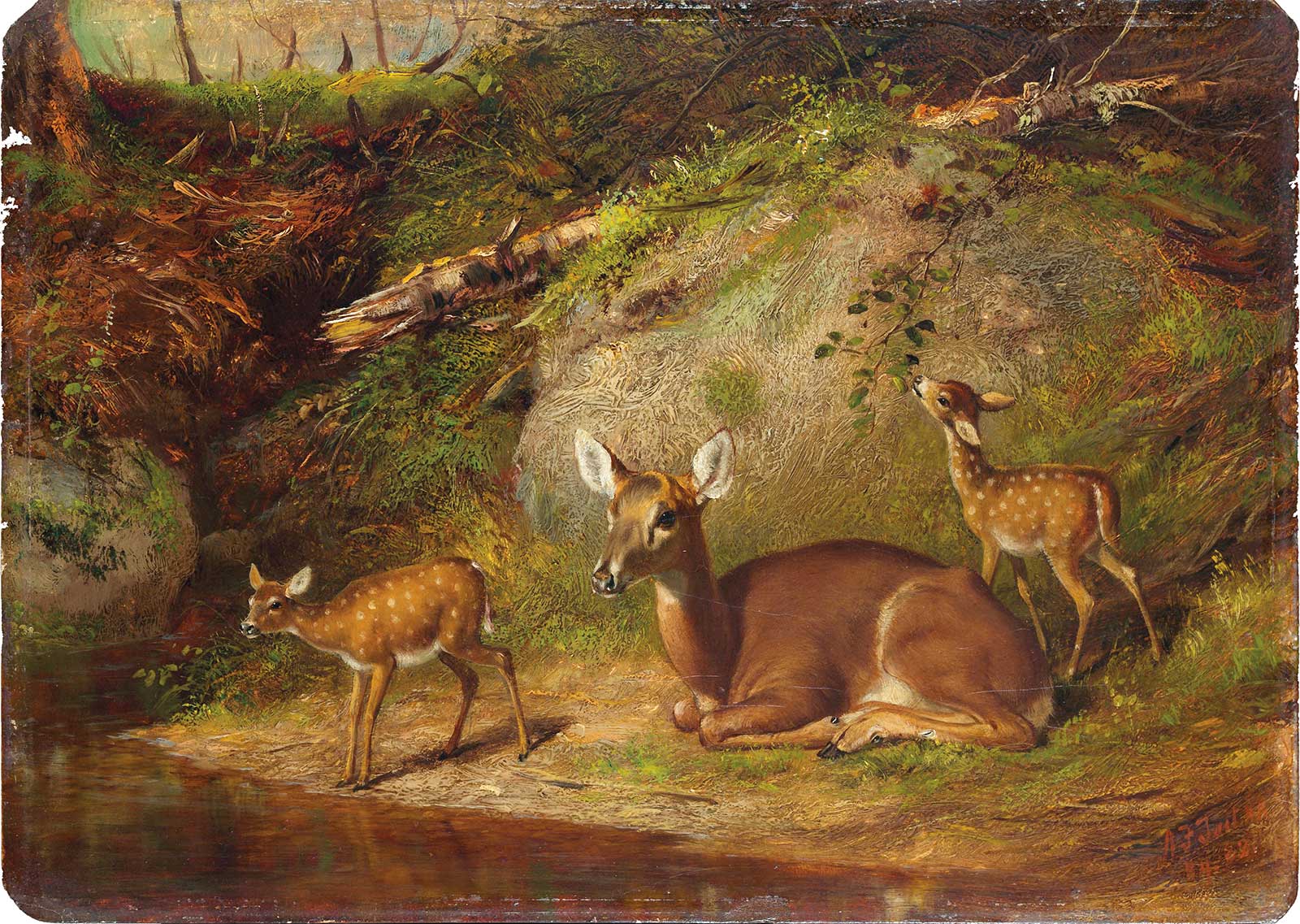
Arthur Fitzwilliam Tait (1819-1905), Doe and Two Fawns, 1882, oil on academy board, 10 x 14 in. The Metropolitan Museum of Art, gift of Mrs. Darwin S. Morse, 1963. 63.200.7.
Whether it’s through direct observation, or another process entirely, wildlife art has taken hold within American art, and even more so within Western art, where it enjoys the highest levels of success: six-figure auction records, inclusion within top collections, acquisition by premier art institutions and respect among the artists. Dürer may have contributed greatly to the genre, but in the American West, wildlife art has taken on a mesmerizing life of its own.
Bozeman, Montana-based artist Amber Sampson has been captivated by wildlife for as long as she can remember, but living in Big Sky Country has deepened that connection in ways she never imagined—from watching grizzlies, wolves, elk and bison in their natural habitat, to experiencing firsthand the landscapes they call home. “While my paintings are rooted in realism, I love pushing color beyond what we see at first glance. Rich violets, aqua highlights and expressive brushwork allow me to capture not only the physical beauty of an animal but also the emotion and energy I feel in that moment,” she says. The dark backgrounds and splattered paint have become a signature part of Sampson’s style, creating contrast that draws the viewer directly into the eyes of each subject. “Whether I’m painting a monumental commission or an intimate wildlife portrait, my goal is always the same: to create paintings that help collectors feel a lasting connection to the wildlife and wild places of the American West.”
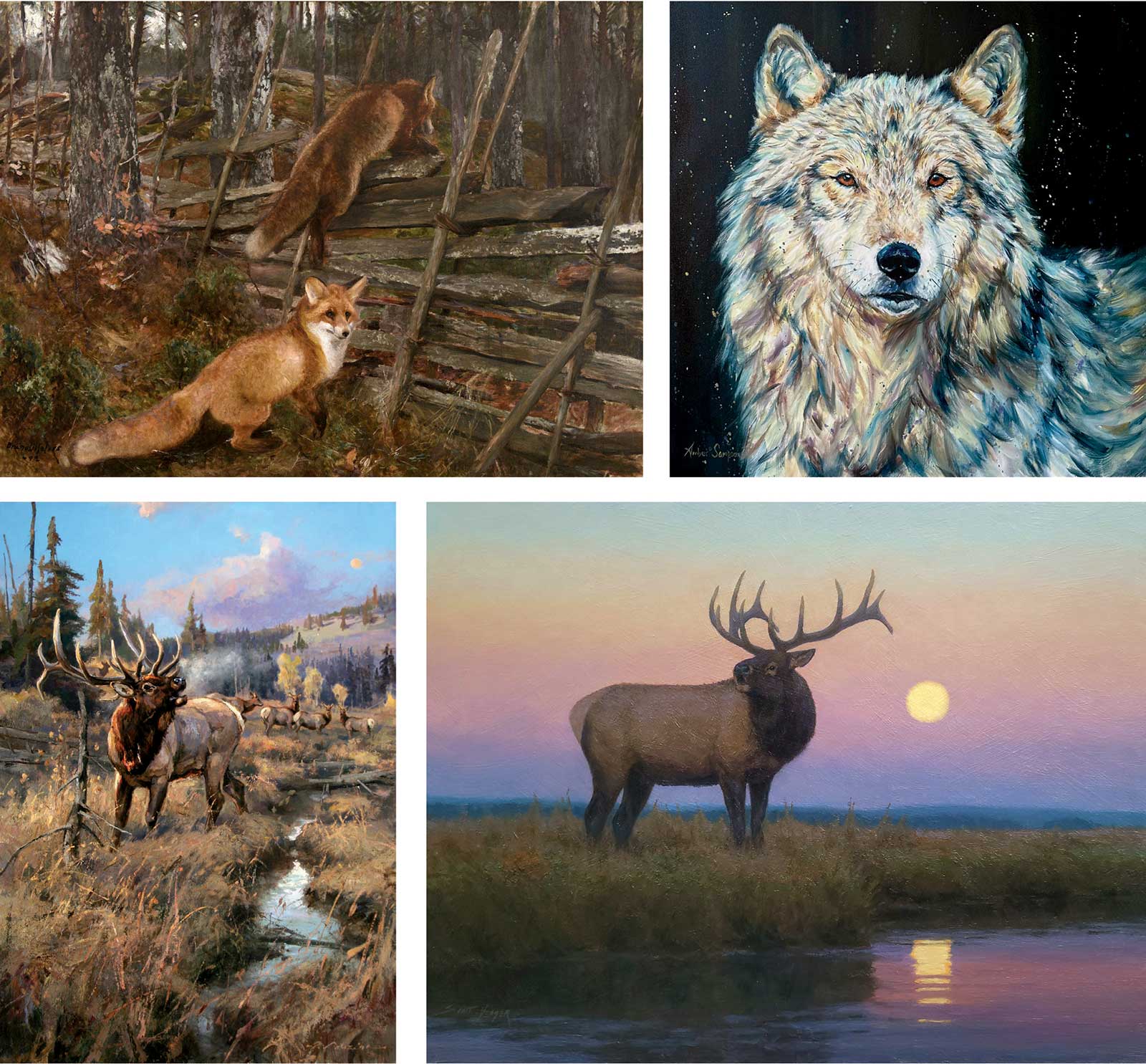
Top: Bruno Liljefors (1860-1939), Foxes, 1892, oil on canvas, 57 ½ x 79 in. Amber Sampson, Stoic One, oil on canvas, 36 x 36 in. Bottom: Coeur d’Alene Galleries, Moonrise Gathering, oil, 38 x 27 in., by Luke Frazier. Coeur d’Alene Galleries, Bull Moon, oil, 11 x 14 in., by Scott Yeager.
Wildlife painter and avid sportsman Luke Frazier is represented by Coeur d’Alene Galleries in Coeur d’Alene, Idaho. “I paint the life I live; I want to offer up the natural world from a different point of view, whether that be bombastic, nostalgic or subtle,” says the artist. “I want to tell a story with my work, not by laying it all out there for the viewer, but rather by leaving questions unanswered. I am in awe of the beauty in nature, from the grandiose, to the smallest exquisite detail.”
“Collecting original wildlife art is about far more than decorating a wall—it’s about preserving America’s natural heritage through timeless works of art,” says Buddy Le, owner of Coeur d’Alene Galleries. “When selecting a wildlife painting, look for exceptional composition, accurate anatomy, masterful use of light and a strong emotional connection to the subject…Paintings that tell a story or celebrate iconic North American wildlife—from majestic elk and whitetail deer to waterfowl, bears and upland birds—often resonate with collectors because they reflect the landscapes and wildlife that define America’s outdoor legacy.”
Dave English’s artistic vision is profoundly shaped by a lifetime of incomparable outdoor experiences as an avid outdoorsman and guide in Montana, Idaho, Colorado and New Mexico.
Living his entire life among the mountainous landscapes of the American West, English’s great love for our rich Western heritage, its landscapes and wildlife, feeds his yearning to share the strong imagery of his own deep, firsthand immersion in nature to genuinely portray the sublime, the powerful and the beautiful. “I paint because I desire to share my unique vision and perspective with the audience in a manner that invokes an emotional connection. Successful art resonates with the viewer on an emotional level,” he says.
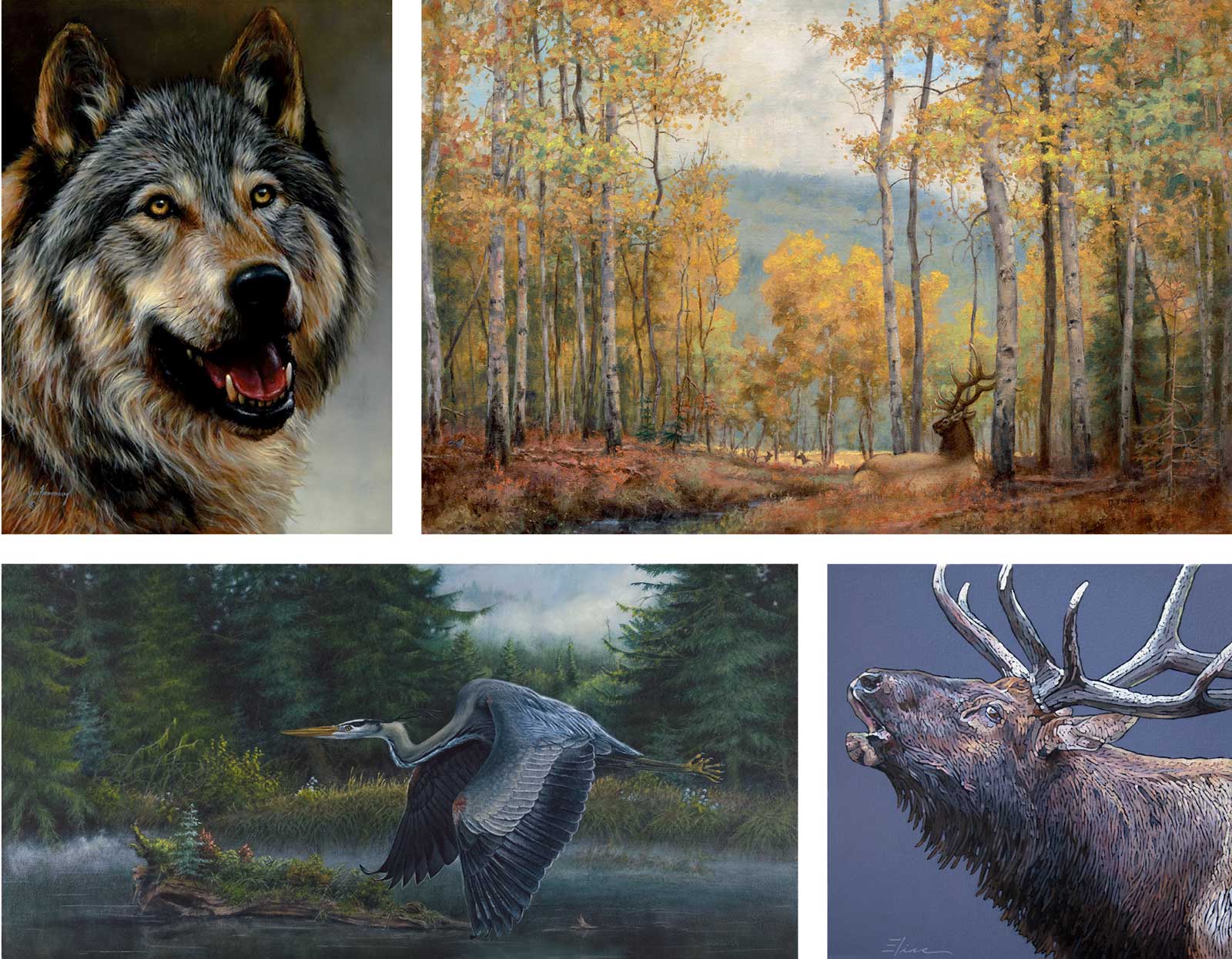
Top: Coeur d’Alene Galleries, Moon Gazer, oil, 24 x 18 in., by Joe Kronenberg. Dave English, Vermejo Gold, oil, 16 x 24 in. Bottom: Dave English, Great Blue Heron on the Siletz, oil, 15 x 30 in. Elise Mahaffie, Dusky Bugler, oil on canvas, 18 x 18 in.
Being a graphic designer for most of her life has influenced how Elise Mahaffie interprets shapes and how she sees the world. “I love bold marks, strong colors and simple compositions—they give the viewer a feeling of easy discovery, so they can relax and focus on the smaller details. A well-designed editorial page invites you to slow down, stay a while and enjoy it. I want that same feeling in my paintings. I’ve always loved animals, and I feel spellbound when I come upon one in the wild,” says Mahaffie, “first that jolt of exhilaration, then I go quiet and just watch. I hope viewers find that same connection with the animals I paint.” The artist advises collectors to trust their initial instincts. “Contemporary wildlife art shouldn’t feel decorative, it should feel like that moment of encounter, the pause before you really see something,” she says. “Look for a piece that stops you the way an animal in the wild would: the initial charge of recognition, then the quiet that follows. That’s the connection worth living with.”
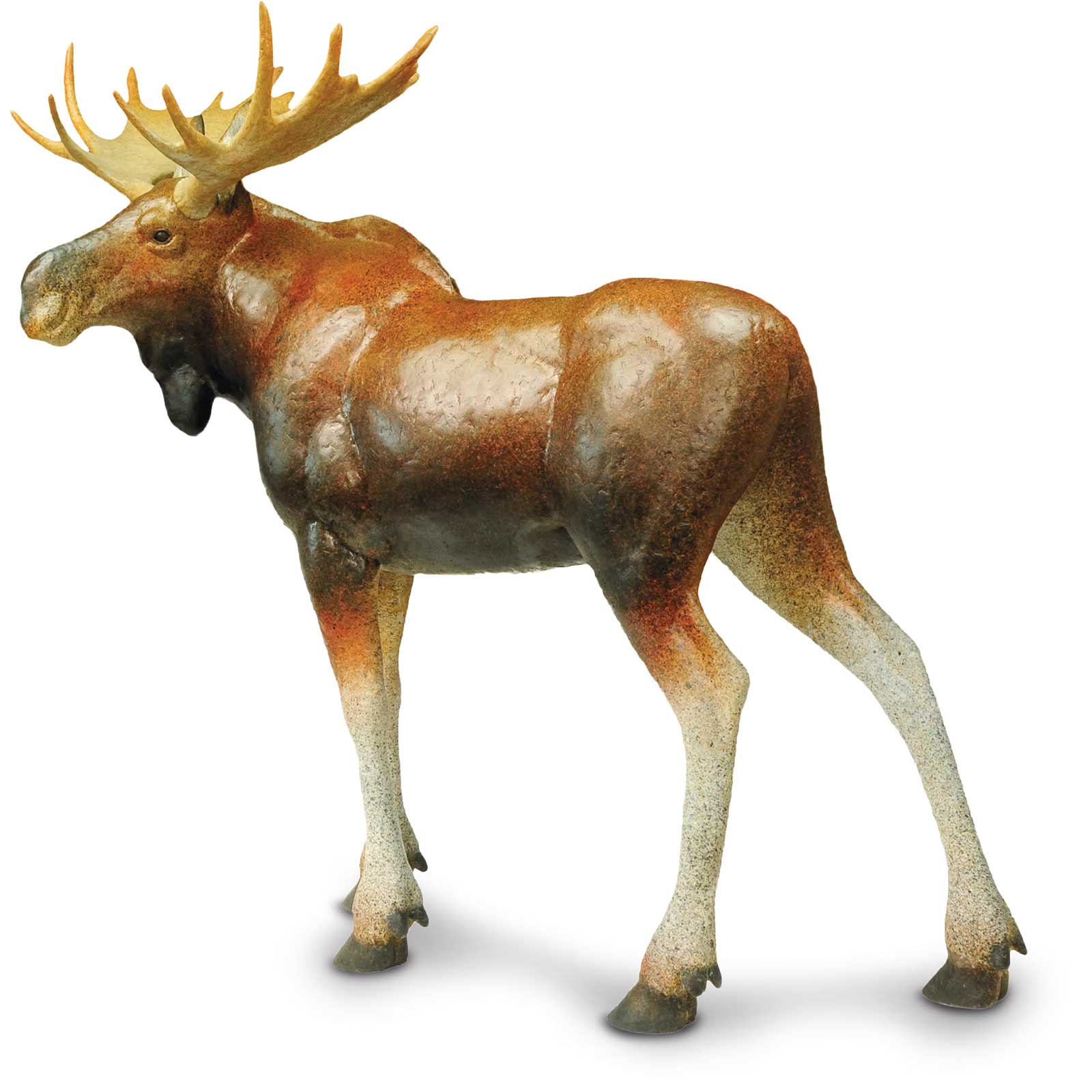
Cassens Fine Art, Macho Man, bronze, ed. 2 of 40, 46 x 48 x 26 in., by Jeremy Bradshaw.
The inspiration behind Jim E. Miller’s West Texas Icon is a whitetail buck the artist observed in the field on a Texas ranch in Sonora. The background was from a lifelong friend’s west Texas 5C ranch out in Rocksprings. “This scene was from my memory of the front pasture. I will always have a special place in my heart for West Texas and for the amazing hill country,” Miller reflects. “Pictures you take of landscapes, favorite places or even wildlife don’t always have everything you want in them to use for a painting. So sometimes we artists have to put our subjects with different backgrounds or Frankenstein them together a bit to get the composition we are after.” Miller mirrors what many others have said regarding collecting wildlife art: “I always advise collecting pieces that move you, ones that you feel a real connection with. Also, it is always good to connect with the artist to understand what inspired them to paint the subjects that they paint.”
“Wildlife observation is my form of meditation. It allows me to disconnect from the chaos of daily life, to breathe deeply and to let go of the stresses that accumulate,” says Norwich, New York-based artist Johanna Lerwick.“In those peaceful moments, clarity emerges, solutions to personal dilemmas become apparent, and I gain a renewed focus that carries me through life’s challenges.” Conservation is deeply important to Lerwick, and something she considers each time she embarks on a new painting. “With the daunting challenges faced by wildlife due to climate change and habitat loss, I feel a sense of responsibility to advocate for our planet’s voiceless inhabitants. Through my art, I hope to ignite passion and action in others, reminding us all that together we can make a difference—even the smallest efforts in raising awareness can have a monumental impact.”
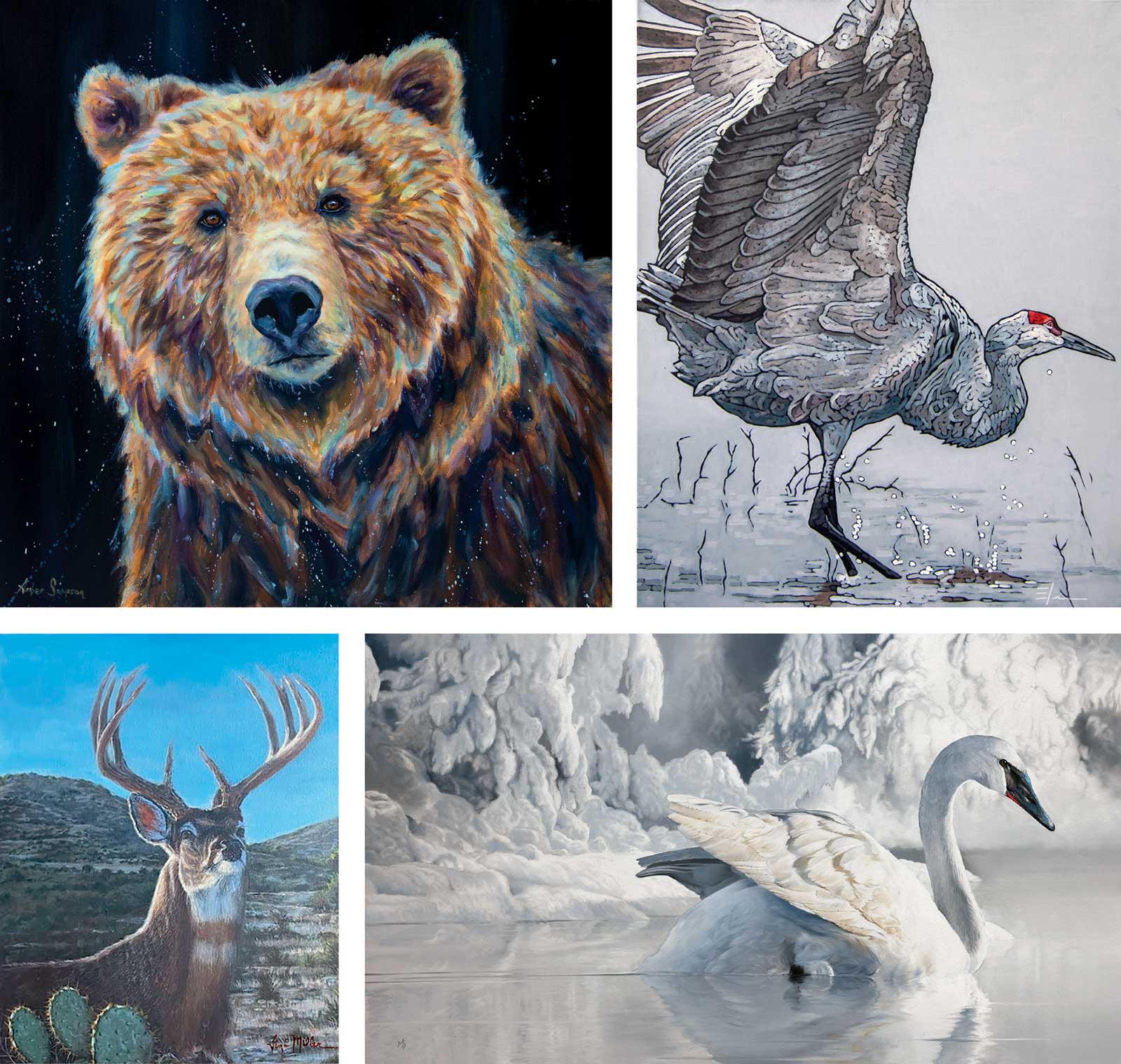
Top: Amber Sampson, Fierce Beauty, oil on canvas, 36 x 36 in. Elise Mahaffie, In Motion, oil on canvas, 24 x 30 in. Bottom: Jim E. Miller, West Texas Icon, acrylic, 20 x 16 in. National Museum of Wildlife Art, A Winter’s Verse, oil on panel, 24 x 42 in., by Mark Kelso. Available at the 2026 Western Visions Art Show + Sale.
Kathi Holzer came to art later in life, and that has profoundly shaped her perspective. “Instead of striving for perfection, I paint with gratitude, curiosity and a desire to celebrate the enduring connection between people, animals and the Western landscape. The ranch embodies authenticity—hard work, stillness and an unspoken respect for the land—and those qualities find their way into every canvas. Whether depicting a solitary horse or two animals sharing a quiet moment, my hope is that each painting evokes a sense of peace, strength and timelessness while honoring the enduring spirit of the American West…The ranch has always represented something deeper to me than a place—it is a way of seeing. When I paint horses, I am less interested in perfect anatomy than in capturing their quiet dignity, resilience and spirit.” Holzer’s work is rooted in impressionism and abstraction, allowing brushstrokes, texture and negative space to communicate emotion rather than detail.
“Wildlife art continues to evolve, and today’s contemporary artists are finding new ways to portray the animals that define the American West,” says Cyndi Hall of Manitou Galleries in Santa Fe, New Mexico. “Rather than focusing solely on realism, artists such as Andrew Bolam, Ethelinda and David Frederick Riley bring their own distinctive perspectives through expressive brushwork, bold color palettes, engaging compositions and a sense of personality that gives each subject a unique presence. Their work celebrates not only the beauty of wildlife but also the emotional connection we share with the natural world, encouraging viewers to see familiar animals in fresh and unexpected ways.”
“Wildlife has always held a special place in my heart. Long before I became an artist, I developed a deep appreciation for animals while spending time in my father’s veterinary practice, where I often helped care for injured wildlife,” says Diana Madaras of Madaras Gallery.“That experience taught me to see each animal as an individual with its own spirit and quiet dignity.” After moving to Tucson many years ago, she found endless inspiration in the incredible wildlife of the Sonoran Desert. “Whether I’m painting a roadrunner, a coyote or another desert resident, my goal is to capture the beauty and individuality of each animal while sharing the wonder of the Southwest that has inspired me for so many years,” says the artist. She works in both pastel and acrylic.
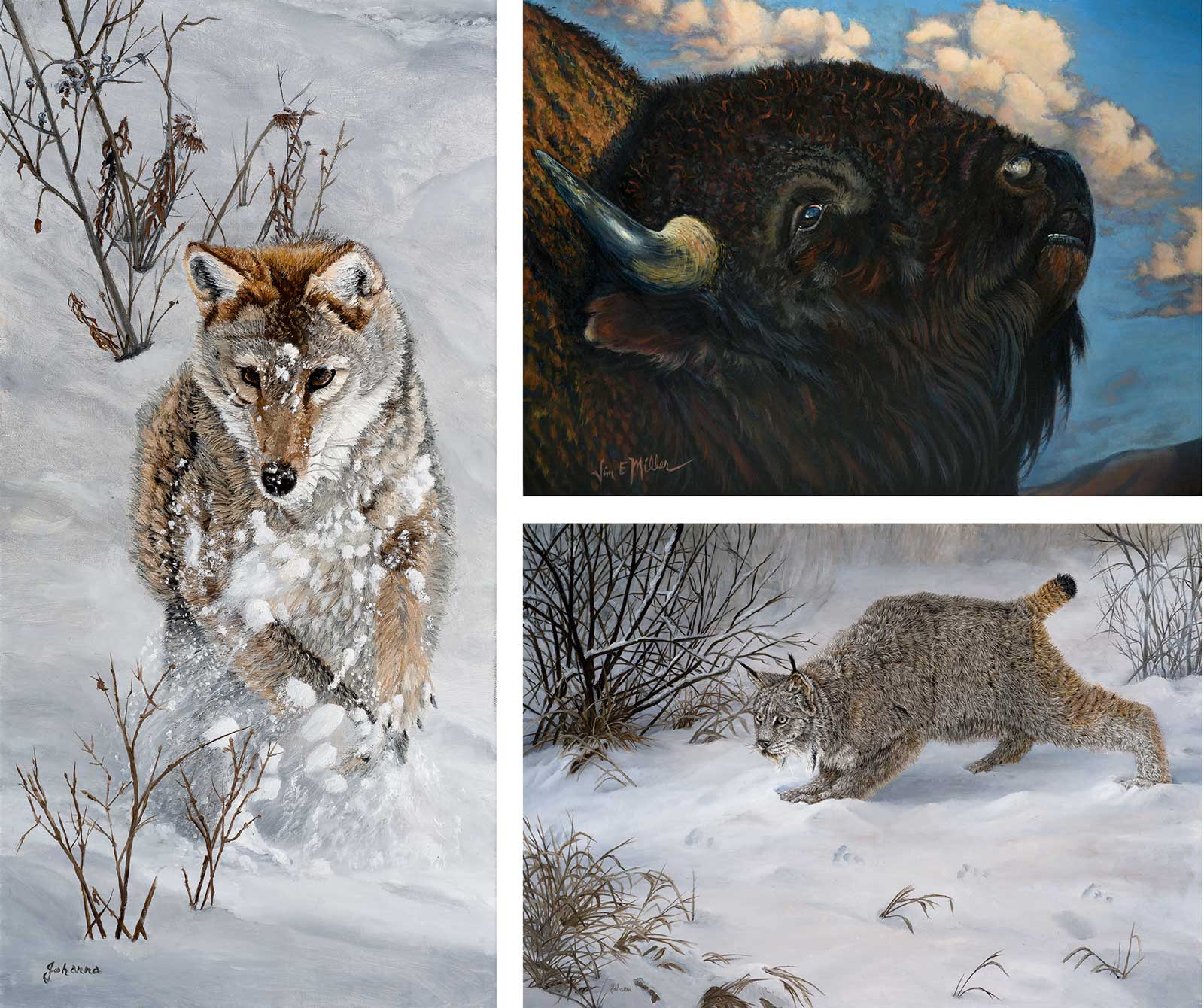
Clockwise from left: Johanna Lerwick, On a Mission - Coyote, oil on linen canvas, 20 x 10 in. Jim E. Miller, Something’s in the Air, oil, 18 x 24 in. Johanna Lerwick, Ready to Pounce – Canadian Lynx, oil on canvas, 20 x 30 in.
The National Museum of Wildlife Art is a world-class art museum holding more than 5,000 artworks representing wild animals from around the world, and Western Visions is the museum’s largest and longest-running fundraiser, as well as one of the signature events of the Jackson Hole Fall Arts Festival. The 39th annual Western Visions Art Show + Sale will be on view at the museum from September 5 to 27, with top contemporary wildlife artists (and collectors) from around the world congregating at the museum for the evening sale on Thursday, September 17.
“Wildlife art offers an opportunity to connect with nature,” says Western Visions director Madison Webb Stanko. “The theme for the large-format section of this year’s show and sale is curiosity. The museum’s vision is to inspire connections with wildlife and nature, and curiosity is often the first step in connection! With 176 works of art ranging from sculpture and paintings to original prints, found objects and cut feathers, there is truly something for everyone in this show.”
Rana Jordahl’s greatest inspiration comes from the quiet moments nature offers to those willing to slow down and truly observe. “Whether standing knee-deep in a marsh before sunrise or watching a solitary bird disappear into the evening light, I’m continually reminded that the most meaningful experiences are often the most fleeting. Those moments become the foundation of my paintings,” says the artist. While wildlife is Jordahl’s primary subject, her true interest lies in capturing atmosphere, light and emotion rather than simply recording anatomy or detail.
“Working in an impressionistic style allows me to suggest rather than define,” she says, “to let expressive brushwork, layered color and softened edges convey the feeling of a place as much as the subject itself. I want viewers to sense the stillness of the air, the changing light and the quiet connection between the animal and its environment.”
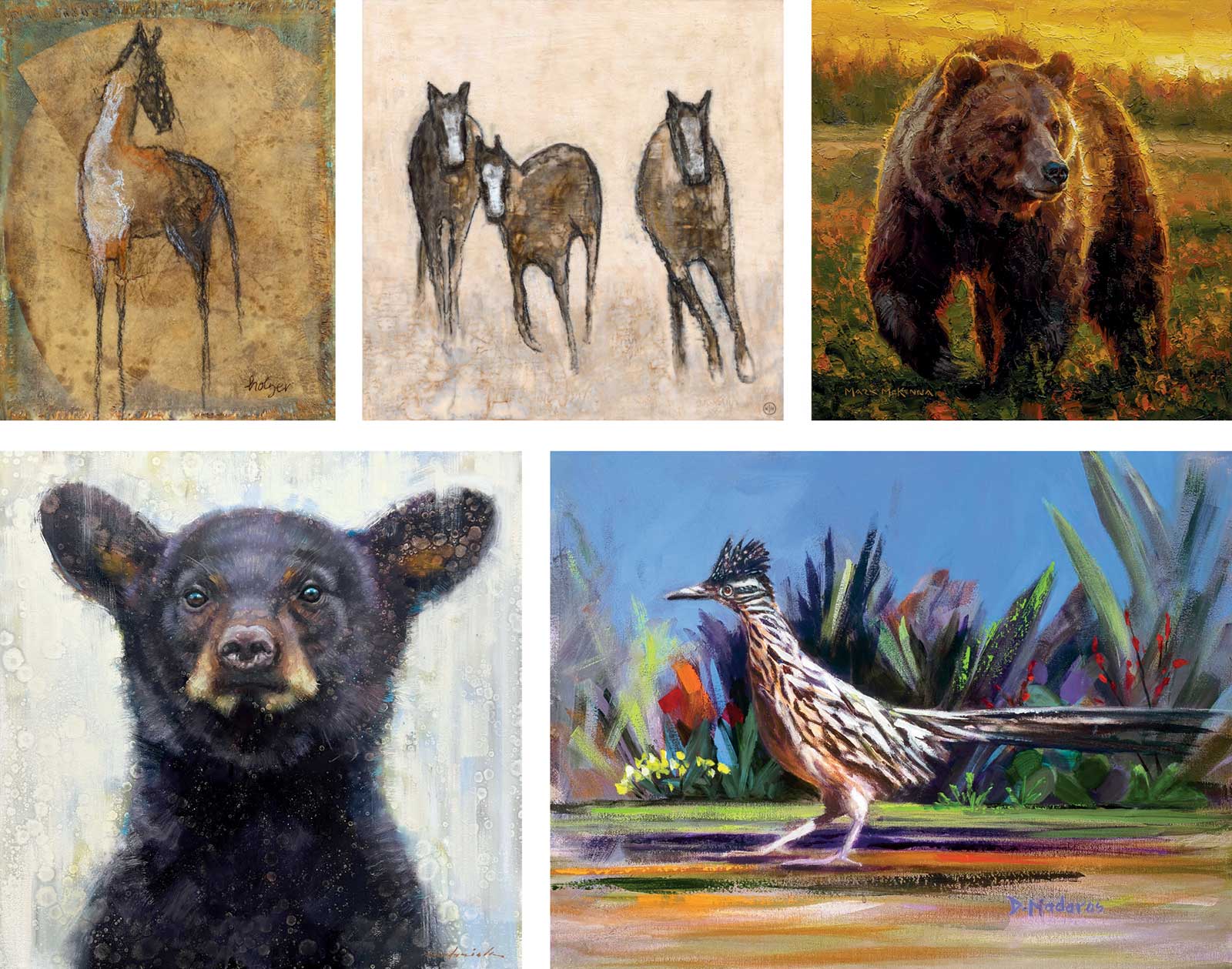
Top: Kathi Holzer, Ghost Rider, encaustic on panel, 12 x 9 in. Kathi Holzer, Headed Your Way, encaustic on birch panel, 12 x 12 in. National Museum of Wildlife Art, Grizzly Glow, oil on panel, 12 x 12 in., by Mark McKenna. Available at the 2026 Western Visions Art Show + Sale. Bottom: Manitou Galleries, Who Me?, oil, 40 x 40 in., by David Frederick Riley. Madaras Gallery, Beep Beep II, acrylic, 18 x 24 in., by Diana Madaras.
Wildlife is more than a subject to Teresa Lynn Johnson, it is a lifelong connection to untamed landscapes. Working in oil, she creates paintings that balance impressionistic sensitivity with a grounded sense of realism, capturing not only the physical beauty of each animal but also the spirit of the places they call home. Based in Aztec, New Mexico, the artist draws on a foundation shaped by rural Texas roots, professional discipline and mentorships with respected painters.
For Johnson, every painting begins long before the first brushstroke; it starts in the field, observing wildlife and gathering her own photographic references, studying the subtle shifts of light, movement and atmosphere that cannot be replicated from secondary sources. A lifetime spent outdoors has cultivated not only an appreciation for wildlife but an understanding that nature speaks most powerfully in its quiet moments.
Jeremy Bradshaw, represented by Cassens Fine Art,has spent much of his life in close company with wild animals. Bradshaw grew up around the chickens and rabbits on his grandparents’ farm and spent his days catching frogs and snakes in the garden. That curiosity continued into his adulthood. Throughout his 20s, he worked, explored, backpacked and fly-fished across the Sierra Nevada, and the more time he spent outdoors, the more he fell in love with wildlife.
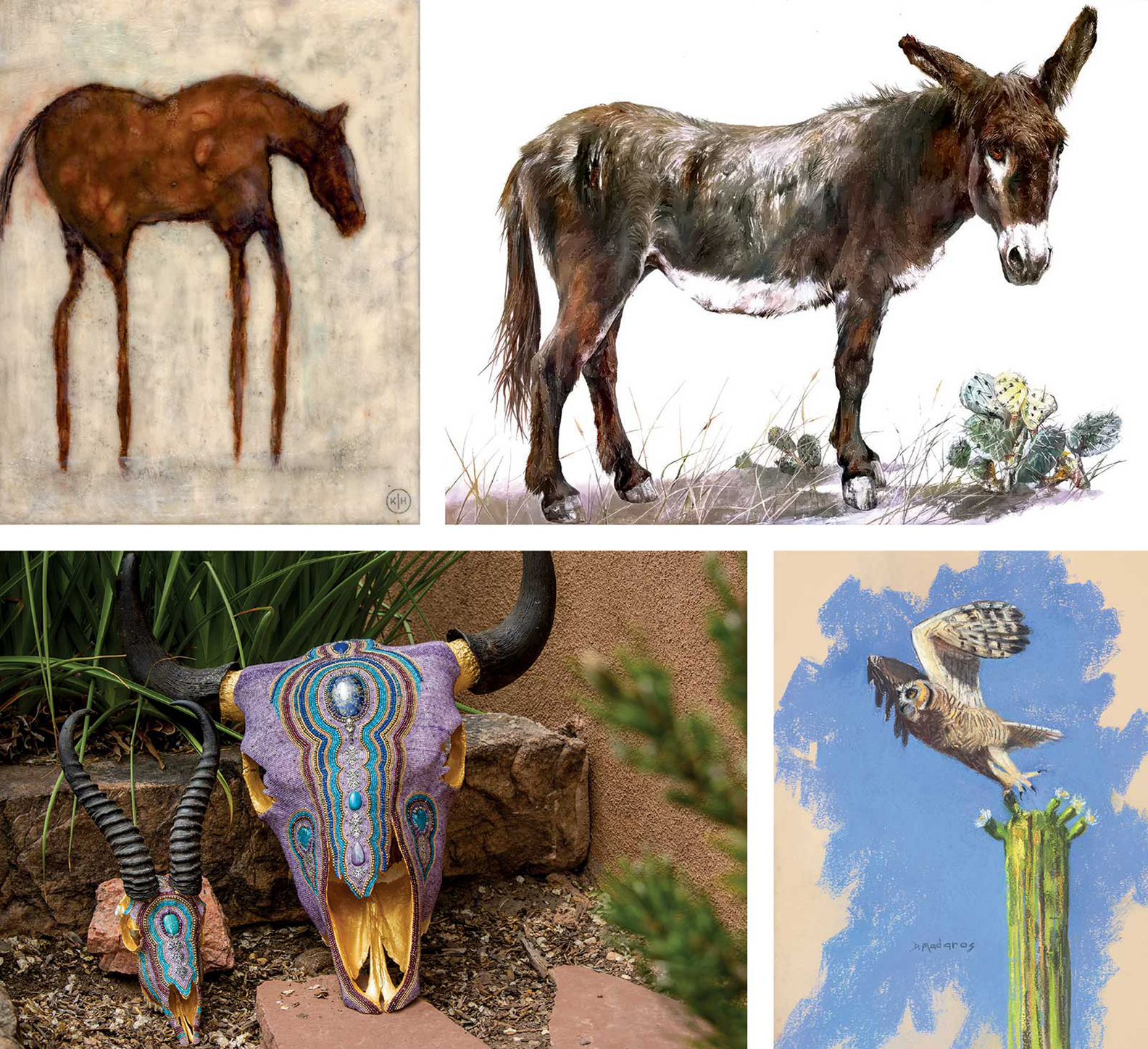
Top: Kathi Holzer, Song of the Mustang, encaustic on panel, 10 x 8 in. Manitou Galleries, Sopaipilla, oil on canvas, 36 x 48 in., by Ethelinda. Bottom: Ali Rouse Beaded Skulls, FIERCE Gem Collection Springbok and Buffalo, beads on bone, by Ali Rouse. Photo by Passion House Media Madaras Gallery, Saguaro Owl, pastel, 18 x 24 in., by Diana Madaras.
Bradshaw approaches each piece in a way that connects the viewer and the animal: “I am inspired to sculpt by my fascination with wildlife and a desire for proximity to wildness in my own life,” he says. “Forming and shaping animal subjects in clay is how I express the admiration and wonder I feel while creating something that I hope will share them equally with others. My goal is to share my passion for nature, wildlife and wildness in each bronze I create.”
Ali Rouse of Ali Rouse Beaded Skulls creates detailed beadwork on real animal skulls, interweaving her art with the animals themselves. Adorned with stones, precious metals and Rouse’s beaded designs, her work gives new life to what was once part of the wild. “Each piece is a tribute to the spirit of the animal and the materials sourced from nature, interweaving them into a complex narrative of existence, transformation and permanence,” she says. “[My] artistic creations are a profound reflection on the concepts of eternal cycle of life, death and rebirth.”
Big Horn Galleries offers work by the great Nick Eggenhofer (1897-1985), who is known for his seminal work on horse-drawn vehicles from his book, Wagons, Mules, and Men, as well as his illustrations ranging from pulp magazines of the 1920s to 1940s through countless books and commissions. Included in this selection are three sketches and an unfinished oil of murals for the Fort Davis National Monument in Texas and Fort Union National Monument in New Mexico that illustrate the importance of those forts to Western History. These works are from Eggenhofer’s personal collection by descent of children to grandchildren and represent some of his finer works in many media.
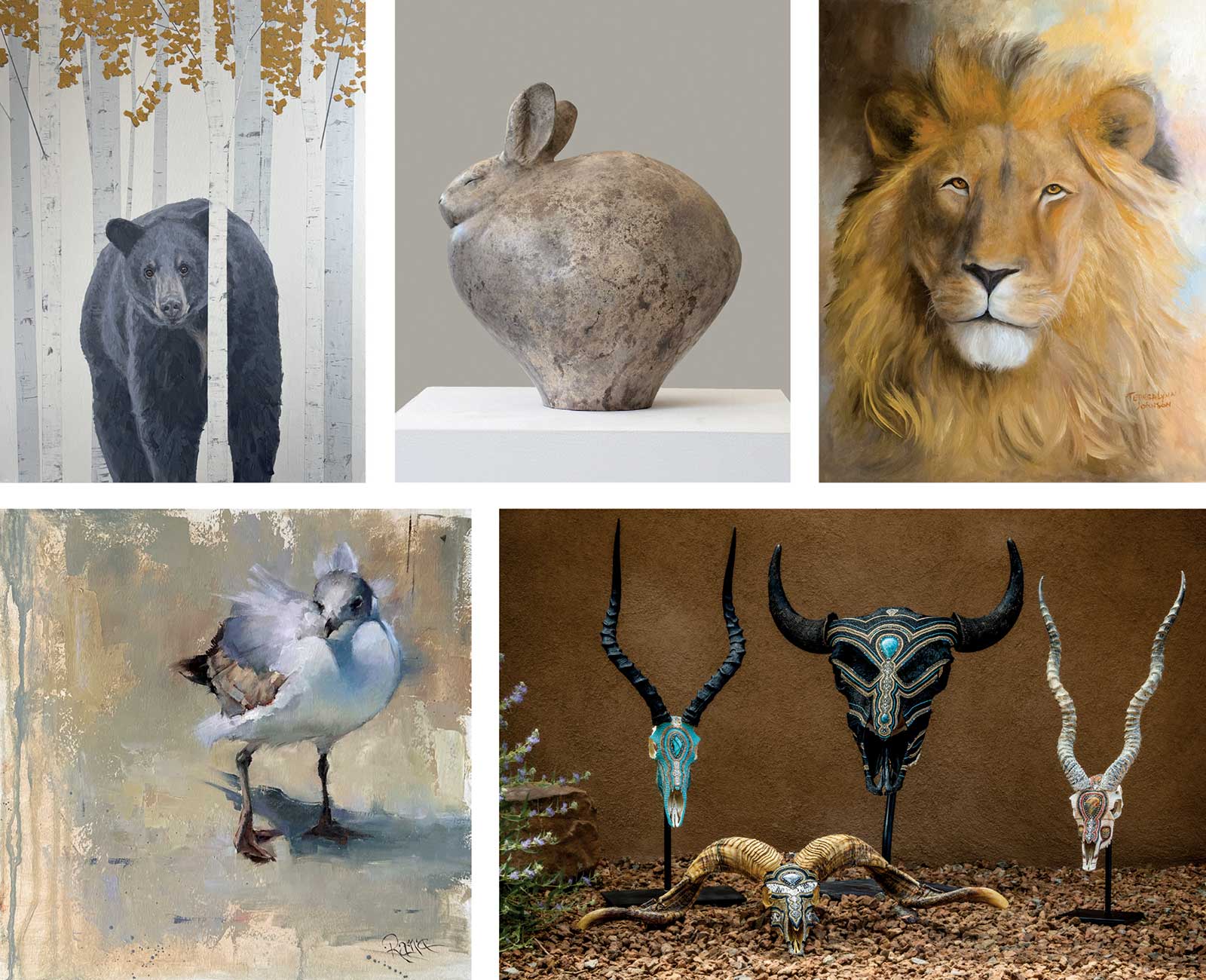
Top: Manitou Galleries, Inquisitive, oil, 60 x 46 in., by Andrew Bolam. National Museum of Wildlife Art, Arctic Prince, bronze, ed. 1 of 35, 10 x 9½ x 6½ in., by Christina Szakonyi. Available at the 2026 Western Visions Art Show + Sale. Teresa Lynn Johnson, Majestic Sovereignty, oil on linen, 20 x 16 in. Bottom: Rana Jordahl, Gull-able, oil, 12 x 12 in. Ali Rouse Beaded Skulls, assortment of skulls, beads on bone, by Ali Rouse. Photo by Passion House Media.
“The sound of whistling wings on a duck hunt one morning is when it all started for me,” says artist Edward Suthoff. “From the salt marshes of the Pascagoula River to the Rocky Mountains and wildlife of Yellowstone National Park, [these things have] forever changed the way I look at nature. I am inspired.”
Practically at the foot of the Grand Teton National Park, Gallery Wild in Jackson Hole, Wyoming, is one of the premier destinations for wildlife art in the country. The gallery, owned and operated by artist Carrie Wild, has a deep roster of wildlife artists, many of them working in a more modernist and contemporary style. Each artist has a voice, which is reflected in every work that Gallery Wild offers, from artists such as Amber Blazina, Jeremy Bradshaw, Richard Burke, Julie T. Chapman, Nicole Gaitan, Patricia A. Griffin, Doyle Hostetler, Amanda Markel and many others.
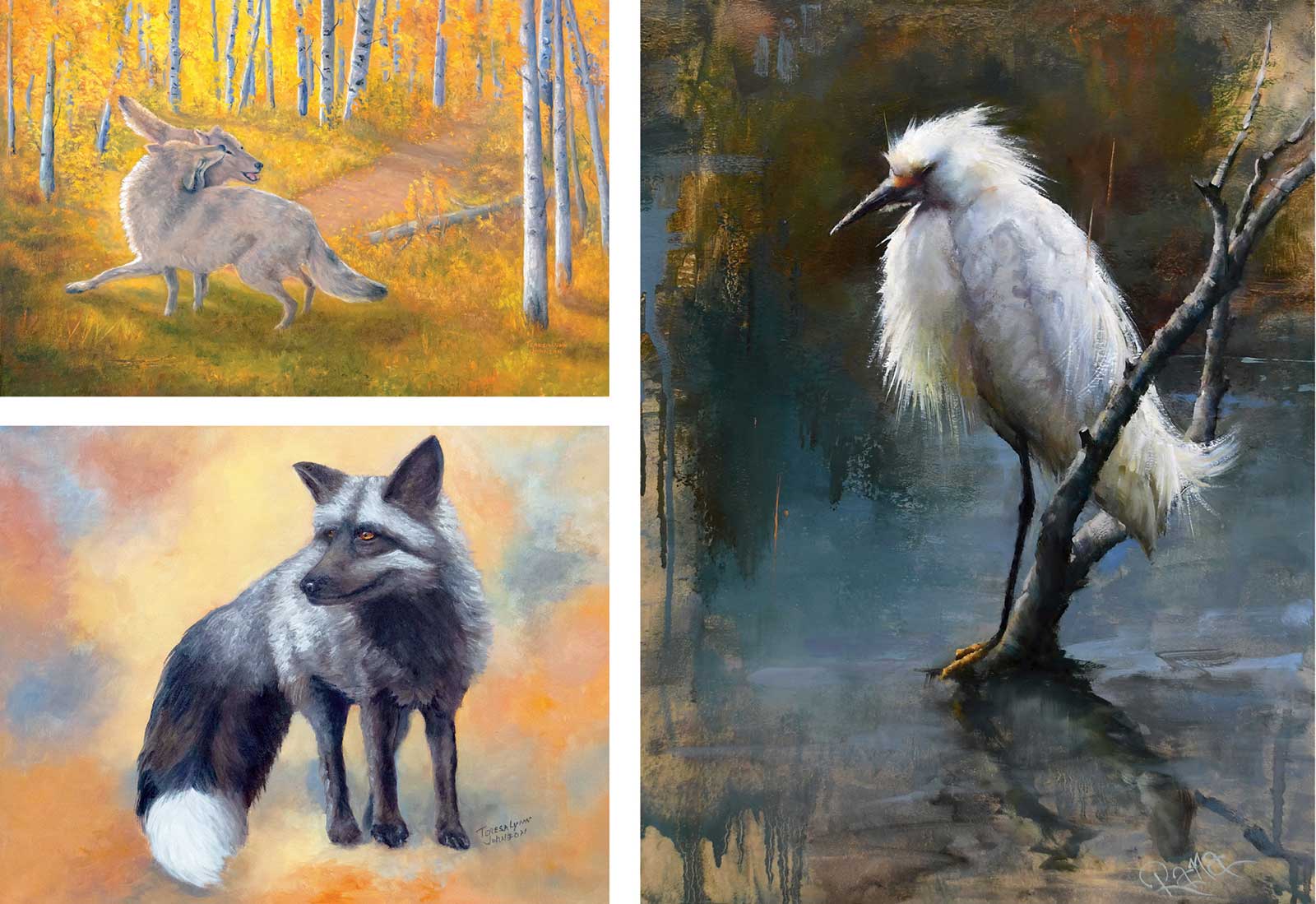
Clockwise from top left: Teresa Lynn Johnson, Autumn Frolic, oil on linen, 24 x 36 in. Rana Jordahl, Brackish Reverie, oil, 12 x 16 in. Teresa Lynn Johnson, Cross Fox on the Qui Vive, oil on linen, 16 x 20 in.
Cindy Sorley-Keichinger is primarily self-taught but has taken workshops with top artists in her chosen genre of landscapes and wildlife, working in acrylic, gouache and oil. She finds animals calming and tries to project that in her work. “In today’s busy world, a little bit of calm and peace is a necessity,” she says. Sorley-Keichinger is a member of several artist organizations and is particularly proud to be a member of the Artists for Conservation and a signature member of the Society of Animal Artists. She is also proud to have designed a coin for the Royal Canadian Mint.
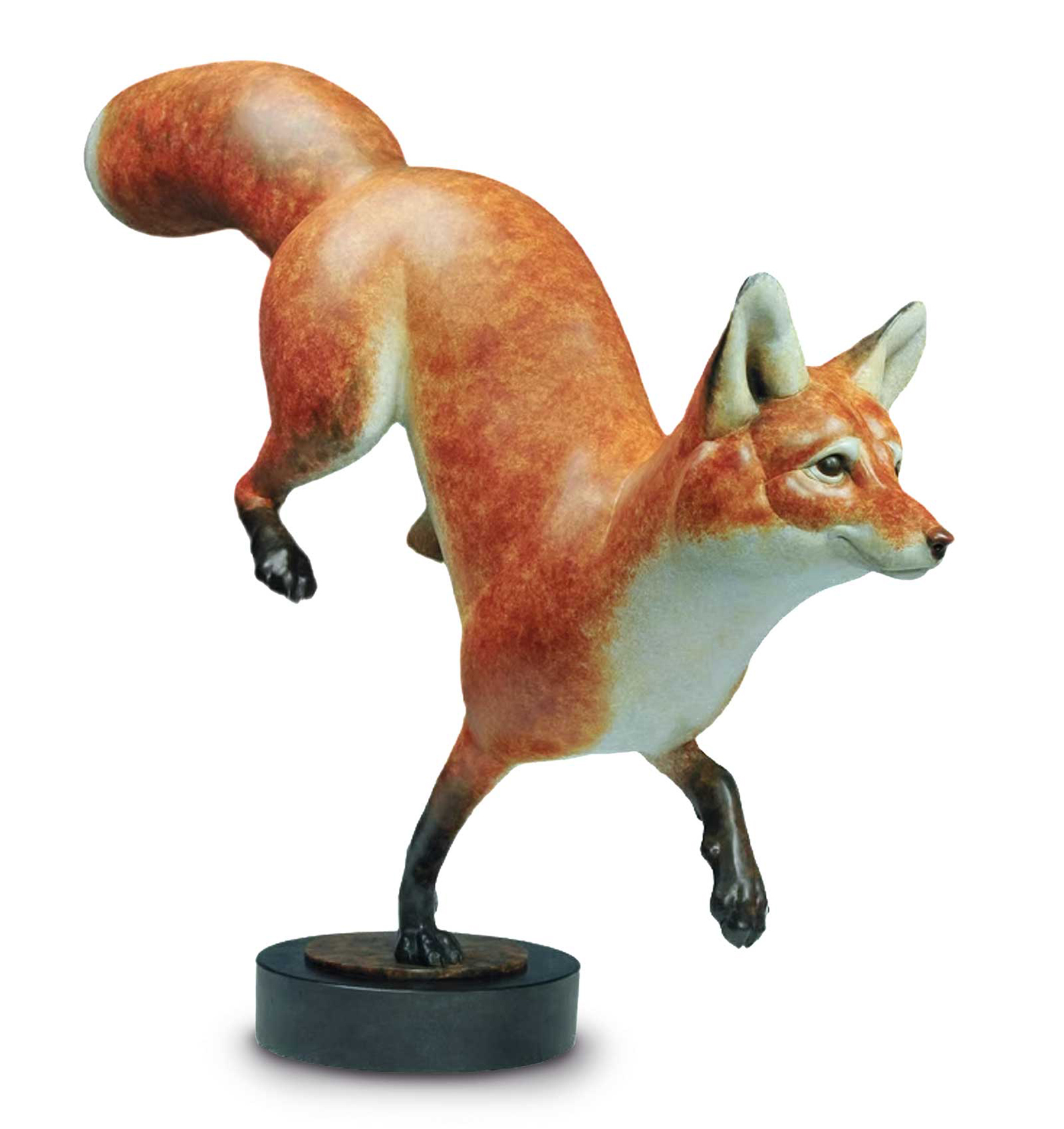
Cassens Fine Art, Fox Trot, bronze, 29 x 38 x 11 in., by Jeremy Bradshaw.
Describing the stories behind her recent work Mother Knows Best, featuring a mother osprey and her chicks, Joyce Cleveland says, “As I cast a line into the Snake River, a large shadow passes overhead. It’s a mother osprey carrying a big fish back to her nest. I can hear the call of her mate in the distance. I have competition! As she gets close to her nest on the opposite bank, the peeping of hungry chicks begins. A small piece is fed to each chick, and a perfect painting [was] created in my head!”
In Two Curious Kids, we see a portrait of two young foxes. “Last spring I encountered a beautiful red fox crossing the road in front of me while driving in the countryside,” says Cleveland. “It had caught some small creature and was headed somewhere in a hurry. I stopped to watch. Out of an opening under the old, weathered barn ran two curious little foxes. They watched intently as dinner was served.”
For the painting Look! Moose!, she says, “Finding moose around Jackson is never too hard. Just follow the river and watch for cars stopped along the road. Photographers with huge cameras train their focus on a distant grove of trees. Then suddenly people are pointing, ‘Look! Moose!’”
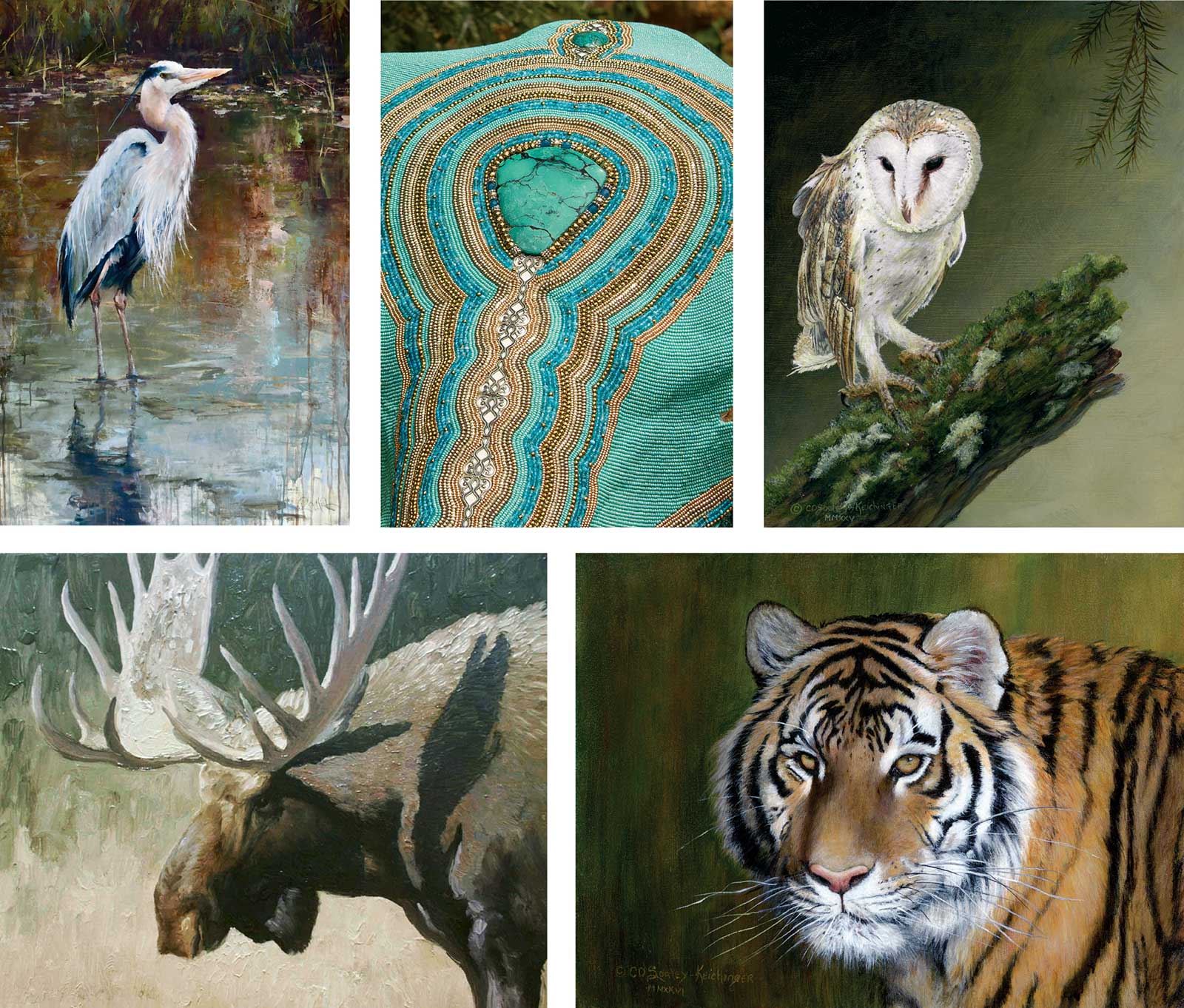
Top: Rana Jordahl, Brackish Estuary, oil, 24 x 36 in. Ali Rouse Beaded Skulls, Blue Buffalo (detail), beads on bone, 22 x 25½ x 11 in., by Ali Rouse. Photo by Passion House Media. Cindy Sorley-Keichinger, Watching, acrylic, 10 x 8 in. Bottom: Edward Suthoff, Moose Portrait, oil on linen, 11 x 14 in. Cindy Sorley-Keichinger, Sun Kissed, acrylic, 9 x 9 in.
Loren Miller believes the finest wildlife art serves as a daily reminder that nature is worthy of our attention and respect. “I often think of nature as both our first and our last cathedral. Long before we built places of worship, humanity encountered the sacred in mountains, rivers, forests, deserts and beneath the vastness of the open sky. Even today, the wilderness remains one of the few places capable of humbling us, reminding us that we are participants in the living world rather than its masters,” says the artist. That idea became the foundation of Miller’s ongoing body of work, Sanctum Naturae. “My hope is that each painting encourages viewers to pause, look more closely and rediscover a sense of awe. If the work inspires even a moment of humility, wonder or gratitude for the natural world, then it has accomplished exactly what I set out to do.”
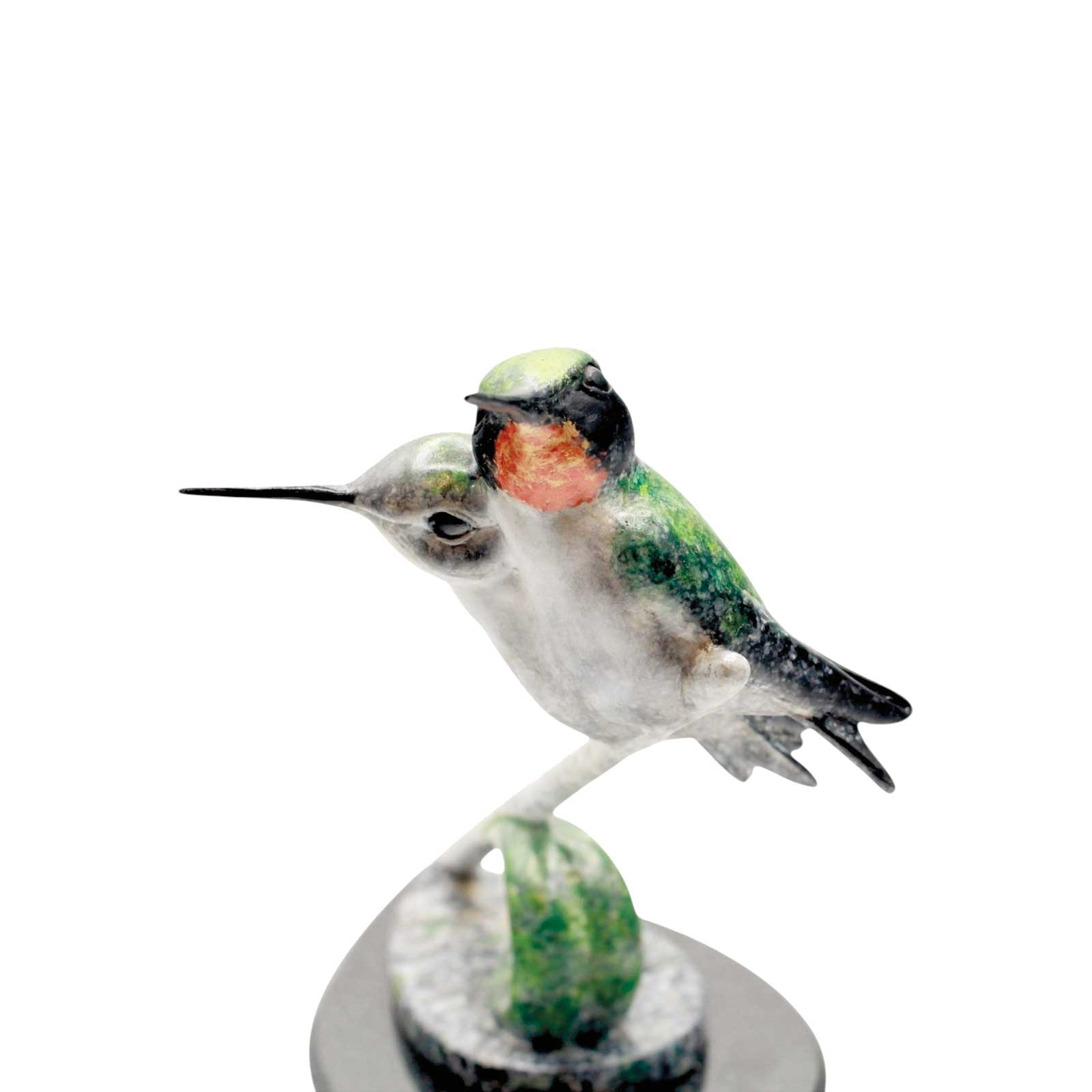
Cassens Fine Art, Ruby Throated Romance, bronze, ed. 30 of 50, 6½ x 7 x 3 in., by Jeremy Bradshaw.
Like many artists, Veryl Goodnight drew animals from the time she could hold a pencil. “My earliest sculptures were created at the Denver Zoo or from wildlife that was being rehabilitated from an injury. These close observations were augmented by extensive travel across the West to observe wildlife in their natural habitats,” says Goodnight, who lives in southwest Colorado in the middle of prime wildlife habitat. “Mule deer do often raise their fawns nearby. The protective mother portrayed in Emergence, while escorting her fawns into the open, is a common sight,” she says of one of her recent bronzes. Goodnight creates both paintings and sculptures.
For generations, Native American artists have portrayed wildlife not simply as subjects, but as cultural stories that express the deep connection between themselves and the natural world.
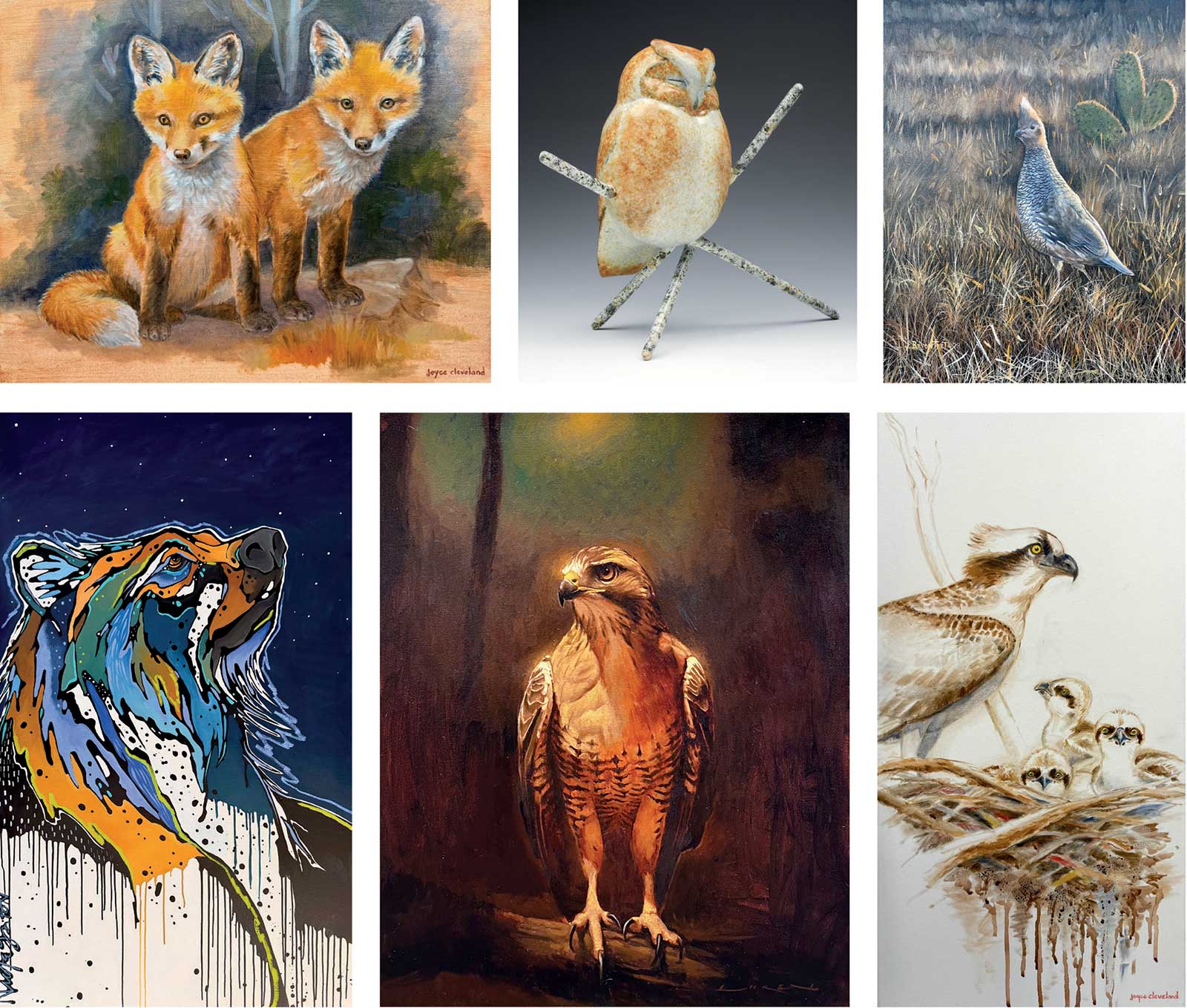
Top: Joyce Cleveland, Curious Kids, oil on canvas, 16 x 20 in. Gallery Wild, Day Dreamer, bronze, 9 x 11½ x 6 in., by Jeremy Bradshaw. Cherokee Art Market, Desert Blue, oil, 20 x 16 in., by Bryon Test (Cherokee). Bottom: Gallery Wild, In the Stars, acrylic on canvas, 60 x 36 in., by Nicole Gaitan. Loren Miller, Seraph of the Canopy, oil, 20 x 16 in. Joyce Cleveland, Mother Knows Best, oil on canvas, 30 x 15 in.
At the 21st annual Cherokee Art Market, these connections come to life through paintings, sculpture, jewelry, pottery, textiles and more, created by more than 160 artists representing tribes from across the United States and Canada. From powerful images of eagles and buffalo to contemporary interpretations shaped by tradition and innovation, Cherokee Art Market offers collectors an exceptional opportunity to experience and acquire Native fine art. The event takes place October 10 and 11 at the Tulsa Hard Rock Hotel & Casino in Oklahoma.
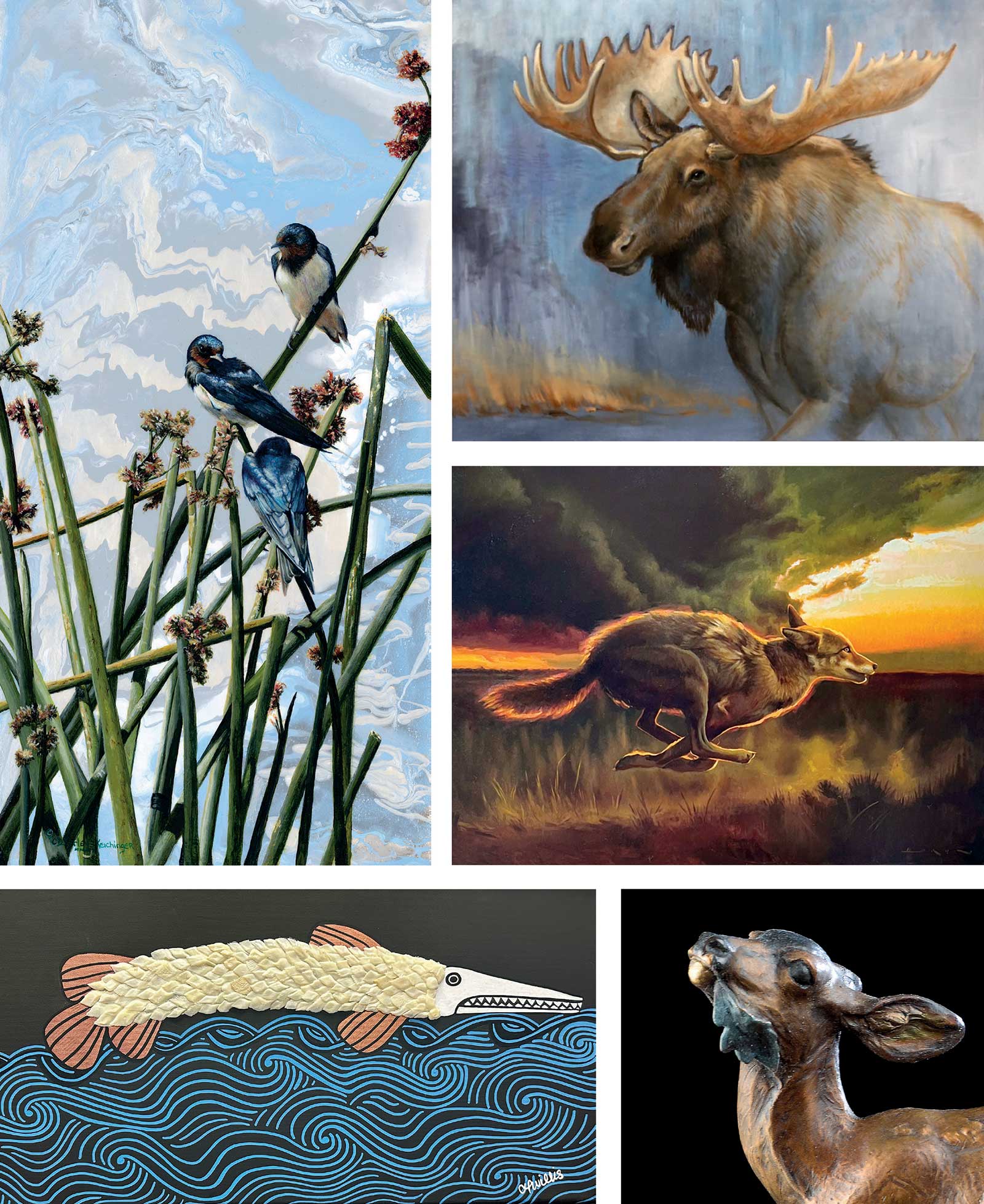
Clockwise from top left: Cindy Sorley-Keichinger, Swallow Dream, acrylic, 9 x 18 in. Joyce Cleveland, Look! Moose!, oil on canvas, 20 x 24 in. Loren Miller, Outrunning the Storm, oil, 30 x 40 in. Veryl Goodnight, Discovery (detail), bronze, 10 x 11 x 2 ½ in. Cherokee Art Market, Moundville Gar, garfish scales, copper pen and acrylic paint, 16 x 20 in., by Nicole Willis (Chickasaw).
The Southeastern Wildlife Exposition is one of the foremost wildlife art fairs in the country, taking place every February in Charleston, South Carolina, and featuring top artists like Julie Jeppsen, Daren Wilding, Peggy Watkins and Walter Matia.
Watkins has long been drawn to the quiet intensity of working dogs, finding beauty not in the moment of the flush, but in the anticipation that comes just before it. In her painting Three Setters, she captures three English setters moving as one through the cover, each canine displaying its own personality while remaining connected by instinct and purpose. Rather than focusing on action alone, Watkins emphasizes teamwork and the silent communication between experienced dogs as they work the landscape together.
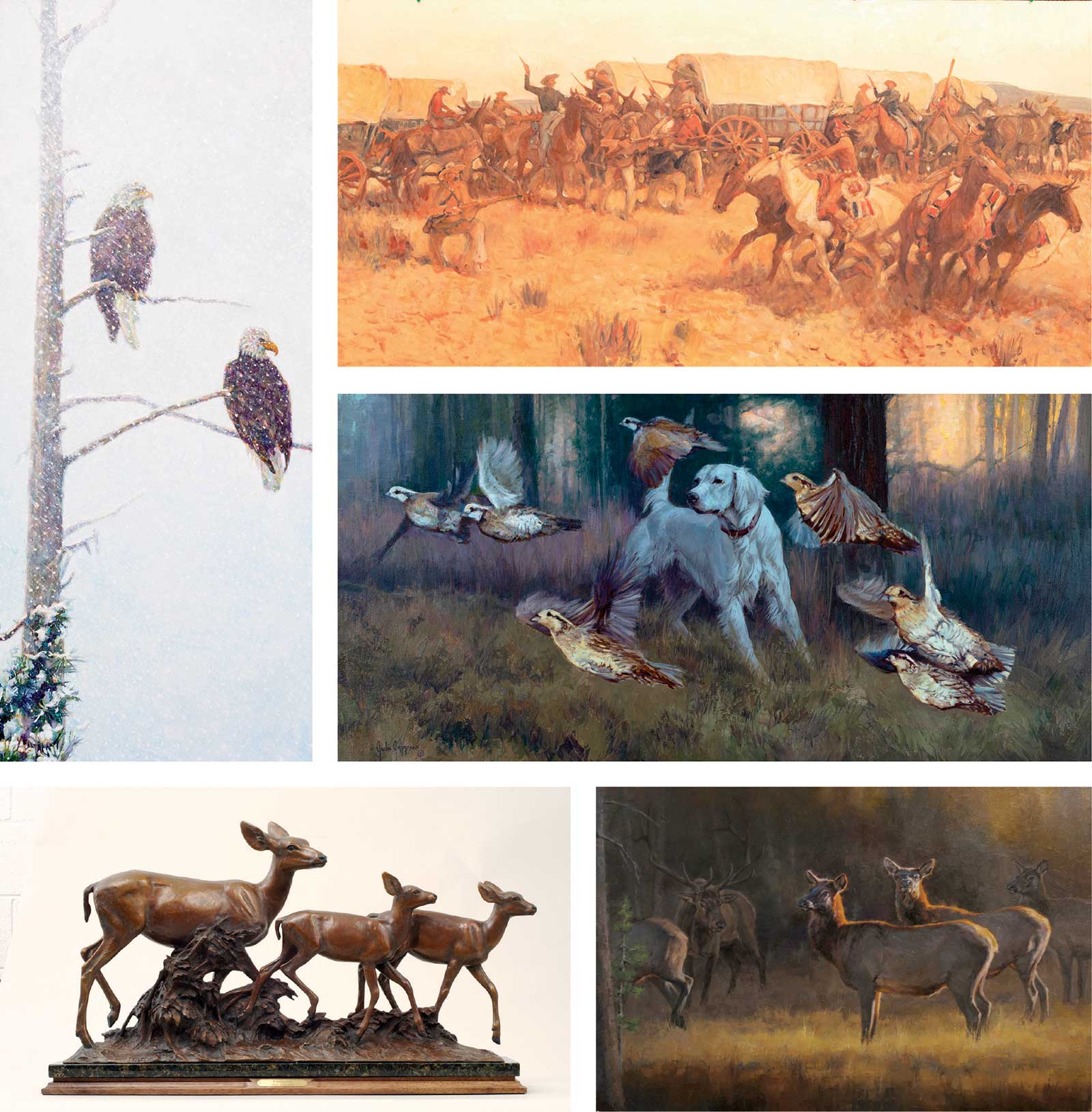
Clockwise from top left: Gallery Wild, Waiting Out the Storm, oil on linen, 72 x 30 in., by Patricia A. Griffin. Big Horn Galleries, Attack on the Wagon Train, oil, by Nick Eggenhofer (1897-1985). Southeastern Wildlife Exposition, Seven to One, oil on linen, 15 x 30 in., by Julie Jeppsen. Southeastern Wildlife Exposition, The Quiet Crossing, oil on canvas, 20 x 30 in., by Daren Wilding. Veryl Goodnight, Emergence, bronze, 17 x 29 x 8 in.
Jeppsen’s Seven to One is not typical of her traditional compositions, making it one of her more compelling works. Rather than placing the setter at the center of the narrative, she chose to give the covey of quail the foreground, allowing their movement to become the driving force of the composition. Jeppsen explored several different versions of the painting before arriving at this arrangement, carefully refining the balance between motion and restraint until the story felt complete.
In The Quiet Crossing, Wilding captures a small herd of elk emerging cautiously from the shelter of the timber into the soft glow of an open meadow. The dominant bull remains partially concealed in the shadows, while the cows pause, alert and attentive. This creates a subtle tension that suggests they have sensed an unseen presence. This could be the artist himself. Rather than relying on dramatic action, Wilding builds the narrative through atmosphere, light and composition. Warm evening light grazes the edges of the animals, separating them from the dark forest beyond and emphasizing the contrast between security and exposure.
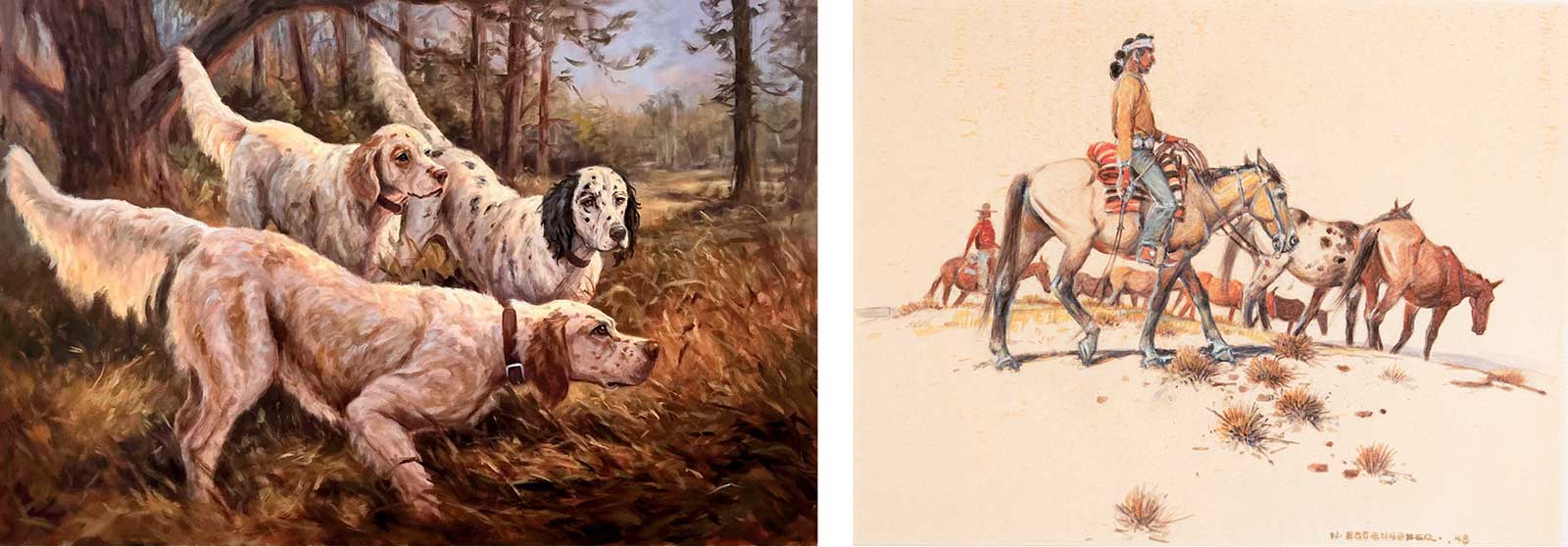
Southeastern Wildlife Exposition, Three Setters, oil on linen, 24 x 36 in., by Peggy Watkins. Big Horn Galleries, Navajo Herder (Lover of Horses), gouache, 12 x 16 in., by Nick Eggenhofer (1897-1985).
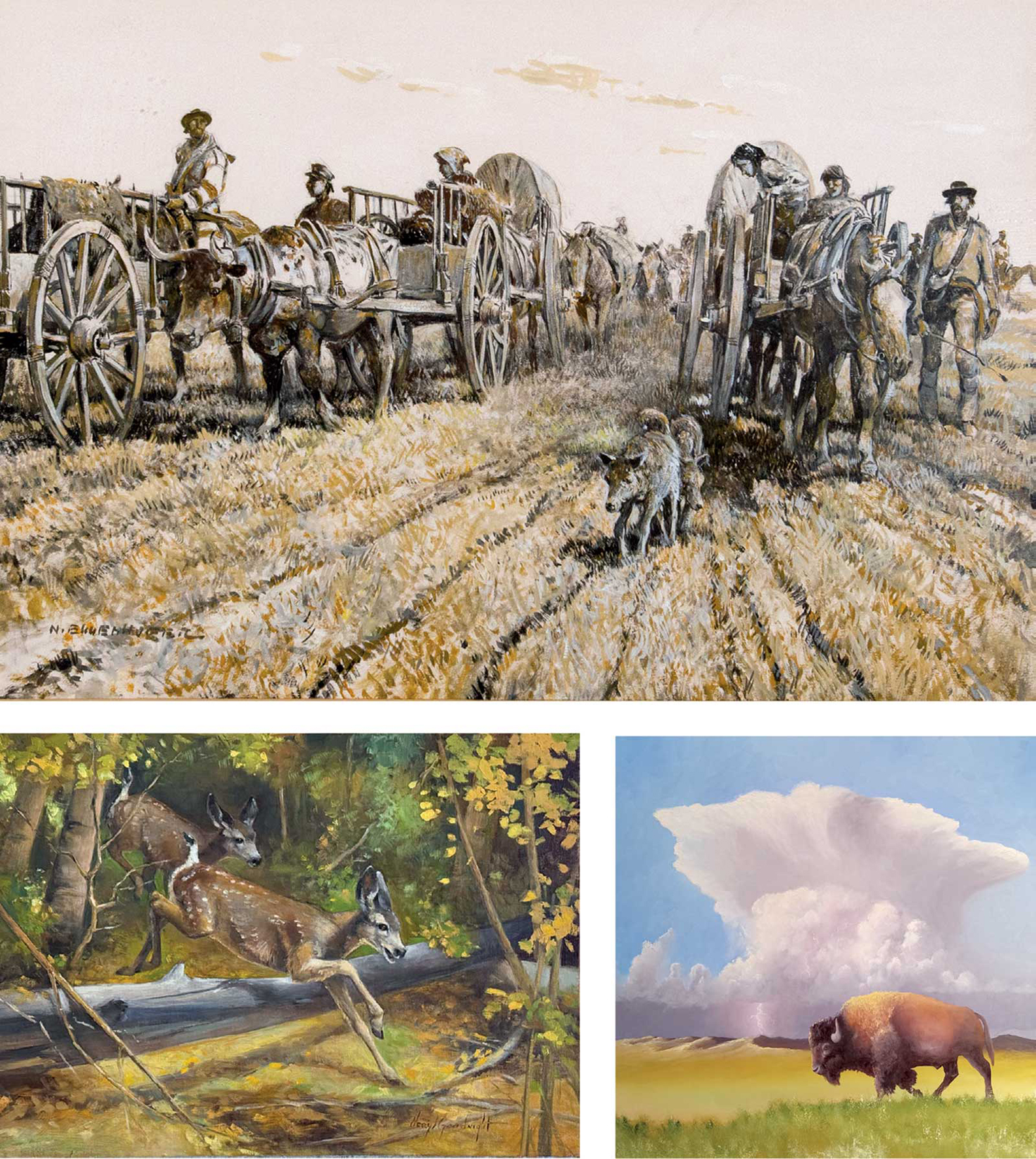
Top: Big Horn Galleries, Red River Carts Pembina County, pen and ink wash, 12 x 18 in., by Nick Eggenhofer (1897-1985). Bottom: Veryl Goodnight, Jumping Lessons. Cherokee Art Market, Southern Plains Splendor, oil on canvas, 30 x 30 in., by Timothy Nevaquaya (Comanche).
Wilding leaves collectors with this: “A painting that continues to draw you into its story over time is one that will remain meaningful for years to come.” —
Featured Artists & Galleries
Ali Rouse Beaded Skulls
(505) 615-7094
www.alirouseart.com
IG: ali_rouse_artist
Amber Sampson Fine Art
Bozeman, MT
www.ambersampsonart.com
IG: amber_sampson_art
Big Horn Galleries
1167 Sheridan Avenue, Cody, WY 82414
(307) 527-7587
www.bighorngalleries.com
Cassens Fine Art
215 W. Main Street, Hamilton, MT 59840
(406) 363-4112
gallery@cassensfineart.com
www.cassensfineart.com
IG: cassensfineart
Cherokee Art Market
cherokeeartmarket@cnbglobal.com
cherokeeartmarket.com
Cindy Sorley-Keichinger
(780) 847-2294, goldfarm@telusplanet.net
Represented by Picture This Gallery
(800) 528-4278
www.picturethisgallery.com
Coeur d’Alene Galleries
213 E. Sherman Avenue, Coeur d’Alene, ID 83814
(208) 667-7732
buddy@cdagalleries.com
www.cdagalleries.com
Dave English
720 W. Aristocrat Drive, Meridian, ID 83642
www.daveenglishstudios.com
IG: imdaveur
Edward Suthoff
artistsforconservation.org/artists/1544
Elise Mahaffie
(301) 325-4899
elisemahaffie@mac.com
www.elisemahaffie.com
Gallery Wild
80 W. Broadway, Jackson Hole, WY 83001
(307) 203-2322
www.gallerywild.com
Jim E. Miller Art
james007twi@gmail.com
www.jimemillerart.com
Johanna Lerwick
Norwich, NY, (607) 336-6218
info@johannalerwick.com
www.johannalerwick.com
Joyce Cleveland
www.joyceclevelandfineart.com
Kathi Holzer
Boise, ID
www.kathiholzerart.com
IG: kathiholzerart
Loren Miller
Represented by Found Fine Art
912 Water Street, Bastrop, TX
(512) 718-1630, www.foundfa.com
Madaras Gallery
3035 N. Swan Road, Tucson, AZ 85712
(520) 615-3001
gallery@madaras.com
www.madaras.com
Manitou Galleries
123 W. Palace Avenue, Santa Fe, NM 87501
(505) 986-0440
www.manitougalleries.com
National Museum of Wildlife Art
2820 Rungius Road, Jackson Hole, WY 83001
(307) 733-5771, www.wildlifeart.org
Rana Jordahl
181 Beresford Creek Street
Daniel Island, SC 29492
(843) 270-4896
www.ranajordahl.com
IG: ranajordahl_fineart
Southeastern Wildlife Exposition
211 Meeting Street, 2nd Floor
Charleston, SC 29401
(843) 723-1748
sewe@sewe.com
www.sewe.org
Teresa Lynn Johnson
(505) 334-1744
www.teresalynnjohnson.com
IG: teresalynnjohnsonartist
Veryl Goodnight
www.verylgoodnight.com
Powered by Froala Editor
Powered by Froala Editor
Powered by Froala Editor
Powered by Froala Editor


