Western art has had many significant periods of intense growth that drastically changed the trajectory of the genre.
Consider the 1830s, when Karl Bodmer and George Catlin made separate journeys west to paint Native American tribes. Or the 1870s, when Albert Bierstadt and Thomas Moran made their own trips west to paint unspoiled lands. In the 1890s, Charlie Russell hung up his spurs and moved to Great Falls, Montana, and Frederic Remington moved to New Rochelle, New York, and created Broncho Buster.In the 1910s, a flood of artists descended into the high desert of Taos, New Mexico, and formed the Taos Society of Artists. These events all created seismic shifts within the foundations of American art—shifts that allowed the formation of Western art as its own movement.
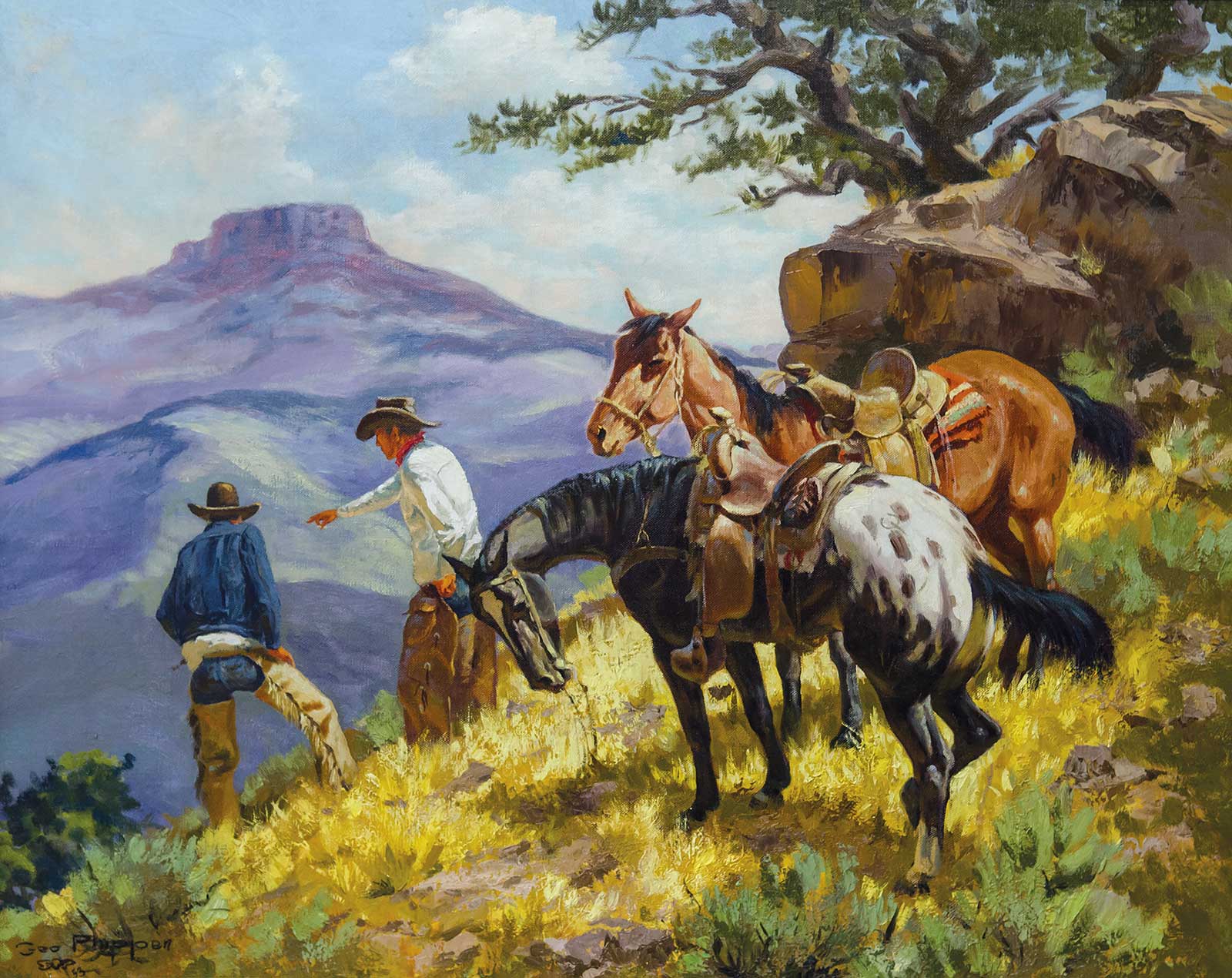
George Phippen (1915-1966), Checking the Herd Below, 1953, oil
But no period was as instrumental to the present-day Western art market than the 1950s and 1960s. It was a time of reevaluation for the American West, and also a time of growing acceptance within cultural institutions. Fans of the genre witnessed the rise of museums built around private art collections owned by Frank Phillips, Amon Carter, Bradford Brinton, Sid Richardson and Thomas Gilcrease. In 1953, a deal was struck to preserve the Charlie Russell home and studio, as well as a major Russell collection. Throughout the post-war period in the 1950s and 1960s, major and early Western art exhibitions were being presented in Missouri, Minnesota, Wyoming, Nebraska and Oklahoma. The needle was moving.
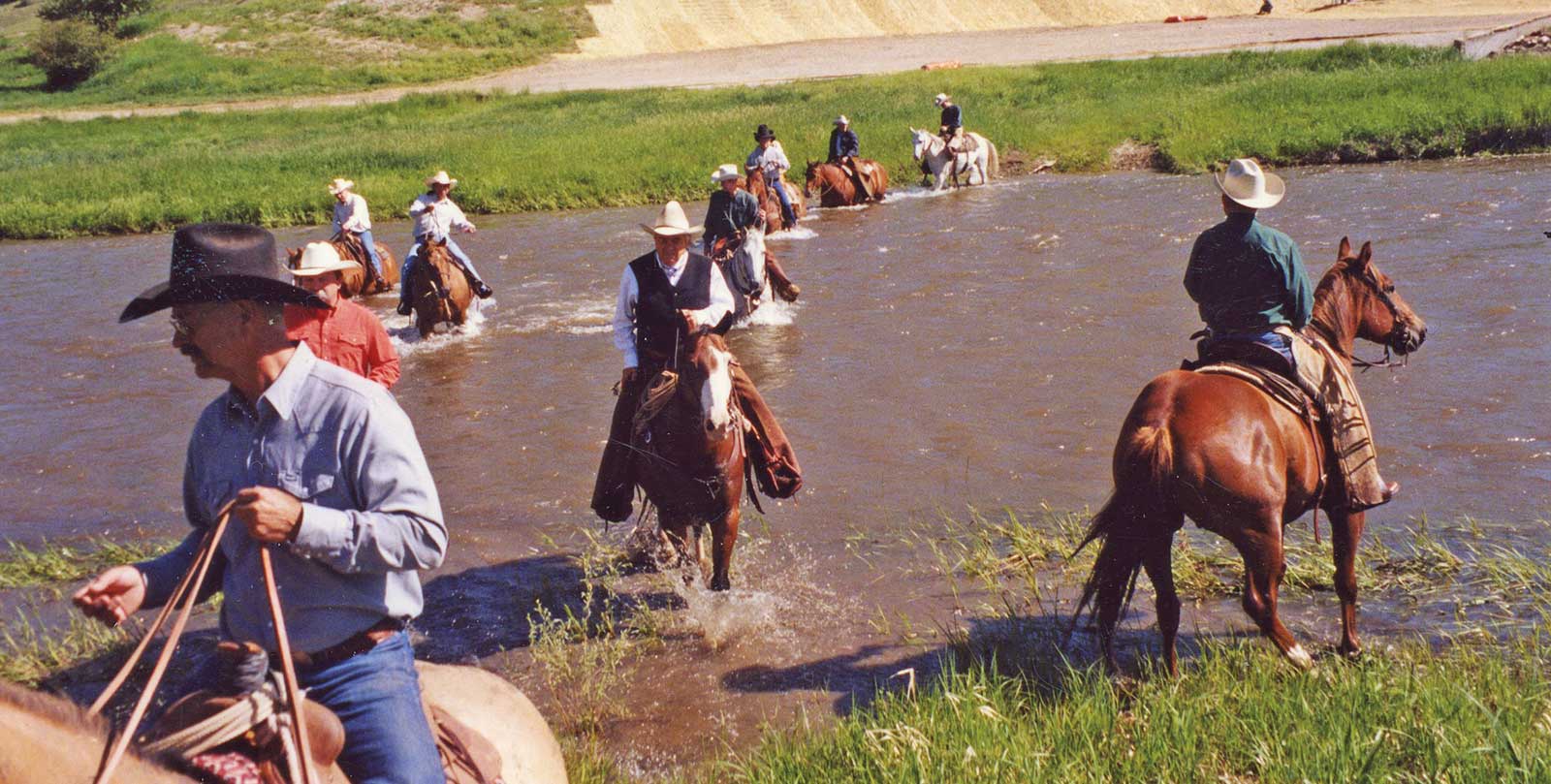
2002 CA trail ride at the 6666 Ranch in Montana. Bill Nebeker rides on the left, with John Coleman behind him. Joe Beeler is in the center riding out of the water. Image courtesy Wayne Baize.
And then, in 1964, three cowboy artists—Joe Beeler, Charlie Dye and John Wade Hampton—attended a cattle round-up on a ranch in Sonora, Mexico. When they returned home, they raved about the experience to George Phippen. Soon an idea was hatched, and the four men formed the Cowboy Artists of America in 1965.
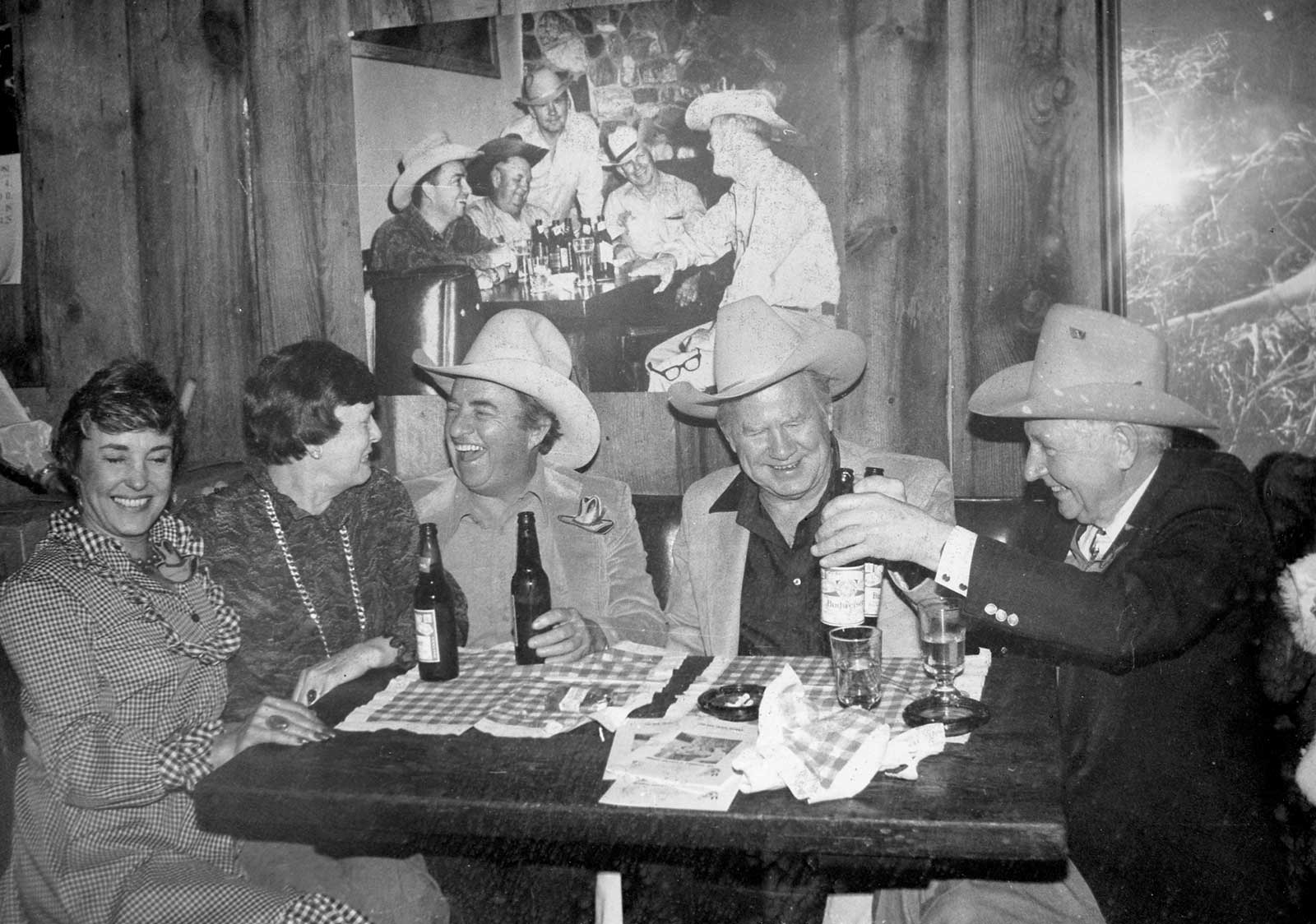
Joe Beeler, left, John Wade Hampton and Bud Helbig celebrate the founding of the CAA. The famous photo of the founders is on the wall. Image courtesy the Sedona Heritage Museum, Sedona, AZ.
This history and the general mood of the period are documented by B. Byron Price in his 2015 book, The Sons of Charlie Russell. The author writes that momentum was building for Western art, but it risked stalling. “Though museums that collected and exhibited historical Western American art flourished in the 1950s and 1960s, the same could not be said for living artists in the region,” Price writes. “In the wake of World War II, abstract expressionism had largely supplanted Depression-era regionalism as the prevailing art from east and west, and many representational painters and sculptors struggled to make a living. More than a few churned out illustration for Western novels, magazines, calendars, advertisements and movie posters to make ends meet, their livelihoods continually jeopardized by the inroads of photography.”
It was the formation of the Cowboy Artists of America—and also the exhibiting of living Western artists at venues such as the National Cowboy Hall of Fame (today the National Cowboy & Western Heritage Center), which opened the same year as the formation of the CAA—that helped turn the tides on Western art, from dusty history made by dead people of the previous century to a living, breathing form of art made by artists of a new generation.
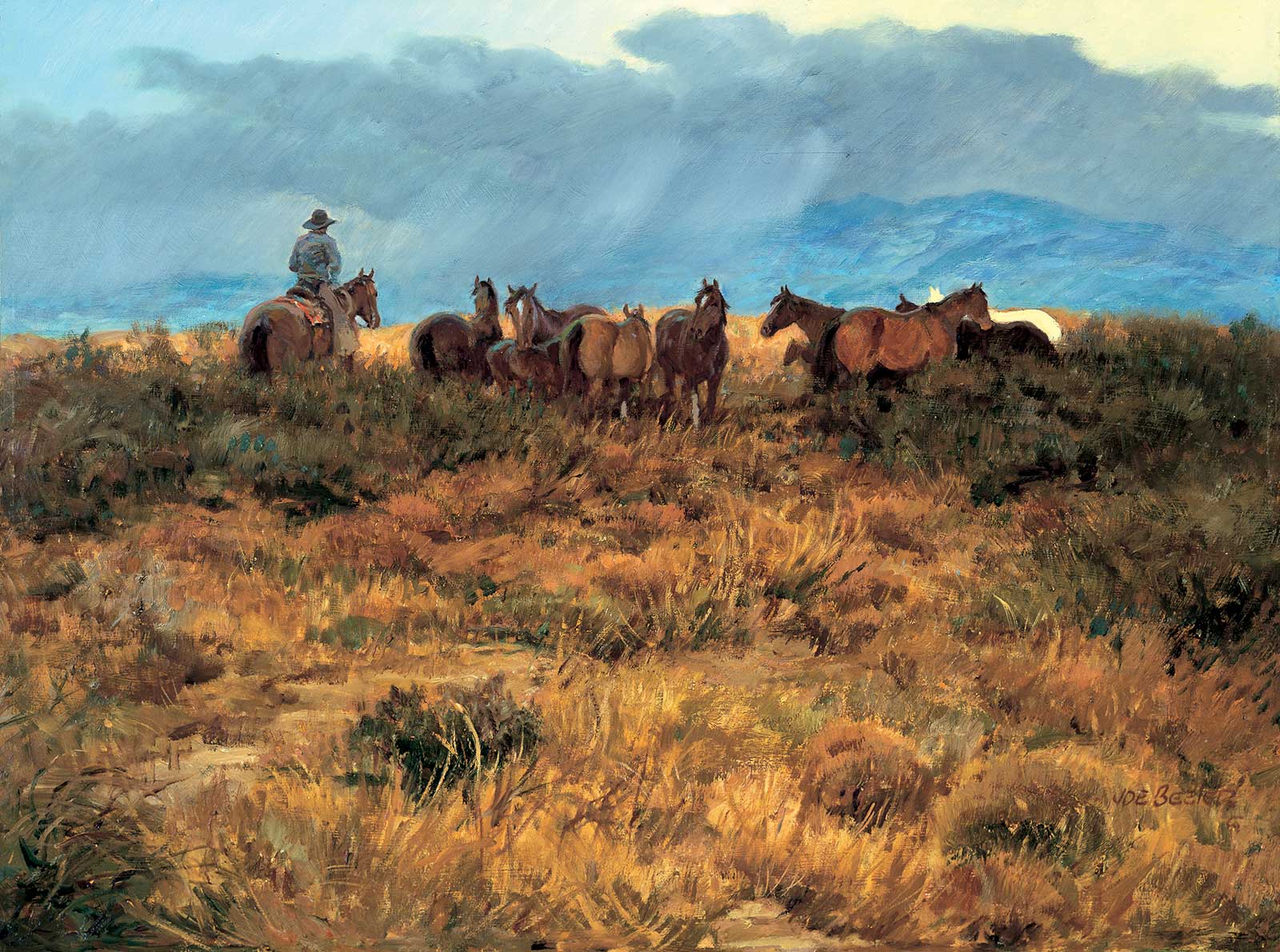
Joe Beeler (1931-2006), Winter Morning, oil, 18 x 24 in.
Sixty-one years later, the group and its famous CA brand are still active participants in the market, even as the members share space in a more crowded field, which is a product of their own success. In October, the group will celebrate its 60th exhibition, a milestone that has allowed members to look back on the past, and also into the future.
Mikel Donahue, who is the current CAA president, credits the longevity of the group to one of its core missions, which is to preserve the authenticity of the West. “It’s very important we maintain the group and the mission if for no other reason than to maintain the authentic representation of the West. Staying true to that is the truth under everything we do,” he says. “Western art and Native American art has become very popular. I have seen examples of both that are simply not accurate or true to the history. When people who know these authentic Western lifestyles look at art, they can see if the artist has painted the wrong kind of bit or saddle, or if they left something off. That bothers me because my goal, and the group’s goal, is to be as accurate as possible.”
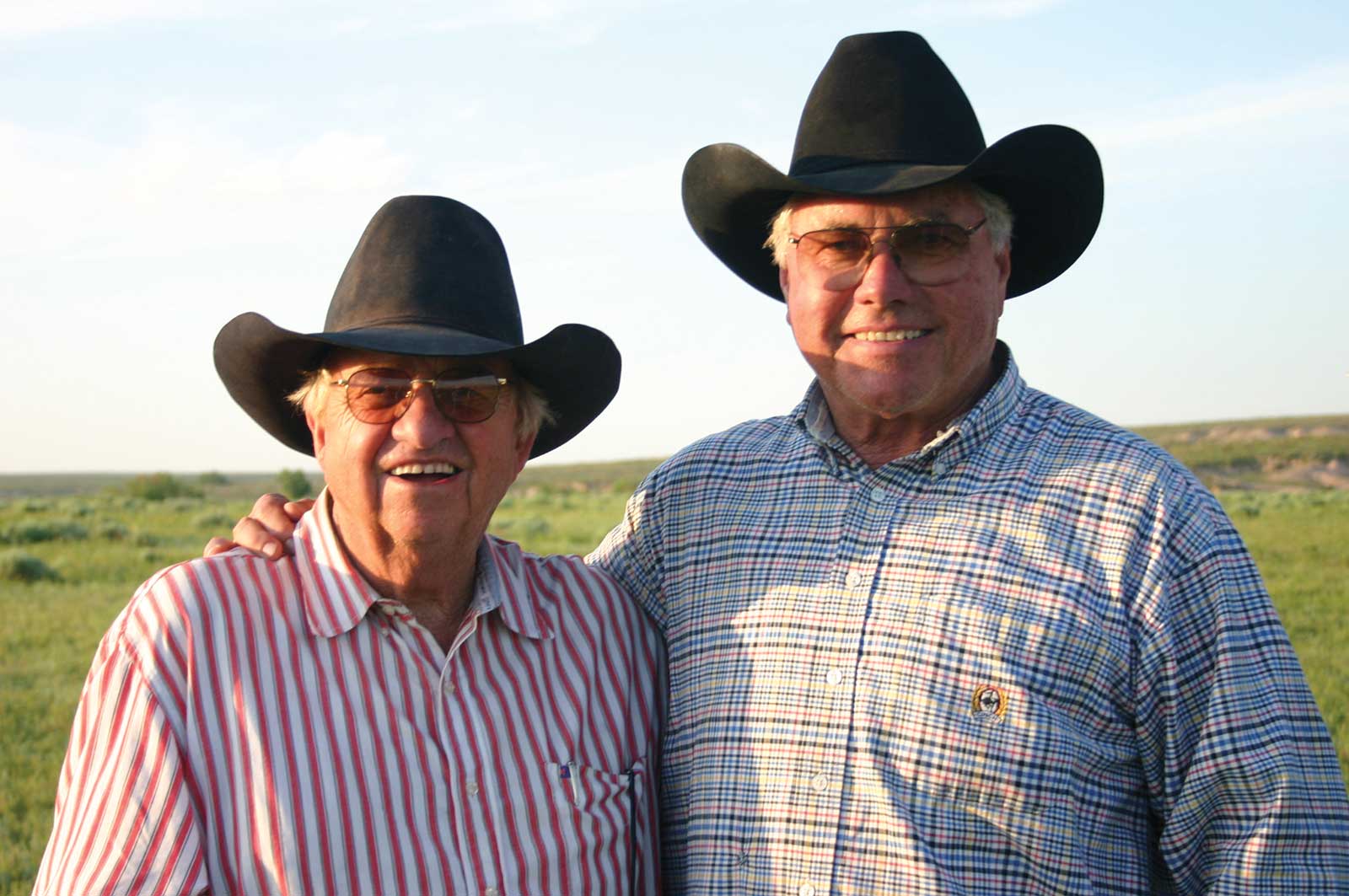
Joe Beeler, left, and Fred Fellows on one of the CA trail rides.
Donahue continues, “We like to bring up Charlie Russell’s work. He knew cowboys because he was one. So, you knew that when he painted cowboys, and the gear and tack they had, it was authentic because he was right there with them. Our high standards for authenticity are what drives the group. The other work is not bad. Just different. But that’s what sets us apart.”
“Not bad, just different” is a point worth underlining. The CAA is not the history police patrolling all the galleries and museums hunting down painters who depict the wrong spurs, chaps or D-rings on a saddle. But by reinforcing the tenets of Western authenticity, the group is telling collectors that do admire that level of detail, history and accuracy that the work at any CAA exhibition has passed muster. To be fair, many artists working today attain the same or similar levels of realism and authenticity as the CAA, even as those artists push accuracy up against narrative, drama, technique and even their own style, which may not even be concerned with pinpoint accuracy at the spur-and-chaps level of detail. Even as Western art has become more stylistically diverse and expanded beyond aesthetic boundaries, what the Cowboy Artists has done over 60-plus years is establish a standard for it and its members, a standard that has urged others—those in the group and not—to preserve as much of the real West as possible.
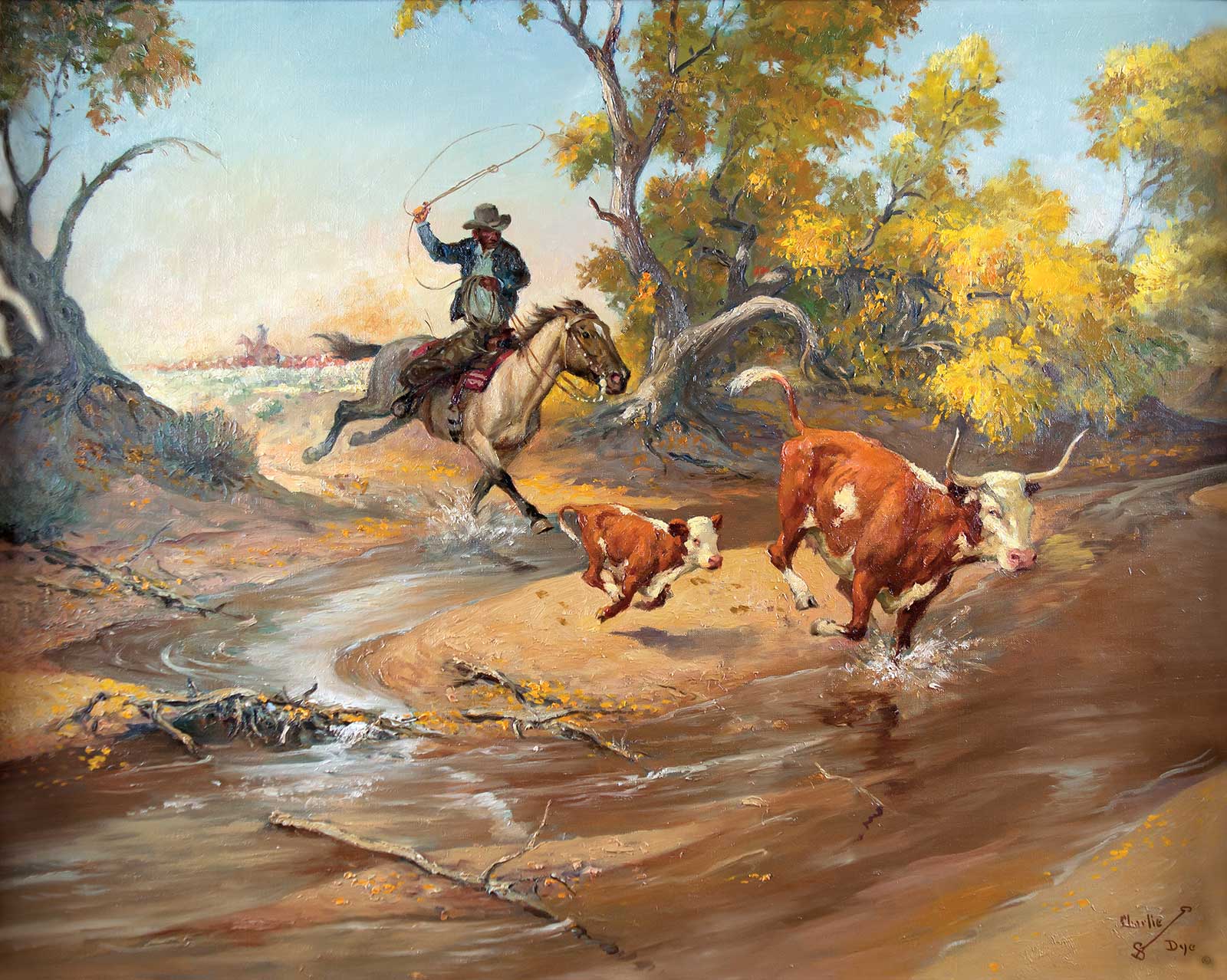
Charlie Dye (1906-1972), After a Bunch Quitter, oil on canvas, 24 x 30 in.
Donahue notes that contemporary art and its recent success within Western art circles provides the CAA with another chance to reaffirm its places within the landscape of Western art. “Every generation has its opportunities to maintain what’s happened before or grow and move forward. I think a lot of our guys see that. They see the opportunity to set ourselves apart, and to provide work that is not seen other places,” he says. “We can’t do what we did in the early years, which is basically be the only Western show in town. But, at the same time, we have an opportunity to reestablish the level of what we do, and maintain that historical relationship with the West.”
As much as the CAA proudly clings to its roots, it’s also embracing the future wholeheartedly. Contemporary art has even found its way into the group thanks to 2016 inductee Phil Epp, whose modern views of vast prairies and clusters of ponies on hilltops have been a huge hit at past exhibitions. He’s not only had numerous sold-out showings, but he’s taken home top awards and gold medals. The group is also continuing to explore its place in the West as it moves the 60th exhibition to Denver after seven years in Fort Worth, Texas. Donahue calls the change of venue a chance to rebrand the show, which will have some throwback elements, including a black-tie sale and a larger effort to keep some of the work secret until the opening weekend, which was a feature of earlier CA events in Phoenix where collectors would frantically dash into the gallery to place bids on works they had only just glimpsed.
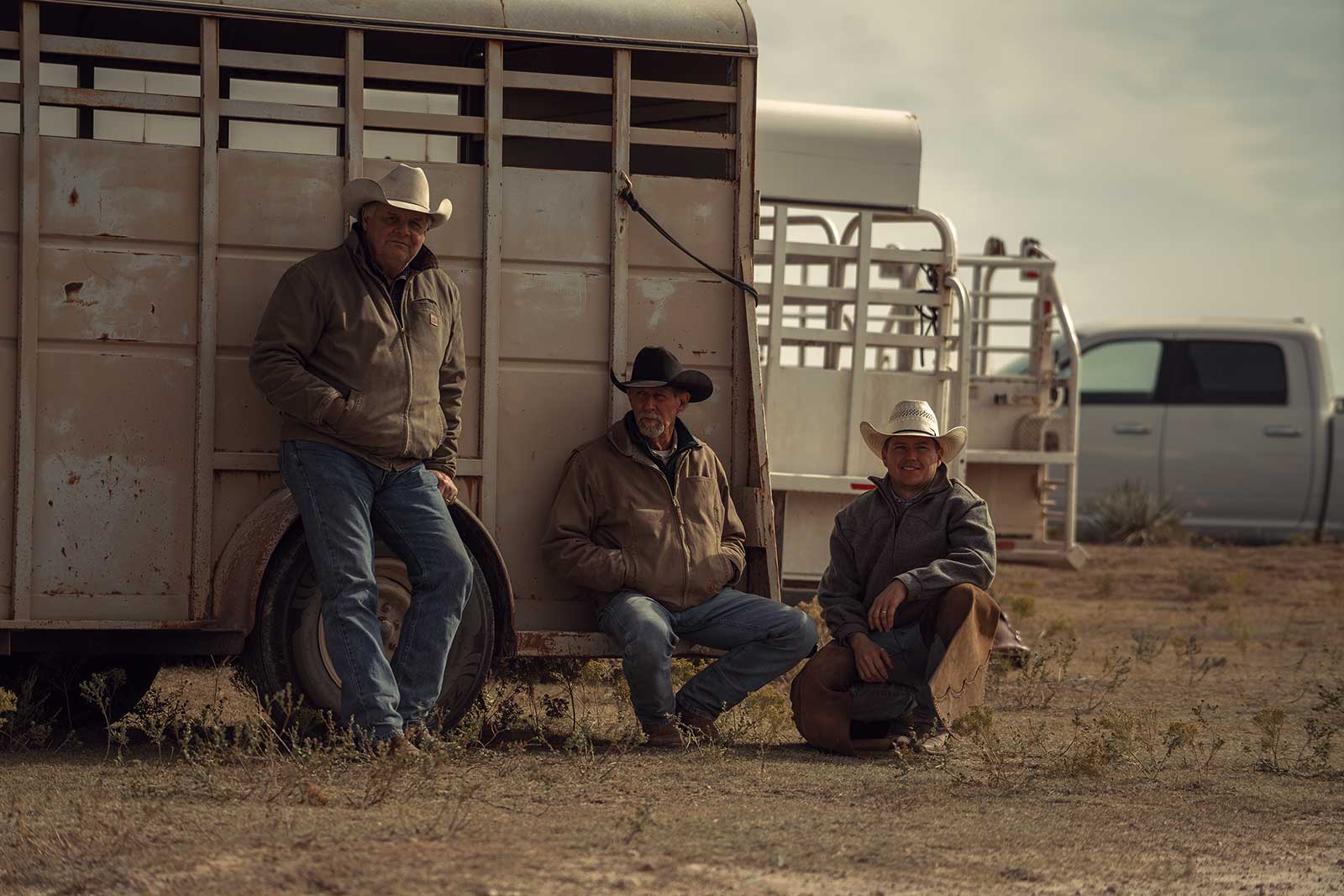
Mikel Donahue, left, Martin Grelle and Tyler Crow on the Bell Ranch in New Mexico.
A smaller piece of this year’s show, but one that holds significant meaning, is this year’s inclusion of two guest artists: Arizona painter Shawn Cameron and Colorado illustrator-turned painter Thomas Blackshear II. It’s the first time the group has worked with a woman artist and a Black artist. Although guest artists are not invited to be members, these CA milestones have not gone unnoticed. The inclusion of Cameron is especially noteworthy since women in the CAA has been a point of contention to outsiders and critics of the group. Cameron and Blackshear are well established in the art world and deserving of the invites, which makes their inclusion not just historic, but also appropriate and timely.
The CAA’s continued and sustained existence might be mystifying to some collectors and historians—keep in mind, the Taos Society of Artists only lasted 12 years—but to some, it was almost preordained from the beginning. Fred Fellows, who was voted into the group in 1969 and is now an emeritus member, has been with the group longer than anyone alive or dead. “I actually did see it lasting this long,” he says. “It didn’t start as an art show. It was a bunch of artists that got together to camp out, sit around the campfire, drink a little tequila and talk about their interest in Western art. There wasn’t magazines yet or other things we have today. It was just us. As they say, misery loves company and we were all having a hard time make it. We went to shows in Oklahoma, then Phoenix, and we all started showing at galleries in Scottsdale and other places. Suddenly everyone wanted to be a cowboy. But you had to have it in your heart. Some roped and rode. Others, like John Clymer and Bob Lougheed, they had never even been on a horse. But we all got together because we shared this thing in our lives. And we respected one another.”
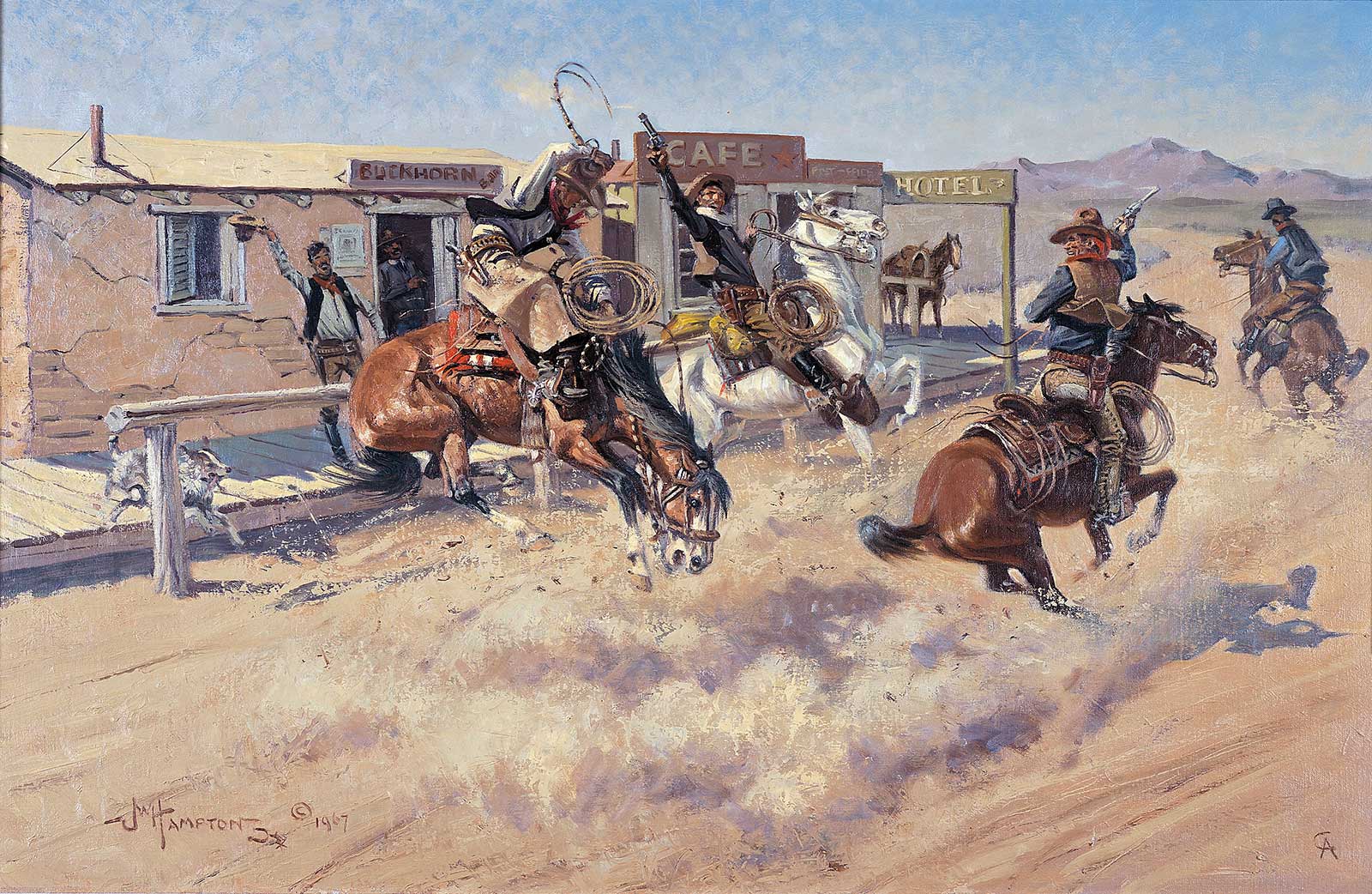
John Wade Hampton (1918-2000), The Dust Raisers, 1967, oil on canvas, 26 x 40 in.
Although he knew the group would last, Fellows admits it’s remarkable the CA has found a way to exist for as long as it has. “Put nine plumbers together in a circle and ask them to form a club. They’d be arguing within a week and break up,” he adds. “But this group is different. The West binds us all together in a special way.”
For Donahue, who is leading the charge to the 60th show in Denver, the Cowboy Artists of America still has a large role to play in Western art and American culture. “Our show isn’t just a chance to rebrand but also an opportunity to expose new people to our brand. The CA has a lot of equity in it, and we have the responsibility to carry that forward to those who came before—for Joe Beeler and Jim Reynolds and Howard Terpning and Fred Fellows,” he says. “What they did was immense, and now we want to continue it for a new generation.”
For more information about the CAA and its October show, visit www.cowboyartistsofamerica.com. —
+++
Editor’s note: Michael Clawson was invited to be an honorary member of the Cowboy Artists of America in 2025.
Powered by Froala Editor


