Harold “Hal” Tate and his wife Naoma purchased Big Hat Ranch outside of Cody, Wyoming, in 1999. Hal had been a member of the board of trustees of the Buffalo Bill Historical Center and both he and his wife had a fondness for the art of the region. After Hal’s death in 2003, Naoma continued to augment their world-class collection and, with her family and the Hal R. and Naoma J. Tate Foundation, continued to donate important work to the Buffalo Bill Historical Center, now known as the Buffalo Bill Center of the West.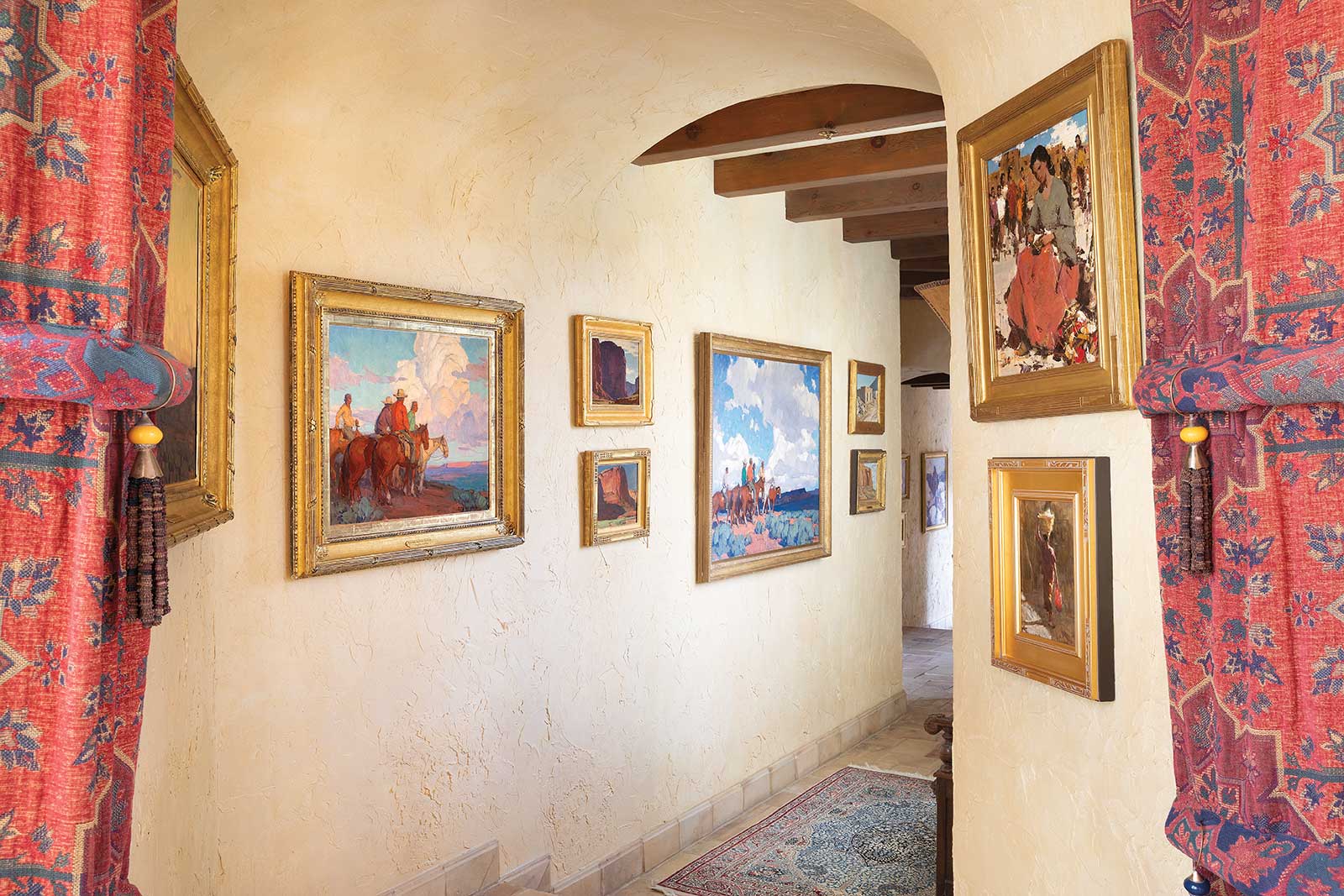 In the hallway, from left to right, are paintings by Edgar Payne (1883-1974): Arizona Indians, oil on canvas; Canyon Wall, oil on canvas on board; Riders in Canyon de Chelly, oil on canvas on board; and Land of the Navajo, oil on canvas. On the right, from top to bottom, are Yarn Maker, oil on canvas, by Burt Procter (1901-1980), and Untitled, circa 2005, by Karen Offutt.Her criteria for the art in her Wyoming home is quite focused. “The work should have been painted primarily in Wyoming or surrounding states—Montana, Colorado, Utah, Idaho. The work should be completed around the turn of the century—roughly 1850 to 1930. The work should reflect (A) the flora and wildlife of Wyoming and (B) the cowboy way of life. The work should reflect life in real time.”
In January 2021, Naoma’s desire to live closer to family and friends prompted her to buy “Big Hat South” in the Sonoran Desert of Scottsdale, Arizona. Her collecting goals for her Arizona home reflect its location. “The goals of excellence and beauty remain the same,” she explains, “but the narrative of the work has shifted to meet the environment in which the house resides, and its style. Whereas the ranch reflects imagery of early exploration of the West, dramatic scenes of wildlife and the restless, rousting cowboy culture of the intermountain West, the Arizona home reflects my longtime interest to explore the Southwest movement in Western art. Perhaps unconsciously, the collection reveals a desire to create a retreat, a quieter life, a home with art that offers more whispers, and fewer shouts. The works offer a more contemplative sensibility with depictions of florals, landscapes, still life, images of Native Americans at peace in their environment and the introspective religious symbolism found in both Catholic iconography inherent in images of adobe missions and processions and the Southwest culture of the ancient and still working pueblos.”
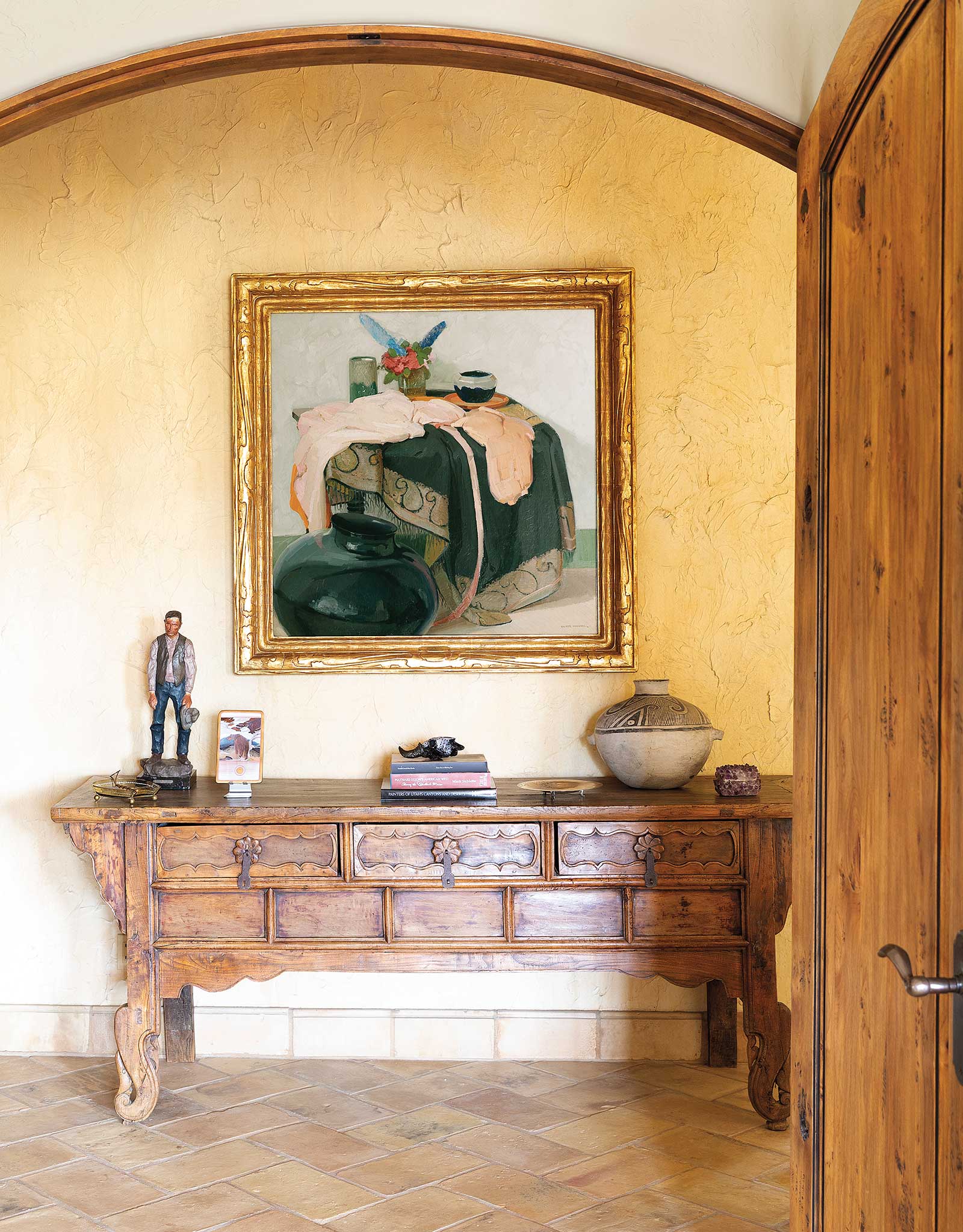 Pink and Black, circa 1918, oil on canvas, by Victor Higgins hangs above the chest on which is Where the Trail Forks, 1964, bronze, by Harry Jackson (1924-2011).
Naoma has always maintained that there is energy and a vital force intrinsic to objects made by hand. Objects such as hand-woven rugs, paintings and sculpture by artists whose creations are born from years of study, talent and expertise, and who stand the test of time have this energy. She comments that her collection of vessels molded of clay as early as the 1850s “hold such physical energy not only from their creation and decorative elements, but from their utilitarian use through generations of Native Americans who relied on these pots for portage and storage. They lived in proximity to these vessels every day and there was a reverence for their care. To live with the agency of these objects is a privilege.”
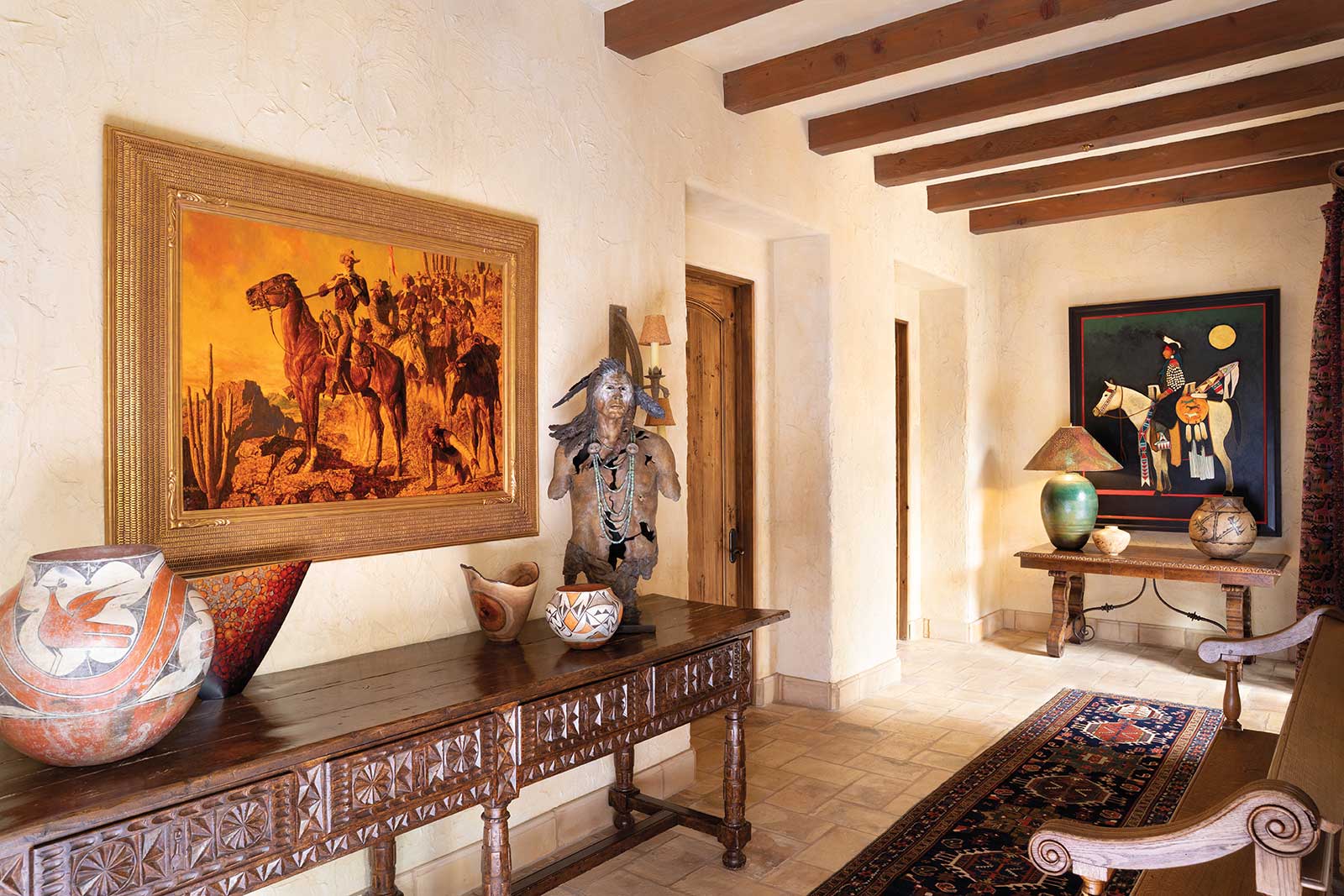
On the left is a Zia polychrome storage jar, circa 1880, clay and pigment. The painting is A Glimpse of Geronimo, oil on canvas, by Arnold Friberg (1913-2010). On the far end of the sideboard is Apsaalooke, 2021, bronze, by Campbell Dosch. At the end of the hall is Evening Parade Rider, 2021, mixed media, by Kevin Red Star. Beneath it is an early Cochiti storage jar, circa 1825-1850, pottery.
An expansive contemporary desert home, the residence is architecturally rooted in the pueblo revival aesthetics with large floor tiles, open beams, long hallways and a large courtyard. Its large empty walls offered her a blank slate from which to dream. It was an opportunity for her to explore art of the Southwest, especially the work of the Taos Society of Artists, a movement in art that had engaged her interest and imagination for years. For Casa Tate, her strategy was to first engage with paintings and sculpture from the Southwest, and secondly, to search for work from the early part of the 20th century by artists who were classically trained and who stood the test of time. The art came first. Acquisitions were never considered as objects to decorate the house, rather the house offered wall space to exhibit the art.
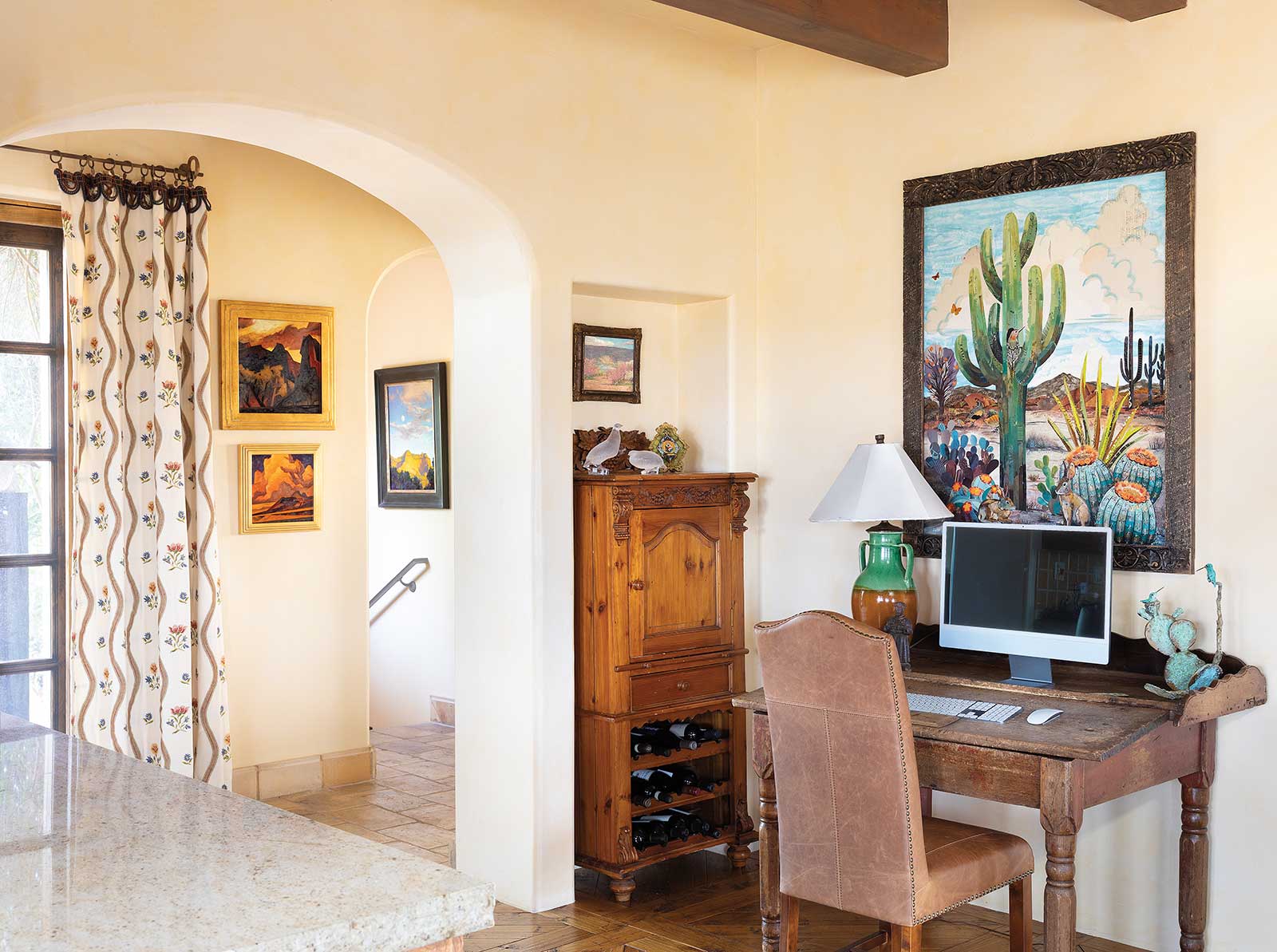
In the hall are two paintings by Ed Mell (1942-2024): Towers of Zion, oil on canvas, and Untitled, oil on canvas. Above the desk is Cactus, 2021, mixed media, by Dolan Geiman.
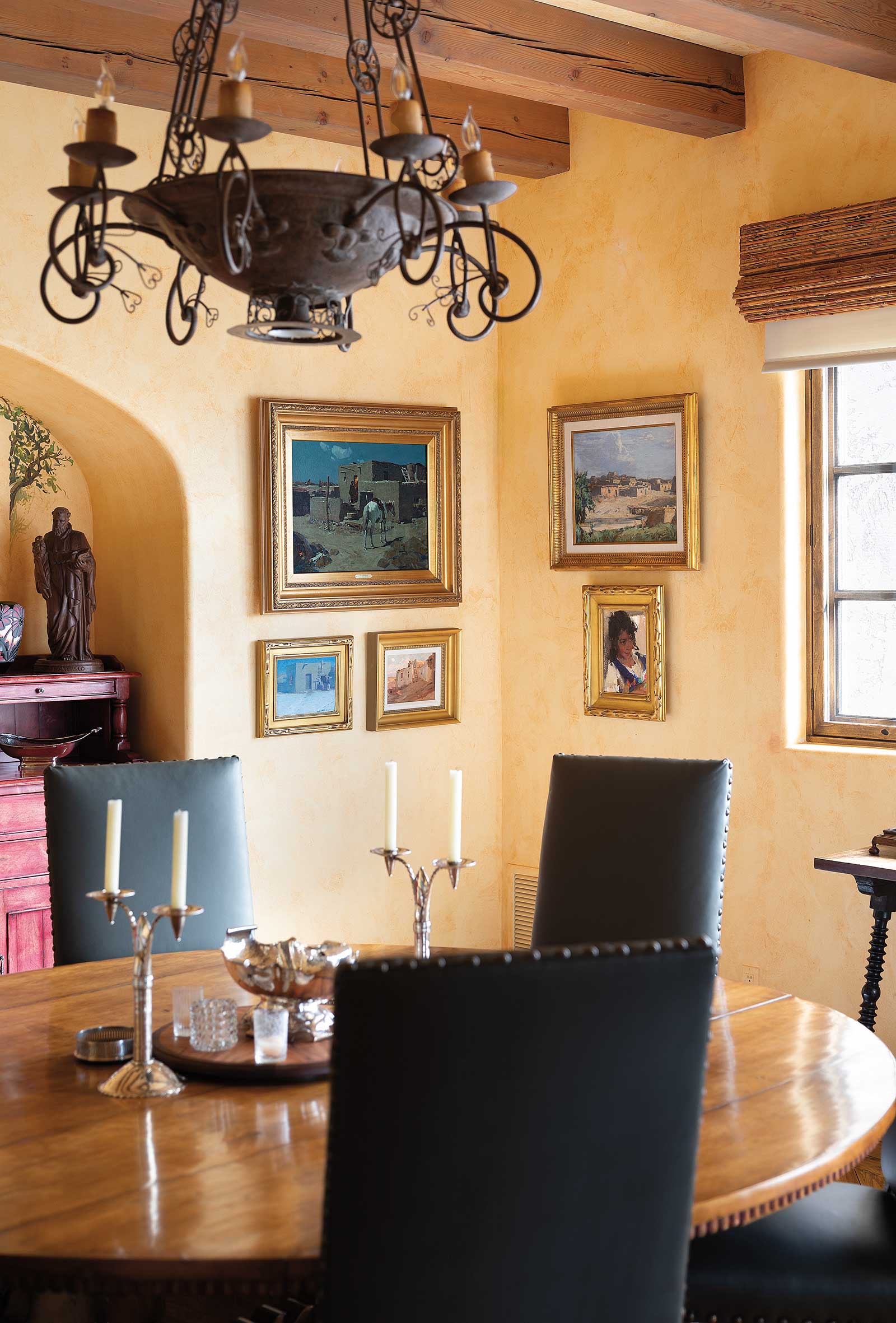
On the wall next to the nicho are The Homecoming, 1934, oil on canvas, by Frank Tenney Johnson (1874-1939). Beneath it are Adobe Village, 1913, oil on canvas on board, by Joseph Henry Sharp (1859-1953) and, on the right, New Mexico Pueblo Walpapi, 1903, oil on canvas by Eanger Irving Couse (186-1936). On the window wall are The Pueblo of the Zuni, oil on canvas, by Carl Oscar Borg (1879-1947), and, on the bottom, Niña, oil on canvas, by Nicolai Fechin (1881-1955).
I am always fascinated by how works come into a collection, and I asked Naoma about the “thrill of the hunt.” “I would say it was an E.I. Couse, which took decades to find,” she replied. “Familiar with his oeuvre, I recognized in the painting Taos Love Call, the work I’d been searching for. It is a large painting, 34 by 46 inches, and is set apart to some extent from other Couse images. With layered tones and shades of green, it depicts spring and it is a love story. The composition, with a proscenium of trees, and the echo of a night sky in the creek, depicts a youth playing a flute and a girl to the side, lured to him by the sound of his music. The painting is calm, melodic and holds hope of new beginnings. Taos Love Call, takes pride of place hanging in my living room.”
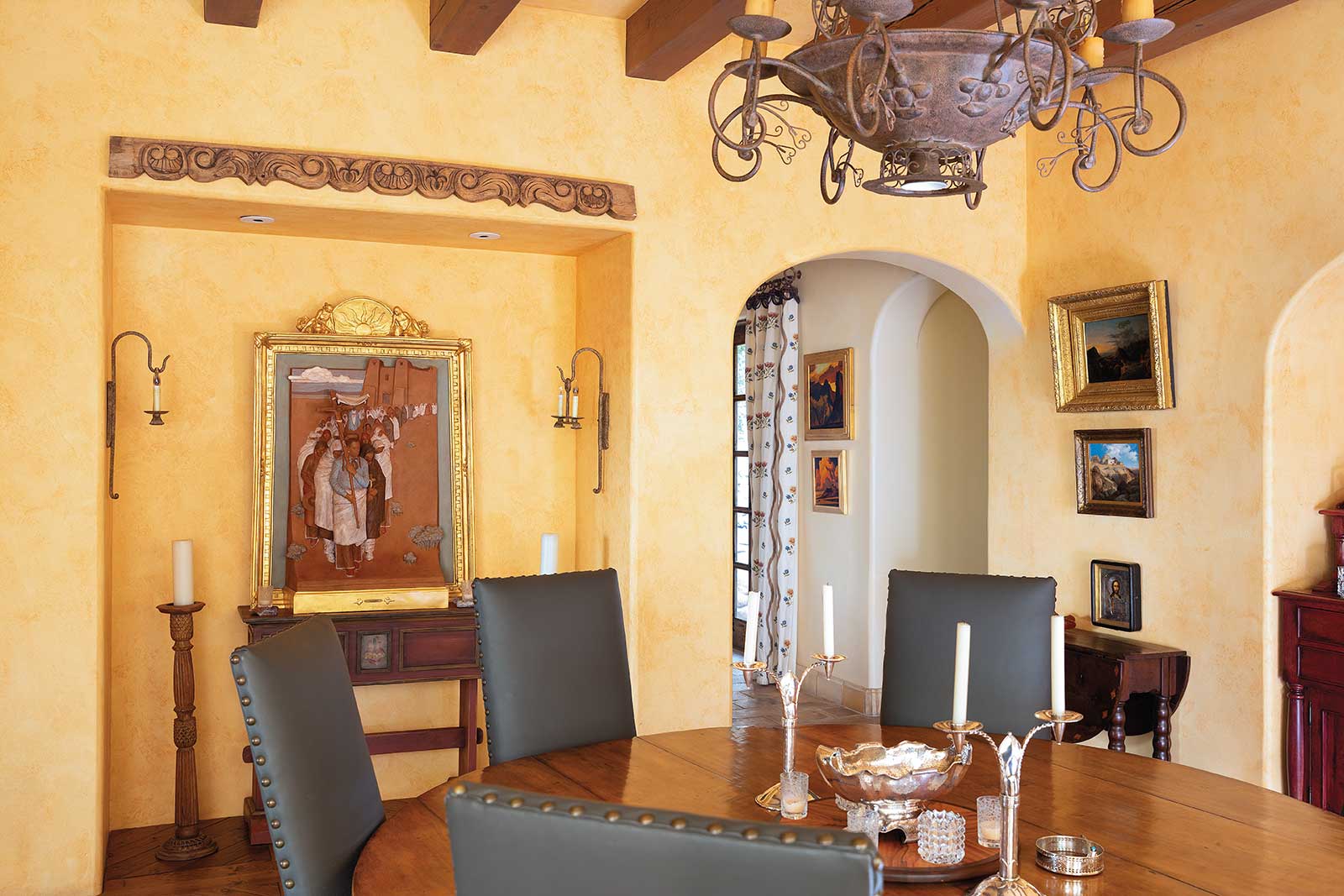 In the alcove is The Procession, 2018, bronze, by Paul Moore.
The Couse was just the beginning, though. “Another is the painting by William Robinson Leigh, The Sand Painter. I recognized his enormous talent and the narrative in this painting held the gravitas I’d been hoping to find.”
Although Naoma’s home is populated primarily with 20th-century art, she has also collected pieces by contemporary artists and friends. Every year, Naoma commissions a painting for her Christmas card. Most of them were painted by Michael Coleman, her friend from the 1980s, when she and her husband first commissioned a painting from him. It was followed by more paintings and many large sculptures.
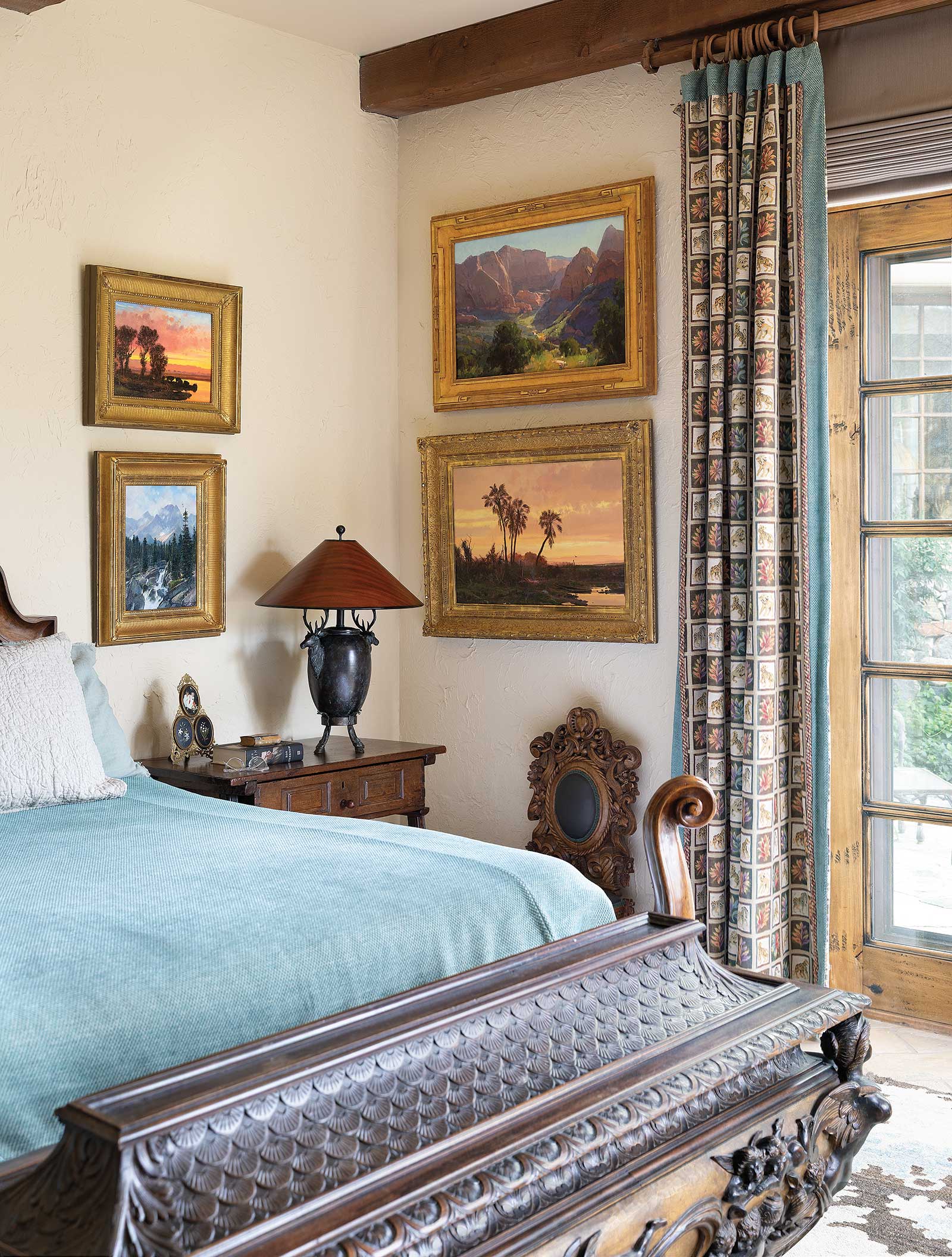
Next to the bed are, top to bottom, Untitled (canyon stream), oil on canvas, by Michael Coleman and his Untitled (evening scene), oil on canvas. On the adjoining wall are, top to bottom, Coleman’s Untitled (evening scene) and Kolob Canyon, circa 2000, oil, by Kathryn Stats.
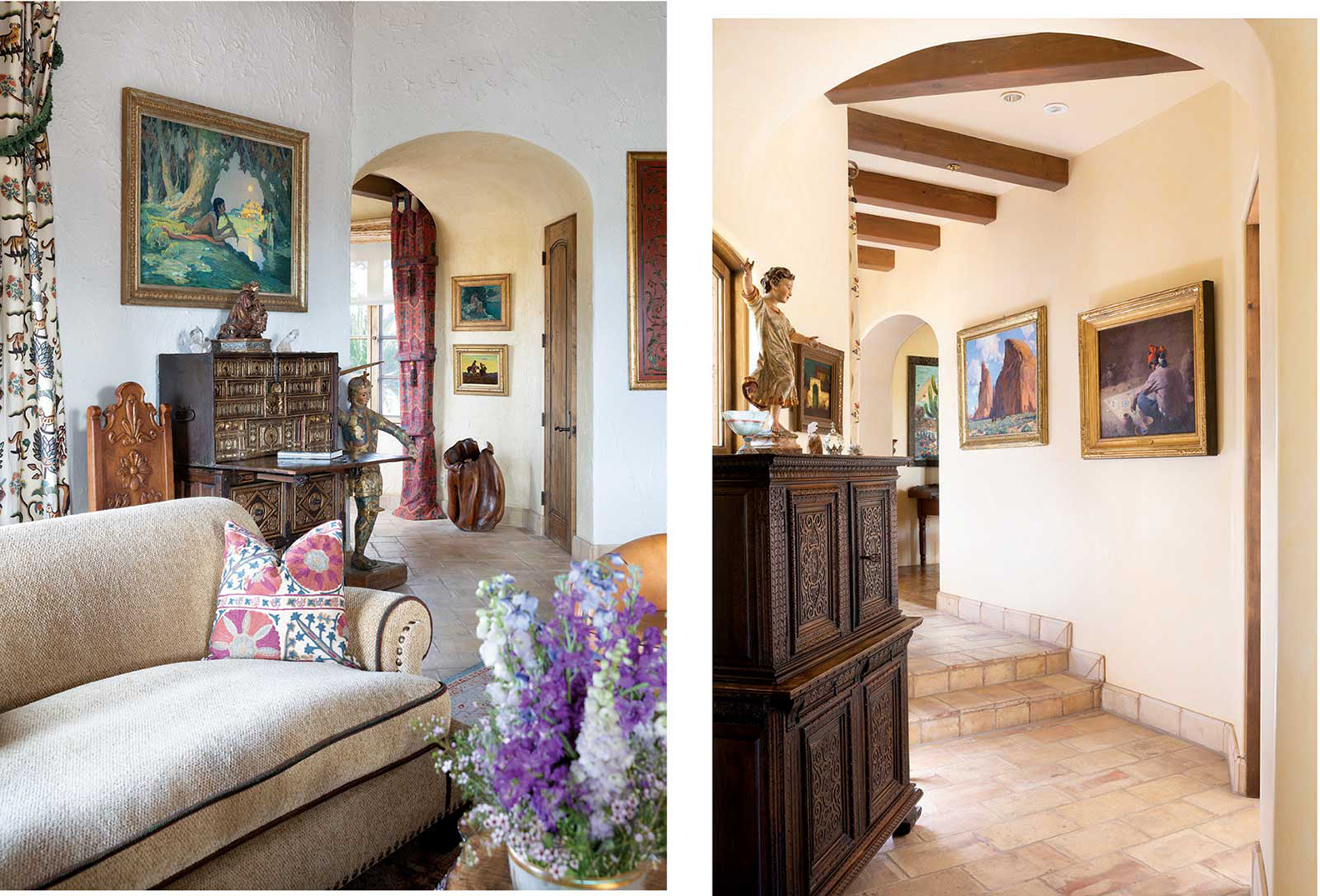
Left: Above the desk is Taos Love Call, oil on board, by Eanger Irving Cause (1886-1936). In the hall are, top to bottom, Couse’s Moonlight Sonata, oil on board, and Scouts, 1921, oil on canvas, by William Gollings (1878-1932). Right: In the hallway are, from left, Navajo Country, circa 2006, oil on panel, by Geoff Parker, and The Sand Painter, 1951, oil on canvas, by William R. Leigh (1866-1955).
She owns several exceptional works by Dolan Geiman at the ranch, and commissioned a work during Covid for Arizona. His meticulously created mosaic Cactus depicts the flora and fauna of Naoma’s backyard. Dolan has spent time at the ranch as an informal artist in residence and they have become good friends.
Another well-known artist she is grateful to have become friends with over the years was Ed Mell. Naoma was first introduced to him on a studio tour and dinner at Mell’s home with American Friends of the Louvre. She spent time at his studio and owns many of his works. She has also acquired several sculptures by her friend Paul Jeffrey Rhymer.
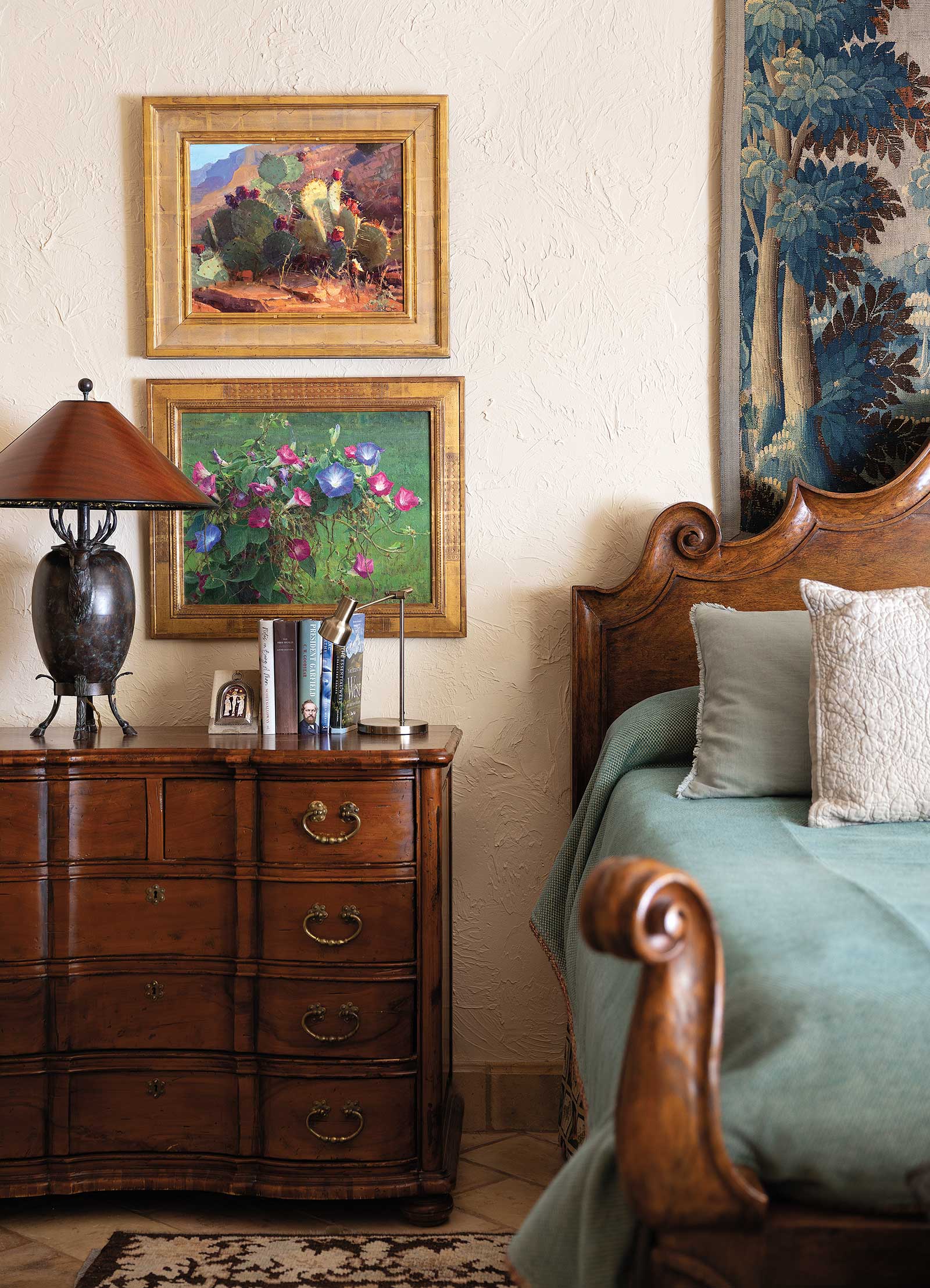
The paintings above the chest are, from top, Desert Still Life, 2005, oil on board, by Kathryn D. Stats, and Morning Glories, oil, by Clyde Aspevig.
Recently, Naoma and her family donated three larger-than-life bronze sculptures of buffalo to the Smithsonian National Museum of Natural History. Sculptor Gary Staab modeled the sculptures from the now-taxidermied bull, cow and calf that had been brought to Washington, D.C., to graze outside the Smithsonian Institution in 1886. The sculptures now grace two plinths at the entrance to the museum that had remained mostly empty since the museum was built between 1904 and 1910.
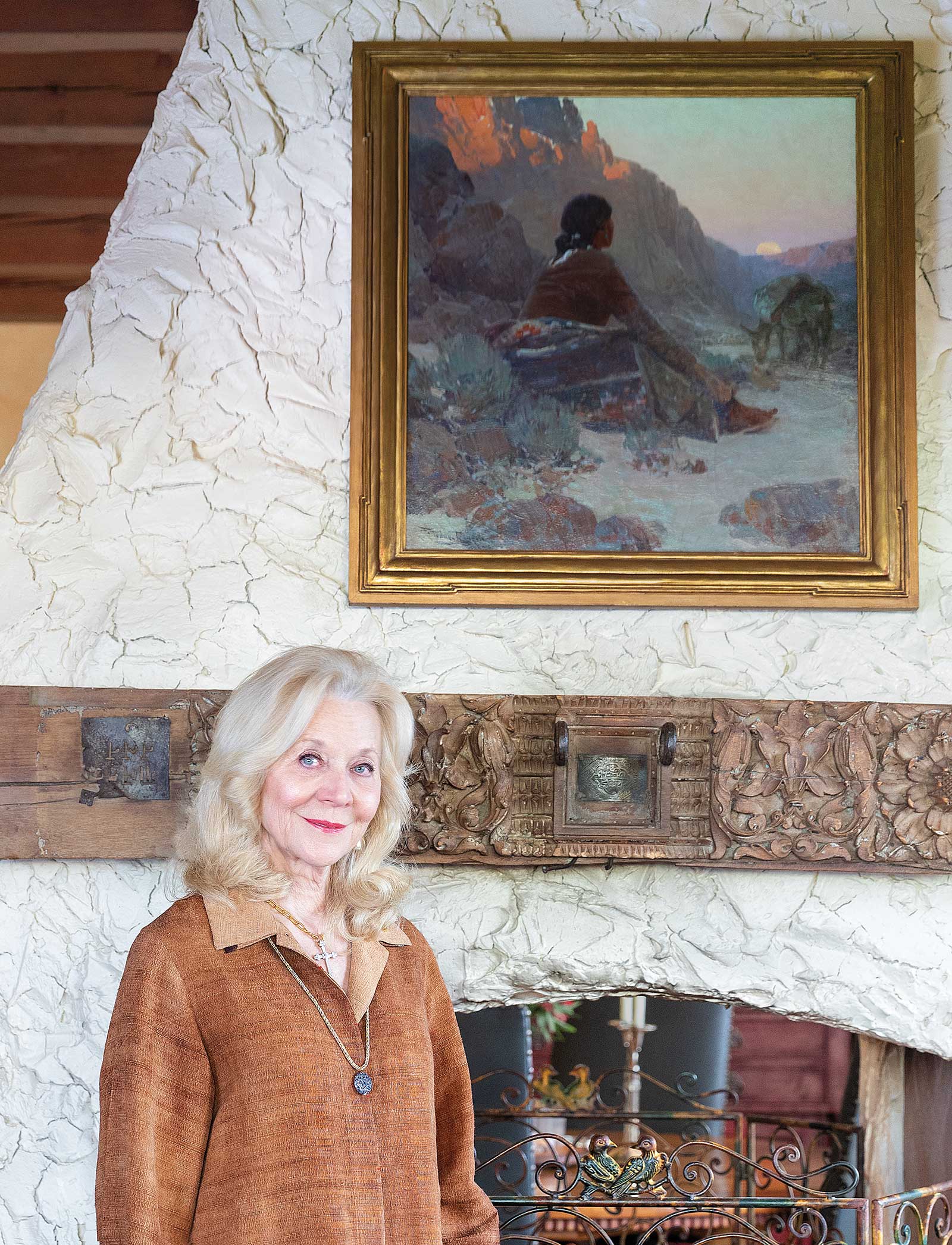
Naoma Tate stands in front of Full Moon Rises, 1926, oil on canvas, by Frank Tenney Johnson (1874-1939).
Naoma is on the national board of the Smithsonian and also on the board of the Smithsonian National Museum of Natural History Museum as well as a member of the Smithsonian Gemstone Collectors. She is a certified gemologist.
Donna Poulton, Naoma’s curator, adds that Naoma’s affiliations also include the boards of American Friends of the Louvre, Leaky Foundation, Buffalo Bill Center of the West, Berkeley Geochronology Center, National Trust for Scotland and American Western Heritage, as well as important affiliation with the University of Wyoming, Utah Museum of Fine Arts and University of Utah.
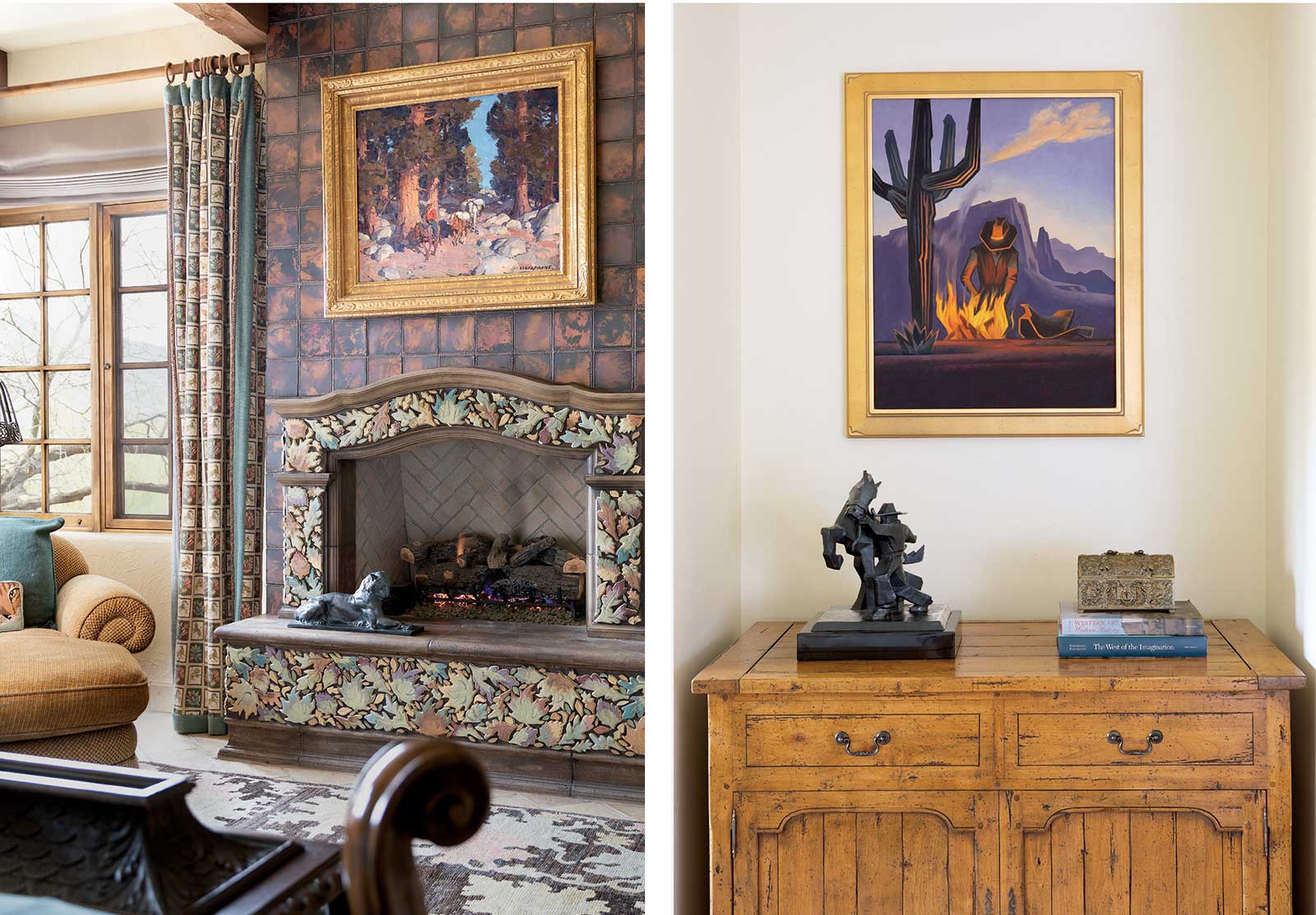
Left: Hanging above the fireplace is Along the Trail, oil on canvas, by Edgar Payne (1883-1974). On the hearth is Princeton Tiger, bronze, by Alexander Phimster Proctor (1862-1950). Right: Above the chest is Keepin’ Warm, 2021, oil on linen, by Ed Mell (1942-2024). On the chest is his bronze Sidestepper.
In addition to the donations of paintings, sculptures and artifacts made to the Buffalo Bill Center of the West by Naoma and her family, at any given time any number of her paintings are on loan to major exhibitions around the country and in Europe. —
Standing Strong
To celebrate America’s 250th birthday, the Smithsonian’s National Museum of Natural History is honoring the national mammal, the American bison, with the exhibition Bison: Standing Strong at the Washington, D.C., venue. Art collector Naoma Tate commemorated the exhibition and the country’s birthday with a donation of three larger-than-life bison bronzes that are now installed on the museum’s plinths that mark the grand entrance to the museum. The monuments, created by sculptor Gary Staab, were gifted to the museum by Tate and the family of Hal Tate, Naoma’s husband who died in 2003.
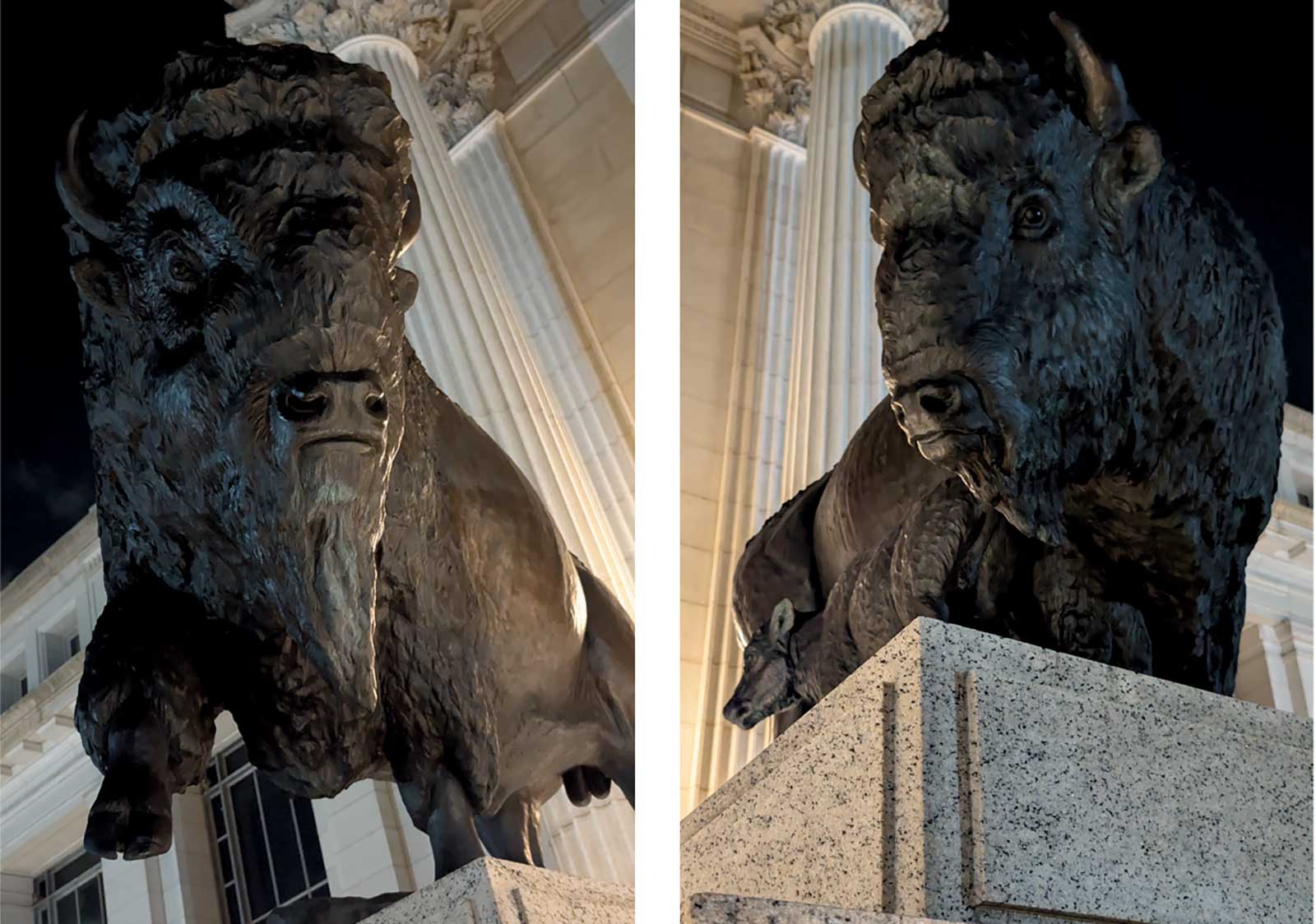
Bison monuments by Gary Staab outside the Smithsonian’s National Museum of Natural History. The monuments were a gift from Naoma Tate and the family of Hal Tate.
While the gift to the museum is new, the history truly begins in 1886, when Smithsonian conservationist William Temple Hornaday traveled to Montana to study buffalo, which were then on the verge of extinction. The Smithsonian brought back three specimens—a bull, cow and a calf named Sandy—that were later taxidermied and put on display in a diorama. The buffalo were deaccessioned from the museum in the 1950s, and today are on display at the Fort Benton Museums & Heritage Complex in Fort Benton, Montana.
Once the Smithsonian identified a need to have the three bison return in some way to the museum, the monuments were commissioned after Tate committed to fund the project. Fittingly, the small calf is named Sandy.
Bison: Standing Strong continues through May 2029.
Powered by Froala Editor


