When a recent Dallas Morning News article celebrating the exhibition New Horizons: The Western Landscape at the Amon Carter Museum of American Art singled out one work above all others, the choice was telling. “For visitors of all ages,” the writer noted, “the exhibition’s showstopper is American Icon, a hulking bronze bust of an American bison by German-Australian-American sculptor Mick Doellinger.” Centered near the title wall, the magisterial piece captures what must have been the awe-inspiring scale of vast bison herds before the species’ near-extinction.
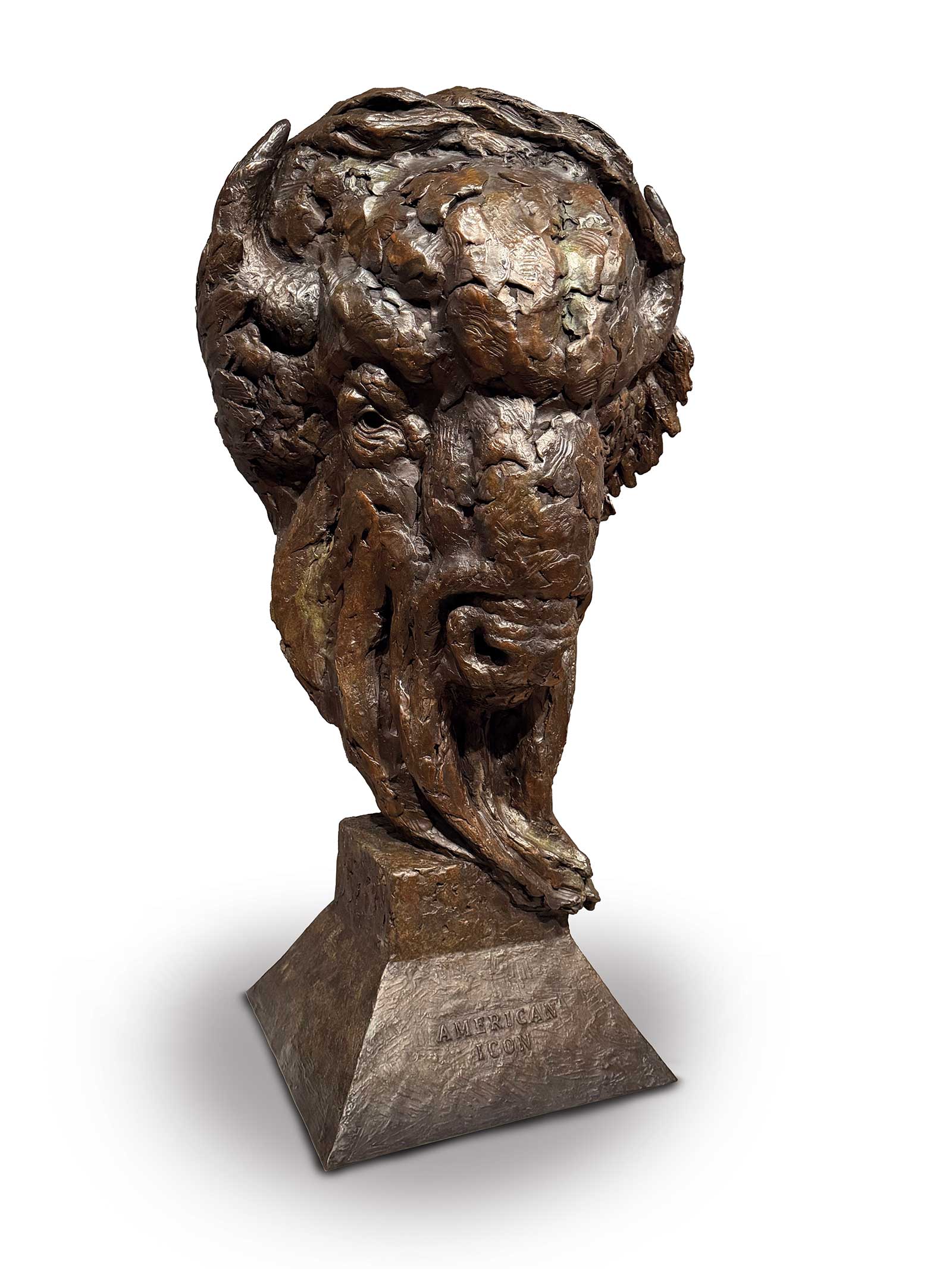
American Icon, 2020, bronze, 50 x 29 x 23 in.
Doellinger forwarded the article to collectors who owned the work, and all of them applauded. What strikes me, though, is how the writer found a historical narrative in an abstracted bison’s head—a work that, in another context, might simply evoke a taxidermy trophy mounted in a hunter’s private room. That gap between mimicry and meaning is precisely where Doellinger operates, and it is a distance he has spent his entire career learning to cross. The Autry Museum of the American West recognized as much when it awarded American Icon a gold medal in its Masters of the American West show in 2020.
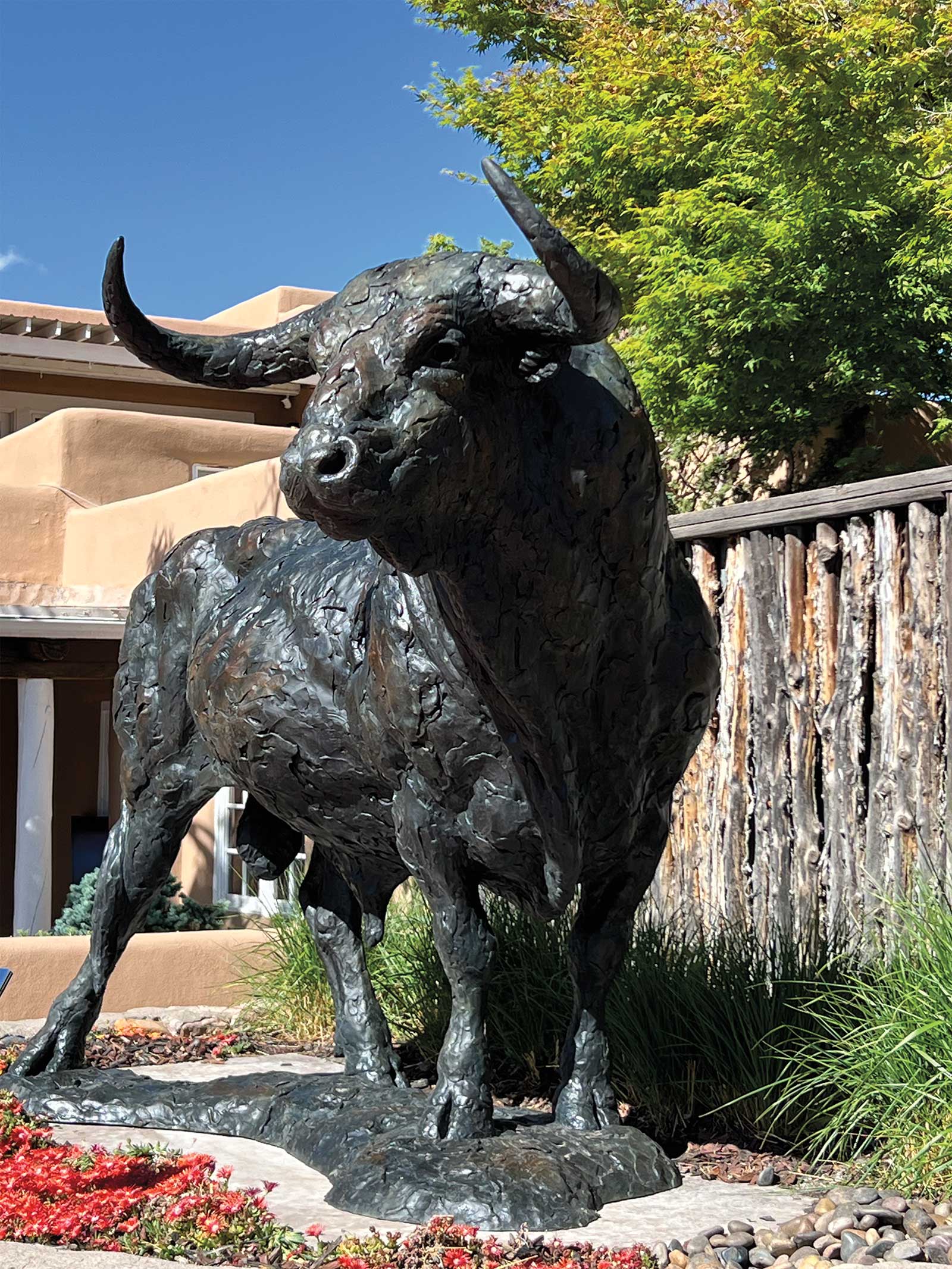
Corriente Grande (Bull), 2026, bronze, 72 x 108 x 53 in.
Doellinger’s path to that recognition was anything but conventional. No art school, no formal residency—his education came from living among the animals he would eventually cast in bronze. Born in Germany and raised in Australia, he immersed himself in a working life defined by physical contact with the natural world. In rural Queensland, Australia, his years in rodeoing, butchering and taxidermy gave him an unusually intimate knowledge of anatomy and movement that no studio curriculum could replicate. Steer wrestling instilled resilience and a visceral understanding of physical force—how a body braces, pivots and absorbs impact in fractions of a second. As a butcher, he deboned countless animals before he ever picked up a sculptor’s tools, learning firsthand how joints articulate, how muscles load and release, how weight distributes across a frame in motion or at rest. That knowledge did not simply inform his sculptures; it became their foundation.
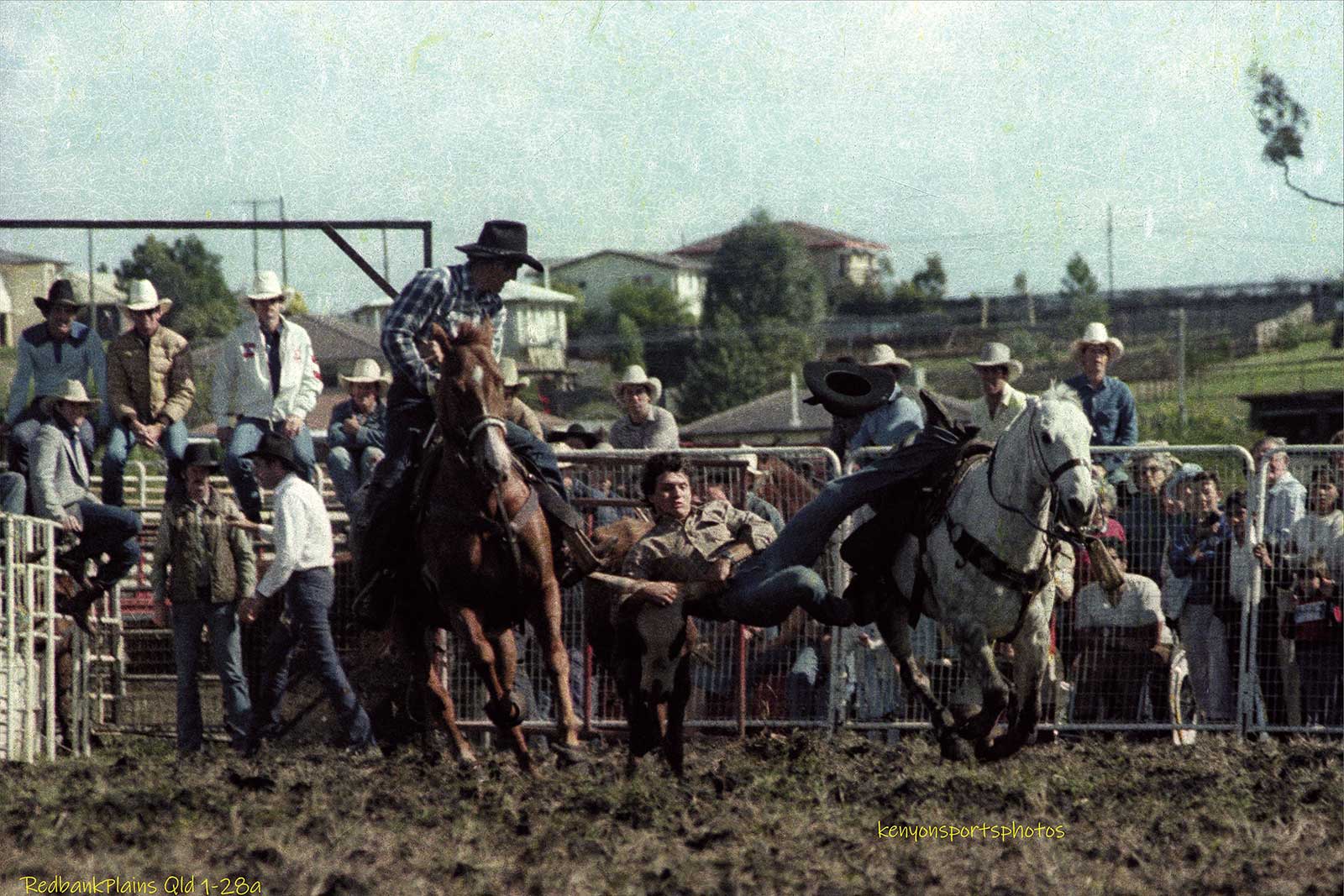
Mick Doellinger, airborne, competing at Redbank Rodeo in Australia, 1983.
A conversation with Doellinger can still turn into a kind of performance as he animates how an antelope dodges a predator or how a lion—as in his Classic with a Twist, Lion (2021)—pivots on its haunch at the precise moment of decision. The body memory he accumulated over years of working life translates directly into the clay, producing figures whose physical logic feels unimpeachable. Where many wildlife sculptors work from photographs or observation alone, Doellinger works from a deeper register of understanding, one built from the inside out.
That grounding in lived experience shapes his understanding of authenticity. For Doellinger, authenticity is not a posture but a process—what he calls “design.” Design, in his vocabulary, means hands-on creation that deepens self-awareness and brings genuine emotion into the work. It is what separates a technically accomplished object from a sculpture that speaks. And it is what builds lasting trust between artist and audience, because viewers are perceptive: they sense when a work has been felt as well as made. His aesthetic sophistication began to deepen meaningfully after he moved to Texas in 2003 and found an individual who pushed his thinking in complementary directions.
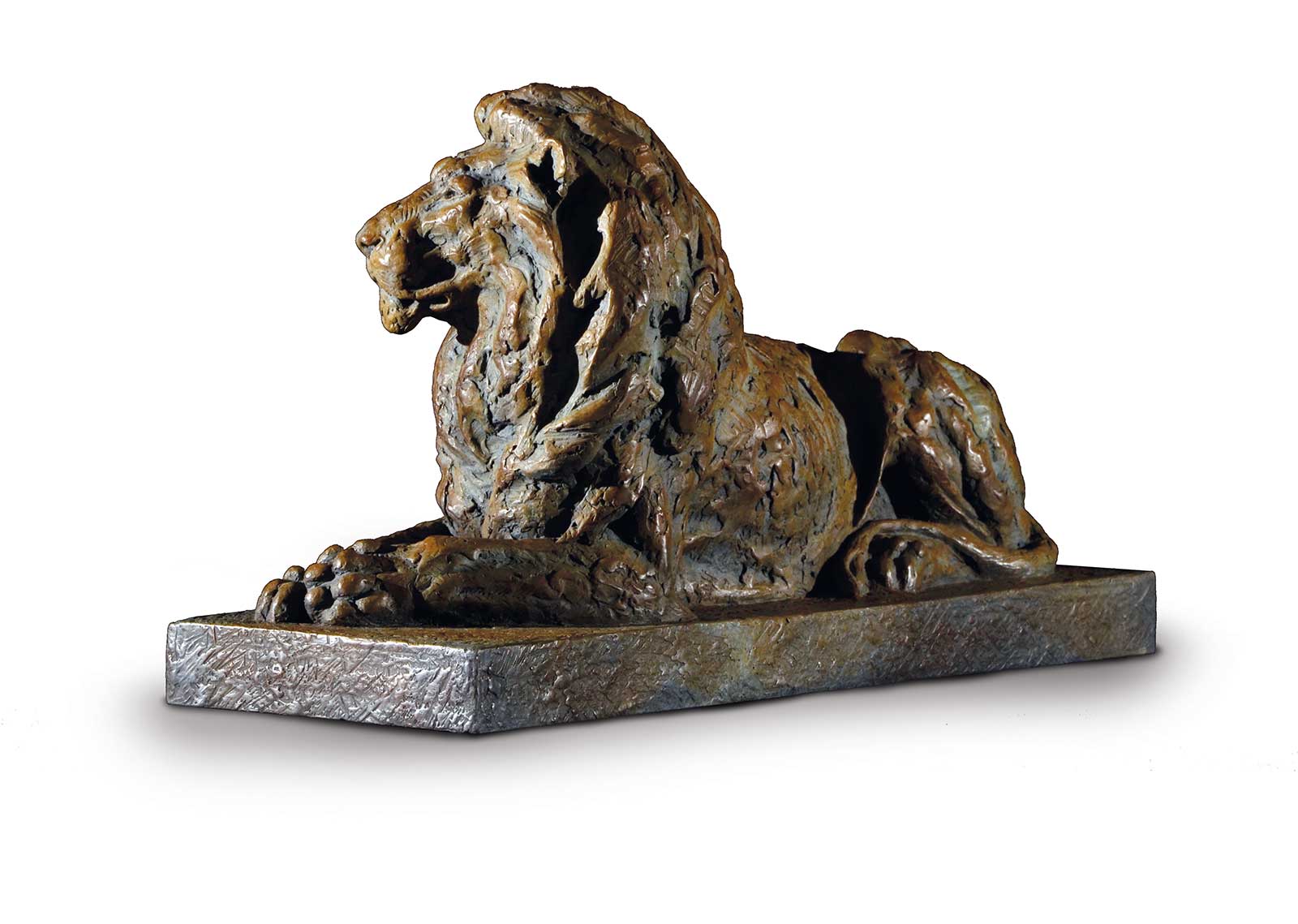
Classic with a Twist (Lion), 2021, bronze, 11 x 20 x 7 in.
That man was businessman and outdoorsman Bubba Wood. When Doellinger walked into Wood’s gallery, Collector’s Covey, Wood recognized a fully formed talent he had never encountered before—a fresh voice in the Western and wildlife market, unburdened by the conventions that can calcify more formally trained artists. Wood offered constructive critique that Doellinger absorbed and acted on, learning to push his work progressively beyond the documentary realism that had defined his early output. His bold, fervent handling of clay gave his work remarkable texture without sacrificing anatomical accuracy, and showed how form could carry abstracted ideas—how the surface of a sculpture could suggest movement and sentiment as powerfully as its silhouette.
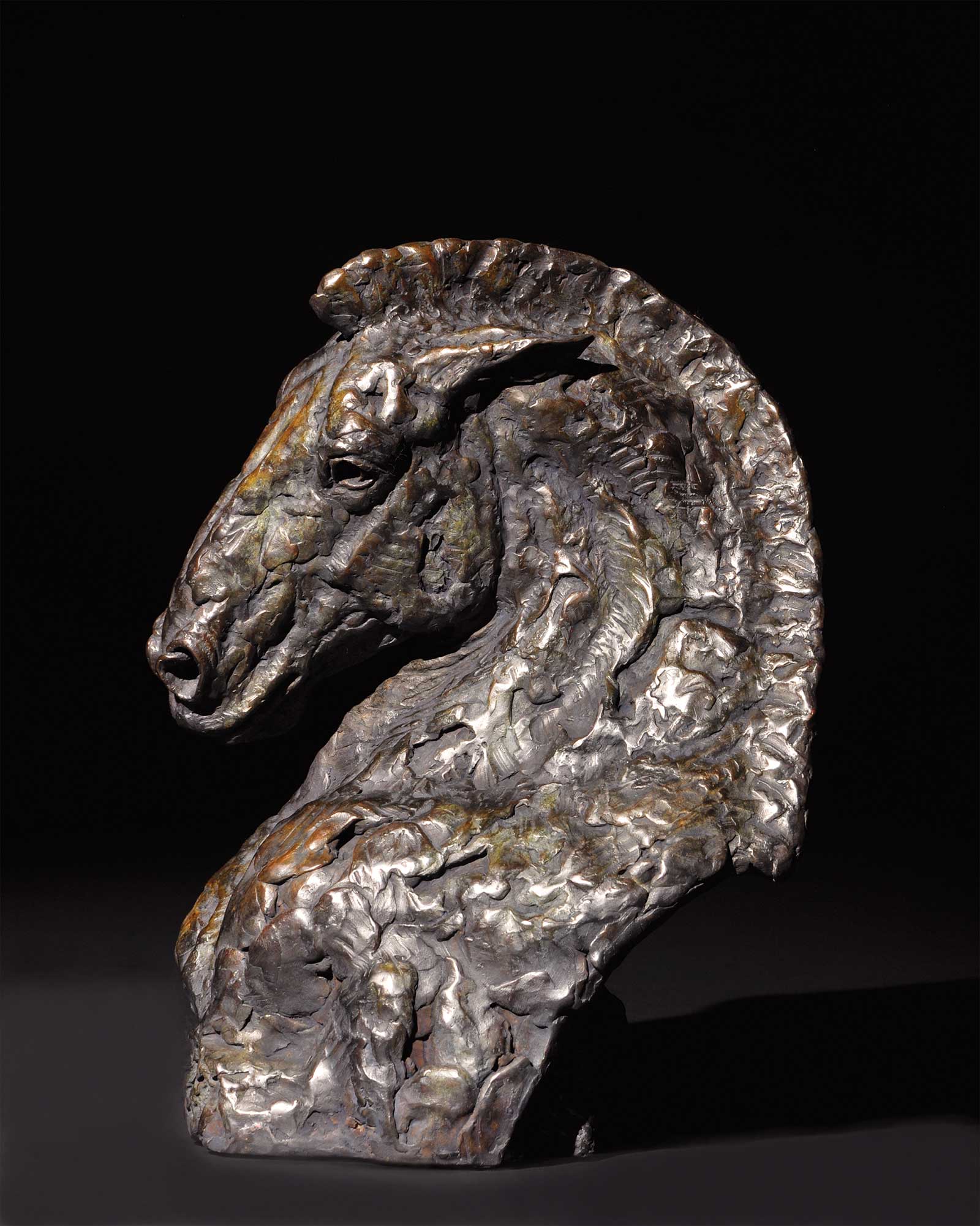
The Knight, 2018, bronze, 15 x 11 x 8 in.
Rodeos, equestrian competitions, and livestock shows became his informal studio. Working cowboys and ranch hands offered an unfiltered window into the culture he sought to capture, and the feedback he received in those settings was honest in ways that gallery conversation rarely is. Those grassroots venues eventually served as a springboard to more prestigious institutions: the National Cowboy & Western Heritage Museum, the Briscoe Western Art Museum, and the Autry, where his work found a broader and more discerning audience without losing the directness that made it compelling in the first place.
Exhibiting widely, combined with travel across the American West, Africa and Europe, has expanded both his ambition and his formal vocabulary in ways that continue to reshape his practice. Africa, in particular, deepened his engagement with megafauna—the elephants, rhinos and lions that now appear regularly in his work alongside the bison, bulls and horses of the American West. Travel has also stimulated his appetite for larger-scale sculpture, pushing him toward works whose physical presence commands space rather than simply occupying it.
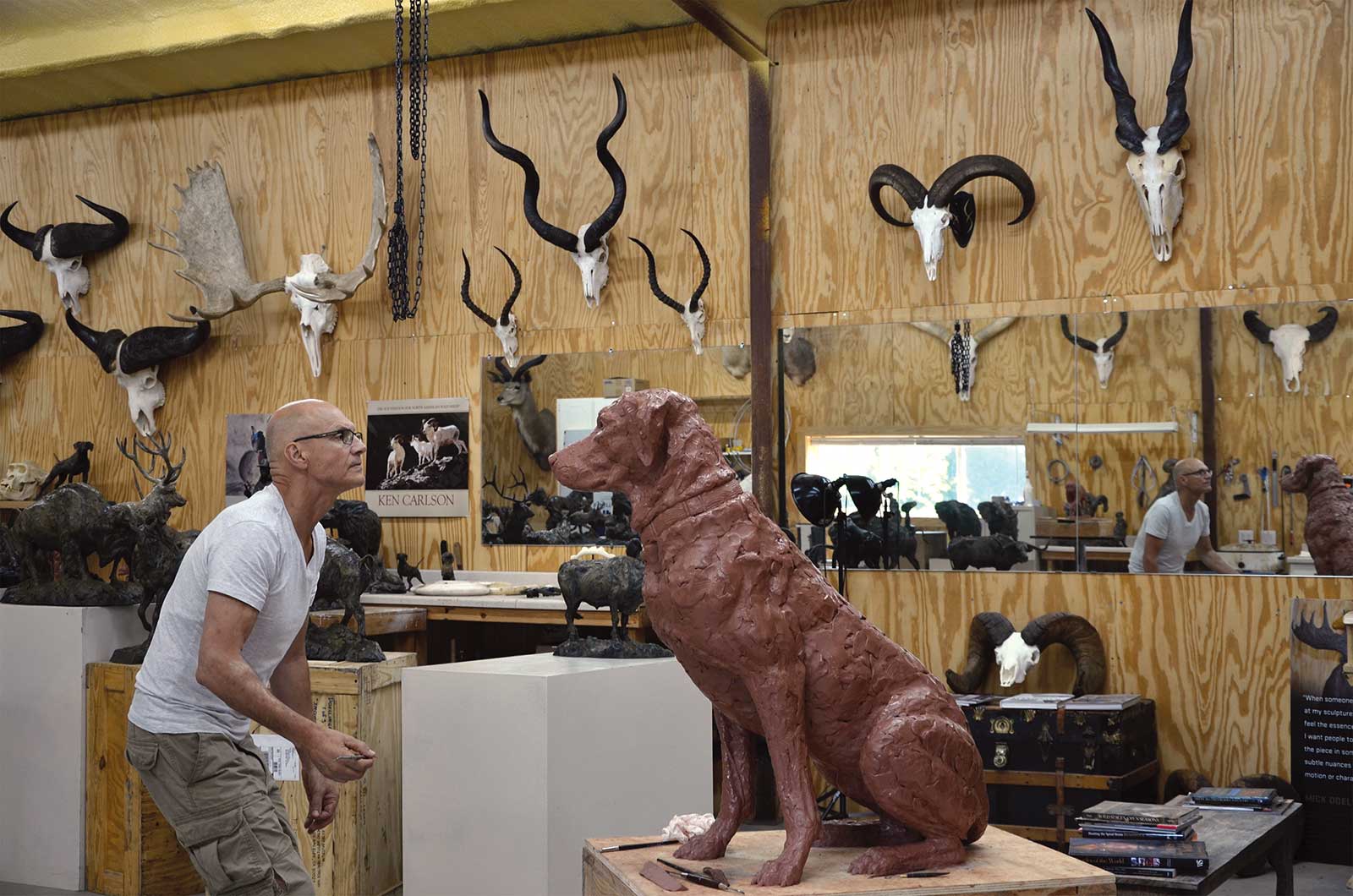
Mick Doellinger inside his studio sculpting a labrador, Sparky.
His most recent major work, Corriente Grande, is a massive bull whose tilted head and coiled tension freeze a single charged moment before eruption. It is a piece that could only have been made by an artist who understands both the animal’s anatomy and the formal language of dynamic design—who knows not just how the body looks, but how it feels from within.
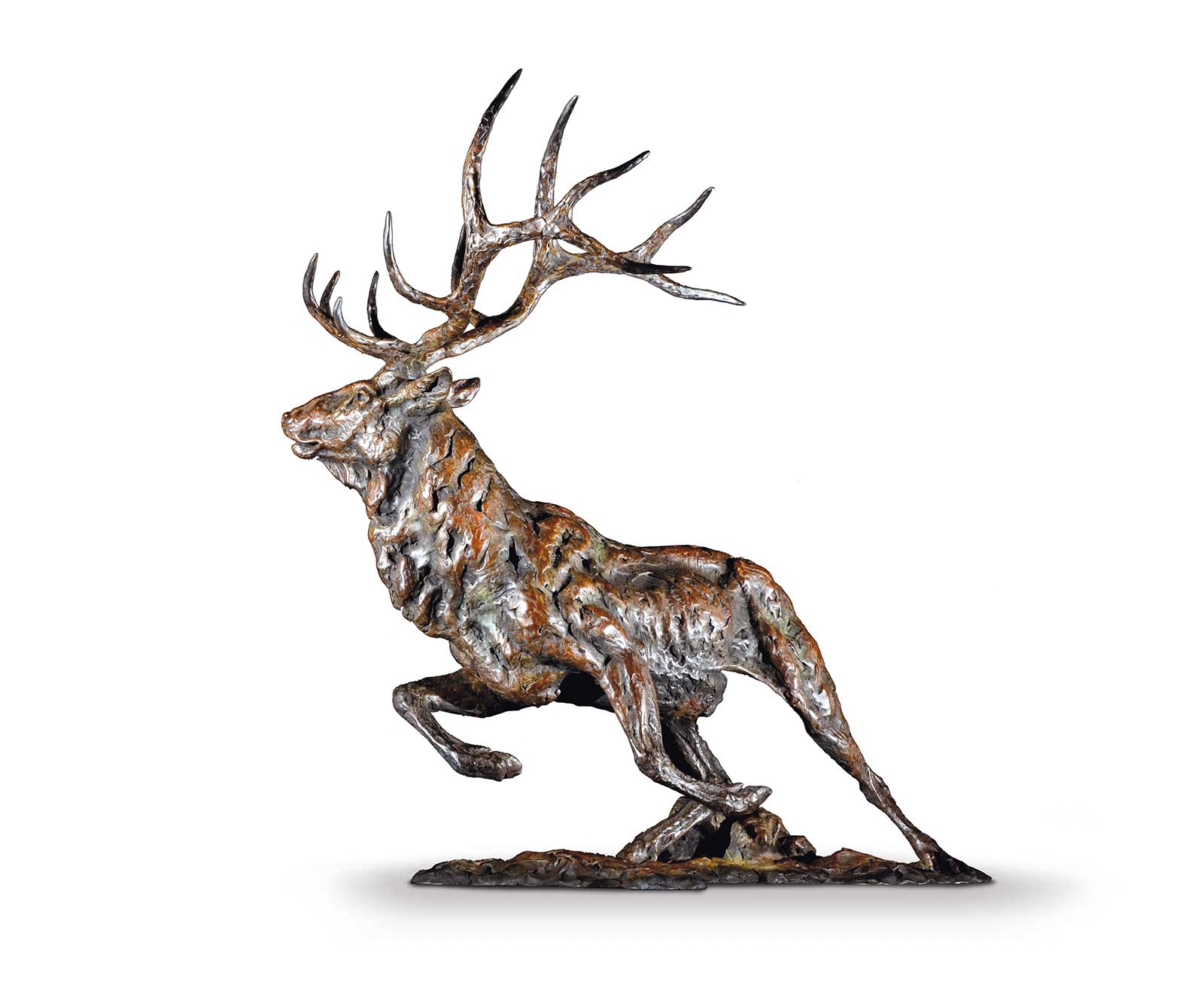
Wind Shift (Elk), 2024, bronze, 30¼ x 28 x 17 in.
“You can create tension and you can create movement without movement,” Doellinger observes, and nowhere is this more apparent than in works like Brute Force, his rendering of a black rhinoceros. The impressionistic surface—deliberately loose textures, smudges, fingerprints preserved in the clay and carried through into the bronze—gives the finished work a sense of barely contained energy rather than static representation. Anatomy and accuracy remain fully intact; the finish is simply freed from rigid literalism. The result is a surface that rewards sustained looking: each viewing reveals something different, a shadow cast differently, a texture that reads as muscle or momentum depending on the light, making the sculpture feel genuinely and continuously alive.
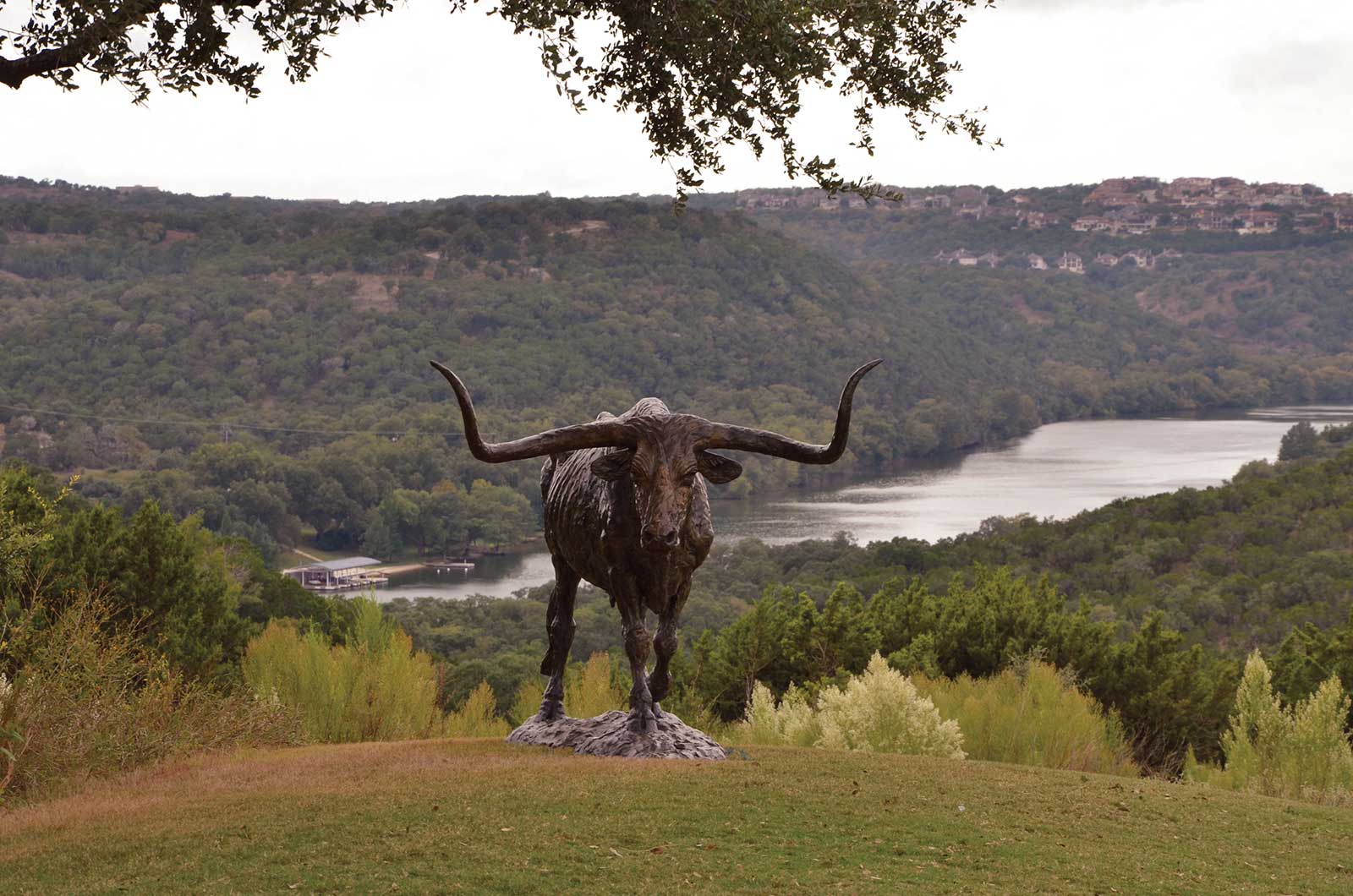
Headin’ North (Longhorn Steer), 2015, at the UT Golf Club in Texas.
His subjects are almost exclusively large animals—megafauna, as he puts it—though he allows that beetles and dragonflies now suggest interesting formal possibilities he has not yet fully explored. And occasionally he subverts the genre altogether with quiet wit: his popular Reclining Nude takes the classic pose of the Western figurative tradition and bestows it on a spirited squirrel, deflating pretension while demonstrating complete command of it. The humor is affectionate rather than ironic, which is characteristic of the man himself.
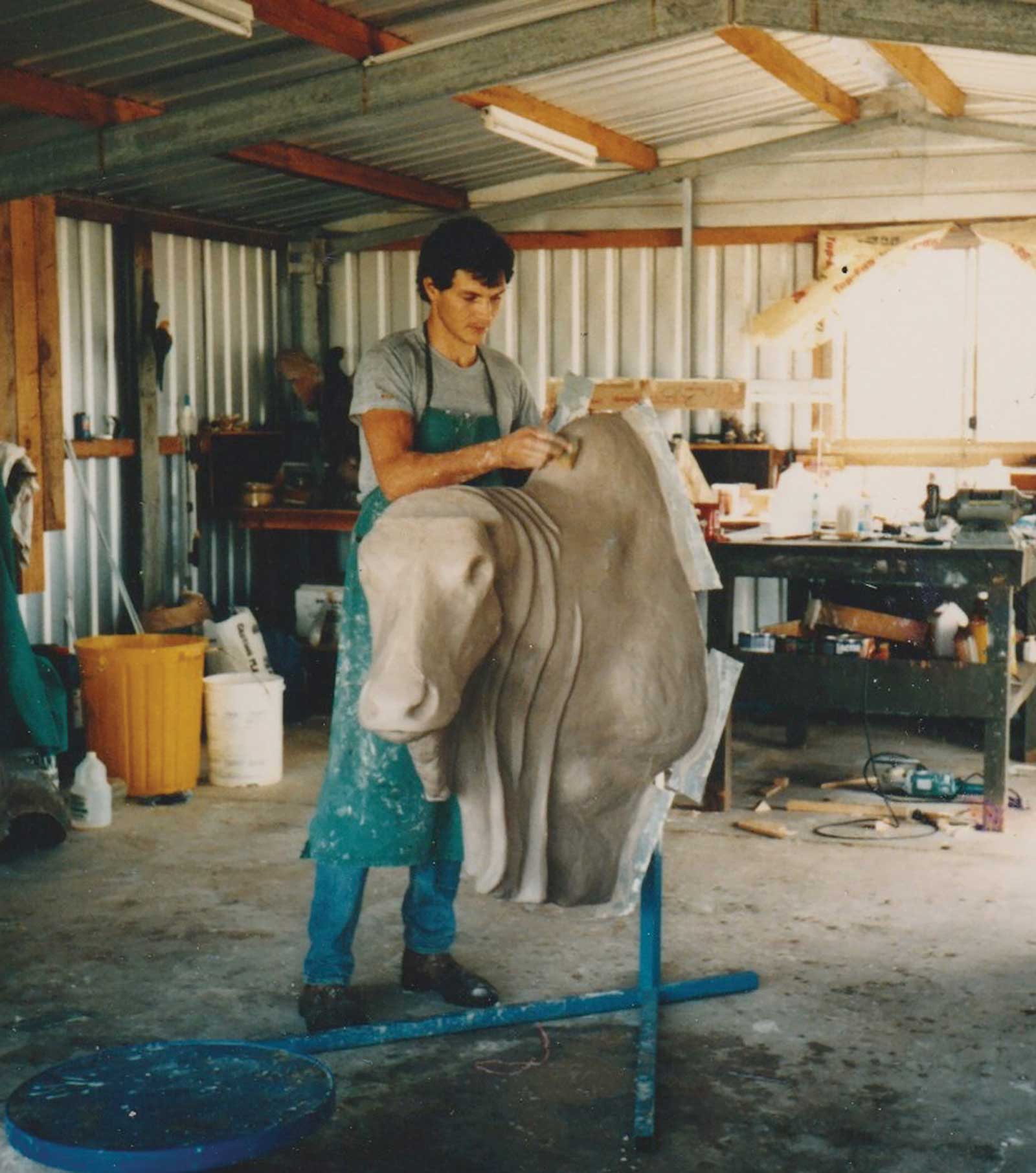
The artist sculpting a bull in 1983.
But the throughline across all of it is consistent. Whether the work is monumental or mischievous, earnest or playful, Doellinger’s sculptures are never mere representations. They are the accumulated product of a life spent in close, physical, sometimes dangerous contact with living things—and that contact, refined through mentorship, sharpened by travel, and elevated by an ever-deepening formal intelligence, is what transforms accurate bronze into vivid and enduring story.
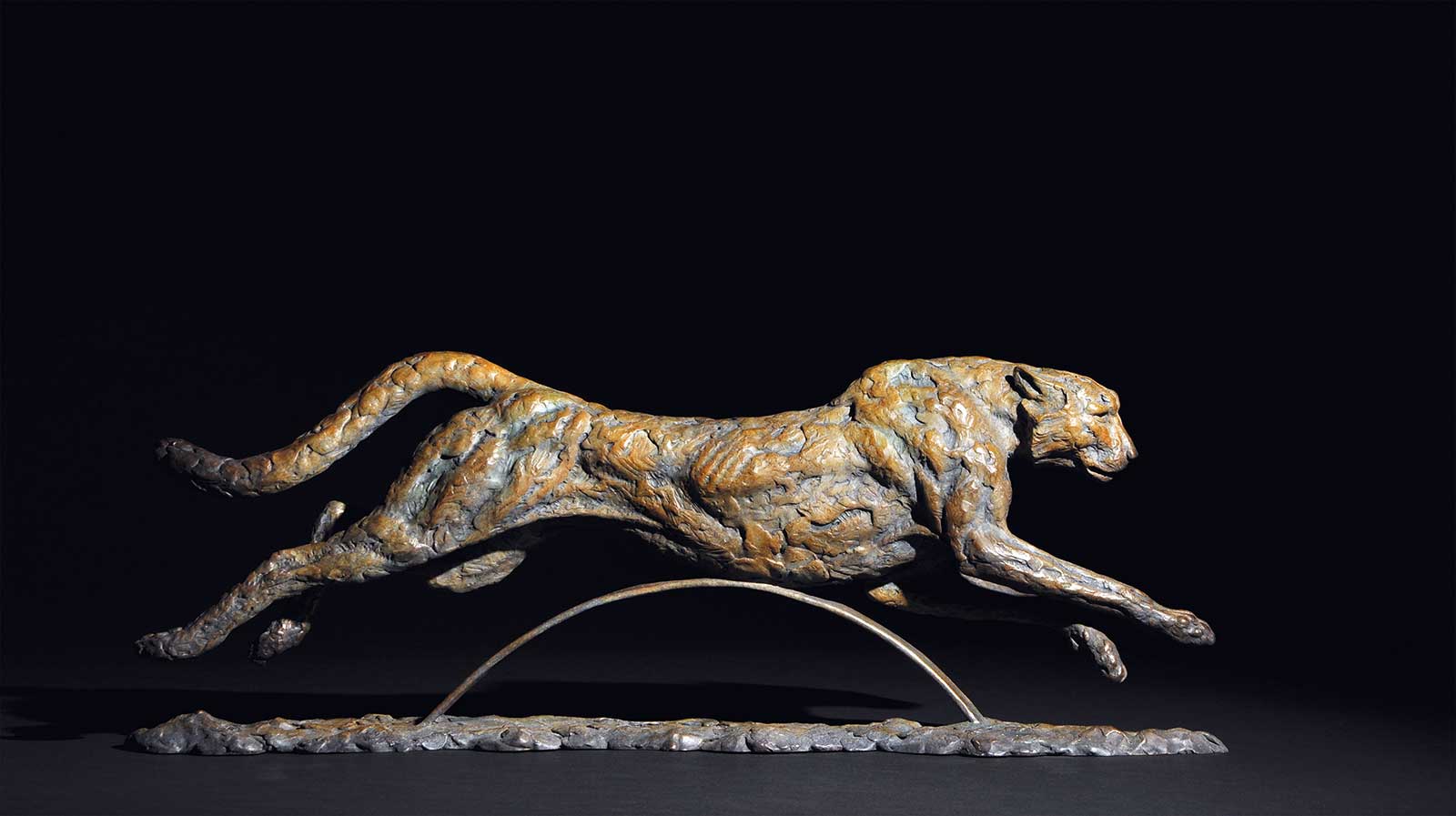
Gaining Ground (Cheetah), bronze, 11 x 29 x 5½ in.
By embracing authenticity, artists not only enrich their own creative journeys but also cultivate meaningful relationships with their audiences, enhancing the overall impact of their work. This dynamic interplay between authenticity and audience engagement ultimately elevates the artistic experience for both parties. Authenticity encourages genuine connections with others and Doellinger not only carves out a niche for himself in the art world but also elevates the significance of authenticity in artistic expression. His sculptures are not mere representations; they are vivid stories shaped by a life well-lived.
See more of Doellinger’s work at www.doellingersculptures.com. —
+++
Andrew J. Walker is the former executive director of the Amon Carter Museum of American Art, where he served for 14 years. Under his leadership, the Carter’s collections and endowment expanded significantly, and the museum’s internal galleries have been renovated and reimagined to improve visitor experience and to emphasize a thematic presentation that connects artists and works through time. Prior to joining the Carter, he served as curator of American art at the Saint Louis Art Museum. In his 21-year museum career, Walker has also held curatorial positions at the Missouri History Museum and the Art Institute of Chicago. His teaching experience includes instructor positions at the University of Chicago’s Department of Art History and the University of Pennsylvania’s Department of the History of Art, and he has been published in scholarly journals across the country. Currently, he is the founder of Walker Art Consulting and represents the American master sculptor James Surls.
Powered by Froala Editor


