Every March, the Sigler Western Museum holds the annual Cowgirl Up! exhibition featuring prominent women artists working within Western art. The full name of the show holds a lot of truth for the participating artists: Cowgirl Up! Art From the Other Half of the West.
“Half” is an important word in this context. Women were not footnotes. They were not support staff. The weren’t cameos in the grander narrative. Women were half the story of the American West.
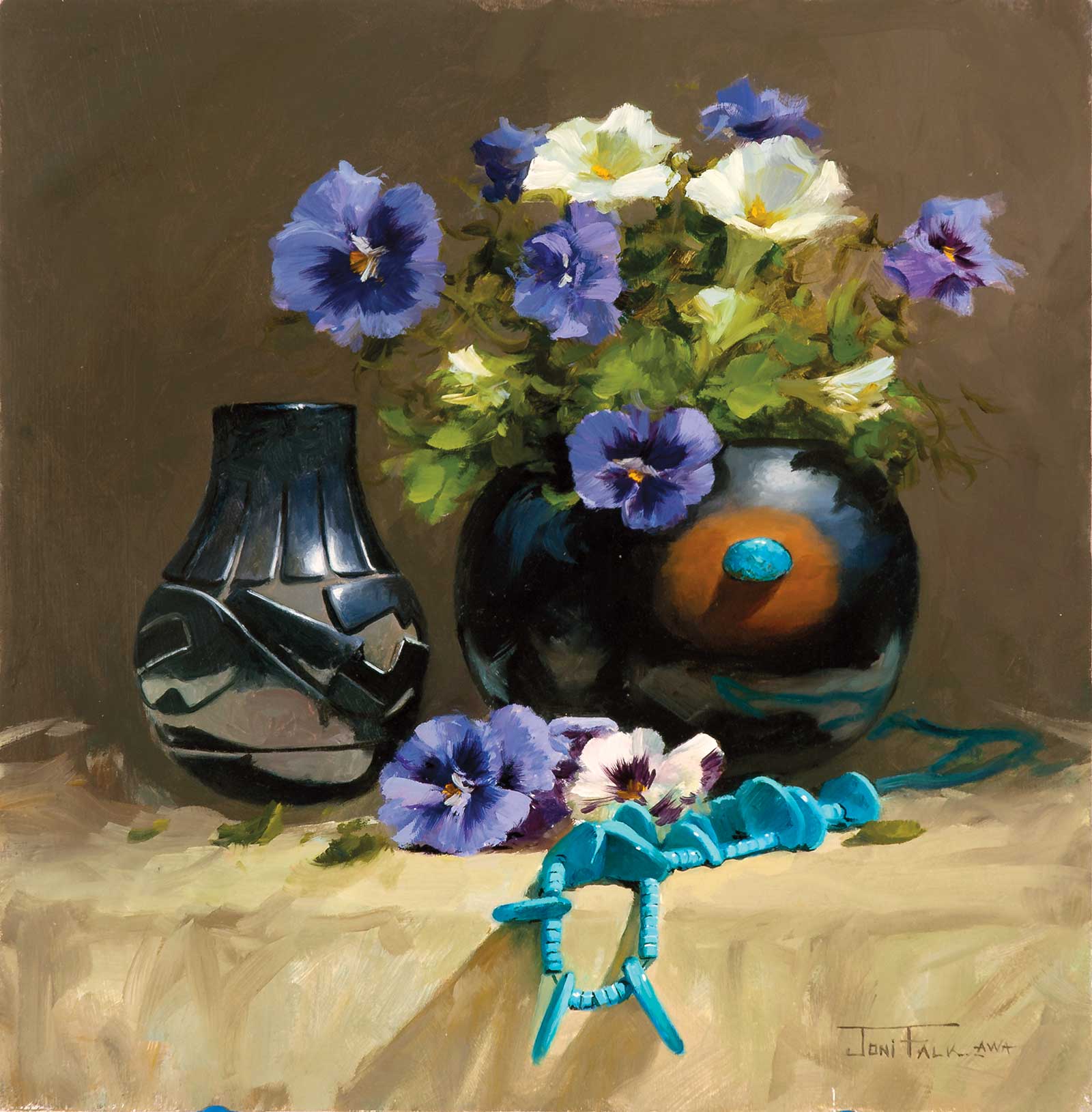
Joni Falk, Turquoise and Ebony, oil, 10 x 10 in.
Women have played a role in every part of the American West and, in many cases, have done so unsung and without fanfare. It was only decades, or even centuries, later their full contributions were acknowledged by historians, authors and even artists. Consider the life of Mary Donoho, who traveled West via the Santa Fe Trail in 1833 to open an inn, Los Estados Unidos House, that is located on the site of what is now La Fonda on the Plaza in Downtown Santa Fe. Or Susan Shelby Magoffin, whose diary of the American frontier offered a detailed chronicle of life in the West during the 1840s. Or Pearl Hart, the outlaw and stagecoach robber. Others include sharpshooter Annie Oakley, frontierswoman Calamity Jane, bronc rider Goldie Griffith, or Mary Field, who became a respected mail carrier in Montana at the age of 60 in the 1890s.
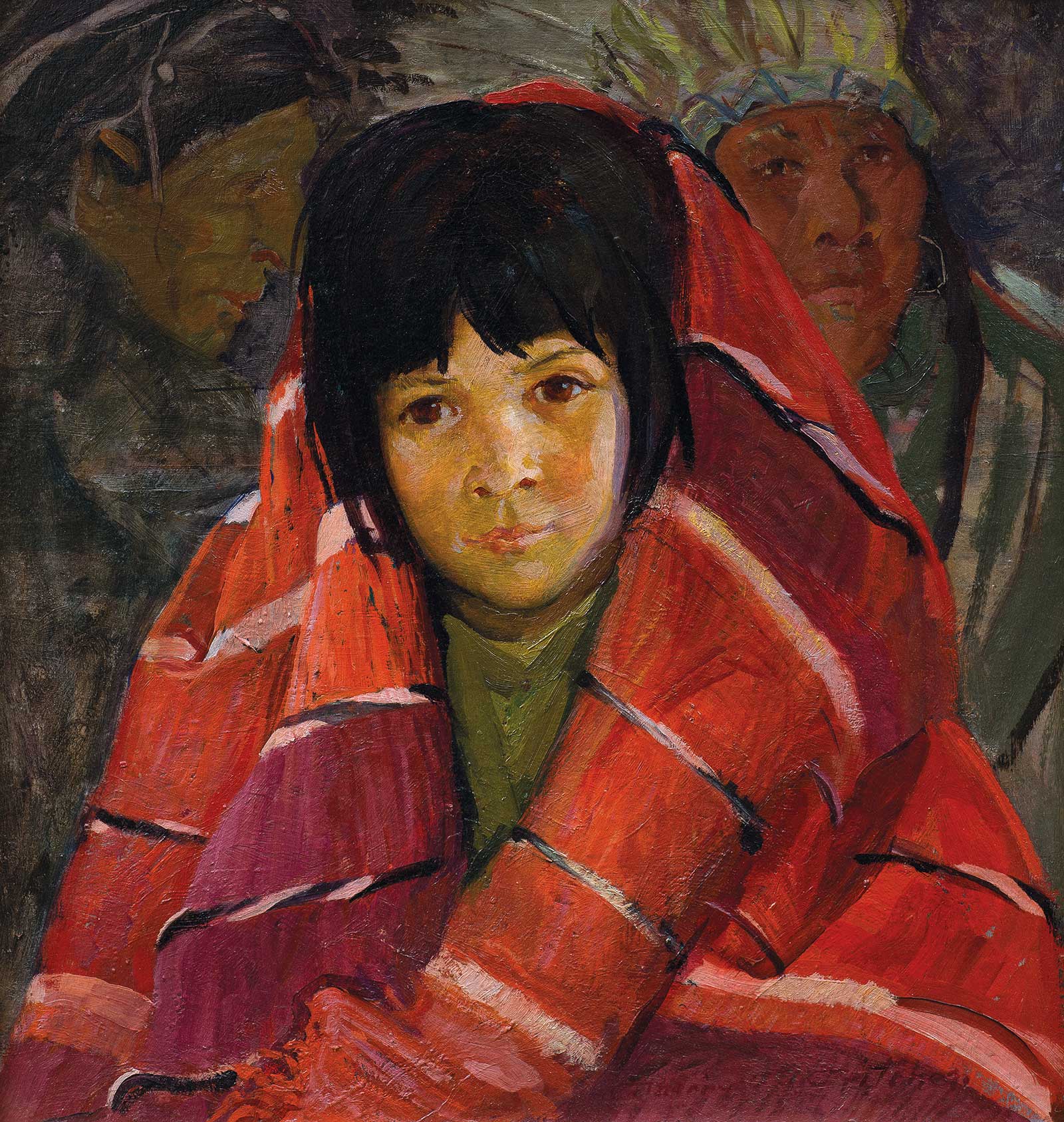
Catherine Carter Critcher (1868-1964), Taos Reflections, oil on board, 18 x 16 in.
Whether it was fame or infamy, or sometimes just quiet feats in the margins of history, women were as much a part of the West as the men. And yet they are still underrepresented in the art world—at museum exhibitions, at galleries and at auctions—although there are certainly outliers that are presenting women artists at a higher rate than others. But more work can be done. And it is being done by prominent female voices, both now and from the past, whether it’s Joni Falk, an early Cowgirl Up! artist, or Dorothy Brett and Catherine Carter Critcher, whose works continue to speak to Western audiences, including women audiences, even today.
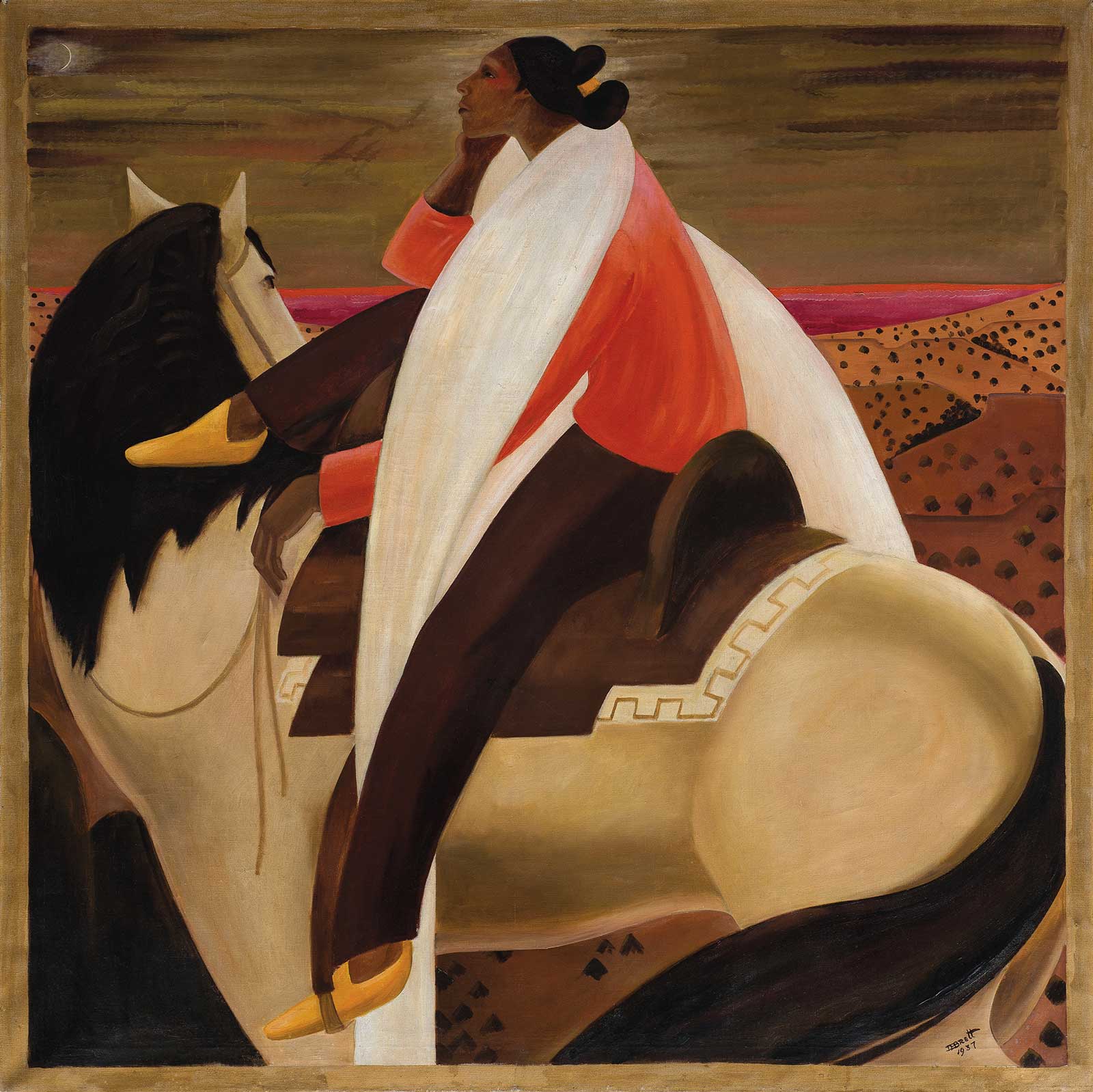
Dorothy Brett (1883-1976), Desert Indian, 1937, oil on canvas, 40 x 40 in.
Falk, Critcher and Brett are just three. There are hundreds more that are worthy of your time and attention, and certainly inclusion in your art collection. Let us introduce you to some more.
One of the great galleries that features a strong roster of women artists is Gallery Wild, which is owned by artist Carrie Wild, who believes in empowering her artists and giving them a platform to share their art. Not only is her roster deep, but it is also exceptionally rich, with artists that push boundaries and blur the lines between genres. The roster includes painters like modernists Julie T. Chapman, Amber Blazina and Taryn Boals; sculptors Sandy Graves, Amanda Markel and Kristine Taylor; and a number of artists who are drawn to wildlife, including Patricia A. Griffin, Jenna Von Benedikt and Carrie Penley. The gallery is active year-round, but rolls out the red carpet for its artists during the Jackson Hole Fall Arts Festival in September.
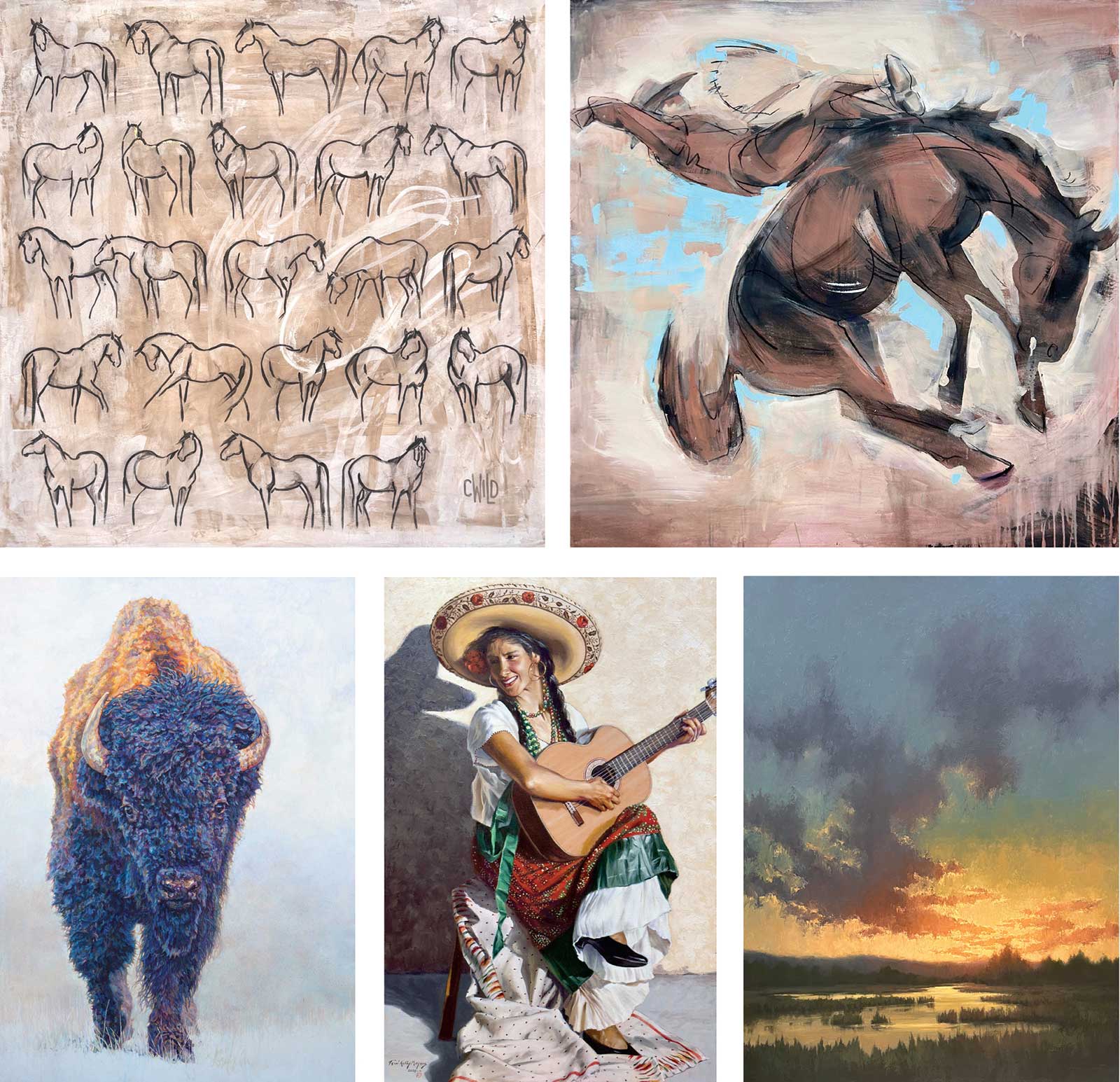
Top: Gallery Wild, Rendezvous Equine Twenty Four.2, acrylic and gold leaf on canvas, 40 x 40 in., by Carrie Wild. Gallery Wild, Troublemaker, mixed media on canvas, 24 x 24 in., by Taryn Boals. Bottom: Gallery Wild, Oscar, oil on linen, 84 x 60 in., Patricia A. Griffin. Legacy Gallery, Musica, oil, 36 x 24 in., by Terri Kelly Moyers. Legacy Gallery, Into the West, oil, 48 x 36 in., by Jane Hunt.
At Legacy Gallery in Scottsdale, Arizona, one of the champions of women in Western art is gallery director Cyndi Hall. “[We] believe women artists are vital not simply because they were historically overlooked, but because they fundamentally expand the way we experience art. For generations, women were cast as subjects rather than storytellers. When they step into the role of creator, the narrative shifts from observation to lived experience, from being seen to seeing,” she says. “What is often overlooked is that women artists don’t just add representation, they deepen the emotional and conceptual range of the work itself. Their perspectives bring nuance, complexity and a different kind of strength that challenges long-held assumptions about identity, landscape and beauty. Supporting women artists is not about correcting the past alone, it is about shaping a more complete future. At Legacy Gallery, we are committed to elevating voices that broaden the story of Western art, ensuring it reflects a richer, more honest view of the world and the people within it.”
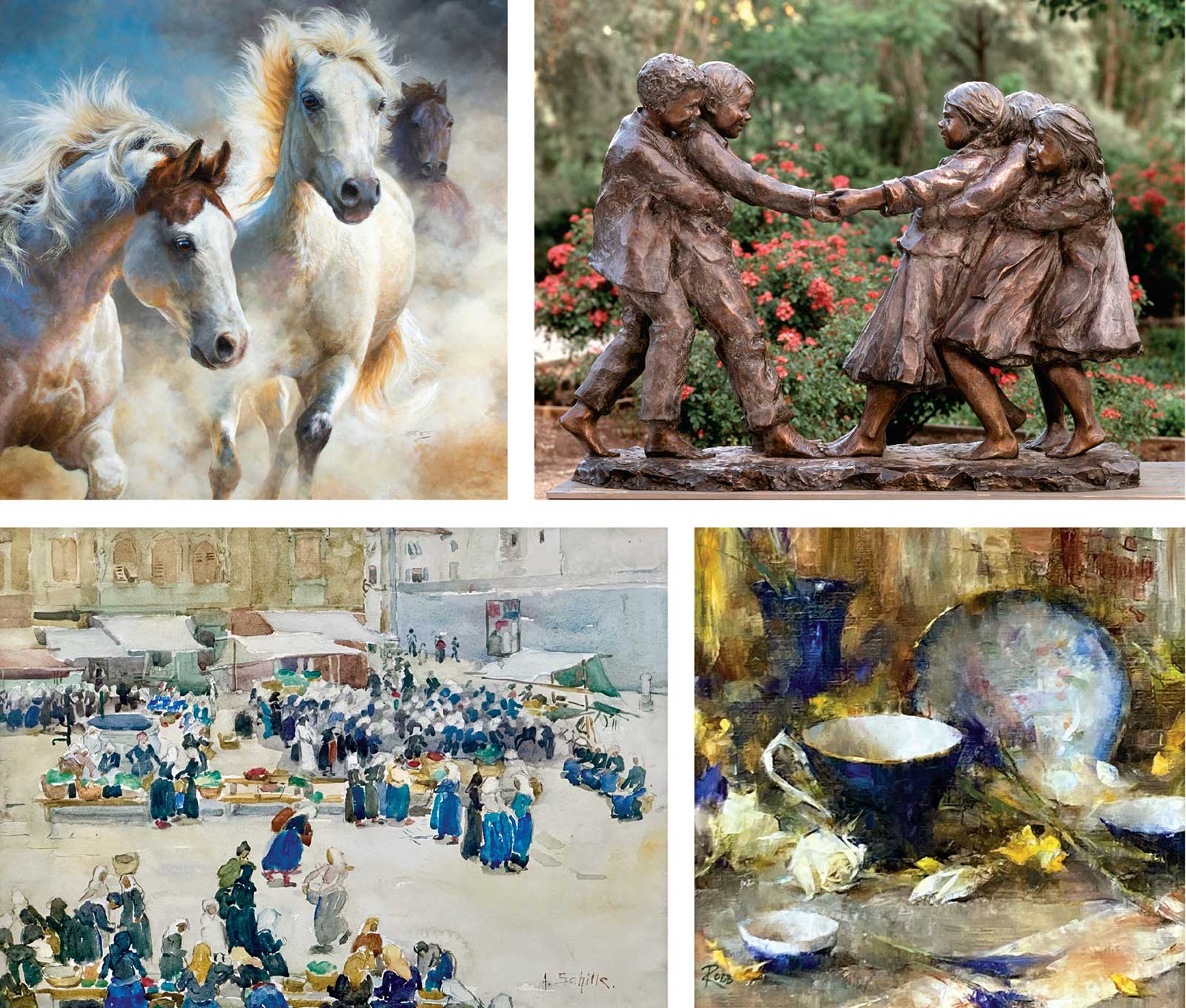
Top: Legacy Gallery, Power of the Medicine Hat Horse, oil, 48 x 48 in., by Bonnie Marris. Nedra Matteucci Galleries, Tug of War, 1989, bronze, ed. of 35, 16 x 21 x 10 in., by Glenna Goodacre (1939-2020). Bottom: Nedra Matteucci Galleries, Market Scene, Le Puy, ca. 1909, watercolor, 10 x 14 in., by Alice Schille (1896-1955). Nedra Matteucci Galleries, Teacup and White Roses, oil on linen, 12 x 12 in., by Laura Robb.
Over in Santa Fe, New Mexico, is Nedra Matteucci Galleries, which has shown work by women artists for decades. “I’m drawn to artists who offer something enduring—and in so many ways, the work of Glenna Goodacre, Alice Schille and Laura Robb does exactly that,” says director Dustin Belyeu. “Goodacre’s bronzes capture the human spirit with remarkable vitality and emotion, from slice-of-life moments in childhood to monumental works that have become part of our national story. Schille’s pieces are also strikingly emotional, in a very different way. She brings a true painter’s perspective to landscapes from her worldwide travels, adding a sense of profound depth and personal nature to everyday scenes. And with Robb, there’s an immediacy and joy in her florals that is difficult to define but absolutely her own. Her confident brushwork and compositions pull you in and grow more intriguing the longer you look.”
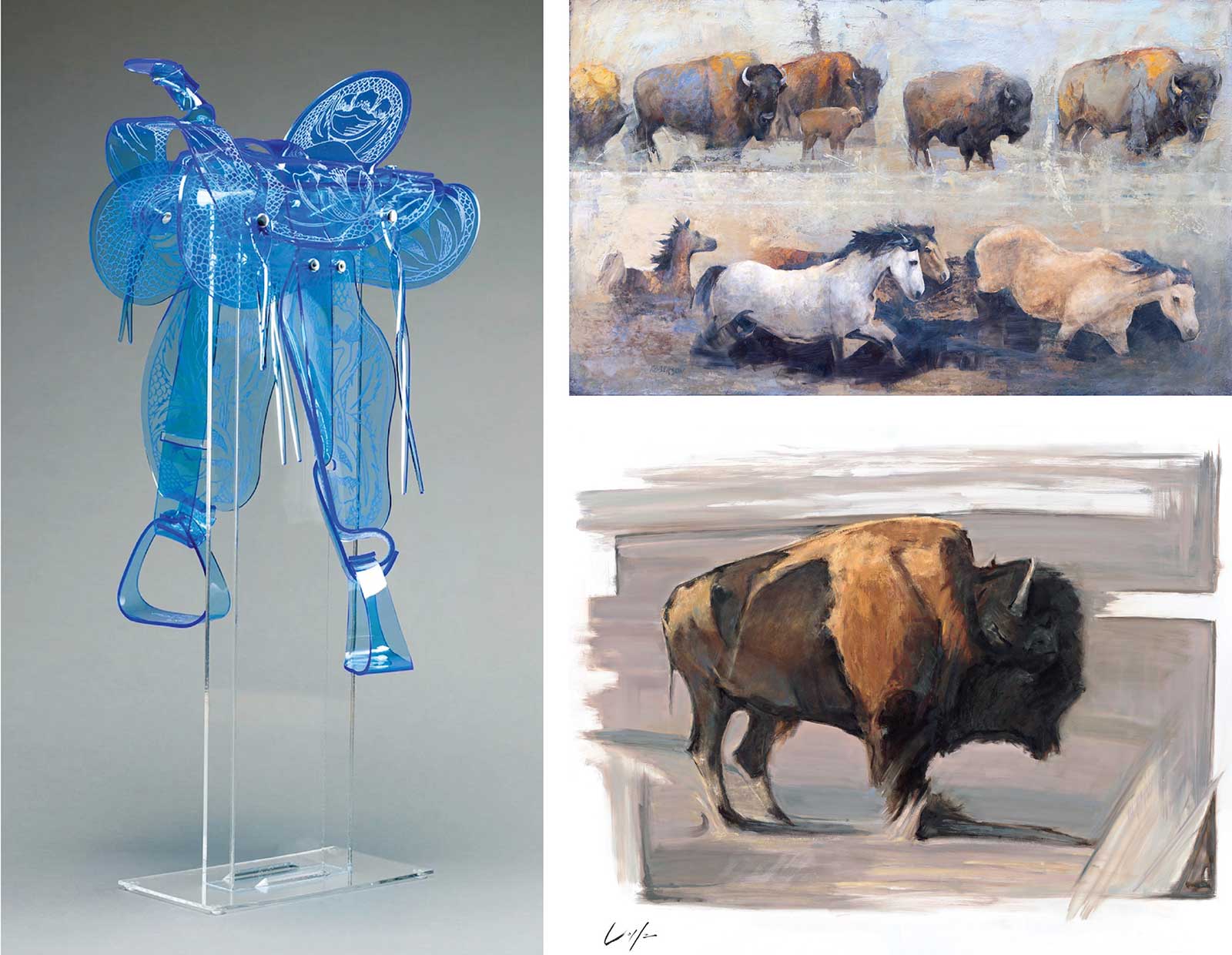
Left: Altamira Fine Art, Kind of Blue, hand-formed Plexiglass, 22 x 10 x 11 in., by Maeve Eichelberger. Top right: Altamira Fine Art, Tribute to the Wild, oil on canvas, 36 x 60 in., by Mary Roberson. Bottom right: Cassens Fine Art, Endurance II, oil on ACM panel, 48 x 60 in., by Coila Evans.
With locations in Scottsdale, Arizona, and Jackson Hole, Wyoming, Altamira Fine Art shows a variety of women artists, including Maeve Eichelberger, Mary Roberson and Maura Allen. “Maeve’s sculptural work pushes material boundaries, her use of translucent acrylic creates an interplay of light, movement and form that feels both contemporary and deeply referential to Western iconography. Mary brings a painterly sensitivity to wildlife, capturing not just the presence of her subjects, but their quiet dignity through layered texture and atmosphere. And Maura distills the human figure into something almost archetypal, her work feels rooted in history, yet undeniably modern in its abstraction and mark-making,” says Jason Williams, gallery owner. “Together, these artists represent the strength of female voices shaping the New West, each approaching the genre from a distinct perspective through material innovation, emotional resonance, or conceptual reduction. What unites them is a commitment to pushing beyond tradition while still honoring the spirit of the West. That tension between reverence and reinvention is where the most compelling work is happening today.”
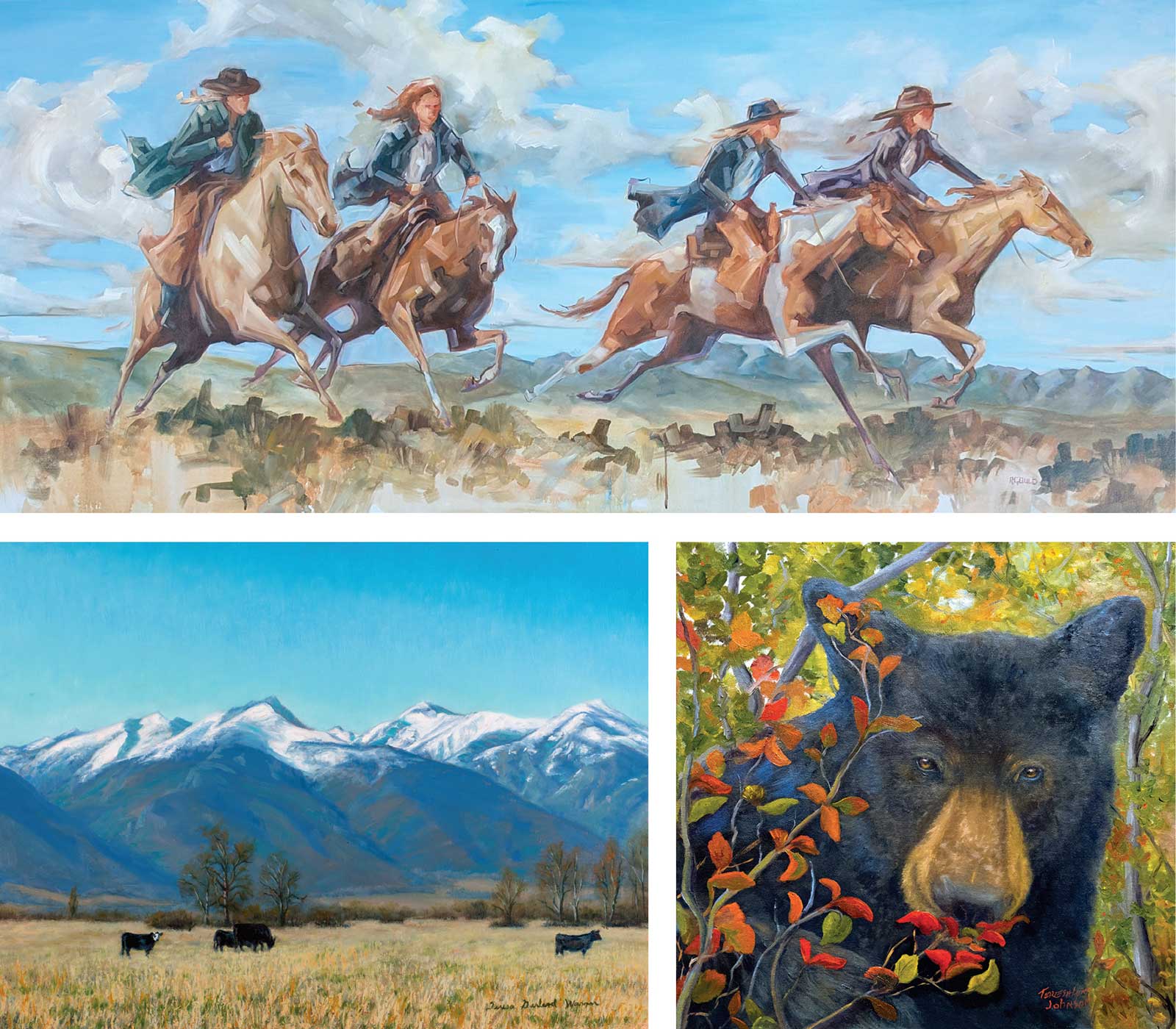
Top: Cassens Fine Art, Some Cowboys Wear Braids, oil on canvas, 36 x 84 in., by Renee Gould. Bottom: Cassens Fine Art, Bitterroot Ranch, oil on linen panel, 18 x 24 in., by Teresa Garland Warner. Teresa Lynn Johnson, The Forager, oil, 16 x 16 in.
Cassens Fine Art in Hamilton, Montana, not only shows work by women artists, but the gallery is run by women. “Buy art that transports you,” says Michelle Cassens. “The work that lasts is usually made by someone who knows their subject from the ground up, and that kind of intimacy finds its way into the painting.” Cassens is currently showing work by three talented artists: Renee Gould, who grew up riding through the Alberta foothills and still splits her time between the saddle and the studio; Teresa Garland Warner, who practiced medicine for nearly 30 years before dedicating herself to painting; and Coila Evans, who developed her technique after years of plein air work in the landscapes around Roundup, Montana.
For New Mexico painter Teresa Lynn Johnson, her work is deeply rooted in her love of the rural, wide-open spaces of the Western states and a profound admiration for both domestic and wild animals that inhabit these landscapes. “My artistic journey is fueled by a spirit of freedom, peace, kindness and an enduring curiosity for the natural world. My portrayal of the animal world offers viewers a perspective that highlights the delicate beauty of nature through a feminine lens,” she says. Johnson embraces oil paints for their rich color and textural possibilities, allowing her to create strong compositions characterized by immediate and expressive brushstrokes. Her art invites viewers to experience a sense of peace and freedom, encouraging a curiosity about the world around them. Memorable moments in her career include close encounters with wild animals used as inspiration for her work and the immersive experiences of plein air painting combined with trail hiking, which continuously informs her creative process. For collectors, Johnson would recommend focusing on passion over trends and buying what you at once love rather than what you think you should buy.
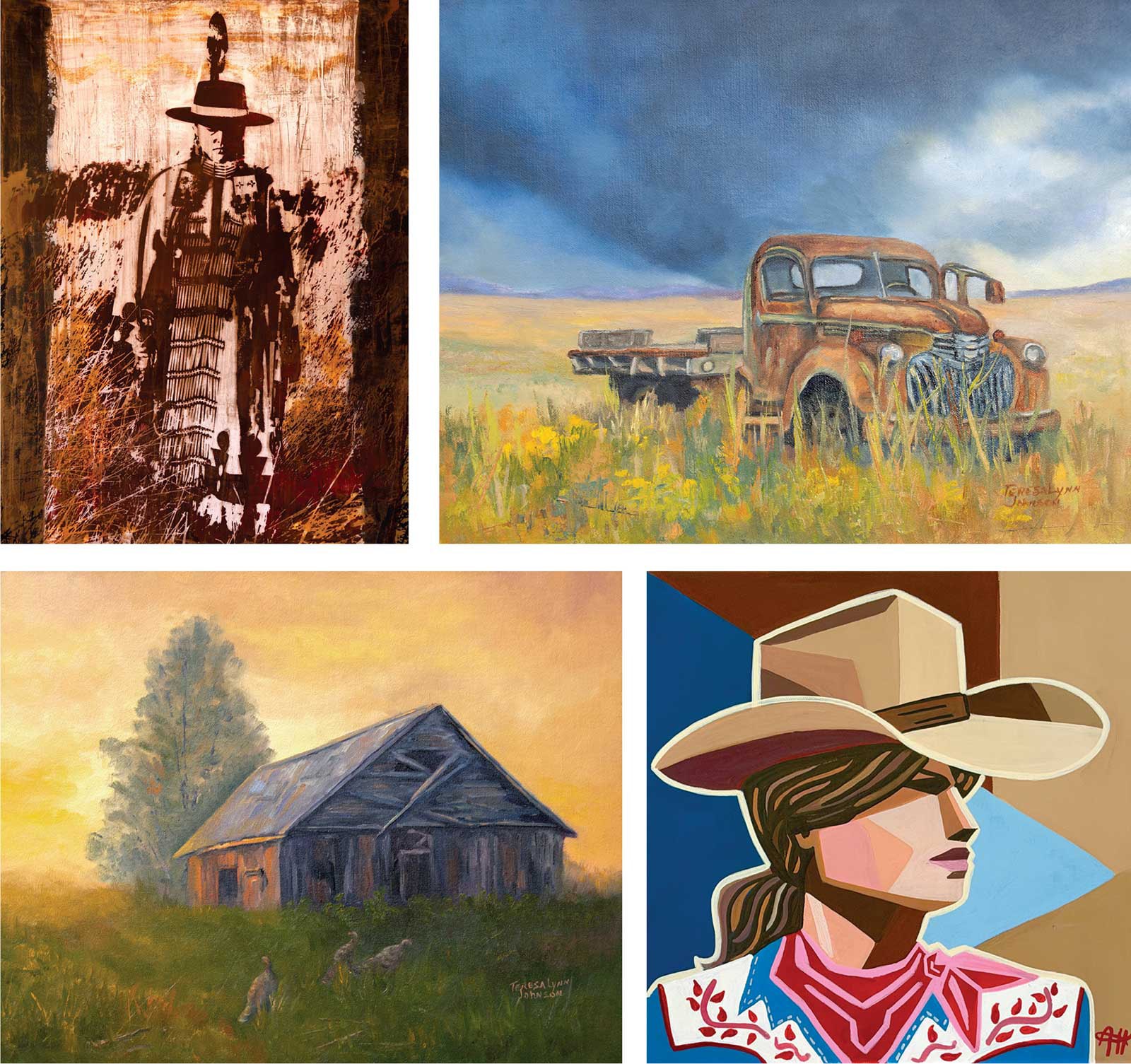
Top: Altamira Fine Art, Reverence, acrylic on panel, 40 x 30 in., by Maura Allen. Teresa Lynn Johnson, Forgotten, oil, 11 x 14 in. Bottom Teresa Lynn Johnson, Evening Curiosity, oil, 16 x 20 in. Angie Haskell, Cubist Cowgirl, acrylic, 14 x 11 in. Available at Marshall Gallery.
Another New Mexico painter is Angie Haskell, whose work has shifted into modernism and even cubism. “My work is inspired by midcentury modern design and Southwest iconography. I love early work by Picasso, Stuart Davis and Georgia O’Keeffe. From an artist’s perspective, I would encourage Southwest collectors to gently push beyond the familiar and consider embracing more modern work, especially pieces that carry a sense of light, optimism and a fresh visual language,” she says. “The history and tradition of Western art are incredibly important, but they were once ‘new’ too, shaped by artists willing to take risks and reinterpret their world. Today’s evolving styles—simplified forms, bold color relationships and more abstracted compositions—are a natural continuation of that legacy. Work with a happy aesthetic is not shallow; it reflects a deliberate choice to capture joy, rhythm and emotional clarity in a complex world. By stepping outside of your comfort zone, you’re not leaving tradition behind, you’re helping to expand it. Collectors play a critical role in shaping the future of Southwest art, and your willingness to support contemporary voices ensures the genre remains alive, relevant and forward-moving. The next generation of important work won’t look exactly like the past. And that’s exactly why it matters.”
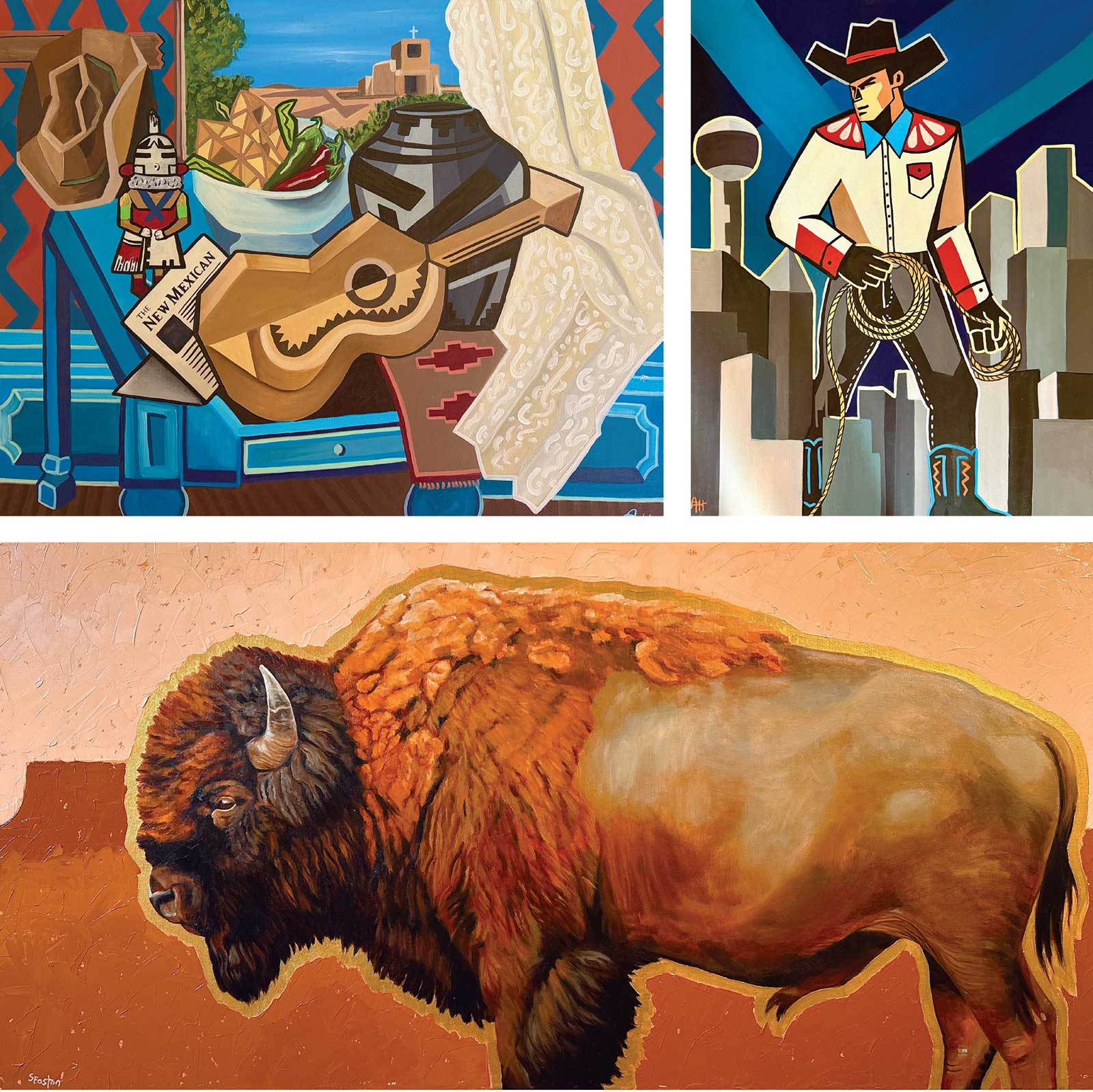
Top: Angie Haskell, Offerings of the High Desert, acrylic, 28 x 22 in. Available at Acosta Strong Fine Art. Angie Haskell, Hank Means Business, acrylic, 28 x 22 in. Available at Acosta String Fine Art. Bottom: Sarah Boston, American Prairie II, oil, 48 x 24 in.
Colorado painter Sarah Boston, who is working on the leading edge of modern design, is not only an artist but also a curator and the director of Oh Be Joyful Gallery in Crested Butte, Colorado. “My current body of work, American Prairie, uses sepia tones and gold leaf to honor the Indigenous people and wildlife who shaped and sustained this landscape prior to Manifest Destiny,” she says. “Guided by a commitment to authenticity, I research my subjects closely and often build compositions around thoughtful, symbolic details. Subtle narrative elements—gesture, texture and carefully chosen motifs—invite viewers to look beyond likeness and consider relationship to place. Through traditional techniques and contemporary intent, my paintings celebrate heritage, resilience and the quiet significance of everyday life on the prairie.”
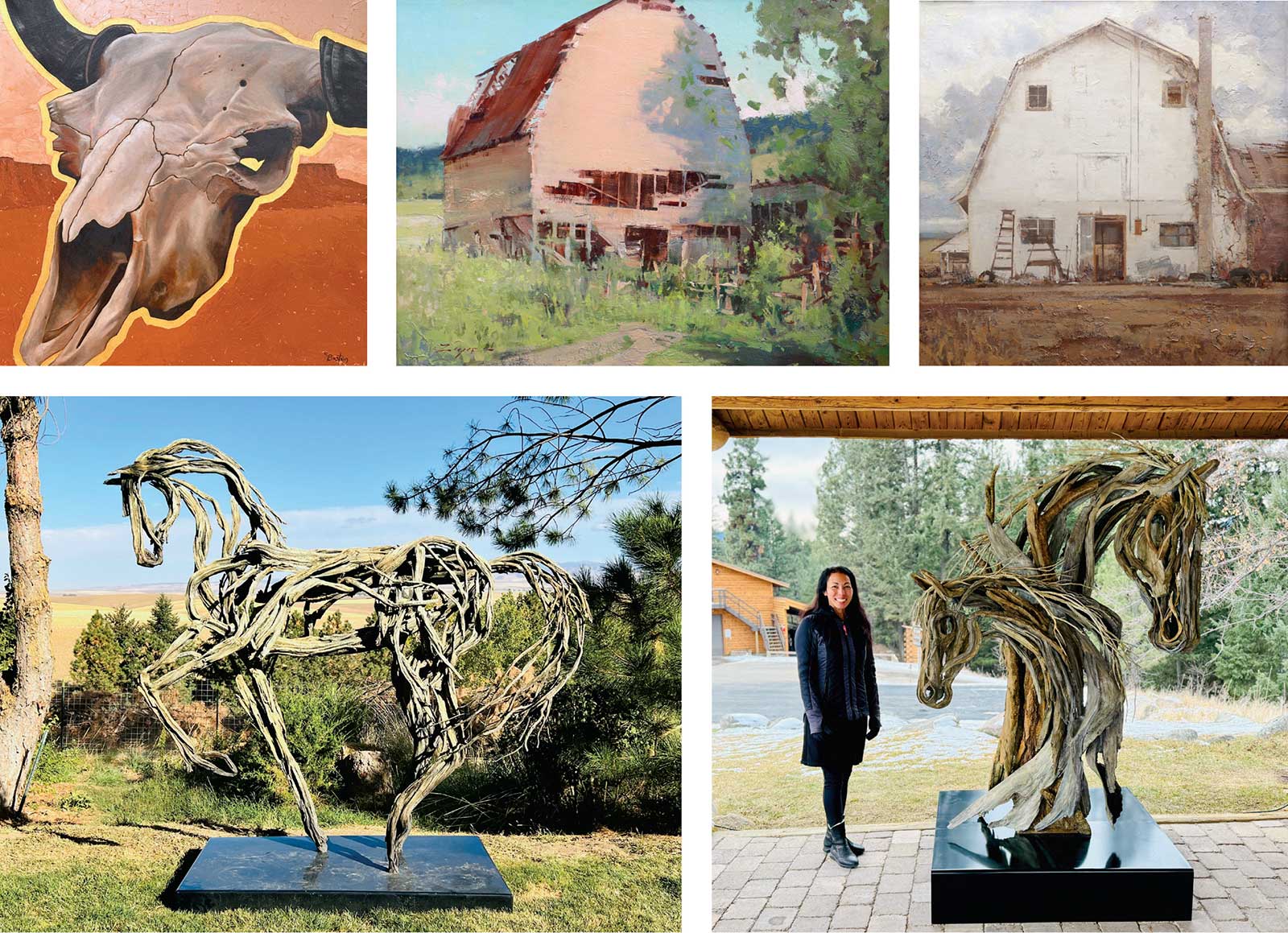
Top: Sarah Boston, American Prairie I, oil, 30 x 30 in. Allie Zeyer, Rhythm of Planks and Patterns, oil, 18 x 24 in. Allie Zeyer, Where the Earth Turns Gold, oil, 36 x 36 in. Bottom: Brenna Kimbro, Western Spirit, bronze, 84 x 108 x 48 in. Brenna Kimbro, Love and Light, bronze, 96 x 72 x 60 in.
Allie Zeyer, whose work is represented by Wilcox Gallery in Jackson Hole, Wyoming, has turned some of her attention to barns, a classic subject. “The Western landscape, whether prosaic or sublime, is the foundation of my painting. Each piece begins in direct experience, shaped by places I have walked, observed and studied firsthand. I don’t paint what I haven’t known. Through plein air painting and careful observation, I gather the visual language of the land—its value, color relationships and underlying design,” she says. “In the studio, I refine those impressions into compositions that are both intentional and enduring. I’m captivated by the simplicity of pastoral views, where the edges of tree lines soften and the pitch of a barn cuts cleanly into the sky. I look for moments that are easily overlooked: a cast shadow slipping off the edge of a roofline or shifting patterns of light and shadow weaving through cottonwood trees. These quiet relationships are what guide my compositions and give structure to my work. My goal is to translate that experience into work that feels honest and visually compelling, both for myself and the collector. This creates paintings that not only describe a place, but allow the viewer to step into it.”
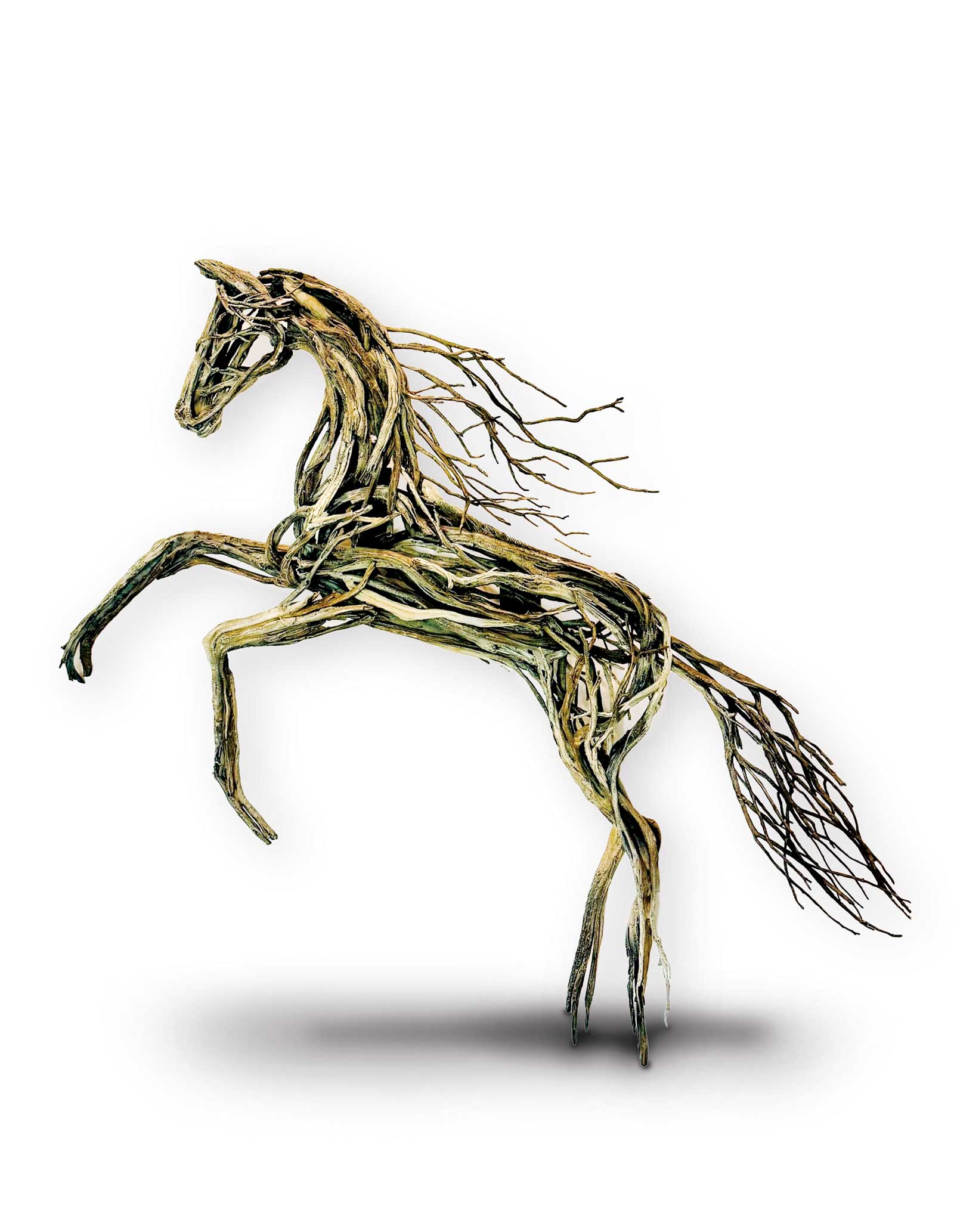
Brenna Kimbro, Flight Line, bronze, 39 x 62 x 8 in.
When discussing her work, sculptor Brenna Kimbro invokes her passion as a driving force behind her studio. “Fire within me fuels my spirit. Art and horses have long been central to my life. They are sources of inspiration, like silent languages through which I express myself and my heart with the world. Inseparable from freedom, my creativity ignites self-discovery as I listen to my inner voice, enjoy clarity, and trust my intuition with peace and coherence. I love seeing people light up with happiness, and I feel so blessed because my horses and art often grant me this joy,” she says. “Memories of my mother’s love and strength have become a powerful source of inspiration. She taught me to remain true to myself in all I do. When I was adopted from Korea, my mom embraced me as her own with all her heart. She instilled her love of the land we live on within me. Our ranch’s aspen grove was her favorite place in the world. She would say, ‘Brenna, love the trees and always do your best to be a good steward of the land.’ From crayons and paint to bronze and mixed media, I have unveiled horses in art since I was very young. Ideas still spark with new opportunities, fresh materials and unbridled imagination.”
Artist Lynne Darrah paints animals of the West, primarily herds and packs. “I like the repetitive pattern of groups of animals—multiples creates impact. Herds commonly think and react in unison, while pack animals coordinate and communicate with each other for hunting. I like to paint large pieces so that I have space for the group members and their facial expressions,” she says. “I use natural colors blending the oil paint for the under coat of the fur followed by a final layer to show fur texture. I like them moving or thinking about moving. I paint on wood to remove the ‘pixels’ created by the threads of a canvas. Once finished, I ask myself, ‘Is the piece pretty and does it express the emotion of the subject?’ I prefer to have the subject looking at the observer, in hopes of making an emotional connection between the two.”
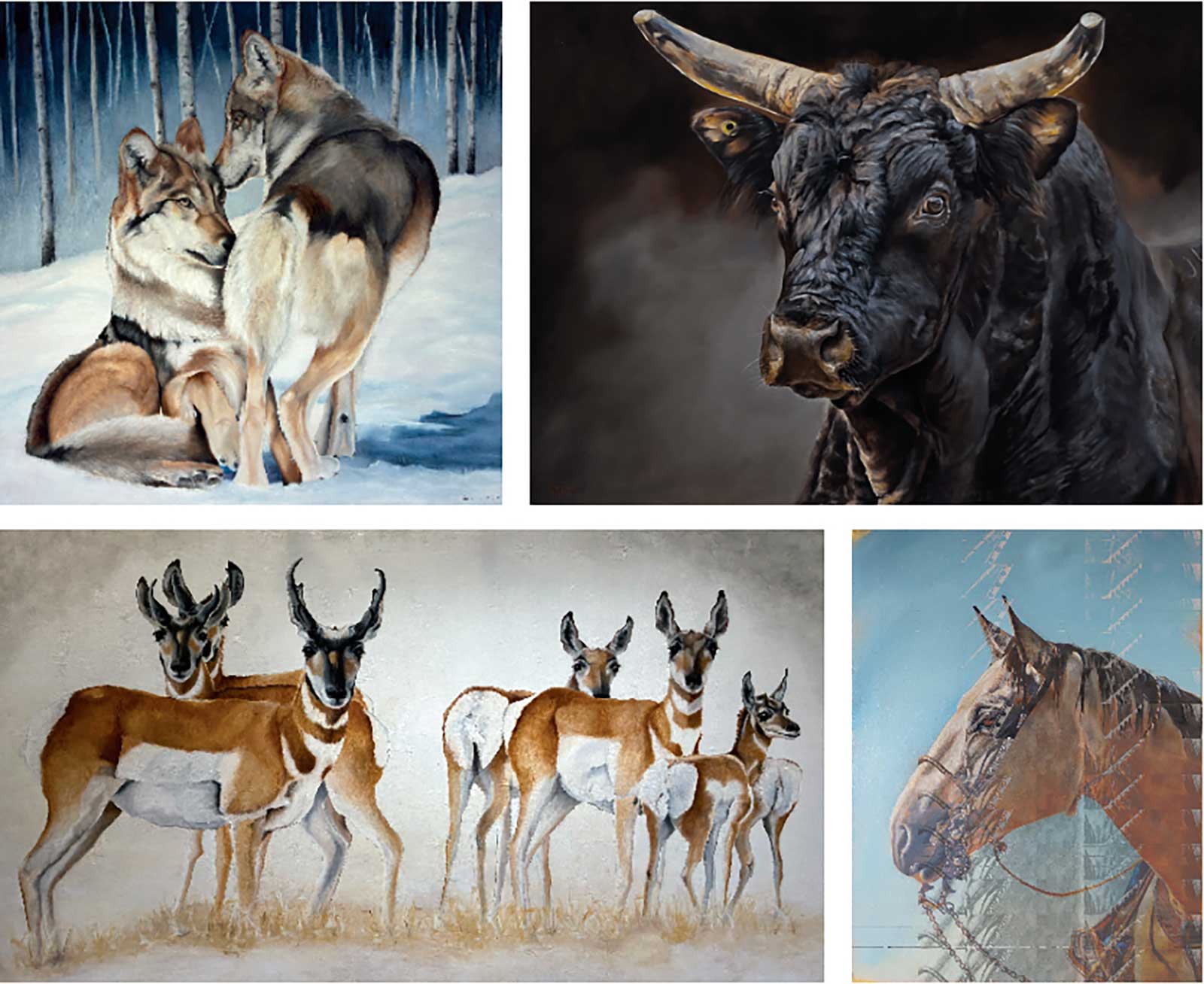
Top: Lynne Darrah, Mexican Grey Wolves – Get Up, oil on wood, 36 x 36 in. Stefanie Travers, Unquestionable, oil, 30 x 40 in. Bottom: Lynne Darrah, Pronghorn on the Blue Mesa, oil on panel, 36 x 65 in. Stefanie Travers, As the Day is Long, oil, 20 x 26 in.
In Stefanie Travers’ newest works, the Canadian painter depicts a horse and a bull in her paintings As the Day is Long and Unquestionable. “I am deeply fascinated by the raw unfiltered power and dynamism of bulls. I find they speak to a more primal level of our being and are such incredible metaphors for the challenges and victories found in life and it’s this resonance with a piece of art, this chord struck, that rings deep within us that draws art and collector together and nothing is more fascinating than to watch the magic when a collector ‘sees’ their piece and cannot live without it. How cool is that, really?” she says about Unquestionable.
Cacti are the subjects of some of Elena Golberg’s newest paintings from her studio. One such work is Saguaro and Cloud.“I chose saguaro cacti as my subject to paint because I admire their strength and beauty. I have spent hours hiking in the desert and photographing them along the trail,” she says. “I remember taking many photos of this cacti. I thought it has perfectly balanced branches crowned by a central trunk with a lot of character. A single cloud was passing by, and I captured the moment when it was perfectly positioned behind the cactus. The contrast between the cloud and the saguaro made the cactus stand out, with its bright warm colors against the crisp, cold sky.”
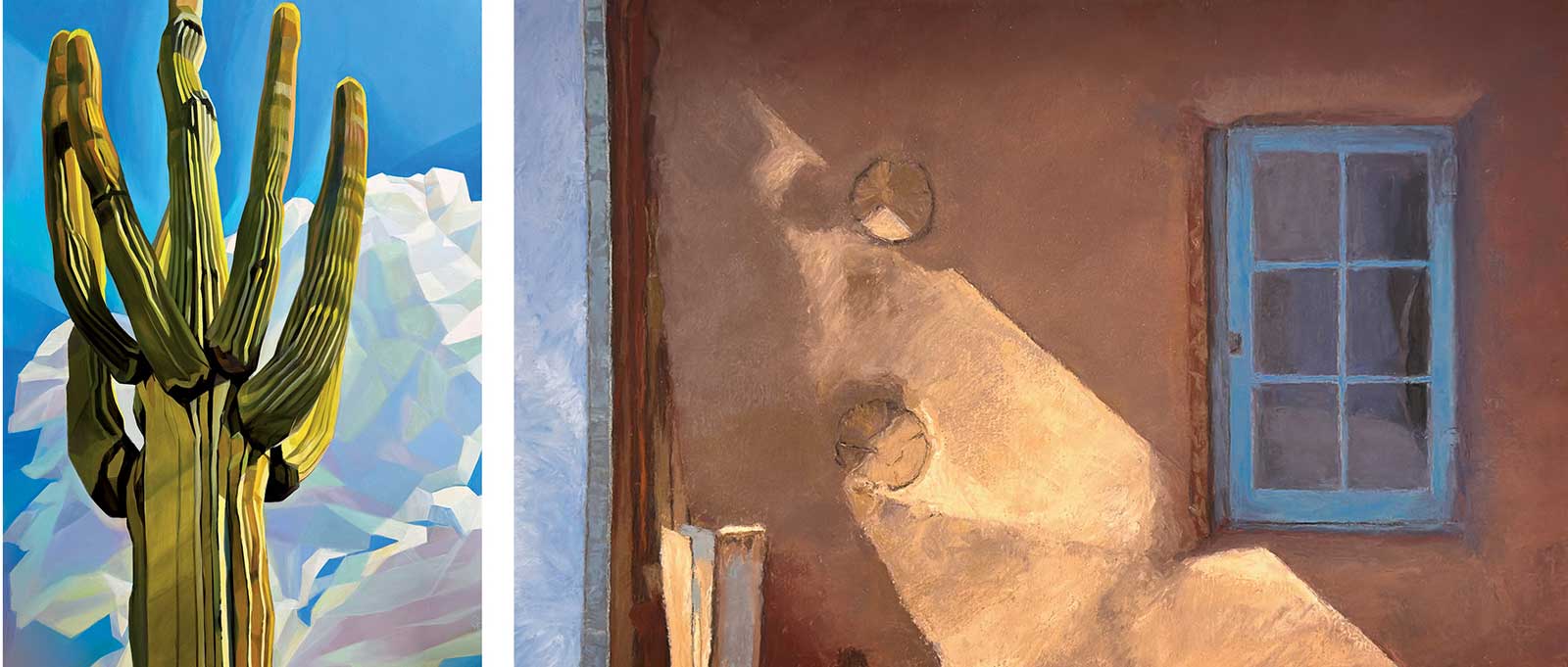
Elena Golberg, Saguaro and Cloud, oil, 84 x 60 in.; Patricia Ridge Bradley, Blue Window, soft pastel on sanded paper, 12 x 9 in.
Patricia Ridge Bradley, who lives in Oklahoma but paints the Southwest, is fascinated by the landscape and the many adobe structures. “At first glance, they may look drab and colorless, but upon closer inspection, they are bursting with color. The morning sun brings out the gentle corals and pinks, and the evening sun transforms the earth into a blaze of reds, ochres and oranges. The shadows are equally beautiful, bringing out the violets, lavenders and deep burgandies. The skies are a deep blue—almost turquoise—that complements all these colors,” she says. “That’s why my paintings ‘sing’ with the real colors of the West. In Blue Window, the contrast of strong sunlight and deep shadow create a triangle that draws the eye in toward the window. The blue window adds a bit of mystery with a touch of everyday life, and the blue sky balances the scene in a strong vertical. Strong composition is the most important element of any painting, followed by use of color, value and skilled use of medium.” —
Featured Artists & Galleries
Altamira Fine Art
172 Center Street Jackson Hole, WY 83001
(307) 739-4700
www.altamiraart.com
Sarah Boston
www.sarahbostonfineart.com
sarahboston.fineart@gmail.com
Patricia Ridge Bradley
(405) 627-0091
www.patriciaridgebradley.com
prb@patriciaridgebradley.co
Cassens Fine Art
215 W. Main Street Hamilton, MT 59840
(406) 363-4112
www.cassensfineart.com
Lynne Darrah
(316) 655-4731
www.studioandgalleryatmontequeen.com
lynnedarrah@sbcglobal.net
Gallery Wild
80 W. Broadway, Jackson Hole, WY 83001
(307) 203-2322 www.gallerywild.com
Elena Golberg
www.elena-golberg.com
golbergelena@gmail.com
Angie Haskell
www.angiehaskell.com
Teresa Lynn Johnson
Aztec, NM
www.teresalynnjohnson.com
(505) 334-1744
teresa@teresalynnjohnson.com
Instagram: @teresalynnjohnsonartist
Brenna Kimbro
www.brennakimbro.com
Legacy Gallery
7178 E. Main Street Scottsdale, AZ 85251
(480) 945-1113
www.legacygallery.com
Nedra Matteucci Galleries
1075 Paseo de Peralta Santa Fe, NM 87501
(505) 982-4631
www.matteucci.com
Stefanie Travers
Kamloops, BC, Canada
www.stefanietravers.com
stefanie@stefanietravers.co
Allie Zeyer
www.alliezeyer.com/wac
Instagram: @alliezeyerfineart
Powered by Froala Editor


