In 1936, Gerard Curtis Delano was commissioned to do a series of drawings and stories titled “Story of the West” for Western Story magazine. During an early portion of the project, the artist offered a poetic characterization of the American Southwest:
“The West—land of the Indian—land of the glamorous unknown—land of glorious Adventureland of the war club and knife—of waterless wastes and cruel distances—of viridian skies and blood-red rocks—it was only natural that its lure would find response in many adventurer’s heart.”
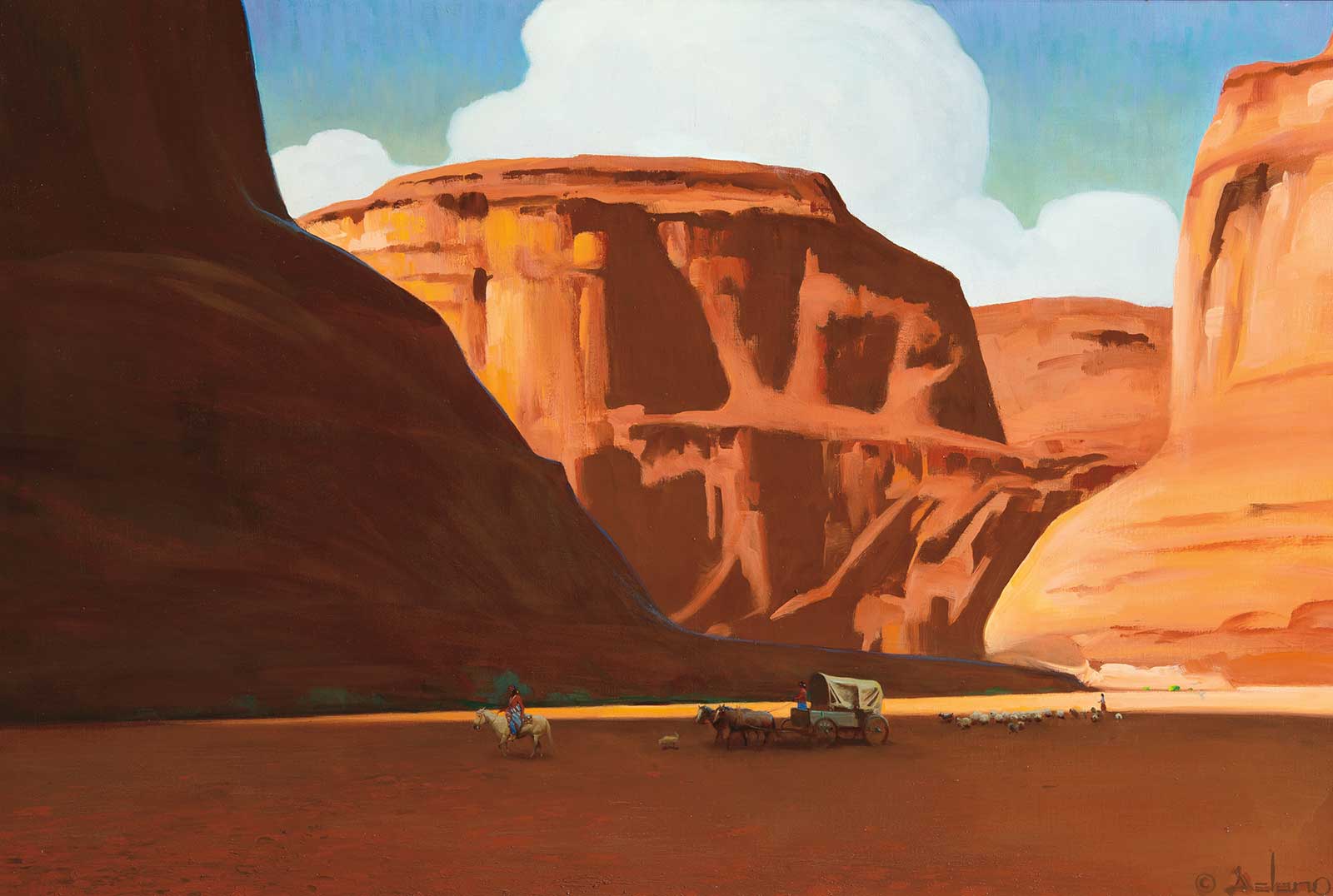 Gerard Curtis Delano (1890-1972), Canyon Exodus, oil on canvas, 32 x 48 in.
Ironically enough, at the time of the project’s publication, Delano had not yet visited Arizona or the Navajo Nation. That would transpire in the fall of 1943. After that initial visit, he again grew poetic: “There is a vastness, an immensity, and the peaceful hush of an enormous cathedral about Arizona’s great canyons. Whoever has been within these walls and has seen the flocks of sheep and goats grazing, heard the distant tinkle of the lead goat’s bell, listened to the haunting song of the bright-skirted shepherdess, and who has seen in the distance and approaching rider, a tiny speck against the massive walls, must yearn to perpetuate his impressions of those precious moments.”
Delano was not the first, nor the last, to paint the canyons and deserts of the American West, although he is certainly one of the most well-known artists and one of the most accomplished. His paintings captured the beauty and enormity of these lands, and he also set the stage for the Diné people who called these stunning places home.
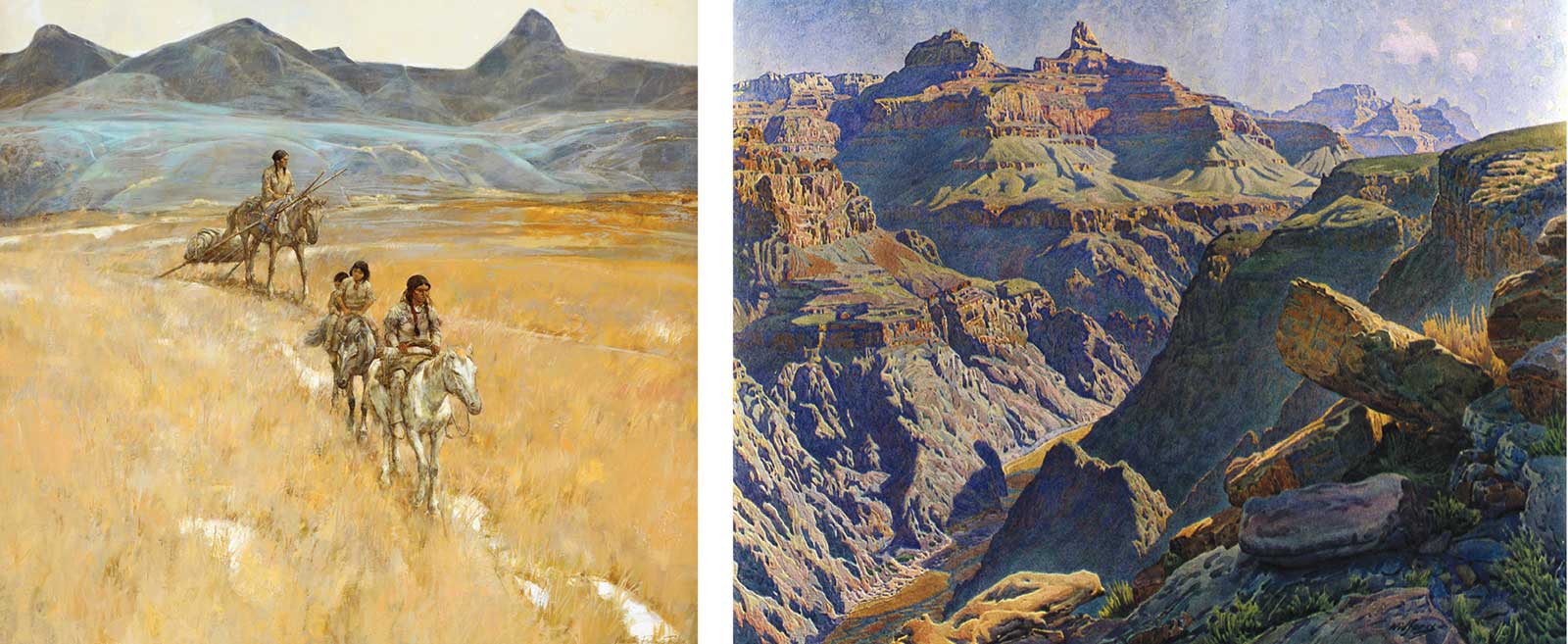 Kenneth Riley (1919-2015), Changing Camps, oil on board, 24 x 26 in. Gunnar Widforss (1879-1934), Plateau Point, Grand Canyon, ca. 1930, watercolor, 20 x 25 in.
Another artist who mixed the land with larger and more profound narrative qualities was Kenneth Riley, whose works were rooted in storytelling, allegory and poetry. While many of his paintings were figurative—including his compositionally complex portrait-like paintings of standing Native American subjects—Riley frequently turned to the desert as a multi-layered subject that could evoke larger concepts in his works. In some paintings, the canyon walls were painted narrow and consuming, as if to metaphorically choke and surround his figures, while in other works the land is more open and freeing. Consider Changing Camps, which shows the desert as an open, boundaryless setting.
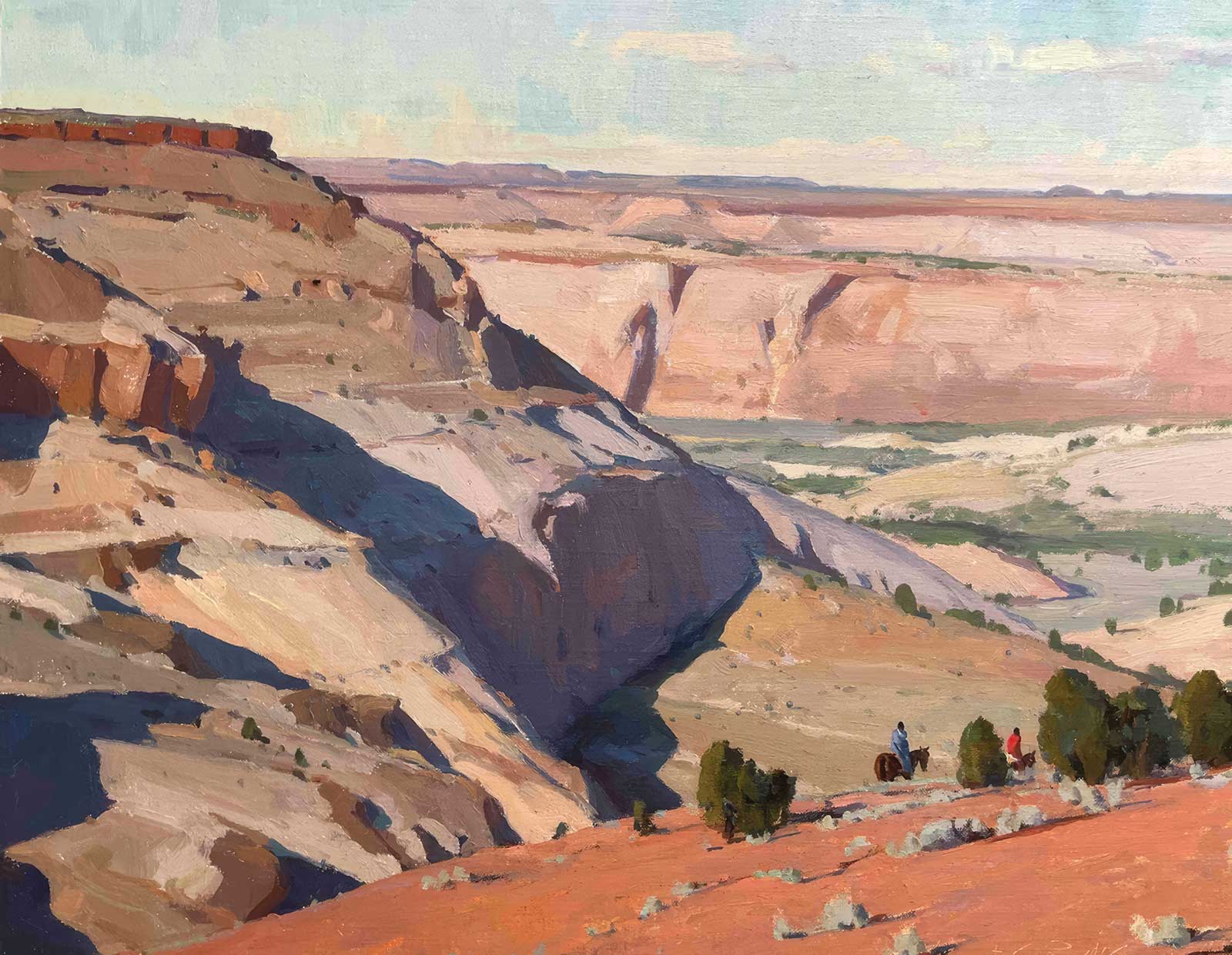
Legacy Gallery, Robbers Roost Canyon, oil, 16 x 20 in., by G. Russell Case.
For Gunnar Widforss, he embraced the geological chaos of the Southwest through the vast majesty of the Grand Canyon, which he first visited in 1923. It didn’t take long before Widforss became the preeminent painter of the famous Arizona landmark. His paintings captured the reality of the canyon, but also the grandness of its power.
Cyndi Hall at Legacy Gallery in Scottsdale, Arizona, says, “The desert and canyon landscapes of the American West have long defined the visual language of Western art, and at Legacy Gallery. These subjects are explored with both reverence and innovation. Towering sandstone cliffs, vast open skies and winding canyon passages are rendered with a sensitivity to light, atmosphere and scale that brings each scene to life. From the sharp edge of a sunlit mesa to the quiet depth of a shadowed canyon, these works capture the ever-changing relationship between land and light. Some artists lean into structure and form, emphasizing the architecture of the terrain, while others embrace a more expressive approach, using color and gesture to convey heat, distance and movement.”
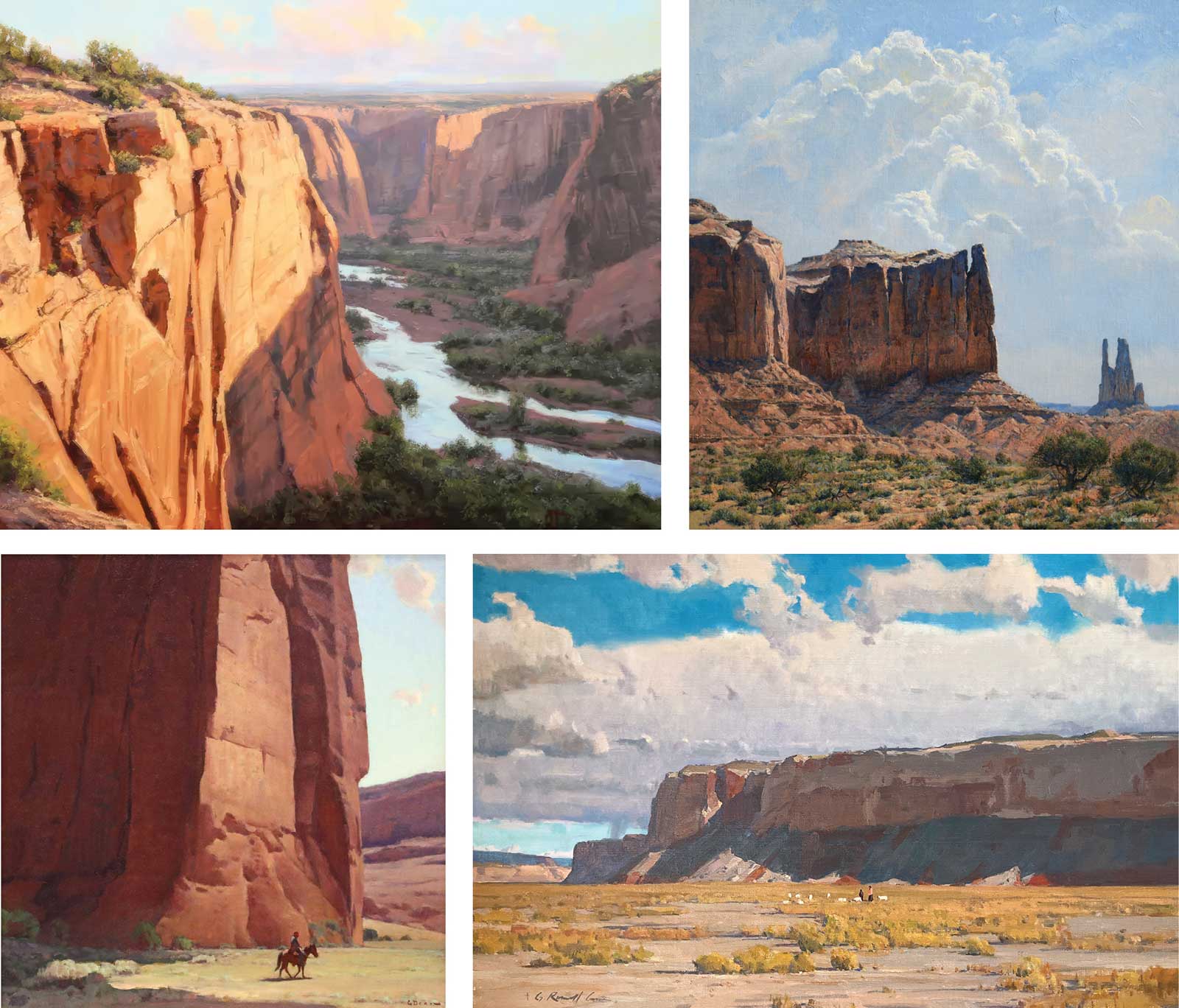
Top: Legacy Gallery, Morning Rim Walk, oil, 40 x 50 in., by Kenny McKenna. Legacy Gallery, Navajo Skies, oil, 30 x 28 in., by Robert Peters. Bottom: Maxwell Alexander Gallery, Canyon Rider, oil, 34 x 34 in., by Glenn Dean. Maxwell Alexander Gallery, The Peaceful Life, oil, 18 x 28 in., by G. Russell Case.
Hall continues, “What unites these works is a deep connection to place. The desert is not empty—it is expansive, powerful and enduring. Through these interpretations, Legacy Gallery artists continue to honor and evolve one of the most iconic subjects in Western art.”
Beau Alexander, owner of Maxwell Alexander, echoes the same sentiments by noting, “Canyons and deserts have long inspired artists as spaces of scale and reflection. Defined by dramatic rock formations and vast open horizons, these landscapes lend themselves to a visual language rooted in light and out-of-this-world shapes. Canyon scenes often highlight the interplay of vertical planes and shifting light, creating natural abstractions, while desert imagery leans into minimalism where open space and subtle tonal shifts carry emotional weight.”
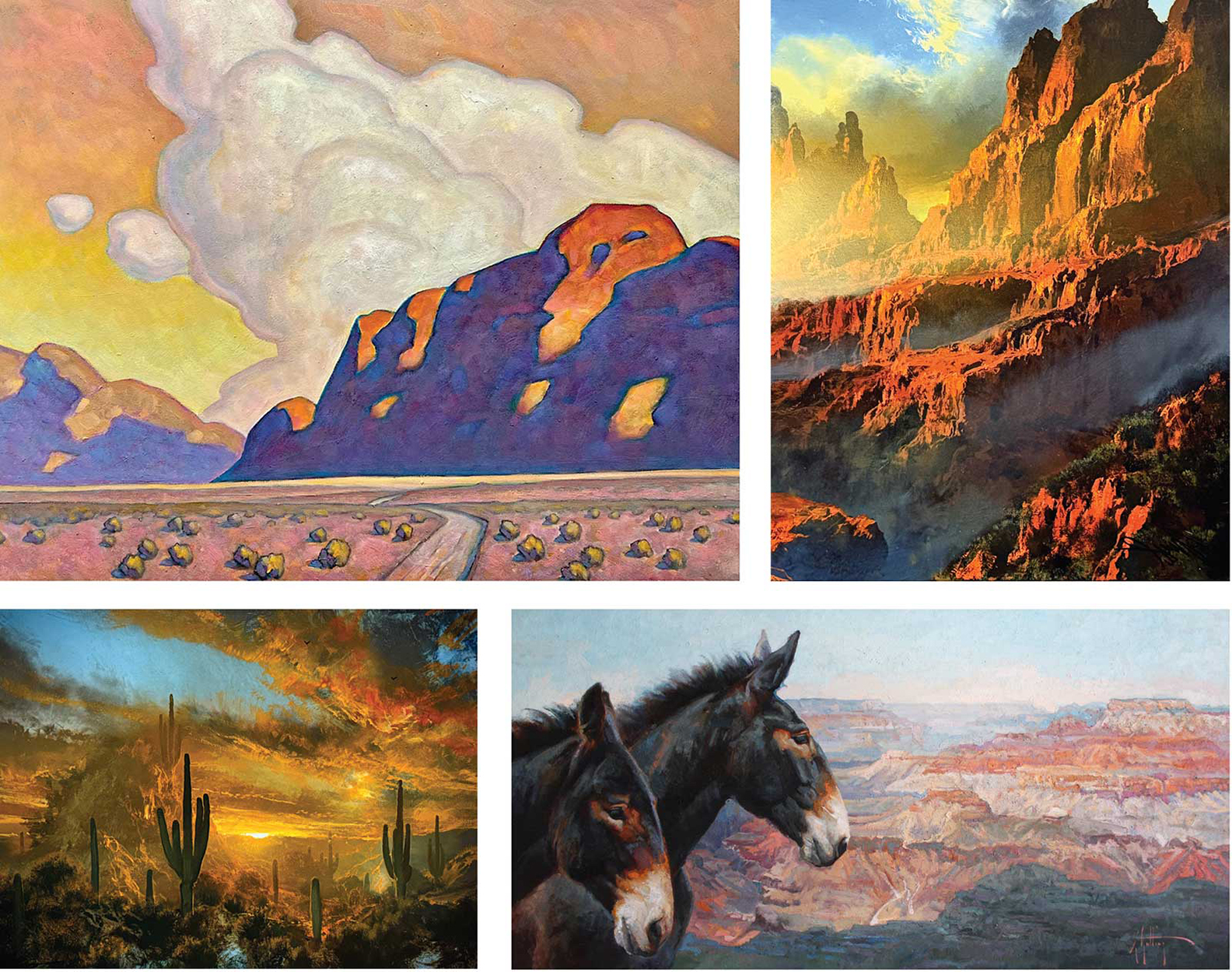
Top: Maxwell Alexander Gallery, Canyon Lands, oil, 24 x 30 in., by Howard Post. Dale Terbush, A Kingdom to Share, acrylic on canvas, 20 x 16 in. Bottom: Dale Terbush, Twice in a Lifetime, acrylic on canvas, 18 x 24 in. Coeur d’Alene Galleries, Dos Amigos, oil on linen, 24 x 48 in., by Abigail Gutting.
Alexander notes that artists like Maynard Dixon and Georgia O’Keeffe approached these environments as more than geology or geography. Dixon emphasized bold silhouettes and quiet expanses, while O’Keeffe distilled the land into refined, almost architectural compositions. Together, canyon and desert artworks balance greatness with intimacy, offering a thoughtful lens on time and the enduring presence of the natural world.
“Mules have been indispensable to the Grand Canyon for over a century, chosen for their sure-footed strength and remarkable intelligence in navigating the canyon’s steep, unforgiving terrain,” says co-owner of Coeur d’Alene Galleries, Buddy Le, in regard to Abigail Gutting’s painting Dos Amigos. “From early mining expeditions and trail building to today’s guided tours and supply transport, their reliability has made them a living thread connecting past to present. Their ability to think, adapt and endure where machines cannot has secured their place in the canyon’s enduring story of survival and exploration. It is this blend of history, resilience and dramatic landscape that continues to draw art collectors to the Grand Canyon.”
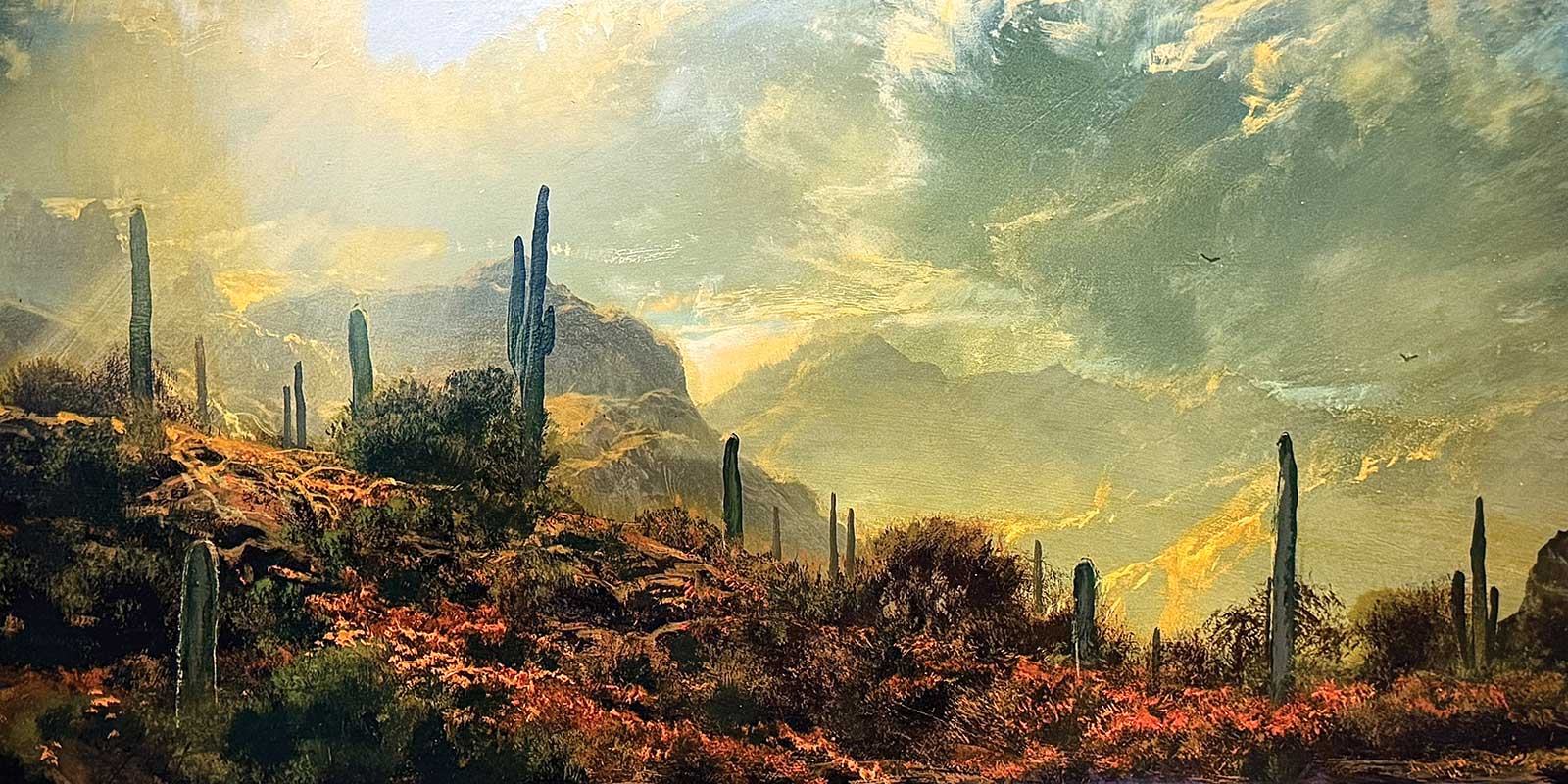
Dale Terbush, The Quiet Times, acrylic on panel, 10 x 20 in.
For Dale Terbush’s imaginary paintings depicting canyons and deserts, what he tries to describe isn’t just a style, but rather a philosophy of seeing. “The idea that light is the emotional core of my art and creating places is the reason why I paint,” he shares. “My joy is taking the viewer into a private world that is totally and uniquely my own. It is not my desire to just create a landscape—a camera in the hands of a great photographer accomplishes that all the time. For me it’s to communicate in my own private language of color—an emotion. I want the viewer to experience something while they spend a moment with my art, so that when they walk away, through their eyes, they heard something inside of themselves they haven’t heard before.”
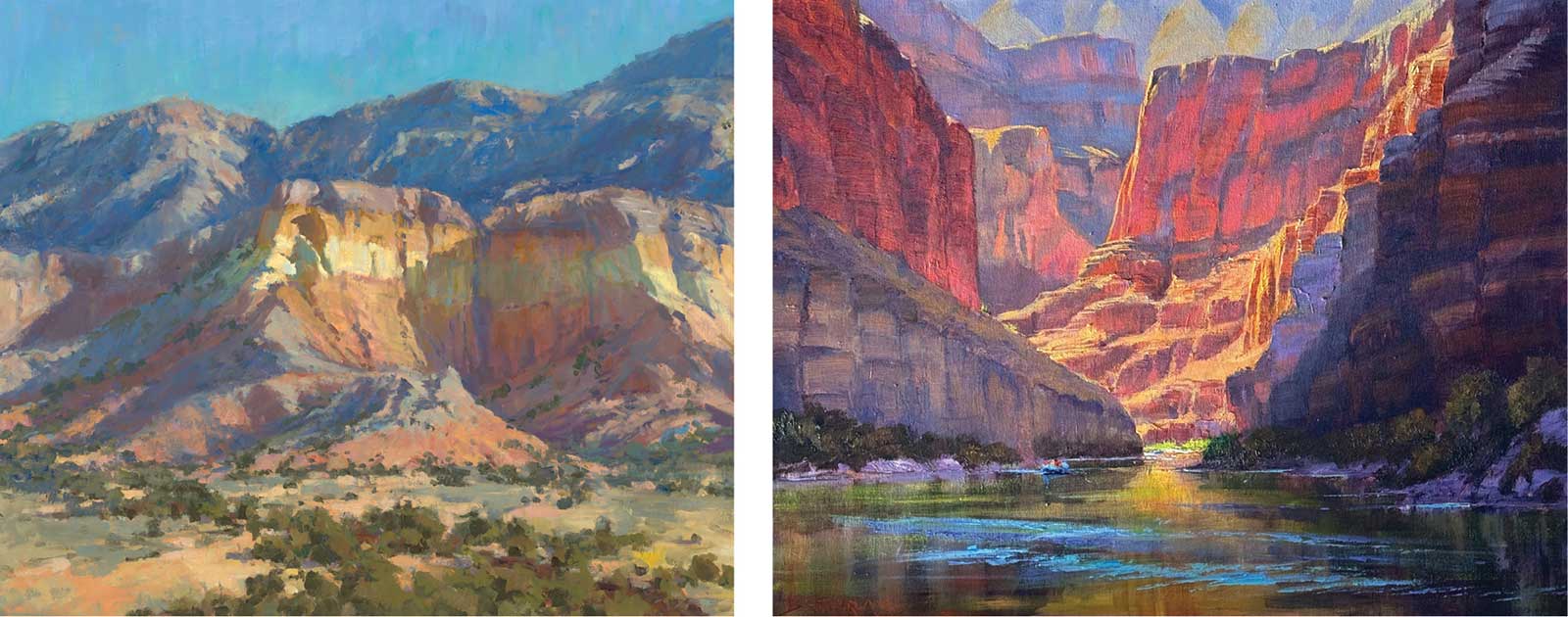
Barbara Coleman, Ancient Echoes, oil, 20 x 24 in. Dawn Sutherland, Into the Light, oil on canvas, 22 x 28 in.
Artist Barbara Coleman strives to create visual poetry when painting images like Ancient Echoes, a canyon piece revealing the colorful layers of strata. “I love to paint plein air to get ideas, color studies and source references. I take all this information, plus my memories and feelings about a place, and start coming up with ideas for compositions in the studio. I explore a variety of formats and ideas for placement and size of the elements of the painting. It is thrilling to make blobs of paint come alive, evoking the emotions I feel and expressing the soul of a place.”
Dawn Sutherland shares, “Light and shadow tell us everything to know about the textures of deserts and canyons.” Her oil painting Carved of Spirit and Stone was painted with a palette knife, adding to the rugged feeling of these hauntingly beautiful and dramatic remnants in the desert. “Reflected light in the shadows is part of the beauty in Grand Canyon especially when one is deep inside that wondrous gorge,” she says.
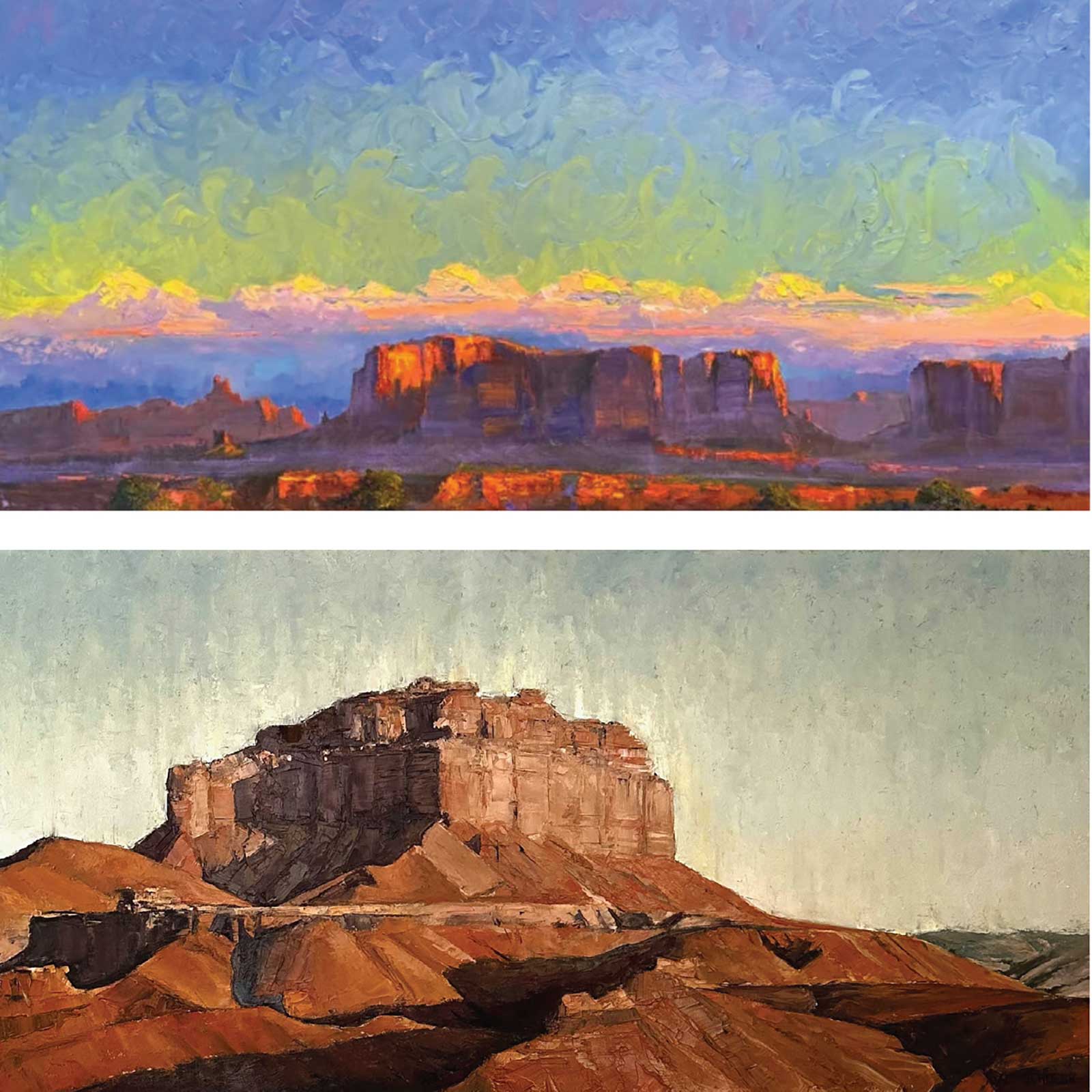
Dawn Sutherland, Carved of Spirit and Stone, oil on canvas, 18 x 36 in. Ryan Schoeck, Golden Hour, oil on panel, 24 x 48 in.
Another painting, Into the Light, tells of the delicate balance of direct light, shadow and light within the shadows. “These features keep me intrigued and challenged with every canvas,” adds Sutherland. “Each painting is a moment captured that will never be quite the same again. Owning such a painting brings that singular moment into your home to preserve and enjoy for a lifetime.”
As a painter with an affinity for the distinctive landscapes of the Southwest, Debbie Carroll is constantly thrilled by canyons and deserts. “The wide-open spaces and enormous skies of the desert lend themselves to contemplation and a sense of solitude,” she says. “Canyons and rock formations are a reminder of the passage of time and how the elements of wind and water constantly sculpt the land, creating beauty and refuge in their wake.”
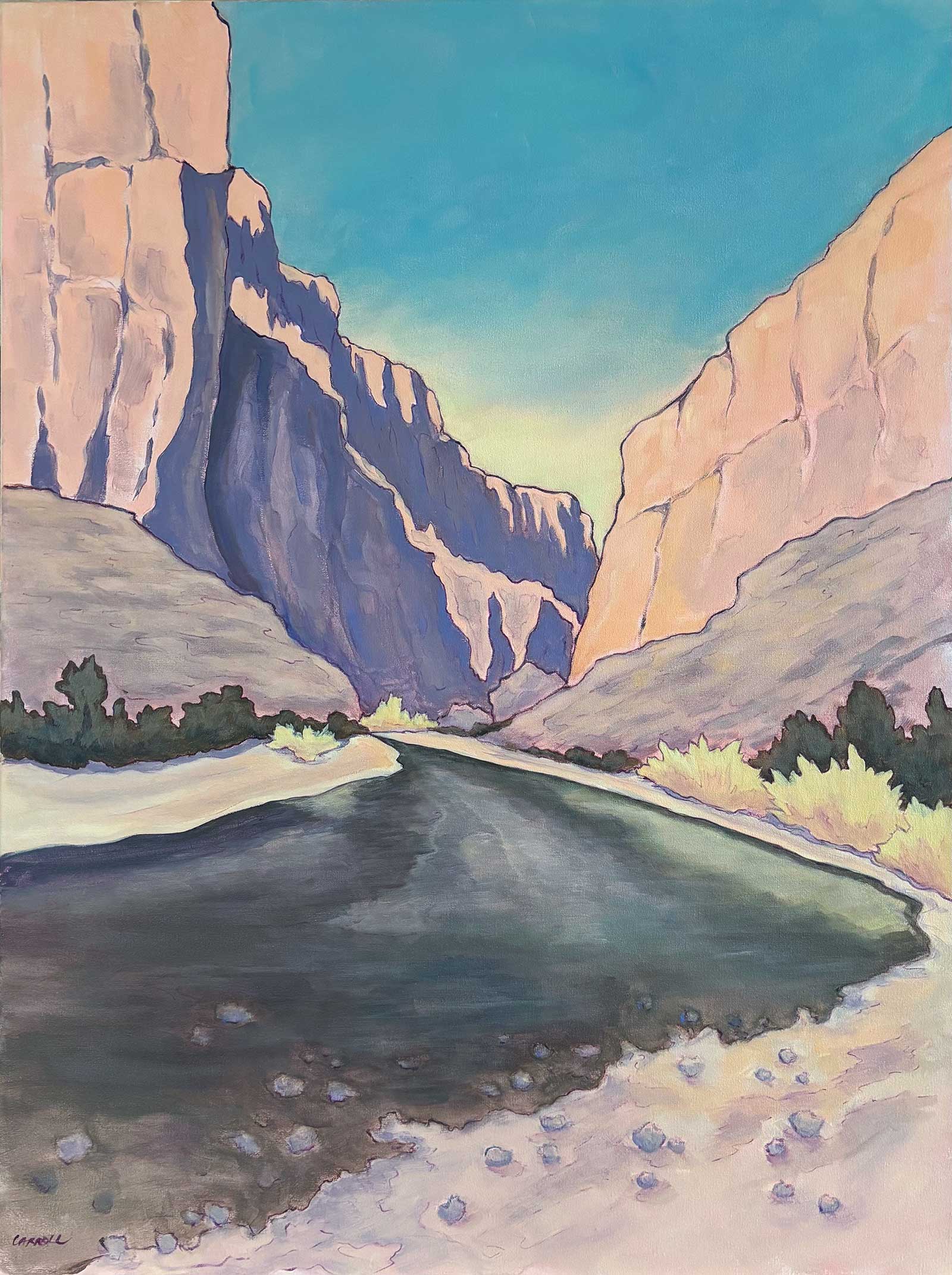
Debbie Carroll, At Santa Elena, acrylic, 40 x 30 in.
Carroll’s upcoming exhibition Sea of Desert, Oceans of Sky is the direct result of her time spent in the desert and how it changed the way she looks at it—a stunning canvas teeming with life if you know where to look. The show opens on July 10 at Worrell Gallery in Santa Fe. When acquiring art, Carroll says that collectors should consider “purchasing artwork in the Western genre [and] choose what you love and what speaks to you, and do not be afraid to venture into the contemporary side of this genre. Collections are more interesting when there is more variety of color and style.”
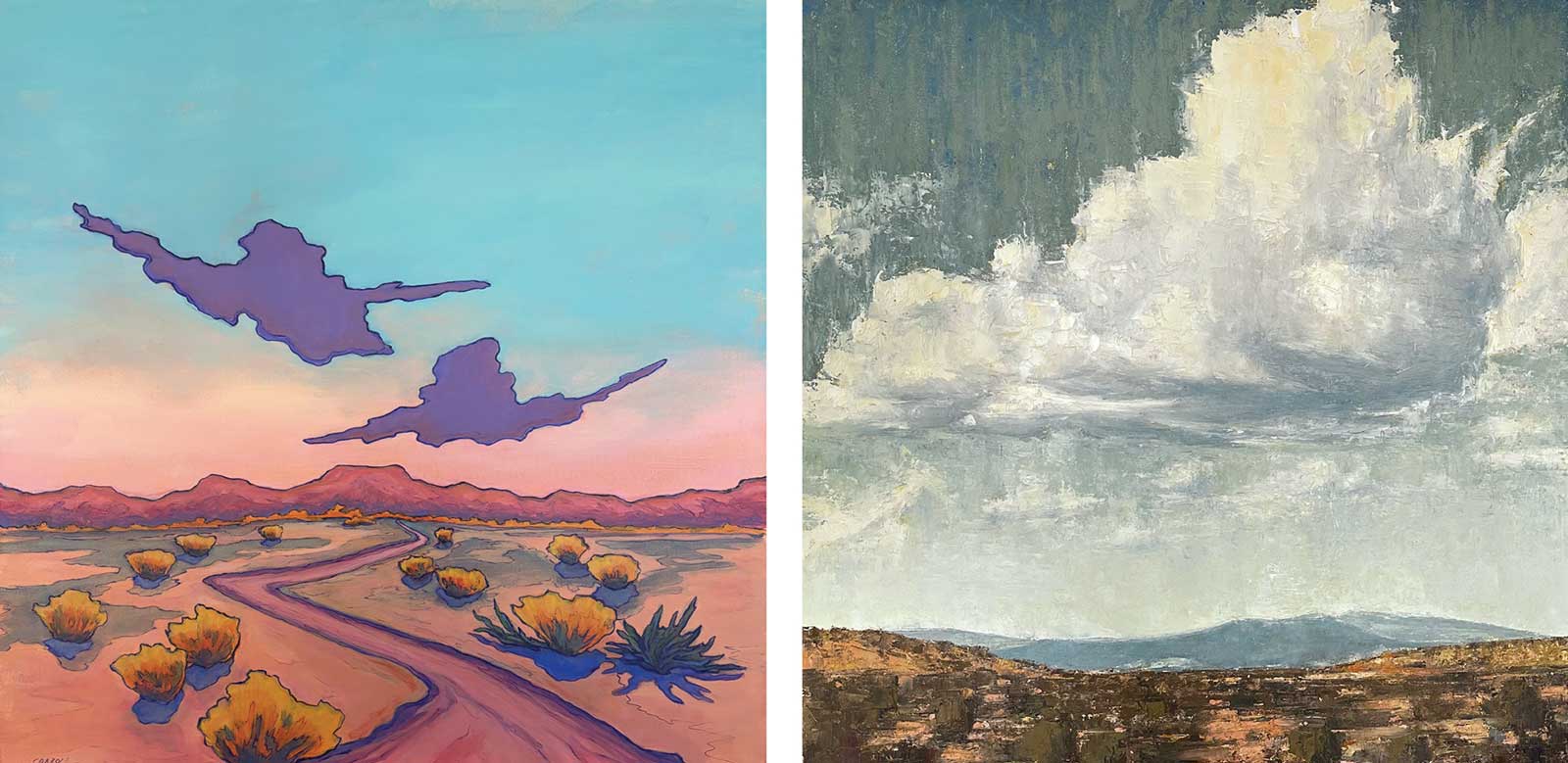
Debbie Carroll, In Search of Beauty, acrylic, 30 x 30 in. Ryan Schoeck, Above Escalante, oil on panel, 30 x 30 in.
When Ryan Schoeck is painting in the desert, he strives to capture the mood of that moment in time. “Rocks, shadows, light, all playing together as they have for thousands of years,” he says. “It’s up to me to find the elements that move me most, before I do my best to translate them through pigment and design. This requires complete immersion in the landscape, free of distraction, where I can walk below ancient mesas, sit in the dirt under the shade of junipers, and feel the sun’s warmth all around me. I create plein air studies and use an old film camera, combining the two references in the studio to create larger works.”
On the subject of collecting art, Schoeck adds, “I would say to seek what moves you,” he says. “If there’s a specific color harmony, an overall tone or an interesting composition that really pulls you into a scene, pay attention to that feeling. I think that’s your heart telling you something.” —
Featured Artists & Galleries
Debbie Carroll
www.debbiecarrollfineart.com
Coeur d’Alene Galleries
213 E. Sherman Avenue Coeur d’Alene, ID 83814
(208) 667-7732
www.cdagalleries.com
Barbara Coleman
barbaracolemanartist@gmail.com
www.barbaracoleman.com
Legacy Gallery
7178 E. Main Street Scottsdale, AZ 85251
(480) 945-1113
www.legacygallery.com
Maxwell Alexander Gallery
1300 N. Lake Avenue Pasadena, CA 91104
(213) 275-1060
www.maxwellalexandergallery.com
Ryan Schoeck
www.suppliedwest.com
IG: @suppliedwest
Dawn Sutherland
www.dawnsutherlandfineart.com
Dale Terbush
www.daleterbushart.com
Powered by Froala Editor
Powered by Froala Editor


