It’s remarkable how tedious the wording is in the National Park Service Organic Act. Created roughly 110 years ago this summer, the act is what created the National Park Service, and thus the national parks. Very few laws, acts and other formal documents approved by Congress read like tales of suspense and adventure, so it can be forgiven. But consider this portion:
“The service thus established shall promote and regulate the use of the Federal areas known as national parks, monuments, and reservations hereinafter specified by such means and measures as conform to the fundamental purpose of the said parks, monuments, and reservations, which purpose is to conserve the scenery and the natural and historic objects and the wild life therein and to provide for the enjoyment of the same in such manner and by such means as will leave them unimpaired for the enjoyment of future generations.”
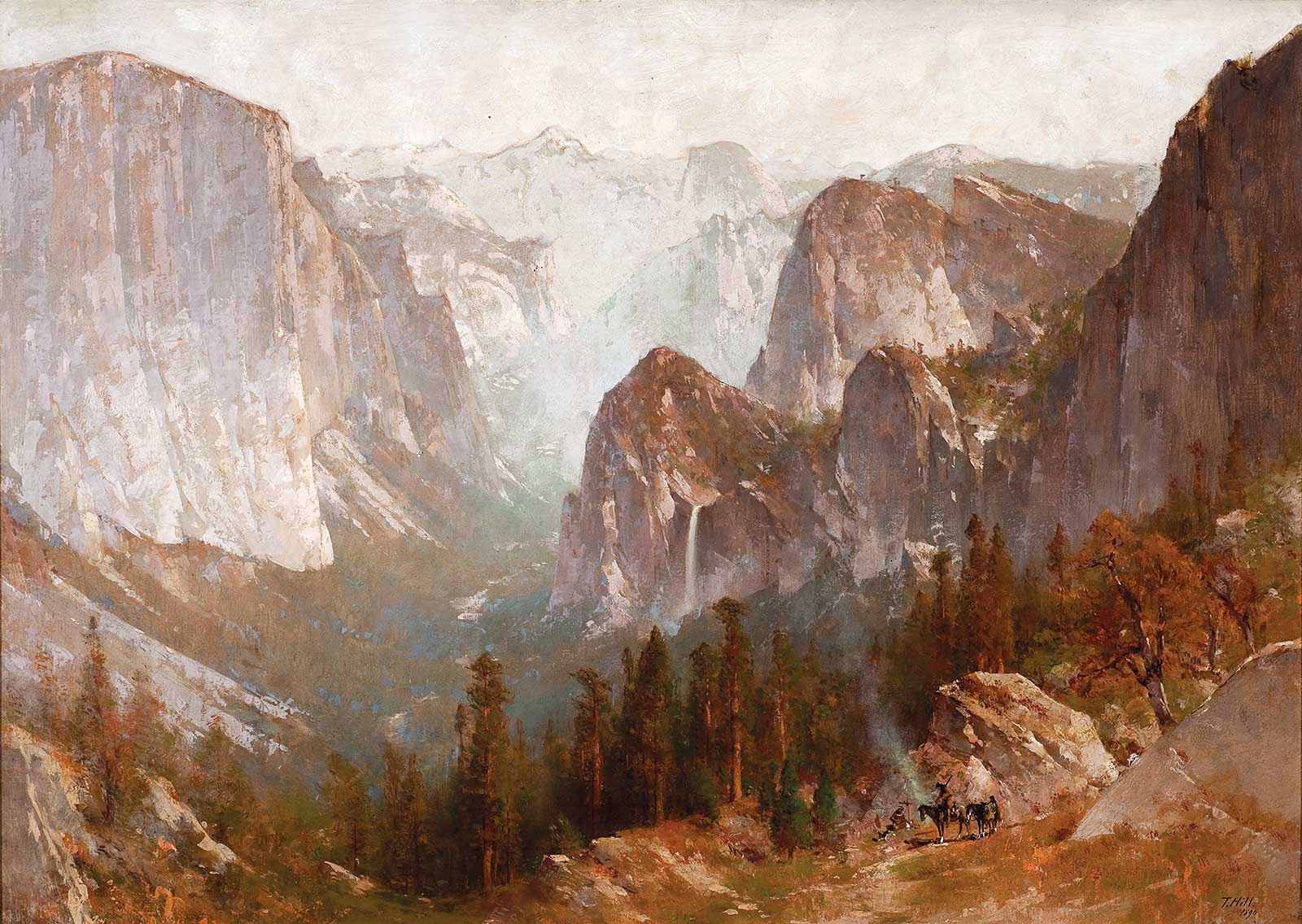 Thomas Hill (1829-1908), Encampment Surrounded, 1890, oil on canvas, 26 ½ x 37 ¼ in.It’s not riveting text, but what it did in 1916, and what it continues to do today in 2026, is momentous. It’s been said that the creation of the National Park Service was not only a visionary achievement for the United States, it is one of the country’s grandest creations. It is hard to argue with those sentiments standing on the South Rim of the Grand Canyon, on the snow-packed slopes of Mt. McKinley (Denali, if you prefer), within the mist and steam of Yellowstone’s Old Faithful, or looking up at Half Dome within Yosemite. Most countries have national parks, but these are ours. And they continue to inspire, especially artists who have been drawn to the parks for more than a century.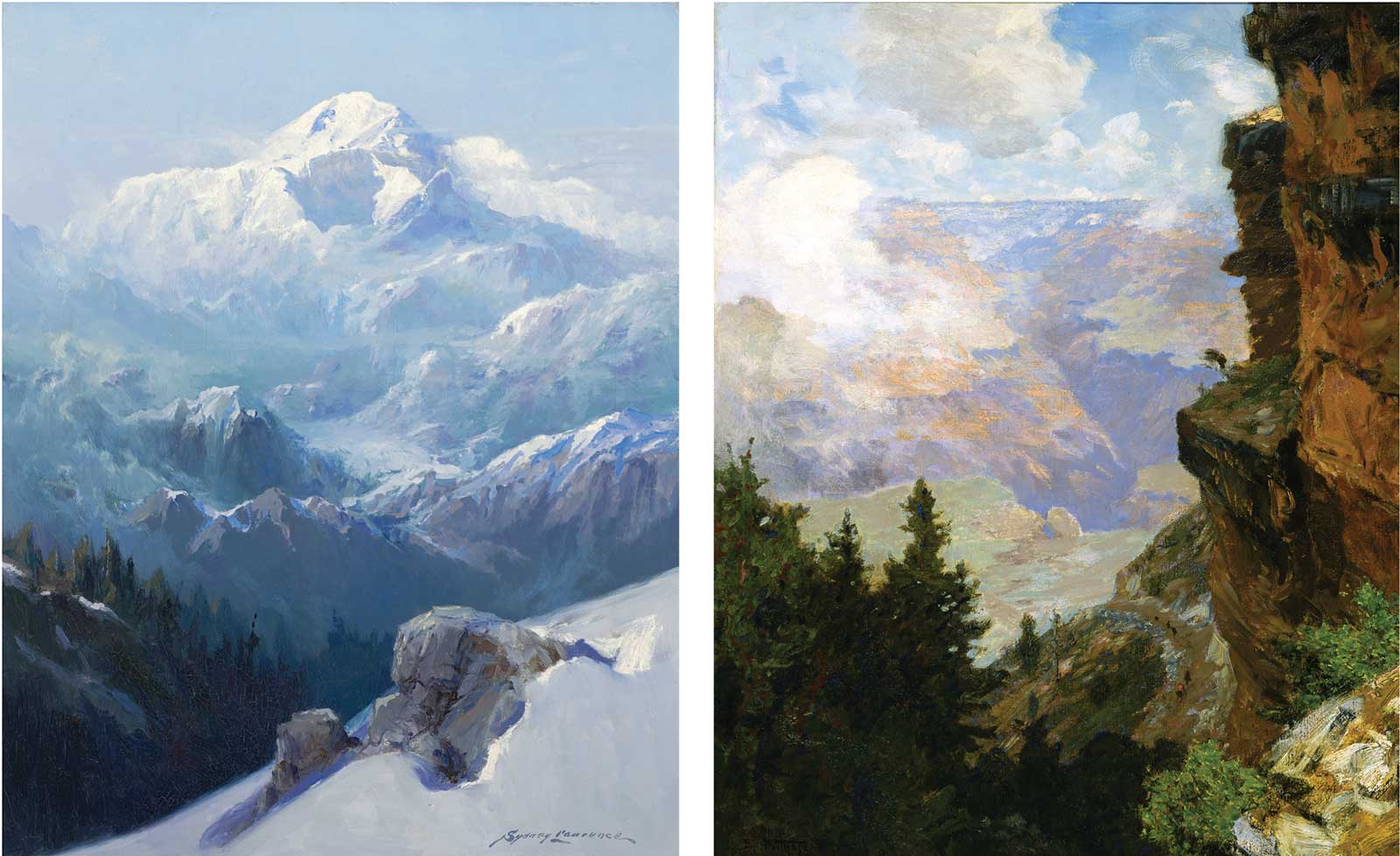
Sydney Laurence (1865-1940), Mount McKinley, 1928, oil on canvas, 20 x 16 in.; Edward Henry Potthast (1857-1927), Bright Angel Trail, Grand Canyon, 1911, oil on canvas, 30 x 24 in.
Thomas Hill, who immigrated from England in 1844, spent the bulk of his career in the United States painting Yosemite. In fact, few artists have a singular purpose as clear and concise as Hill had with his famous Western subject. When Hill was painting Yosemite, prior to his death in 1908, it was not yet a national park, but today his paintings are a testament to the beauty of the destination and Hill’s adoration of this majestic place. Similarly for Sydney Laurence, once he had seen Mt. McKinley in Alaska, it became his life’s work. These places had a way of seducing artists, and not for a handful of paintings, but for an entire career’s worth of artwork.

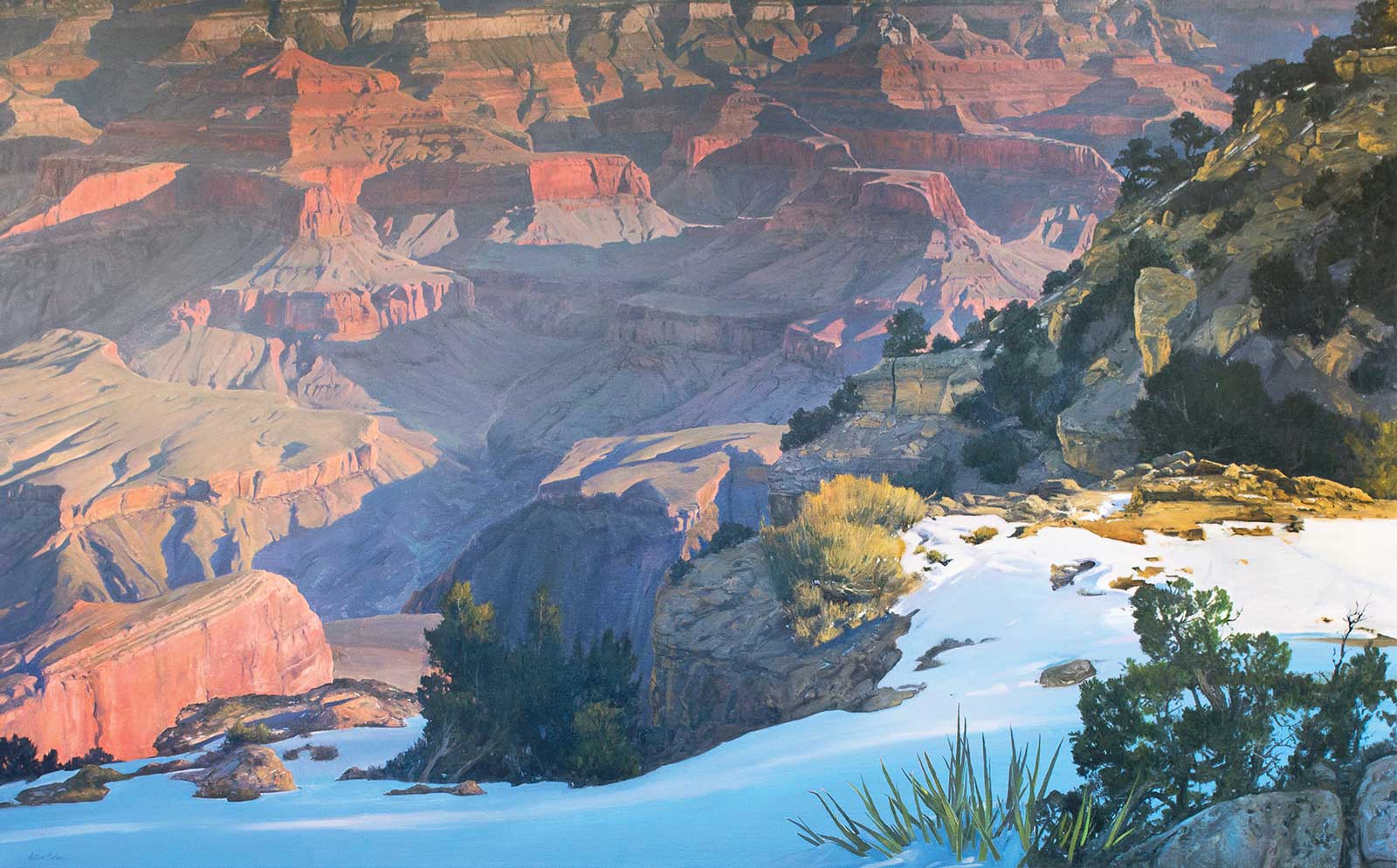
Arturo Chávez, Isis Sunrise, oil on linen panel, 60 x 96 in.
Today, the national parks are still capturing the imaginations of new generations of visitors, naturalists, explorers and artists. For the painters, the national parks provide limitless inspiration, which is reflected in the artist’s studios, and also at countless galleries and museums that are devoted to Western art.
One of those artists who is creating magical work of the national parks is Santa Fe-based painter Arturo Chávez. The artist takes no half measures: he paints large, panoramic images at a grand scale. In Teton Pronghorns, Chávez “captures early winter’s approach in Grand Teton National Park, painted from on-location studies near Jenny Lake,” the artist says. “Three vigilant pronghorn antelope stand calmly in the foreground, framed by vast slopes rising toward the cloud-shrouded Grand Teton Peak. Fresh snowfall dusts the upper elevations against a blue sky, blending with draping clouds, while lower hills glow in fading greens and golden aspens, cottonwoods and maples—a timeless scene of nature’s endurance and beauty.”
For Isis Sunrise, Chávez turns his attention to the Grand Canyon in Arizona. “Isis Sunrisedepicts a spectacular winter sunrise at Grand Canyon National Park, one of the world’s seven natural wonders revealing 1.6 billion years of Earth’s history,” he says. “Created from on-site oil studies and photographs east of Yavapai Point on the South Rim, the composition forms an isosceles triangle: the Temple of Isis in the upper left, Buddha Temple in the upper right and Cheops Pyramid directly below Buddha, all prominent features rising above the deep gorge in dramatic morning light.”
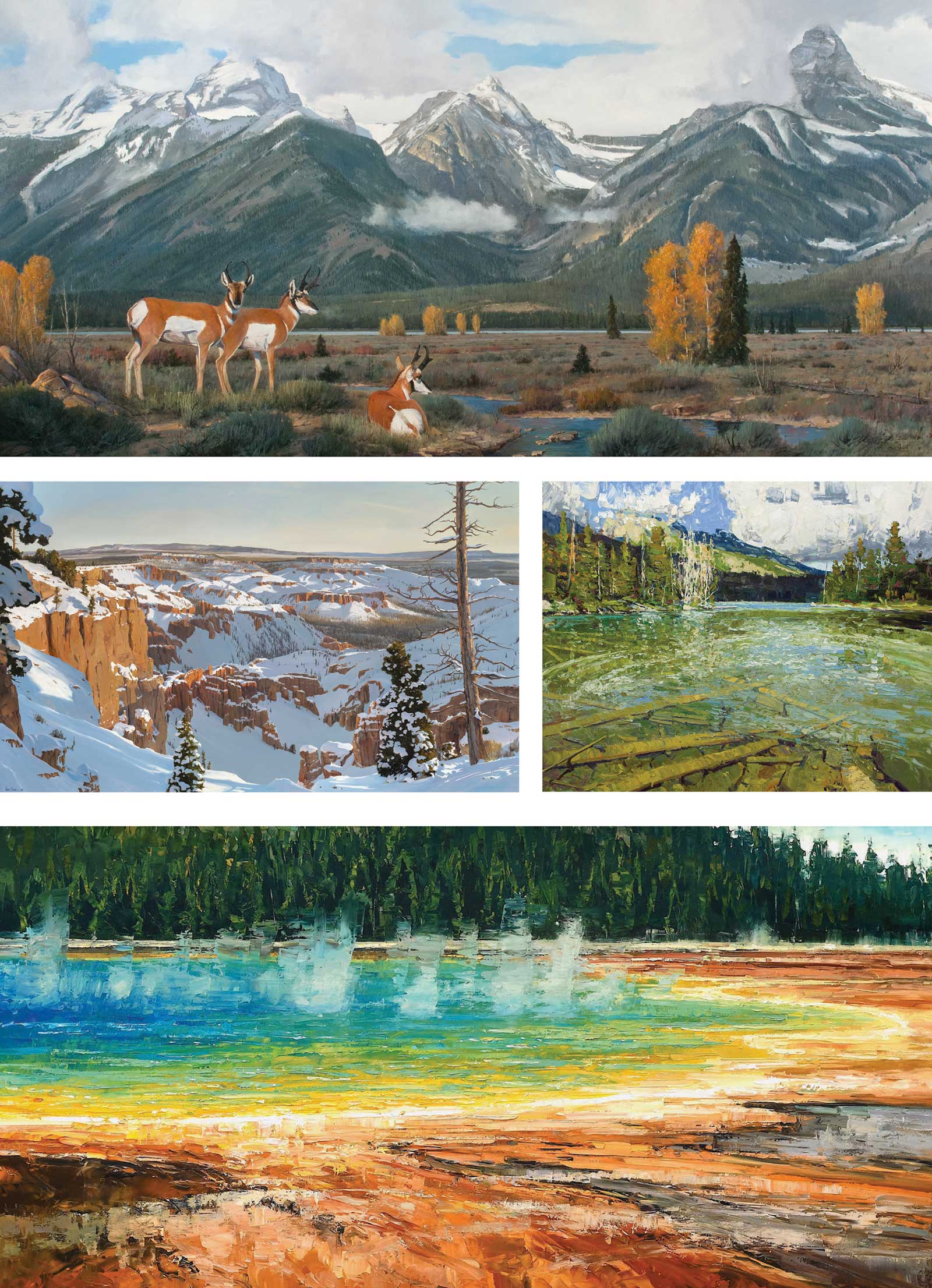
Top: Arturo Chávez, Teton Pronghorns, oil on linen panel, 60 x 120 in. Center: Arturo Chávez, Bryce Winter, oil, 54 x 96 in.; Gallery Wild, Taggart Delight, oil on canvas, 40 x 50 in., by Silas Thompson. Bottom: Gallery Wild, Infinity Pool, oil on canvas, 40 x 80 in., by Caleb Meyer.
Gallery Wild, located practically at the gate of Grand Teton National Park, has numerous artists that paint the Tetons, but also nearby Yellowstone and Glacier national parks. Artists include Silas Thompson, Patricia A. Griffin, Caleb Meyer and many others. “National parks have long stood as both muse and mandate for artists of the American West, and at Gallery Wild, that relationship feels deeply personal,” says Carrie Wild, artist and gallery owner. “Situated within close proximity to two of the nation’s most treasured landscapes—Grand Teton National Park and Yellowstone National Park—we experience daily the profound influence these places have on creative expression. The greater Yellowstone ecosystem, with its vast migrations, shifting seasons and iconic wildlife, offers endless inspiration to artists seeking to capture not just what these lands look like, but what they feel like. For contemporary Western artists, national parks represent more than scenery; they are living symbols of resilience, balance and responsibility. The creatures that roam these protected lands: bison, wolves, elk, bears, become storytellers in paint, bronze and mixed media, reminding us of our connection to the wild and our role in preserving it. This intersection of art, conservation and place lies at the heart of Gallery Wild’s mission. We curate a collection of contemporary art that celebrates wildlife, wild places and the enduring spirit of the Wild West, with conservation always in view. Our hope is that visitors who experience the awe-inspiring beauty of Grand Teton National Park can carry that feeling home with them—through a piece of artwork that captures the emotion of that transformative moment. In doing so, the art becomes both a keepsake and a continued call to protect these irreplaceable landscapes for generations to come.”
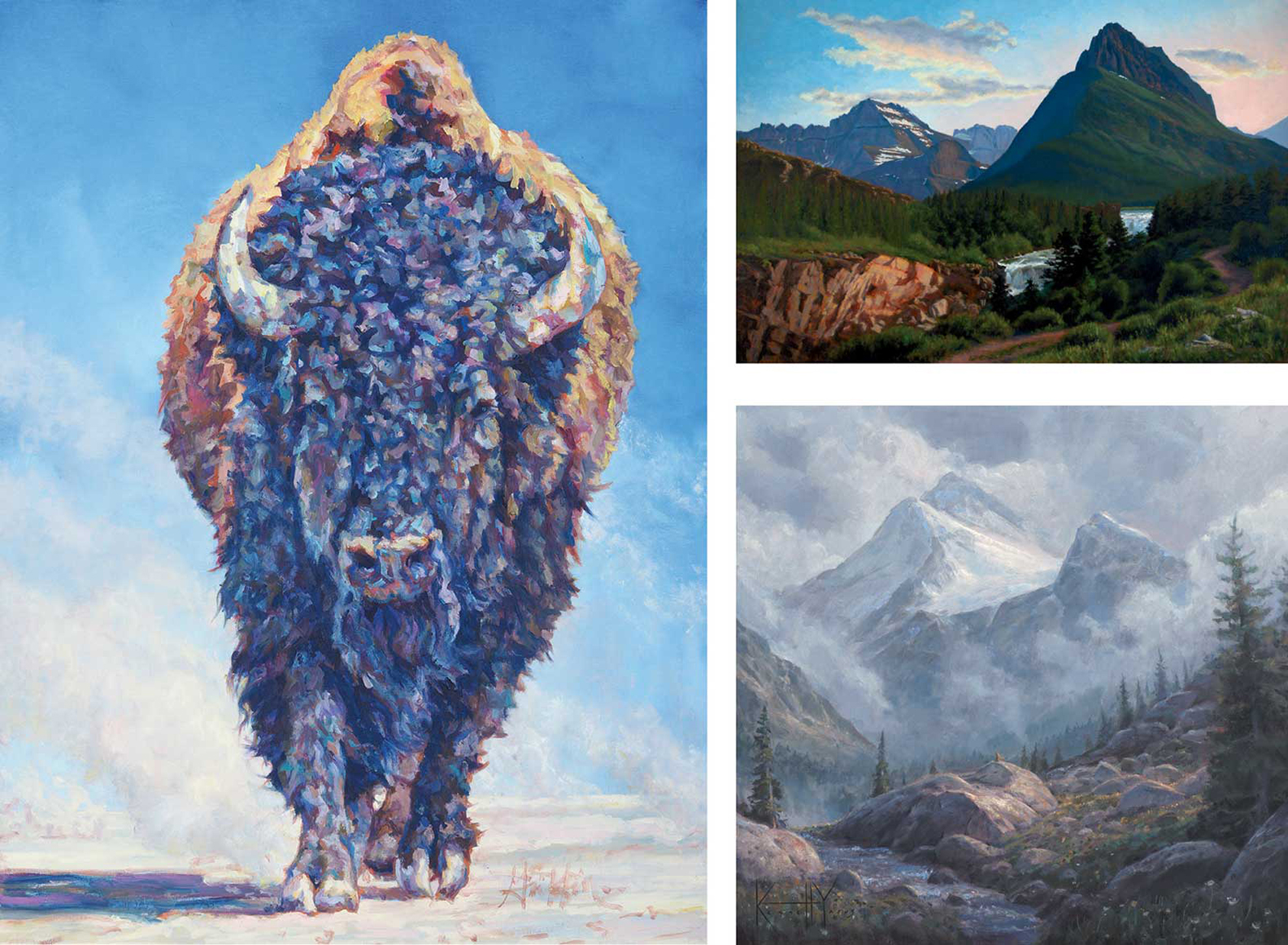
Clockwise from left: Gallery Wild, Ted at the Thermals, oil on linen, 48 x 30 in., by Patricia A. Griffin; Cassens Fine Art, Entering Many Glacier, oil on linen panel, 32 x 48 in., by Teresa Garland Warner; Cassens Fine Art, Not a Soul in Sight, oil on ACM panel, 16 x 16 in., by Kenneth Yarus.
At Cassens Fine Art, in Hamilton, Montana, the national parks play a prominent role for many of the artists in the gallery. One park that is depicted frequently is Rocky Mountain National Park. “In these mountains, light and elevation shape how a place is experienced as much as it is seen,” the gallery writes, noting artists such as Teresa Garland Warner, Kenneth Yarus, Nate Closson and others have painted the Rockies, Glacier, Yellowstone and other parks.
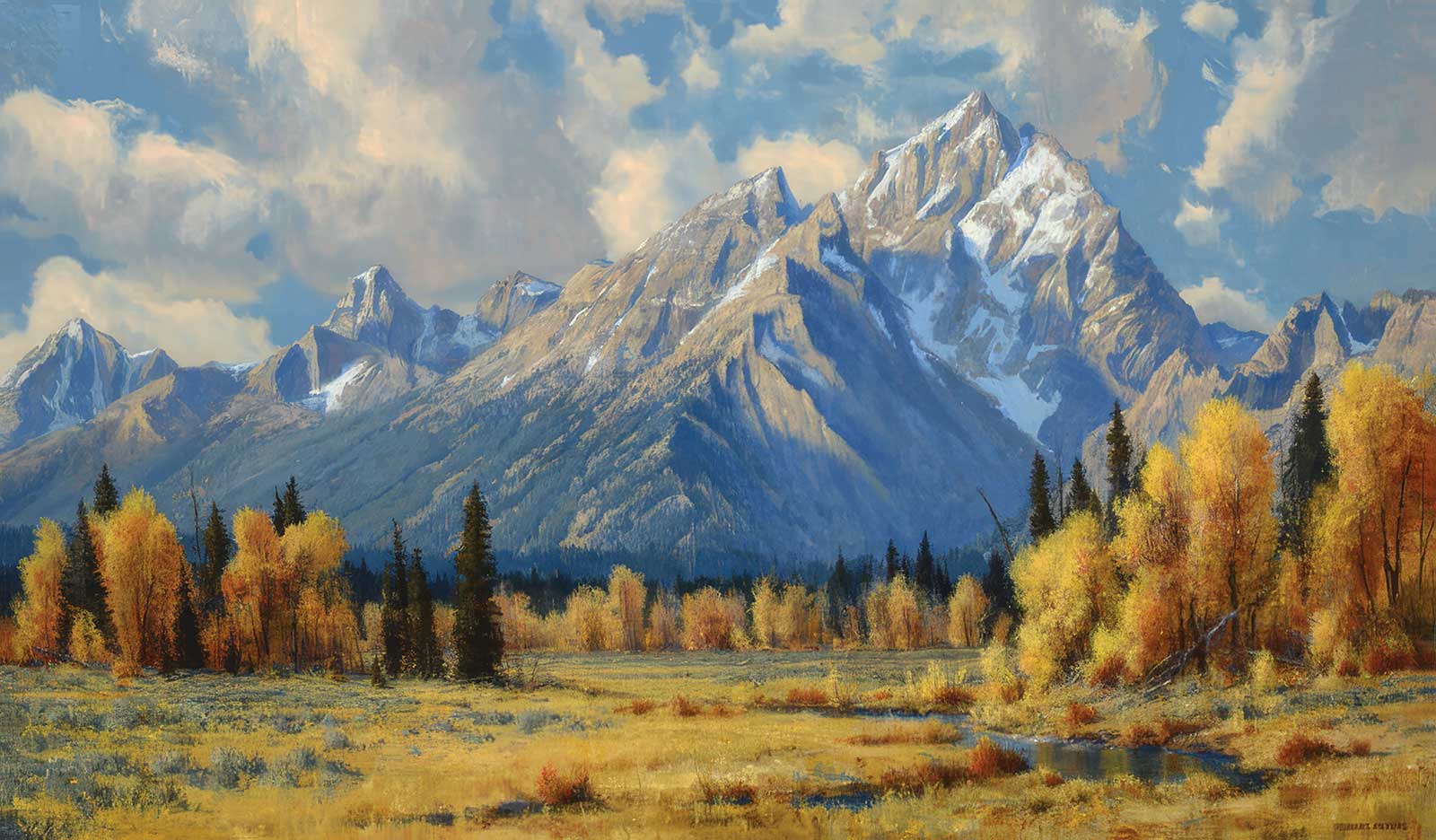
Legacy Gallery, Autumn, Teton Range, oil on linen, 32 x 54 in., by Robert Peters.
“Look for artists who truly know the place they’re painting and spend time there, often starting their work en plein air,” says gallery owner Michelle Cassens. “Choose a piece that stays with you and brings you there each time you see it. Pay attention to those who support the landscapes that inspire them, like Kenneth Yarus, who gives back to the Glacier National Park Conservancy with each painting that finds a home. When art supports the land that inspired it, everyone benefits.”
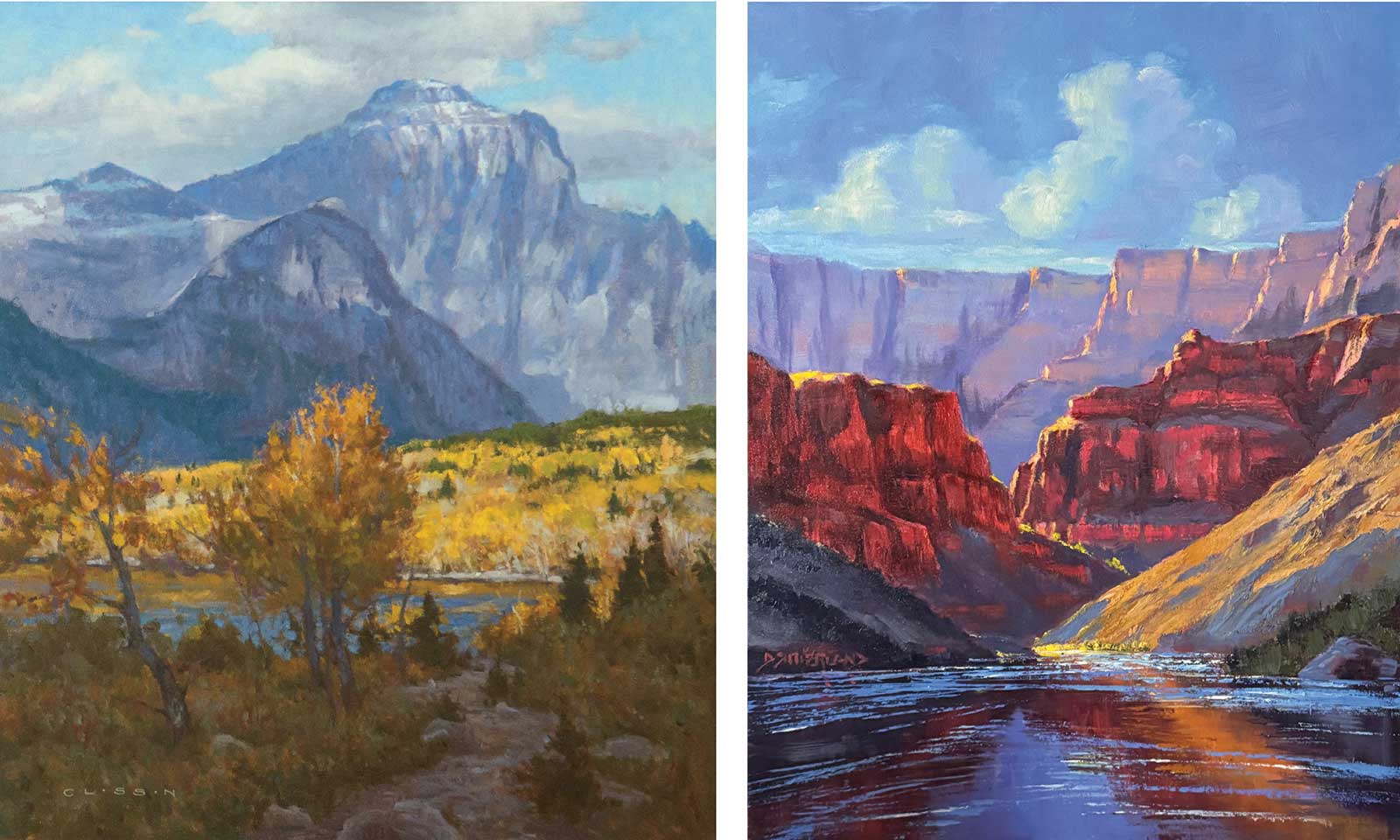 Cassens Fine Art, St. Mary Lake – Early Fall, oil on ACM panel, 30 x 26 in., by Nate Closson. Dawn Sutherland, Carried by the Current, oil on canvas, 28 x 22 in.
In Scottsdale, Arizona, and Santa Fe, New Mexico, Legacy Gallery has committed to showing works of the national parks since the gallery’s creation. “In the earliest days of the national park idea, art helped make the case. When the Hayden Survey returned from Yellowstone in 1871, the paintings of Thomas Moran and photographs of William Henry Jackson gave Congress something undeniable to see—proof on paper that these places were real, rare and worth protecting. That legacy still matters,” says gallery director Cyndi Hall. “This collection feels like a modern continuation of that same tradition: Ray Roberts’ Passing Storm on the Grand Canyon, Robert Peters’ Autumn, Teton Range and Mark Boedges’ From the Ashes, Life (Glacier National Park) aren’t just landscapes—they’re acts of witness. Each artist honors the lineage of those early park painters, while speaking in a distinctly contemporary voice: bold, personal and alive to light, weather, season and renewal. Taken together, these works reaffirm what the parks have always asked of us—to pay attention, to feel reverence and to remember that magnificence is not a backdrop, but a responsibility.”
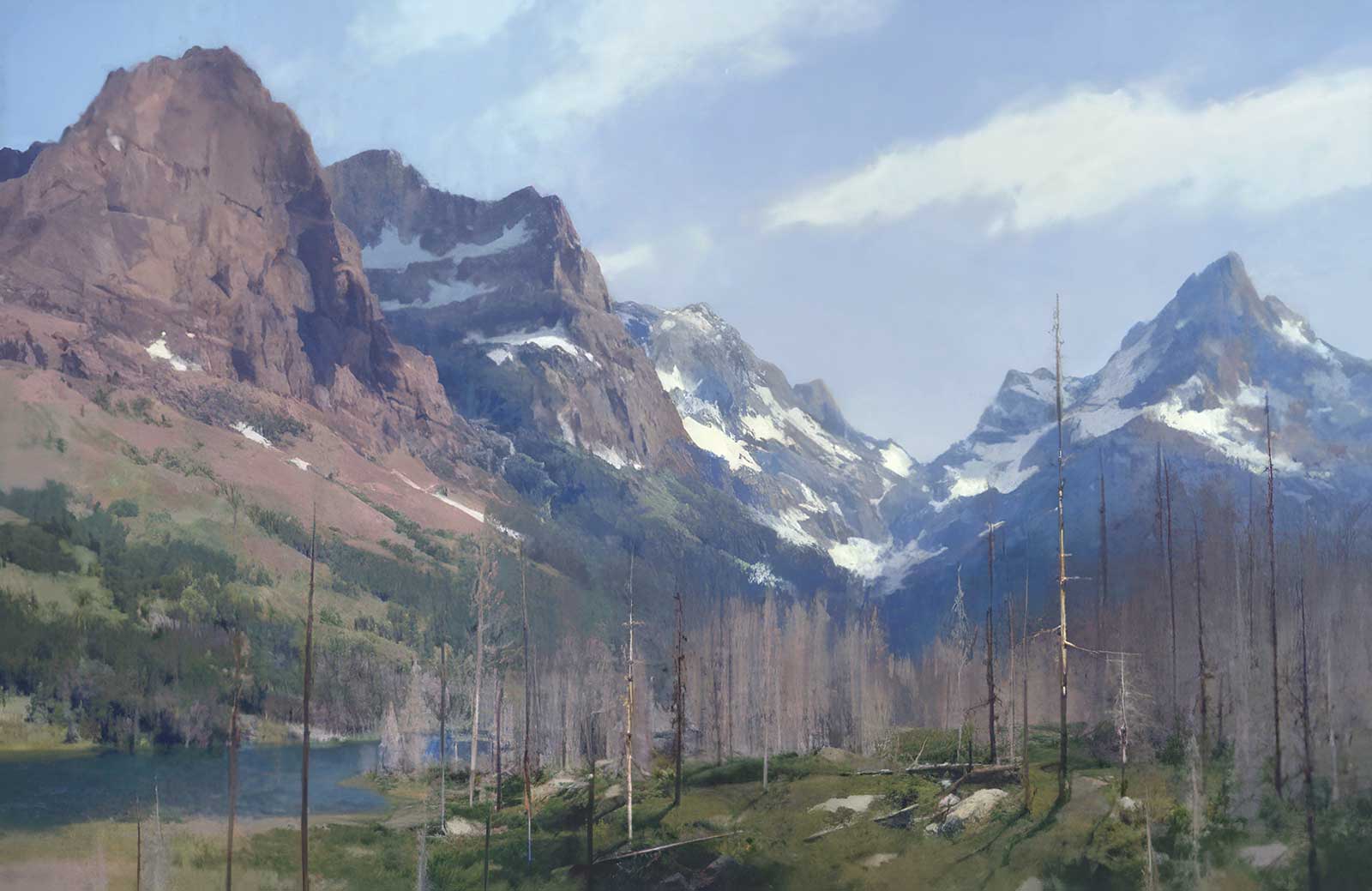
Legacy Gallery, From the Ashes, Life (Glacier National Park), oil, 24 x 36 in., by Mark Boedges.
For some of her newest work, Arizona-based painter Dawn Sutherland turns to her state’s most iconic landmark. “The Grand Canyon calls constantly to me, challenging me with each blank canvas I place on the easel,” Sutherland says. “The ever-changing light, colorful sunsets and incredible depths make each scene unique and personal. Plein air painting at the canyon adds truth to these marvelous scenes. Purchasing such a painting is bringing a moment of time into your home to enjoy every day.”
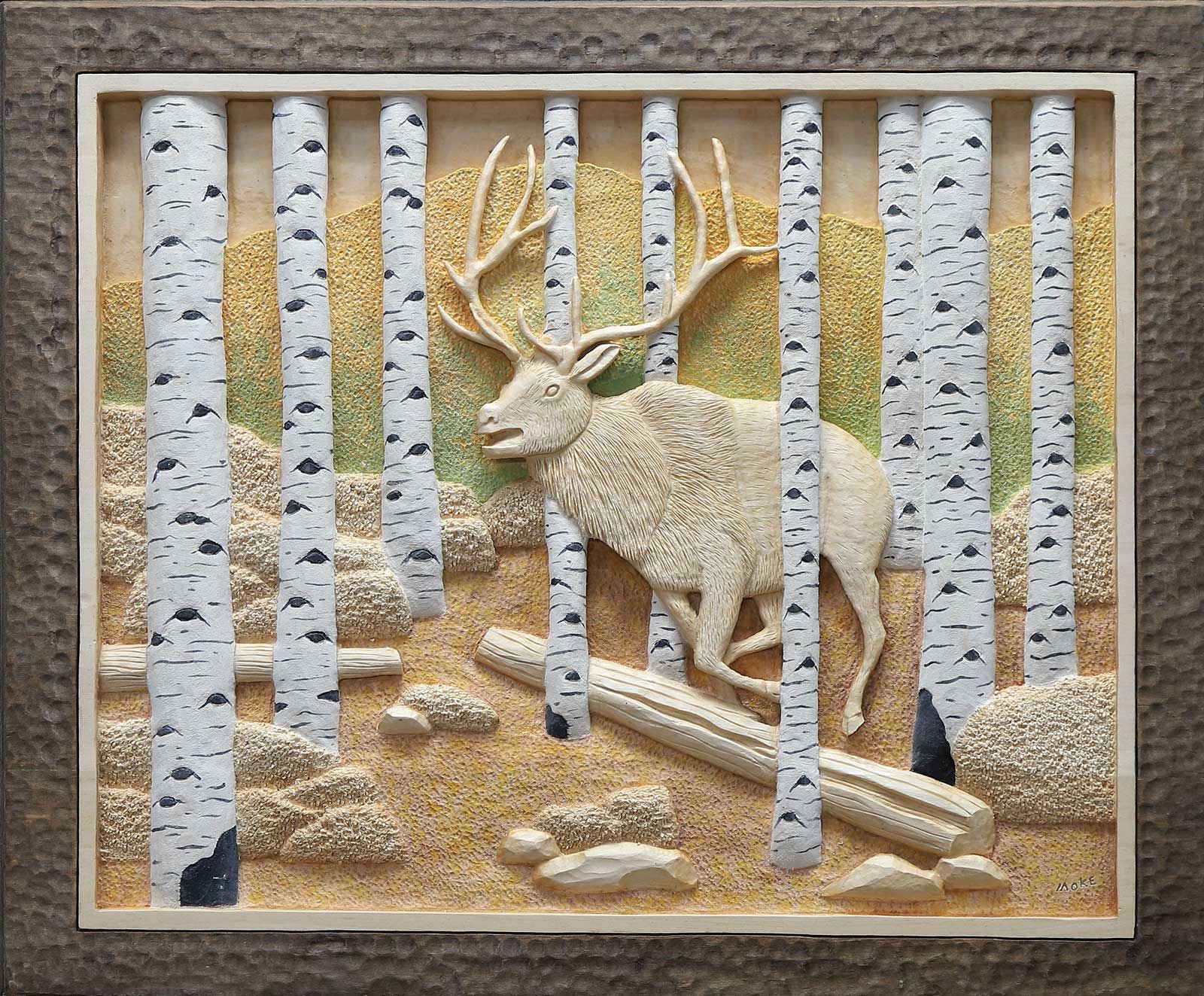
Don Woodard, Run from the Burn (Rocky Mountain National Park), hand-carved and painted linden wood, 21 x 25 ½ in.
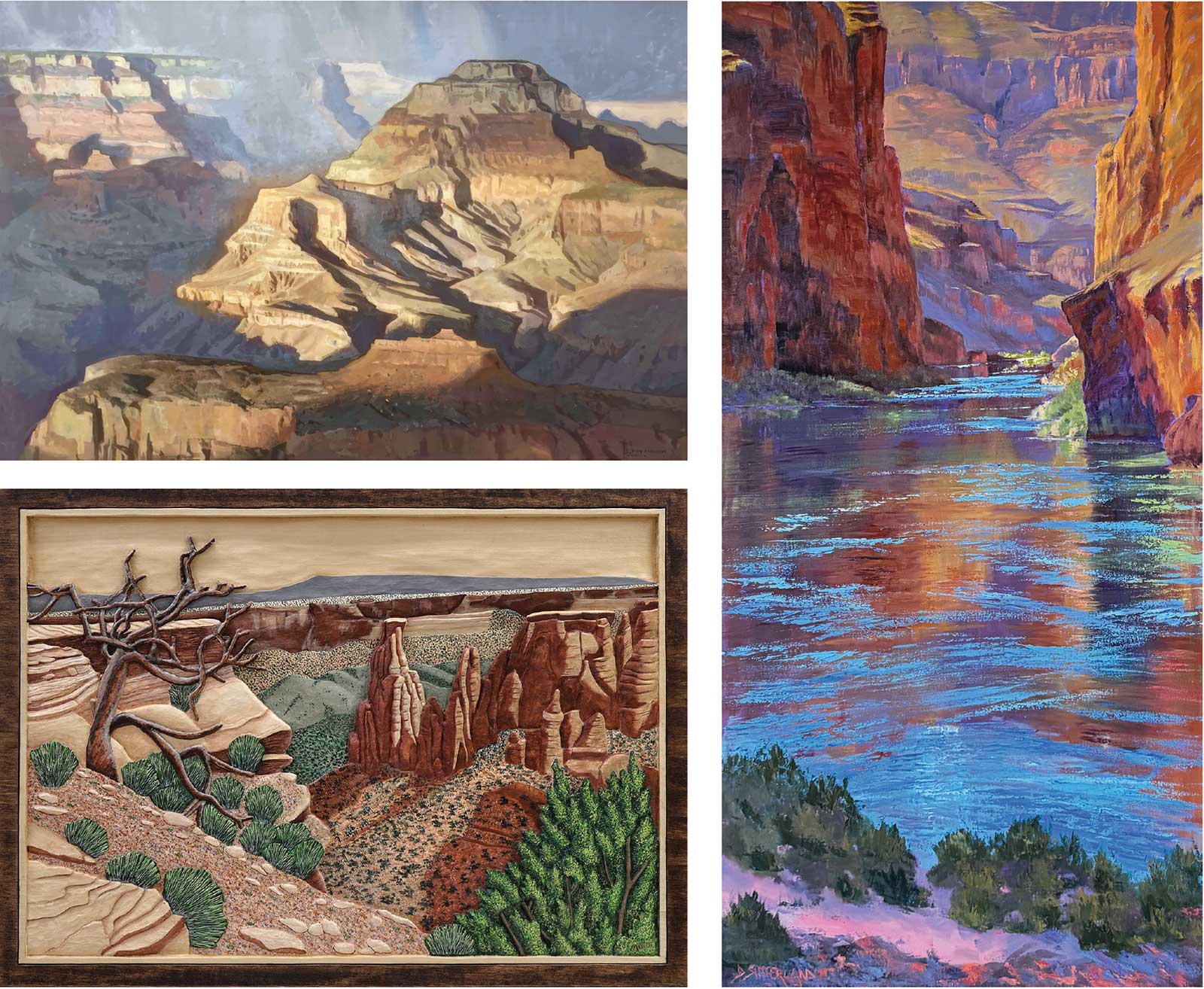
CLockwise from top left: Legacy Gallery, Passing Storm on the Grand Canyon, oil on linen, 40 x 60 in., by Ray Roberts; Dawn Sutherland, River Adagio, oil on canvas, 48 x 24 in.; Don Woodard, Pipe Organ Monument (Colorado National Monument), hand-carved and painted linden wood, 18 x 25 in.
Artist Don Woodard doesn’t just paint the national parks, but he also carves them with his unique bas reliefs made out of wood. Woodard refers to his works as three-dimensional paintings. “After creating a drawing from memory, or from a photograph or multiple photographs, along with experiences and situations I have personally encountered, I create an image that I transfer to a wood panel, made from select woods,” he says. “I then hand carve the image, in relief, into the wood panel. Once the carving is completed, I paint the image, often leaving areas of the natural wood exposed as part of the image.” Woodard has two upcoming exhibitions: National Park Art and Fine Art in Wood, along with other events through 2028. Learn more about these exhibitions and other events at the artist’s website.
Featured Artists & Galleries
Cassens Fine Art
215 W. Main Street Hamilton, MT 59840
(406) 363-4112 www.cassensfineart.com
gallery@cassensfineart.com
IG: cassensfineart
Arturo Chávez
www.arturochavez.com
Represented by: Manitou Galleries, Santa Fe, NM
(505) 986-0440
www.legacygallery.com
Legacy Gallery, Santa Fe, NM and Scottsdale, AZ
(505) 986-9833 and (480) 945-1113, www.legacygallery.com
Gallery Wild
80 W. Broadway, Jackson Hole, WY 83001
(307) 203-2322
www.gallerywild.com
info@gallerywild.com
Legacy Gallery
7178 Main Street, Scottsdale, AZ 85251
(480) 945-1113
225 Canyon Road, Santa Fe, NM 87501
(505) 986-9833
www.legacygallery.com
Dawn Sutherland
Flagstaff, AZ
www.dawnsutherlandfineart.com
dawn@dawnsutherlandfineart.com
Don Woodard
www.donwoodard.com
Powered by Froala Editor


