It’s been said history can be dusty and stale, but even a glance at the most mundane fringes of the American West reveals narratives that can be as thrilling and suspenseful as any big-budget movie, which is why early Hollywood was defined by the Old West. The plots wrote themselves: train robberies, bank heists, cattle stampedes, buffalo hunts, the exploration of the untamed wilderness, cavalry charges, pony raids and high-noon gunfights. This was all history before it was film.
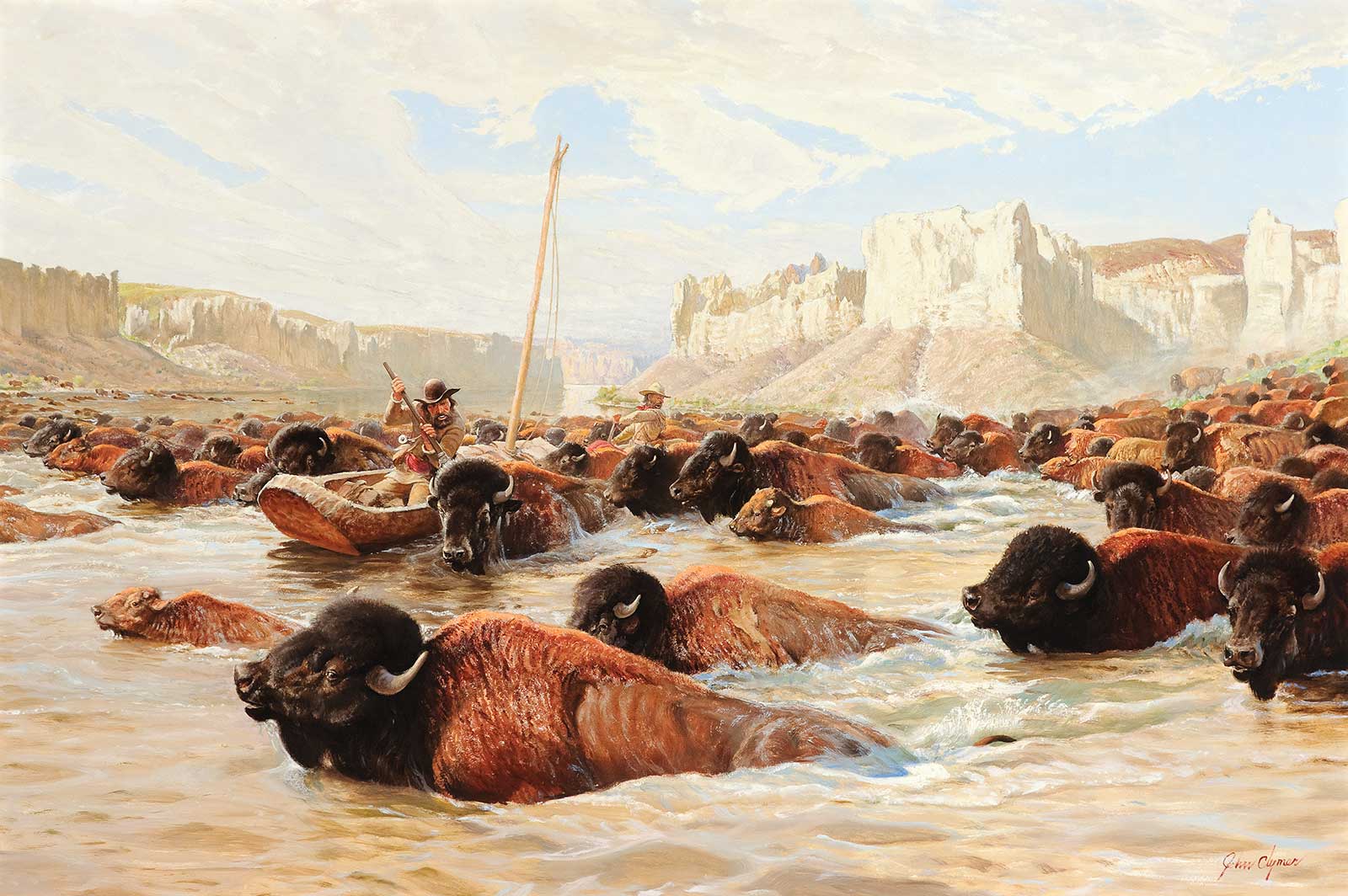
John Clymer (1907 -1989), Buffalo Crossing, ca. 1967, oil on board, 24 x 36 in.
Western art, more than any other genre of American art, has captured the drama, excitement, danger and romance of American history. It’s the art—and later film, TV and pulp magazines—that drove some of the early tourists into the American West. The promises of the Harvey Houses and the railroads were that the West was about adventure, excitement and beauty, and remnants of the Old West were still right there, just under the surface.
One of the great painters of the Old West was John Clymer, whose work was thoroughly researched (frequently by his wife, Doris) before even a single brushstroke was laid down on canvas. “Part of the fun in the early years, though, was in searching for the places we read about. We found such well-known places as Split Rock, Sweetwater Crossing, Devil’s Gate, Independence Rock and South Pass in Wyoming were marked, but we had to find for ourselves Register Rocks and the wagon ruts in sandstone near Guernsey, Wyoming, and also Massacre Rocks and Three Island Crossing in Idaho. The more we traveled the old [Oregon] Trail the more interested we became,” the artist wrote in John Clymer: An Artist’s Rendezvous with the Frontier West.“One cannot study the Oregon Trail without learning what a large part of Western history took place along it. First came the Indians following the game trails, then the early trappers and mountain men looking for furs and bringing supplies to rendezvous, next the wagon trains of the settlers, the Mormon pushcart brigades, the missionaries, the gold seekers, the Army and Army posts, the Pony Express, the Overland Stage, the telegraph.”
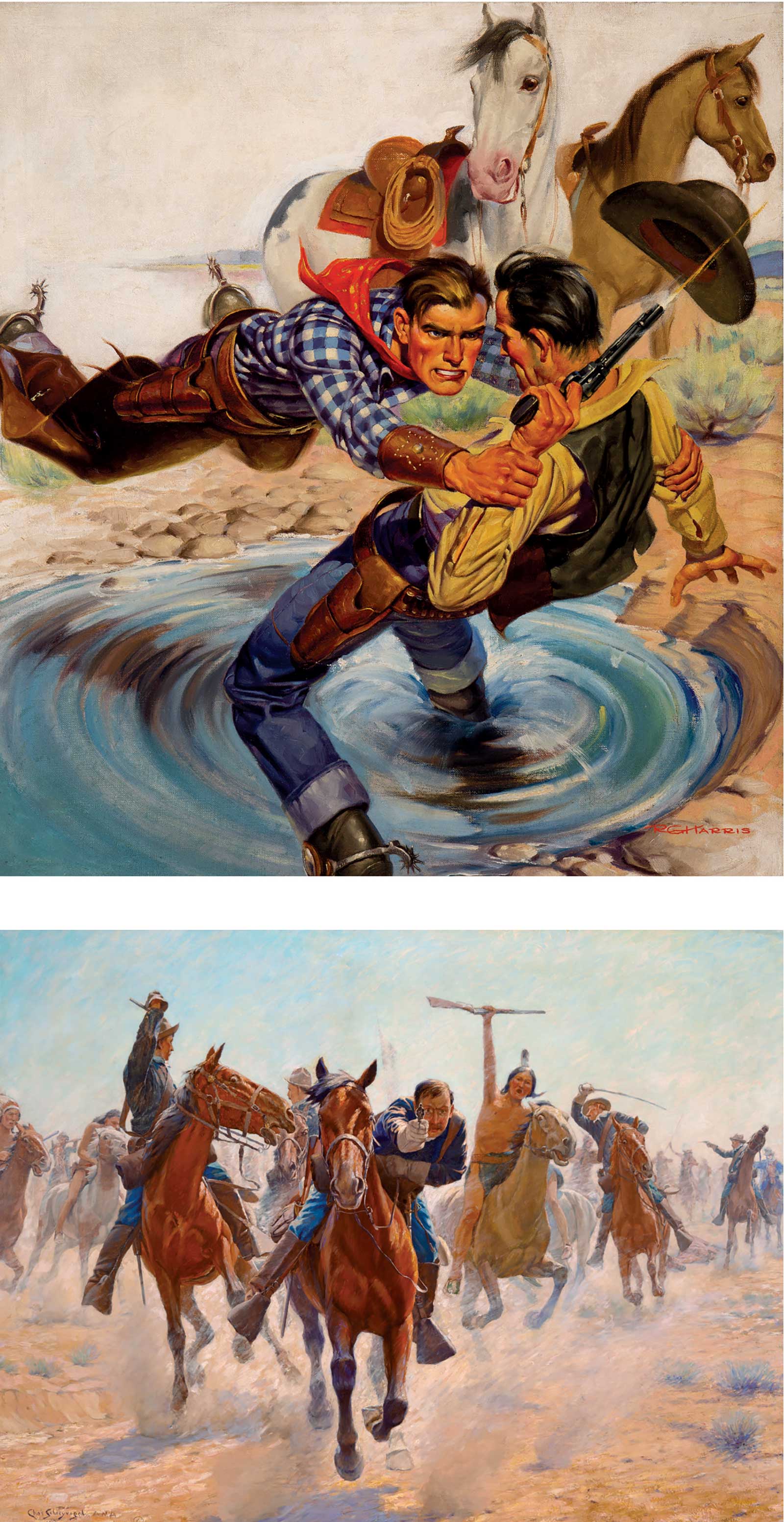
Top: R.G. Harris (1911-2007), Untitled Sonny Tabor illustration, oil on canvas. Bottom: Charles Schreyvogel (1861-1912), Breaking Through the Line, oil on canvas, 38 x 50 ¾ in. Gilcrease Museum, 01.1235.
Clymer painted many of those subjects including early trappers, who can be seen in great effect in Buffalo Crossing, showing a herd of buffalo that threaten to sink a pair of figures who were caught in the wrong place at the wrong time. Clymer offers hints to their fate, but whether the men survive or not is left to the viewer.
Two other works that have unknown conclusions, and both show artists dramatizing the Old West, include pieces by R.G. Harris, one of the great pulp artists whose works brought thrills to history, and Charles Schreyvogel, who brought viewers directly into his paintings by featuring subjects who pointed rifles, pistols and bows directly at the viewer.
Whether it’s from these artists, or many others, the Old West remains a popular subject in Western art. As you explore this section, consider adding this genre to your own art collection.
For instance, a group of works from Legacy Gallery reads as a single, unfolding moment from the Old West—quiet, tense and deeply human. “In Bill Anton’s Undetected, two cowboys move through a rocky canyon under cover of night, their presence defined by restraint and awareness,” says gallery manager, Cyndi Hall. “The darkness is intentional, allowing them to pass unseen, and you can almost hear the softened rhythm of hooves against stone. That sense of anticipation carries directly into Terri Kelly Moyers’s Ground Tied, where a lone horse waits, secured to a pile of rocks. The stillness feels temporary and charged, suggesting unseen riders nearby and a story paused rather than finished. The narrative shifts from implied action to confrontation in Scott Rogers’ Gunfighter Bookends,where two figures face one another in a moment of irreversible tension, the space between them alive with motion and consequence.”
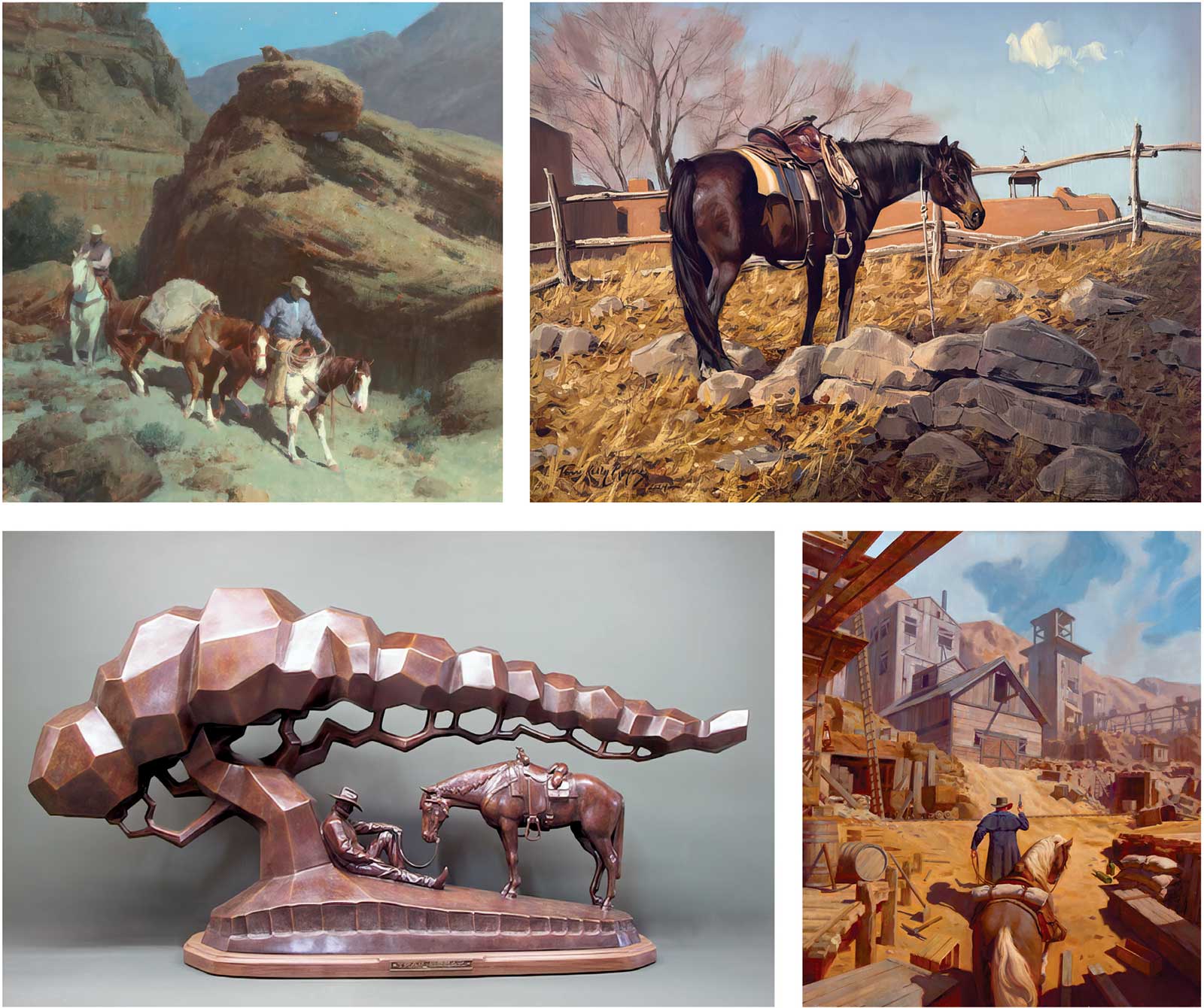
Top: Legacy Gallery, Undetected, oil on linen, 40 x 40 in., by Bill Anton. Legacy Gallery, Ground Tied, oil, 18 x 24 in., by Terri Kelly Moyers. Bottom: Legacy Gallery, Trail Break, bronze, ed. of 10, 31 x 60 x 15 in., by Rick Terry. Mark Sublette Medicine Man Gallery, Echoes of Gold, oil on linen, 24 x 20 in., by Mathieu Nozieres.
Completing the arc, Rick Terry’s Trail Break offers a moment of rest, depicting a cowboy paused along the trail, grounded and reflective. “Together, these works move seamlessly from secrecy to suspense to release, capturing the Old West not as legend, but as a lived experience shaped by vigilance, risk and endurance,” Hall adds.
Over at Mark Sublette Medicine Man Gallery in Tucson, Arizona, collectors will find impressive Old West examples. “Mathieu Nozieres’ Echoes of Goldis an oil painting rich with narrative subtext,” says Patrick Travers, gallery marketing director. “It shows a lone wanderer venturing through a seemingly abandoned mining encampment with the possibility of a classic Western ambush looming. Revolver drawn, horse in tow, the gunslinger approaches the derelict facility where pickaxes, mine carts and other gear all lay abandoned in the dust. These details that Nozieres renders so effortlessly, in combination with a story unfolding before our very eyes, are trademarks of the French transplant and a small taste of his unique perspective of the Old West.”
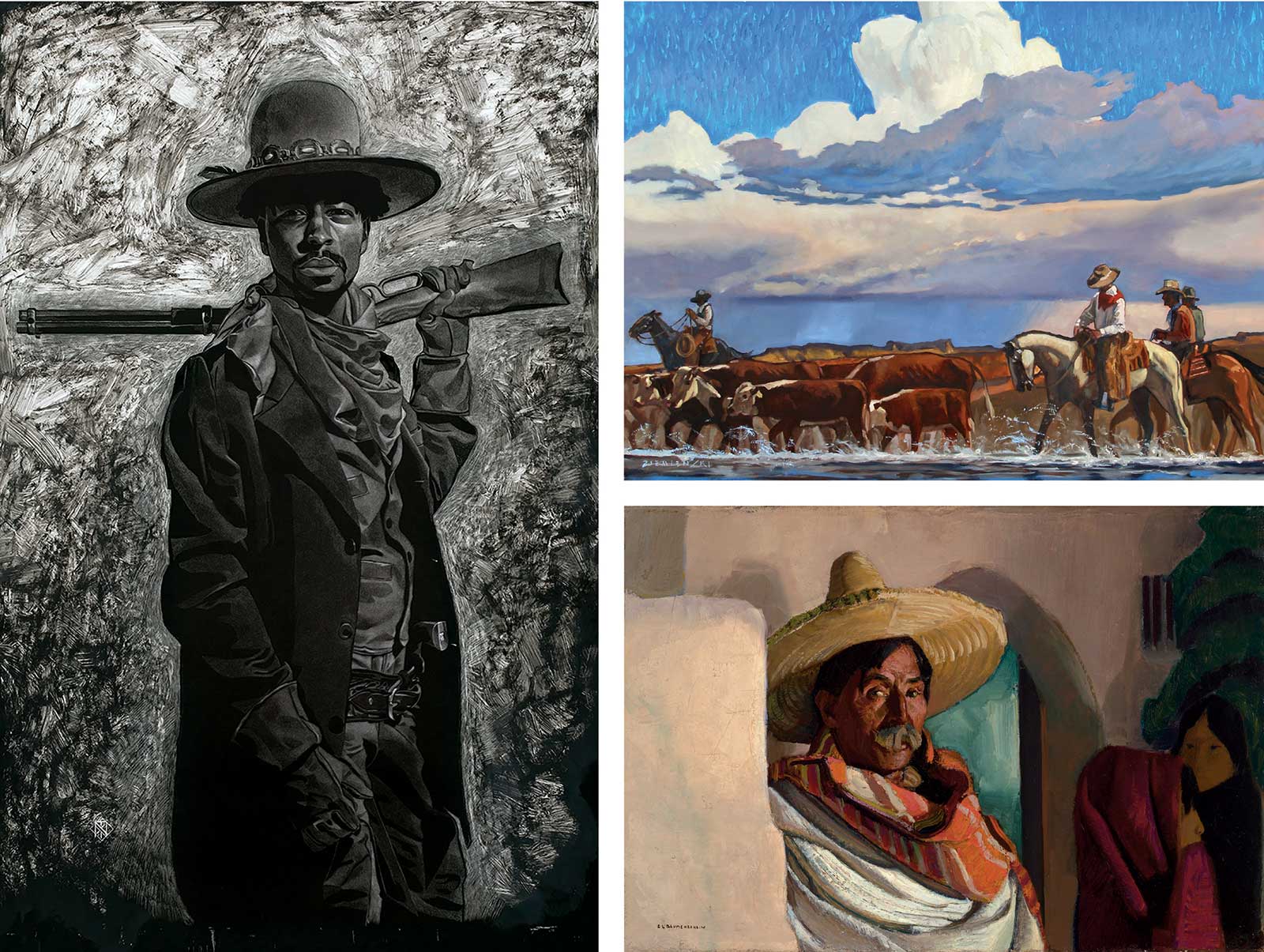
Clockwise from left: Mark Sublette Medicine Man Gallery, On Patrol, scratchboard, 36 x 23 in., by Nelson Tucker. Mark Sublette Medicine Man Gallery, Shallow Creek Crossing, oil on canvas, 36 x 48 in., by Dennis Ziemienski. Maxwell Alexander Gallery, Mexican in Hallway, Half Breed and His Family, ca. 1927, oil 14 x 20 in., by Ernest L. Blumenschein (1874-1960).
On Patrol depicts a man with a wide-brimmed hat and a lever-action rifle staring outward, seemingly communing with the viewer. “In lieu of brushes, pencils and other traditional instruments, artist Nelson Tucker uses various blades and sharpened tools to dig into the blackened clay-board with his final vision emerging through the white substrate beneath,” Travers explains. “The piece shows the mastery of the subtractive media of scratchboard that the artist has already gained in his short career.”
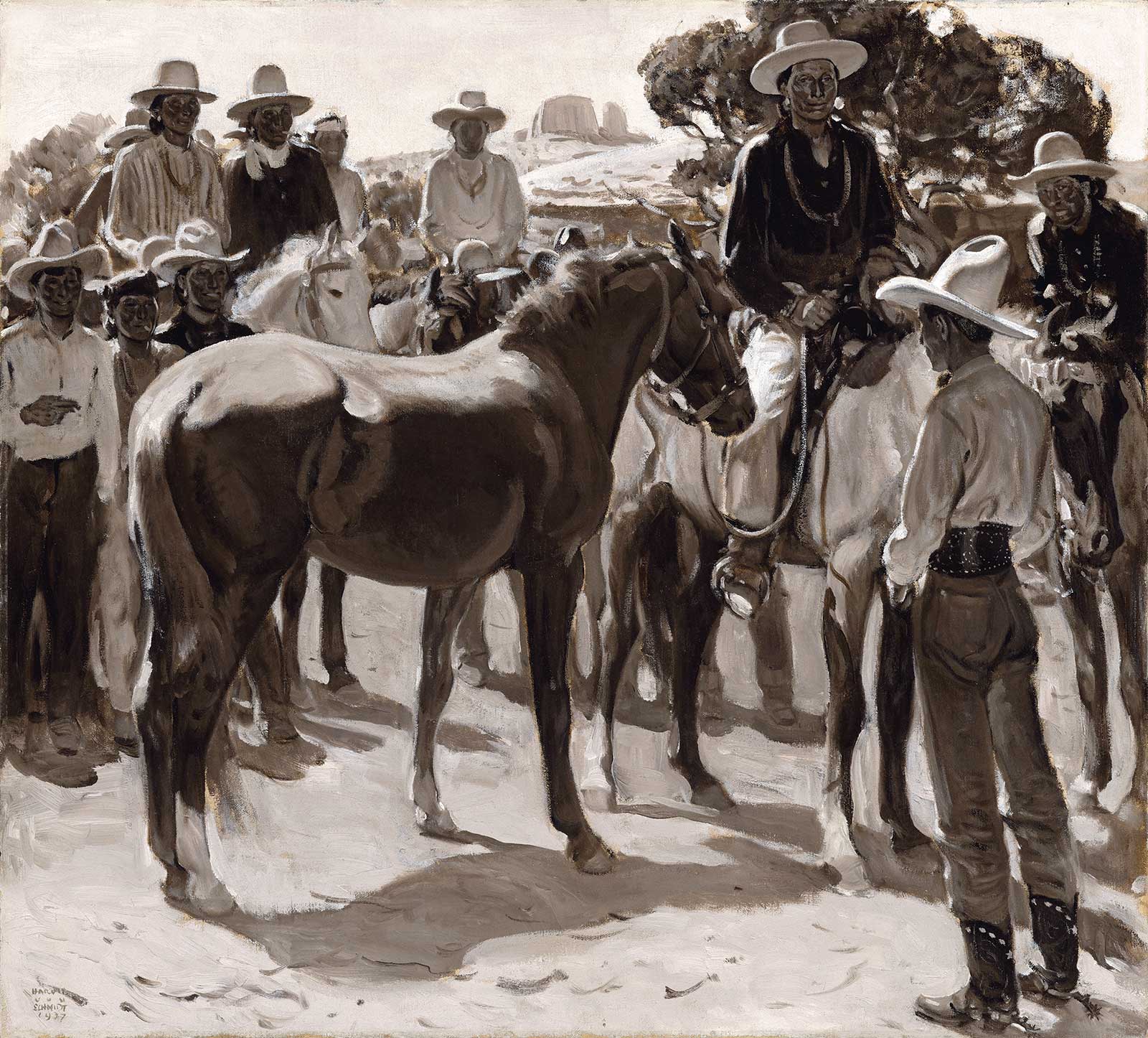
Maxwell Alexander Gallery, Bill Looked Over..., oil, 29 ½ x 33 ½ in., by Harold Von Schmidt (1893-1982).
Also consider Dennis Ziemienski’s Shallow Creek Crossing, “a snapshot in time that shows a band of cowboys driving cattle through running water with a downpour gracing the dry desert lands in the background,” says Travers. “This truly magnificent painting is emblematic of its illustrious Californian creator and his works in museums and private collections around the world.”
Beau Alexander, owner of Maxwell Alexander Gallery in Pasadena, California, notes that “the inspiration behind the work of Ernest Blumenschein, Maynard Dixon and Harold Von Schmidt stemmed from lived experience and a profound belief that the American West could be defined and ultimately understood through fine art.” The gallery offers work by all three artists.
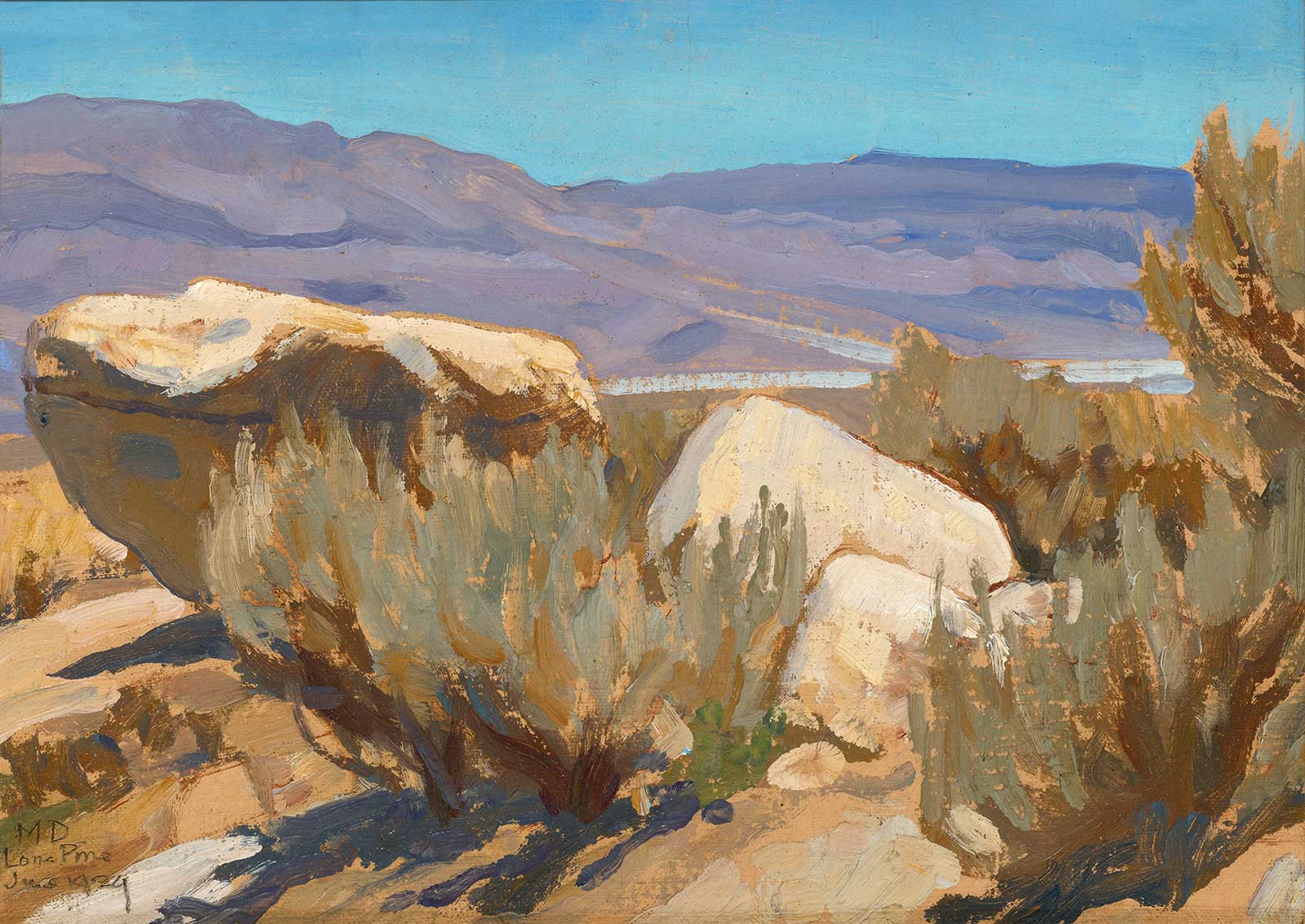
Maxwell Alexander Gallery, Lone Pine, 1924, oil, 10 x 14 in., by Maynard Dixon (1875-1946).
Alexander continues, “Blumenschein was driven by a search for authenticity, the light and cultural presence of Northern New Mexico offered him a subject that felt both timeless and distinctly American. Dixon distilled the West even further, stripping it down to vast skies, sculptural clouds and simplified forms that expressed spiritual solitude. Dixon once said, ‘Ever since I began to see and think, I have had a feeling that the West is spiritually important to America.’ Von Schmidt, shaped by the golden age of illustration, infused the West with narrative drama capturing its tension and human grit. Together, these artists were not merely documenting a region, they were constructing a visual language for American identity. Their work suggests that the West was not simply geography, but the clearest articulation of what it meant to be American.” —
Featured Artists & Galleries
Legacy Gallery
7178 E. Main Street Scottsdale, AZ 85251
(480) 945-1113
www.legacygallery.com
Maxwell Alexander Gallery
1300 N. Lake Avenue Pasadena, CA 91104
(213) 275-1060
www.maxwellalexandergallery.com
Mark Sublette Medicine Man Gallery
6872 E. Sunrise Drive, Suite 130
Tucson, Arizona 85750
(520) 722-7798
www.medicinemangallery.com
Powered by Froala Editor


