A surprise announcement started filtering out into the world in January: the Denver Art Museum had acquired Maynard Dixon’s 1925 painting Cloud World, widely considered one of the most important and influential pieces of Western art ever created. The work is iconic among Western art fans, a Holy Grail for curators and practically scripture to artists, who cite it as a vital piece of Western modernism. Adding to the mystique of the masterwork is that it is rarely exhibited publicly and has been in private collections since the 1940s.
And then, poof,it was at the Denver Art Museum.
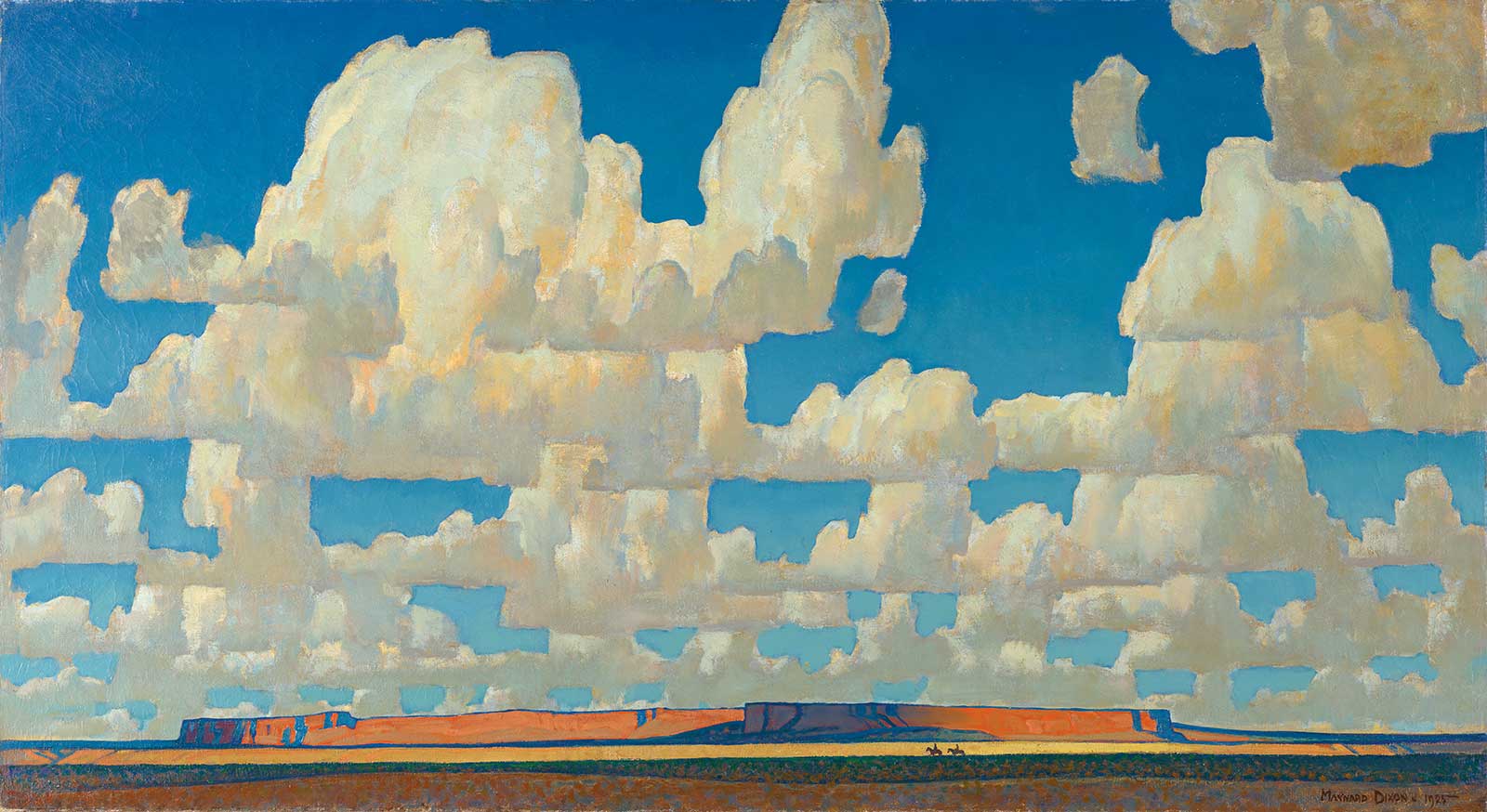
Maynard Dixon (1875-1945), Cloud World, 1925, oil paint on canvas, 34 x 62 in. Denver Art Museum: Funds from the LARRK Foundation, Jane and Tom Petrie, and Nicole and Craig Harrison, with funds, by exchange, from the Peck Collection, Harmsen Collection, Roath Collection, and the Art American Purchase Fund, 2025.433
The story of its journey from Dixon’s easel to the Denver museum is a fascinating example of how Western art moves through the world, and how players at many levels are involved in helping guide a painting to its new and presumably final home.
The painting’s most recent chapter begins in the 2000s, when Denver art collector Tom Petrie, long known for his interest in Charles M. Russell, created a wishlist of artwork that would strengthen the museum’s collection. In 2007, Tom and Jane Petrie made a generous financial gift to the museum that funded the creation of the Petrie Institute of Western American Art. “I was working with Thomas [Brent] Smith, who was the curator at the Denver Art Museum and the director of the Petrie Institute at the time. We had a list, and Cloud Worldwas on it,” Petrie says. “I was very interested to see what we could do. There were some challenges and it seemed to be just out of reach for quite some time. We wanted it because—and I’m truly not exaggerating when I say this—it is a perfect example of a masterwork. When it came to Dixon, this was it.”
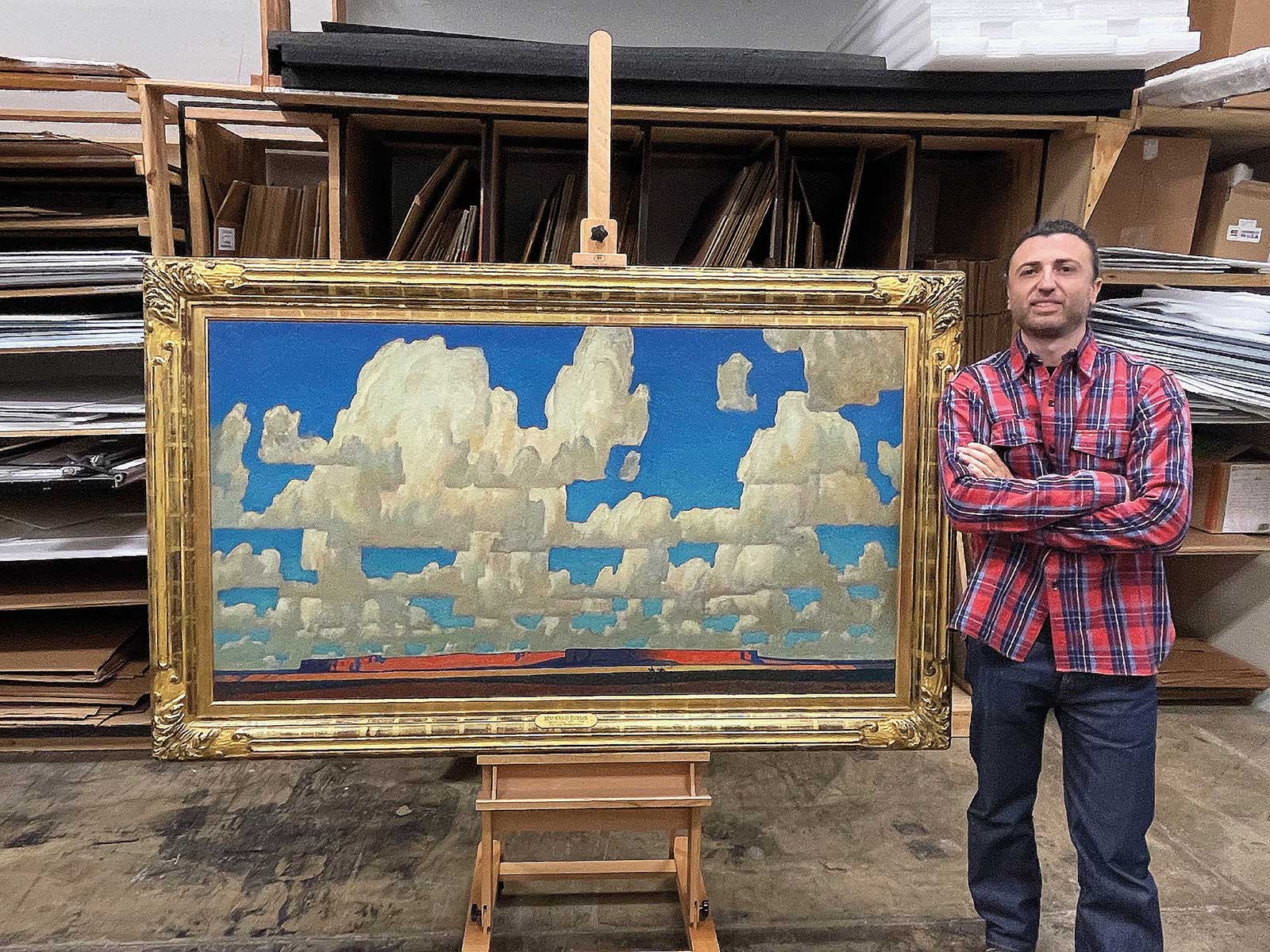
Beau Alexander, owner of Maxwell Alexander Gallery, with Cloud World in Dallas. Alexander brokered the deal that resulted in the acquisition of the painting by the Denver Art Museum.
At that time, and up until recently, Cloud World was in the collection of William Ruger, who purchased it in 1993. Ruger never sold the painting in the 2000s when Petrie was looking to acquire it, but rumors of its availability materialized nearly 20 years later, in February 2025. Art dealer Beau Alexander was in the right place at the right time.
“I had been speaking with [artist] Nicolas Coleman, who had heard it might become available. Everyone knew who owned the painting, so we knew where it was,” says Alexander, who owns Maxwell Alexander Gallery in Pasadena, California. After several false starts, Alexander started conversations with Cloud World’s owners, the Ruger family, who agreed to put the work on the market. Working with an intermediary, Alexander served as the broker. “I knew a number of people would want to buy it, but I also knew it had to be kept secret and handled carefully. At first, I wasn’t even using its name. I was saying that it’s ‘the most important painting in Western regionalism.’ The importance of the painting was always right there for me. When I think of the West, Cloud World is the painting that comes to mind. It’s such an iconic image that it defines the career of the artist. Frederic Remington had Broncho Buster, but it had many casts. With Charlie Russell, you could pick anywhere from 5 to 10 paintings that someone could say are his best. Same with [Ernest L.] Blumenschein or [William Herbert ‘Buck’] Dunton. But Cloud Worldis the Maynard Dixon painting. There’s just nothing else like it.”
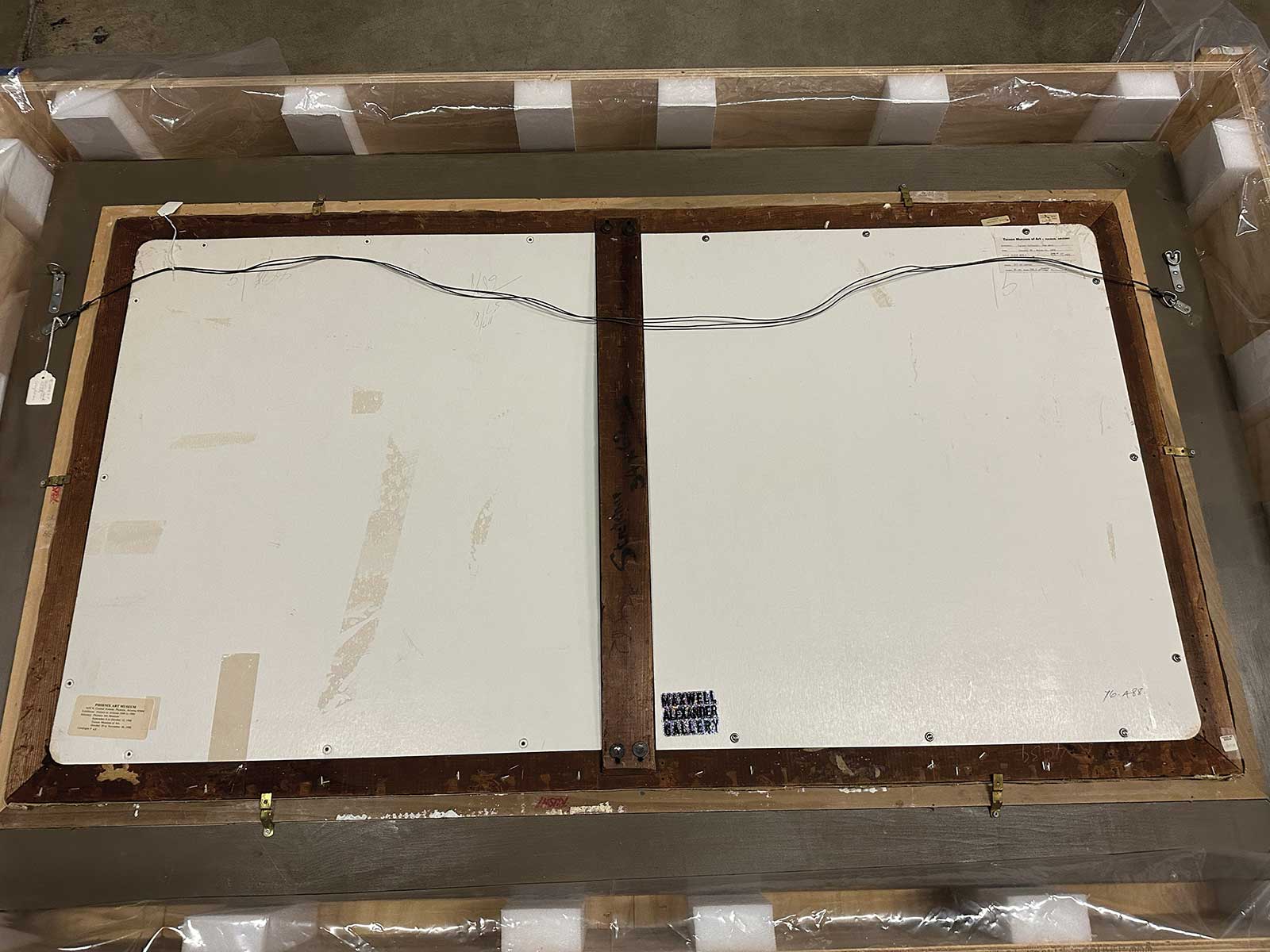
Reverse side of Cloud World showing stickers and labels from the Phoenix Art Museum, Tucson Museum of Art, Maxwell Alexander Gallery and others.
Once Cloud World officially became available, the painting was shipped from its long-time home on the East Coast to an art facility in Dallas so Alexander could use a more central location to bring in potential buyers. It arrived in a massive crate—after all, Cloud World is 62 inches wide—to a place Alexander describes as a “super secret art storage facility.” After it arrived, there was a quiet moment between the art dealer and the iconic painting. “It was surreal just being there alone with it,” Alexander adds. He was bound to secrecy and unable to share what he was offering except to the most trusted buyers. One of his first calls was to Craig Harrison, a trustee at the Denver Art Museum.
“Beau told me that he was going to come to me with something, a major painting, and he couldn’t talk about it, but it would be something perfect for the museum. All he would tell me is that we had the artist in the collection, but this would be the best example by the artist that any museum could get. It definitely made me curious,” Harrison says. “Once he got some loose ends tied up, and secured the painting, it finally came out that it was Cloud World.I remember asking him what kind of timeline we had, and he told me ‘ASAP.’ Well, museums don’t move on a dime, but I said I would see what I could do.”
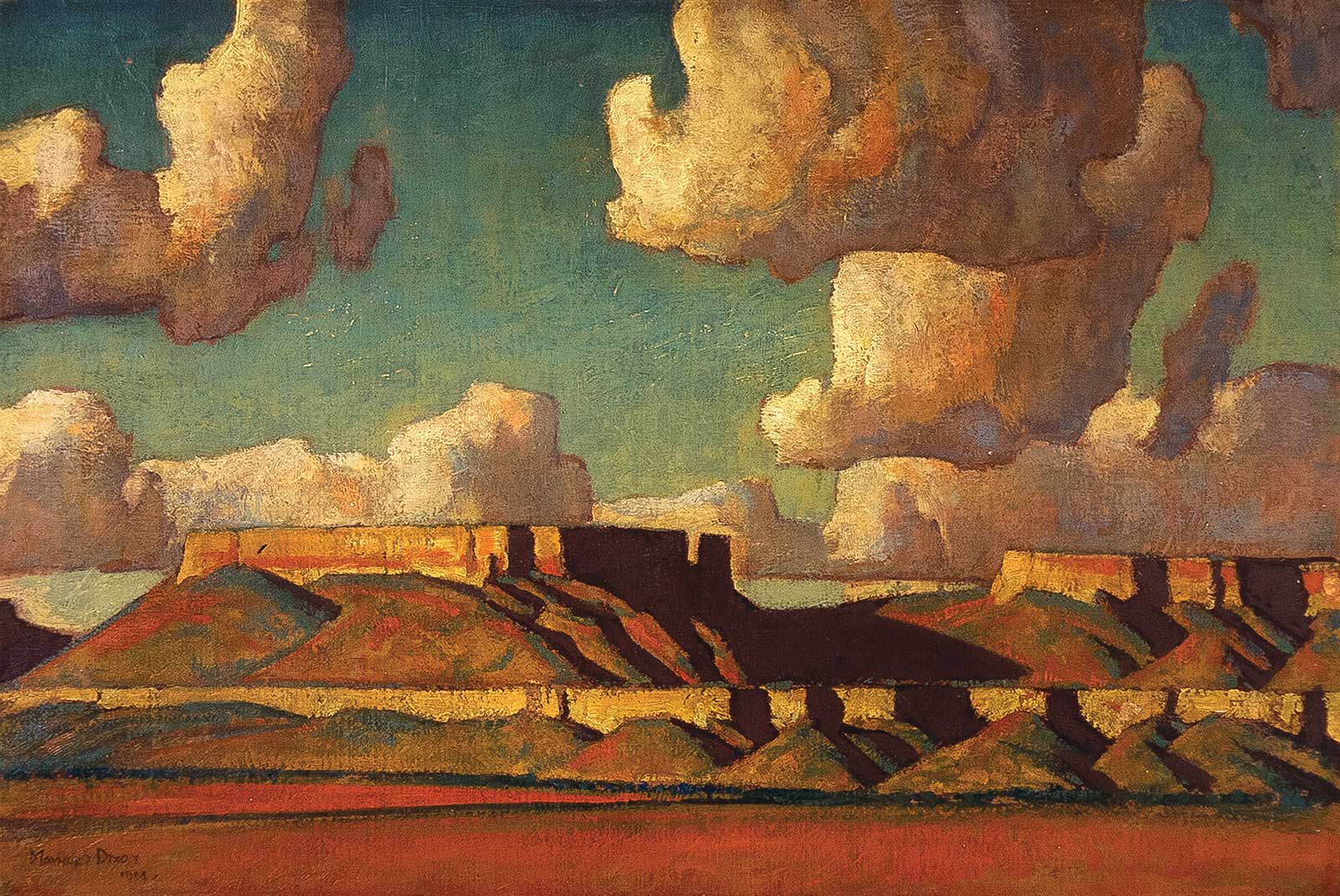
Maynard Dixon (1875-1945), Remembrance of Tusayan, 1924, oil on canvas, 20 x 30 in. Courtesy Maynard Dixon & Native American Art Museum.
Harrison put the wheels into motion in Denver, which included the complicated process of lining up funds to acquire the work, and looping in experts at DAM who could authenticate the painting and evaluate its condition. He also notified JR Henneman, the director and curator at the Petrie Institute, who was already very familiar with the painting’s reputation in Western art. Within a week, many of the key pieces were in place, enough for a visit to Dallas. In the group that went to Texas were Harrison, Henneman, Petrie and Christoph Heinrich, DAM’s director. The drive to the painting’s location took them past dive bars and strip clubs before they turned into an industrial district with non-descript warehouses, one of them holding a priceless and storied work of art.
“We knew going in, this was a major acquisition. We were going to go after it with everything we had, but it was a heavy lift, especially with the glacial swiftness of how museums move. Our fear was that we would take too long or someone else would look at it and then it would be gone,” Harrison says. “We really appreciate Beau going out on a limb to give us a shot.”
From Alexander’s perspective, the Denver Art Museum was an ideal home for the painting. “I called them first,” he says. “There are no better or more thoughtful collections out there, and I knew DAM was still adding to their collection. A painting like Cloud World could highlight what the museum is about. Part of the reason the painting is so important is because it is a direct link to art still being created today. Only a handful of paintings have had a tectonic shift like that in the art world, and Cloud Worldis one of them. For this work, Dixon pulled away from the cowboy and Native American figures and turned his attention to the iconic Western landscape and the big open sky. It was his vision of the West. And it would become the story of the West.”
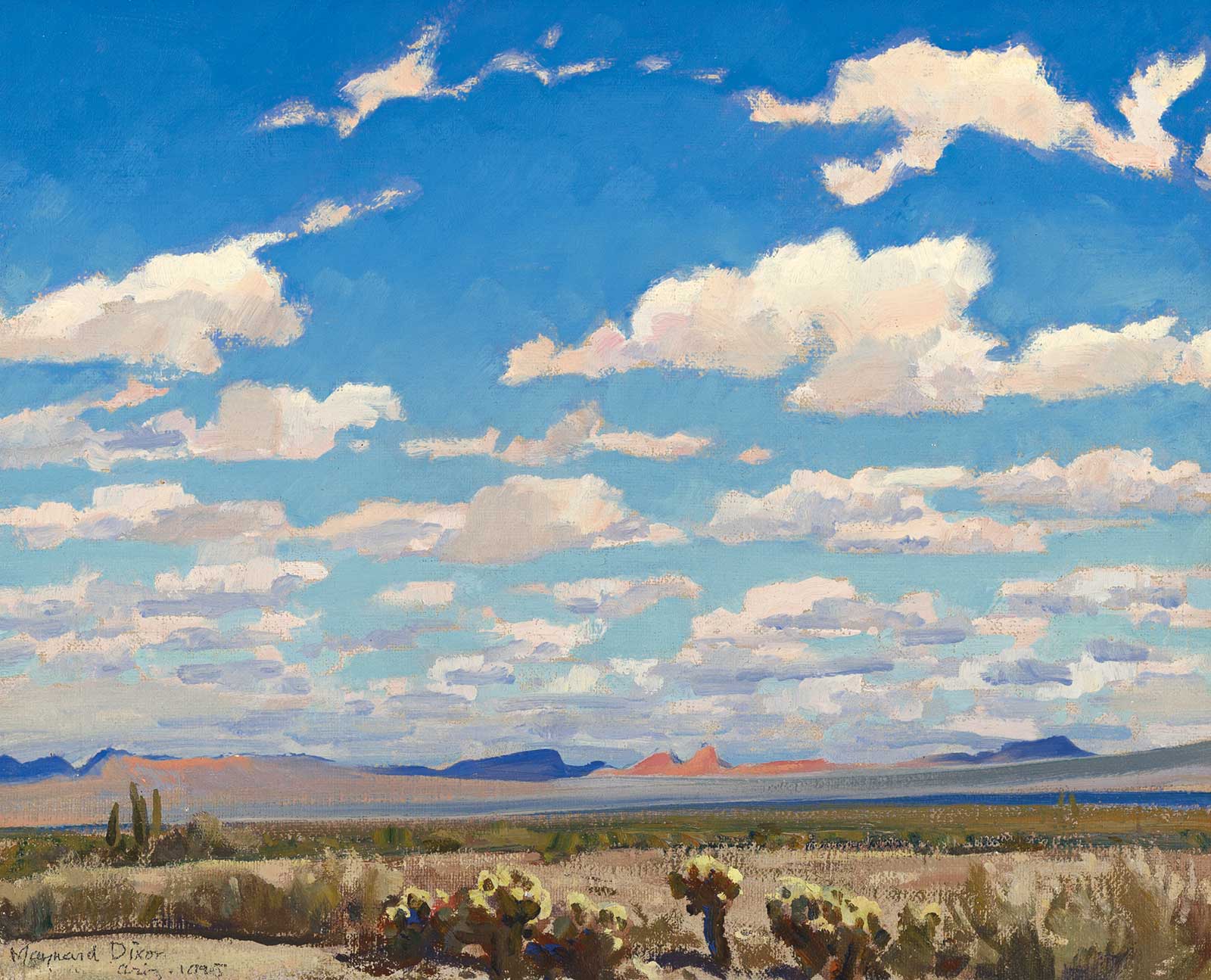
Maynard Dixon (1875-1945), Clouds of a Summer Afternoon, 1945, oil on canvas board, 16 x 20 in.
Alexander also appreciated the ramifications of placing it in a public institution. The painting—once referred to as the most famous and least exhibited Western painting by the late Dixon scholar Don Hagerty—would finally be regularly accessible to the public unlike any other time in its history. More importantly, it would have a permanent home for the foreseeable future.
Once the seller agreed to sell and DAM agreed to buy, at least several rounds of negotiations took place. Harrison commends Henneman and Heinrich for guiding the museum to an acceptable purchase price. “Most museums use a longer timeline. That’s the tightest I’ve ever seen any decision made,” Harrison adds. “Nothing moves that quickly.”
All parties involved refused to divulge the price, adding that it would remain private. There is speculation that the painting sold for more than $2.1 million, which is Dixon’s world auction record, but all parties refused to comment. Officially, from the painting’s label, the work was acquired with “funds from the LARRK Foundation, Jane and Tom Petrie, and Nicole and Craig Harrison, with funds, by exchange, from the Peck Collection, Harmsen Collection, Roath Collection, and the Art American Purchase Fund.” The acquisition was a team effort between Denver Art Museum and some of its most loyal patrons.
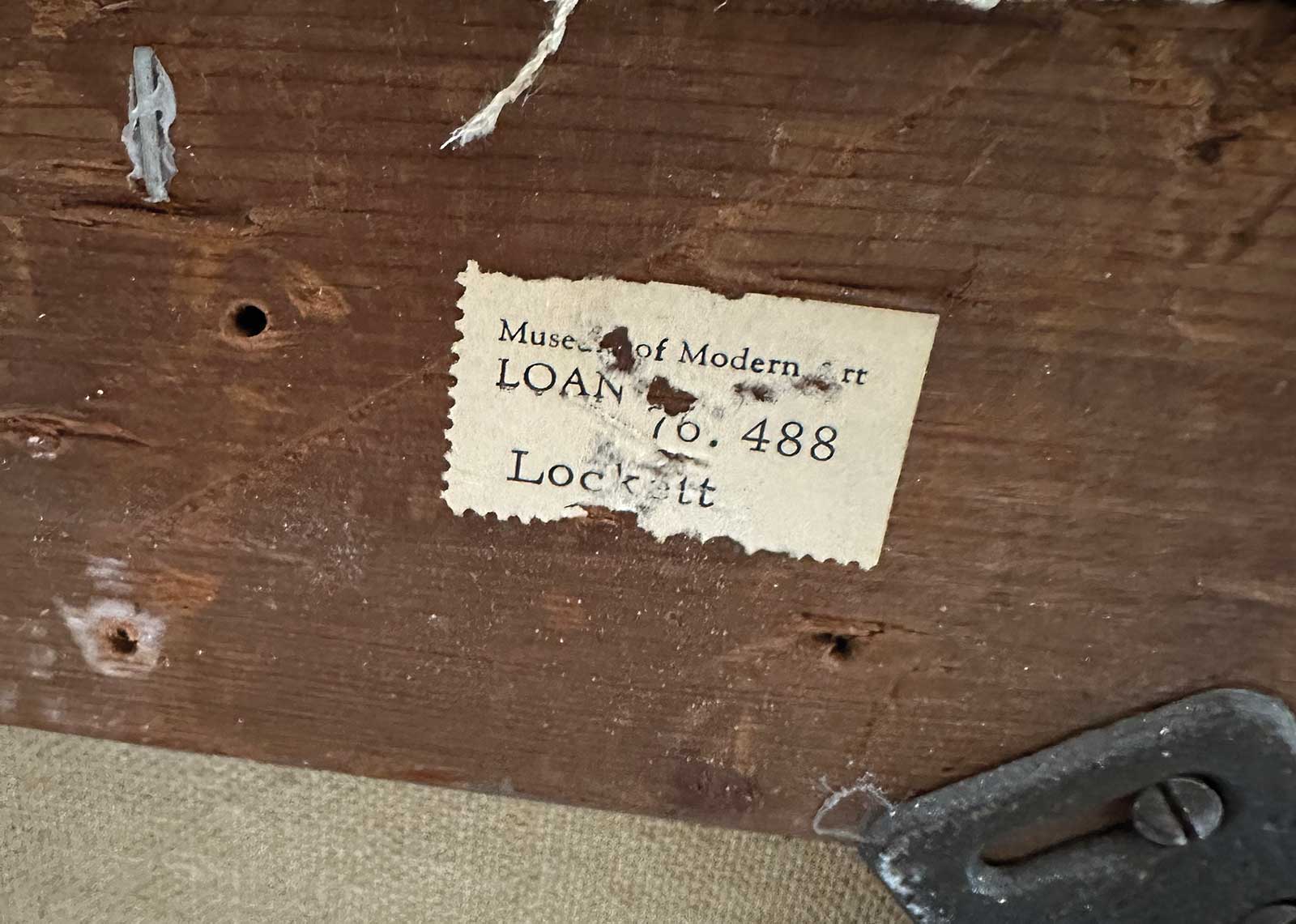
A label on Cloud World from the 1976 loan to the Museum of Modern Art in New York City. The label includes the name of the painting’s 1976 owner, Clay Lockett.
After the purchase was finalized, the painting was transferred to the museum, where it was reframed and went on view in December 2025. “Cloud World is the first artwork visitors see when entering the Western American art galleries on the seventh floor of the Martin Building of the Denver Art Museum,” says Henneman. “It is on display near Dixon’s later rendition of the desert in Wide Lands of the Navajo (1945), Birger Sandzén’s epic A Mountain Symphony (1927) featuring Long’s Peak in Rocky Mountain National Park, and Alexander Phimister Proctor’s elegant bronze Indian Warrior (ca. 1922).”
That’s where the painting ended up, but where did it come from? There is a relatively complete record that helps answer that question.
Cloud World was painted by Dixon in 1925. The work is listed in the artist’s logbook as painting 297, notes Mark Sublette, who owns the logbook and other important Dixon material at the Maynard Dixon & Native American Art Museum in Tucson, Arizona. The logbook also shows that Dixon had priced the piece at $1,800, and it was originally titled with a hyphen as Cloud-World. Sublette says the work may have been painted in the Phoenix area due to numbered works featuring Camelback Mountain that follow Cloud World in the logbook. The subject is likely Arizona, though its exact location may never be known, Sublette adds.
Although the painting was completed in 1925, Dixon held onto it for 17 years, during which time it was exhibited at least four times between 1926 and 1928. Venues included the California Palace of the Legion of Honor in San Francisco; University of California, Berkley; Wichita Art Association in Wichita, Kansas; and the California State Fair in Sacramento, California. In 1942, it transferred to Native American arts trader Clay Lockett. Details of the transaction are lost to time, but one persistent story, partially confirmed by the trader’s family, is that Lockett traded $2,500 worth of goods to Dixon for the painting. After Lockett died in 1984, the painting was sold to Dixon fan and art dealer A.P. Hays, who purchased the work for $168,000, according to Sublette. In 1993, Hays sold it for $300,000 to Ruger, its owner prior to the Denver Art Museum. 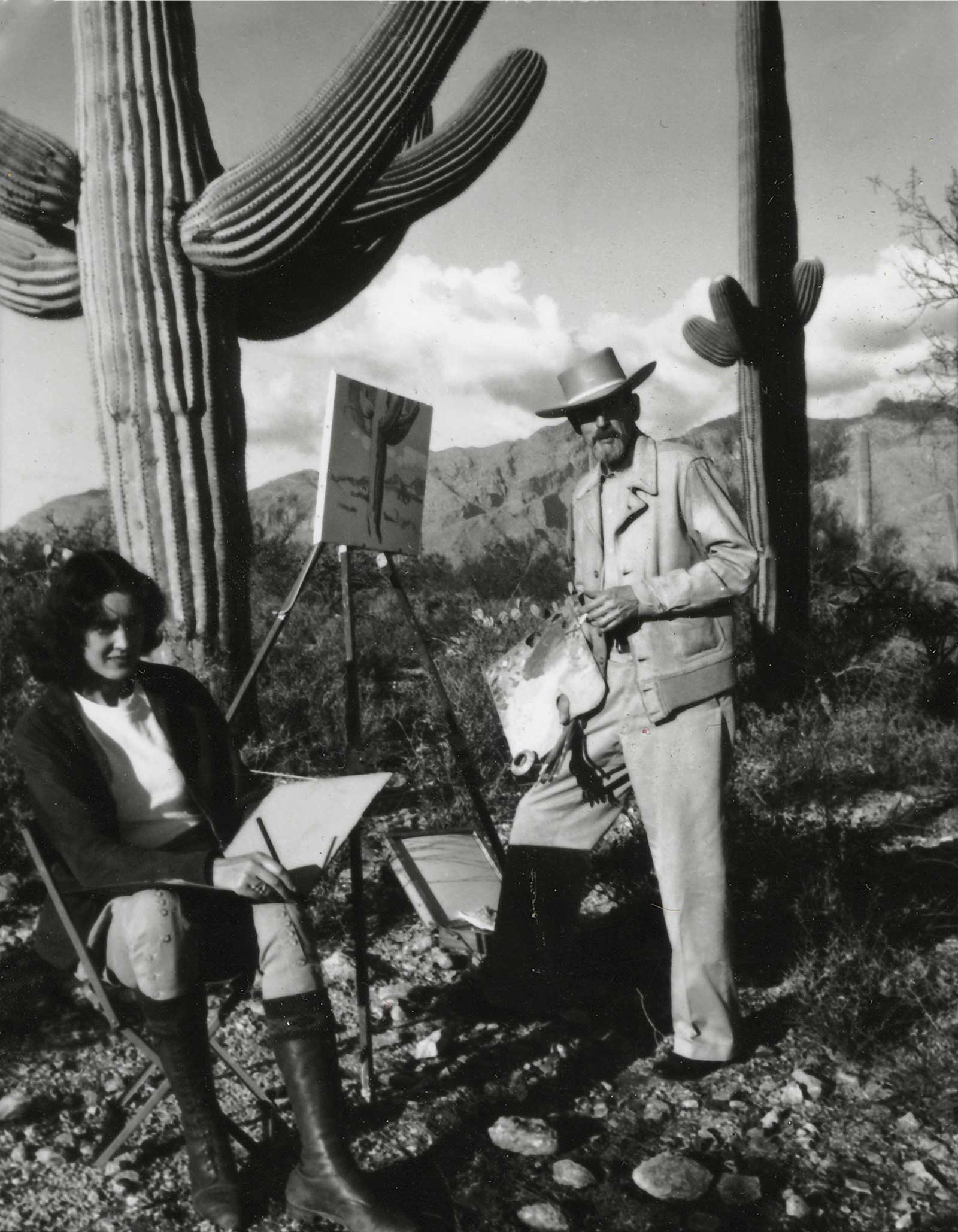
Maynard Dixon and his third wife, Edith Hamlin, in Tucson, Arizona, in 1940. On his easel is Sahuaro – Tucson, Arizona.
In addition to the four exhibitions that featured the painting while Dixon owned it, Cloud World was also shown briefly in a handful of exhibitions between 1976 and 2021, including The Natural Paradise, Painting in America, 1800-1950 at the Museum of Modern Art in New York City in 1976. It was most recently at a major Dixon exhibition, Maynard Dixon’s American West, that opened in 2019 at Western Spirit: Scottsdale’s Museum of the West in Arizona. For the Western Spirit exhibition, Cloud World served as the first and introductory piece as visitors entered the gallery.
In Don Hagerty’s 2010 book The Art of Maynard Dixon, the author wrote about the painting. “One of Dixon’s most important canvases was painted during his trip to Arizona in 1925. In Cloud World, clouds of the Arizona desert hang in the blue sky, row on regimented row as far as the eye can see, a setting for some celestial drama. There is no rush, no theatrical hurry about them. They are perfectly poised, conformed to the horizontal landscape lying in their long shadows. Below is a flat-topped mesa rising from the vast yellow sunlit desert. Two figures ride along the edge of the mesa, insignificant objects in a boundless vista. There is a sense of fundamental mass, clarity and precision in the composition—an architectonic statement. Dixon used a strong cubist-realist approach in the composition but made little attempt to destroy or greatly distort the recognizable character of the cloud formation. A mural quality infuses the painting constructed with brash colors, but there is vigorous depth as well, unlike the two-dimensional appearance of a typical mural,” Hagerty wrote. “Though he sometimes used groups of humans or horses to point an imaginary line across the distance and emphasize the flow of his composition, Dixon gradually reduced or eliminated the human element in his work as he found himself more absorbed with nature’s patterns during the 1920s. The human figure became subservient to the landscape. Furthermore, in Cloud World, as in many of the landscape paintings that followed, there is sensitivity to the horizon line, with the upper three-fourths or more of the canvas devoted to sky and clouds, shaping a feeling of immense distance.”
Dixon painted skies and clouds throughout much of his career, but Cloud World stands out as a unique composition, even a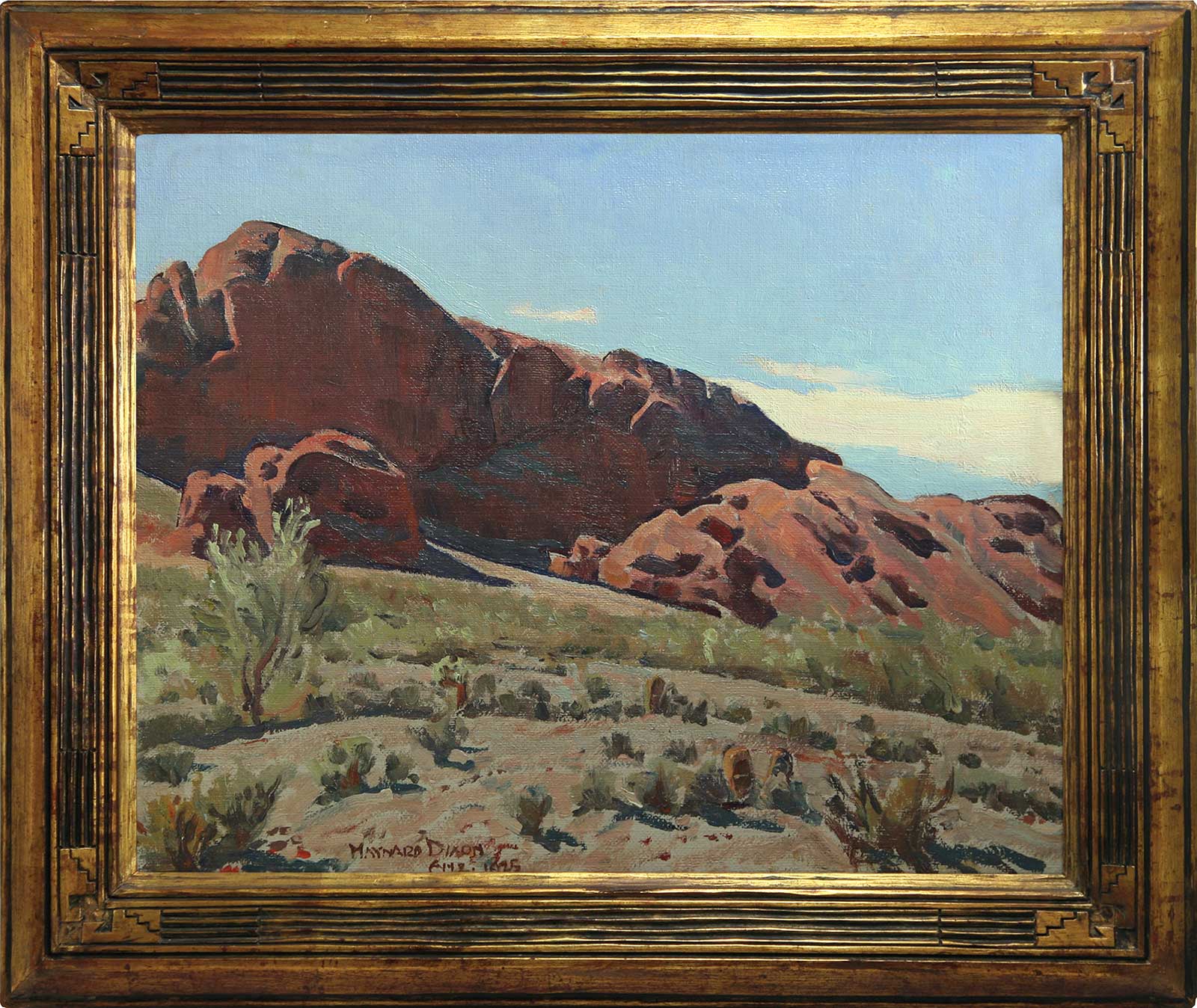
Maynard Dixon (1875-1945), Desert Rock One (Camelback), 1925, oil on canvas, 16 x 20. In Dixon’s logbook, this painting is listed as No. 303, five paintings after Cloud World. Courtesy Maynard Dixon & Native American Art Museum.
s several works—including Remembrance of Tusayan from 1924 and Clouds of a Summer Afternoon from 1945—do show similar scenes with small and scattered clouds that fill the sky.Although the painting is celebrated today, the artist may have viewed the work differently. “Dixon probably didn’t see it as his masterpiece. We do know he felt that way about several other works, including Earth Knower and Shapes of Fear. We know that because he talks about them and he writes about them,” Sublette says. “What makes Cloud World so interesting is that it has become so iconic in retrospect by other artists who are drawn to its imagery and design. It has become an extremely important painting that has codified the modern West…I’m glad it’s going to be in a museum so that others can go view it and be inspired by it.”
Petrie, who’s thrilled to have the masterwork in the institute that bears his name, says the painting has an unmistakable power. “When we went down to see it, it hit me right between the eyes,” he says. “I had been chasing it for a long time, so I knew how special it was, but then seeing it in person was something else entirely.” After he viewed the painting in Dallas, Petrie returned to his home in Maine, where he witnessed three consecutive days with skies reminiscent to Cloud World. “It was Mother Nature informing me that we had to do the best we could to bring the painting to Denver,” he says. “Those clouds underscored to me how important this work is.”
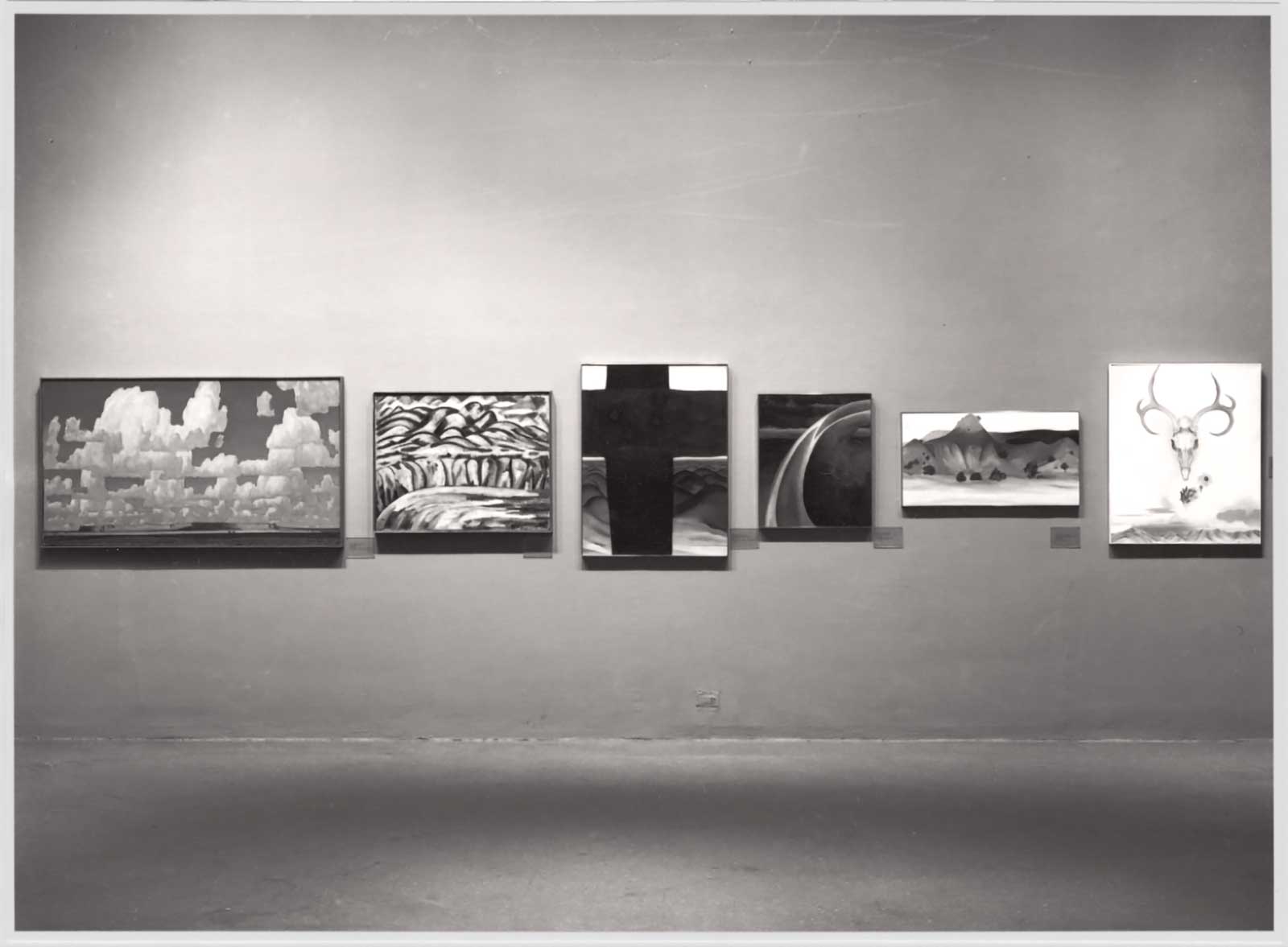
Cloud World, left, on view in The Natural Paradise, Painting in America, 1800-1950 at the Museum of Modern Art in New York City in 1976. Dixon’s painting hangs next to a work by Marsden Hartley and several Georgia O’Keeffe paintings.
While the painting will certainly entice new visitors and art collectors to Denver, it will also draw interest from artists who recognize the painting as a seminal work of Western modernism. Utah painter Brett Allen Johnson is one of those many artists who consider the painting one of the most important pieces of Western art ever made. “It certainly shows me what is possible in the Western genre. It’s one of those eye-opening pieces that you never forget,” Johnson says. “Dixon simplified the land and the sky. He distilled the painting to its most simple parts, each one of them powerful—from the design and the color to the beautiful layers and the repetition of the clouds. Dixon painted it to seem like there is endless sky beyond the horizon. It shows the spaciousness of the West, and the drama.”
Alexander, who represents Johnson and numerous other artists who swear by Cloud World’s importance, is honored he had a hand in placing the work at its new home, and notes with its new visibility it will continue to touch new generations of artists who want to explore the limitless possibilities within Western art. “Cloud World is in great hands,” he says.
Although he wasn’t part of the transaction, Western author and Dixon scholar Don Hagerty took great interest in the future home of Cloud World. Hagerty had been in failing health and died October 13, 2025, just as the deal with the Denver Art Museum was finalizing. Alexander had been in contact with him during the last months of his life and was hopeful the sale would be far enough along so he could notify the author. Finally, after months of waiting, Hagerty was told Denver Art Museum was the buyer. Hagerty’s reply was likely his final word on Dixon: “Perfect landing spot.” —
Powered by Froala Editor


