My wires had crossed prior to speaking with Billy Schenck on the occasion of his new retrospective. I had understood it would be his fifth, or maybe sixth, retrospective of his long and storied career. “No, no,” he says. “This is number 15. You were off a bit.”
“Yeah, my first was in 1983 at the Scottsdale Center for the Arts, and the next one was in 1996, and then I had three or four retrospectives with my serigraphs, and then Schenck/Warhol that was up for a period of about fives years,” he adds. “I’ve got them all on my résumé because, honestly, I can’t keep track of them anymore.”
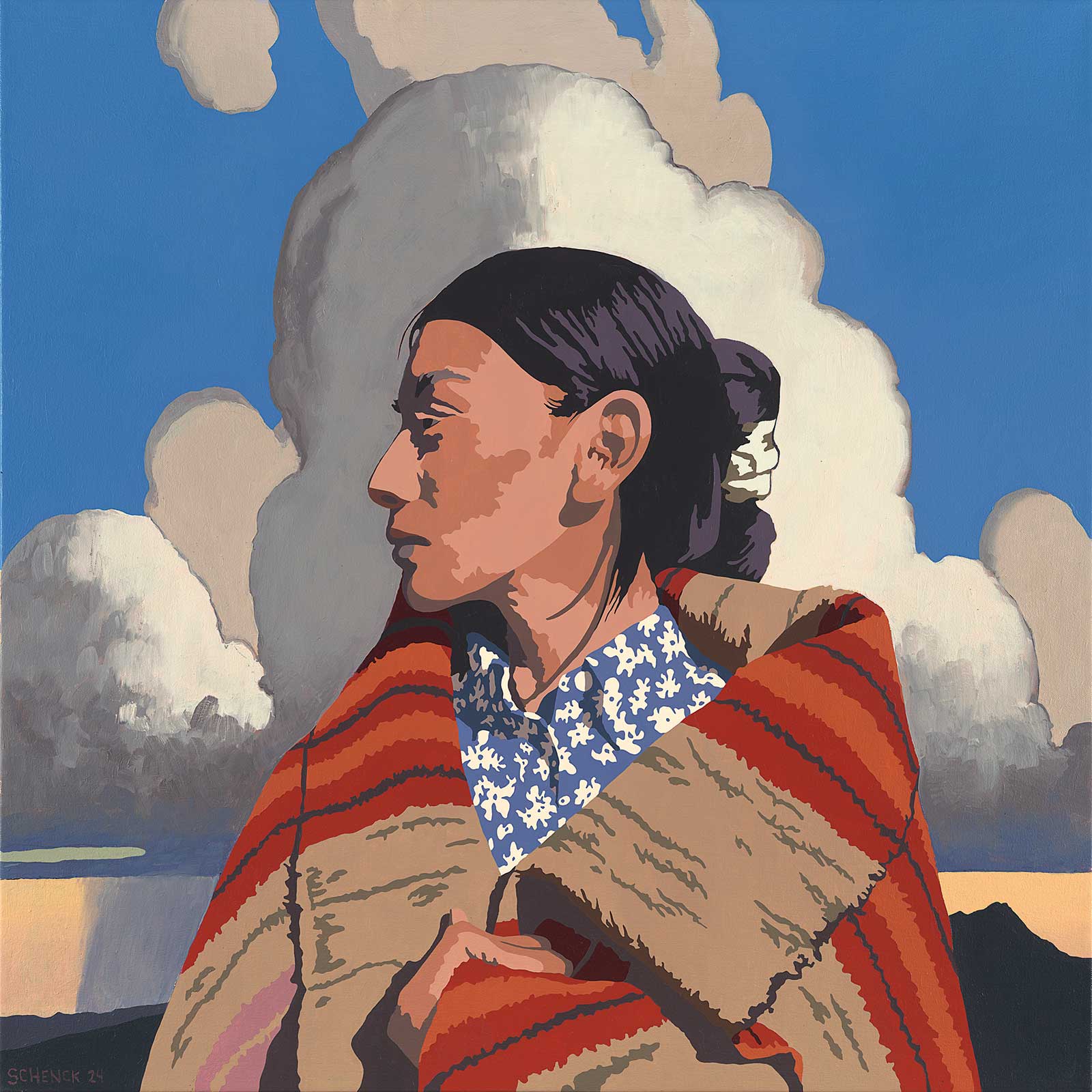
Lady in Calico Blouse, oil on canvas, 32 x 32 in.
Most artists, even those at the top of their game, haven’t had five major retrospectives, let alone more than a dozen. For his newest, Schenck heads down to Tucson, Arizona, at the Maynard Dixon & Native American Art Museum and the Medicine Man Gallery, where the owner of both venues, art dealer Mark Sublette, is rolling out the red carpet for the iconic painter starting February 6. Although Schenck has done these kinds of exhibitions before, the Tucson one, titled Billy Schenck: 55-Year Retrospective, is special because it will be populated entirely by work from the Schenck Foundation Collection (along with around 30 works for sale in the gallery side of the show). Schenck is an avid art collector himself—of works by Western greats, his own paintings, pueblo pottery and Molesworth furniture—so the foundation collection is not just a repository of great art, it’s part of his legacy. The show will also produce a new book, Billy Schenck: New Wave Westerner.
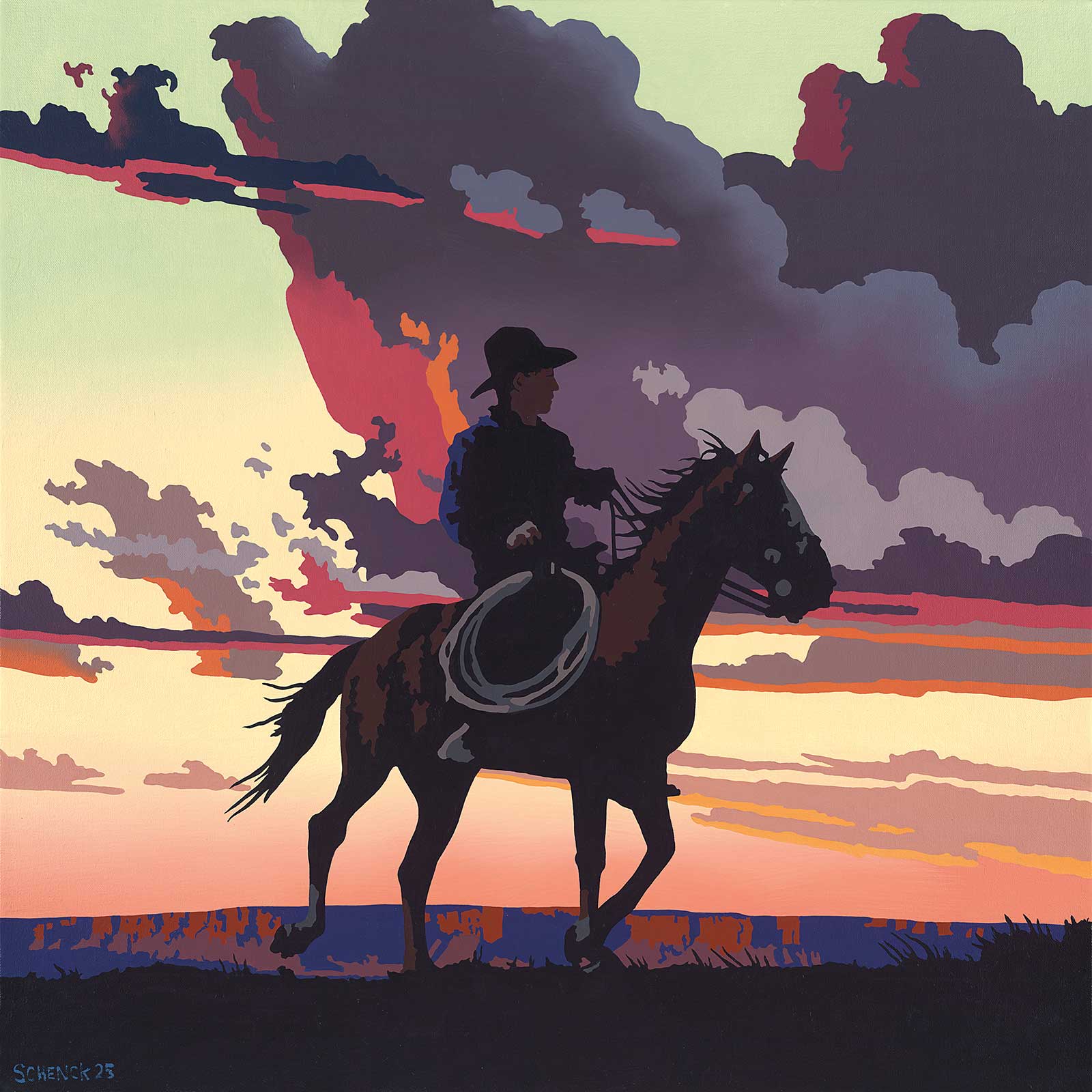
Antonito, oil on canvas, 26 x 26 in.
But what goes into a good retrospective? “Traditionally, these things are curated by museum people, either curators or the directors, so it is always their vision of what they wanted in the show and who they thought I was,” Schenck says. “For this, Mark gave me carte blanche to be my own curator. I loved that opportunity…For the sale portion at the gallery, the work will be mostly landscapes, in that sort of vein. But at the museum, the focus will be much more radical and off-the-wall kind of material.”
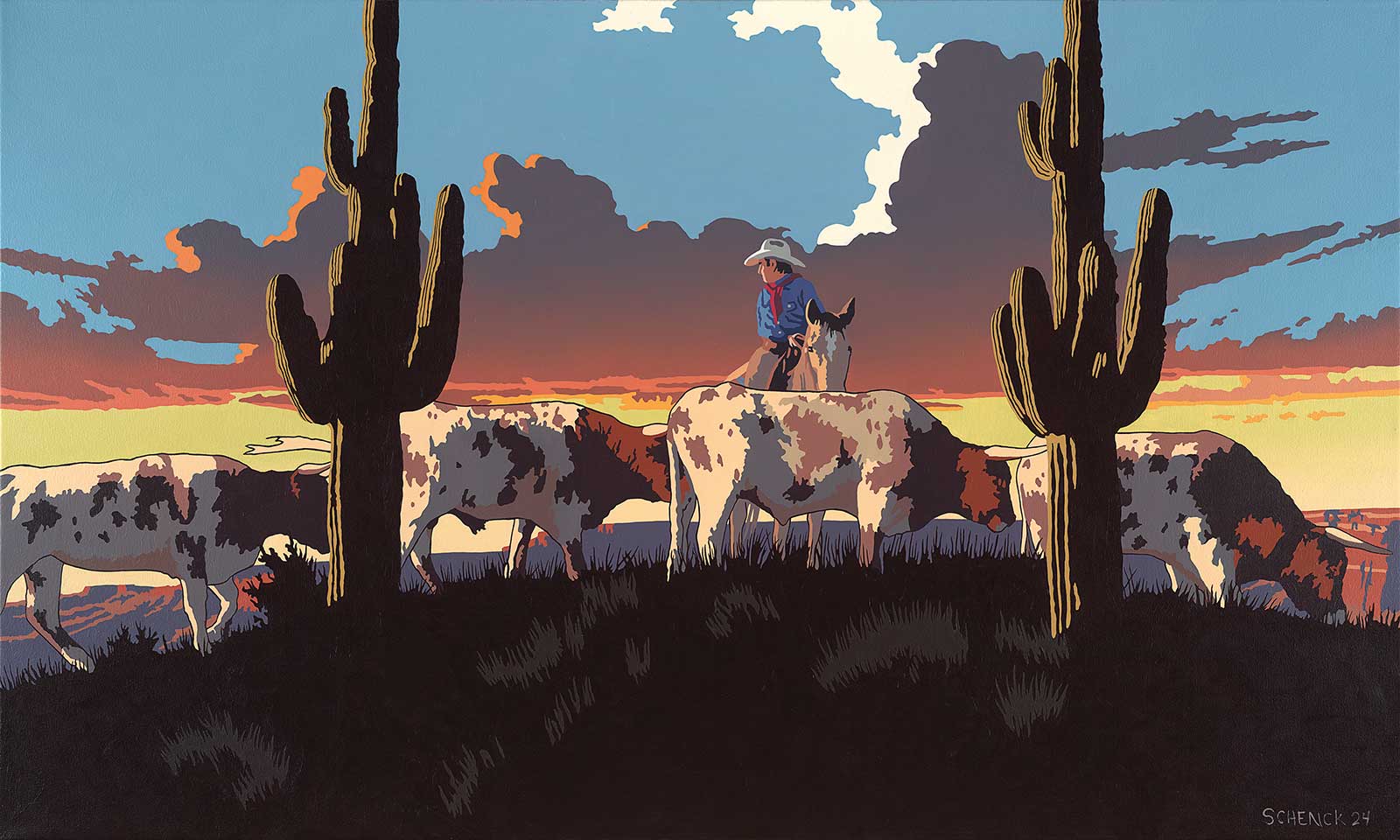
Hills Above Laredo, oil on canvas, 30 x 50 in.
The New Mexico painter says the show will include traditional cowboy subjects, his classic images of Native Americans in the Southwest and also some of his famously provocative caption paintings, including several with characters Cliff and Geoff, who bumble around the West. In one work, Schenck paints a cactus shot clean through with bullet holes. The caption reads: “In his last days he became a saguaro serial killer…” These works—Maynard Dixon meets Roy Lichtenstein—are infused with Schenck’s wickedly perceptive brand of comedy, from satire and gallows humor to absurd tragedy and other pricklier forms of commentary. These are the works that are often most misunderstood, particularly by those who think Schenck is laughing at the plight of the West’s original inhabitants, Native Americans. In reality, Schenck is an ally and defender of Native American rights and sovereignty. By poking at American history, he’s trying to expose the contradictory nature of the West, which American culture has taught us is filled with heroes of the frontier. But some of those heroes also colonized the land and murdered Indigenous people. There’s no way to square that neatly, so Schenck uses art and humor to seek out some semblance of historical truth.
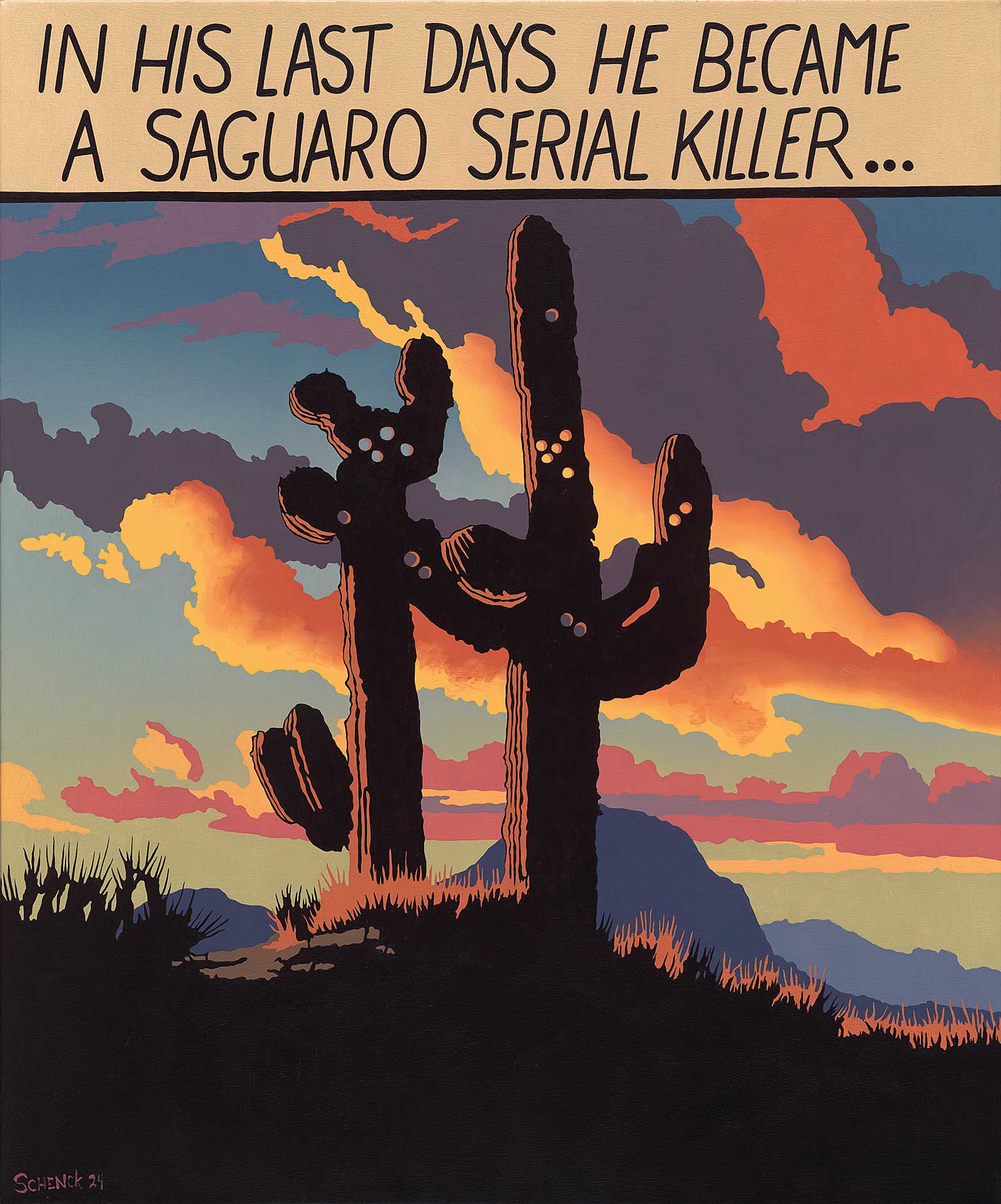
His Last Days, oil on canvas, 36 x 30 in.
“I’m an intense believer in the theater of the absurd. You know, I started to reread Albert Camus and looking at existentialism and Joseph Heller’s Catch-22. Existentialism can really take you into dark places, but it can do it with a layer of humor and absurdity. That’s me,” he says. Schenck calls out to stand-up comedy and the power it has to cut through darker subject matter. “Comedians say things that others might get murdered repeating in public, but it’s important to have some dialogue about these things, even if they are not socially acceptable. It’s fun for me to be tongue in cheek that way. If we can’t explore those subjects, then what is even the point of art?”
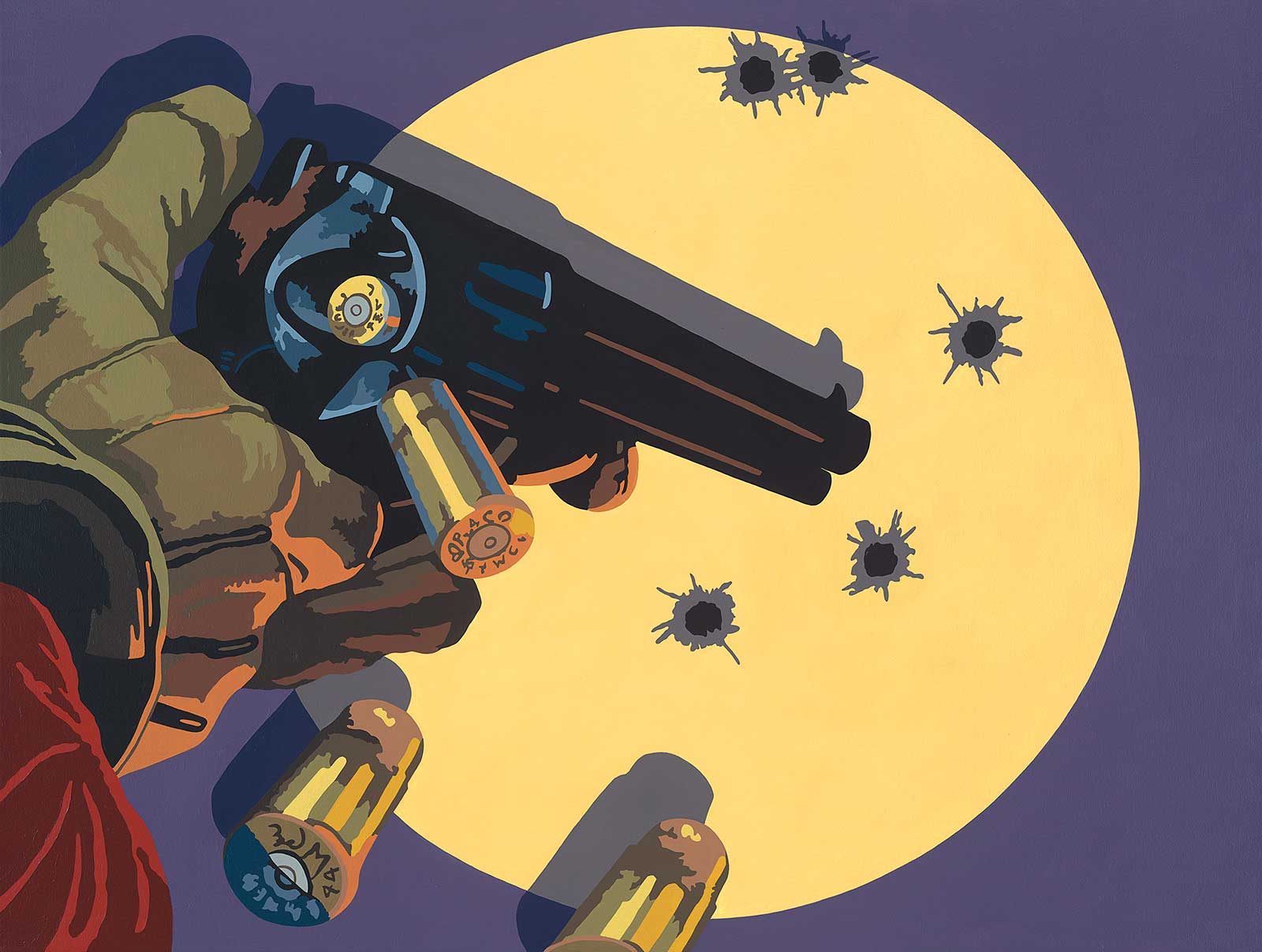
Moon Shot, oil on canvas, 30 x 40 in.
These are the conversations Schenck wants to have about his work. Specifically, he wants art that says something and can last forever. For many years, what dominated discussions were his outside-the-box processes: the paint-by-numbers style, projectors in the studio, Hollywood press stills filling large binders, studio assistants painting later stages of the paintings and the genuine openness Schenck has for these unconventional studio methods. Then there was Schenck himself: his connections to Andy Warhol and the Velvet Underground in New York City, his larger-than-life personality, a champion rodeo career and even his own iconic image as the maverick in sunglasses and leather jacket, a cigarette dangling from his mouth and “Billy Famous” on his belt. These aspects of the artist will always be part of who he is, but there is also renewed and active interest in what he is saying in his art. Retrospectives like the Tucson show, coupled with endorsements from younger artists such as Logan Maxwell Hagege, and his enduring appeal in Western circles, are proof Schenck has staying power within the culture of Western art, now and in the future.
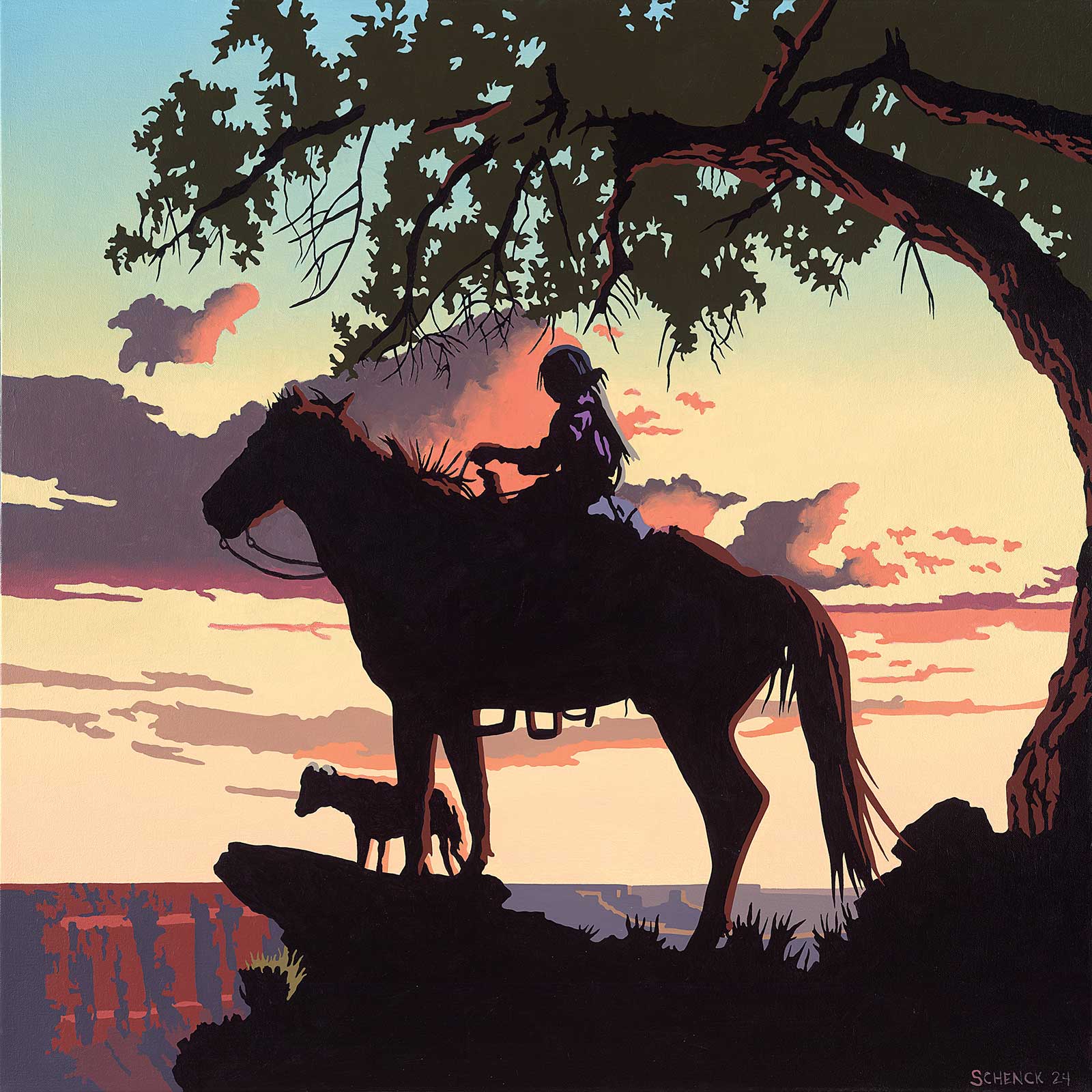
Up On the Bluff, oil on canvas, 30 x 30 in.
Sublette, who has represented the artist for 15 years, says he is as “complex a person as I’ve ever met.” He writes in the introduction of Billy Schenck: New Wave Westerner: “A man as intuitive and driven as Schenck could have taken many roads to the artistic highlands which he was destined to climb. The list includes rodeo champion, writer, artist, interior designer, architect, furniture designer specialist, art critic, restorer, historian, pueblo pottery expert and art dealer. All have crisscrossed Schenck’s life at one point or another during his 55-year art career. These disparate disciplines have the commonalities of immense love for the arts and history seen through one of the best trained eyes I have ever encountered… Schenck has the rare standing of being one of a few artists who brought a new dimension to Western and Native arts. Fritz Scholder (Luiseño tribal member) being another. Both artists were represented by Elaine Horwitch, the acclaimed Santa Fe and Scottsdale art dealer of the 1970-90s, who showcased the pillars of the foundation I categorize as the Modern West Movement. Schenck sees his world differently than most and throws passion where he finds excitement, usually in the form of collecting a masterpiece by a wide range of artists, from Francis Bacon to Ed Mell, or an outstanding Navajo weaving or pueblo pot.”
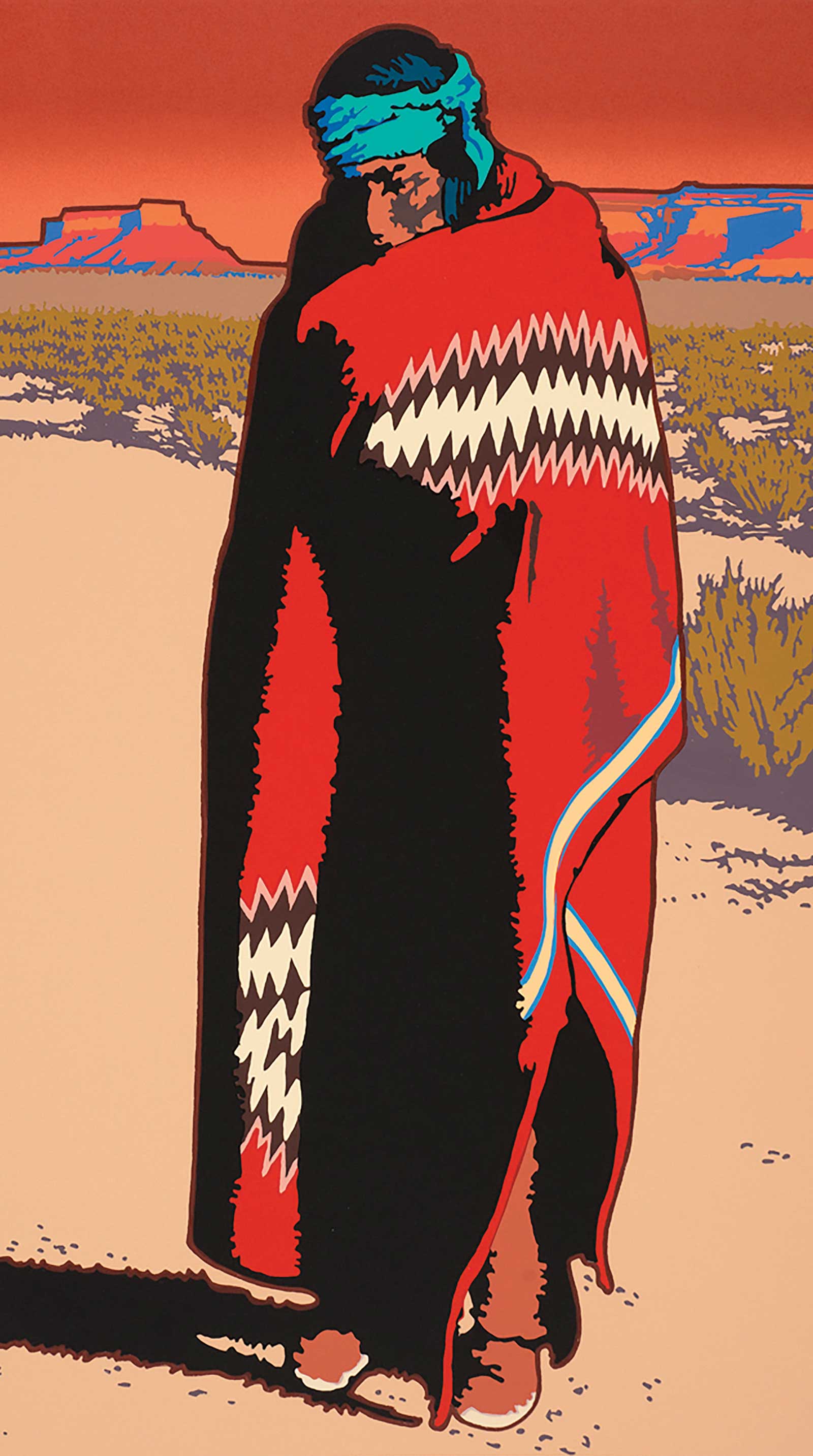
Deep Into the Desert, State I, serigraph, ed. of 72, 40 x 25 in.
The artist is thrilled to be part of a genre as exciting as Western art, and admires his fellow artists, both traditional and contemporary. “I think the great thing about the Western genre is that it’s a medium or a genre that everybody in the world has some familiarity with. It’s a diving board to explore so many other ideas. I certainly stood there and leapt off, and I’ve been passionate about it ever since,” Schenck says, adding that he’s been more active then ever. “I had one of these museum groups in the studio a month or so ago, and there’s always one person who inevitably asks if I’ve run out of ideas. The truth is I have not run out of ideas. In fact, I’m overwhelmed with ideas to paint. I’m working longer and harder now than I was earlier in my career.”
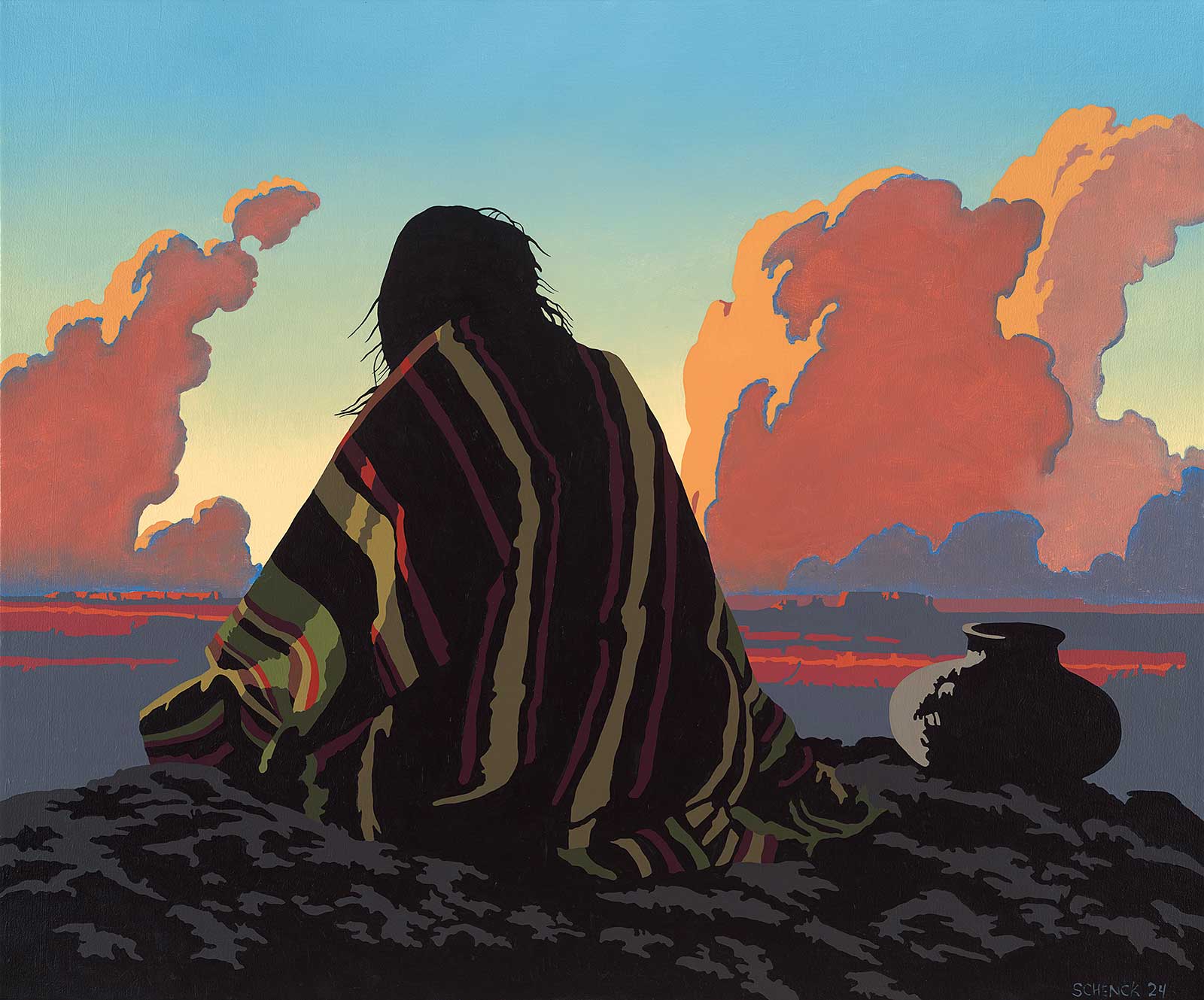
Enchanted Mesa, oil on canvas, 30 x 36 in.
Billy Schenck: 55-Year Retrospective opens February 6 at both the Maynard Dixon Museum and at Medicine Man Gallery. The museum will host the retrospective from the Schenck Foundation Collection, and the gallery will present around 30 works by the artist that will be fore sale. The opening night will feature a reception from 5 to 7 p.m. The publication, Billy Schenck: New Wave Westerner, will be available on the website and at the gallery. —
Billy Schenck: 55-Year Retrospective
Opens February 6, 2026
Maynard Dixon & Native American Art Museum
6866 E. Sunrise Drive, Suite 150, Tucson, AZ 85750
www.maynarddixonmuseum.org
Medicine Man Gallery
6872 E. Sunrise Drive, Suite 130, Tucson, AZ 85750
(520) 722-7798
www.medicinemangallery.com
Powered by Froala Editor


