In today’s digital world, the word “influence” can lead someone to the word “influencer,” which often suggests inauthentic content. However, in the world of Western art, the word “influence” frequently leads to more authenticity. Consider the lives of working cowboys, who have inspired countless Western artists to create accurate depictions of their way of life.
Although rare, Western artists and working cowboys (and cowgirls) can often be one in the same. The result is even more authentic depictions about Western culture. For Western artists who ranch and live the cowboy lifestyle, their art is forever influenced by the actual real-time ranch experience. Pushing mother cows and calves to summer pasture, watching the sun set behind granite spires, feeling awed by the beauty of rustic outbuildings and old corals, or witnessing the grace and athleticism of a cutting horse are experiences the Western artist is forever influenced by. What follows is a look at several Western artists who live or have lived this way of life.
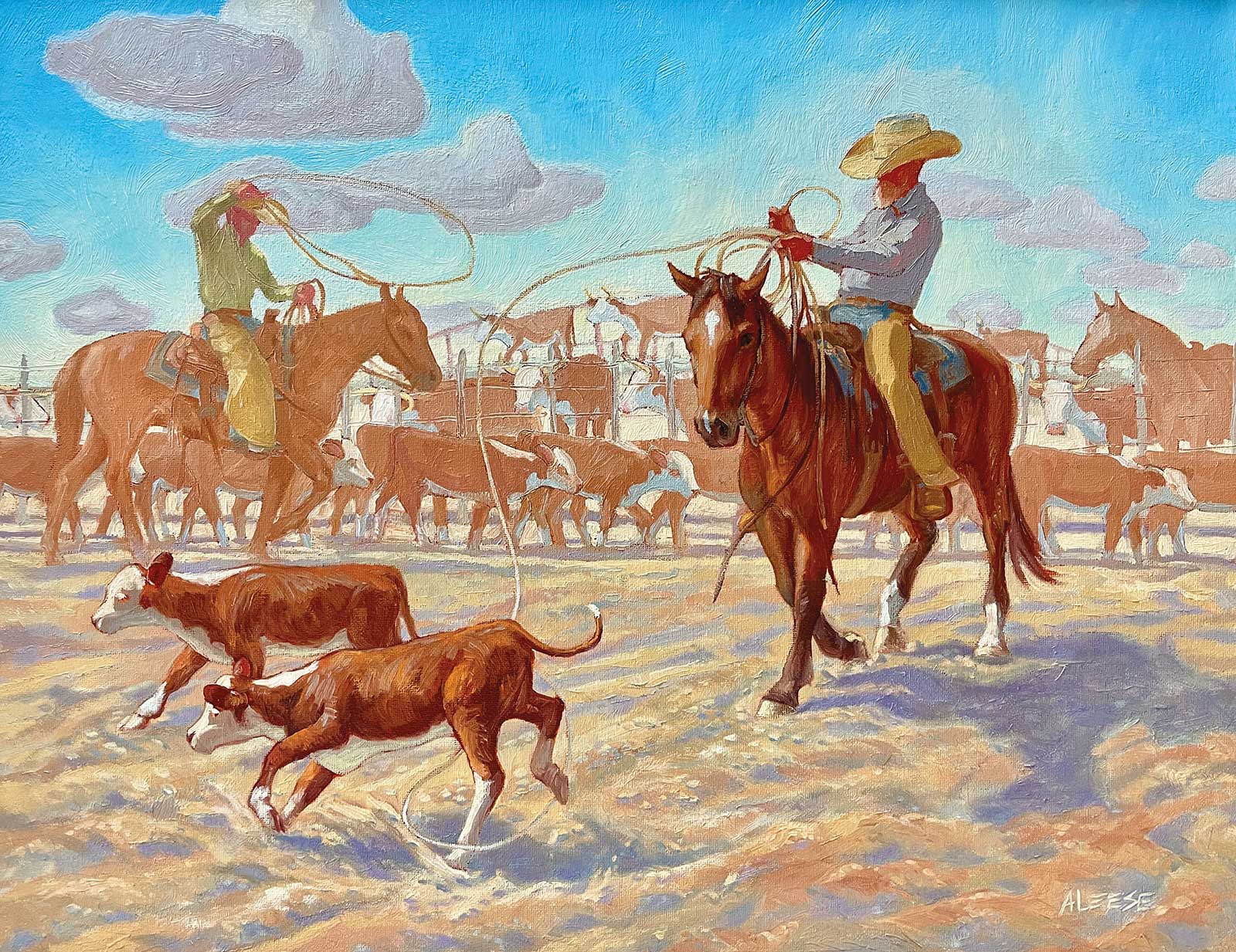
Alice Leese, Good Loop, oil, 16 x 20 in.
Alice Leese
From her West Texas ranch and studio 50 miles from Odessa, Alice Leese takes raw beauty and marries it with the ethereal. Complex and intriguing, some of her landscapes and cowboy paintings could be companion pieces to Vincent van Gogh’s The Starry Night, or the surreal works of Salvador Dalí. Her creativity comes married to a strong regional ranching heritage that runs as deep as the Ogallala Aquifer that runs under the Texas Panhandle. With a passion for plein air painting, Leese never sees a subject the same way twice. Her largest creation, the 72-by-360-inch Frying Pan Fire, hangs in the Ellen Noel Art Museum in Odessa. Leese’s intimate connection and feeling of responsibility for the land and its people is underscored by the fact she waited 10 years to paint Frying Pan Fire. She wanted a scab to form over the pain this grass fire had caused before moving forward with the painting. When asked if gender plays any part in what she sees, she answers, “I believe it does. For example, a woman may be more aware of the various levels of exhaustion written on a face or expressed in an individual’s body language.” The artist is a four-time recipient of the National Parks Arts Foundation, Artist in Residence.
www.aliceleese.com
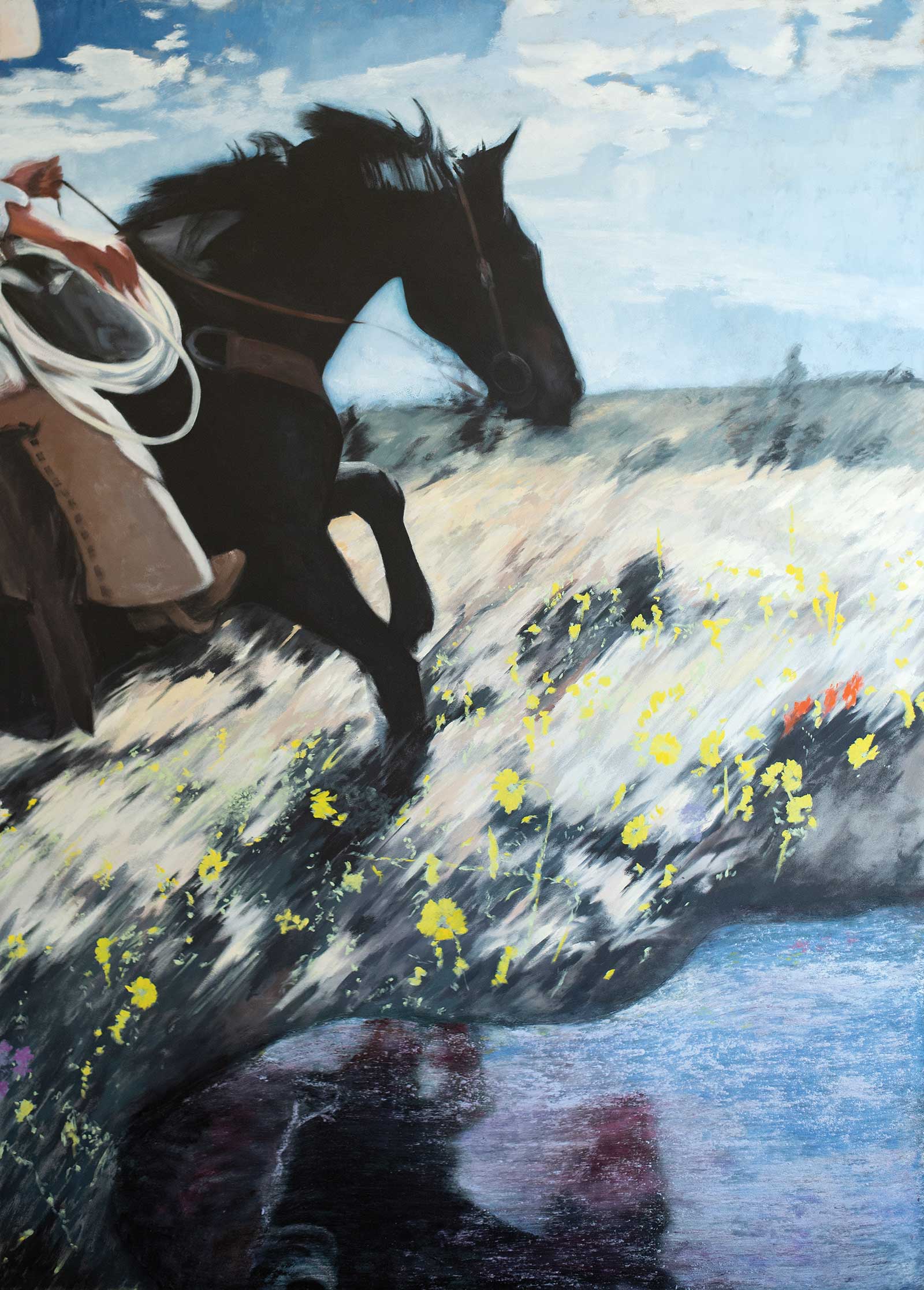
GL Richardson, El Agua Es La Vida, oil, oil stick and raw pigment on aluminum panel, 68 x 48 in.
GL Richardson
The story GL Richardson tells is unique. Disillusioned by San Francisco and the world of advertising, he broke out a set of paints not used since he lived in Virginia and painted two cowboys duking it out. “It was a god-awful representation, and I’m not sure why I elected to paint that subject,” Richardson says. But what this exercise did is make him apply for a ranch hand job at Wyoming-based Ranchlands. He had absolutely no experience, but, to his surprise, they hired him. The artist believes this turn of events happened because he was forthright about being a true city slicker. Ranchlands wanted someone they could mold into the kind of ranch hand they wanted. He worked that first summer helping brand and wean calves. He couldn’t ride a horse, but today he’s an accomplished horseman. During 14 months at Ranchlands, he was also honing his oil painting skills, and with the ranch experience juxtaposed with his artistic side, Richardson’s Western art soared. Since then, he’s been featured in shows and galleries from Texas to Los Angeles. Ranchlands was transformative, something that afforded him the visual language that defines his art today. Combining the imagery he finds, along with personal photography, he blurs the lines between myth and reality.
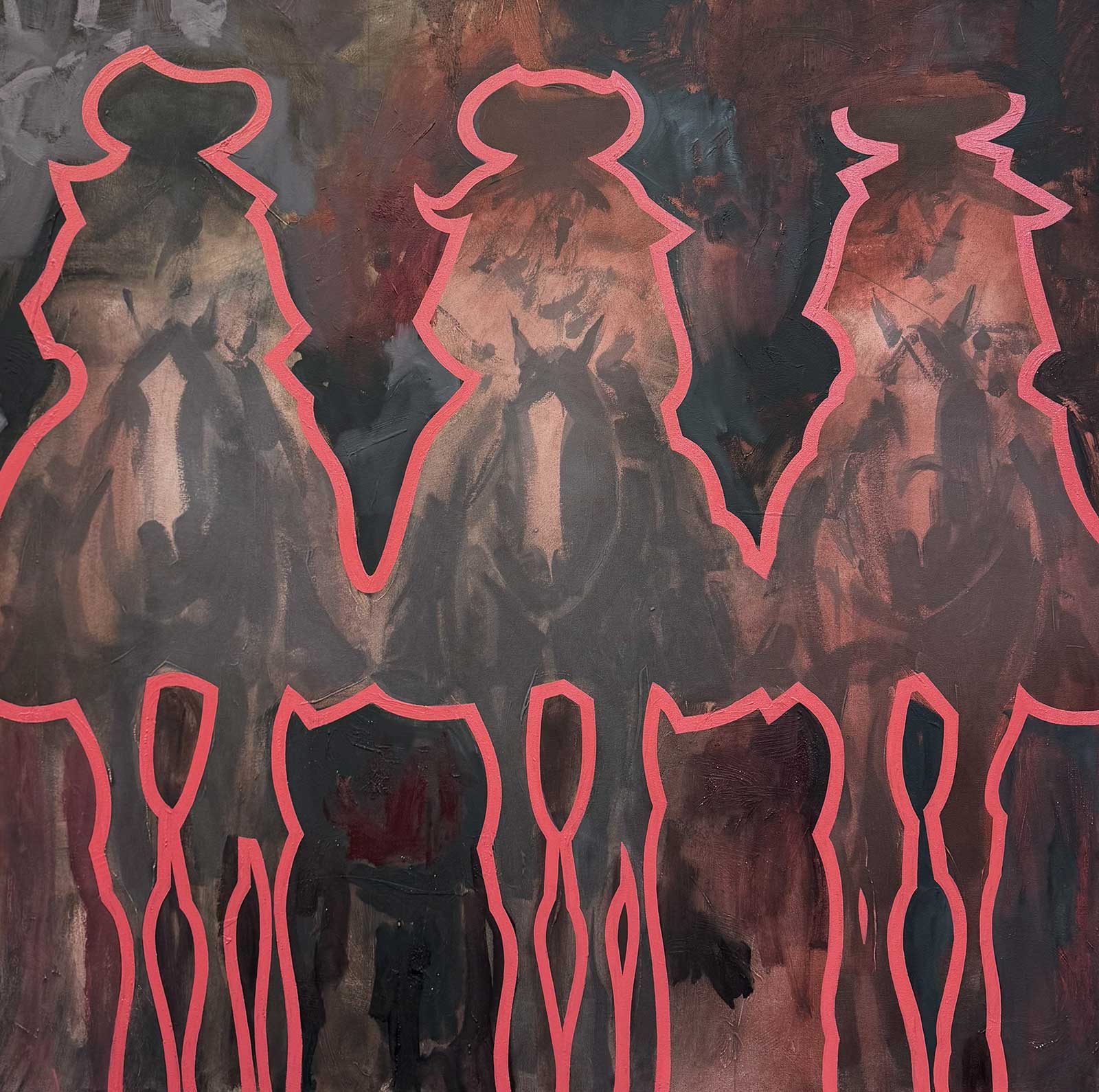
Duke Beardsley, Red River, mixed media on canvas, 48 x 48 in.
Duke Beardsley
When pressed on the matter, Duke Beardsley admits his passion for cowboying is pretty close to that of his passion for Western art. A fifth-generation Coloradoan and a fourth-generation rancher, half of the family was from Denver and half from Colorado Springs, and they would meet on weekends at the family’s cow/calf ranch along the Front Range between the two cities. Some of his earliest memories are sitting in the saddle in front of his father and riding out to “cowboy.” His style of Western art is unique. He paints mostly scenes of ranch work taking place from horseback by cowboys and cowgirls, or anything that involves rope work. Beardsley explains that the interaction and tension between a horse and rider are among his favorite subjects to paint, especially when a young horse is learning what is expected of it. Working in mixed media, a painting typically begins as a charcoal sketch that moves next to a grayscale acrylic painting, which involves thinning black acrylic that is used for the transparent grayscale. Oil paints are then added to give color and depth to the painting. This has been the artist’s focus in painting for the last 15 years.
www.dukebeardsleystudio.com
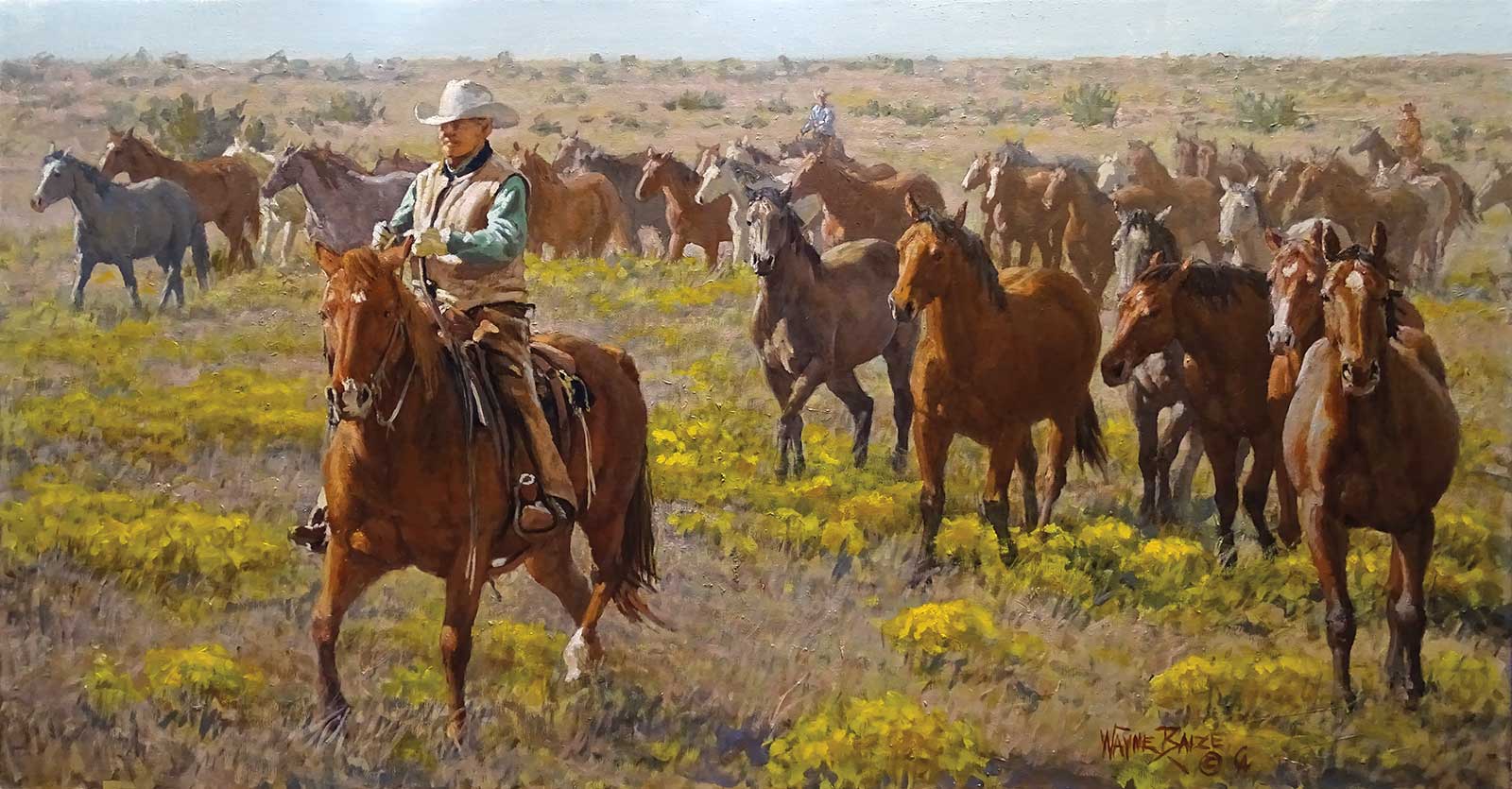
Wayne Baize, 6666 Ranch – Legend of Men and Horses (Boots O’Neal and 6666 Horses), oil, 24 x 36 in.
Wayne Baize
Working as a boy on his uncle’s mixed-cattle operation, today he runs Herefords on his own ranch down in Big Bend Country while his wife tends Shetland sheep for her cottage industry. From here, he often wanders with camera and sketchpad over to the bigger adjacent ranches like the 6666 Ranch to study the skeletal/muscular symmetry of cowboys and their horses at work. “We’re not talkin’ about what a horse looks like on a trail ride,” the artist says. “A working cow pony is unique. Its muscle groups are well defined and bold. It’s imperative that my paintings capture the fine details.” For him visuals such as these are important, with these characteristics finding their way into his oil paintings. The synergies Baize sees between a rider and his horse are also of paramount importance. “There’s a majesty that’s present when a cowboy and his horse become one,” he adds. But that’s only part of the equation. A more subtle but profound reason collectors today seek Baize’s art is that he had the unbelievably good fortune of being tutored and having his work rigorously critiqued by renowned Texas Western artist Tom Ryan. “He pulled no punches when it came to critiquing my work,” Baize says. “He was tough. I had to suck [it] up and listen, but my work today reflects it.”
www.waynebaizeca.com
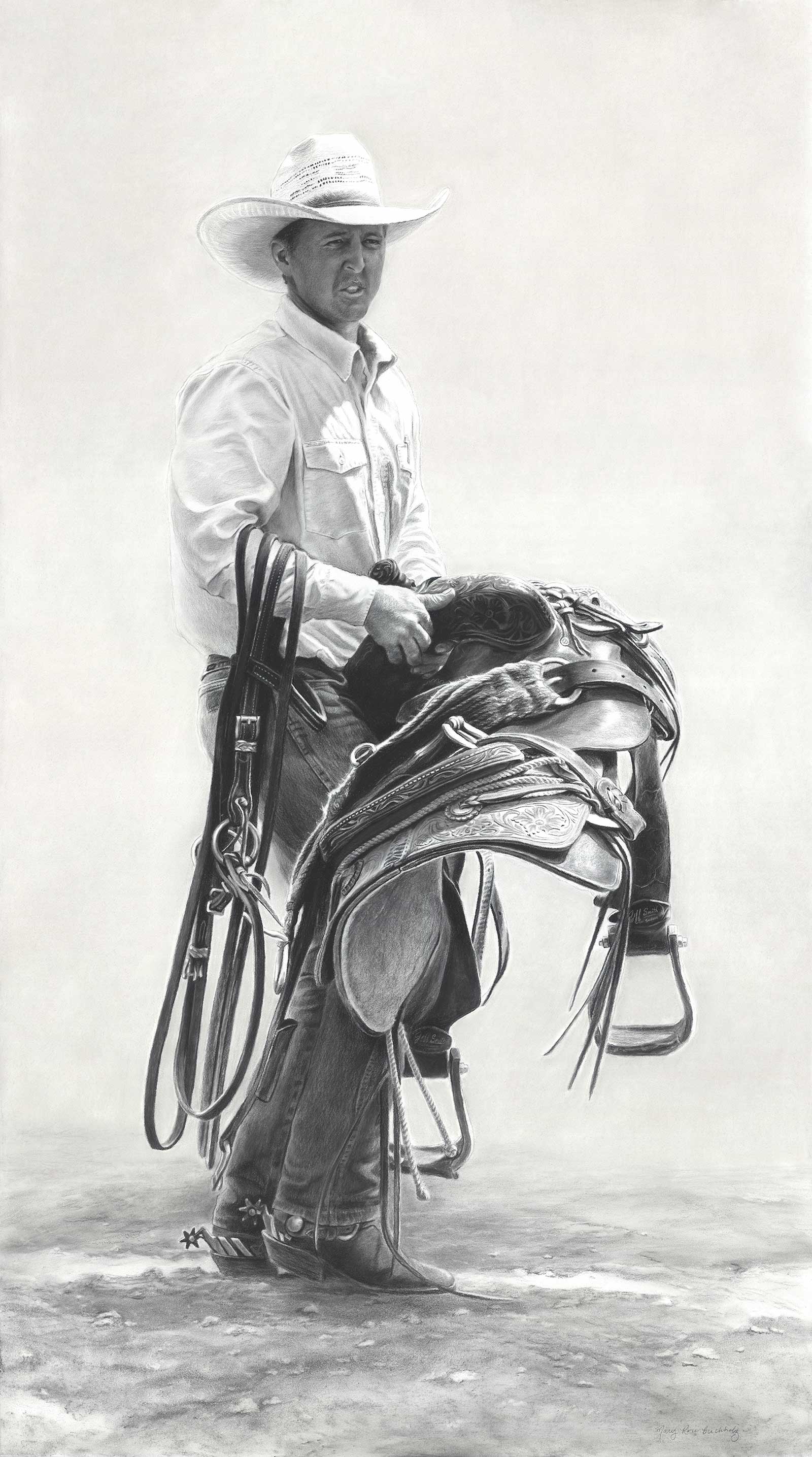
Mary Ross Buchholz, Saddling the Fresh One, charcoal, graphite and pastel, 36 x 20 in.
Mary Ross Buchholz
Memories of growing up on the family ranch northwest of San Angelo, Texas, are vivid for Mary Ross Buchholz. She remembers sitting in front of her father in a saddle, cushioned by a corduroy pillow, riding out to cowboy. If a challenging situation arose, he would lower Mary to the ground and tell her to “wait right.” The sounds of wildlife, the wind, the warmth of the sun on her face—she remembers all of it as she waited for her father to return. Today, those experiences find their way through her pencils, chalk and brushes and out into her art. The flexibility of being an artist and a rancher could not be more compatible, she says. Finished with preparing breakfast for 20 hired hands who have come to gather cows, she immediately walks into her studio and voila, she’s in the other world she loves. And when it comes time to feed and water goats, sheep and cows, and let the border collies out to romp, she puts down her pencils and brushes and out she goes to do evening chores. She has a catalog of memories that inspire her work.
www.maryrossbuchholz.com
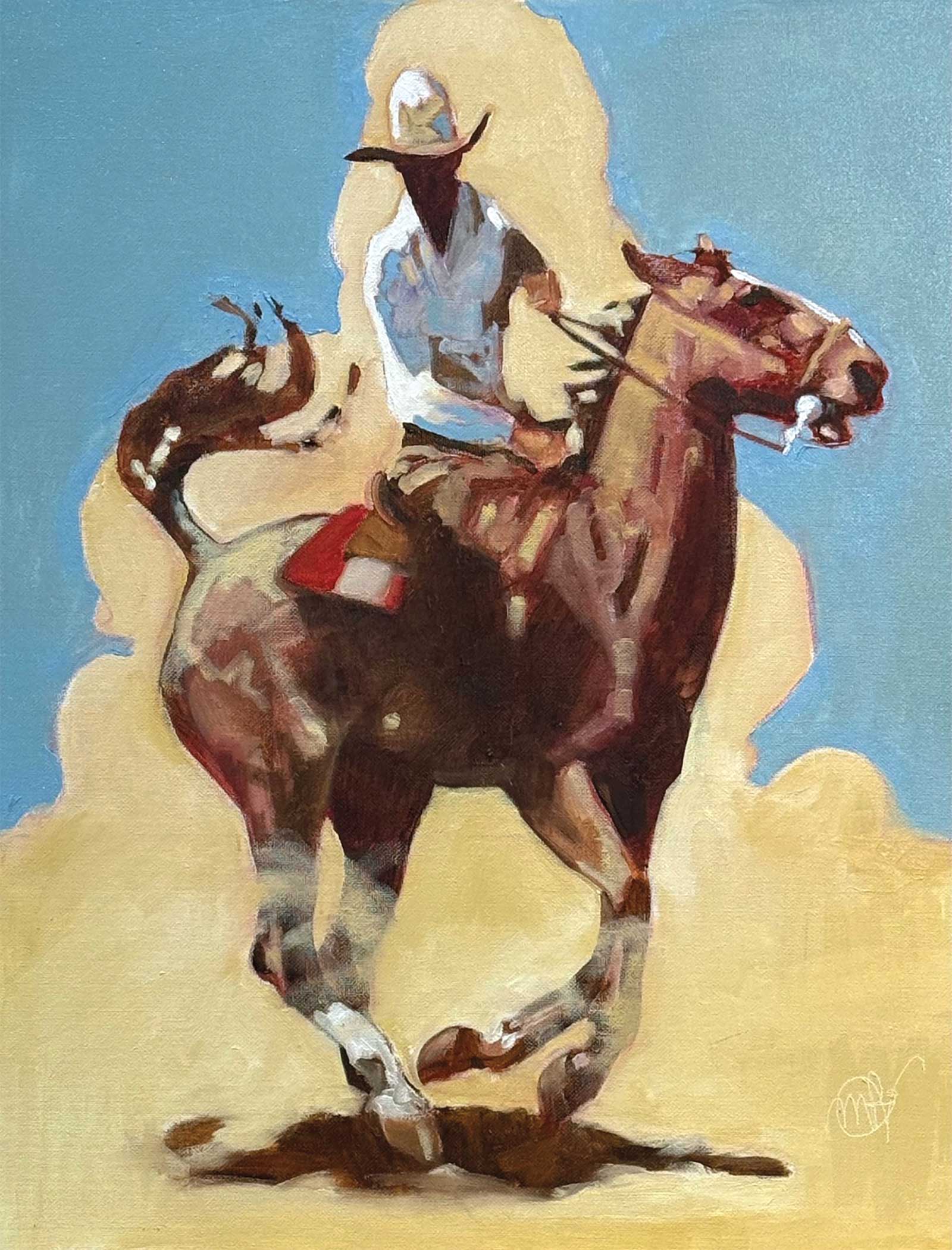
Peggy Judy, Sun and Dust, oil on canvas, 20 x 16 in.
Peggy Judy
Peggy Judy’s ranch is southwest of Telluride, Colorado. It sits on what was once part of Joe Cocker’s Mad Dog Ranch. After putting her children through college and 30 years of raising and training quarter horses and equine for dressage, Judy went full time into Western art. Drawing upon a formal education in illustration, her oil paintings of cowboys and livestock reflect a graphic approach to design and composition. Long story short, her paintings provide a framework of visual information that are unlike detailed paintings that attempt to replicate every line and dimension. She provides a framework that allows the observer to process what they are seeing through a lens that is uniquely their own. The years of having watched cowboys and their horses do their business is what she draws upon for inspiration. And when she needs to refresh her image bank, she makes the 75-minute drive to get to town and resupply. This is cowboy country, and here, Judy is gifted with new ideas that make their way into her art.
www.peggyjudyfineart.com
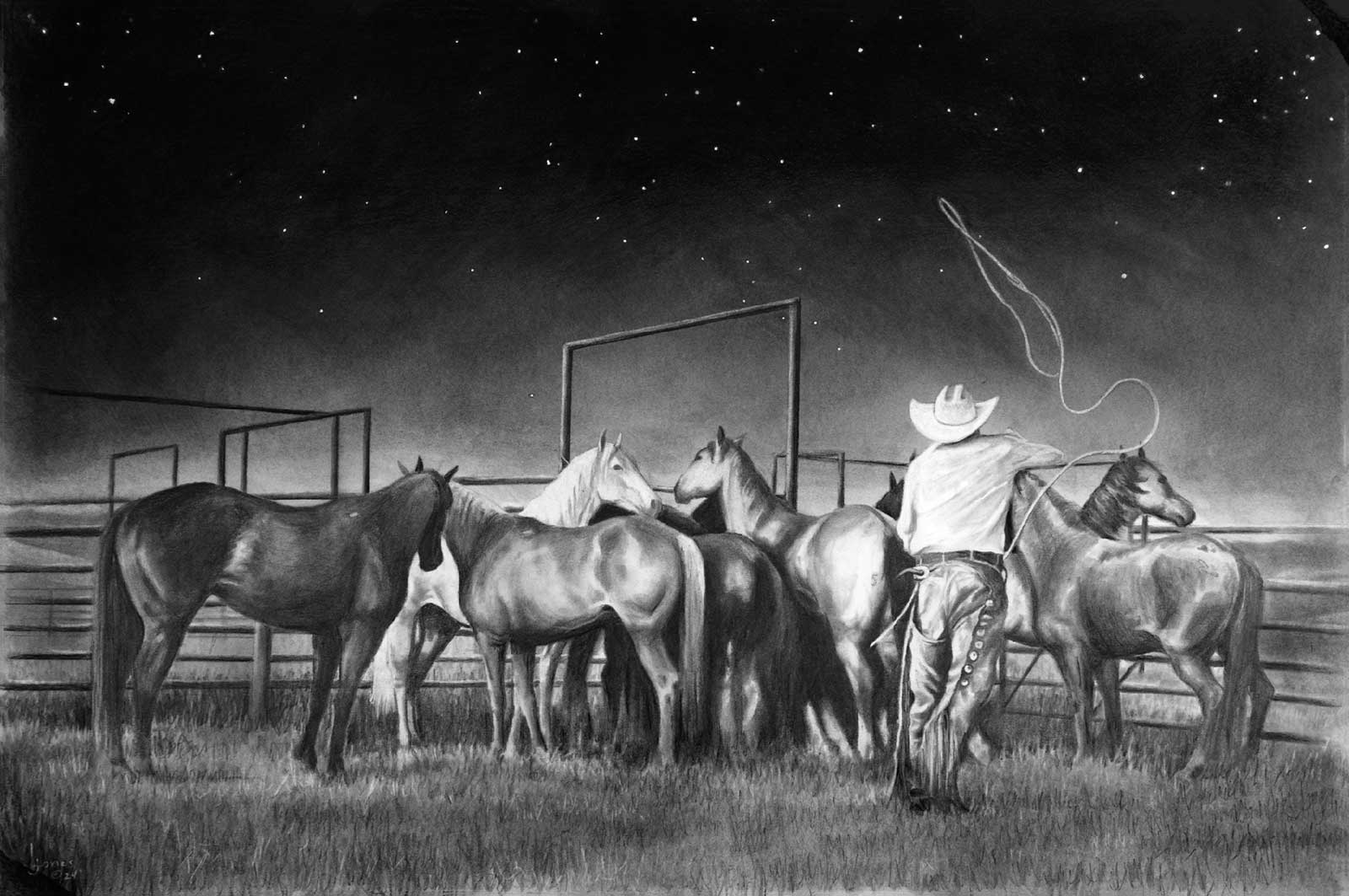
Lori Jones, Early Start, pencil and charcoal on paper
Lori Jones
Painter Lori Jones remembers as a child when her father brought home two wild horses and how she ran to the house to get her sketchpad and pencils. “In my mind I knew what I wanted to lay on paper, but I couldn’t make it happen,” she says. “I remember crying and running to my mother.” Today, Jones is recognized for her pencil and charcoal drawings, with collectors lining up to add her work to their collections. She and her husband are ranching purists. They use only traditional ranching methods, which include using horses to ride fence, gather in the spring and manage livestock even inside corrals. No ATVs or side-by-sides in this cattle operation. Continually taking photos, Jones is forever viewing her world in real time. Early on her work emphasized horses but that evolved into portraits. Other drawings feature the day-to-day life of working ranchers, such as chuckwagons and hungry cowboys. Her drawings can take as long as a week to complete.
www.lorijonesart.com
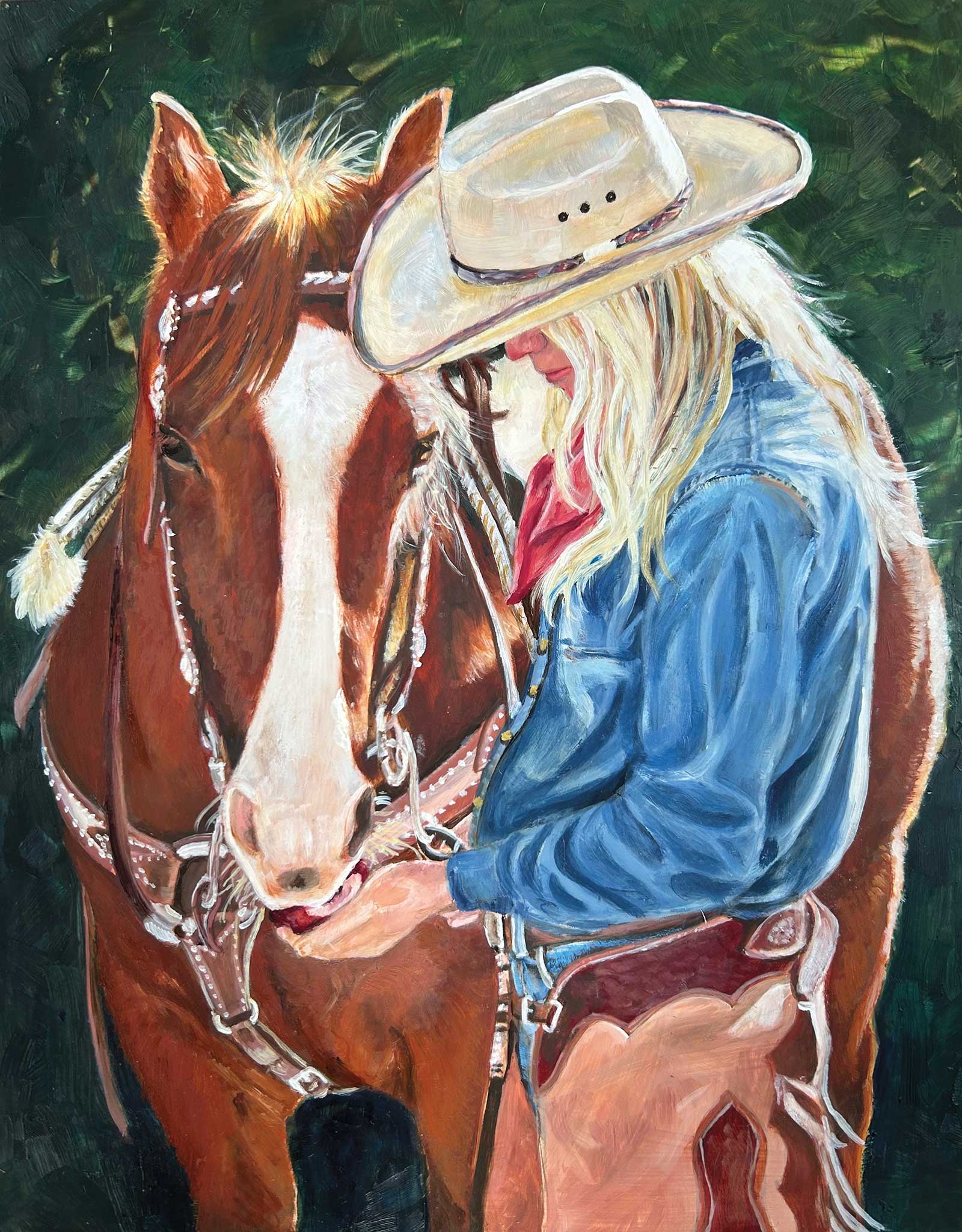
Kim Trickey, Soul Mates, oil, 14 x 11 in.
Kim Trickey
At 5 years old, Kim Trickey was on horseback, gathering cows and calves with her father for branding. She began riding solo on a Shetland pony at 3 years old. Today, Trickey and her husband, Mackey, still gather cows and calves for branding and shipment. Her time is split between her art and working on their ranch in the White Mountains of eastern Arizona. They run black angus, a switch they made from Hereford cattle because the whiteface of a Hereford in the desert sun causes skin problems. The absence of horns on angus also helped make this decision. Trickey’s résumé is impressive, going back to her university days when her reputation as an artist began to rapidly gain traction. She belongs to the Cowgirl Artists of America, something she believes has been a launchpad for the growing number of Western artists who are women.
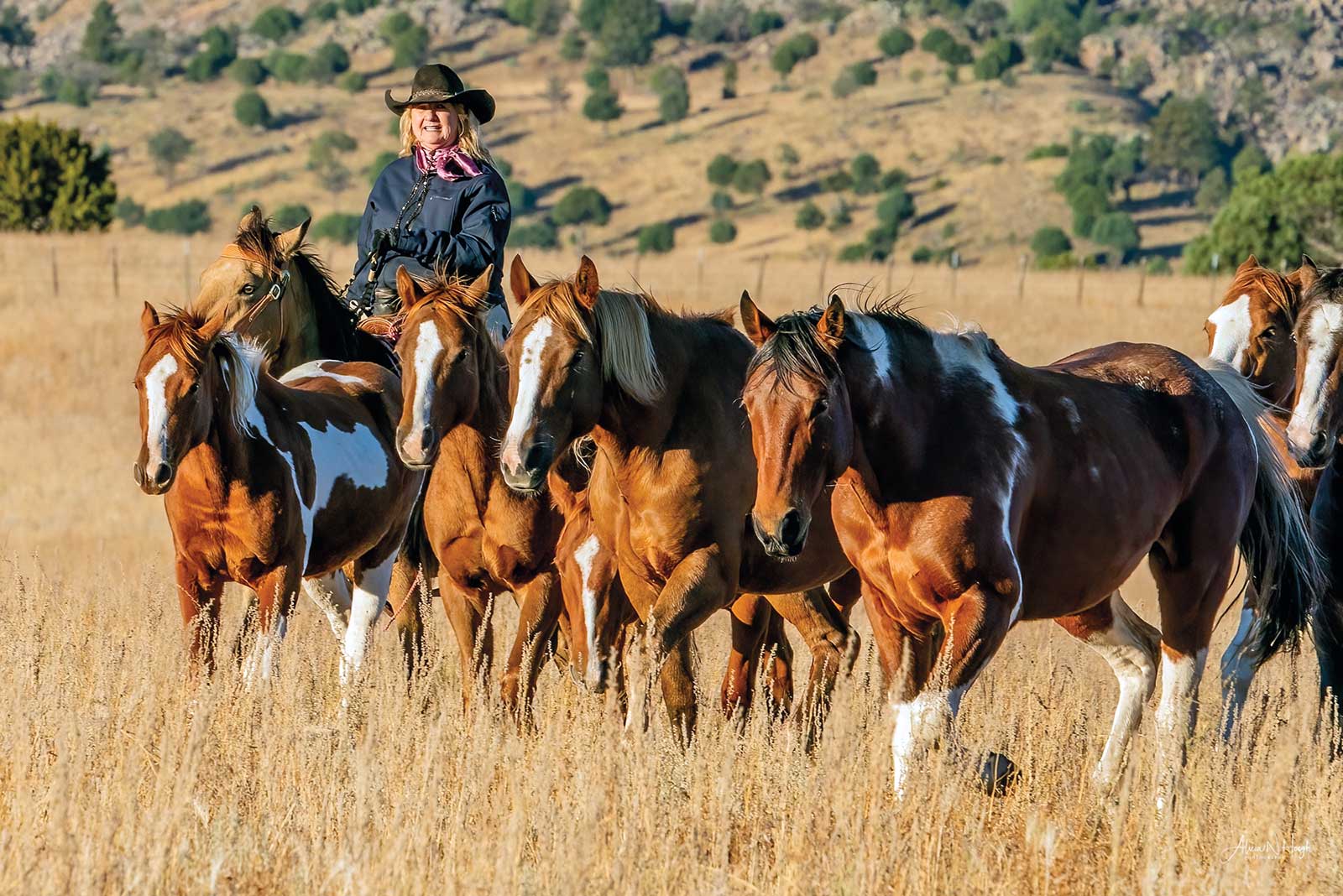
Kim Trickey riding on her family ranch. Courtesy the artist.
Powered by Froala Editor


