"There is a little bit of me and a whole lot of Hopi in every katsina I carve,” Tayron “Tay” Polequaptewa says, as if the wood itself remembers the hands of his ancestors and waits for his breath to wake it.
From Shongopovi, atop Hopi’s Second Mesa in Northern Arizona, Tay brings form to the living teachings of the Hopi world. Tithu, what are commonly known as katsina dolls, are far more than carved figures. They are echoes of ceremony, guardians of memory—vessels of harmony, season and spirit. They remind the Hopi, and anyone willing to listen, that heritage is not a possession. It is a pulse meant to be honored, shared and protected.
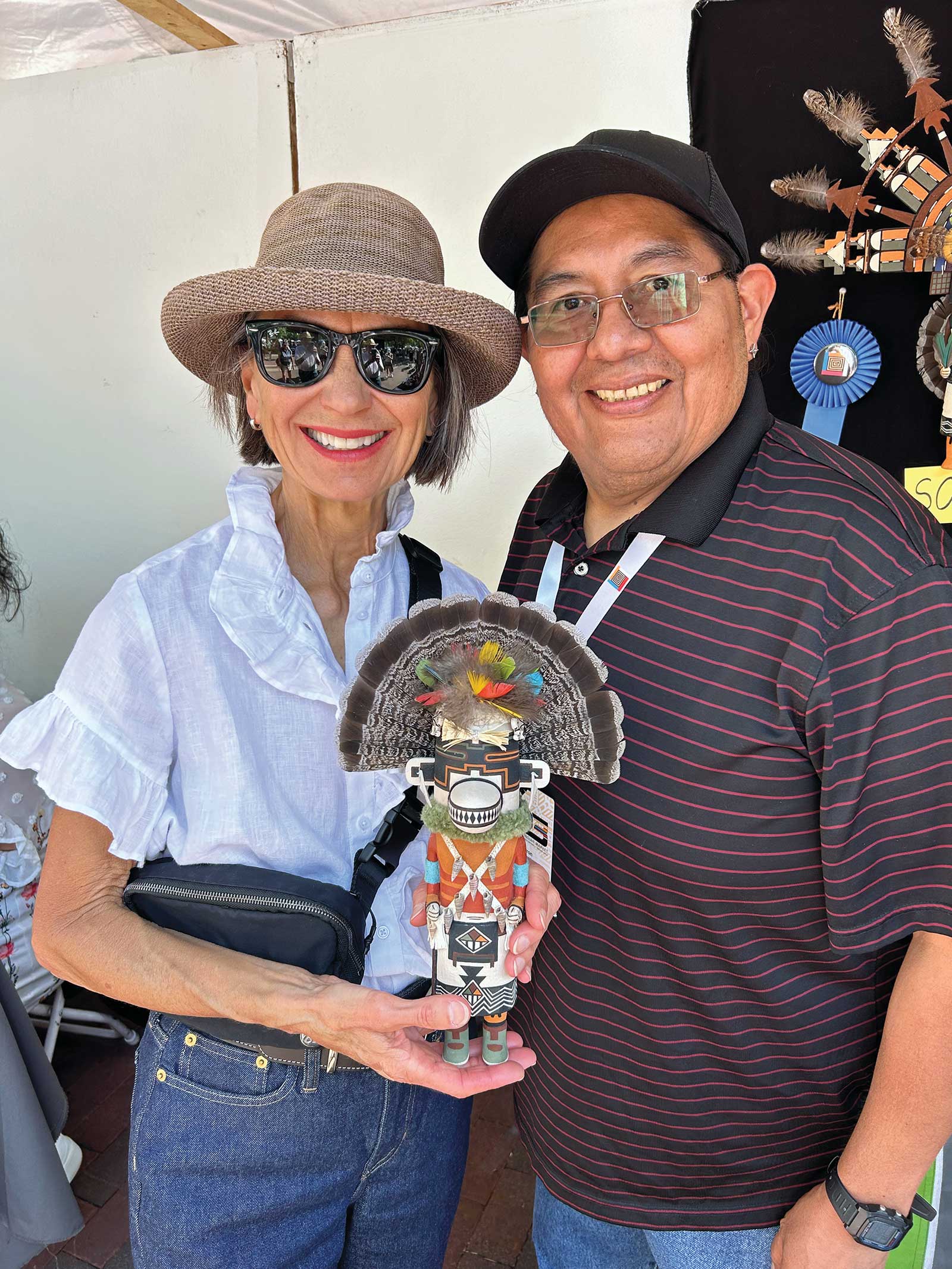
Painter Mary Calengor, left, with Hopi carver Tayron Polequaptewa and his Mongongya (Lizard) katsina for their collaboration project.
“For us, true wealth isn’t what we have. It’s what we share,” Tay says. For decades, his carvings have traveled far beyond their birthplace, carrying quiet songs of the mesas with them. Yet, he knew that to widen the path for Hopi culture—to lift it into new light—his voice would need companions. He had seen katsina imagery taken and stripped of meaning by non-Hopi artists and commercial interests quick to exploit what they did not understand. Misuse, misrepresentation and misunderstanding had created generations of mistrust among the Hopi.
“Our katsina tradition is sacred. There is much we don’t talk about with non-Hopis,” Tay explains. His challenge was clear: guard what must remain sacred, yet open what could be shared. Create a bridge to culture, not a breach of culture.
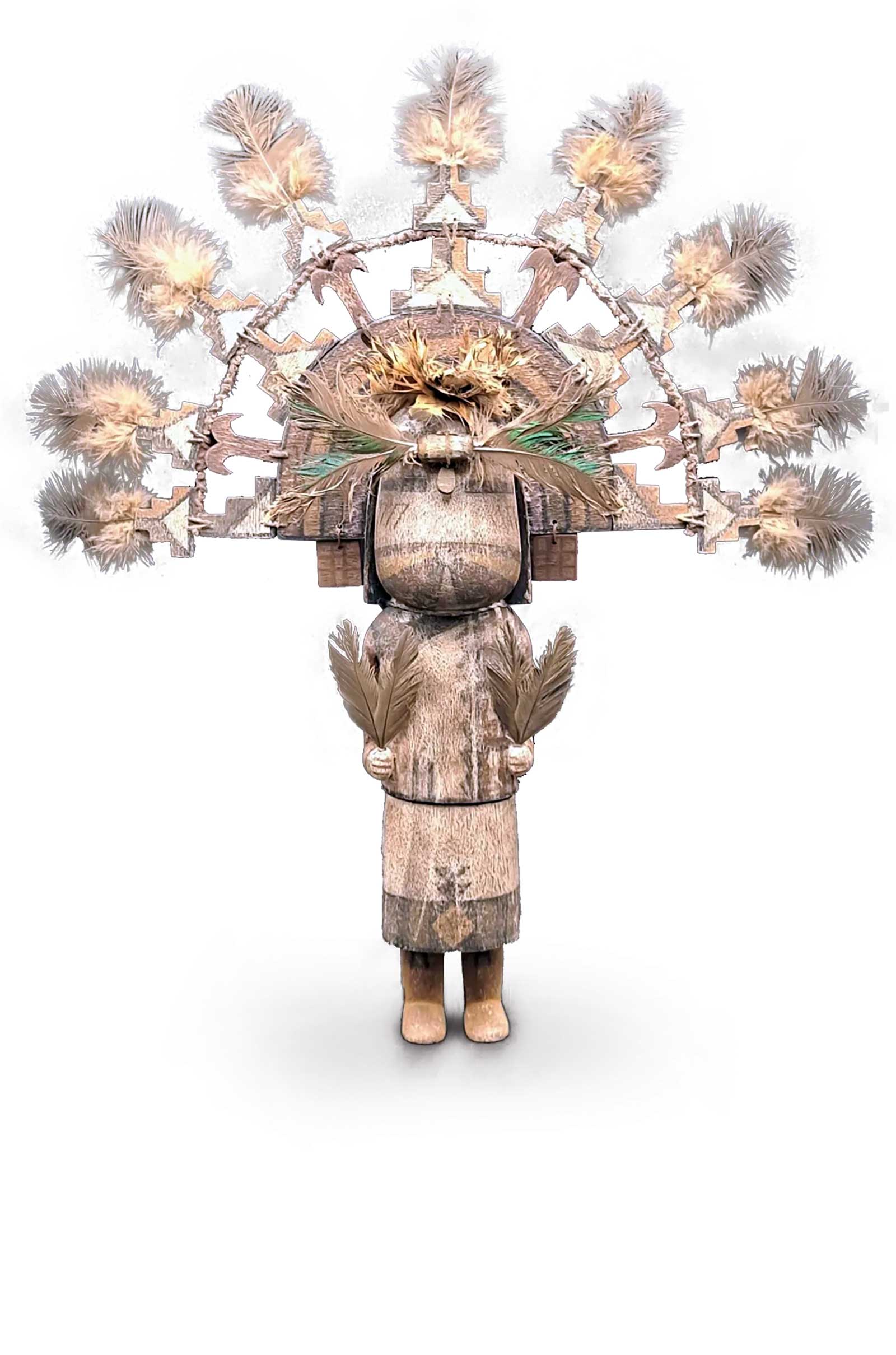
Tayron Polequaptewa (Hopi), Pahlik Mana (Water Moisture Maiden katsina)
He sought artists whose spirits resonated with his own: Mary Calengor, Sean Michael Chavez, Drew Christie, Josh Gibson, Max Grover, Greg Newbold and Kim Wiggins. All exceptionally talented painters with audiences that reached far beyond his own. Artists whose reverence ran as deep as their skill. Together, they formed a chorus—many voices carrying one shared vision.
Charles Sublette of Medicine Man Gallery in Tucson, Arizona, notes that Tay’s versatility sets him apart. “He carves in three distinct looks within the traditional katsina style,” he explains. “Finely detailed katsinam with immaculate painting and featherwork; intentionally aged carvings; and works inspired by his great-grandfather, Wilson Tawaquaptewa. It’s exciting that all three appear in these collaborations.”

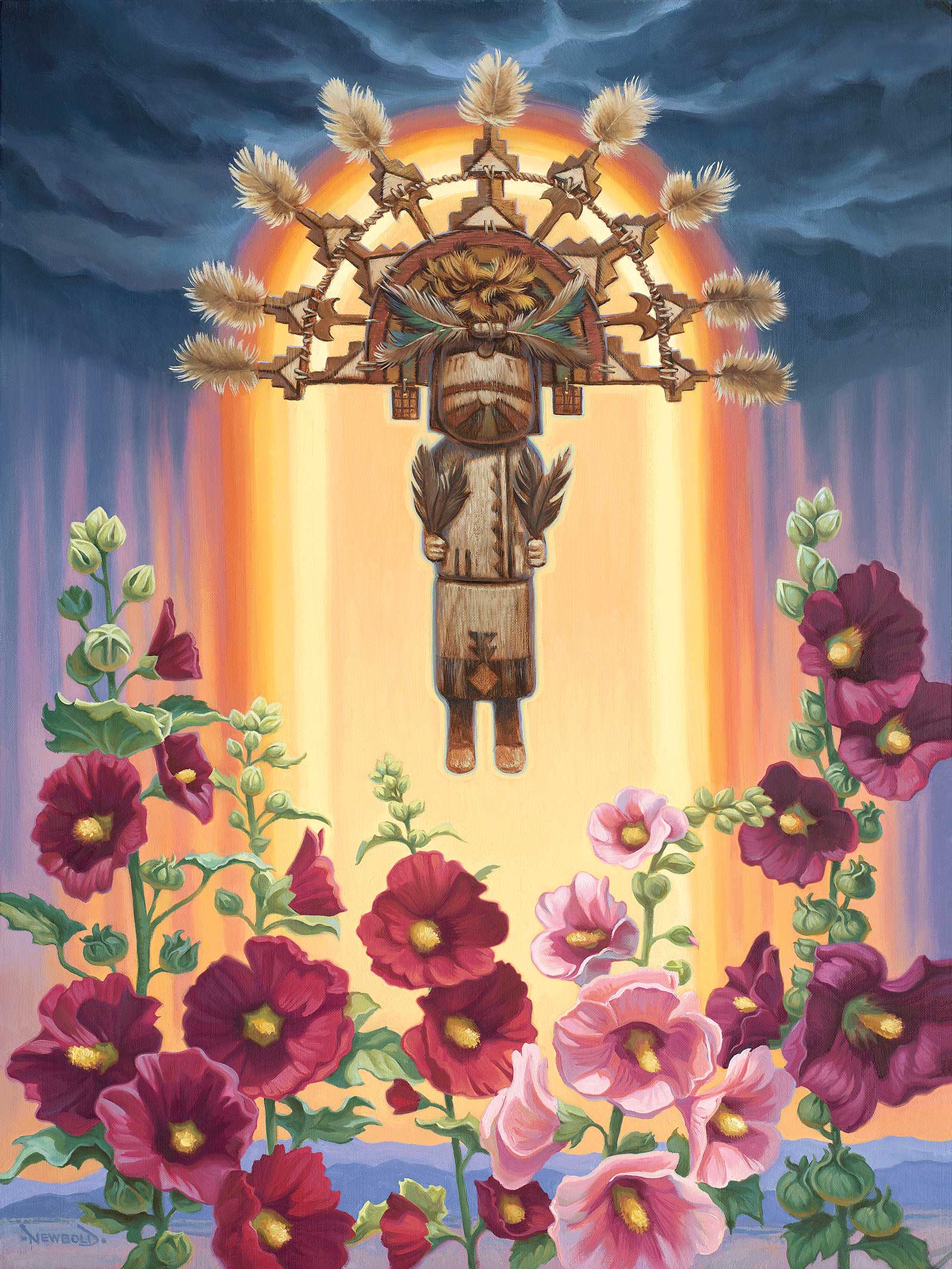
Greg Newbold, Sacred Petitions, oil on linen mounted on board, 24 x 18 in. Courtesy Medicine Man Gallery, Tucson, AZ, and Manitou Galleries, Santa Fe, NM.
Together, these collaborative works form a body of art that occupies a shared cultural space, one where Hopi teachings are honored, artistic interpretation is welcomed and dialogue replaces assumption. It is a shared cultural space that invites a wider audience to engage respectfully with Hopi heritage.
These paintings are not simply depictions of katsina tithu. They achieve something far greater: visual poetry born from intercultural respect. They open a door to conversation—one rooted in appreciation rather than appropriation.
It is, at its heart, a conversation between the artists, the viewers and the enduring beauty of the Hopi people.
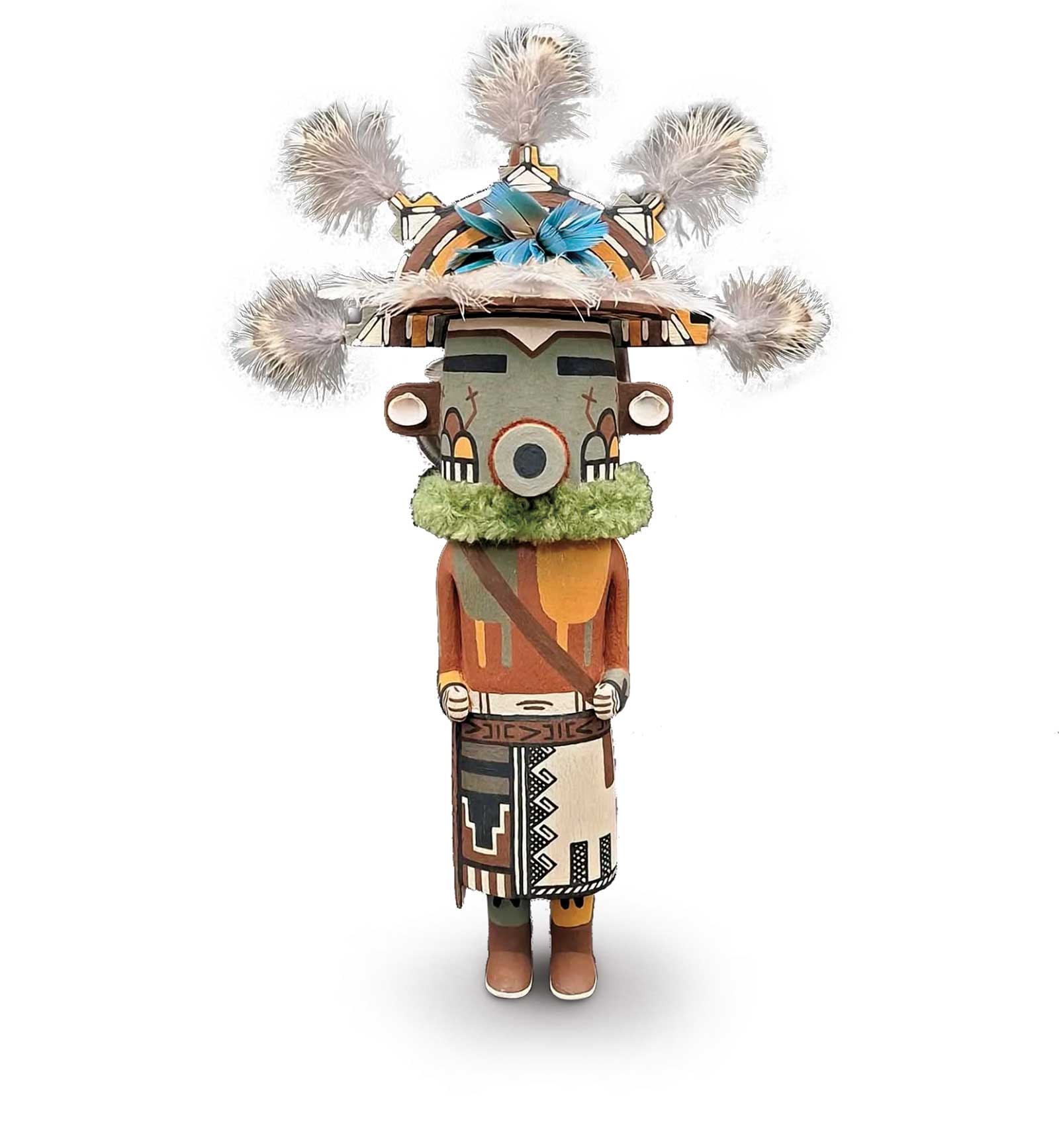
Tayron Polequaptewa (Hopi), Tangikchina (Rainbow katsina)
Greg Newbold, Sacred Petitions
Greg Newbold selected a Pahlik Mana (Water Moisture Maiden) carved in Tay’s aged style. With a fusion of dynamic colors, expressive brushwork and graphic composition, Greg brings captivating interpretations to timeless themes.
“Life in the desert is water,” Greg says. “I wanted to depict her ethereal essence bringing rain—rebirth, fertility, abundance and...rainbows.”
His stylized storm imagery is symbolic, vibrant and full of movement.
“Everything in the piece reflects Hopi life,” the painter says. He approached the collaboration with curiosity and humility. “It’s fascinating to learn about cultures different from my own. Katsinam are the foundation of Hopi belief. They bring what is asked—and everyone receives what they need.”
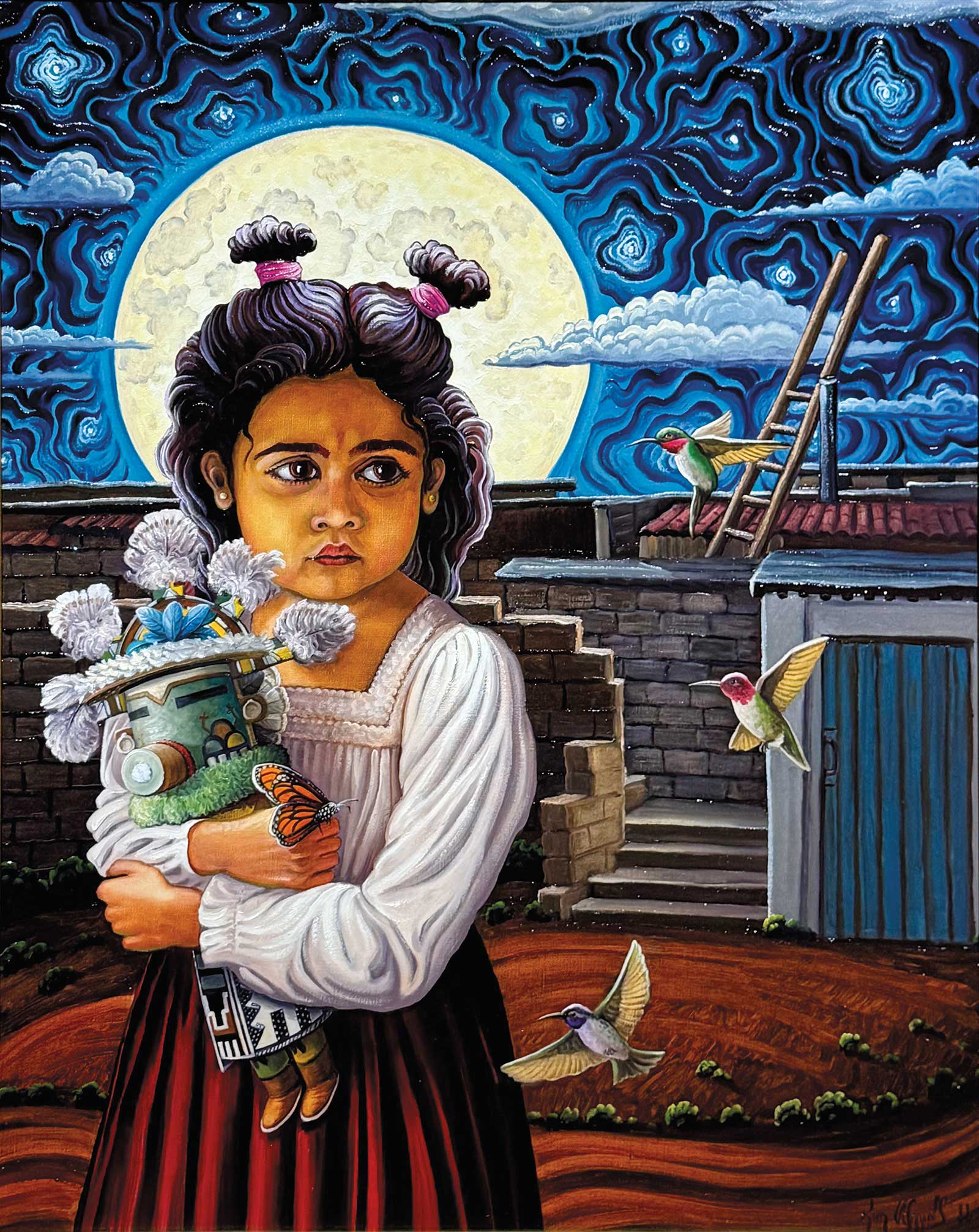
Kim Wiggins, Second Mesa Moonrise, oil on canvas, 30 x 24 in. Courtesy Legacy Gallery, Scottsdale, AZ, and Manitou Galleries, Santa Fe, NM.
Kim Wiggins, Second Mesa Moonrise
Tay was especially grateful for the opportunity to collaborate with Western painter Kim Wiggins. “Every time I see Kim, he’s always been interested in what I’ve made and learning more about our culture,” Tay says.
Kim’s bold, stylized vision and approach to his subject matter made him a natural fit. “Katsina dolls are given to young Hopi girls by the Katsina dancers during ceremonies,” he explains. “They help children recognize the Katsinam, what they represent, and their spiritual significance.”
Tay knew Kim had long sought to honor the stories of the American West through his work. Sharing Hopi culture with him felt meaningful. “Most people don’t know how katsina tithu fit into our lives,” Tay says. “I was excited to see what he’d create with my Rainbow katsina, and the story his painting would tell. What he painted was perfect.”
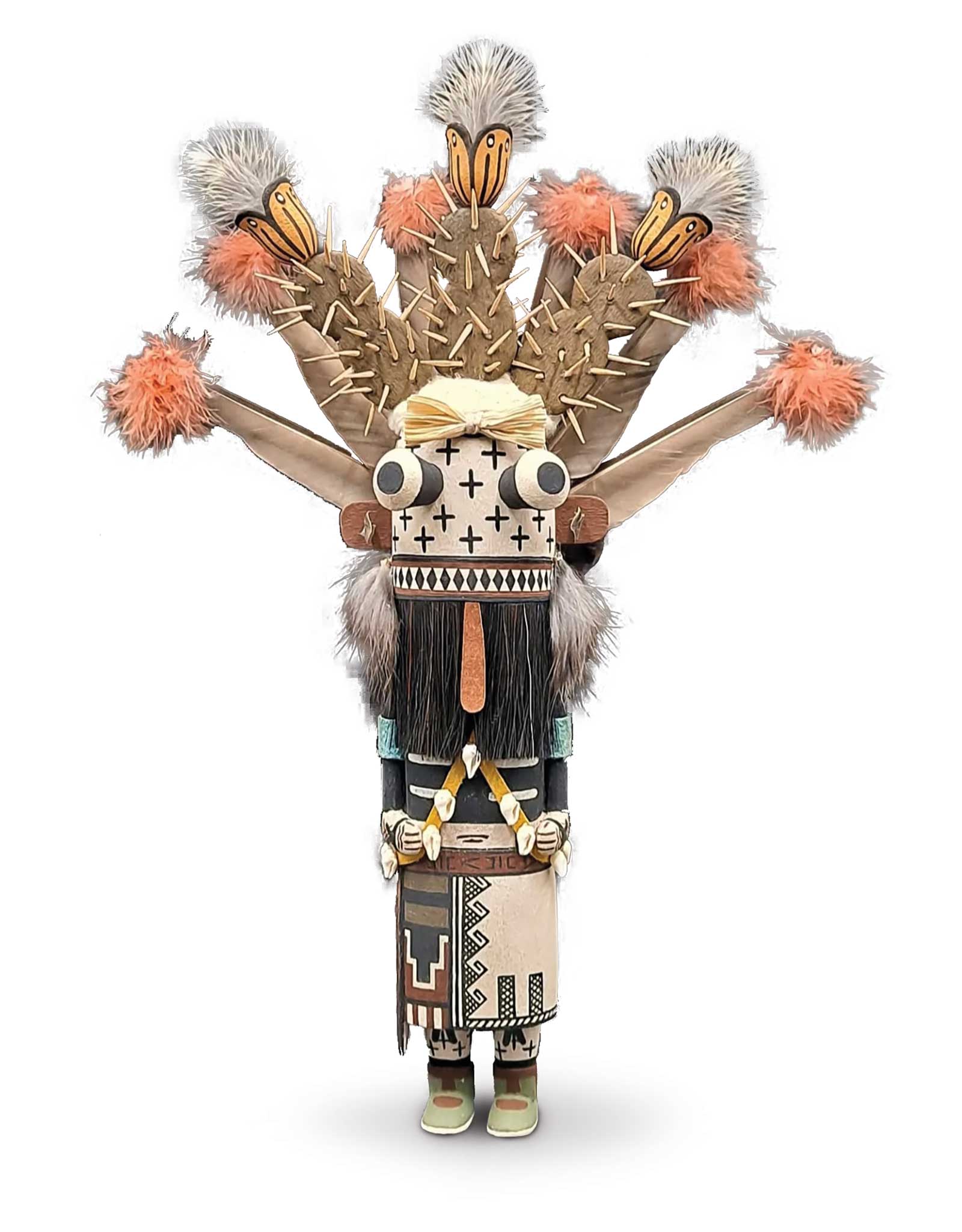
Tayron Polequaptewa (Hopi), Yunguh (Prickly Pear Cactus katsina)
Kim infused his piece with intentional symbolism. “From a distance, it looks like a religious scene,” he explains. “The full moon acts as a halo, reflecting the purity and spirituality of Hopi beliefs.” The swirling night sky suggests ancestral guidance, their messages brought by three sacred hummingbirds. At the center stands a Hopi child holding a Rainbow katsina—entrusted to her earlier that day…a rare monarch butterfly rests on her hand, all representing our interconnectedness with nature, balance, harmony and the fragility of cultural continuity. Kim’s iridescent coloration choices mirror the nocturnal hues of the rainbow.
“The monarch is on the verge of extinction,” Kim says. “It symbolizes the truth that even the oldest continuous cultures can fade in a generation if not protected by people like Tay.” His painting is a reverent tribute, capturing both beauty and vulnerability—an image grounded in deep respect.
Sean Michael Chavez, Yunguh – Prickly Pear Katsina
Sean Michael Chavez brings a contemporary energy to traditional Western themes. His prickly pear cactus katsina painting centers on symmetry, something unusual for him. “Most subjects I paint are asymmetrical, but I wanted this katsina to be balanced,” he says. “Balance is central to the Hopi way.”
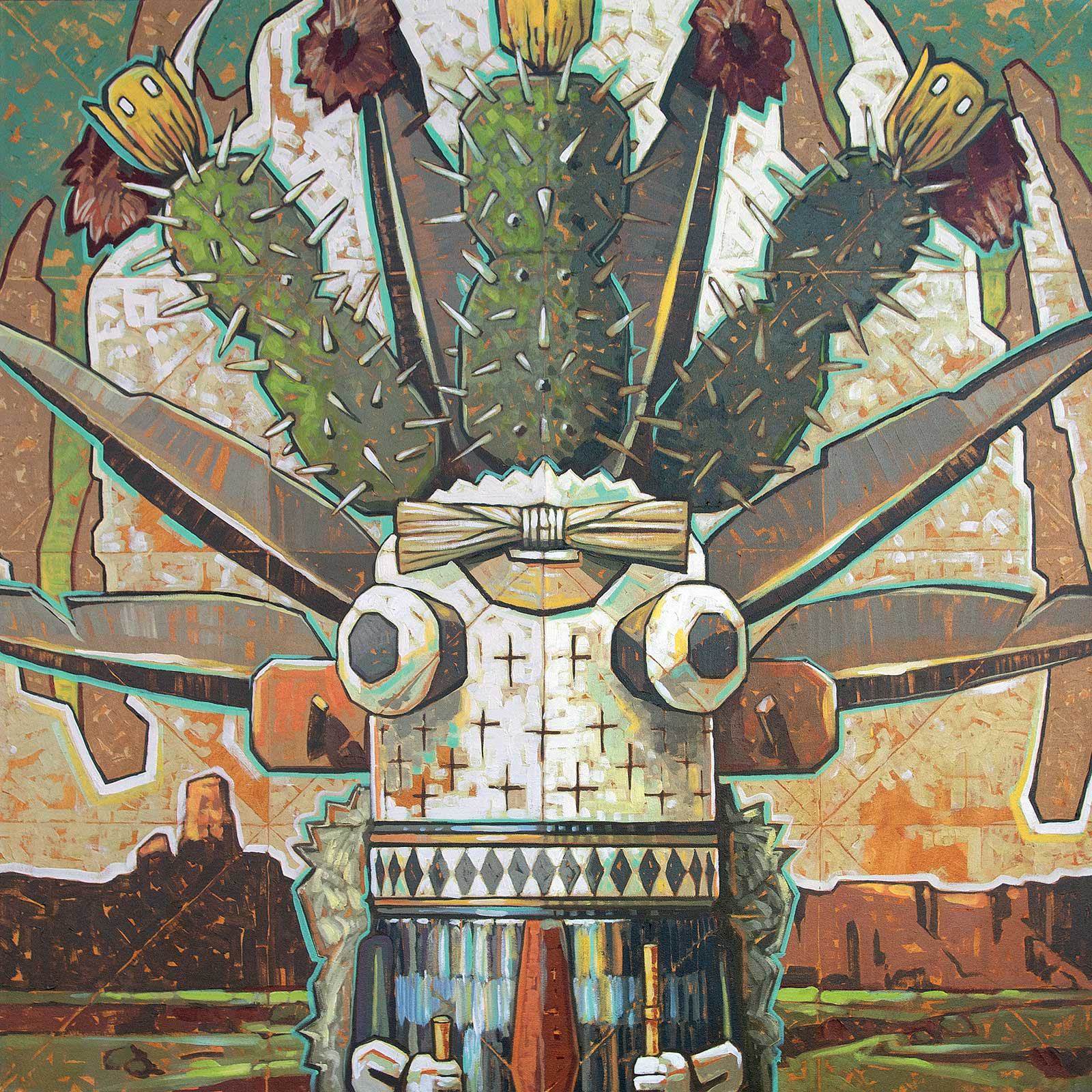
Sean Micheal Chavez, Yunguh- Prickly Pear Katsina, oil on canvas, 36 x 36 in. Courtesy Acosta Strong Fine Art, Santa Fe, NM.
Sean, who had the rare fortune of attending a Katsina dance as a child, wasn’t sure he was allowed to paint a katsina until Tay’s invitation. What he found in Tay’s carving resonated with his own artistic themes, especially the saguaros and cacti that appear throughout his work. “Cacti survive in harsh climates,” Sean explains. “They reflect the Hopi people’s resilience and adaptability.”
Upon their meeting, Tay shared with him that this katsina also serves as a disciplinarian, carrying yucca whips to correct behavior. Sean incorporated that presence: “I wanted him to feel imposing—staring straight at the viewer.” This intensity evokes childhood memories, where the katsinam felt both awe-inspiring and intimidating. “I channeled a bit of youthful fear and wonder into painting him,” he admits.
Sean was moved by Tay’s courage. “Not everyone agreed with how he was sharing Hopi culture,” he says. “But he stood by what he believed was right. I admired his willingness to ruffle some feathers to protect and uplift what matters.”
Mary Calengor, Monongya Lolmaht Tuhawmah
Ruffled feathers are one of the features to Tay’s katsinam that inspire Mary Calengor. A mastery of light and atmosphere gives her work an emotional depth that goes far beyond representation. She has painted both Tay’s fine-detailed katsinam and those intentionally aged.
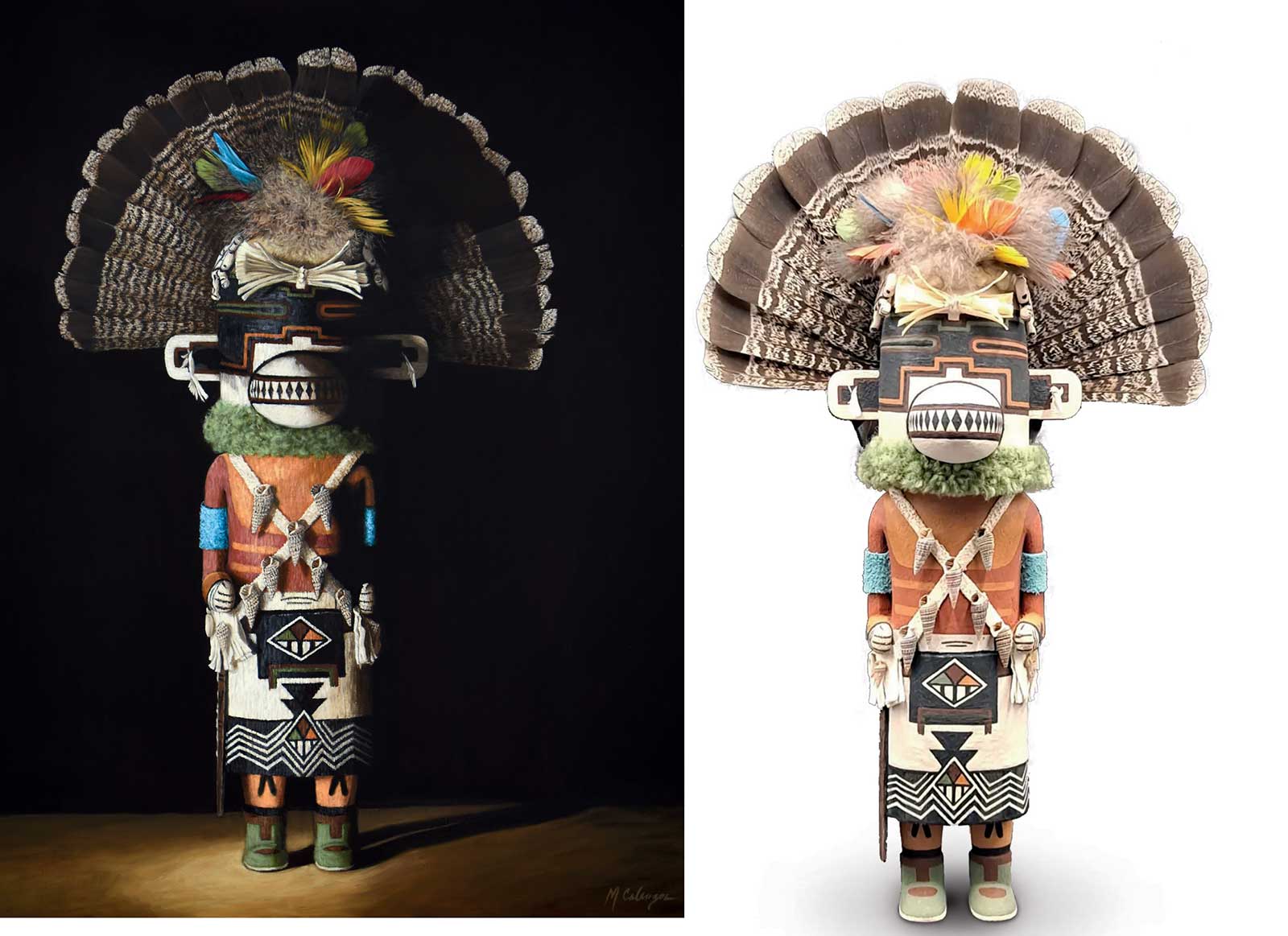
Left: Mary Calengor, Monongya Lolmaht Tuhawmah, oil on linen, 32 x 24 in. Courtesy King Galleries, Scottsdale, AZ, and Santa Fe, NM. Right: Tayron Polequaptewa (Hopi), Monongya (Lizard Katsina)
“Each presents different challenges,” she says. “His featherwork is meticulous, but in the aged style the textures become something entirely new—an old soul emerging through color and patina.” The aged surfaces radiate character. “They vocalize soul—the heartbeat of the Hopi people. You can feel it.”
Mary chooses her subjects carefully. “I want people not just to see my paintings, but to feel them,” she explains. “When I hold a katsina, I think about where it has been, who created it, what stories it carries.” Tay’s carvings, she says, are alive with that inner story, “which is why they are so exceptionally compelling to paint.”
Drew Christie, The Messenger
Occasionally, Tay carves in the style of his great-grandfather, Wilson Tawaquaptewa, the former village chief and one of history’s most important katsina carvers. Tawaquaptewa intentionally altered features so katsinam wouldn’t be accurately replicated outside ceremonial use. His style blends clarity with mystery.
Drew Christie chose Tay’s Tawaquaptewa-inspired Mongwu, the Great Horned Owl katsina. As well as being the one who watches and monitors the clown’s behavior at ceremonies, he is a messenger associated with knowledge and vision beyond the physical world. Mongwu appears in Drew’s painting like a dream image just before waking.
When it came to him choosing a katsina to paint, destiny seemed to take over.
Drew shares, “My 5-year-old son, Siggi, loves owls. Every time he wants me to come in from my studio he stands on the balcony and makes owl calls until I hear him and come in, as if transforming into an owl himself.”
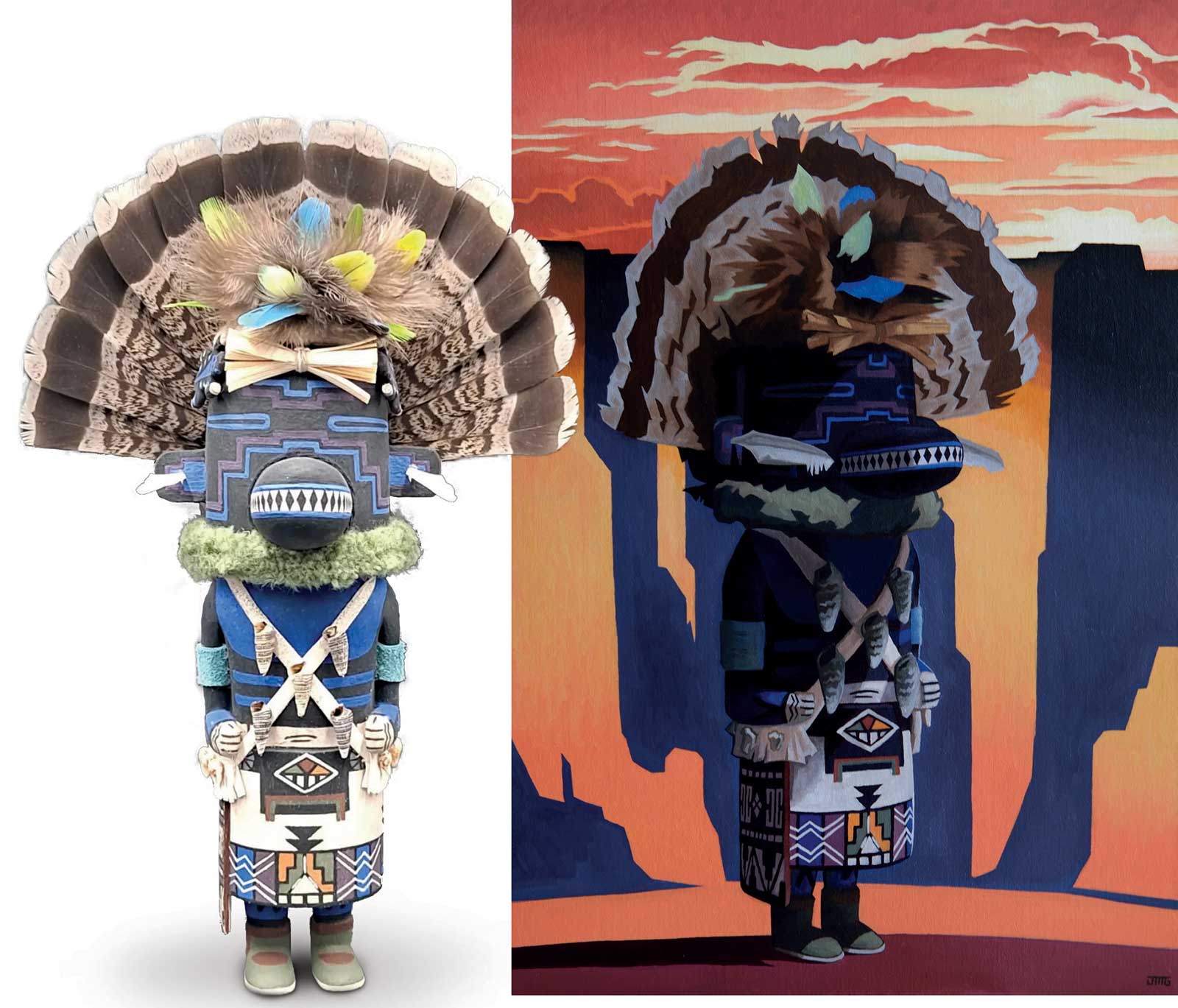
Left: Tayron Polequaptewa (Hopi), Monongya (Blue Lizard katsina) Right: Josh Gibson, Twilight of the Blue Lizard, oil on canvas, 36 x 24 in. Courtesy Medicine Man Gallery, Tucson, AZ.
A surrealist at heart, Drew allowed instinct to guide him. “Once I held the katsina, it told me how to depict it,” he says.
Tay was struck by Drew’s interpretation. “It’s perfect, the way it stares right at you,” he says. “That’s exactly how the Mongwu appears in our ceremonies.”
Tay explains that to the Hopis the owl katsina is considered an omen. Some of the messages are good, some are warnings. Drew captured that duality with striking clarity.
Josh Gibson, Twilight of the Blue Lizard
Josh Gibson’s dynamic compositions and modern palette reinterpret Western themes through an expressive, contemporary lens. Tay and Josh have been friends for years, and Josh has long admired his traditional-style katsinam.
“They reminded me of historic dolls from my childhood in Arizona,” Josh says. “Tay’s designs, proportions, detail—and their quiet, spiritual quality—always impressed me.”
When Tay began carving a blue lizard katsina, he sought Josh’s expertise with color pigments.
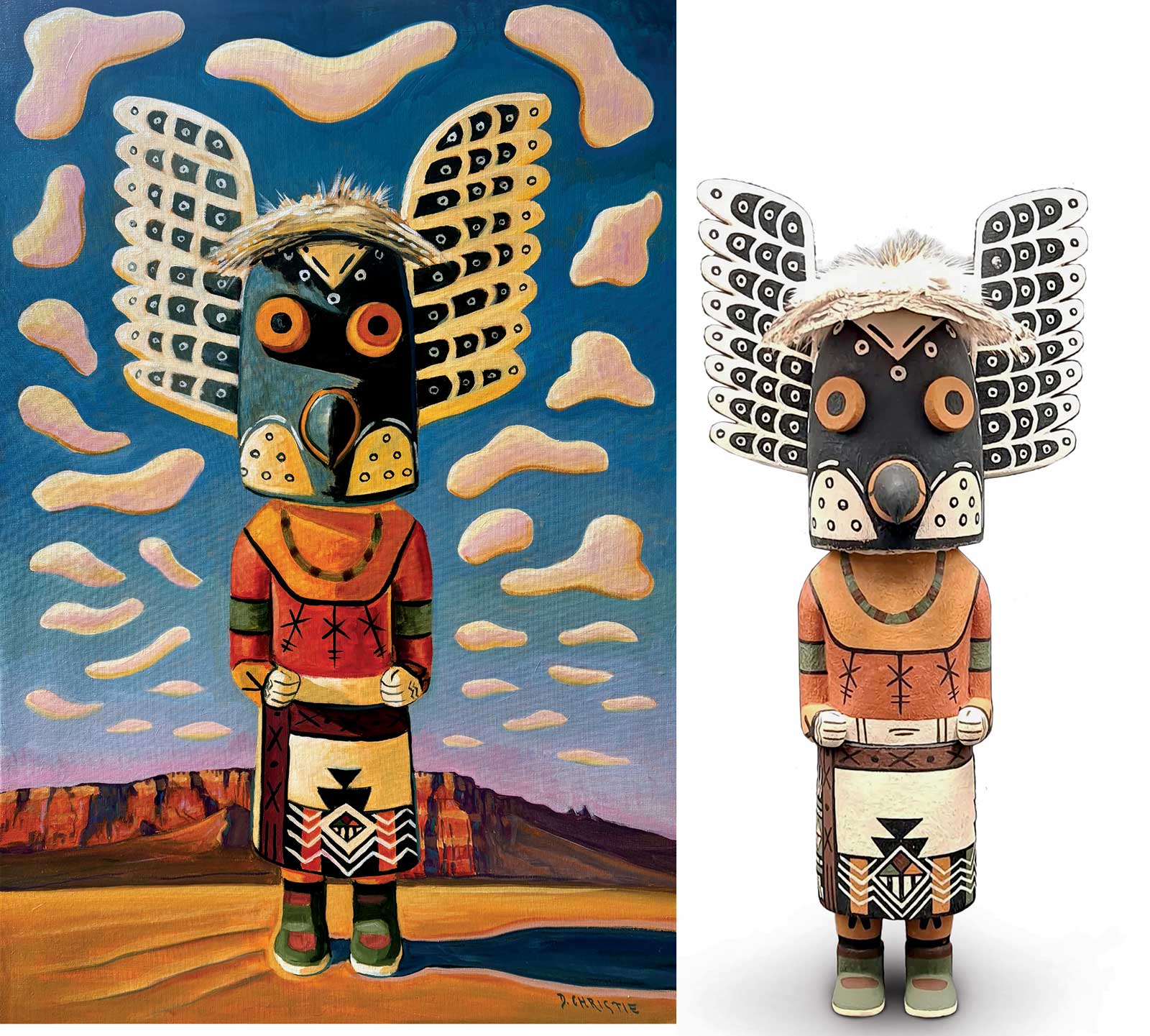
Left: Drew Christie, The Messenger, oil on linen, 36 x 24 in. Courtesy Broadmoor Galleries, Colorado Springs, CO. Right: Tayron Polequaptewa (Hopi), Mongwu-Tawaquaptewa interpretation (Great Horned Owl katsina
“He helped me mix the exact blue I needed,” Tay recalls.
That collaboration made Josh’s choice for the project easy. “I didn’t think twice,” Josh says. “Tay’s Blue Lizard is the best katsina doll I’ve ever seen.”
Josh’s painting amplifies the katsina’s vibrancy and symbolism, bridging traditional form with modern expression.
Max Grover, Tobacco Flower Transcendence
Known for whimsical, joyful paintings, Max Grover approached Tay’s Tobacco Flower katsina with both excitement and caution. “I was hesitant,” he admits. “It’s not my culture, and I didn’t want to misrepresent something sacred.” But Tay’s permission and guidance gave him confidence.
Max was drawn to the katsina’s spiritual weight and decided to elevate it—literally—by creating a two-dimensional wooden cut-out and suspending it above the surface of the work. This collage-style composition creates an illusion of floatation, amplifying the sense of transcendence and spirituality.
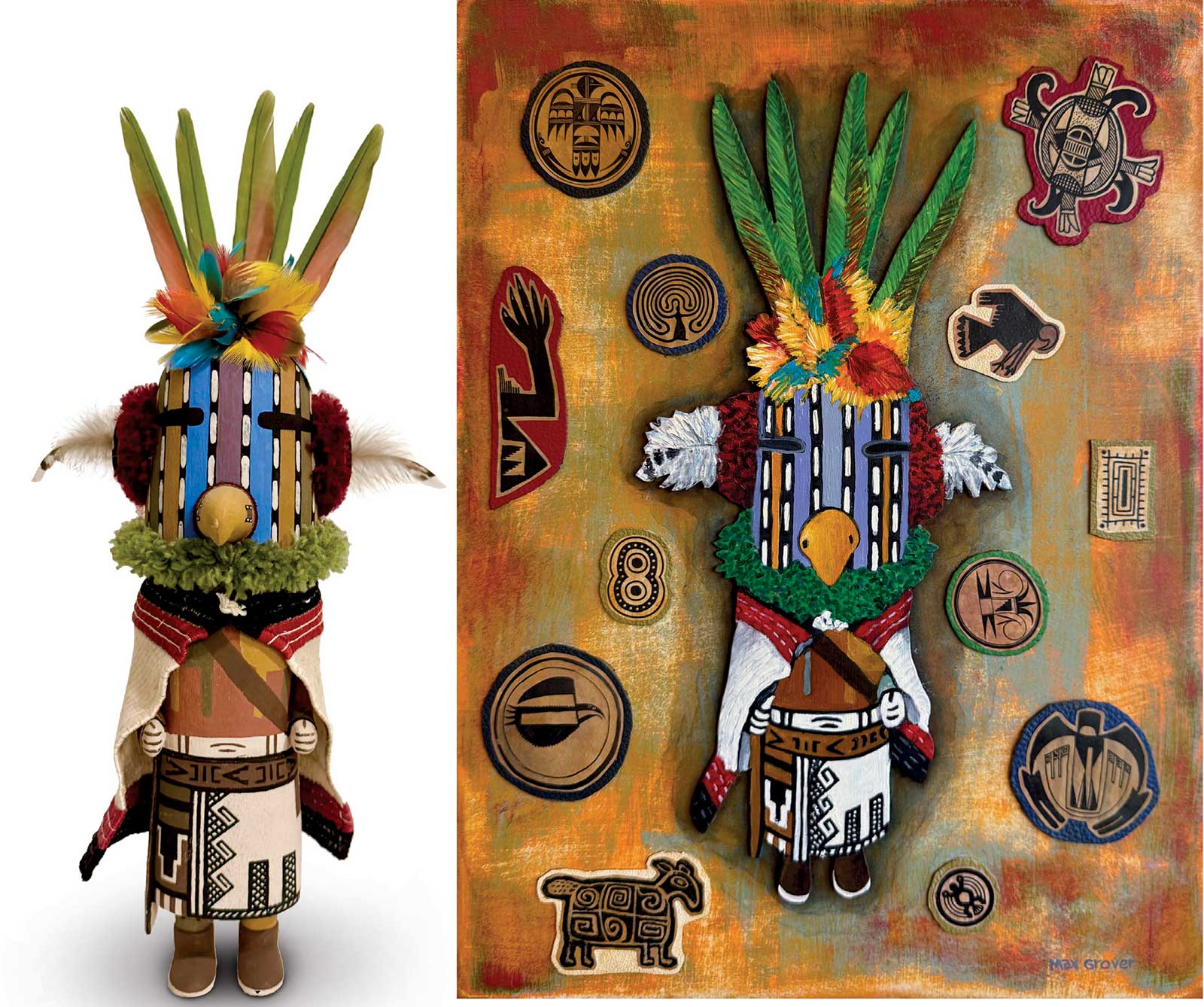
Left: Tayron Polequaptewa (Hopi), Tsito (Tobacco Flower katsina Right: Max Grover, Tobacco Feather Transcendence, oil on board and leather collage, 16 x 12 in. Courtesy Max Grover Gallery, Port Townsend, WA.)
“I wanted viewers to feel connected to something larger than themselves,” Max says. “That feeling you get watching a katsina ceremony.” The process awakened something in him. “Learning about Hopi culture has been inspiring,” he says. “That’s the beauty of art—awakening in each of us something you didn’t know was there.” —
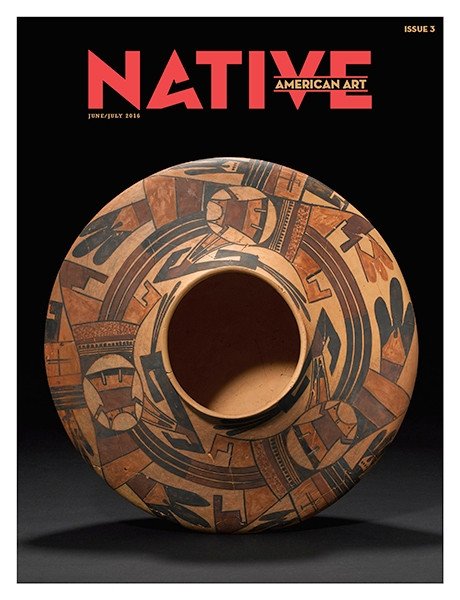
To learn more about Tayron Polequaptewa, read Russ Hoover’s companion piece in the February/March issue of Native American Art.
Powered by Froala Editor


