Early news articles about the Southwest—primarily Arizona, New Mexico, Utah and Southern California—reveal an almost fairy tale-like understanding of this mysterious and distant place. Some of the attention was on the Indigenous people and their unique customs and clothing, but some was also on the bizarre plants and wildlife, the intense heat, the adobe and Spanish architecture, the vastness of the desert, and the lawlessness of the land. These strange and wonderful details would weave their way into newspapers, pulp magazines and, later, into early American cinema. And as people learned more, the Southwest took shape in their minds.
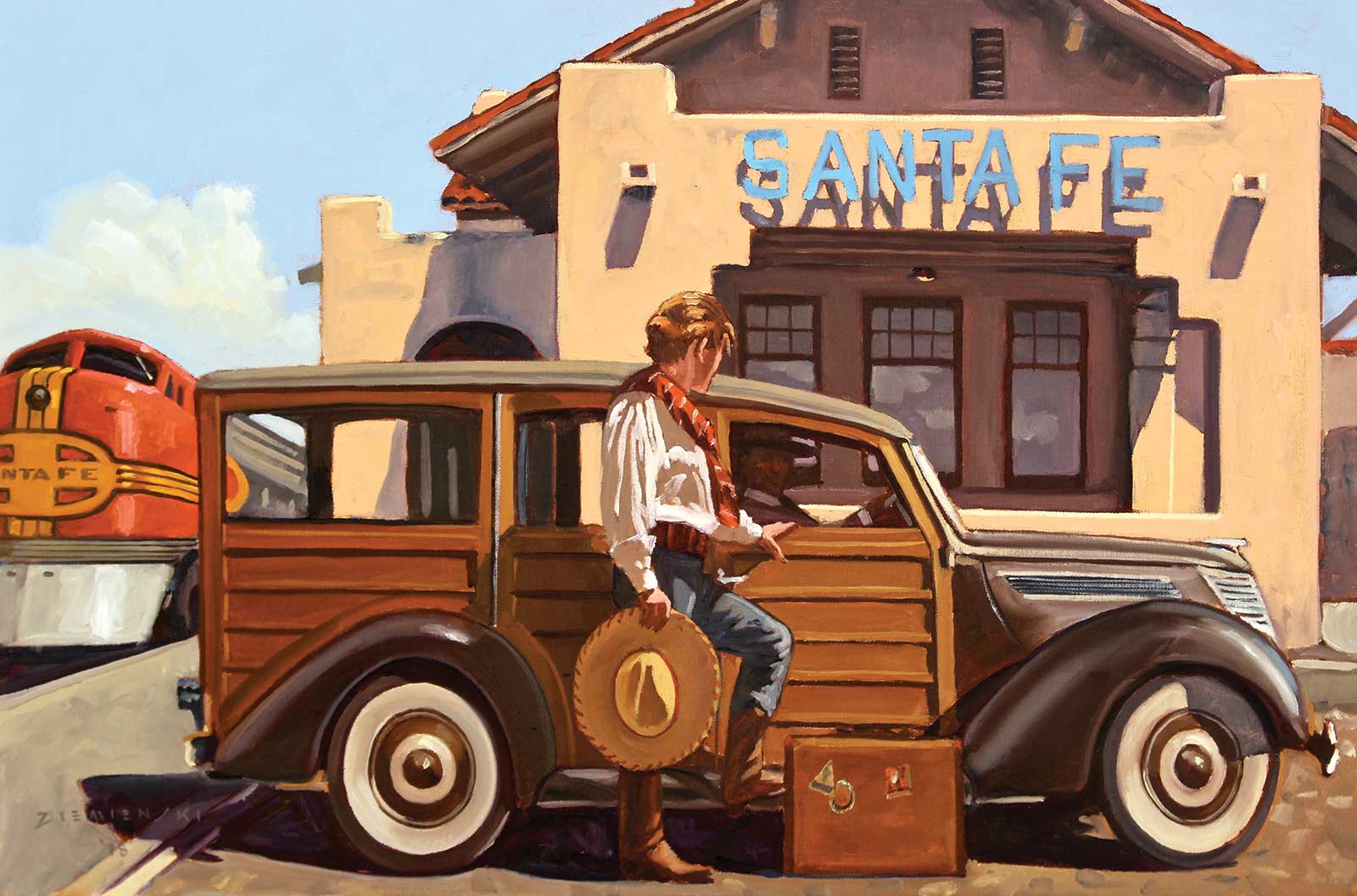 Dennis Ziemienski, At Santa Fe Station, oil, 20 x 30 in.
 East Coasters—some of them choking in the soot and smog of the factories in New York City, Pittsburgh and Boston—were reading these accounts in the early 1900s and longing for the open spaces, the wonderful new cultures and even the danger of a Western lifestyle. In the book The West of the Imagination, a case is made that the Southwest would come to represent a new chapter in the myth of El Dorado, the city of gold—the irony here is that gold was discovered in California, which changed the history of the West for good. Some of these stories were facilitated by the railroads and entrepreneur Fred Harvey. They romanticized the West until people had to see it for themselves. And guess who was there to offer them train tickets and hotel rooms?
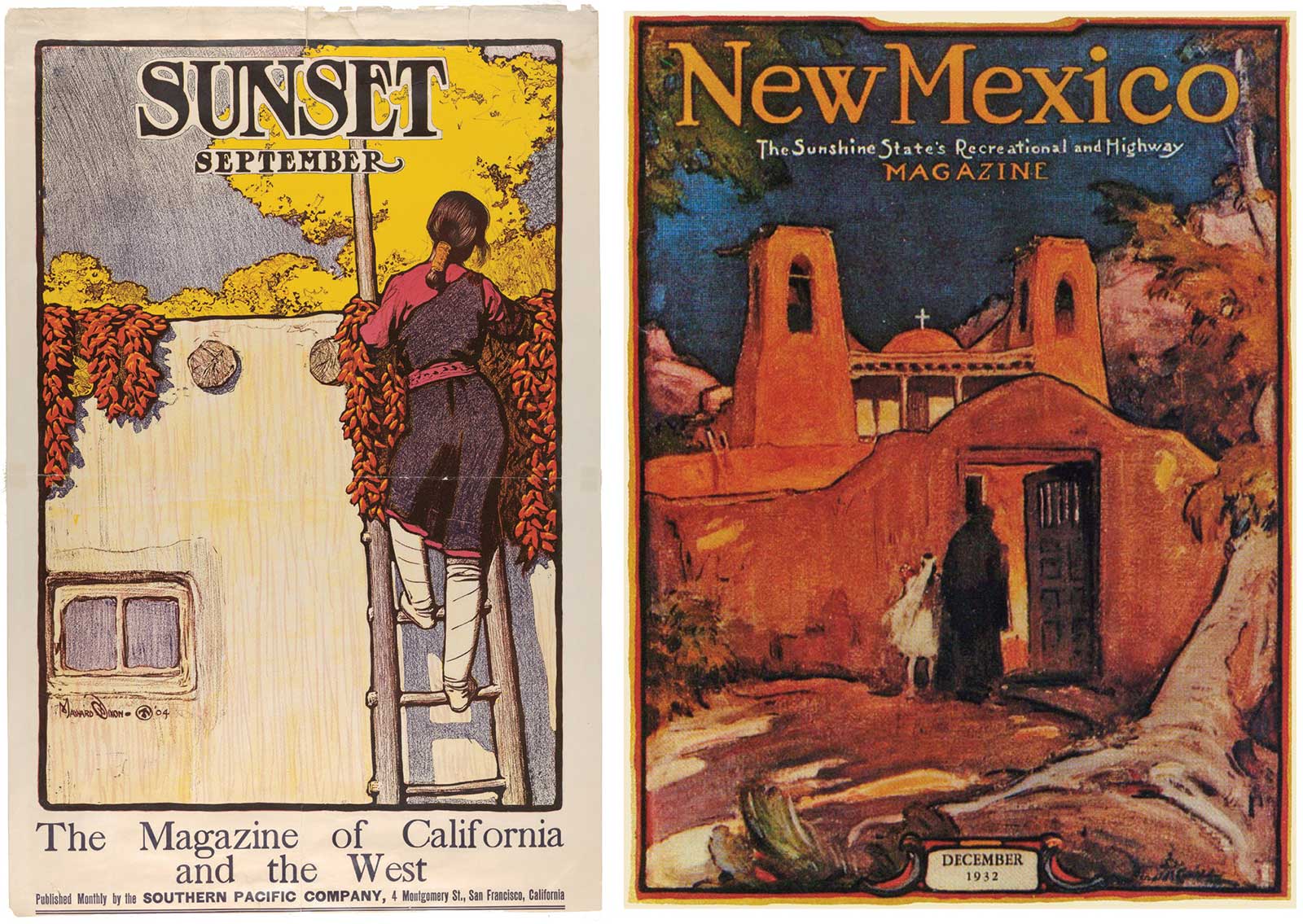
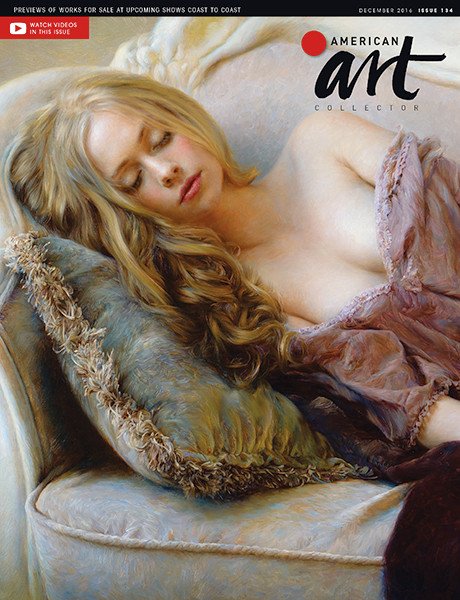
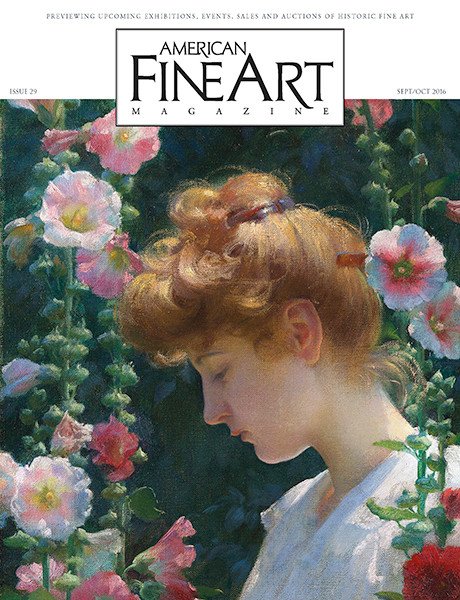
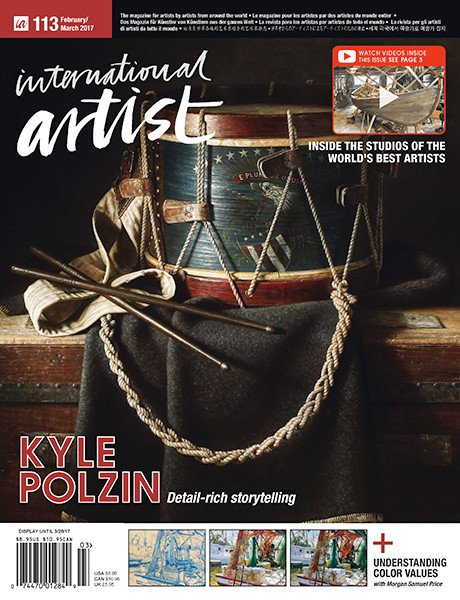
Maynard Dixon (1875-1946), Sunset Magazine, September 1904. Courtesy The Met, New York, NY; Gerald Cassidy (1869-1934), New Mexico Magazine, December 1932.
Regardless of how people ended up in places like Santa Fe, Gallup, Phoenix, Tombstone, Prescott or the Grand Canyon, they were often lured here by the timeless story of the Southwest, one of clear skies, open lands and fresh starts. These qualities are reflected in the artwork, whether it’s from the art of Maynard Dixon and Gerald Cassidy, who celebrated the Southwest by illustrating for the magazines that helped establish the lore of the American West, or in the work of Dennis Ziemienski, a contemporary painter who uses old travel posters to inform new stories about living in and visiting the Southwest.
Today, the region is not just reflected in classic Western imagery—dried chilis hanging from a patio, Native Americans standing in iconic pueblos, trains crossing vast deserts full of sagebrush—but also in the spirit of the artists, galleries and museums who celebrate this unique place, a place unlike any other in the country and the world.
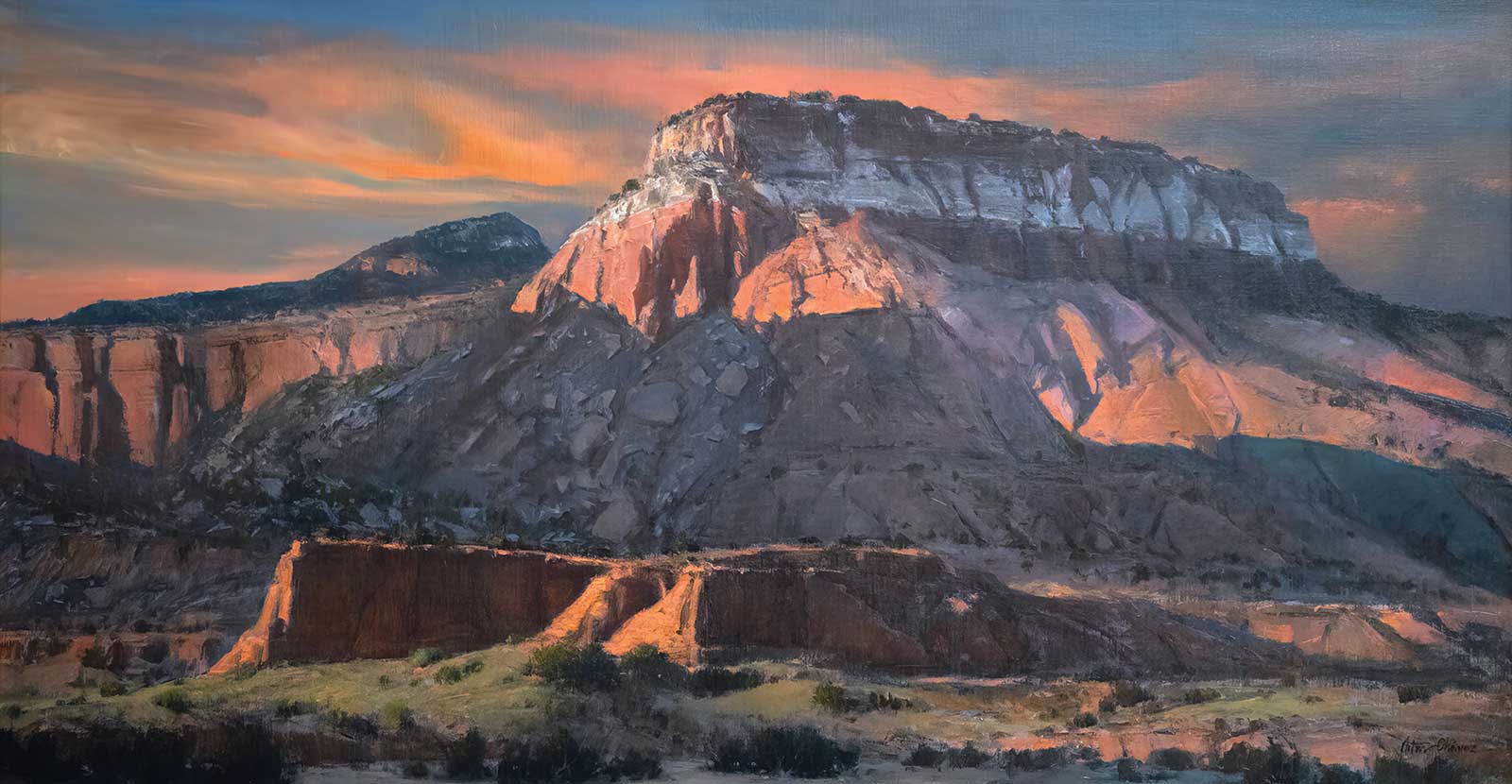
Legacy Gallery, Magic Mountain, oil, 26½ x 49½ in., by Arturo Chávez.
Continue exploring the pages of this special section for even more ways that artists are capturing the spirit of the Southwest.
Artist Jonathan Noon is often asked where he finds inspiration for his work. “My immediate response is that it comes from the paintings and films and landscapes I am surrounded by. But the inspiration ultimately comes from my love for the transcendently beautiful, as well as the myths and stories that connect us as Americans,” he says. “When you collect, don’t chase trends or names alone—collect the work that makes you stop and feel something. A painting you love will reward you every day you live with it, far beyond any market value. That’s when collecting becomes a legacy, not just a transaction.”
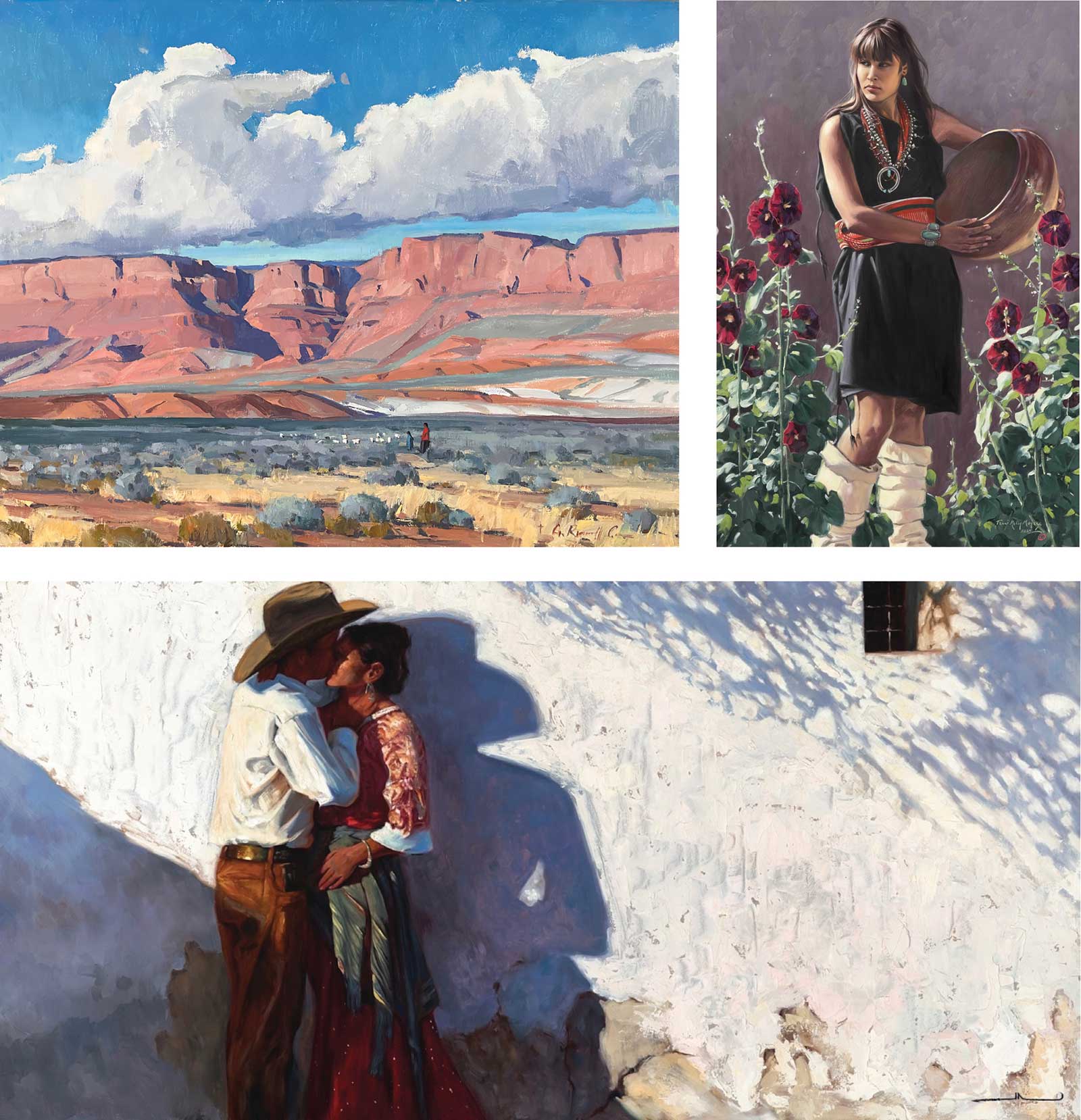
Top: Legacy Gallery, Along Broken Mesa, oil, 16 x 20 in., by G. Russell Case; Legacy Gallery, The San Juan Bowl, oil, 36 x 24 in., by Terri Kelly Moyers. Bottom: Jonathan Noon, Go With God, oil, 24 x 48 in.
Legacy Gallery in Santa Fe, New Mexico, represents such esteemed artists as G. Russell Case, Arturo Chávez and Terri Kelly Moyers. Case draws inspiration from creation, placing little value on literal translations. His sweeping, idealized renditions of the Western landscape are compositions that blend the beauty of the created world with the rich imagination and originality of an artist’s mind. Chávez, a 13th-generation New Mexican, traces his roots to 1600 when the first in his Chávez line arrived in New Mexico from Spain. Raised amid the spectacular vistas of northern New Mexico, Chávez has long been deeply inspired to express his feeling for the landscape through his paintings. Moyers has never wanted to do anything in life but paint. Even as a child growing up in the Canadian city of Calgary, she was constantly drawing with her main subject matter being horses.
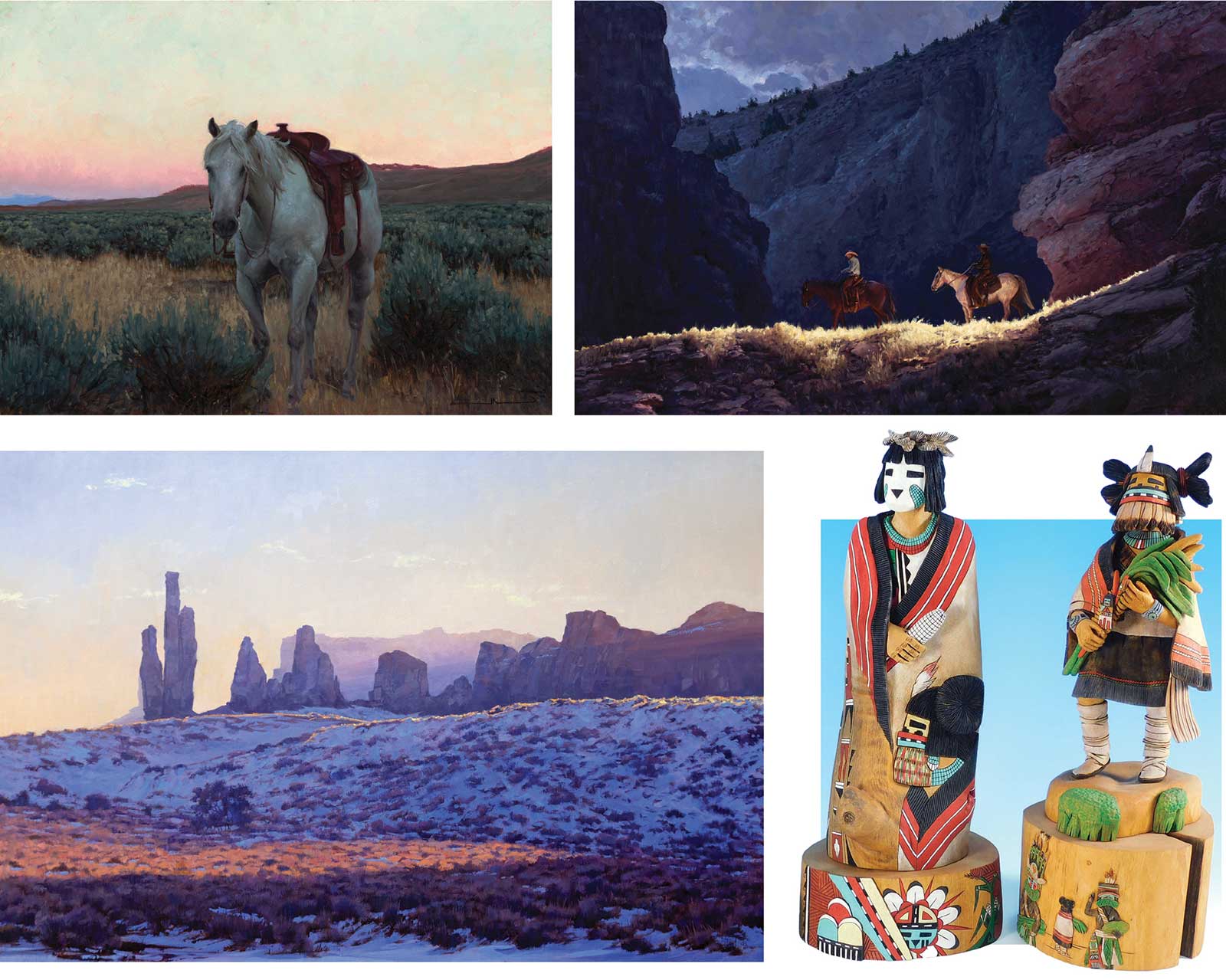
Top: Jonathan Noon, Saddled for a Promise, oil, 15 x 20 in.; Jonathan Noon, Lanterns in the Dust, oil, 30 x 48 in. Bottom: Darcie Peet, Dawn Awakens Yei Bi Chei - Monument Valley, oil, 24 x 36 in.; Territorial Indian Arts & Antiques, katsina sculptures, hand-carved dried cottonwood root and paint, by Loomatoochi, Armand Fritz (Hopi).
“There’s nothing quite like Monument Valley in the winter,” says Western painter Darcie Peet. “The valley is eerily quiet at dawn as the snow absorbs what little sound might be around. Azure blue and lavender shadows contrast against the red rock, winter shrubs and the emerging, dazzling light of dawn creeping in…This painting depicts the Yei Bi Chei monuments, or ‘Navajo spiritual gods,’” she says of her piece Dawn Awakens Yei Bi Chei. “There is a Yei Bi Chei dance that is performed for healing purposes in a nine-day ritual called the Night Way Ceremony. This was an unforgettable mood that had to be captured on canvas.”
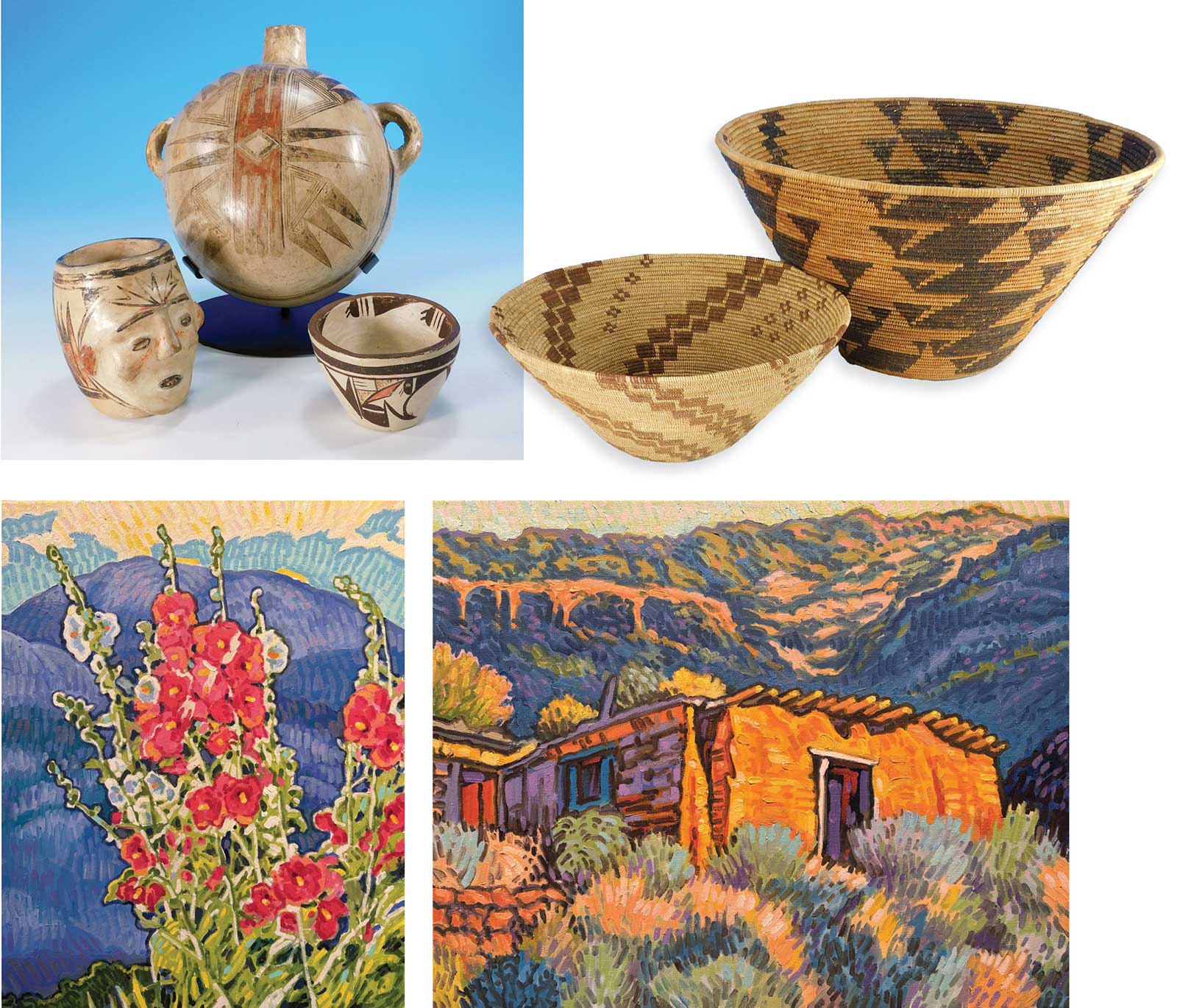
Top: Territorial Indian Arts & Antiques, antique Hopi pottery, hand-built with native clay, slip and paints, pit-fired, by Nampeyo of Hano and great-great-granddaughter Bonnie Nampeyo Sahmie; Territorial Indian Arts & Antiques, California Indian basketry from the early 20th century, hand-woven with native materials, often used for feast bowls. Bottom: Brad Price, Pueblo Peak Hollyhocks, oil on canvas, 20 x 16 in.; Brad Price, Pilar Homestead, oil on canvas, 16 x 20 in.
Brad Priceis an Oklahoma-based artist known for his expressive oil paintings that capture the vibrant landscapes of the American Southwest. Primarily working in oil, Price is an alla prima painter whose compositions feature bold unblended brushstrokes, striking color contrasts and a style that blends elements of post-impressionism with the early Taos painters. Influenced by artists like Vincent van Gogh and Robert Daughters, Price employs techniques such as simultaneous color contrast to bring nature to life on canvas. His work has awarded him numerous accolades, including the permanent collection of the La Fonda Hotel in Santa Fe.
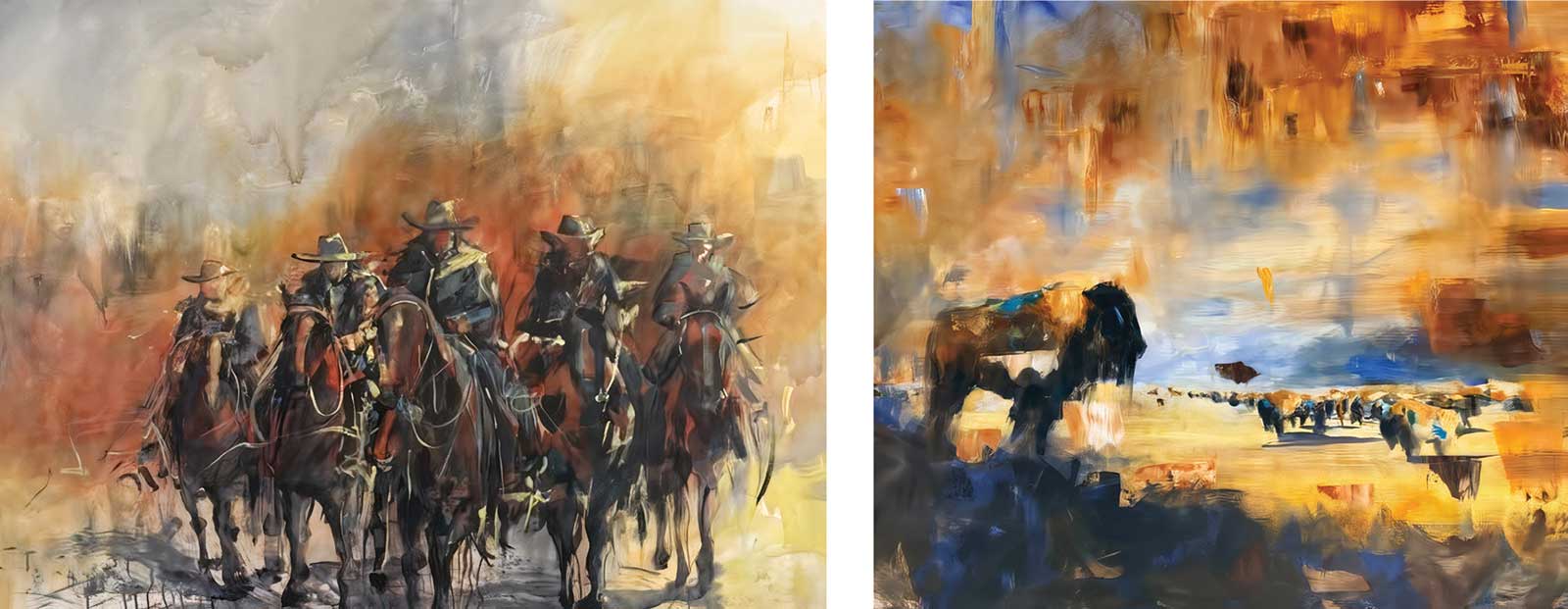
Bottom: Your Private Collection Art Gallery, Ride of the Scorched Horizon, acrylic, 68 x 52 in., by Jeremy Serna; Your Private Collection Art Gallery, Golden Plains, acrylic, 48 x 60 in., by Jeremy Serna.
Territorial Indian Arts & Antiques in Scottsdale, Arizona, offers collectors a vast array of exceptional Native American treasures. Among these are beautiful katsina sculptures by legendary Hopi artist Loomatoochi, Armand Fritz; antique Hopi pottery by Nampeyo of Hano and great-great-granddaughter Bonnie Nampeyo Sahmie; as well as two fine examples of California Indian basketry from the early 20th century. Each of these pieces undoubtedly captures the history and spirit of the Southwest.
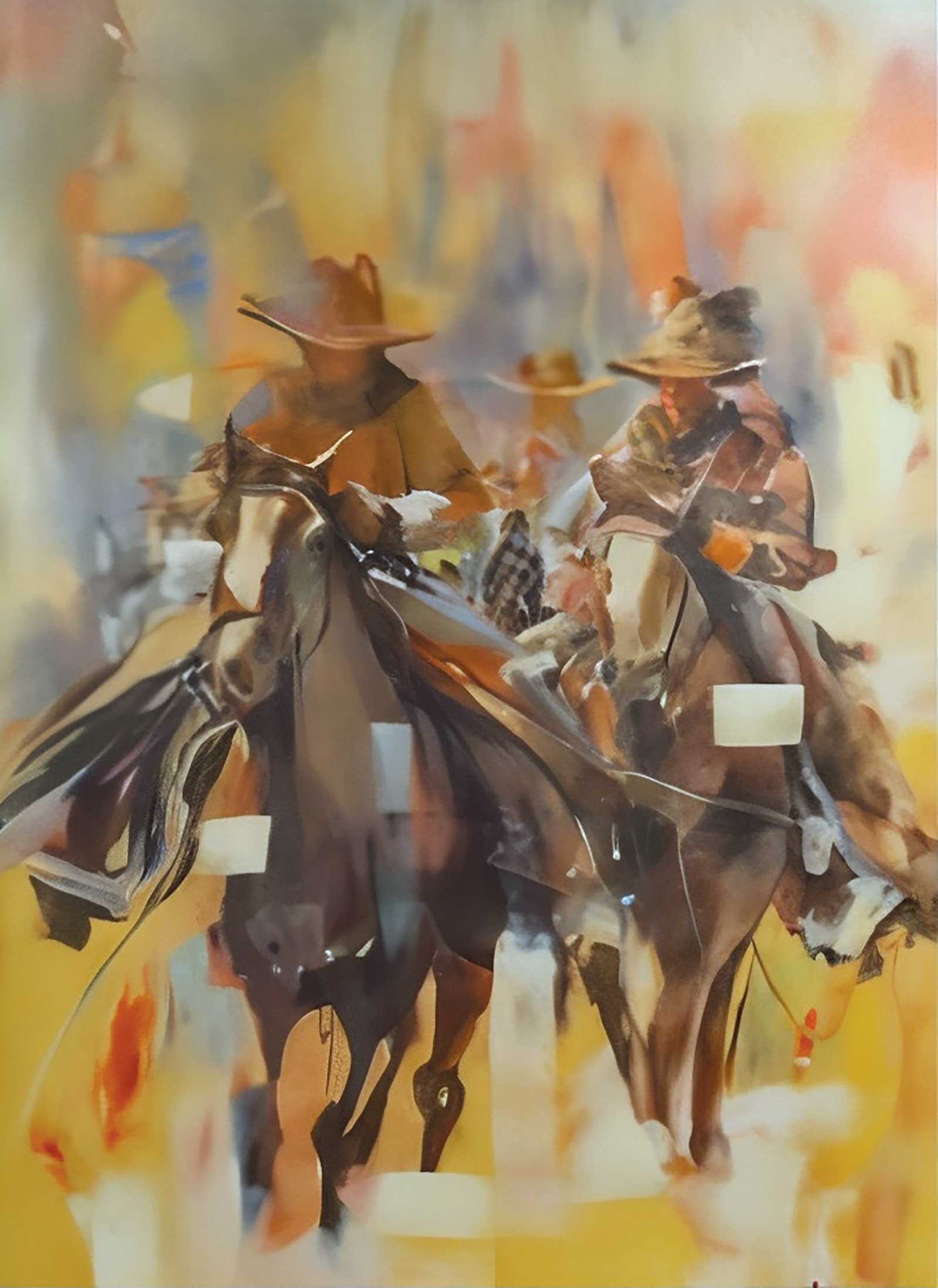
Your Private Collection Art Gallery, Riders of the Fading Ember, acrylic, 68 x 52 in., by Jeremy Serna.
Jeremy Serna of Your Private Collection Art Gallery is an artist whose work is deeply inspired by chaos and the often uncomfortable subjects that challenge our perception of reality. “Through his evocative paintings, Serna invites viewers to step into an alternate world—one where emotion takes precedence and the boundaries of conventional beauty are blurred. His artistic process is rooted in the raw, visceral act of mark making, allowing each brushstroke to carry its own weight and significance. Rather than shy away from difficult themes, Serna confronts them head-on, transforming turmoil into striking visual narratives of the West. —
Featured Artists & Galleries
Brad Price
meyergalleries.com/artist/brad-price
www.theadobefineart.com/brad-price
Darcie Peet
www.darciepeet.com
Facebook: /darciepeet
Jonathan Noon
info@jonathannoon.com
www.jonathannoon.com
Legacy Gallery
225 Canyon Road, Santa Fe, NM 87501
(505) 986-9833
www.legacygallery.com
Territorial Indian Arts & Antiques
Alston & Deborah Neal 7100 E. Main Street, Suite #3
Scottsdale, AZ 85251
(480) 945-5432
www.territorialindianarts.com
Your Private Collection Art Gallery
106 N. Houston Street
Granbury, TX 76048
yourcollection@att.net
(817) 579-7733
www.yourprivatecollection.com
Powered by Froala Editor


