Storytelling in New Mexico has a long and colorful history. Histories, stories and religious rites have been passed on orally among Native peoples for thousands of years. In the 1960s, Helen Cordero at Cochiti Pueblo began making figurative clay sculptures of storytellers and children in honor of her grandfather. Historic narratives of Hispanic culture and the colorful, often tall, tales of heroes and outlaws of the American West become visible today in the paintings of New Mexico artist Jim Vogel.
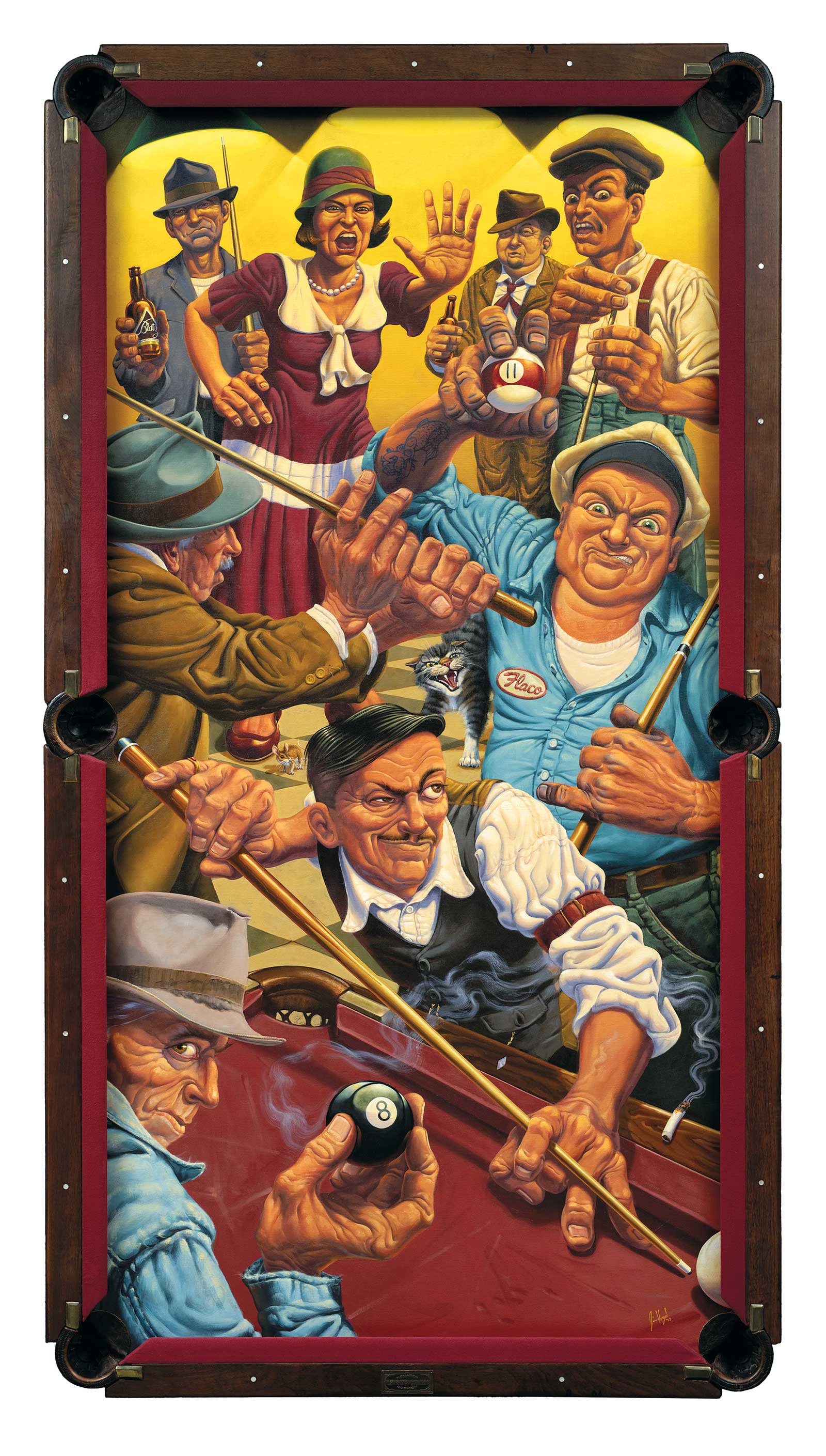
8-Ball, oil on canvas panel with 1920s Brunswick pool table frame by Christen Vogel, 110 x 61 in.
Drawing since before he can remember, Vogel attended the Art Institute of Chicago where he met Christen Hupfer. They married and eventually settled in Dixon, New Mexico, where they raised three children and collaborate on making art. Today they share a studio they built with their son Sage, who collaborates with them on storytelling. His debut short story collection, Dichos en Nichos, is illustrated by his parents. Christen gathers oddments from cap pistols to pool tables to create frames for her husband’s paintings.
An exhibition, Jim Vogel – It’s Not All Fun and Games, opens October 10 at Manitou Galleries in Santa Fe, and runs through October 19.
The Derringer cap pistol appears in Bang! Bang! You’re Dead!in which his oil on panel figure is cut out and mounted along with the pistol on her vintage marble game.
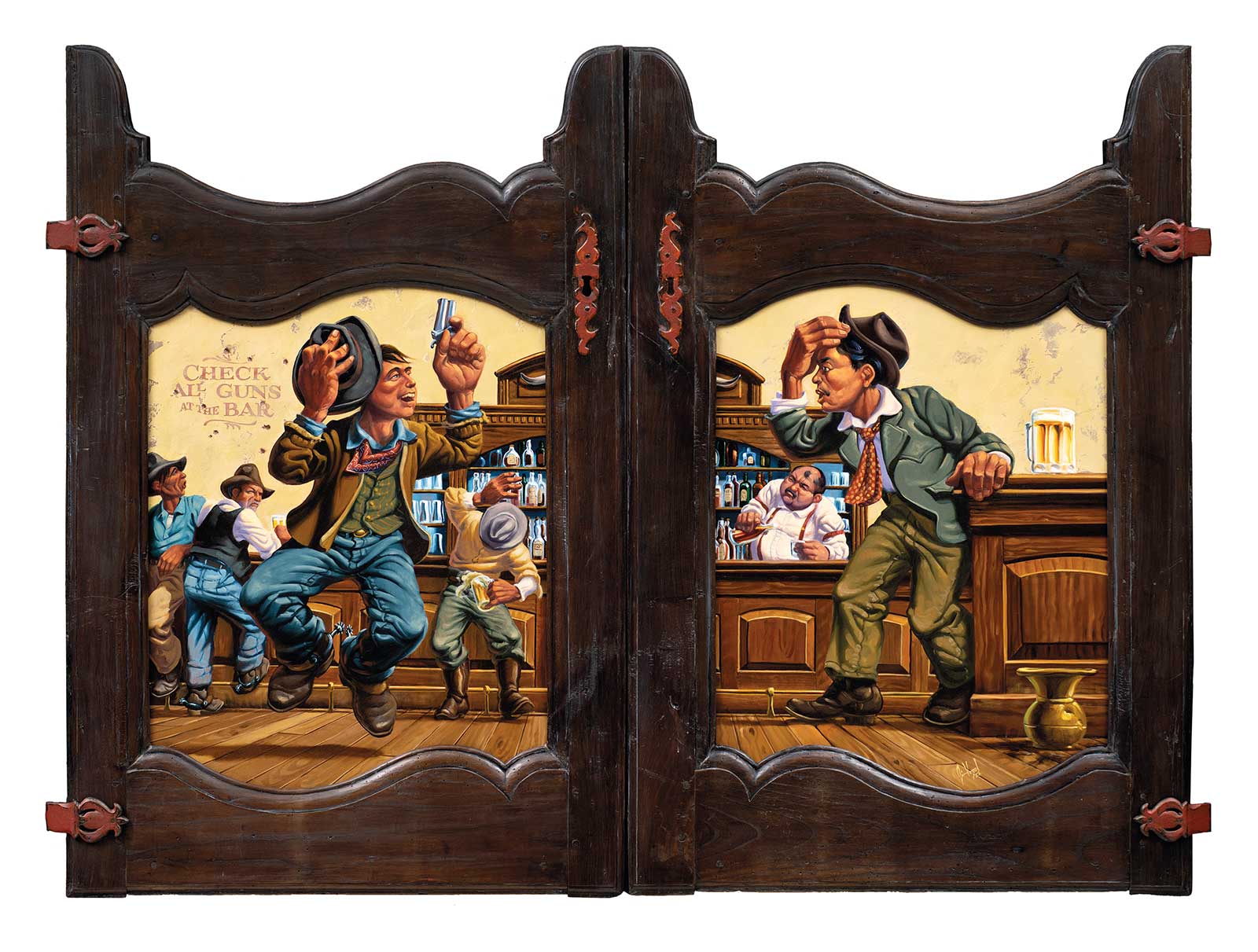
Check All Guns at the Bar, oil on gesso panels (diptych) with antique walnut saloon doors frame by Christen Vogel, 36 x 47 in.
Men of a certain age often played with toy pistols—cops and robbers or cowboys and Indians—when they were boys. Vogel wonders if our carelessness with toy guns has contributed to the fetishization of guns today. He finds overt racism in some of the toy games they use in their collaborations—negative inferences that would never have crossed our minds but may have become ingrained when we were young.
He celebrates another storyteller in Check All Guns at the Barmounted in a pair of saloon doors. In the right panel is his depiction of Elfego Baca, a New Mexican gunfighter, law enforcement officer, lawyer and politician.” He was a contemporary and friend of Billy the Kid about whom he told a few possibly “tall” tales.
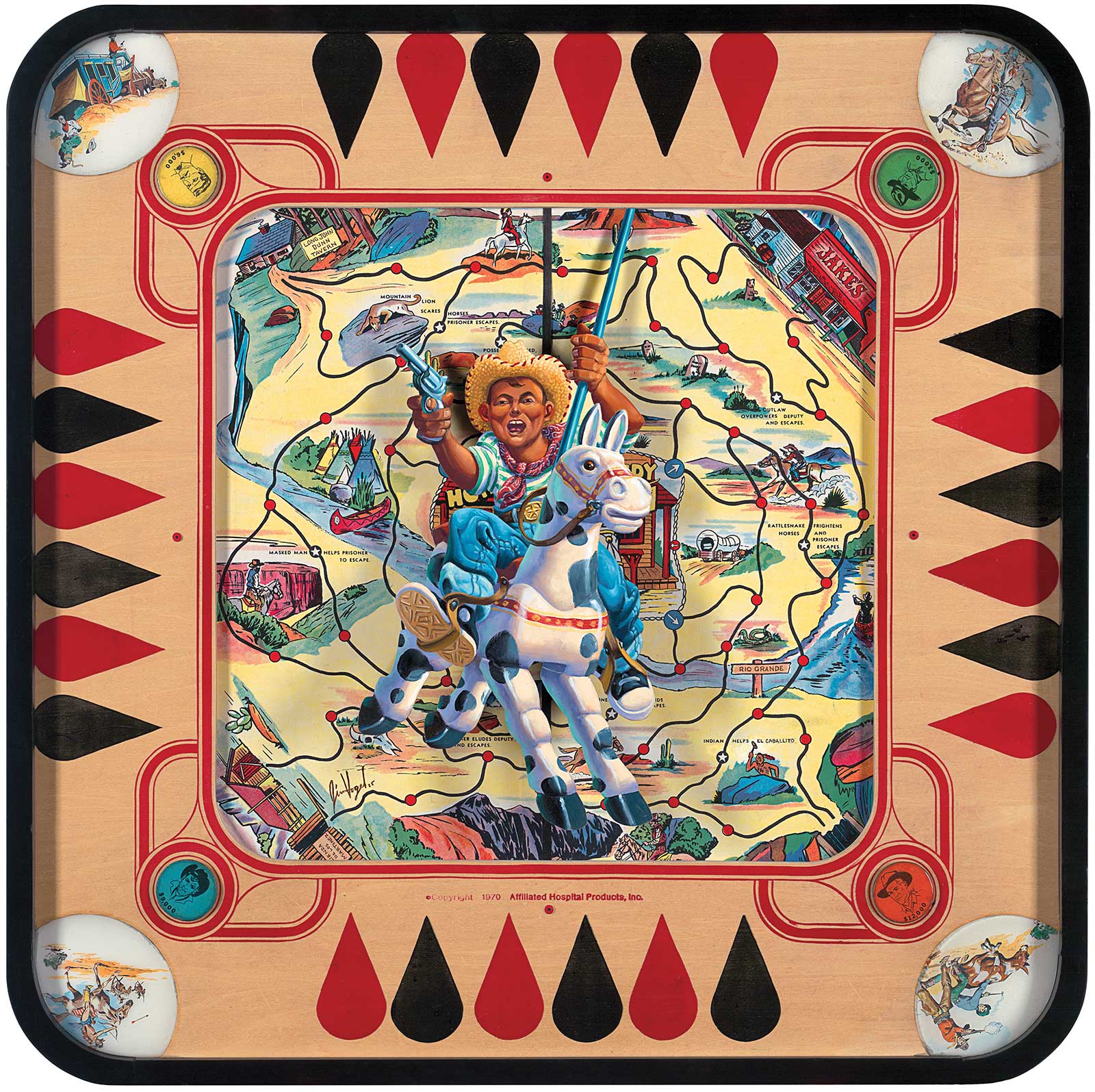
In Pursuit of Bandits El Caballito Breaks Free From the Flying Jenny (El Caballito), oil on gesso panel with vintage game board and vintage Carrum board, frame by Christen Vogel, 28¼ x 28¼ in.
Baca told of him and the Kid riding into Socorro, New Mexico, taking the train to Albuquerque and going to the bar in Old Town. The bar had a strict “Check All Guns at the Bar Policy” but the Kid got rowdy and pulled out a small Derringer from under his hat and shot off a few rounds, quickly returning the gun to its hiding place.
Vogel says, “I make art that speaks to me. If I do it right, someone will connect with it. It’s about being a proud New Mexican. There are elements in our history that are in me that I can’t let go. For years I avoided the classical New Mexico cowboy and Indian and Billy the Kid stories from the 1870s.” But Billy the Kid became irresistible and an opportunity to add his own embellishments.
Eclipse Croquet: Billy Loses His Patience with Charlie Bowdre is mounted in an arch-topped door and antique croquet set frame with its original “Eclipse Croquet” emblem. A few years ago, a photo of a group of people playing croquet appeared on the market and a brouhaha about its authenticity arose.
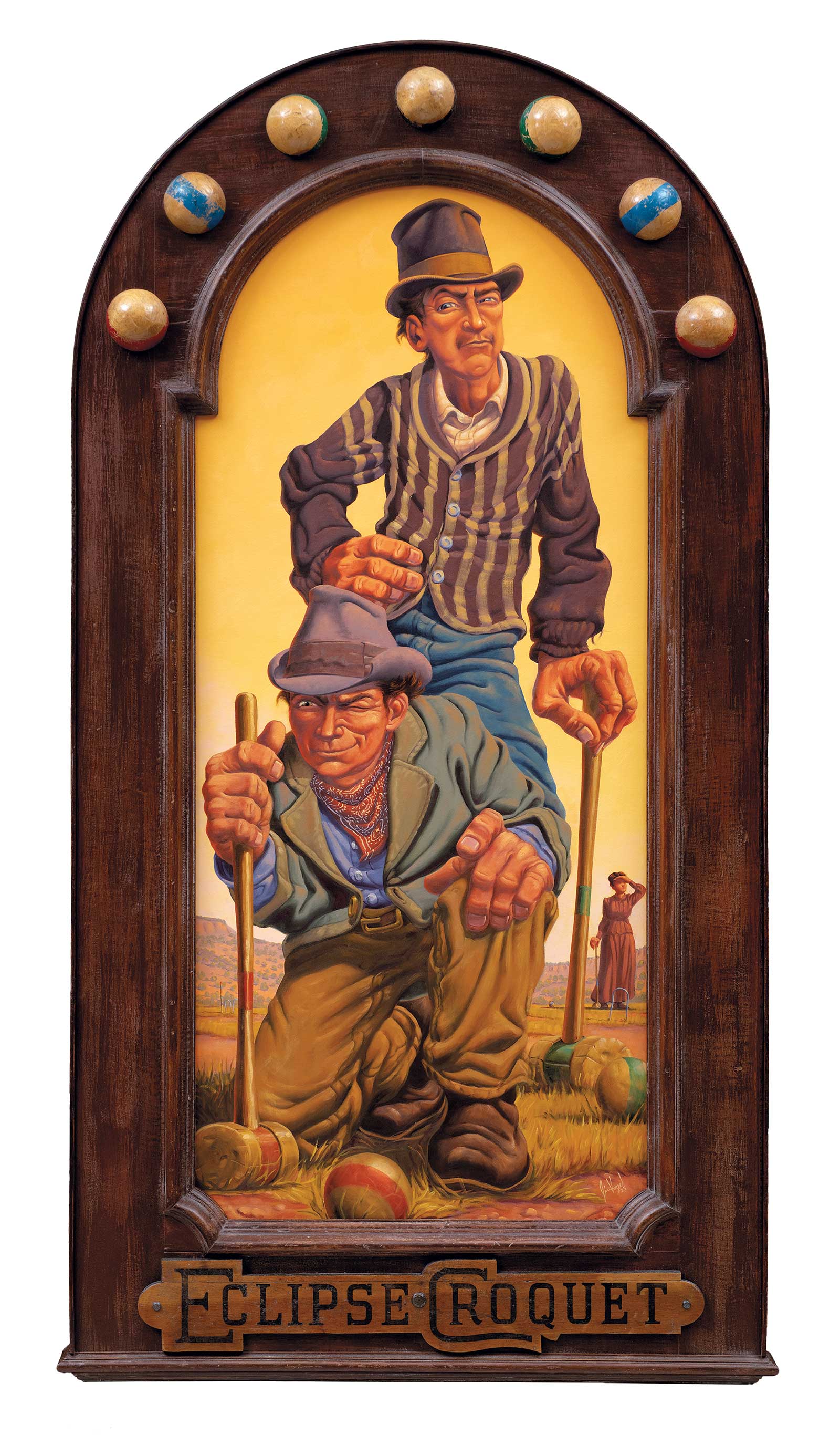
Eclipse Croquet: Billy Loses His Patience With Charlie Bowdre, oil on canvas panel with antique arch-topped door and antique croquet set frame by Christen Vogel, 64 x 33 in.
Vogel, equally a historian as a storyteller, relates how Billy the Kid fought in the Lincoln County War in 1878, a battle between rival commercial and political factions—one of which was headed by the Englishman John Tunstall. Tunstall had hired the Kid as his bodyguard. Tunstall may have brought croquet to Lincoln County when he arrived in 1877. There are few alleged photographs of Billy the Kid. Some Kid fans are convinced one 19th-century photo shows him and his cohorts, including Charlie Bowdre, posing with croquet mallets. (The photo’s authenticity is wildly contested.)
Vogel depicts Bowdre laboriously contemplating his next stroke while Billy the Kid stands anxiously behind him. The color of the sky behind them recalls an eclipse which a woman competitor behind them cautiously contemplates. The arrangement of croquet balls in the arch are more than decorative. They represent the waxing and waning of an eclipse, their colored bands progressing toward and receding from the full eclipse in the center.
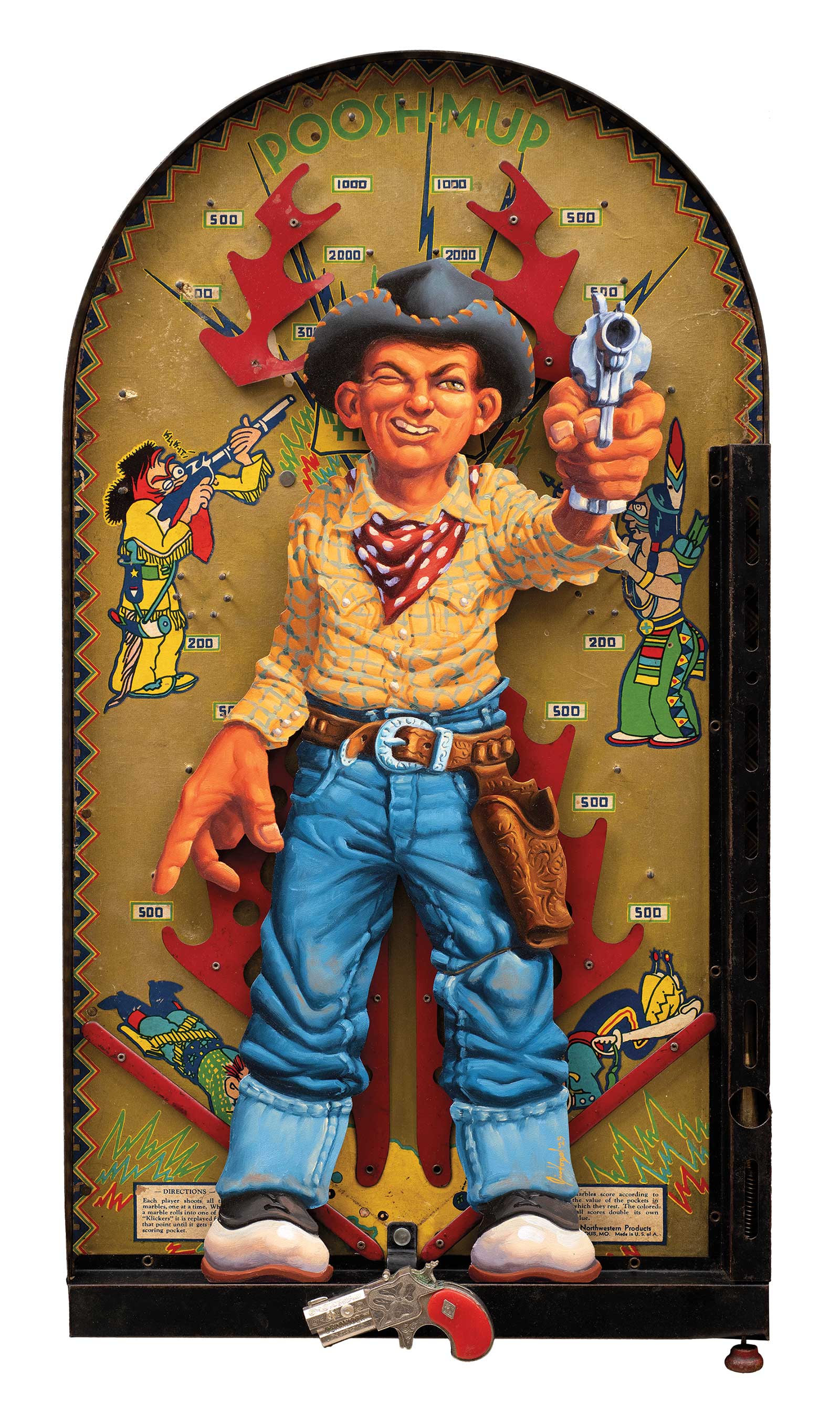
Bang! Bang! You’re Dead!, oil on gesso panel with vintage marble game and vintage cap-gun frame by Christen Vogel, 24½ x 13 in.
The large hands of his subjects honor the people who have worked the land around his home and New Mexico for centuries. Commenting on their expressive faces, he says, “Over the years I’ve lost the ability to be satisfied with being anatomically precise. I do what I feel is right. I just want to grab the emotion that I initially feel when I’m doing this. I’m representing an emotion in time. Christen and I feel the paintings in this show are a really good series. The frame’s relationship to the paintings is tighter and my composition is better informed by what she’s doing. It’s a personally important body of work.” —
Manitou Galleries 123 W. Palace Avenue » Santa Fe, NM 87501 » (505) 986-0440 » www.manitougalleries.com
Powered by Froala Editor


