Depth and dimension can indicate space and distance within a painting. They can also relate to metaphorical themes related to time, tradition and history.
In the painting Unified,painter Logan Maxwell Hagege marries many of his favorite subjects in a delicate and evocative still life featuring a Navajo weaving, a pueblo wedding vase and hollyhocks, the flowers that have become iconic elements of his works. A recurring motif in his paintings is his union of a flat background with a more three-dimensional subject in the center. This subtle effect appears in many of his pieces, including a great number of his outdoor scenes, where distant mountains and clouds are rendered with simplified forms and colors, while subjects in the center of the painting are more detailed and have more dimension.
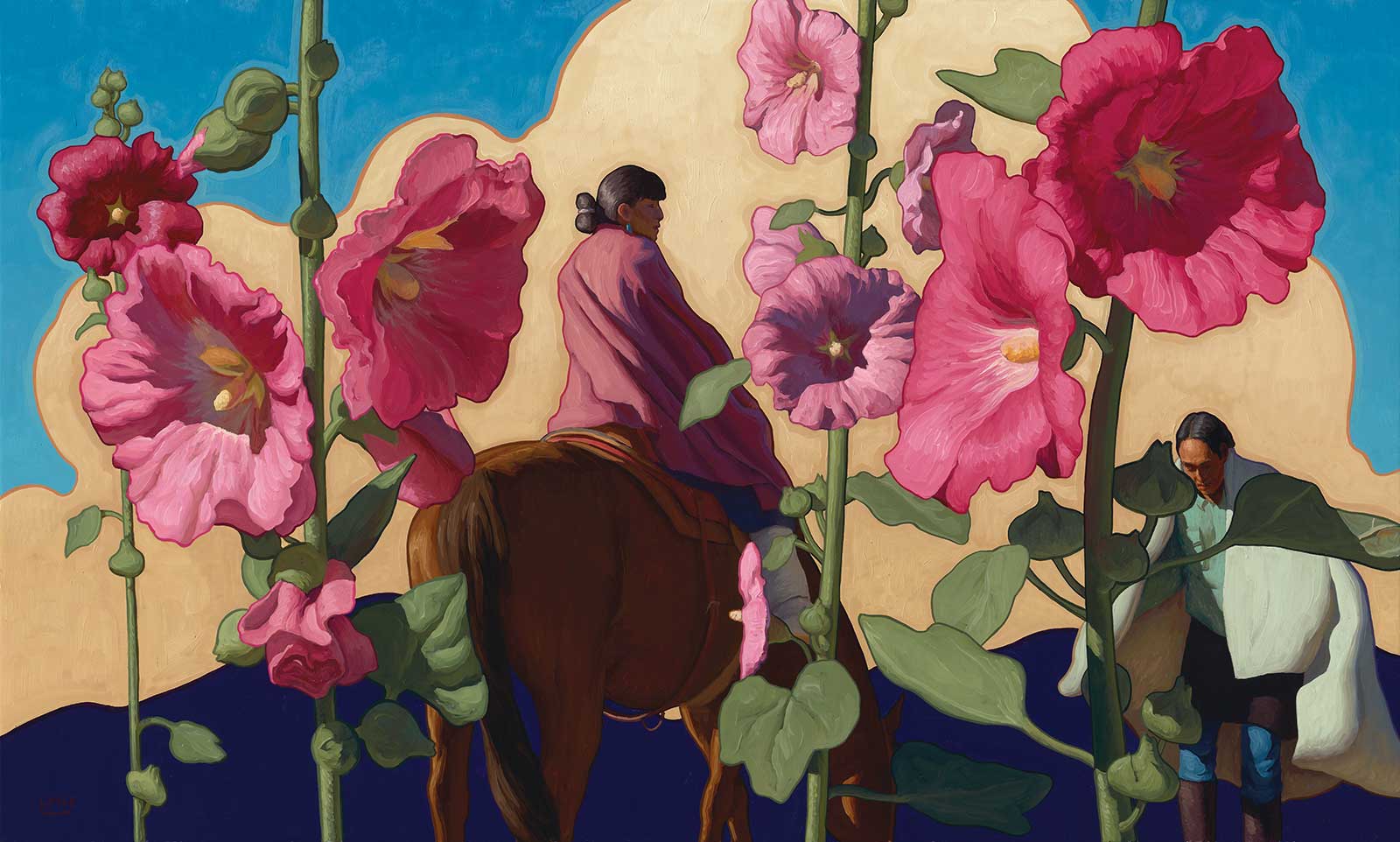
Answer to the Rain, oil on linen, 24 x 40 in.
Through this simple visual language, the artist creates a bridge that unites complex narrative subjects: historic versus contemporary, abstraction versus realism, colossal versus small, light versus dark, and even celestial versus terrestrial. The pairing that hits the hardest is the one that resonates in nearly every painting: the conflict and resolution of the past versus the present. “I love playing with that space,” Hagege says. “It’s the interplay between the two-dimensional with the three-dimensional. That area is very interesting to me.”
These themes will be explored in Hagege’s newest show, Logan Maxwell Hagege: Fertile Ground,opening August 1 at Owings Gallery in Santa Fe, New Mexico. As he was assembling the work for the show, the title leapt out at him as he pondered his relationship with New Mexico.
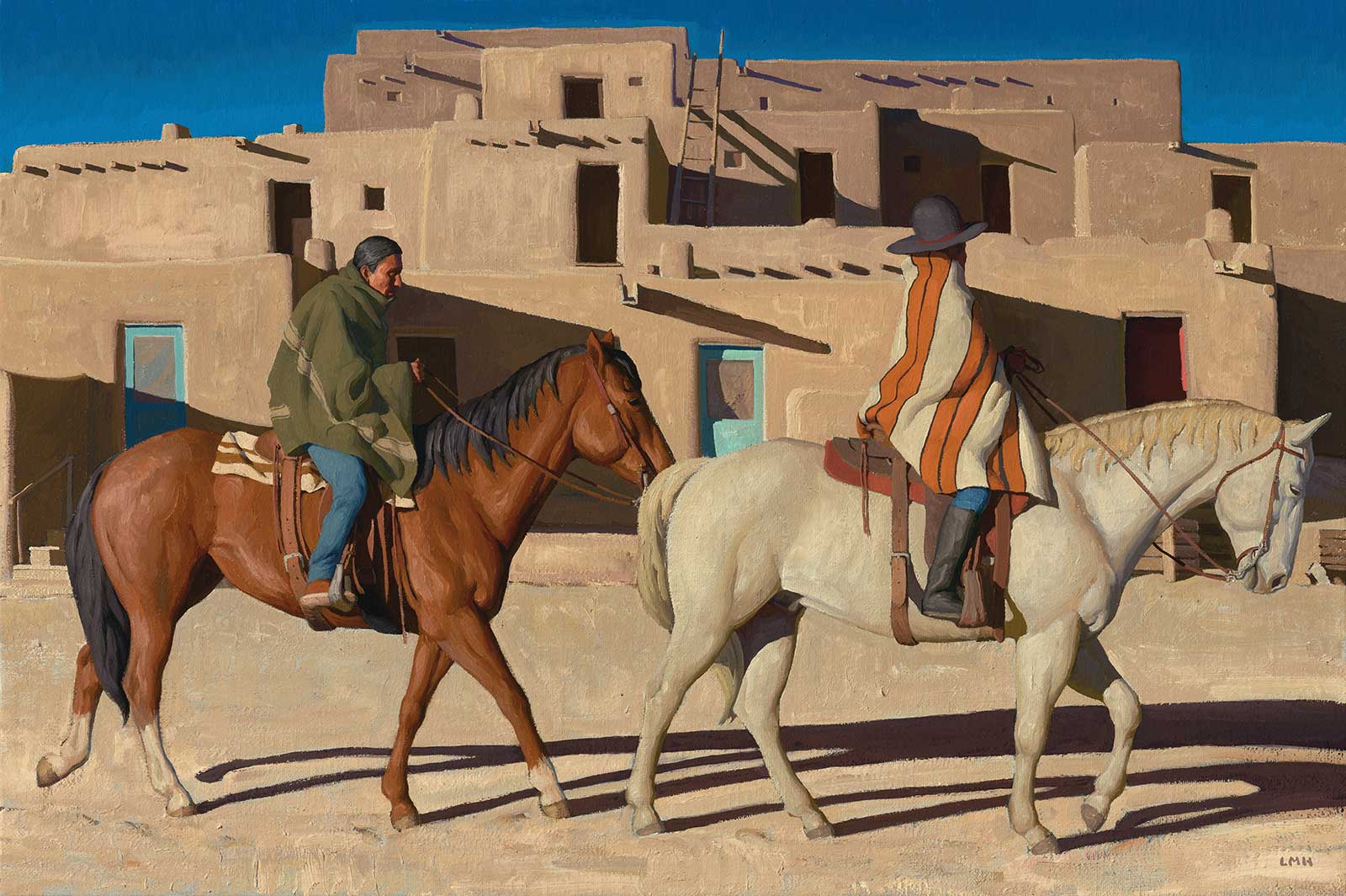
Approach, oil on jute, 30 x 45 in.
“The title refers to how I feel about the state and the artistic ideas I get when I’m there. It’s the land, the people, it’s all of it. It’s just endless inspiration for me. Ultimately, it’s the deep culture that really pulls me in,” he says. “I’ve done a handful of shows in Santa Fe, and even several in August, but this is my first at Owings. I intentionally wanted the show before Santa Fe Indian Market, because I didn’t want to compete with that and all the people that are in town, but there’s no better time to be in Santa Fe than during Indian Market in August. It’s just a special time to be there and be around so many great artists.”
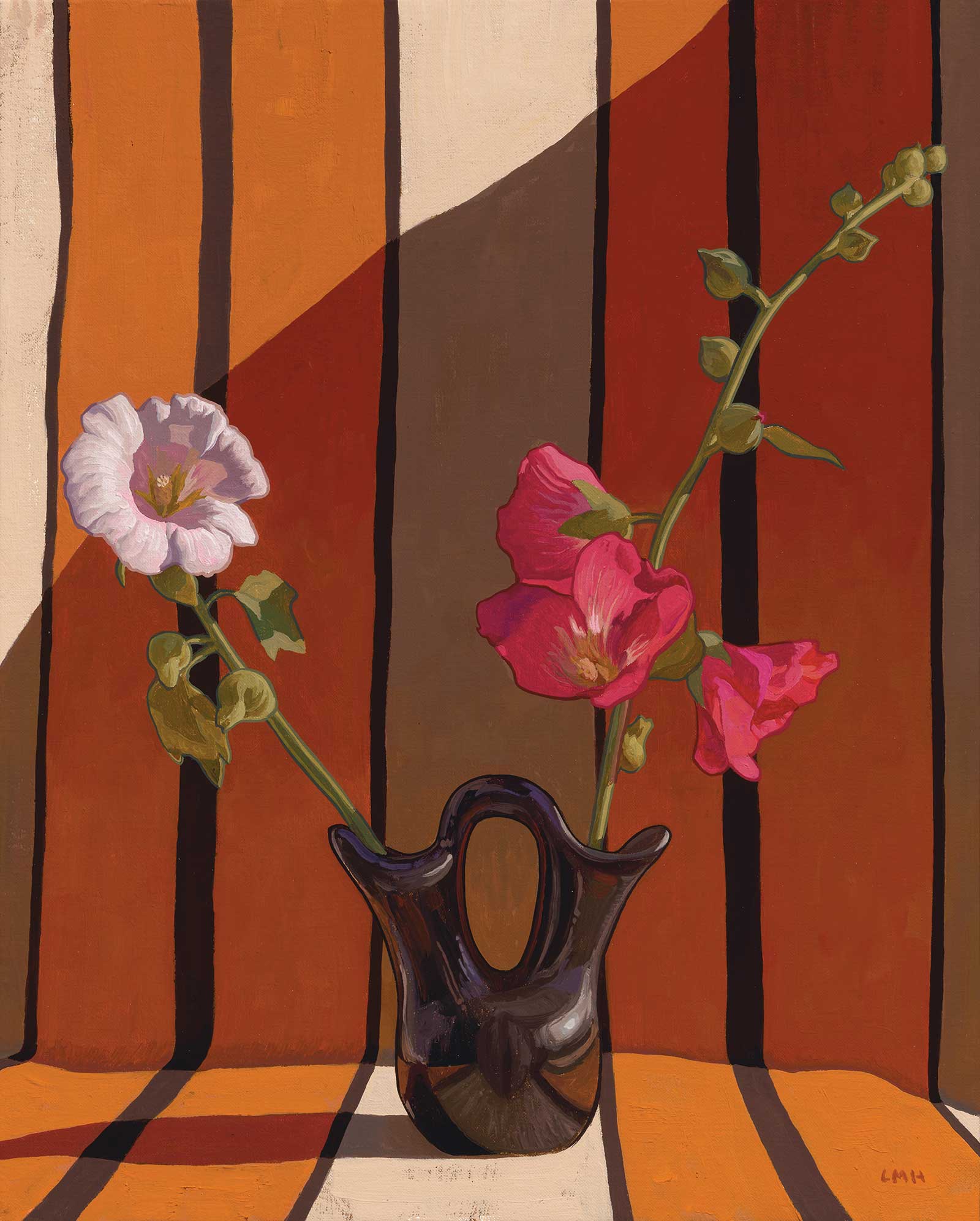
Unified, oil on linen, 20 x 16 in.
Hagege is planning on bringing roughly 15 new works to the Owings show, including several important larger paintings that expand the artist’s unique visual language of the Southwest. Consider Approach,a 30-by-45-inch oil depicting the Taos Pueblo. The artist’s unique vision of the West—2D versus 3D as narrative device—translates exceptionally well into the Taos Pueblo, which is a collection of right angles and flat adobe walls. His two riders on horseback unite time and place, blurring the distance between them and their heritage and culture.
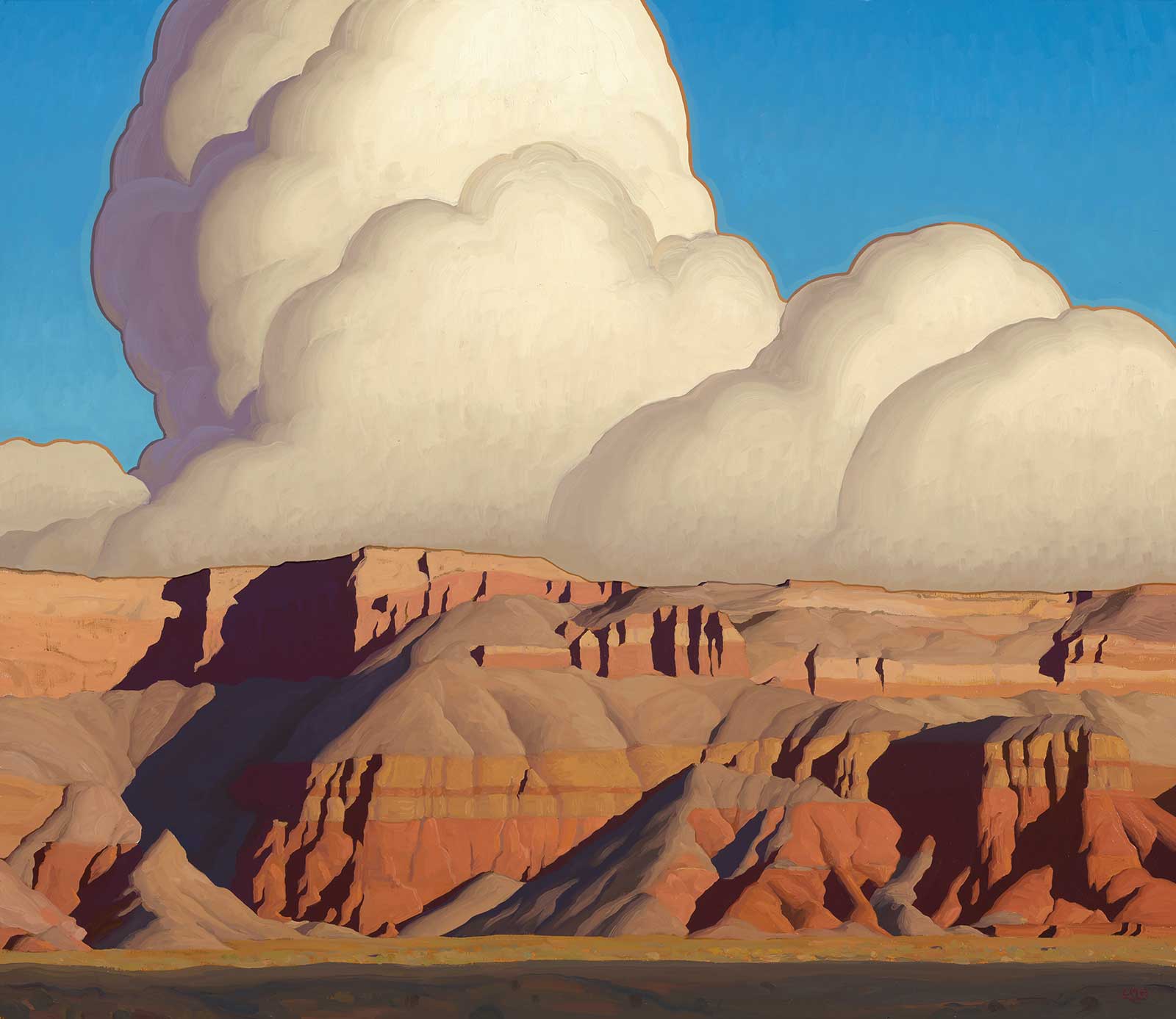
Autumn Whisper, oil on linen, 32 x 37 in.
Hagege has always painted modern-era Native American subjects, as opposed to subjects from the 19th century or earlier, but several of the new paintings make the point even clearer with subjects in blue denim jeans, a clothing item that dates the subjects in more contemporary times. “I generally work with the same models fairly regularly. I don’t direct them. They show up usually in what they wore to work that day, whether that’s construction or farmwork or something else entirely. They’ll come in jeans and work boots and sometimes in sweatshirts. The blankets are often their own, from their own families,” the artist says. “Their clothing is another way to mix elements related to time together within a more contemporary setting. The important thing for me is to show that these are living people today. These are their clothes, both their heirlooms and their more modern clothing items. And they are also natural horsemen. For that Taos Pueblo painting, those models must have 11 horses between the two of them. So they look natural because they are—they’re pros.”
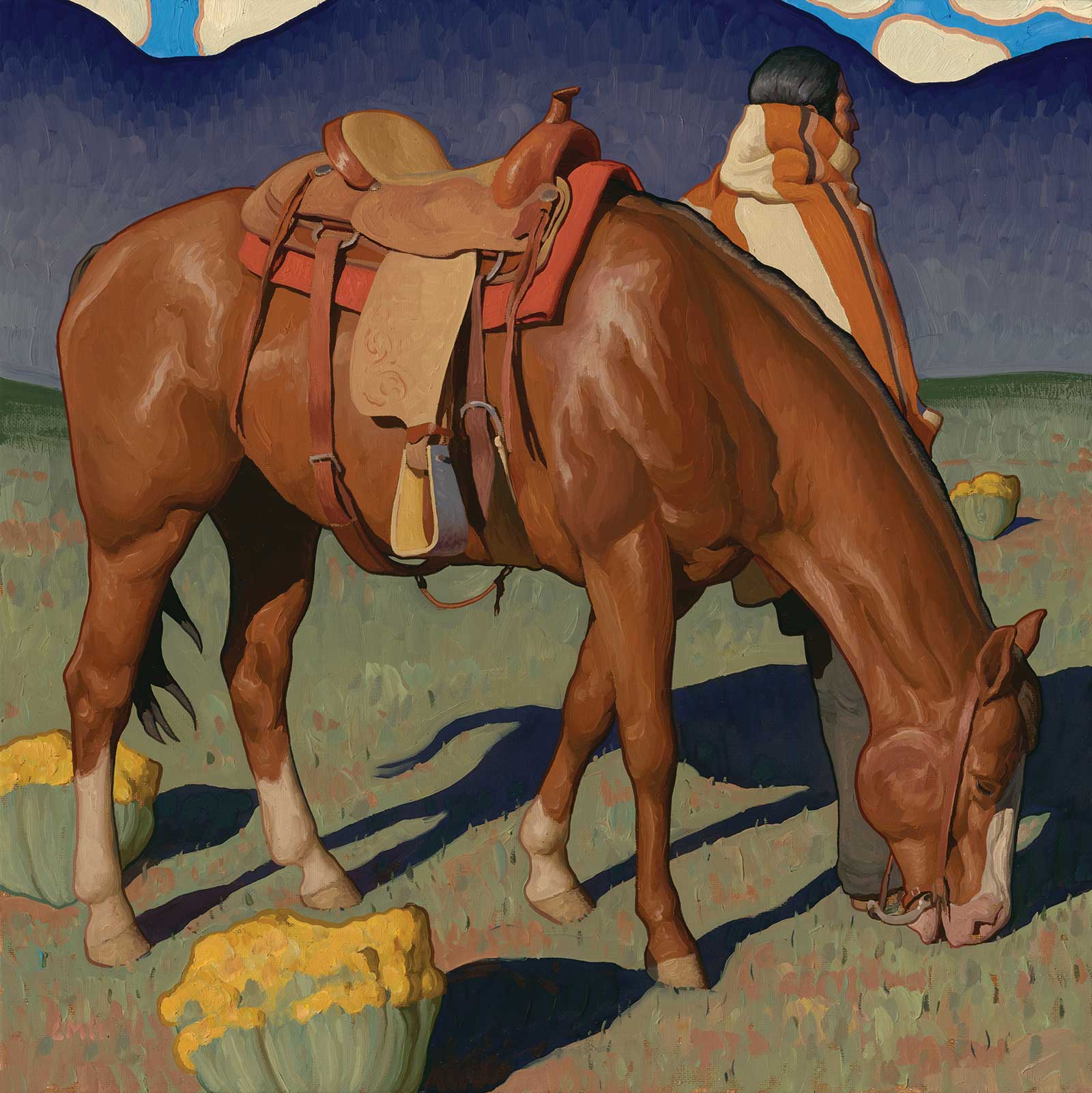
Spring Grass, oil on linen, 22 x 22 in.
For the setting of the Taos Pueblo, the painter says that being respectful to the place and its people is paramount to his own art. “You know it right away that it’s a sacred place. There’s an energy there, something I’ve felt every time I’ve been there. It has a spiritual quality to it. Trying to capture that in a painting can be difficult,” he says. “And it’s also just a unique place. It’s the oldest place in the country where people have continuously lived. You can feel the history.”
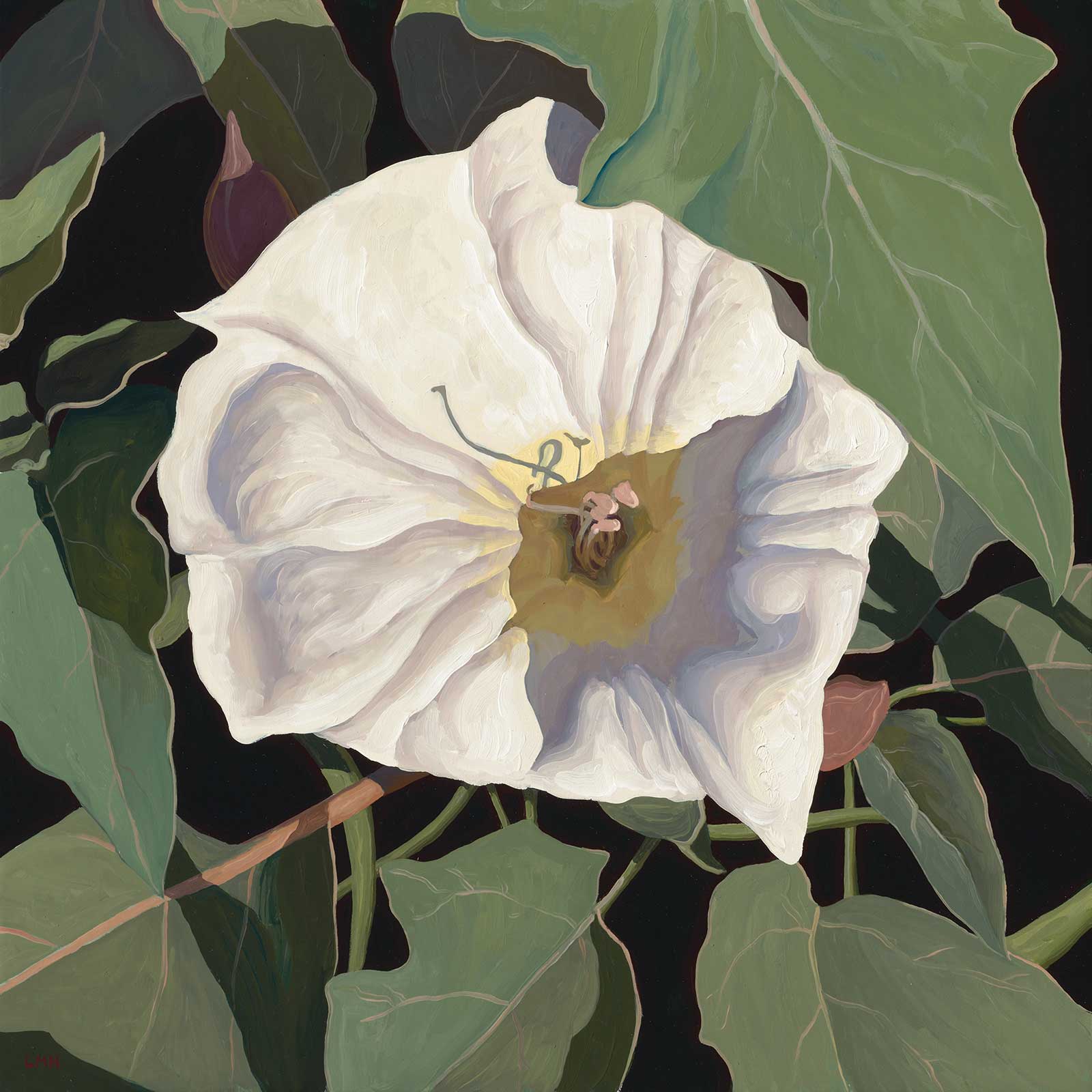
In the Oak Grove, oil on linen, 20 x 20 in.
Approach, as well as Unified and a third new painting, Connected Isolation, show a tan and orange Native American weaving that prominently appears in a handful of pieces from the new show. This weaving, as well as Hagege’s hollyhocks and other subjects, reveal a fresh color palette. “These colors are definitely inspired by nature, which is important for me and serves as a connecting point to Fertile Ground. So many of my colors refer to nature, and that’s primarily just me visually connecting to the experience of painting the landscape outdoors,” the artist says. “Sunlight is really important to the experience. When I’m outdoors and the light falls on nature, that’s where my color palette comes from. Even when I’m out in a really desolate area of the desert, in places with a lot of sand and brown cliffs, the naked eye really makes you look a little deeper to find those colors I’m looking for. They aren’t always there at a first glance, because they are subtle. I really like what painter Eric Merrell does with sunlight. He’ll paint these mid-day scenes with blown-out color and light. Just too much light everywhere, but he’ll find a way to make it work. When I’m in those settings, I try to paint some shadow just as something to hold onto, but not Eric. And he can still bring out all this amazing color in his works. Finding those color harmonies can be tricky.”
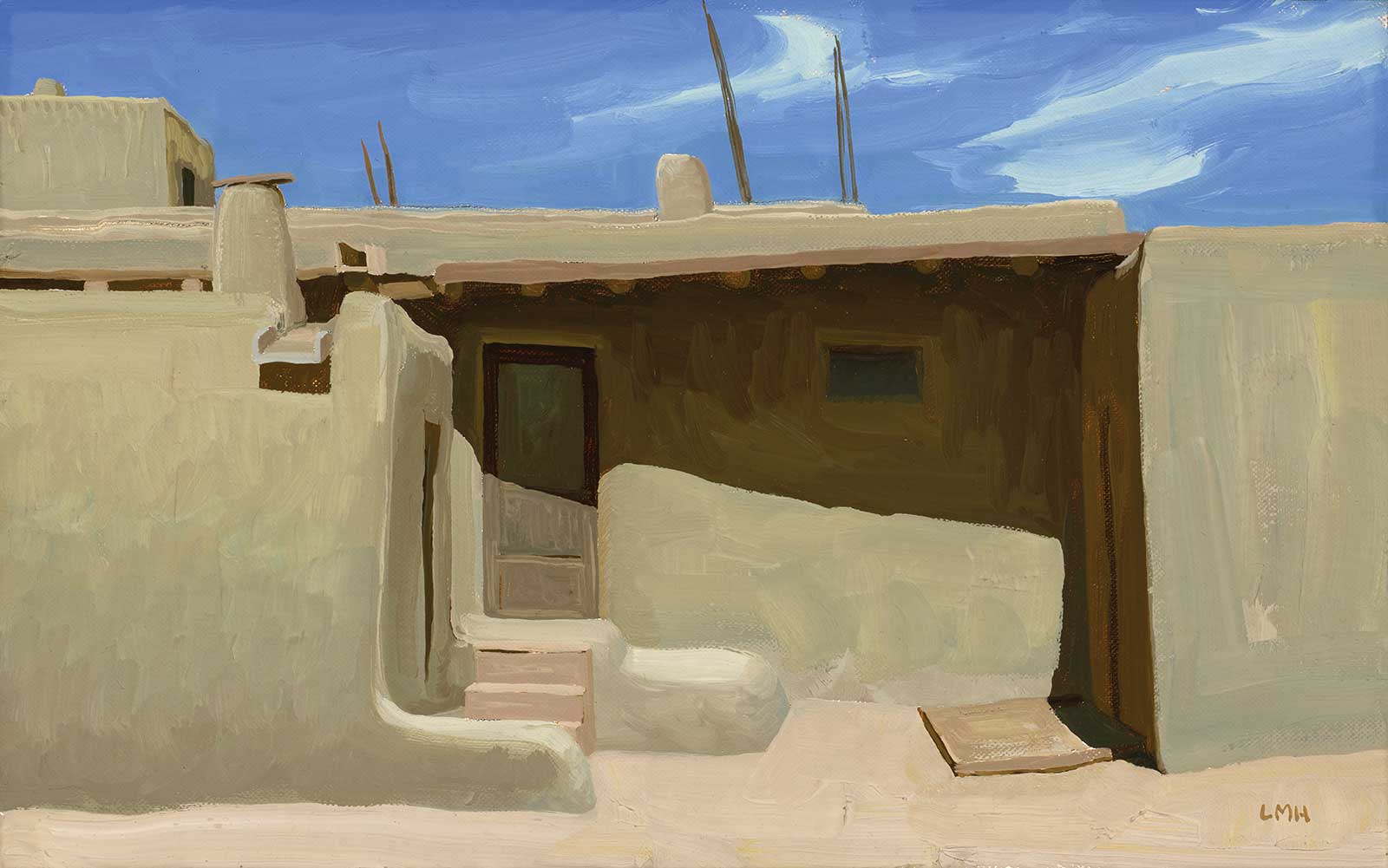
Life Lived, oil on canvas, 10 x 16 in.
Hagege is in the middle of what is sure to be an intense six months of work. He sent two pieces to the Prix de West in June, and then a week later was in Taos, New Mexico, for a joint exhibition with Glenn Dean and Josh Elliott. The major Owings show is in August, but even then there’s no rest because he has to turn around new work for the group retrospective at the Woolaroc Museum in Oklahoma. There are also group shows at Maxwell Alexander Gallery in the fall and then he’s the featured artist for the 2026 Coors Western Art Exhibit in January. That’s an epic run, one that really makes him ponder slowing down and taking his time. “I have to be conscious of my time, purely because I just want to always maintain that high quality. It does seem that I’m always perpetually planning major work, but that’s just the nature of this all,” he says. “I don’t even really see my work coming from a specific phase or period of who I am as an artist. I have found that it’s best to just react to my interests and let that guide me forward.”
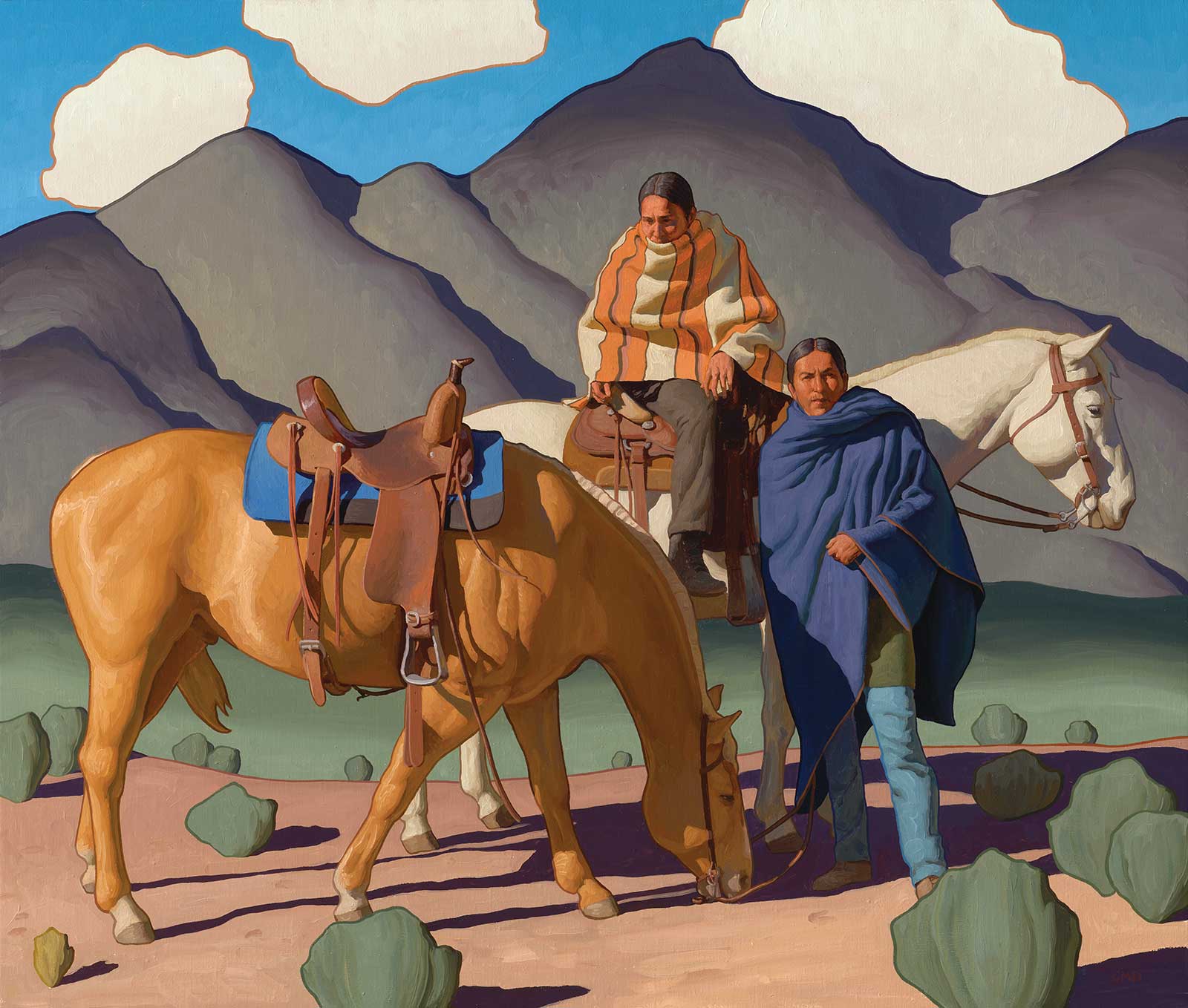
Connected Isolation, oil on linen, 34 x40 in.
Hagege’s newest show, Fertile Ground, opens August 1 at Owings Gallery.
Logan Maxwell Hagege: Fertile Ground
August 1-October 1, 2025
Owings Gallery
120 E. Marcy Street, Santa Fe, NM 87501
(505) 982-6244, www.owingsgallery.com
Powered by Froala Editor


