
From the 17th through the early 19th centuries, watercolors were largely used by artists and explorers for the practical purposes of mapping and documenting the American landscape. Eventually, artists began employing watercolors to create larger, more “finished” pieces that were soon regarded as works of art in their own right.
Through a collection of 30 watercolors, a new exhibition at the National Gallery of Art explores how a diverse group of artists depicted the landscape across two centuries.
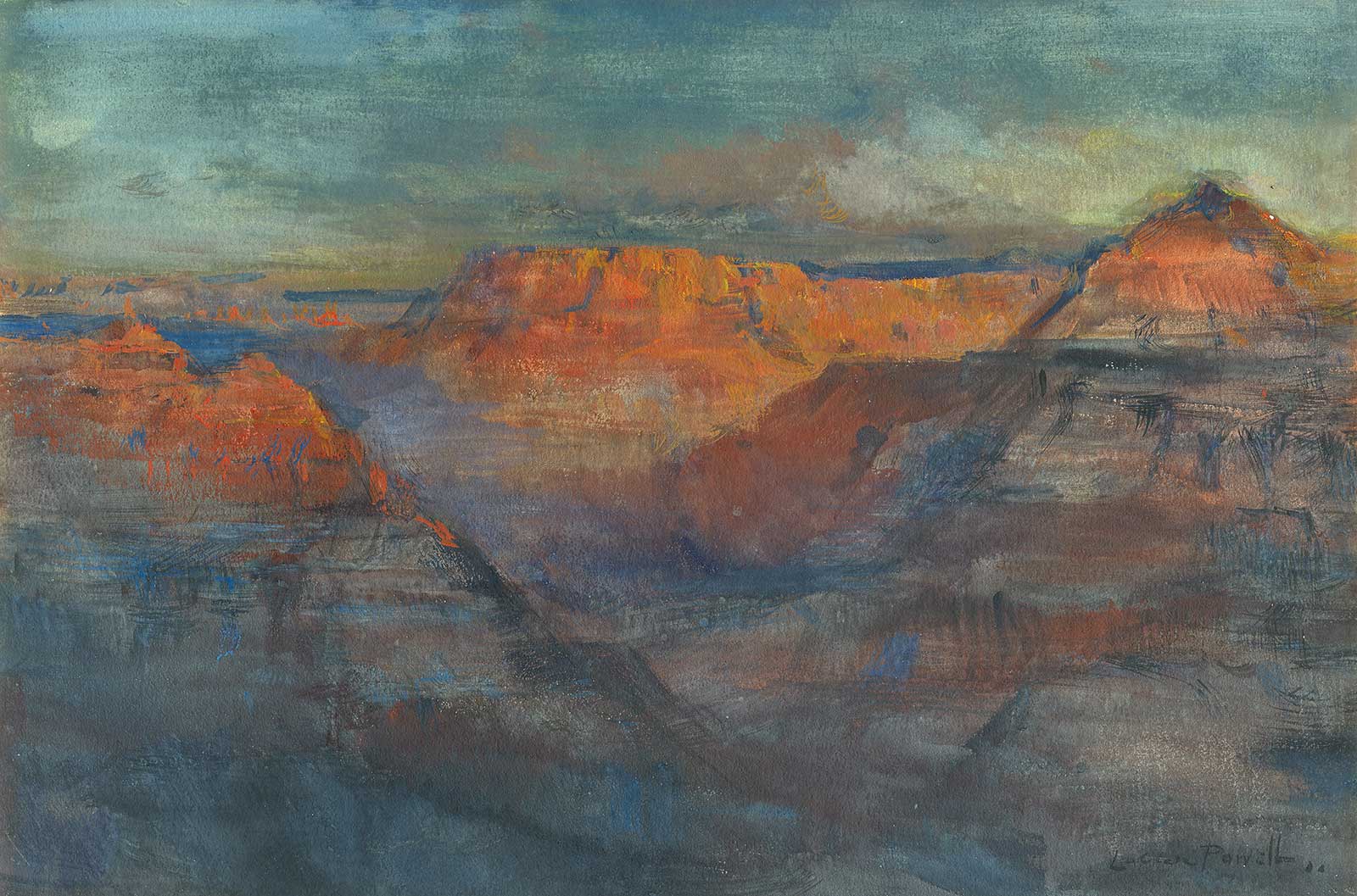
Lucien Whiting Powell (1846-1930), The Afterglow, Grand Canyon, Arizona, ca. 1904, watercolor and gouache on paperboard sheet, 201/8 x 301/8 in. National Gallery of Art, Corcoran Collection (Museum Purchase).
American Landscapes in Watercolor from the Corcoran Collection covers a lot of terrain, from the Washington Monument to the New England coastline, Grand Canyon and Yosemite national parks to the Hudson River Valley. It includes early examples of works more utilitarian in nature from the early 1800s, as well as fully developed studio pieces from as late as the 1990s.
Although associate curator Amy Johnston cites William Trost Richards’ South-West Point, Conanicut as one of the most significant works in the exhibition, notably for its size, important watercolors featuring Western subject matter are also represented in the show.
Lucien Whiting Powell (1846-1930) created the sweeping vista titled The Afterglow, Grand Canyon, Arizona, circa 1904. Powell was a renowned landscape painter with Virginia roots. After serving with the Confederate Army in the Civil War, he studied with Thomas Moran at the Pennsylvania Academy of the Fine Arts, an influence that can be seen in the present piece. Following in Moran’s footsteps, Powell accompanied a geological survey expedition to the Grand Canyon in 1901, in all likelihood the inspiration for The Afterglow.
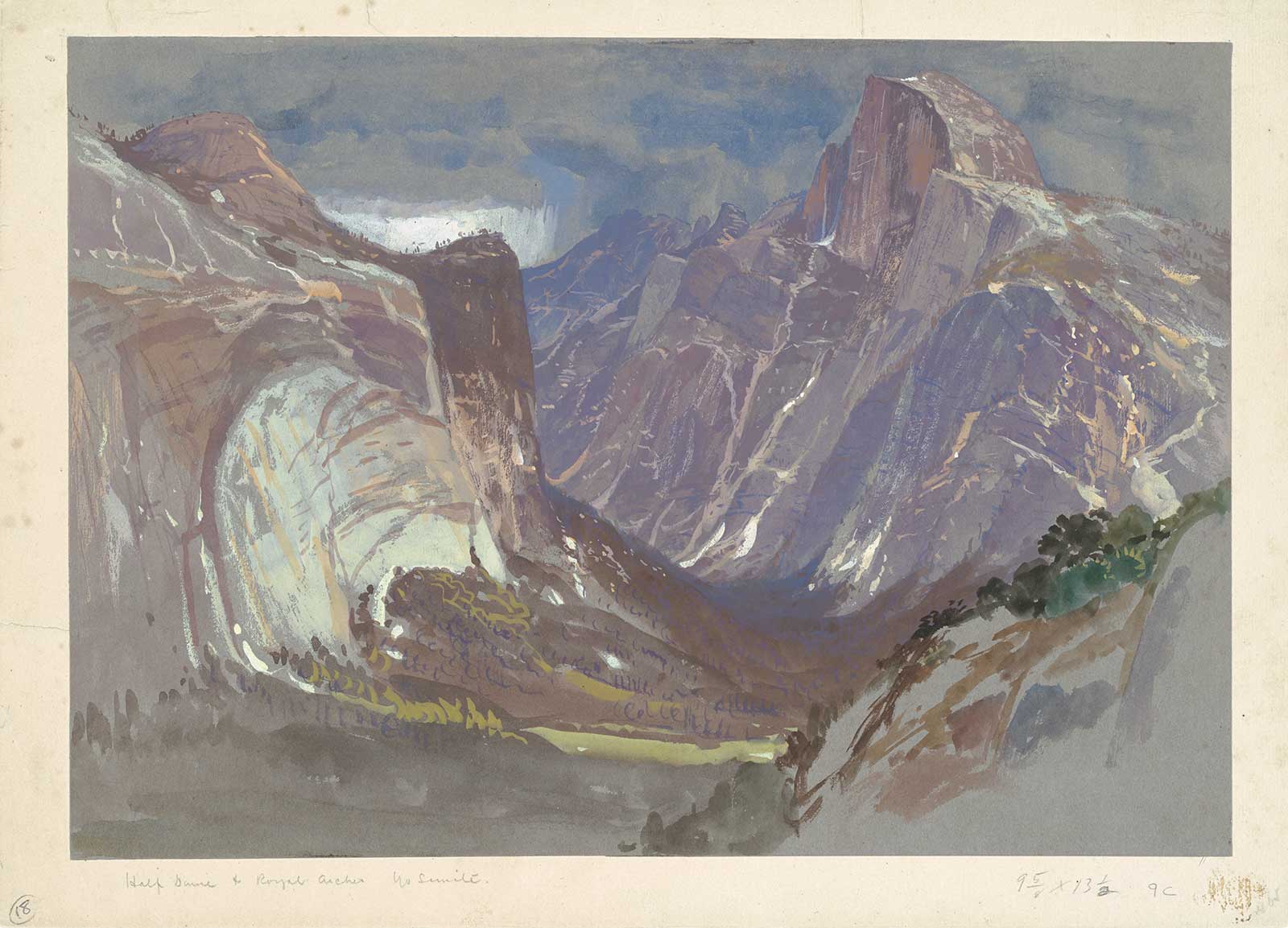
Samuel Colman (1832-1920), Half Dome and Royal Arches, Yosemite, from Glacier Point, ca. 1870, watercolor and gouache over graphite on gray wove paper sheet: 9 5/8 x 13 5/8 in. National Gallery of Art, Corcoran Collection (Museum Purchase through a gift of Ralph Cross Johnson).
Another piece capturing the grandeur of the West is Samuel Colman’s Half Dome and Royal Arches, Yosemite, from Glacier Point, from around 1870. The watercolor and gouache on gray-wove paper depicts the iconic national park landmarks as seen from Glacier Point, which offers one of the most breathtaking views of Yosemite Valley. Born in Maine, Colman was another artist from the east that fell in love with the western landscape. He first traveled to the American West in 1866 and so enamored he began a series of trips to capture its vast beauty on paper.
Another work of note is Winslow Homer’s vibrant Hudson River, Logging, from the early 1890s. Drawing a comparison between Richards’ South-West Point Conanicut and Homer’s river logging scene, Johnston says, “While the two works were painted less than 15 years apart, they exemplify two very different approaches to watercolor painting. Richards painted this dramatic Rhode Island seascape with great care, building up the image with many small brushstrokes of opaque watercolor (gouache) on the tan-colored paper. His choices add up to an overcast view of the cliffs of Conanicut Island which appears very realistic.
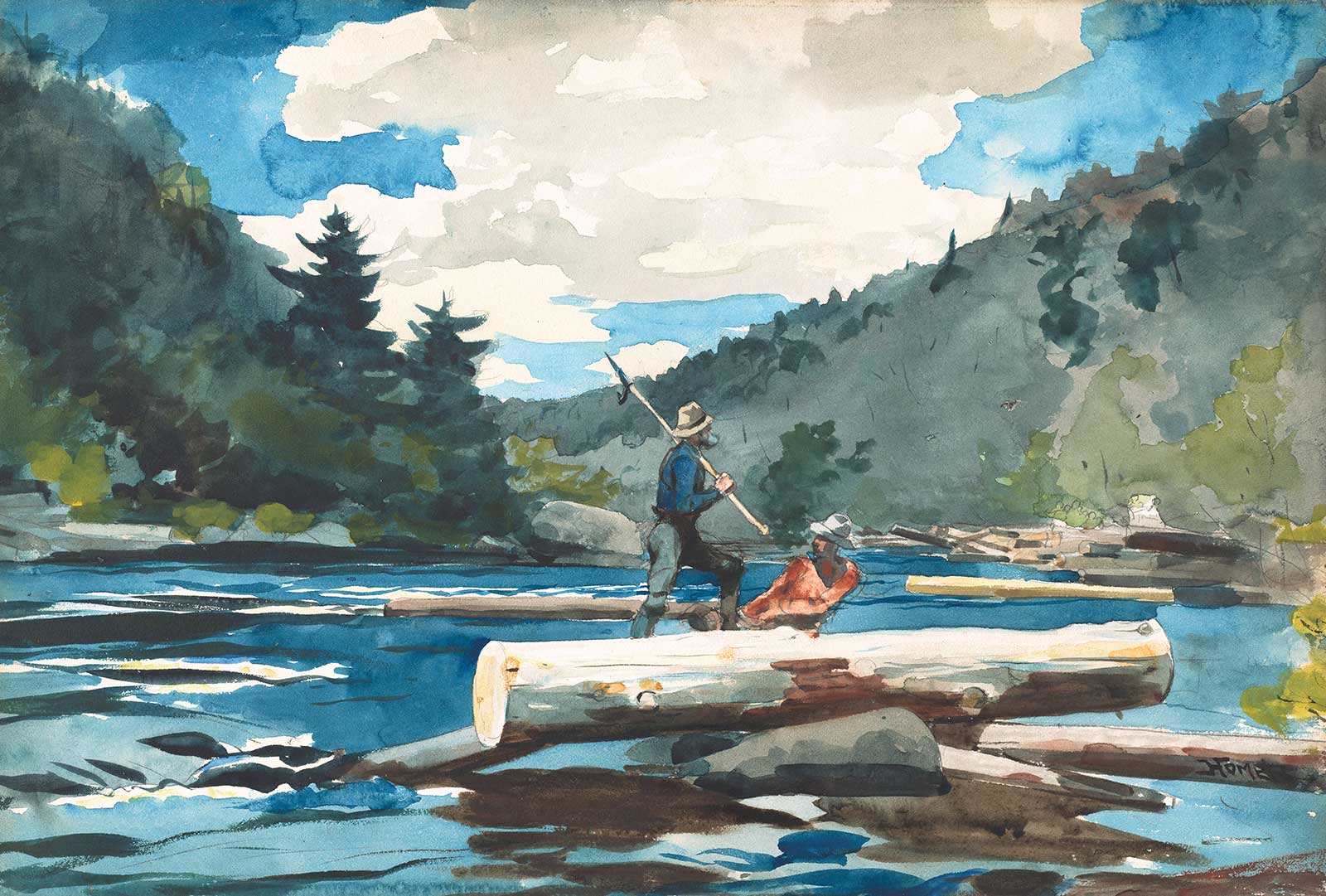
Winslow Homer (1836-1910), Hudson River, Logging, 1891-1892, watercolor over graphite on wove paper sheet, 14 x 20 5/8 in. National Gallery of Art, Corcoran Collection (Museum Purchase).
“Homer on the other hand, was a more independent artist, interested in pushing watercolor to new limits,” Johnson continues. “He applied broad strokes of color with a wet brush, sometimes mixing colors on the paper. And he skillfully reserved spots of white paper. Homer was extremely confident with the medium, exploiting the specific aspects of watercolor—its translucency and fluidity—to its best advantage.”
American Landscapes in Watercolor from the Corcoran Collection opens August 2 and remains on view through February 1, 2026, at the National Gallery of Art in Washington, D.C. —
American Landscapes in Watercolor from the Corcoran Collection
August 2-February 1, 2026
National Gallery of Art
Sixth Street and Constitution Avenue NW, Washington, D.C.
(202) 737-4215, www.nga.org
Powered by Froala Editor


