There is no mistake that the desert is glorifying in all its majesty. That part, at least in the world of Western art, is largely unquestionable. It’s a theme that comes up in many works by countless artists.
And yet, there is also something lurking in paintings of the desert: a feeling of loneliness, isolation and emptiness. These qualities might sound negative or downright terrifying, but consider that these are qualities that make many appreciate the desert even more. We seek out the silence, the isolation and the vast landscapes void of other people. There is a reverence in that stillness.
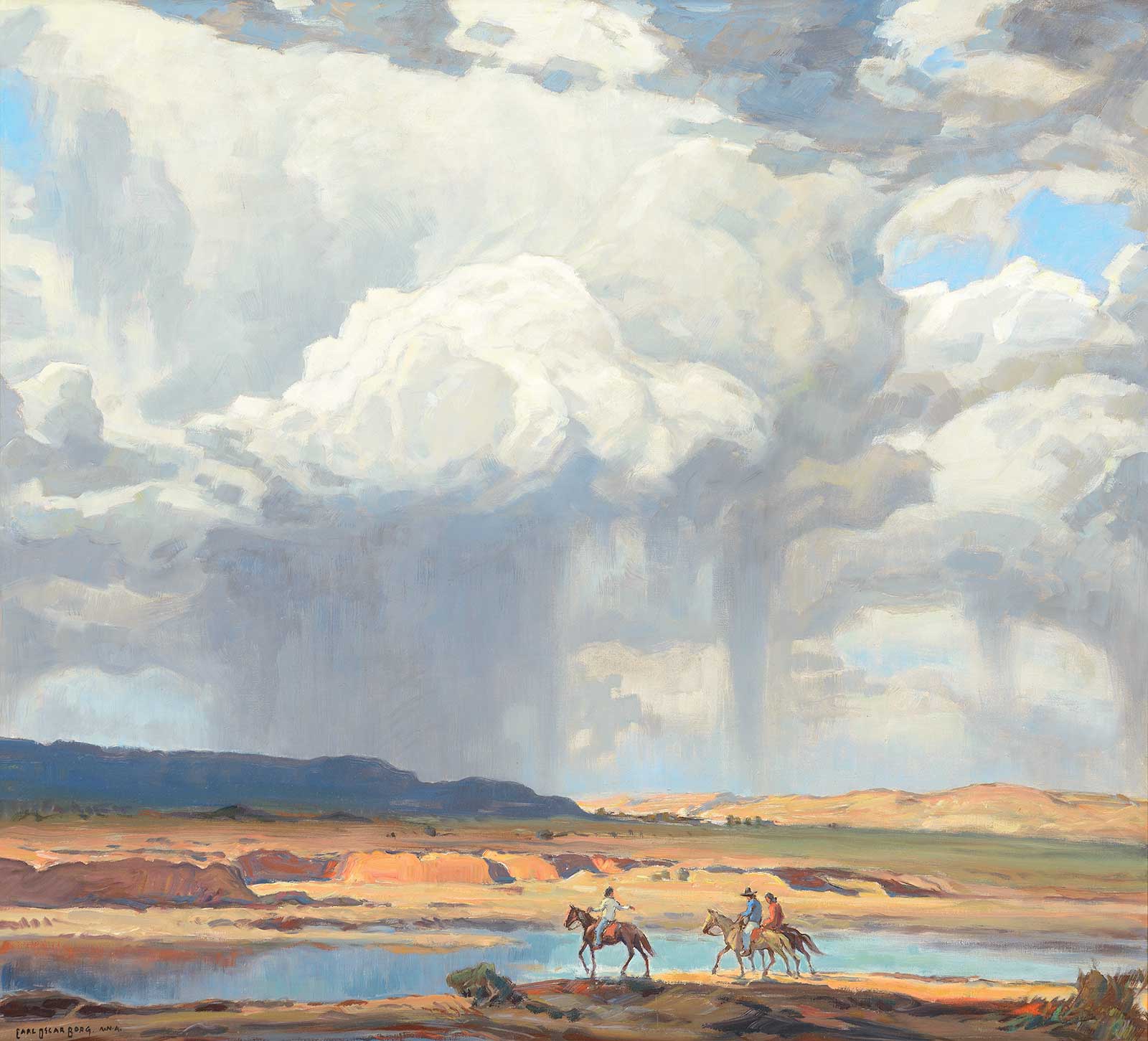 Carl Oscar Borg (1879-1947), Desert Storm, Arizona, oil on canvas, 36 x 40 in.
Author Cormac McCarthy, who lived in Santa Fe until his death in 2023, frequently turned to bleak descriptions of the desert to convey a sense of despair tinged with rugged beauty. His writing reached a fever pitch in his 1985 masterpiece Blood Meridian:
“In two days they began to come upon bones and cast-off apparel. They saw halfburied skeletons of mules with the bones so white and polished they seemed incandescent even in that blazing heat and they saw panniers and packsaddles and the bones of men and they saw a mule entire, the dried and blackened carcass hard as iron. They rode on. The white noon saw them through the waste like a ghost army, so pale they were with dust, like shades of figures erased upon a board. The wolves loped paler yet and grouped and skittered and lifted their lean snouts on the air. At night the horses were fed by hand from sacks of meal and watered from buckets. There was no more sickness. The survivors lay quietly in that cratered void and watched the whitehot stars go rifling down the dark. Or slept with their alien hearts beating in the sand like pilgrims exhausted upon the face of the planet Anareta, clutched to a namelessness wheeling in the night.”
McCarthy went bleaker than most, but the danger of the desert—be it heat and sunlight, lack of water, isolation and madness, or human antagonists—is very real, which gives most paintings uniquely serious stakes, even as the scenery and landscape provide feelings of peace and wonder.
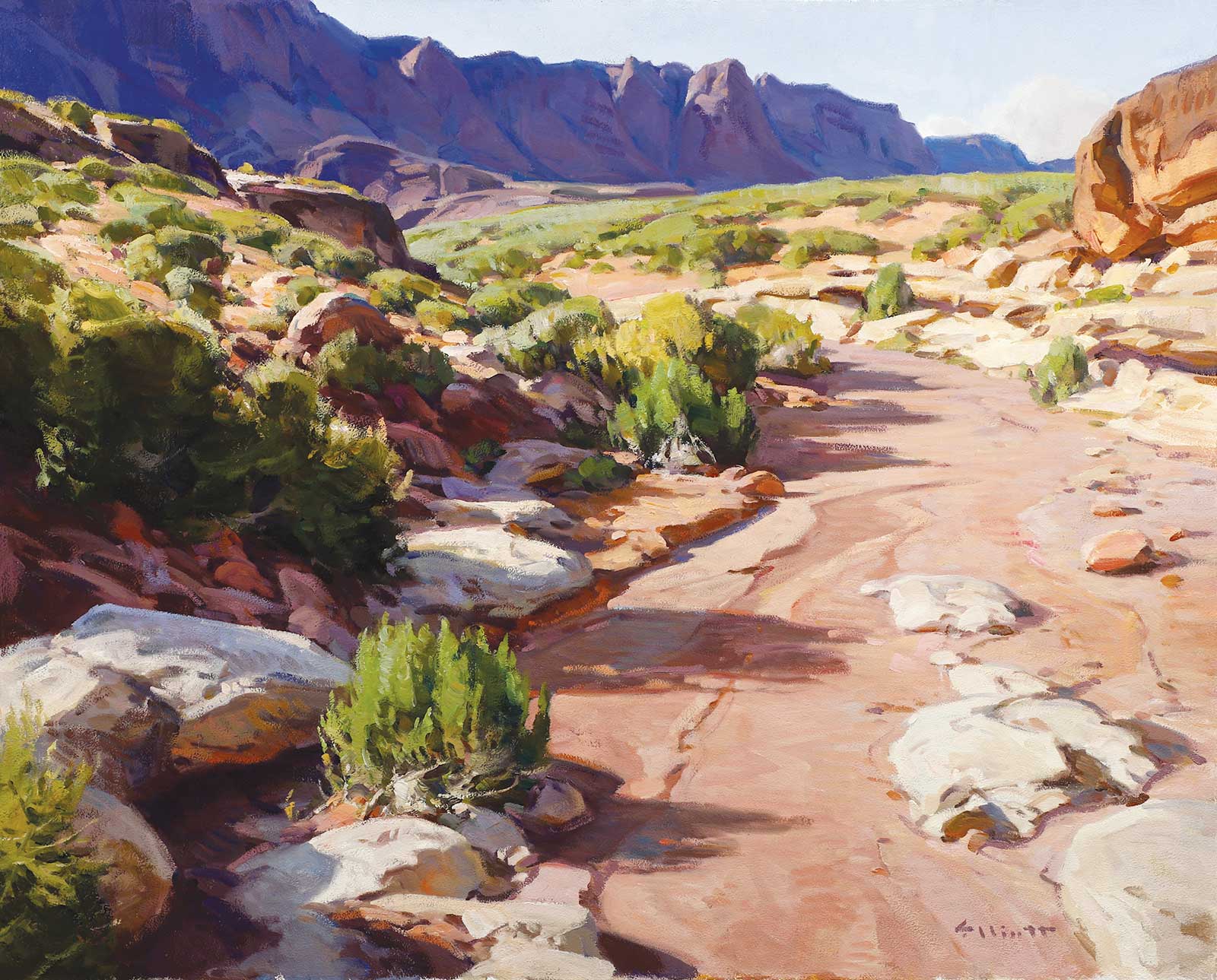 Josh Elliott, Arroyo Echo, oil, 16 x 20 in.
Here, in works by Josh Elliott, Edgar Payne and Carl Oscar Borg, the deserts (and canyons) reveal their dual natures as places of stunning splendor and intense foreboding. The Payne painting, Canyon de Chelly, is especially fascinating. His riders are almost insignificant in the painting as the canyon walls tower over them and create a sense of doom as they ride into a tiny sliver of hopeful light surrounded by shadow.
As you enjoy images of canyons and deserts in this month’s special section, remember that the desert is not just a place, but also a symbol of your relationship with the natural world, be it tranquility or fear, and everything in between.
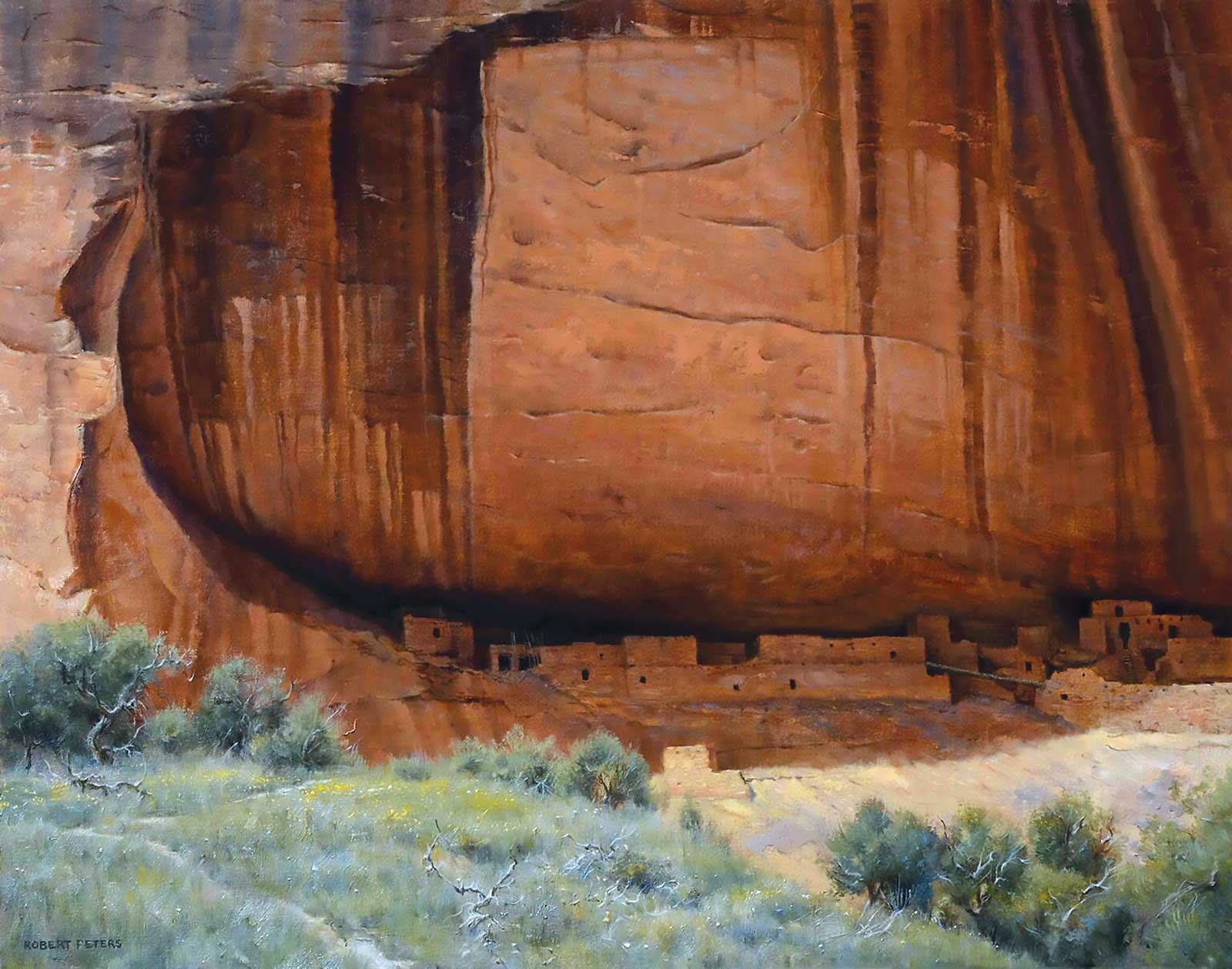
Legacy Gallery, Secrets in Stone, oil, 22 x 28 in., by Robert Peters.
Places like Legacy Gallery represent some of the finest artists in the country focusing on canyon and desert scenery. This includes the above mentioned artist Josh Elliott, with paintings like Rock Garden, Vermilion Cliffs. “Elliott cites many artistic influences and paints a variety of subjects within the landscape genre,” shares the gallery “He is motivated more by ideas than a particular location.” He says, “I look for artistic elements like shapes and patterns, value relationships or color combinations. I want there to be reason to start a painting; do I want to make it epic or poetic or maybe iconic? My hope is that it is always artistic.”
For artist, Robert Peters, the Western landscape is an endless source of inspiration—exemplified in paintings like Secrets in Stone. “I draw strictly from my own observations, which imparts an authentic and natural quality to my paintings,” he says. “If something is in one of my paintings, I’ve been there and I’ve experienced it.”
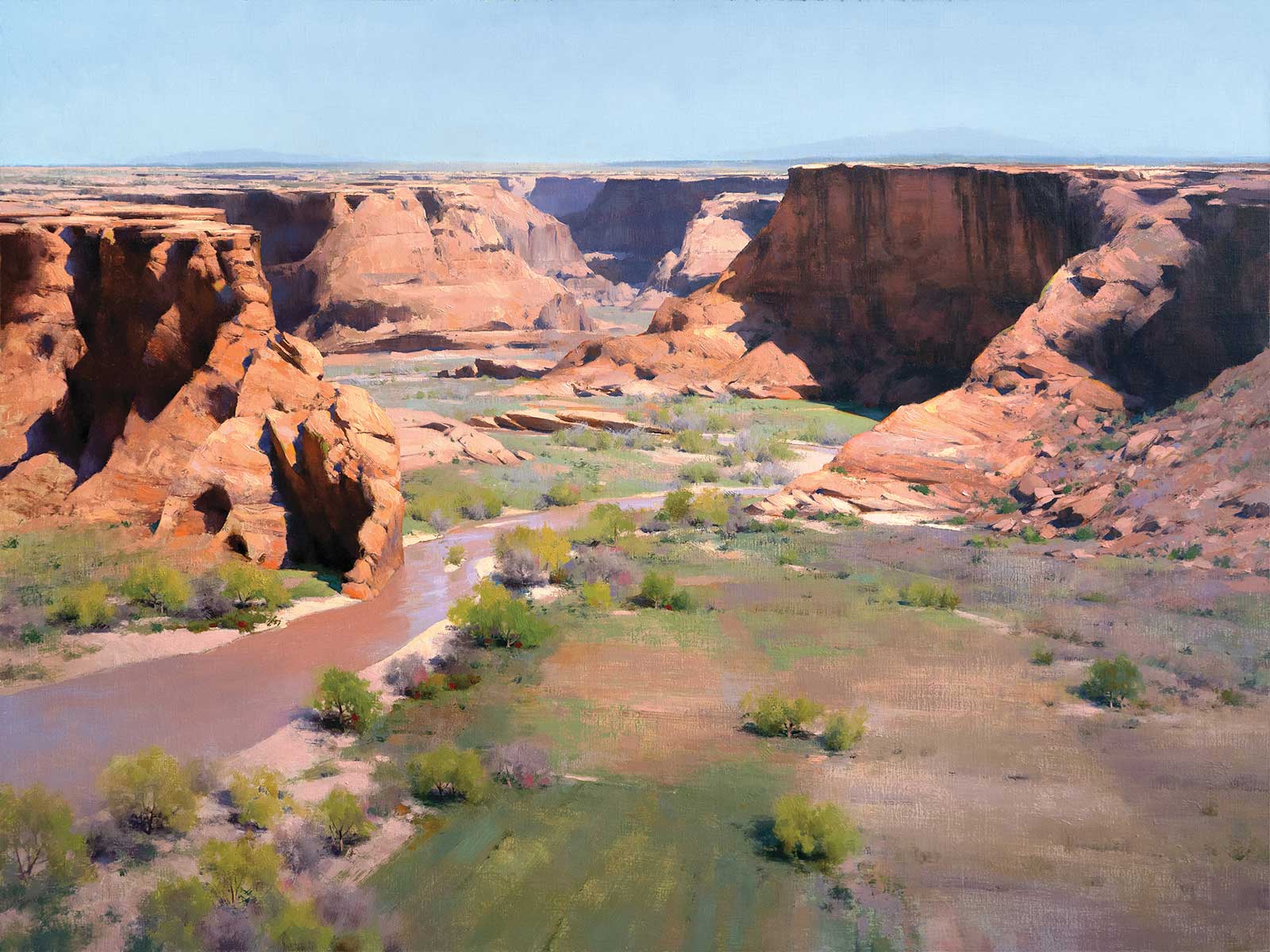
Legacy Gallery, Carved Through Rock and Time, oil, 36 x 48 in., by Mark Boedges.
For yet another Legacy artist, Mark Boedges, the landscape is also a great love and inspiration, as seen in Carved Through Rock and Time. “For me, what is essential about nature is its complexity,” he shares. “Everywhere I look, I see the grittiness, cragginess and fine-grained texture of the natural world. It is this essential ruggedness and complexity that I try to capture in paint.”
Following in his father’s footsteps, Adam Smith, represented by Coeur d’Alene Art Galleries, has done a tremendous job of putting his own stamp on his style. In Canyon Country Gold, a cougar is elevated in the composition as it looks down on potential prey. By elevating his primary subject, it allows Smith to also highlight the reddish gold of the canyon and texture of the rocks in the foreground.
Coeur d’Alene Art Galleries represents additional artists that play with canyon scenery in unique and beautiful ways, as is the case for Tobias Sauer’s painting Dare to Cross; and Bruce Cheever’s oil Grand Canyon.
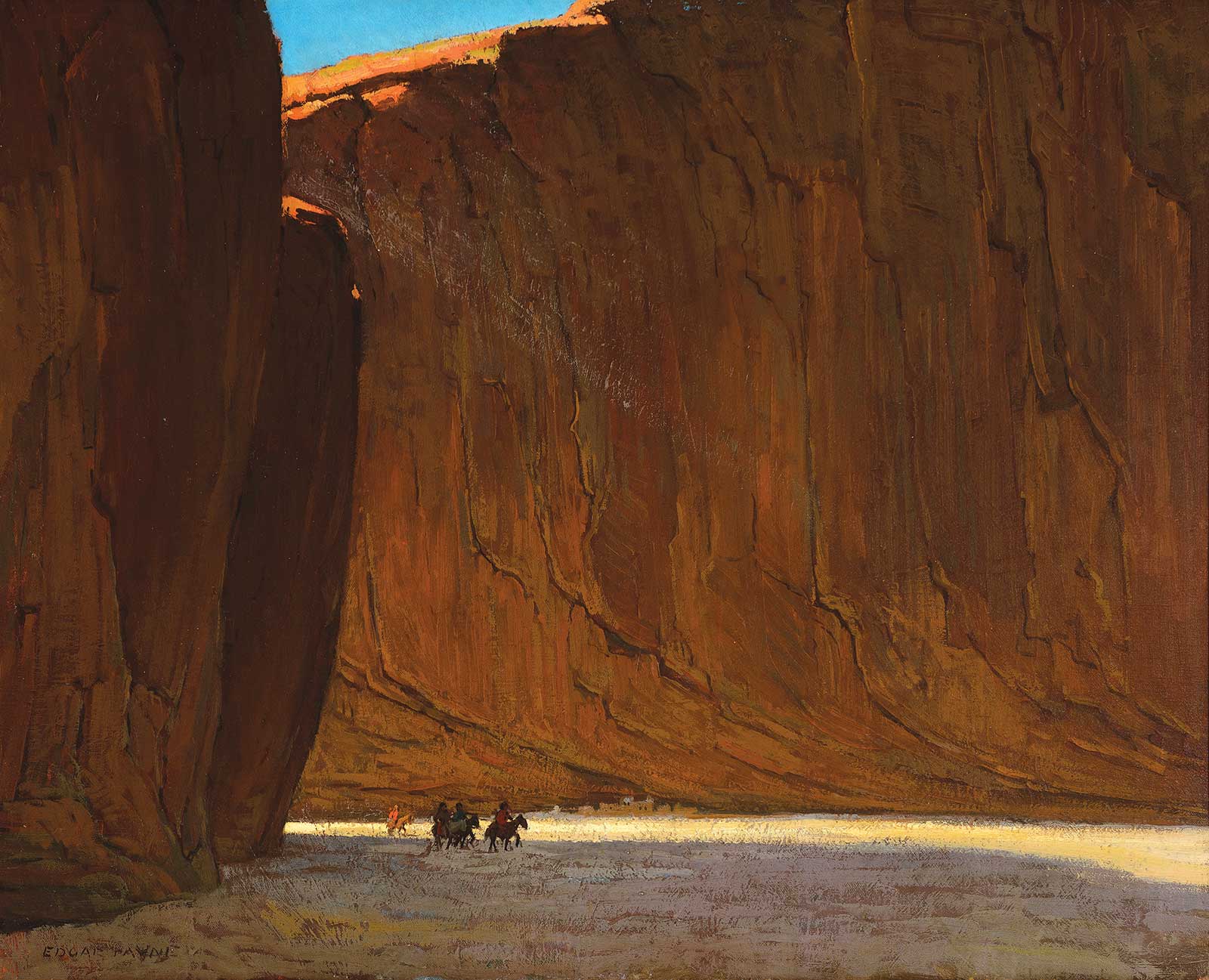
Coeur d’Alene Art Auction, Canyon de Chelly, ca. 1916-1919, oil on canvas, 26 x 32 in., by Edgar Payne (1883-1947).
“My advice for collectors,” says gallery owner Buddy Le, “is to look at as much art as possible. Visit museums and galleries...to view a variety of artists and styles. Eventually, you will easily be able to identify what you like and don’t like. Finally, pull the trigger and buy the art! It’s always the one you don’t buy that haunts you.”
Western landscape artist Arturo Cháveztakes a technical, almost scientific approach, to illuminating the classical beauty of Northern New Mexico, but the exquisite results transcend any formula. Chávez brings meticulous attention to color in his paintings, beginning by painting at least one plein air color study on location before returning to his studio. Regarding the importance in studying color on-site he says, “The human eye is far more sensitive to subtle variations in color than can be revealed in photographs.”
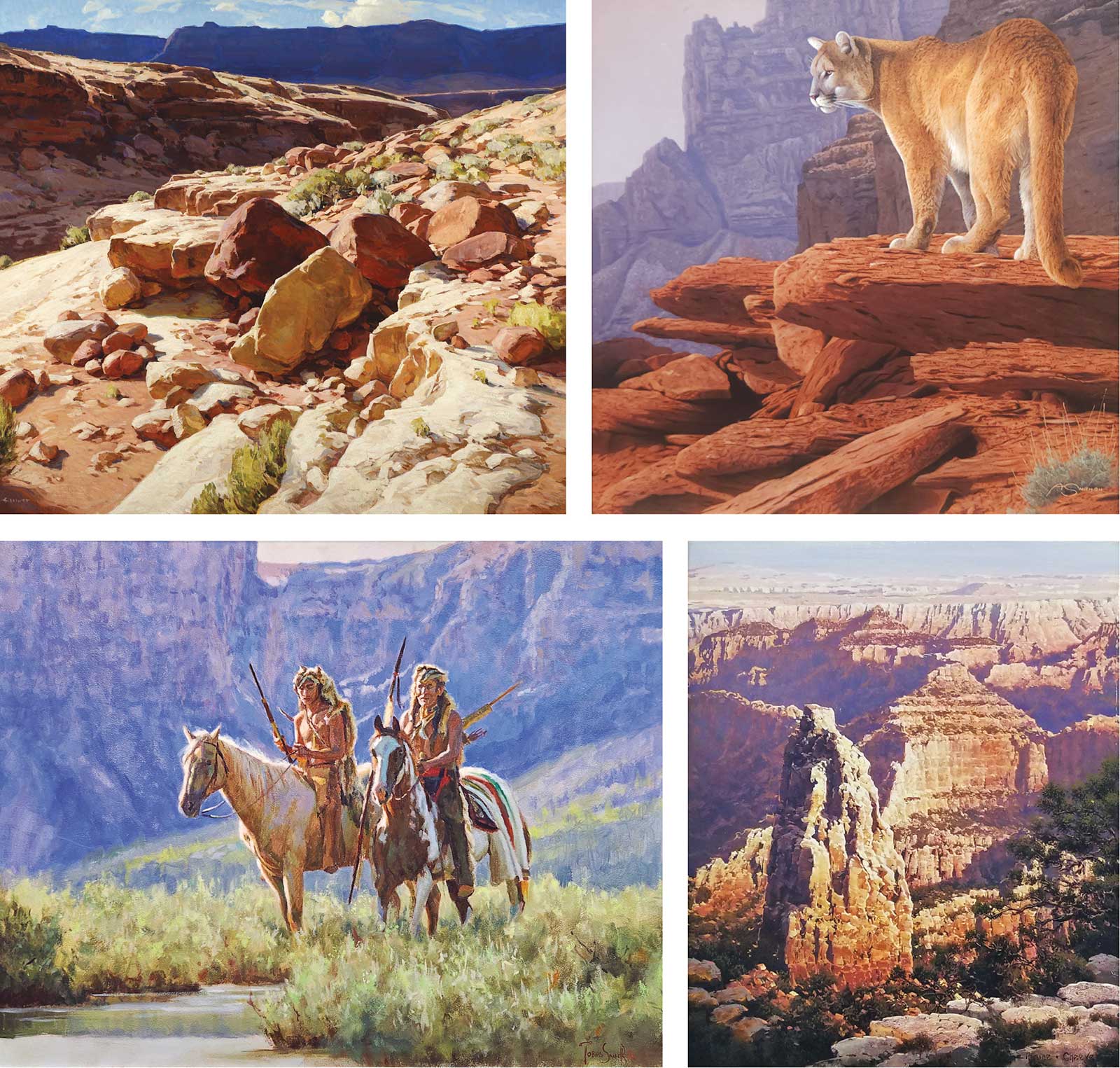
Top: Legacy Gallery, Rock Garden, Vermilion Cliffs, oil, 30 x 33 in., by Josh Elliott. Coeur d’Alene Galleries, Canyon Country Gold, acrylic, 16 x 16 in., by Adam Smith. Bottom: Coeur d’Alene Galleries, Dare to Cross, oil, 24 x 30 in., by Tobias Sauer. Coeur d’Alene Galleries, Grand Canyon, oil, 20 x 16 in., by Bruce Cheever.
Chávez spent his childhood exploring the expansive landforms of Northern New Mexico—his family’s home for 13 generations, dating back to 1601, when the first Chávez came to New Mexico from Spain. Chávez has been studying and painting the landscape for over 40 years. “I never tire of experiencing and painting the magnificent beauty of the ever-changing dynamics of the American Western landscape,” he says.
Artist Robert Obermiller shares that “it can be hard during the long, dry seasons [in the desert] of Texas Hill Country to find spectacular beauty. The spring wildflowers blanketing the hill sides are often the showstoppers that people seek out, rather than brown fields and pastures covered with bland prickly pear cactus. But if you look beyond to the rarer times when the cactus come into bloom, you can get down close and truly appreciate the brilliant colors and intricacies of these lowly and unsung plants. This just calls to me in so many ways to paint and preserve the memories of my time here in the hill country.”
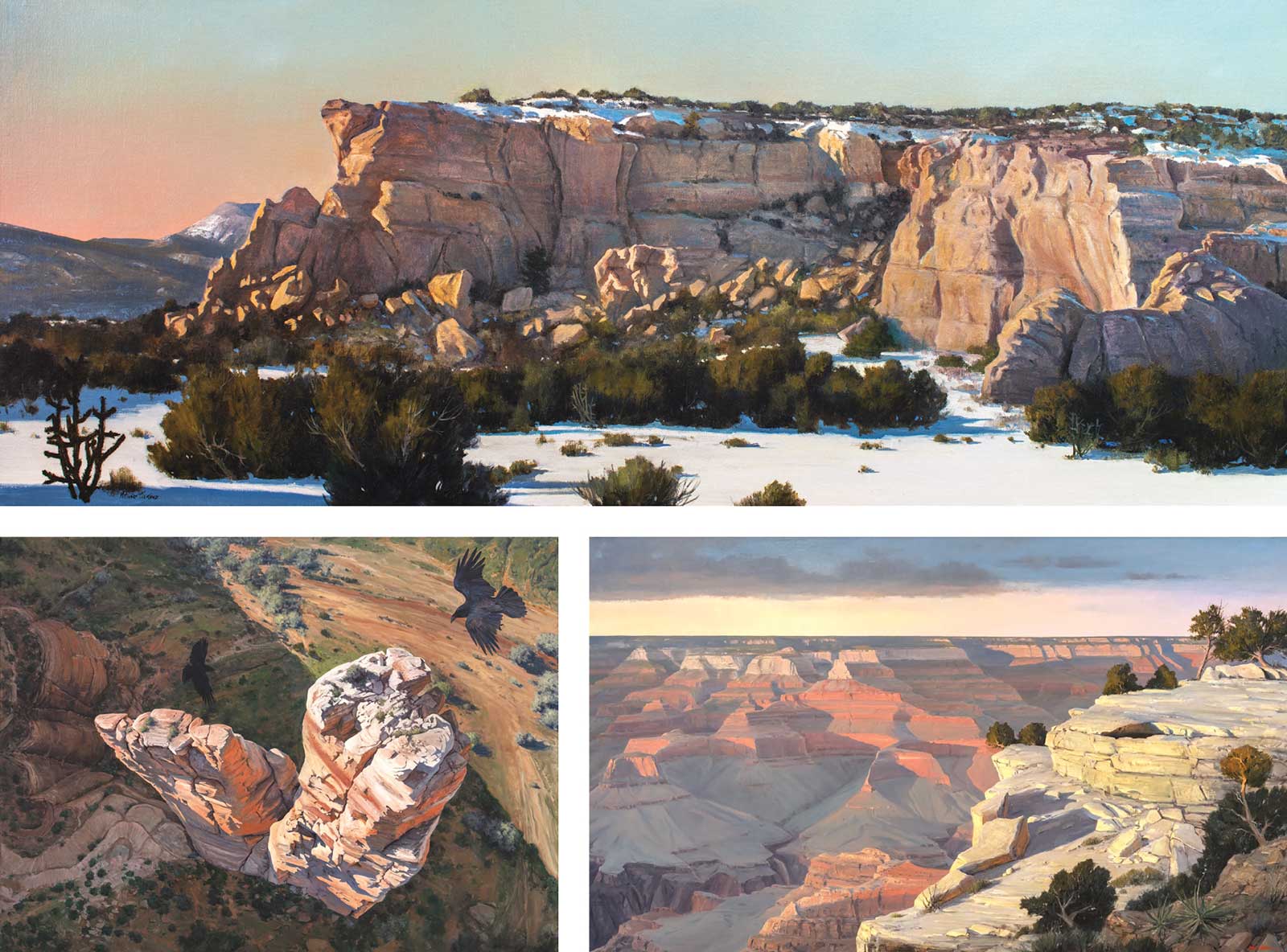
Top: Arturo Chávez, Near La Ventana, oil on linen, 30 x 48 in. Bottom: Arturo Chávez, Three Ravens, oil on linen, 45 x 60 in. Arturo Chávez, Timeless Beauty, oil on linen, 36 x 60 in.
Obermiller adds, “the world is becoming a drier place, and already our wildflowers and bluebonnets are seen less and less. As an artist, I want to continue to paint the memories we have of lost and forgotten places, and emphasize the beauty and success of those things that will continue to thrive in our ever-changing world.”
Being able to explore the canyons in the deserts of the southwest help inspire the subjects that Naomi Brownpaints. “I recently went around Lake Mead and was in awe of the amazing washes and desert canyons,” she says. “This was the first time I had the opportunity to drive through that area. I was in awe of the beautiful array of colors that the mountains had. They were similar to the colors of the painted desert just outside of Winslow, Arizona, but more vibrant. I didn’t have the time to stop and explore, but I’m looking forward to making a trip back so I can take pictures, maybe camp and take the time to paint a few studies for some future paintings.”
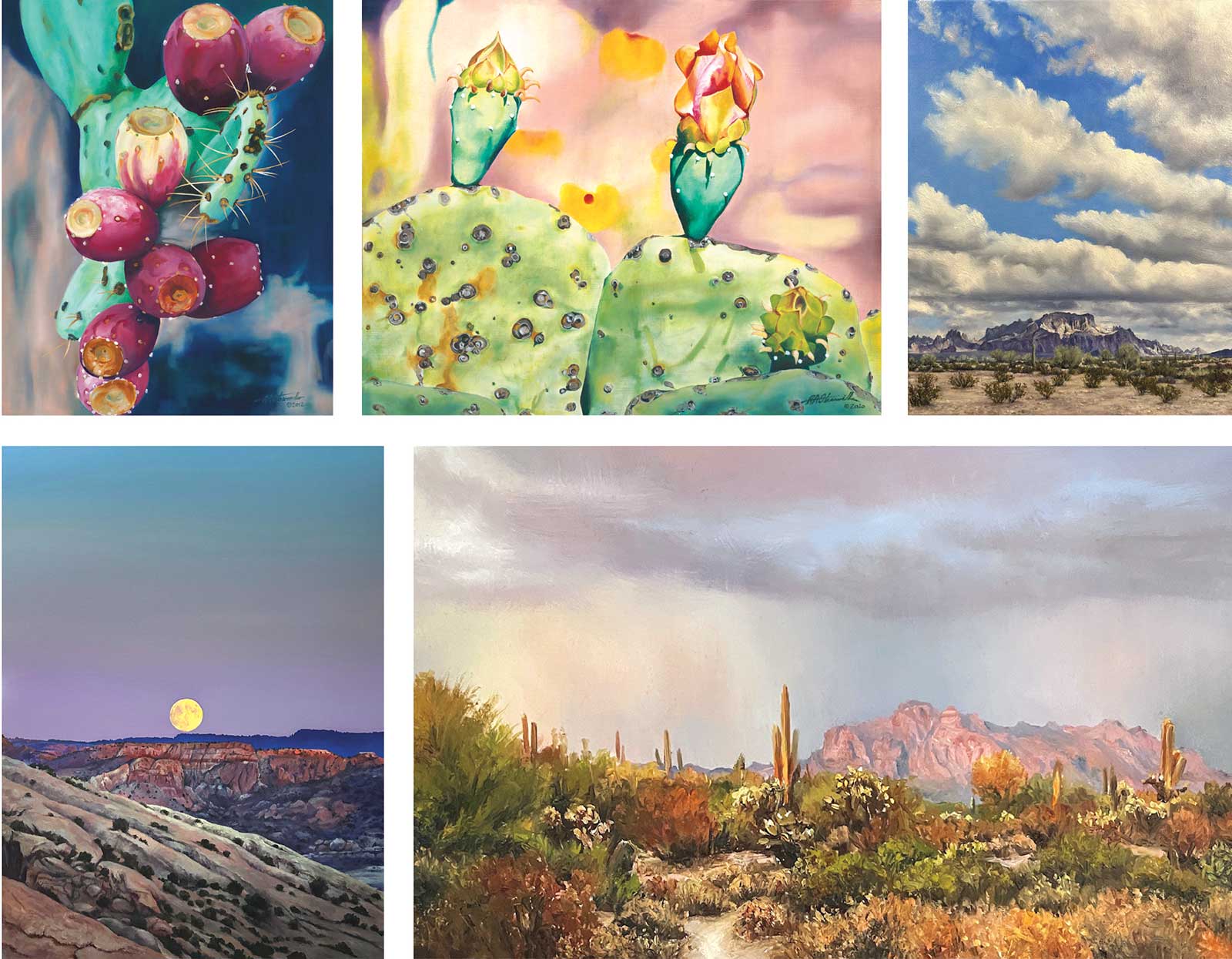
Top: Robert Obermiller, Hill Country Pears, oil on canvas, 20 x 16 in. Robert Obermiller, Hill Country Garden, oil on canvas, 16 x 20 in. Naomi Brown, Clouds Over the Kofa Mountains, oil, 16 x 20 in. Bottom: Naomi Brown, Moonlit Canyons, oil and acrylic, 40 x 30 in. Naomi Brown, Morning Light Superstitions, oil, 9 x 15 in.
Artist Steve Hastings presents unique desert scenery in pieces like Brave New Bloom, a highly animated composition that “more than implies an aggressive oscillation between foreground and background, causing the viewer to recoil from the cactus needles and the advancing hills and buttes,” he says. “The oscillation flips from experiencing the picture plane advancing into the viewer’s space and the sensation of the viewer falling into the picture plane.”
His piece Badlands depicts a “denizen of the high desert that wore every bit of finery in its possession in order to sit for this portrait,” the artist continues. “The painter need only to capture what is there.” In T-Bird, Hastings invites you to lay in wait with him as he kneels beneath a cluster of fiery swirling blossoms in order to sneak a peek at the mountain’s birthmark… The light is brilliantly handled, but it is the depiction of the air that is stunning.
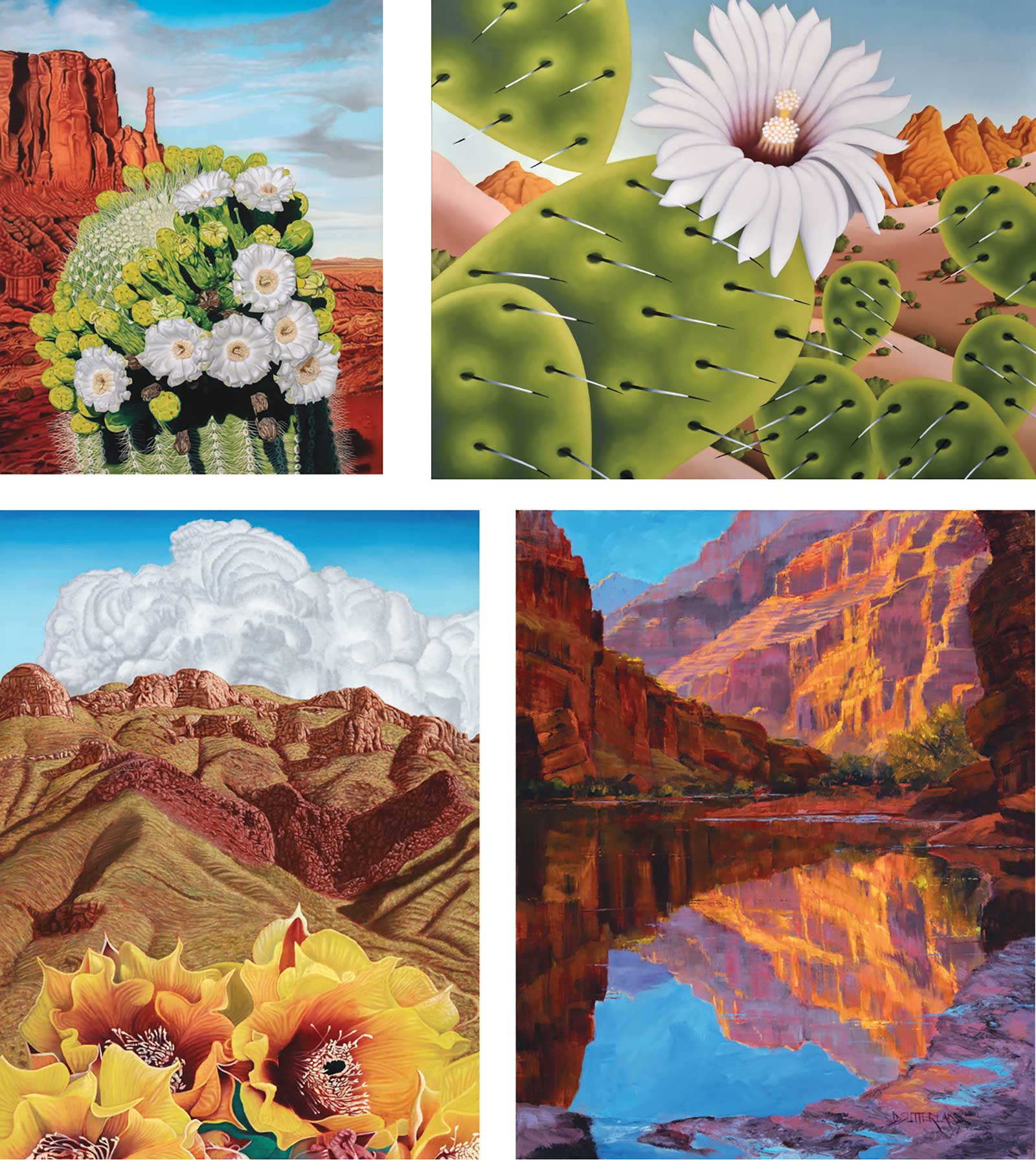
Top: Steve Hastings, Badlands, oil on canvas, 60 x 48 in. Steve Hastings, Brave New Bloom, oil on canvas, 48 x 60 in. Bottom: Steve Hastings, T-Bird, oil on canvas, 40 x 30 in. Dawn Sutherland, Heaven Reflected, oil, 30 x 24 in.
Sometimes it is the time-worn walls, the still water or a glimpse of the sky above that makes the Grand Canyon such an intriguing subject to paint for artist Dawn Sutherland. “Sometimes the Canyon presents us with a gift of all three,” she adds. “Heaven Reflected honors these three features with the focus on the reflections giving one an intimate and unusual view.”
When collecting artwork depicting canyons and deserts, Sutherland says, “A painting may remind a viewer of a place they’ve seen or take them to a location they may never have an opportunity to visit. Landscape paintings carry that unique gift right into one’s home.” —
Featured Artists & Galleries
Featured Artists & Galleries
Arturo Chávez
www.arturochavez.com
Naomi Brown
www.naomibrownart.com
Instagram: @naomibrownart
Coeur d’Alene Art Auction
www.cdaartauction.com
(208) 772-9009
Coeur d’Alene Galleries
213 Sherman Avenue, Coeur d’Alene, ID 83814
(208) 667-7732
www.cdagalleries.com
Josh Elliott
www.joshelliottart.com
Instagram: @joshelliottart
Steve Hastings
El Paso, TX
stevehastingsworks.com
Legacy Gallery
7178 Main Street, Scottsdale, AZ 85251
(480) 945-1113
www.legacygallery.com
Robert Obermiller
raoartist@robertobermiller.com
www.robertobermiller.com
Dawn Sutherland
Flagstaff, AZ
dawn@dawnsutherlandfineart.com
www.dawnsutherlandfineart.com
Powered by Froala Editor


