Before the market hunters killed all the buffalo. Before the transcontinental railroad. Before the western Indian wars fully erupted, Swiss draftsman Karl Bodmer (1809-1893) accompanied German naturalist Prince Alexander Philipp Maximilian of Wied-Neuwied, Germany (1782-1867), on a scientific journey from St. Louis to the northwestern reaches of the Missouri River, as far as Fort McKenzie, a trading post north of what is now Great Falls, Montana. Between April 1833 and May 1834, they traveled by steamship where the river was wide up to Fort Union in present day North Dakota, and then by keelboat. Returning, they spent a particularly brutal winter camped three months near the Mandan village, Mih-Tutta-Hangkusch.
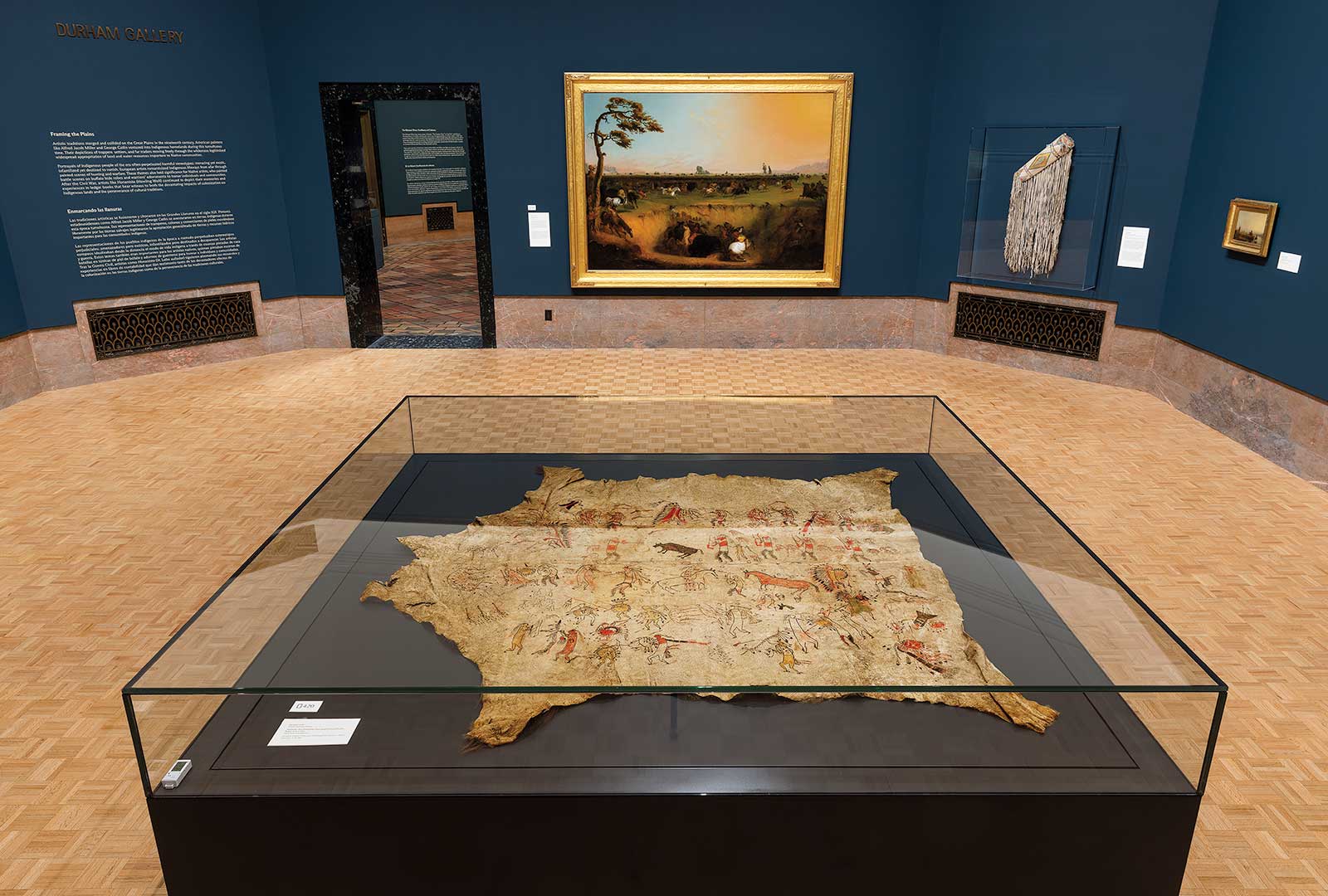
Installation view of the Joslyn’s Durham Gallery. Pictured in foreground: Ancestor Artist, Očhéti Šakówiŋ (Sioux), Tĥatĥáŋka Šiná Wiokíčhize Zuya Iyuŋpi (Painted Buffalo Robe), before 1846, bison hide and pigment, Friedrich Köhler Collection. Ethnologisches Museum, Staatliche Museen zu Berlin, Germany, IV B 208. Photograph courtesy Bill Ganzel, Ganzel Group Communications, Inc.
Making their nearly 5,000-mile round-trip journey in advance of events that would bring cataclysmic change to the Upper Plains in subsequent decades, the artist and the aristocrat found, and meticulously documented, a dynamic network of Native American nations spread across hundreds of thousands of square miles featuring biodiversity and a profusion of animals unimaginable today.
This was the apex of the Plains Tribes.
Native communities had been interacting with non-Natives for decades and had already survived epidemics and changes, but nothing like what was to come.
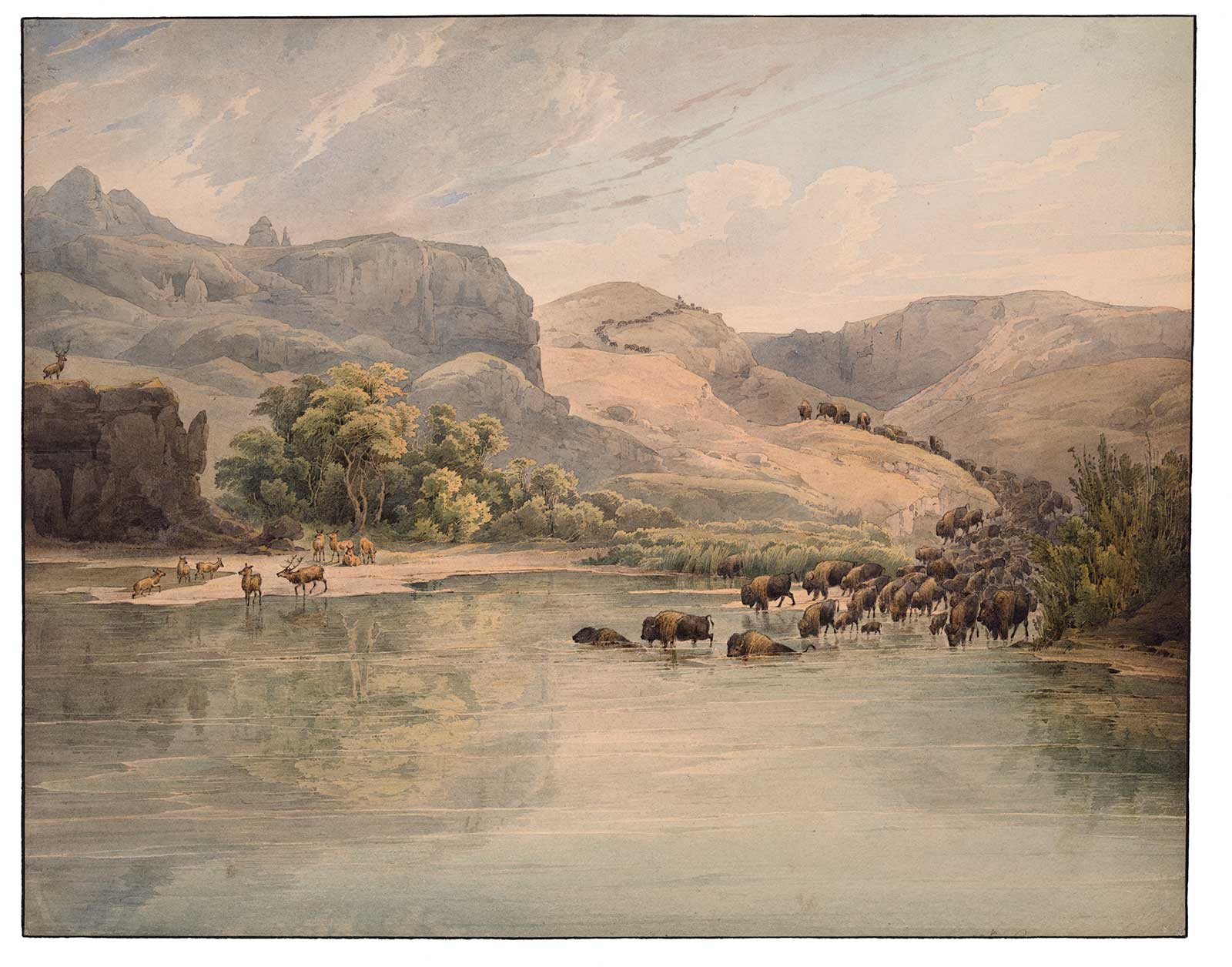
Karl Bodmer (1809-1893), Buffalo and Elk on the Upper Missouri, 1833, watercolor and graphite on paper, 9¾ x 123/8 in. Joslyn Art Museum, Omaha, Nebraska. Gift of the Enron Art Foundation, 1986.49.214. Photograph © Bruce M. White, 2019.
What Bodmer and Maximilian experienced along the Missouri River would have been largely unknown to non-Native people outside the fur trappers and traders who travelled the same routes. The American Fur Company, founded in 1808 by John Jacob Astor, future wealthiest man in America, was essential to the expedition, assisting with introductions to Native people and logistics.
Bodmer was a prominent European artist hired by Maximilian to visually record the journey. Through some 400 drawings and watercolors produced along the way, he depicted the landscapes, plants and animals, and, most spectacularly, portraits of Indigenous leaders from the Missouri River tribes the 50-man party interacted with.
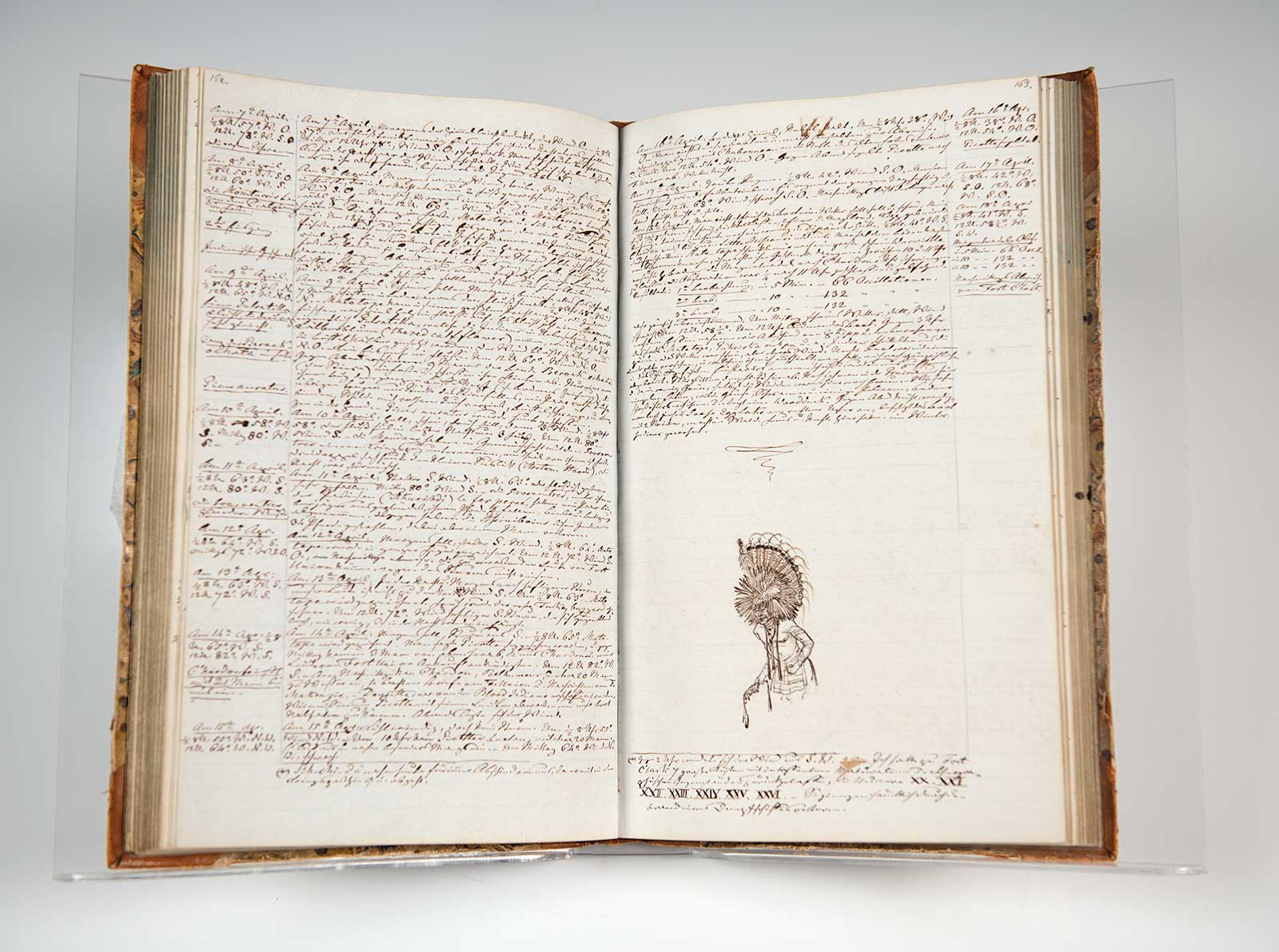
Prince Maximilian zu Wied (1782-1867), Journal (Tagebuch), Volume III, September 1833-August 1834, p. 162-163, ink and graphite on paper. Joslyn Art Museum, Omaha, Nebraska. Gift of the Enron Art Foundation, 511.NNG.
Bodmer’s acute sensitivity of observation, combined with subtle, refined brushwork, provided an unparalleled level of detail on roughly 90 sitters, almost exclusively men, from the Omaha, Ponca, Yankton, Lakota, Mandan, Hidatsa, Assiniboine and Blackfoot nations among the many encountered. These details matter. Every beaded design, carefully arranged feather and painted robe carries meaning and tells a story. The artist’s precise eyewitness attention to facial likeness, body decoration and regalia distinguishes his work.
Historian William H. Goetzmann, who contributed an essay to a 1984 book reproducing Bodmer’s watercolors, Karl Bodmer’s America,” wrote, “No other painter of the American Indian came close to the ethnographic accuracy that Bodmer achieved in clothing, ornamentation, body marking, accouterments and ceremonial paraphernalia.”
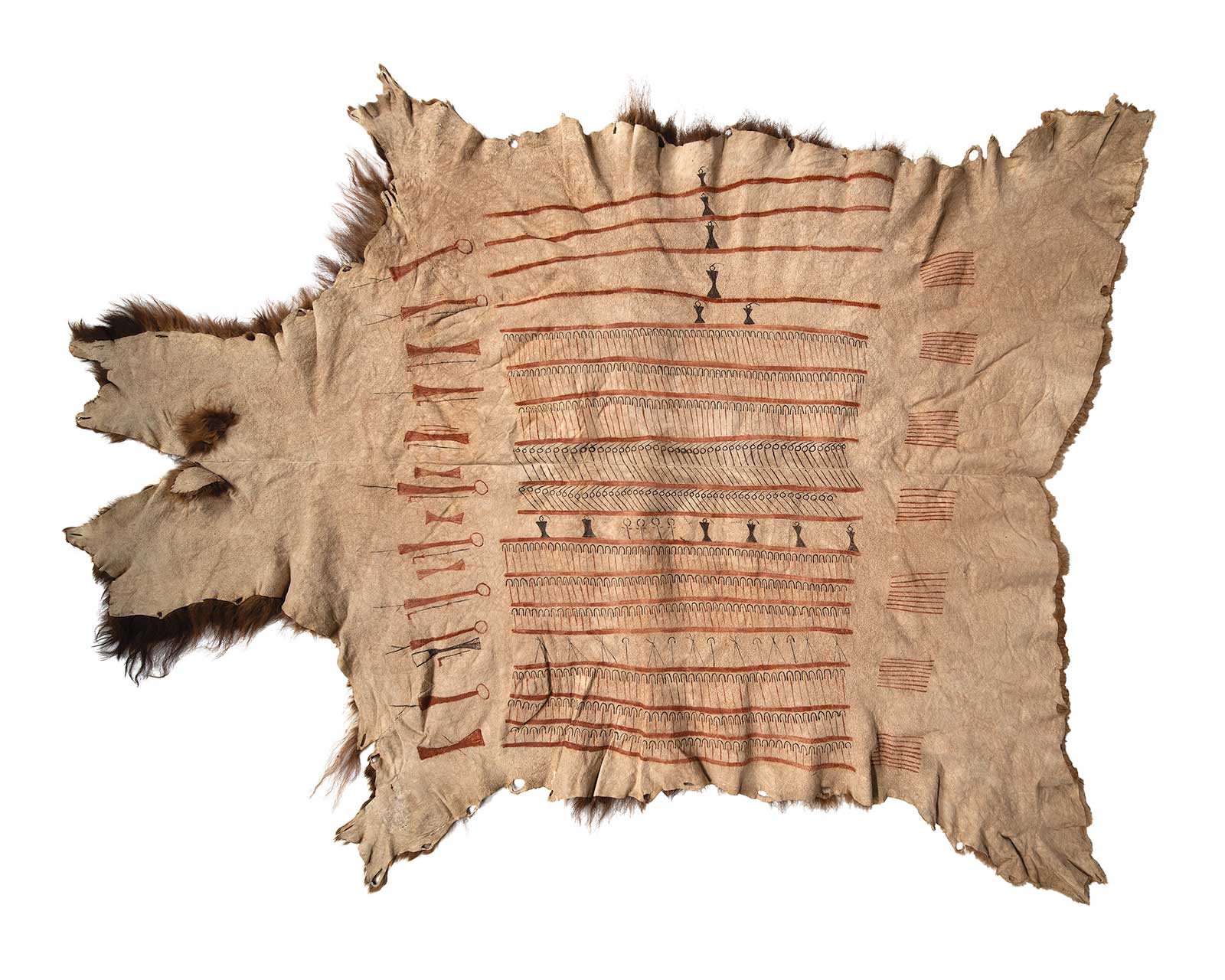
Ancestor Artist, Hiraacá (Hidatsa), Āashi (Robe), ca. 1830, bison hide and pigment, 10615/16 x 855/8 × 65/16 in. Maximilian zu Wied Collection, Ethnologisches Museum, Staatliche Museen zu Berlin, Germany, IV B 202. Photograph: Jon Hustead.
Bodmer’s portraits were created through diplomatic and social exchanges described in Maximilian’s extensively detailed journals. The Prince’s journals—three volumes with sketches and written descriptions—are a staggering time machine in their own right. An eight-year research project was required to translate them.
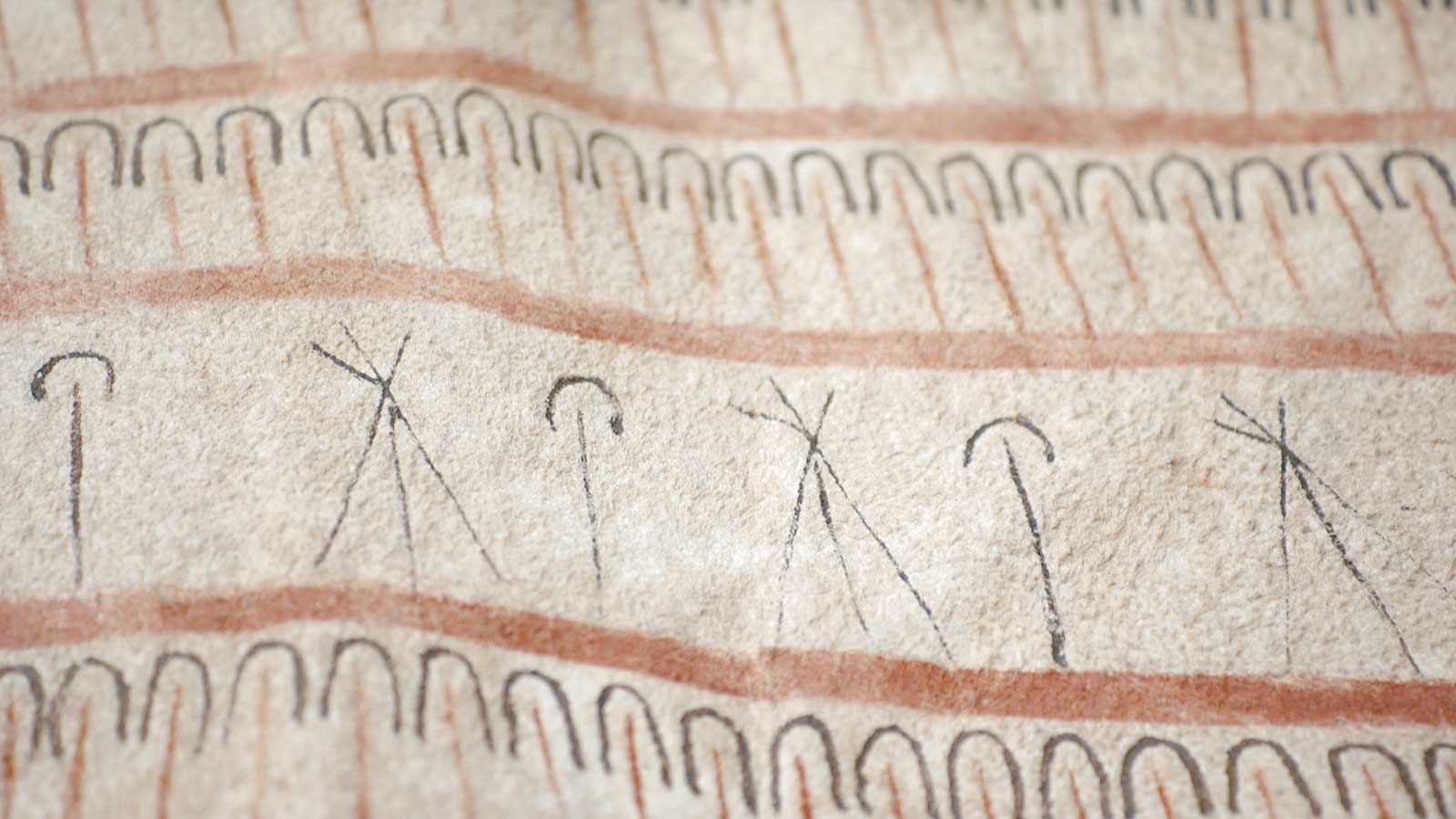
Ancestor Artist, Hiraacá (Hidatsa), Āashi (Robe), ca. 1830, bison hide and pigment, 10615/16 x 855/8 × 65/16 in. Maximilian zu Wied Collection, Ethnologisches Museum, Staatliche Museen zu Berlin, Germany, IV B 202. Photograph: Jon Hustead.
Taken together, what has come to be known as the Maximilian-Bodmer Collection represents, “perhaps the most important document of the American West because it is written material as well as visual material,” says Jack Becker, Joslyn Art Museum executive director and CEO. The collection forms a cornerstone of the Joslyn Art Museum in Omaha, Nebraska.
“Lewis and Clark are an incredible research archive. Those journals are fascinating, but you have to imagine what they’re thinking about or talking about in your head,” Becker says. “The ability to connect the text with the image and to have a visual record as well as a written record is remarkable. There are times in the journals (Maximilian references) the (Bodmer) watercolors (and what they were) depicting.”
Pictures and words.
Lewis and Clark’s journals lack the pictures. George Catlin’s (1796-1872) paintings of Native people lack the words. The Maximilian-Bodmer Collection has both.
Coincidentally enough, Bodmer and Maximilian met William Clark, then superintendent of Indian Affairs, in St. Louis before embarking, and Catlin first traveled from St. Louis up the Missouri River to paint Native people and their homelands in 1832, one year prior to Maximilian and Bodmer.
The Maximilian–Bodmer Collection
Reopened in September of 2024 following a two-year construction closure for renovations and expansion, Maximilian-Bodmer Collection artworks ground the Joslyn’s reinstalled American galleries weaving together more than 150 years of creativity across cultures and artistic traditions in North America.
“It is a collection that has national and international significance,” Becker says.
So much so that the Metropolitan Museum of Art in New York exhibited Bodmer watercolor portraits of Native people from the Joslyn in 2021.
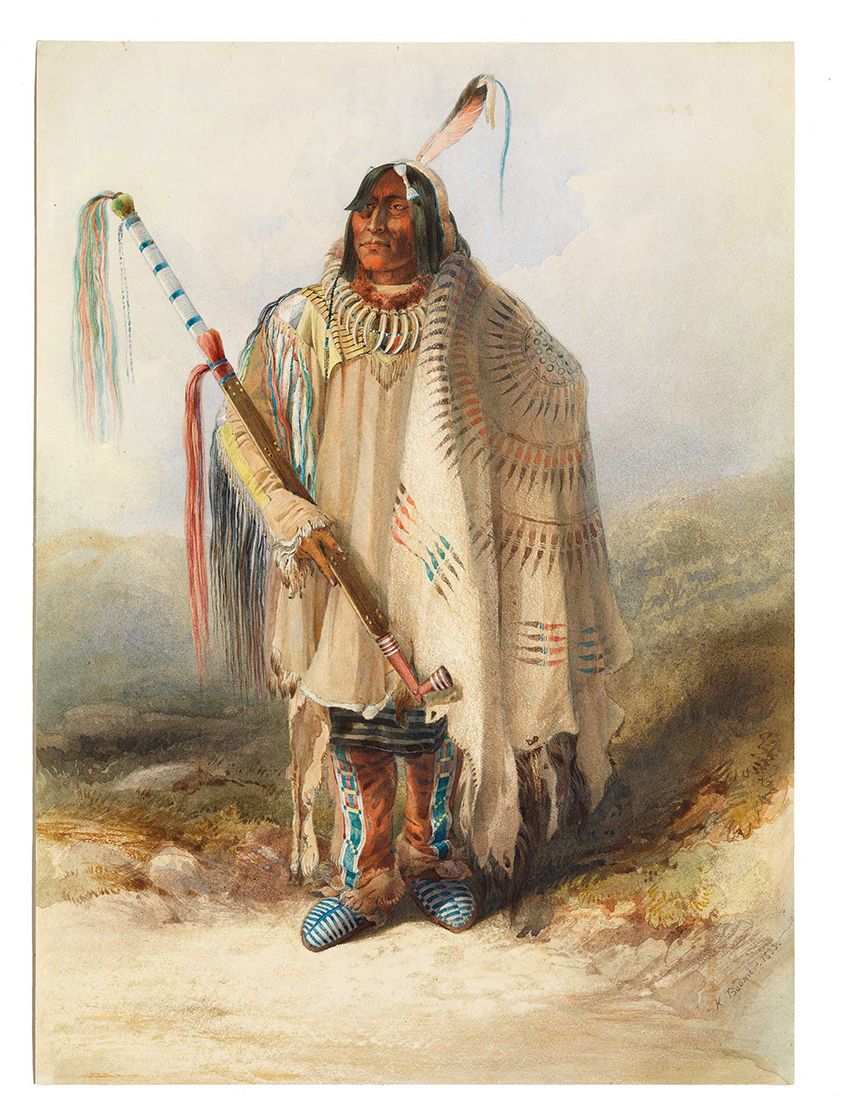
Karl Bodmer (1809-1893), Péhriska-Rúhpa, Hidatsa Man, 1833, watercolor and graphite on paper, 157/8 x 11½ in. Joslyn Art Museum, Omaha, Nebraska. Gift of the Enron Art Foundation, 1986.49.390. Photograph © Bruce M. White, 2019.
Local significance, too. Omaha sits on the banks of the Missouri River. Bodmer and Maximilian would have passed within two miles of where the Joslyn is today. The pair met and documented encounters with the Omaha (Umoⁿhoⁿ) nation. When the Joslyn last exhibited the portraits in large numbers, after they were on view at the Met, it recruited numerous descendants of individuals represented from around the region to gain further insight into what Bodmer’s sitters were seen wearing and why.
Throughout the expedition and after, all that had been collected, written, and painted was crated up and shipped back to St. Louis, then on to present day Germany. Included in the lot were four live bears destined for trans-Atlantic transport.
Upon returning, Maximilian wrote up his observations in a two-volume book titled Travels in the Interior of North America.Bodmer created copper plates from his watercolors, producing and publishing commercial prints sold across Europe.
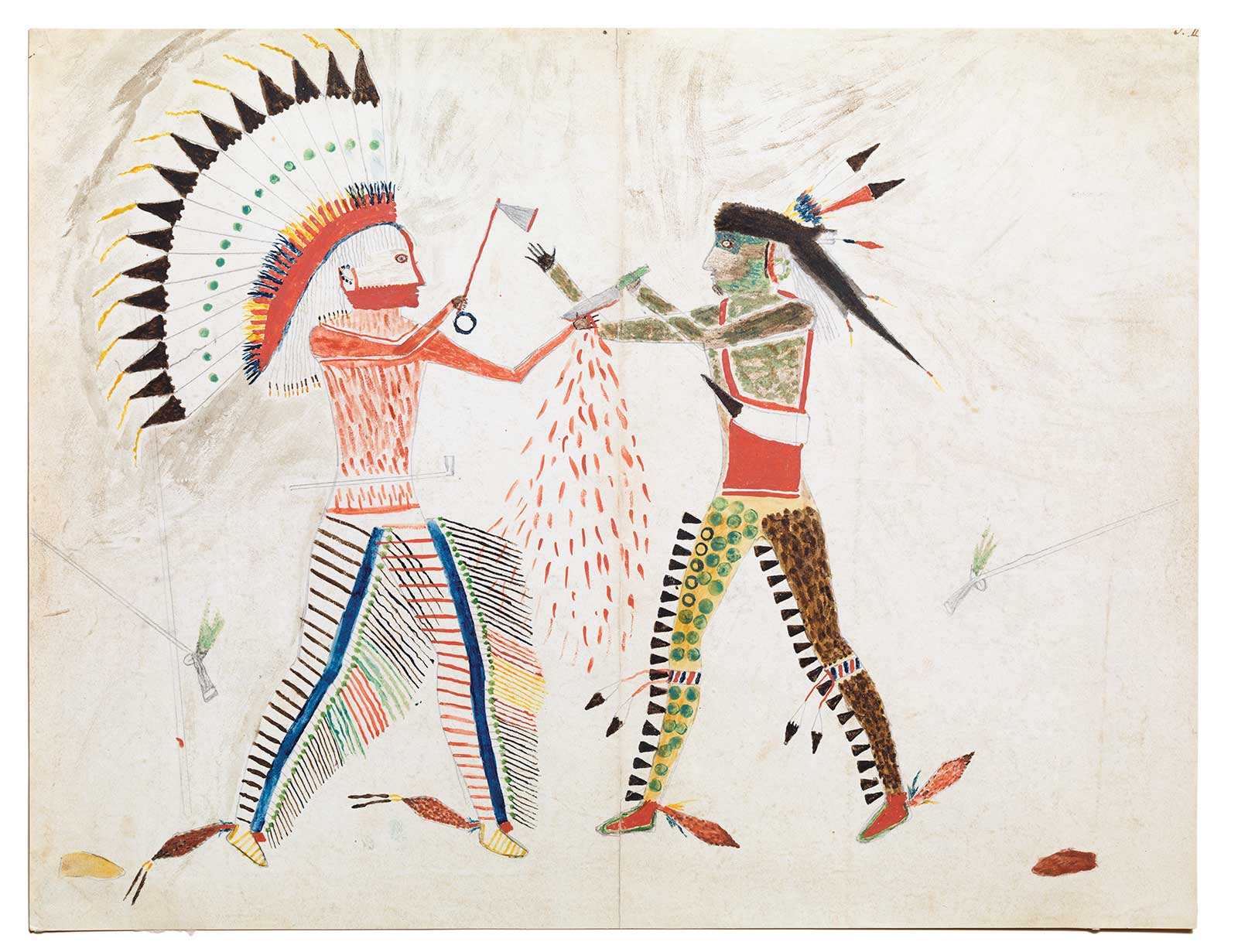
Mató-Tópe (Four Bears) (Mandan, ca. 1795-1837), Battle with a Cheyenne Chief, 1834, watercolor and graphite on paper, 12 x 155/8 in. Joslyn Art Museum, Omaha, Nebraska. Gift of the Enron Art Foundation, 1986.49.384. Photograph © Bruce M. White, 2019.
The whole lot came to market after World War II. It was acquired by a dealer in New York, then by a local Omaha company, Northern Natural Gas. That company, infamously, became Enron, and gifted the Maximilian-Bodmer Collection to the Joslyn in 1986.
The full collection includes Bodmer’s original watercolors, drawings and copper plates, along with Maximilian’s original journals, letters and ephemera acquired along the way. Also included are paintings by Mandan Síh-Chidä made during the winter of 1833-34 at Fort Clark, highlighted by a watercolor and graphite self-portrait. Mandan Chief Mató-Tópe produced a watercolor of hand-to-hand combat with a Cheyenne chief given to Maximilian and Bodmer. Additional watercolors produced by Bodmer from his travels around America prior to heading up the Missouri are also included.
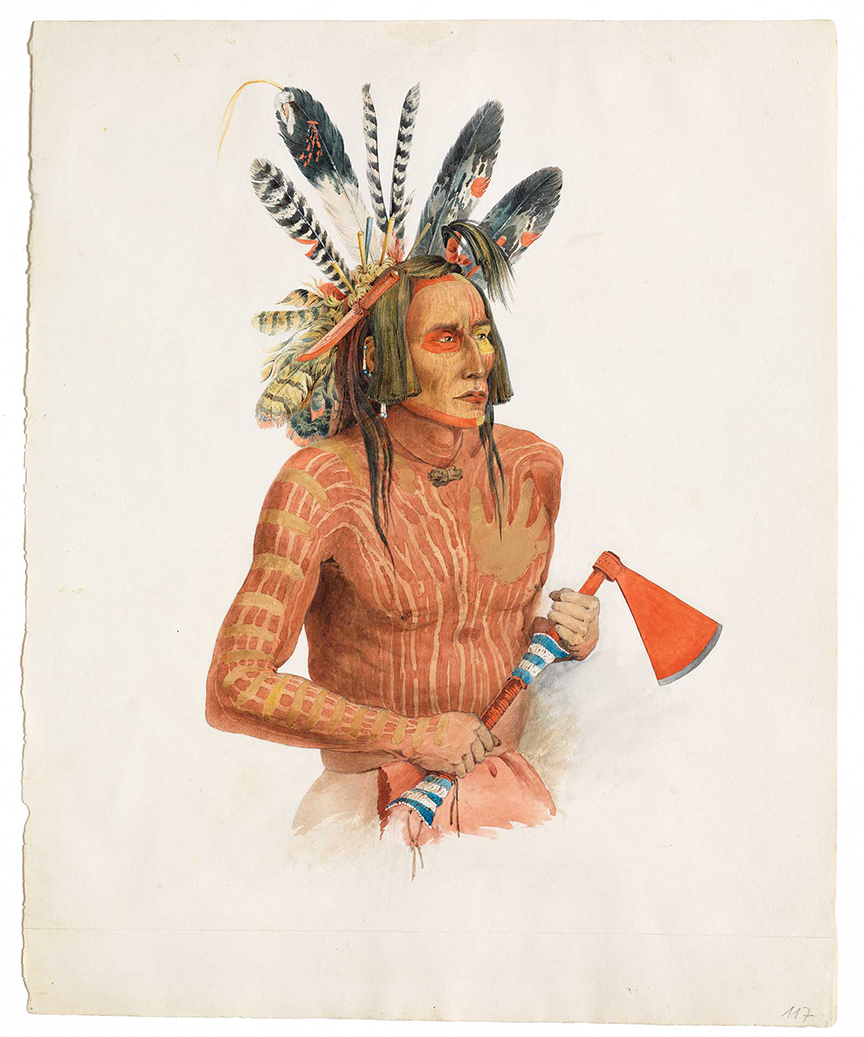
Karl Bodmer (1809-1893), Mató-Tópe, Mandan Chief, 1834, watercolor and graphite on paper, 137/8 x 11¼ in. Joslyn Art Museum, Omaha, Nebraska. Gift of the Enron Art Foundation, 1986.49.260. Photograph © Bruce M. White, 2019.
Both Maximilian’s journals and Bodmer’s pictures continue undergoing extensive research, much of it performed at the Joslyn’s Margre H. Durham Center for Western Studies. Bodmer’s watercolors remain remarkably fresh, appearing as if they were painted in recent years.
A partnership between the Joslyn, Creighton University, and the Nebraska Indian Community College has produced a digital initiative, “The Natural Face of North America,” increasing public access to the Maximilian-Bodmer Collection and archive. The portal is accessible online and in the museum’s galleries. Users can view all Bodmer’s expedition paintings from anywhere in the world with an internet connection.
His portrait of Hidatsa man Péhriska-Rúhpa (“Two Ravens”), dancing in Dog Society regalia, is the collection’s pièce de resistance. The painting may be the finest Native American portrait ever created. Demonstrating the synergy between Bodmer’s artworks and Maximilian’s journals, the Prince noted that the leader’s enormous headdress was made of raven or magpie feathers, with white down feathers at the tips and wild turkey tail feathers in the middle.
Or maybe it’s Leader of the Mandan Beróck-Óchatä with full buffalo head mask, spear and shield—adornments so spectacular as to appear made up, pure fantasy—and the accompanying sheet with multiple figures of Men of the Mandan Buffalo Bull Society.
Decide for yourself.
Admission to the Joslyn Art Museum is always free, as is perusing “The Natural Face of North America” website. —
The Natural Face of North America
www.maximilian-bodmer.org
Joslyn Art Museum
www.joslyn.org
Powered by Froala Editor
Powered by Froala Editor


