In 1871, Thomas Moran stood on the precipice of history, gazing down into the vast and magnificent Grand Canyon of the Yellowstone. What he saw ultimately appeared in two major works titled The Grand Canyon of the Yellowstone— one in 1872 and another completed in 1901. They are some of the most arresting and important works in all of American art.
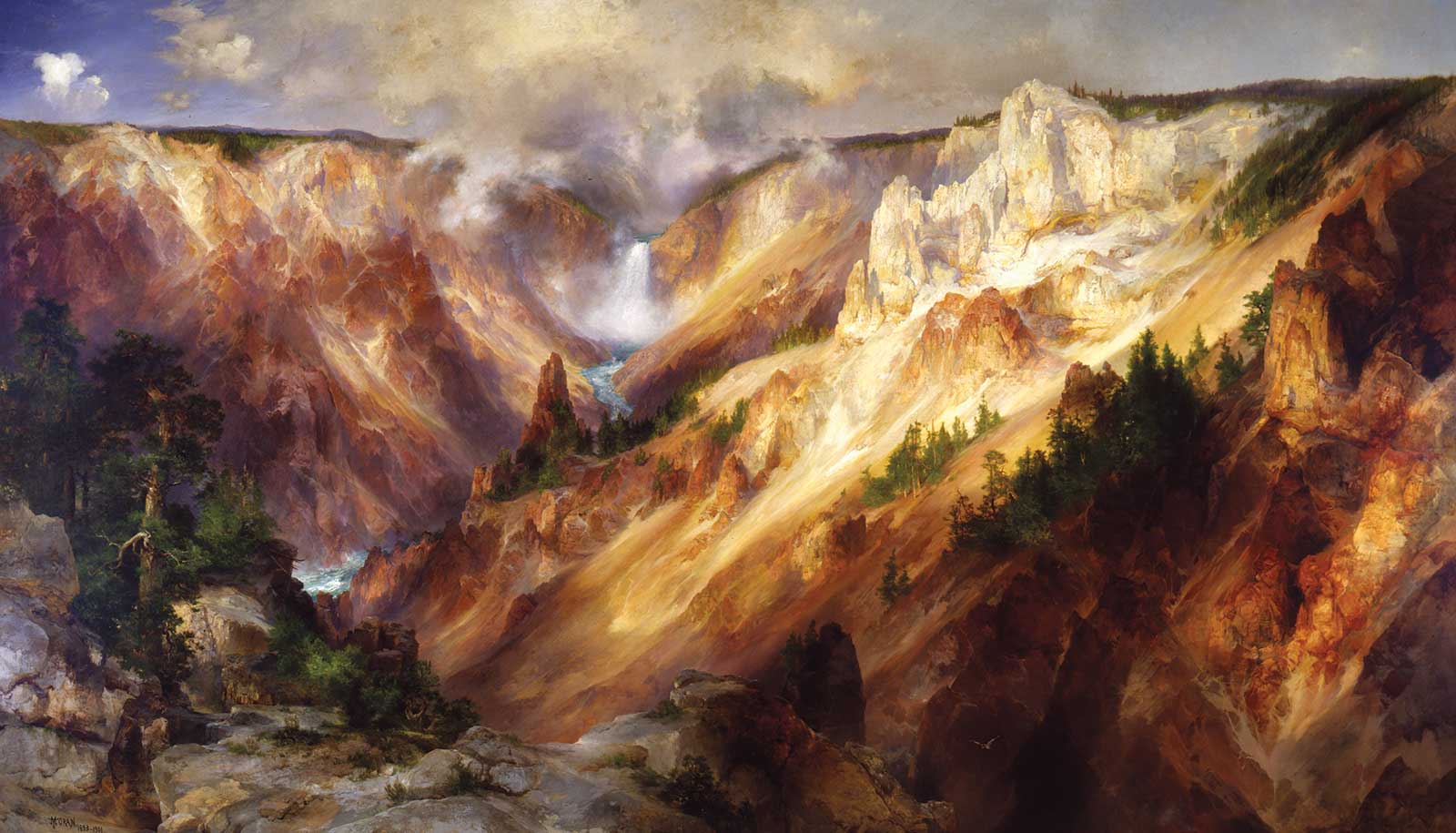 Thomas Moran (1837-1926), The Grand Canyon of the Yellowstone, 1893-1901, oil on canvas, 96½ x 1683⁄8 in. Smithsonian American Art Museum. Gift of George D. Pratt, 1928.7.1.
And to think the paintings originated from a patch of dirt measuring essentially 2 square feet. That’s 2 square feet amid 1.8 billion square feet that is today, Yellowstone National Park. That patch of earth would help inspire further American exploration, Westward expansion, the railroads, countless other artists and the National Park Service. The best part about that spot where Moran stood is that we—the collective “we” as Americans—own it together. We share it, along with all the land in all the other national parks.
Another reason to celebrate Moran’s vantage point is that it was repeatable. Artists have returned to it. They’ve stood in his spot and painted what he saw. They’ve also gone upstream, downstream, across the river, closer to the water, above the falls, underneath the falls and thousands of other locations—each one a celebration of this breathtaking view. This is one of the many joys of landscape art. Each artist brings their unique perspective to the work, even when the location is the exact same.
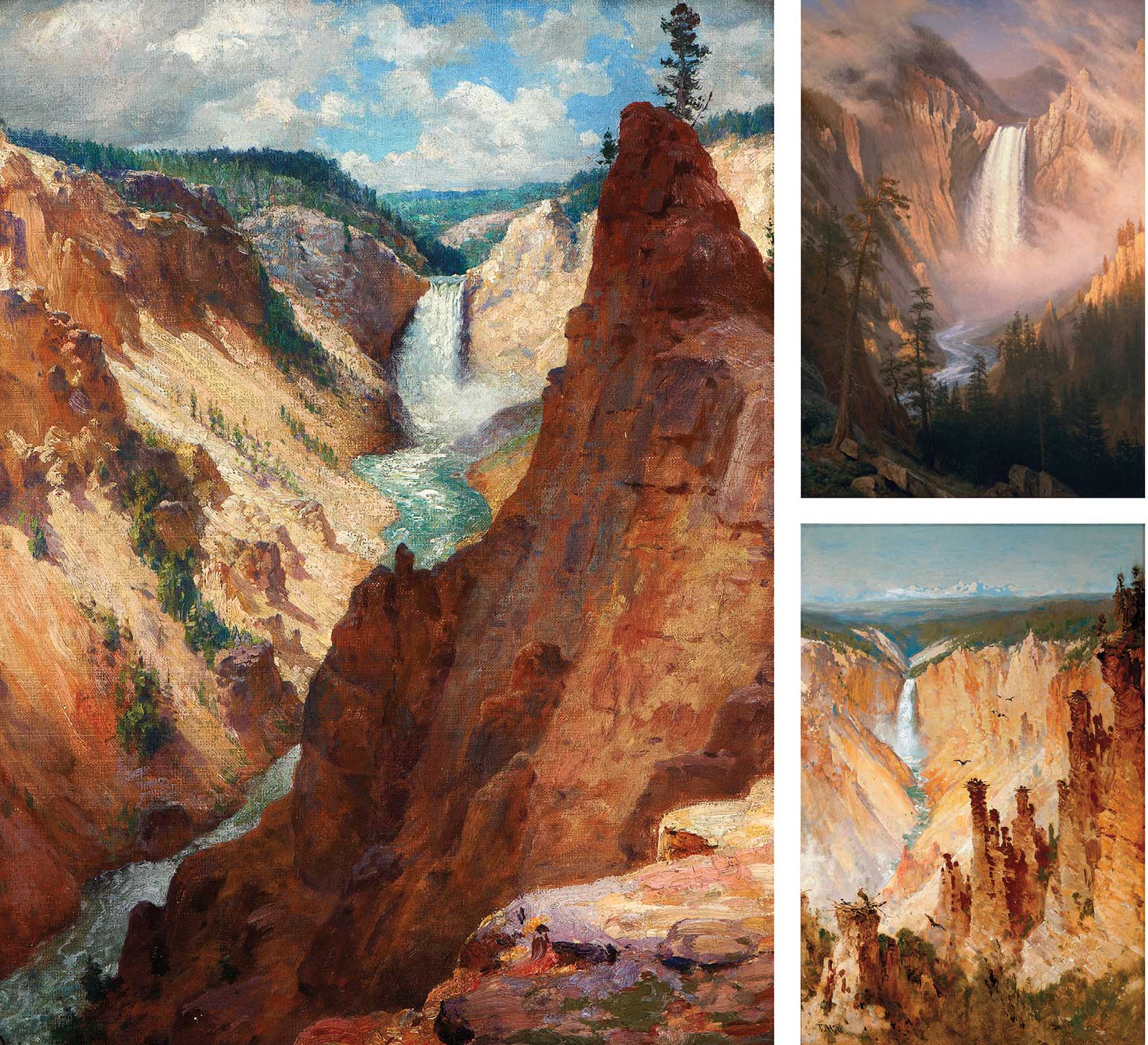
Clockwise from left: William R. Leigh (1866-1955), Grand Canyon of the Yellowstone, 1911, oil on canvas board, 26 x 22 in. © Gilcrease Museum. Gift of Ethel Traphagen Leigh, 01.986; Albert Bierstadt (1830-1902), Yellowstone Falls, 1881, oil on canvas, 44 x 30½ in. Whitney Gallery of Western Art, gift of Mr. and Mrs. Lloyd Taggart, 2.63; Thomas Hill (1829-1908), Great Falls of the Yellowstone, 1884, oil on canvas, 30 x 20 in. JKM Collection, National Museum of Wildlife Art, M1993.038.
Just look at the examples we’ve included here. We have Moran’s 1901 painting of The Grand Canyon of the Yellowstone and William Henry Jackson’s photograph of the same view (both men were part of the 1871 Hayden geological survey into Yellowstone), and they are paired with works by later artists. Grafton Tyler Brown turned his painting vertical, as did Thomas Hill. Albert Bierstadt used a vertical composition, but he also focused on the clouds and mist around the falls. Contemporary painter Josh Elliott focuses more on Lower Falls, as does Kathy Wipfler. Bruce Cheever moves the falls to the left side of the painting, which puts the focus on the cliffs on the far canyon wall. William R. Leigh, who painted the canyon in 1911, uses his high-key color to accentuate the “yellow stone” of the cliff.
Each artist brings their own perspective to their work. This can be as specific as color palette and the size of the brushstrokes, or as nebulous and abstract as their art background, their relationship with nature and their specific mood on the day of the painting.
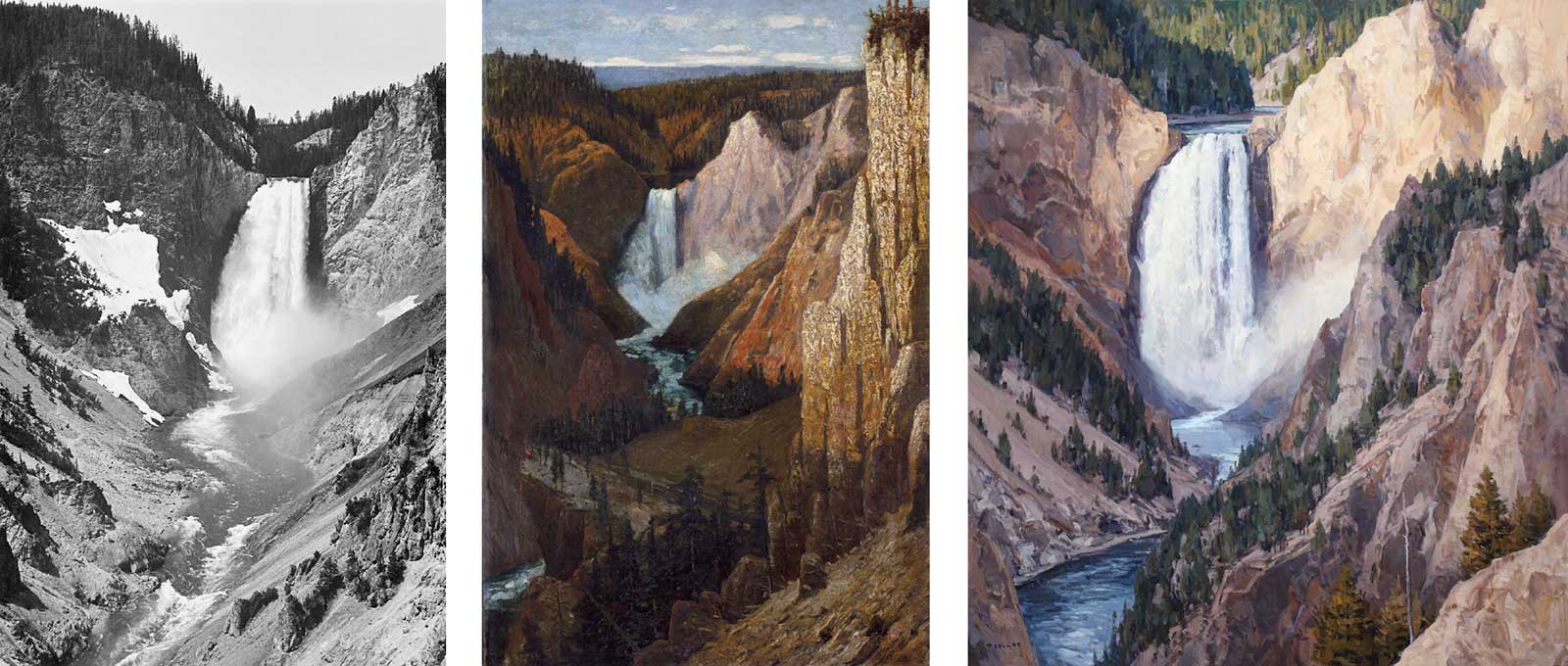
Ansel Adams (1902-1984), Lower Falls of the Yellowstone River, Yellowstone National Park, Wyoming, 1968, photograph; Grafton Tyler Brown (1841-1918), View of the Lower Falls, Grand Canyon of the Yellowstone, 1890, oil on canvas, 30¼ x 201/8 in. Smithsonian American Art Museum, Museum purchase through the Luisita L. and Franz H. Denghausen Endowment and the Smithsonian Institution Collections Acquisition Program, 1994.56; Josh Elliott, Grand Canyon of the Yellowstone, 2017, 40 x 36 in.
These variations are what makes art so wonderful. Because even two artists standing in the exact same spot, painting the exact same subject and under the same conditions, even then the works are different and unique. These differences are what make landscape painting so magical.
Legacy Gallery with locations in Santa Fe, New Mexico, and Scottsdale, Arizona, has no shortage of impressive Western landscape works by prominent artists. For instance, Arturo Chávez was raised amid the spectacular vistas of Northern New Mexico. Through his works, like his oil Spring Moon Whispers, he aims to inspire and to preserve the natural landscape throughout the American Southwest that has sustained his creative life.
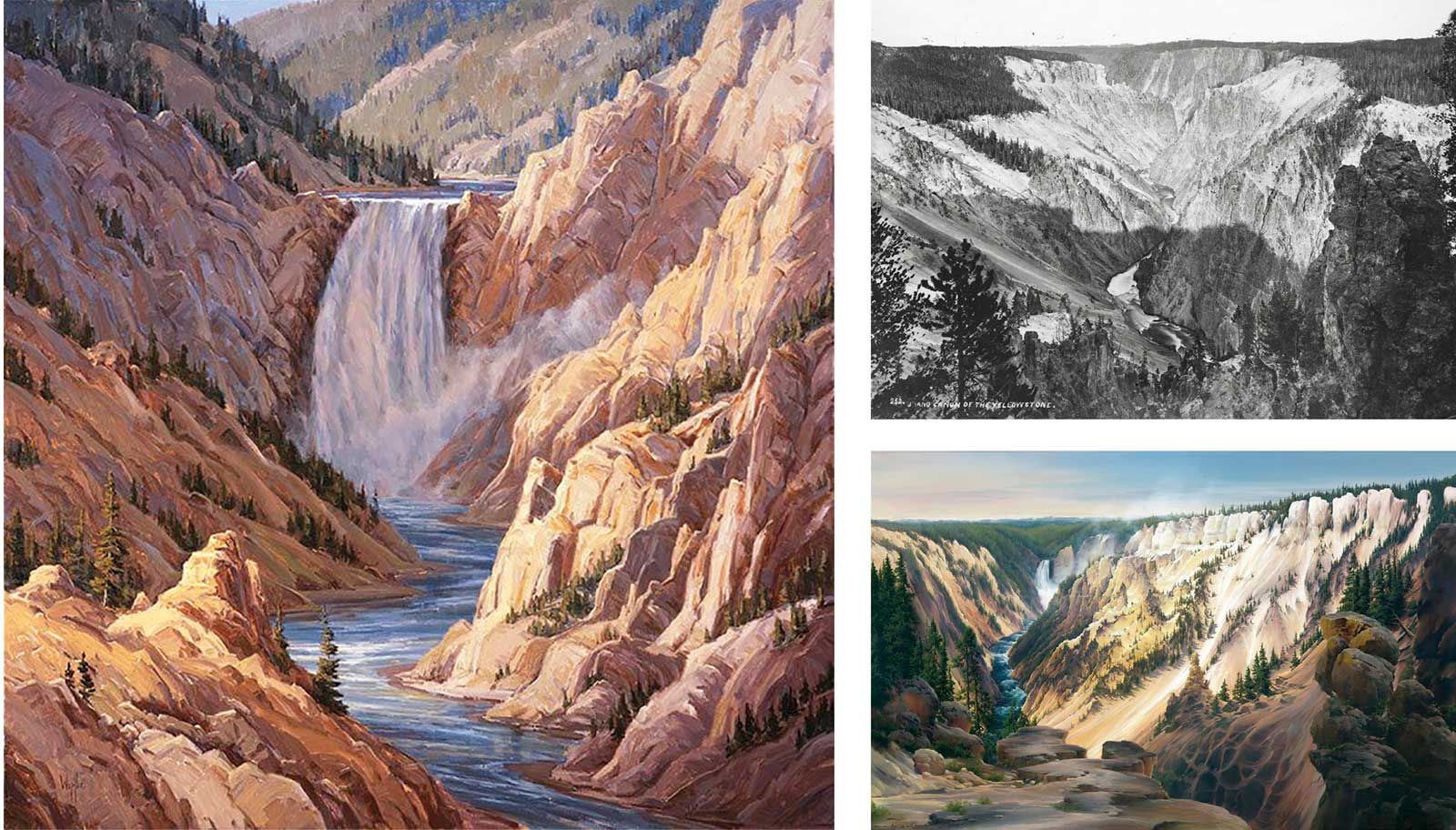
Clockwise from left: Kathy Wipfler, Lower Falls of the Yellowstone, 2006, oil on canvas, 50 x 50 in. Gift of the Mary A.H. Rumsey Foundation. 10.07; William Henry Jackson (1843-1942), Grand Canyon of the Yellowstone, 1871, photograph; Bruce Cheever, Chasm of the Yellowstone, oil, 20 x 24 in.
Artist Robert Peters, raised in Phoenix, credits his early memories of the Southwestern deserts with sparking a passion for the outdoors. “I draw strictly from my own observations, which imparts an authentic and natural quality to my paintings,” he explains. “If something is in one of my paintings, I’ve experienced it.” This is the case in his oil painting Autumn, Teton Range.
Yet another Legacy artist, Douglas Aagard, began his career as a watercolor artist. In 2000, after seeing a show of paintings by Gary Ernest Smith, he was hooked on the power and possibilities of oil paints. “I never get bored painting with oil,” he says of his pieces like Rising Mist. “There are so many possibilities; so many techniques to try that one could never exhaust the love of learning. I have found that my work has a more dimensional feel or depth when painted with palette knife, and often times the texture is more fun than the composition.”
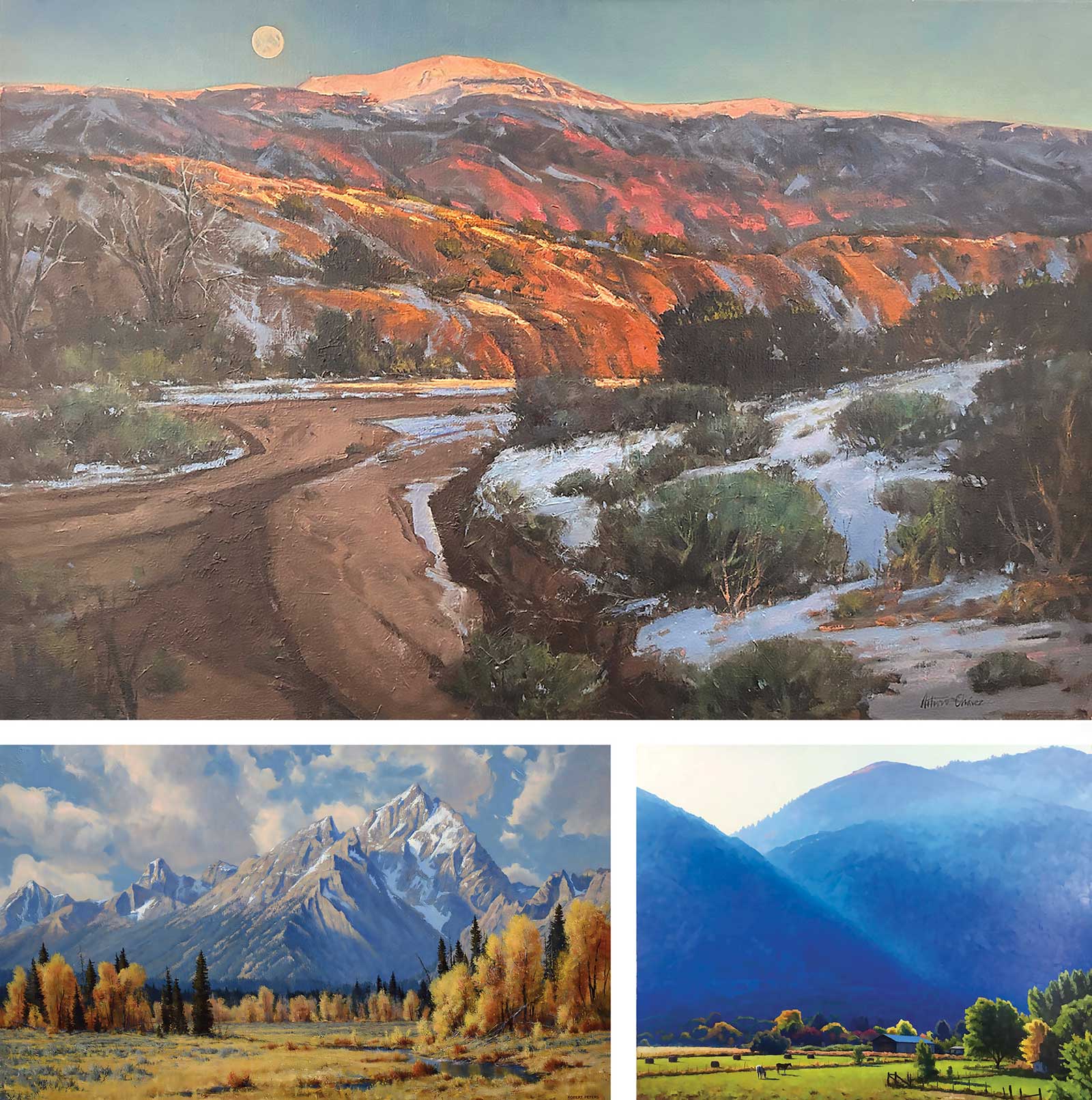
Top: Legacy Gallery, Spring Moon Whispers, oil on linen, 24 x 36 in., by Arturo Chávez. Bottom row: Legacy Gallery, Autumn, Teton Range, oil on linen, 32 x 54 in., by Robert Peters; Legacy Gallery, Rising Mist, oil, 48 x 60 in., by Douglas Aagard.
As part of the Arizona Pastel Artists Association’s 9th Annual Exhibition & Sale, hosted at the Phippen Museum in Prescott, Arizona, collectors will find quite the variety of Western landscapes. “This exhibition will be available for viewing February 22 through April 20,” says the museum, and “visitors to this all-pastel exhibition will be treated to a wide variety of outstanding fine art that explores the vivid colors of pastels’ pure pigments in a wide range of expression.” This includes stunning Western landscapes like Lorenzo Chavez’s The Long View, Tony Allain’s Sundown and Christine Debrosky’s Oak Creek Tea.
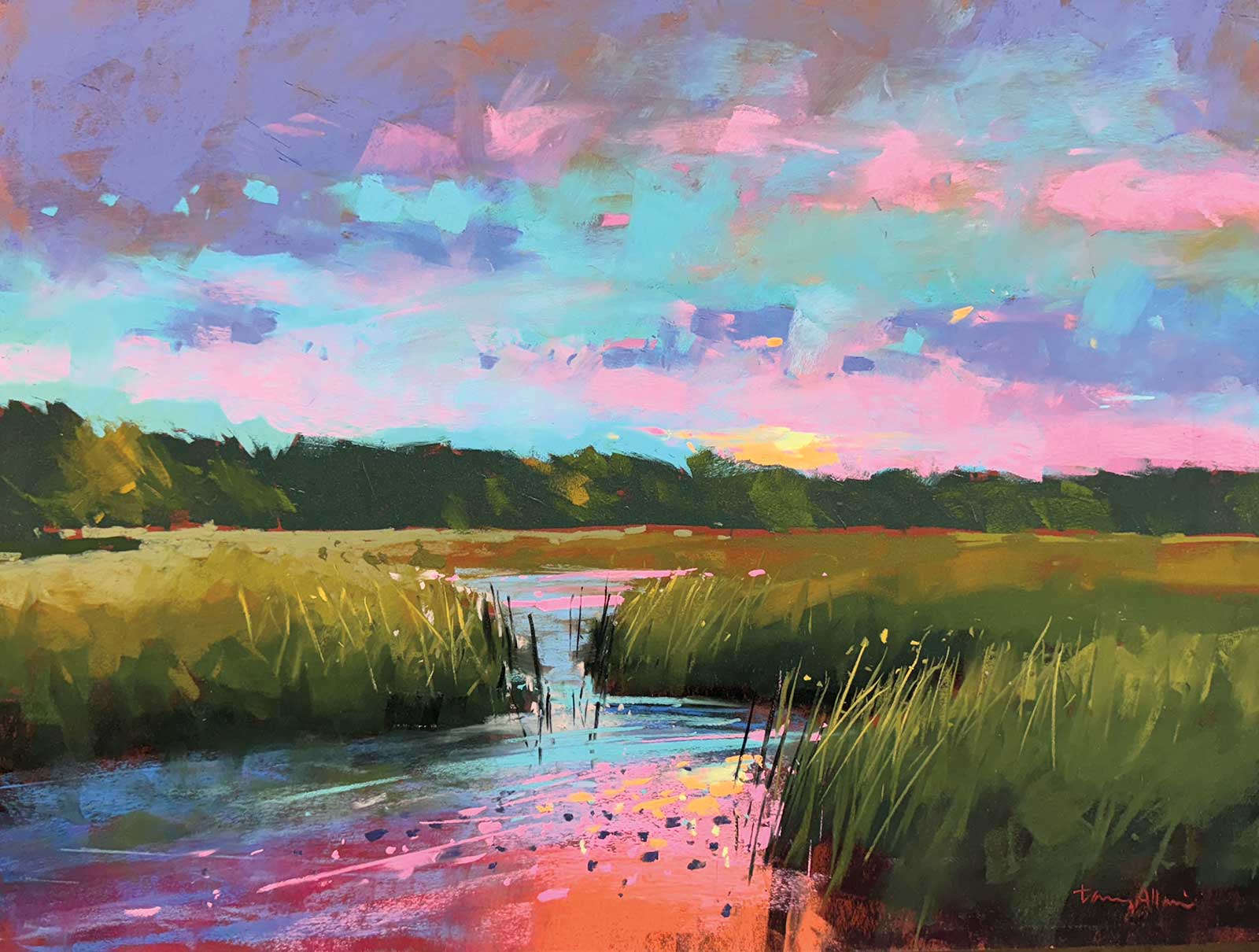
Phippen Museum, Sundown, pastel, 18 x 24 in., by Tony Allain.
The museum adds, “Prescott area artists will also be showcased in the exhibition of more than 70 pastel masterworks and include the pastel artistry of Signature Members Jeanne Wellins and Dorothy Dooley, as well as offerings by Northern Arizona painters, including Sedona artist Pamela Delay and Distinguished Member [Christine] Debrosky from Clarkdale.”
Three remarkable artists represented by Medicine Man Gallery—Matt Smith, Jill Carver and David Meikle—share a love of Western landscapes. Considered masters in their respective lanes, each has a unique voice in interpreting the land they revere.
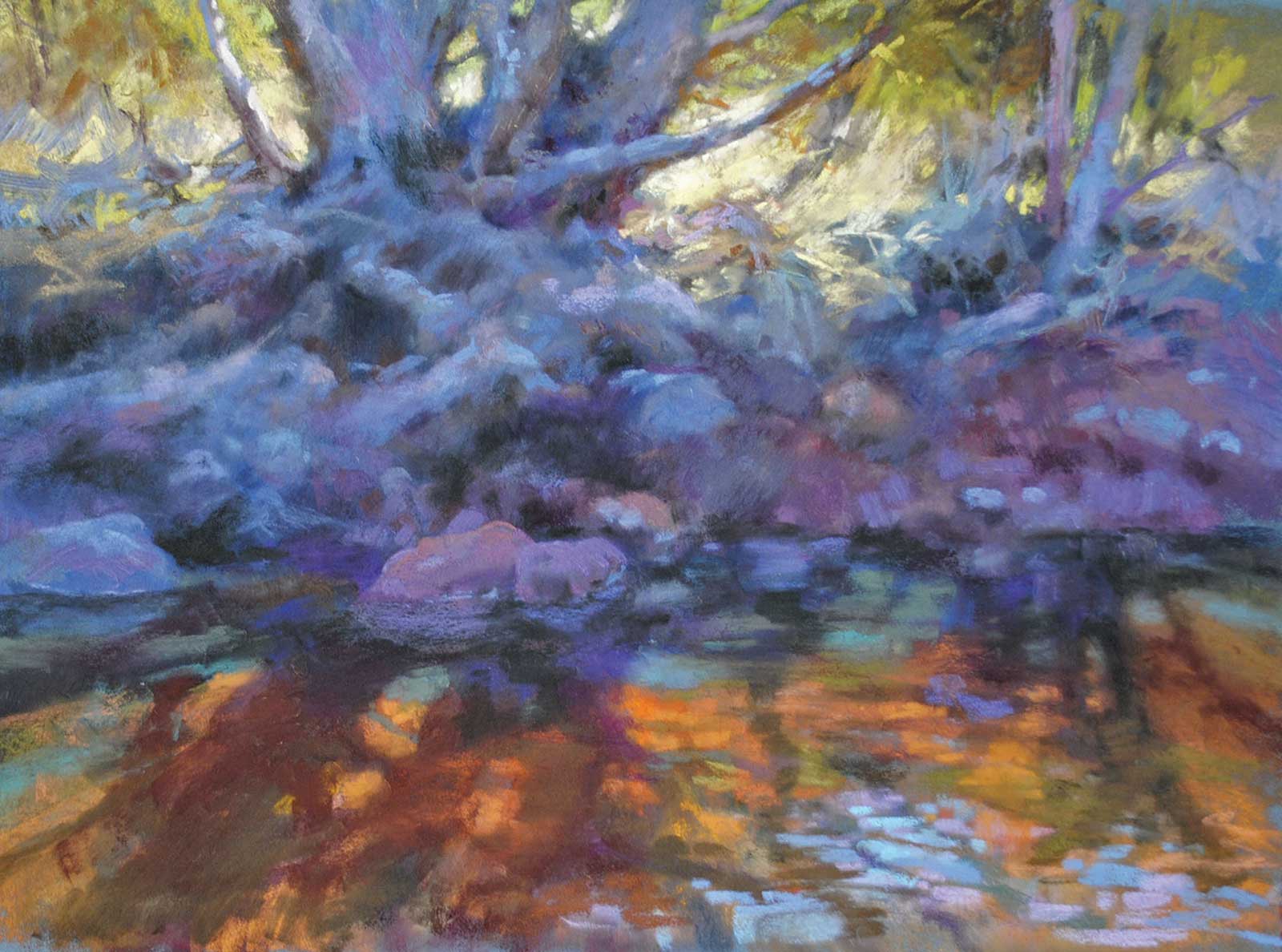
Phippen Museum, Oak Creek Tea, pastel, 18 x 24 in., by Christine Debrosky.
“Smith, often referred to as the granddaddy of plein air painters, has spent endless hours working in arid lands few artists dare to paint,” shares Mark Sublette, gallery owner. “His influence on the Southwestern landscape is so profound that his name has become synonymous with it. Meikle, the artist behind the artwork for Wes Anderson’s movie Asteroid City, has a tight realism all his own. When you enter the state of Utah, visitors drive by giant billboards with Meikle illustrations, a testament to the impact of his art. Carver, who spent 12 years at the National Portrait Gallery in London, has a unique perspective on landscape art. Her style spans the moat of abstraction to realism. Her take on the landscapes of Southern Colorado, where she lives and paints, is a unique departure from traditional approaches.”
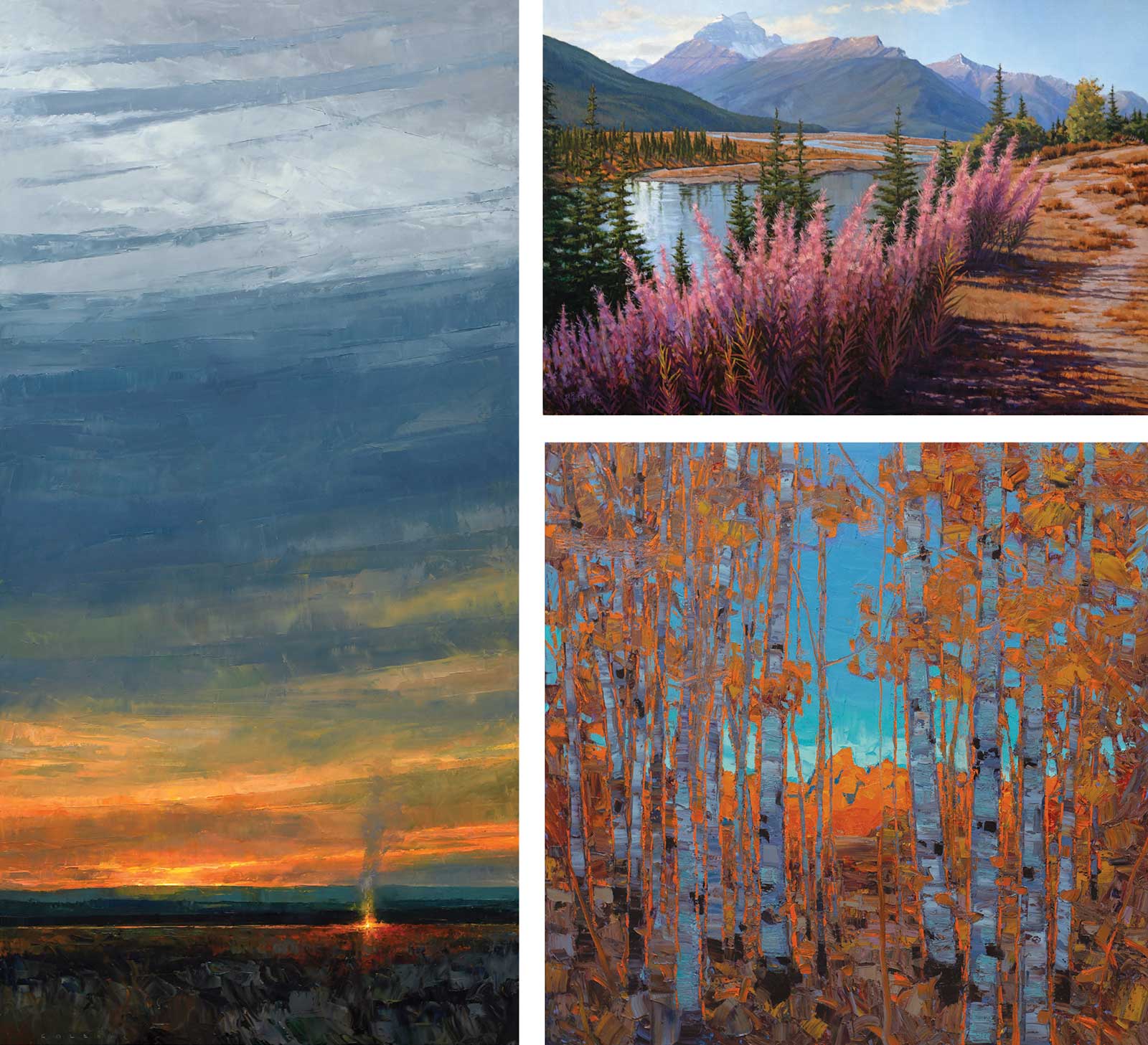
Clockwise from left: Gallery Wild, Layers of Sky, oil on canvas, 80 x 40 in., by Caleb Meyer; Darcie Peet, Edged in Wispy Plumes of Fall Fireweed, oil, 20 x 30 in.; Gallery Wild, Royal Alpenglow, oil on canvas, 48 x 48 in., by Silas Thompson.
“The diverse landscape across the American West can be wholly characterized by its vastness,” says Gallery Wild, based in Jackson Hole, Wyoming, and Santa Fe, New Mexico. “These pristine, untouched terrains, shaped and preserved over millennia, continue to inspire artists across generations. For landscape artists especially, there is an enduring pursuit to capture the fleeting beauty of their surroundings. Whether it’s the shifting shadow on a desert mesa, towering clouds sweeping across an expansive sky, or a glimmer of light filtering through dense aspen trees, Western landscape artists are devoted to preserving these transient moments. Their work highlights the enduring beauty of the American West amidst its ever-changing nature.”
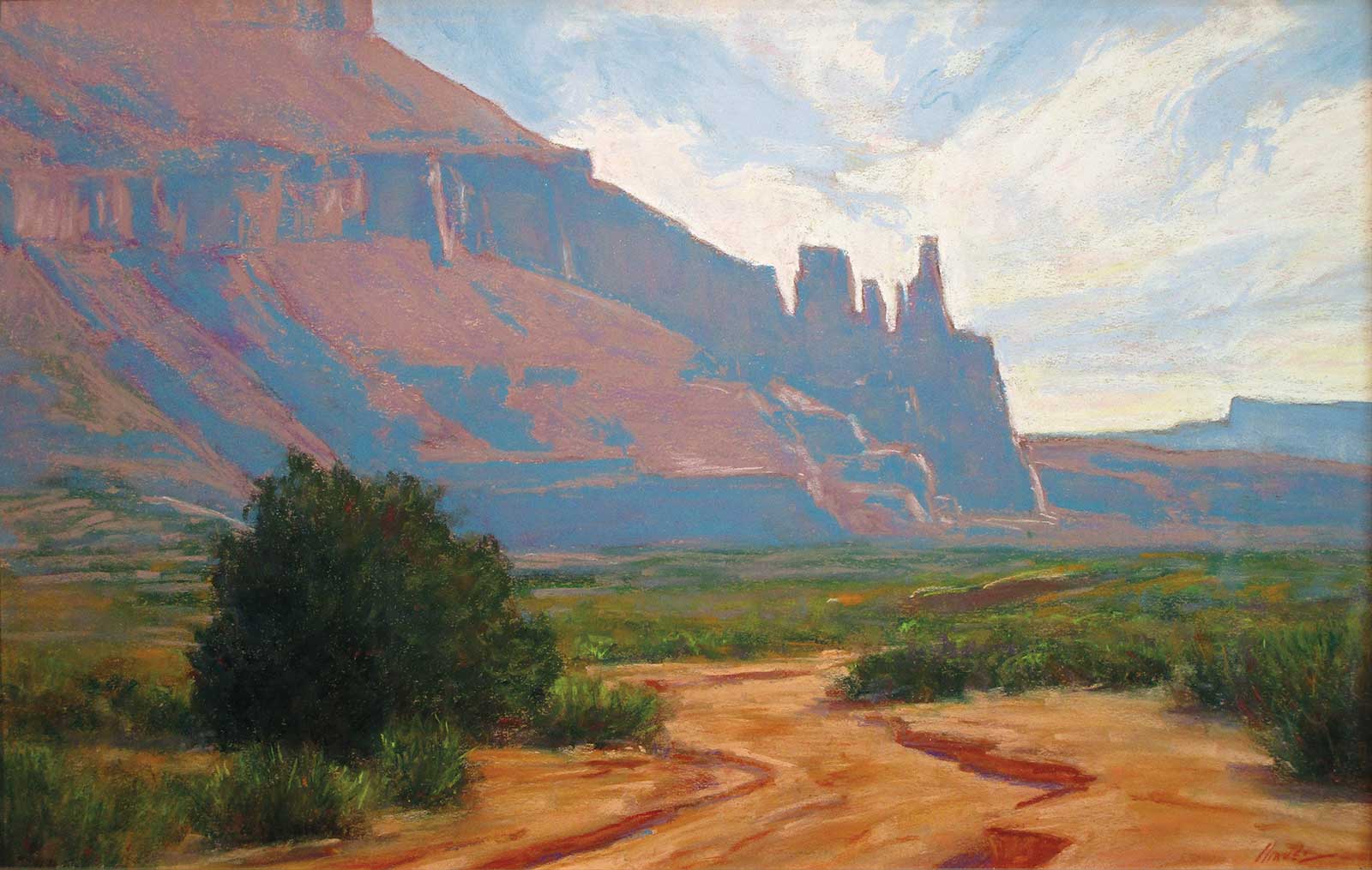
Phippen Museum, The Long View, pastel, 14 x 22 in., by Lorenzo Chavez.
When collecting Western landscapes, gallery representatives suggest you “consider the artist’s signature style and fall in love with what makes a single piece standout. The details are where you find a personal connection with a piece. If that connection feels irreplaceable then it is meant to be.”
The precision and patience required for Calvin Nicholl’s Western landscape paper sculptures is rewarded as he harnesses light to create subtle shadows and highlights across the surface of the world’s finest papers. “I am constantly amazed at how the technique and images of nature combine in a delicate harmony,” he shares. “Celebrating my favorite subjects in the studio becomes an expression of the very fragility of our natural world. In contrast, the materials I use offer a timeless conversation piece due to the permanence. My art adventure of exploring fine papers as a medium continues to propel me forward with each piece, albeit at a pace of perhaps a dozen or so pieces per year.”
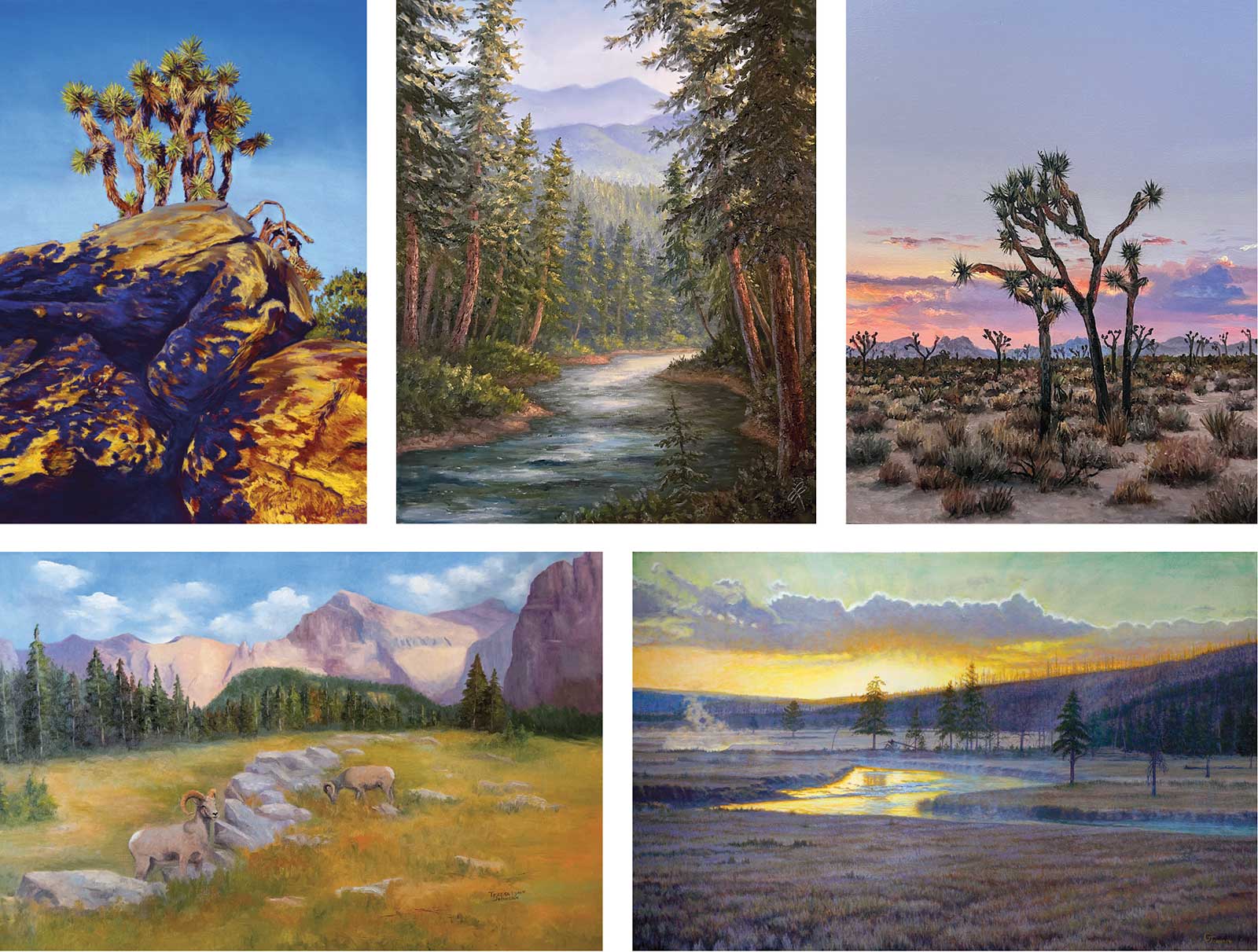
Top: Gary Johnson, Morning Shadows, pastel, 17 x 12 in.; Sandy Bridgewater, Turquoise River, oil on canvas, 20 x 16 in.; Naomi Brown, Sundown in Joshua Tree National Park, oil on panel, 10 x 8 in. Bottom: Teresa Lynn Johnson, Fleeting Moment in Glacier Park, oil on linen, 24 x 36 in.; Gary Johnson, The Silence of Dawn, oil on linen, 23 x 36 in.
For artist Darcie Peet, wildflowers often find a place in her landscape paintings. And the day she captured the scenery found in Edged in Wispy Plumes of Fall Fireweedwas no different. “What a crystal-blue day to be outside exploring along Canada’s Icefield Parkway and to stumble across this sprawling patch of my favorite mountain wildflower!” Peet expresses. “Fireweed stands out from the rest in every season. It’s long spear of narrow leaves and magenta blooms are easy to spot all summer. By September, after the blooms fade and fireweed goes to seed, it transforms into a long duster of soft, wispy light pink to white plumes, which gradually waft away in the fall breeze. What painting inspiration to find this mass of fireweed lining the hillocks above the meandering Bow River in the Canadian Rockies.” The painting is available at A. Banks Gallery in Bozeman, Montana.
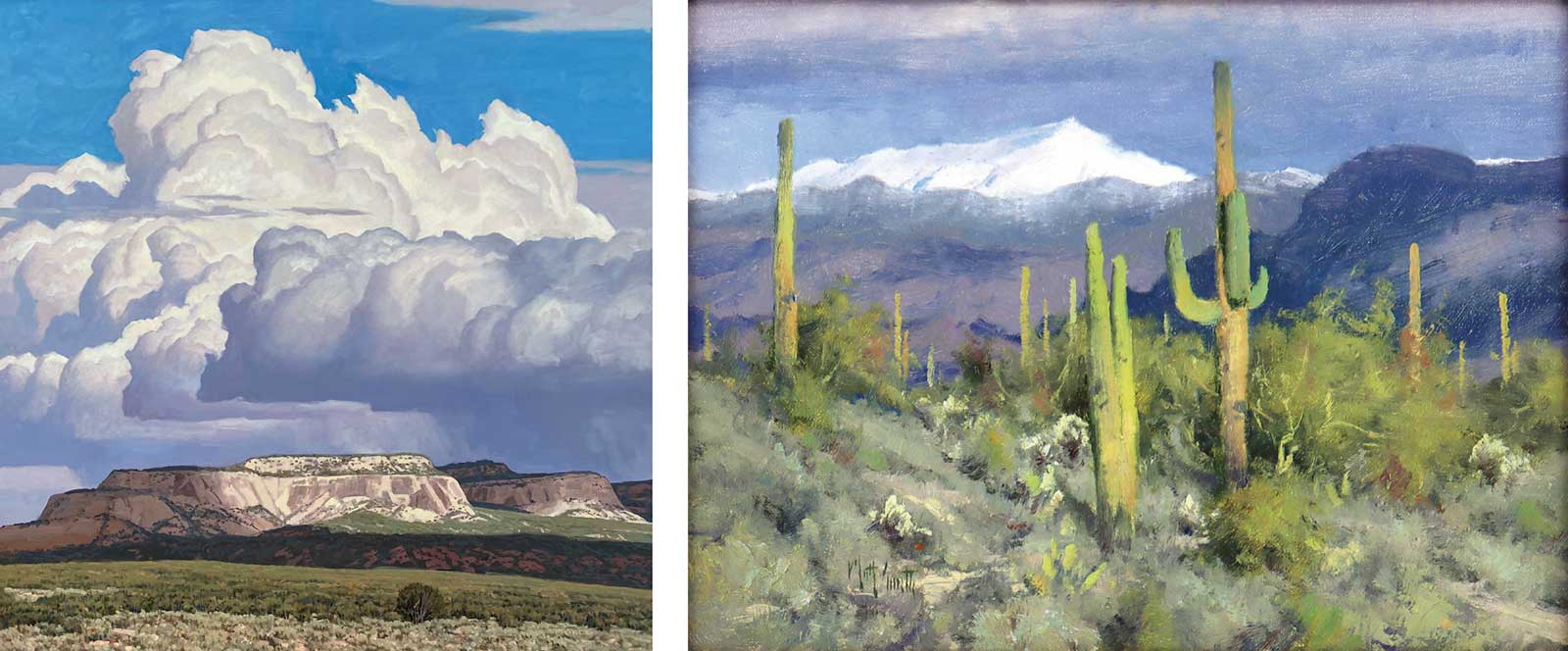
Medicine Man Gallery, Diana’s Throne, oil on canvas, 36 x 36 in., by David Meikle; Medicine Man Gallery, Winter Conditions, Mt. Ord, oil on linen, 12 x 16 in., by Matt Smith.
Naomi Brown paints landscapes scenes of the Southwest, and often gets asked if she has her own work hanging in her home. “My husband has claimed a few of my pieces and they hang in his office that is detached from our home,” she notes. “I personally don’t want my own work hanging in my home, [since] my husband and I really enjoy collecting art from other artists. Some of our pieces we have bought are by established, well-known artists, while some are still emerging. When we are collecting art, especially a landscape piece, it’s fun to collect work with a different style than mine. It’s also important for us to have a connection to the area or an experience of being in that particular place. We enjoy landscapes from the Southwest regions like New Mexico and Southern Utah, to California and of course, Arizona, where we live.”
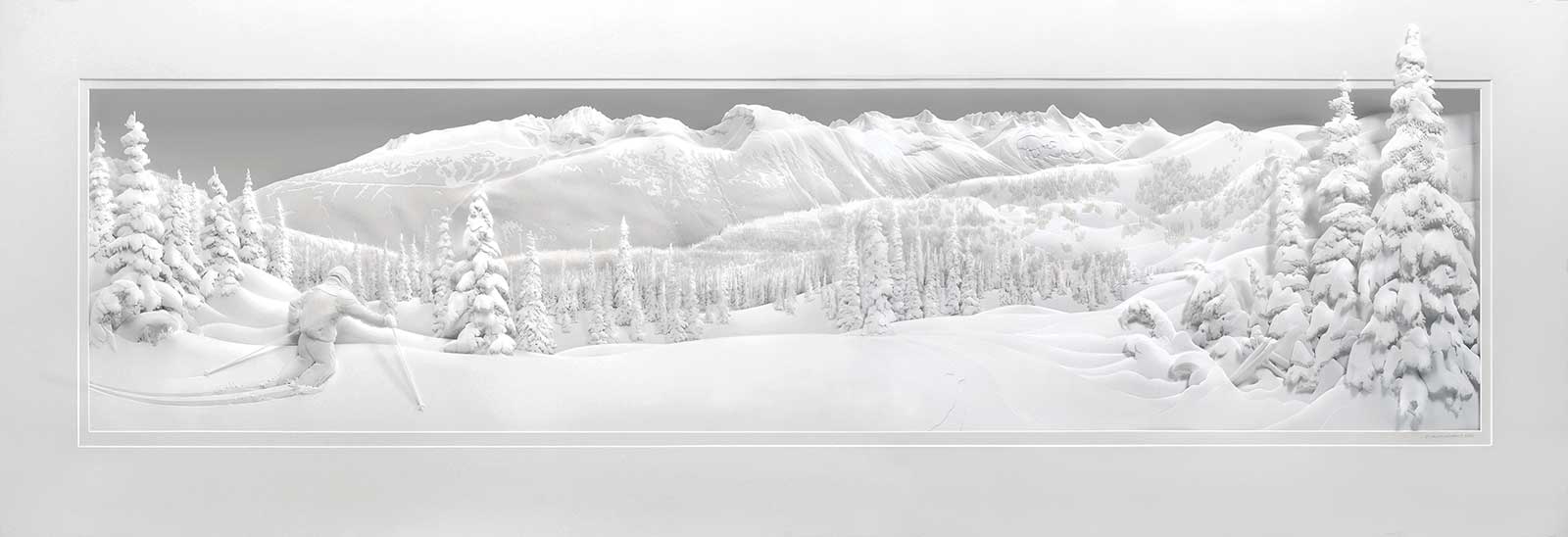
Calvin Nicholls, Firstracks, cotton fine art paper, 30 x 86 in.
Painting nature and painting in nature have always been Gary Johnson’s passion since starting his art career more than 30 years ago. “All of the elements of a painting, shape, form, values, color, mood, lighting and more are all around you in the natural world,” he says. “Not to mention the sounds and atmosphere of painting on location is both invigorating and inspiring.” His painting Dream Lake is a location in the Rocky Mountain National Park that Johnson painted during his stay as artist in residence at the park. Morning Shadows is a pastel painting on location during a backpacking trip in Joshua Tree National Park, and The Silence of Dawn is a studio painting from plein air studies in Yellowstone National Park. A small 9-by-12-inch version of this painting won the Grand Prize Gold Medal in the 2005 Arts for the Parks competition.
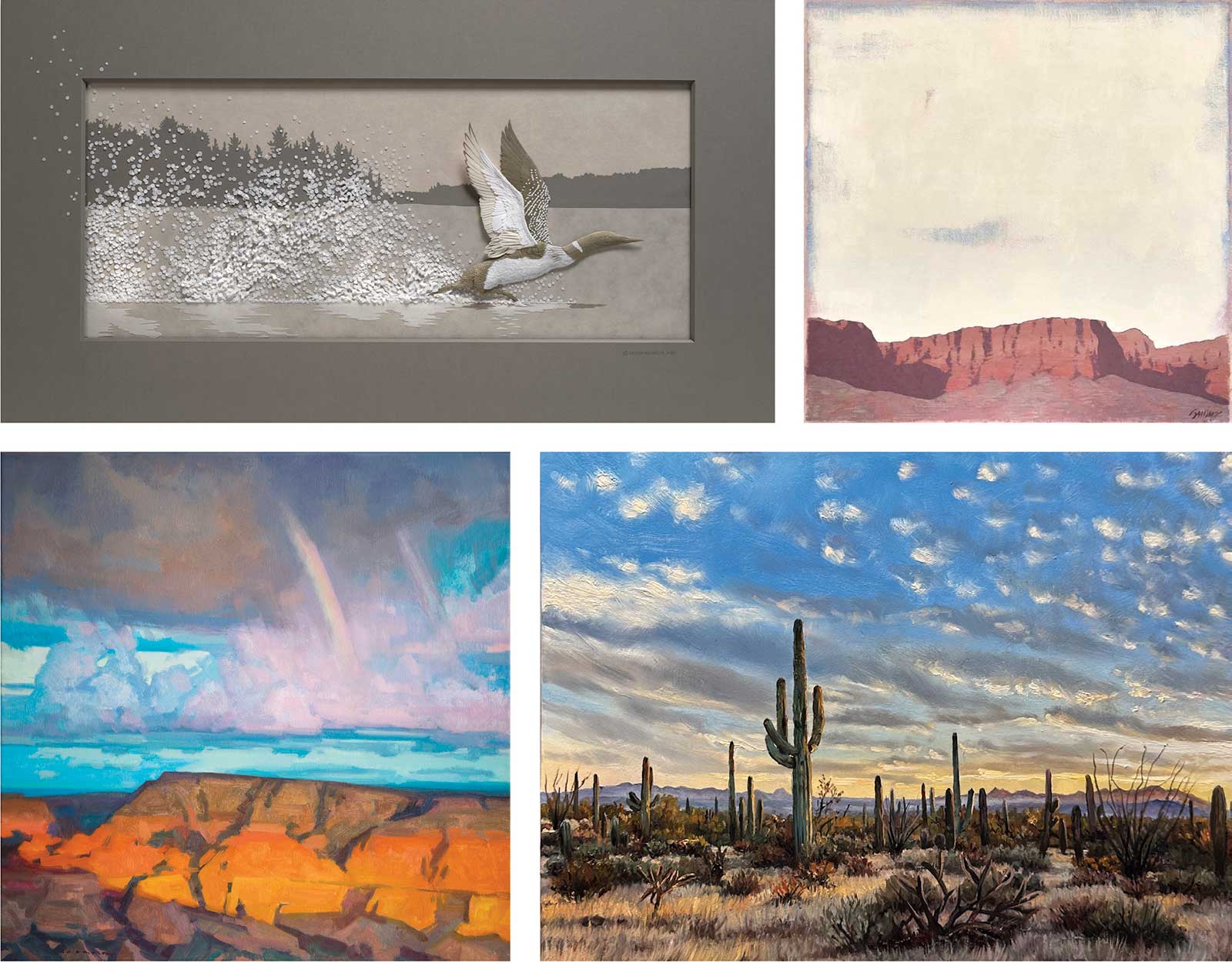
Top row: Calvin Nicholls, Drum Roll, fine art and handmade mulberry fibre paper, 17 x 32 in.; Gallery Wild, Desert Sky, oil on panel, 30 x 30 in., by Jared Sanders. Bottom row: Medicine Man Gallery, Grand Canyon Showcase, oil on canvas, 24 x 24 in., by Jill Carver; Naomi Brown, Sundown in Saguaro National Park, oil on panel, 9 x 12 in.
Johnson’s advice to collectors when purchasing landscape art, or art of any genre, is to “surround yourself with art that inspires, awes and moves you, so as you live with artwork, you have that feeling of connectedness that you felt upon first seeing the artwork.”
The beauty of the natural world that Sandy Bridgewater gets to live in and explore always inspires her—catching a glimpse of an amazing little viewpoint, a place hard to get to or something easily missed if you don’t look up. “I love to continue to capture these emotions and magic found in a single frame or a small window of time,” she says. “My art is always evolving, moving recently from painting far viewpoints of distant mountain scenes, down to rivers and lakes. This last year I was painting a lot of hiking trail scenes in the woods, sometimes just focusing on a few trees. This year I’ll get back up to the mountaintops for some plein air, as I’m ready to focus on that horizon atmosphere again!”
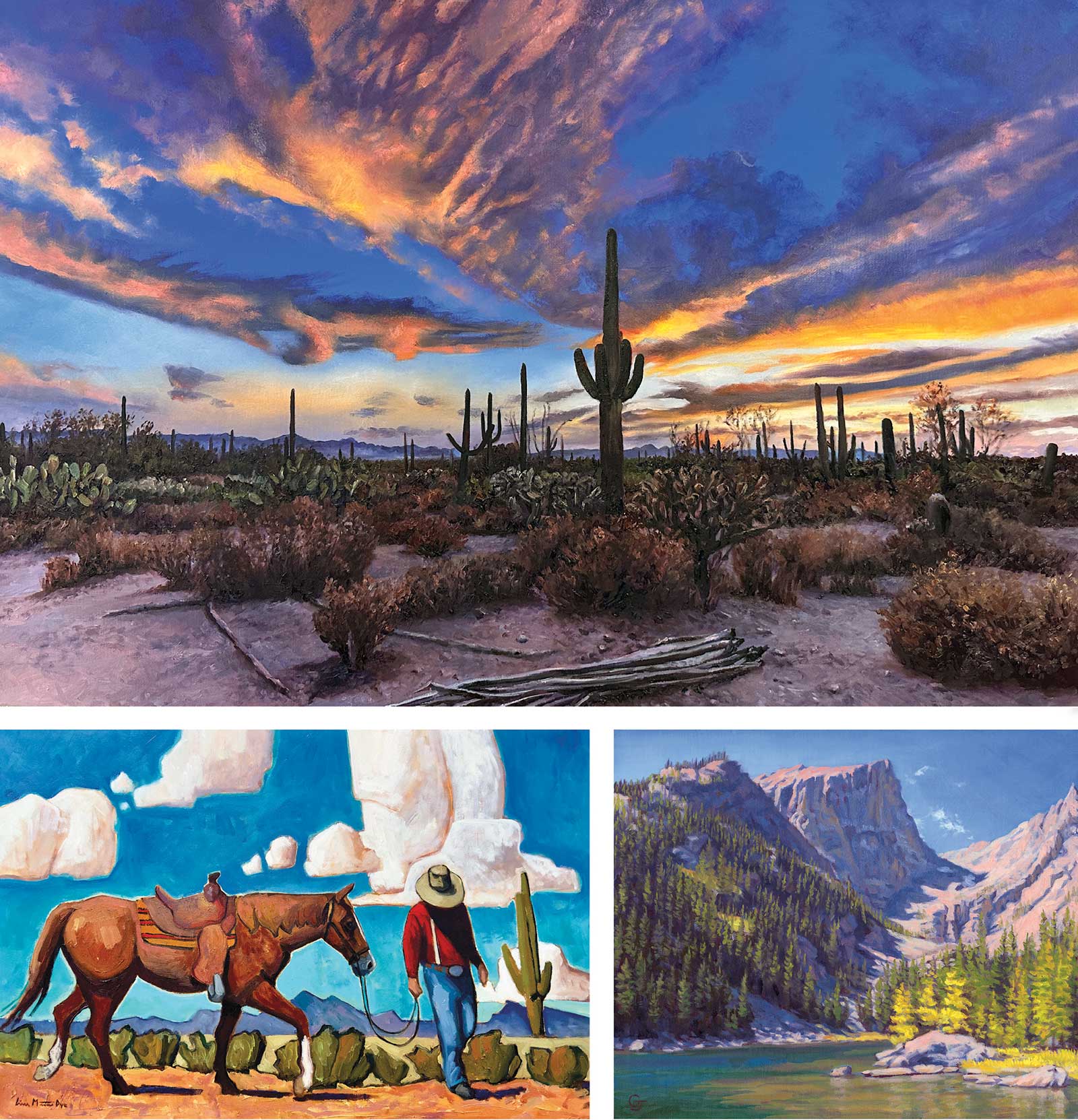
Top: Naomi Brown, Desert Drama, oil and acrylic on canvas, 24 x 36 in. Bottom: Liam Matthew Dye, The Lost Dutchman, oil, 24 x 36 in.; Gary Johnson, Dream Lake, oil on canvas, 10 x 12 in.
Artist Teresa Lynn Johnson loves being out in nature, especially in the mountains. Landscape artwork for Johnson is about the light, trying to capture it as naturally as possible and creating a beautiful interpretation of the beauty she sees right in front of her eyes. “My inspiration for Fleeting Moment in Glacier Park, was the light conditions that stayed for just a moment,” she shares of her visit to the park. “I was hiking and while it had been overcast earlier, the sun popped out giving me some beautiful light. In addition to the landscape, I wanted to add the bighorn sheep that I had seen earlier. Both cases were fleeting moments.” Her inspiration for other highlights like Winter Song, was the interplay of warm and cool, as is often seen in New Mexico—where Johnson lives—during the winter after a snowstorm.
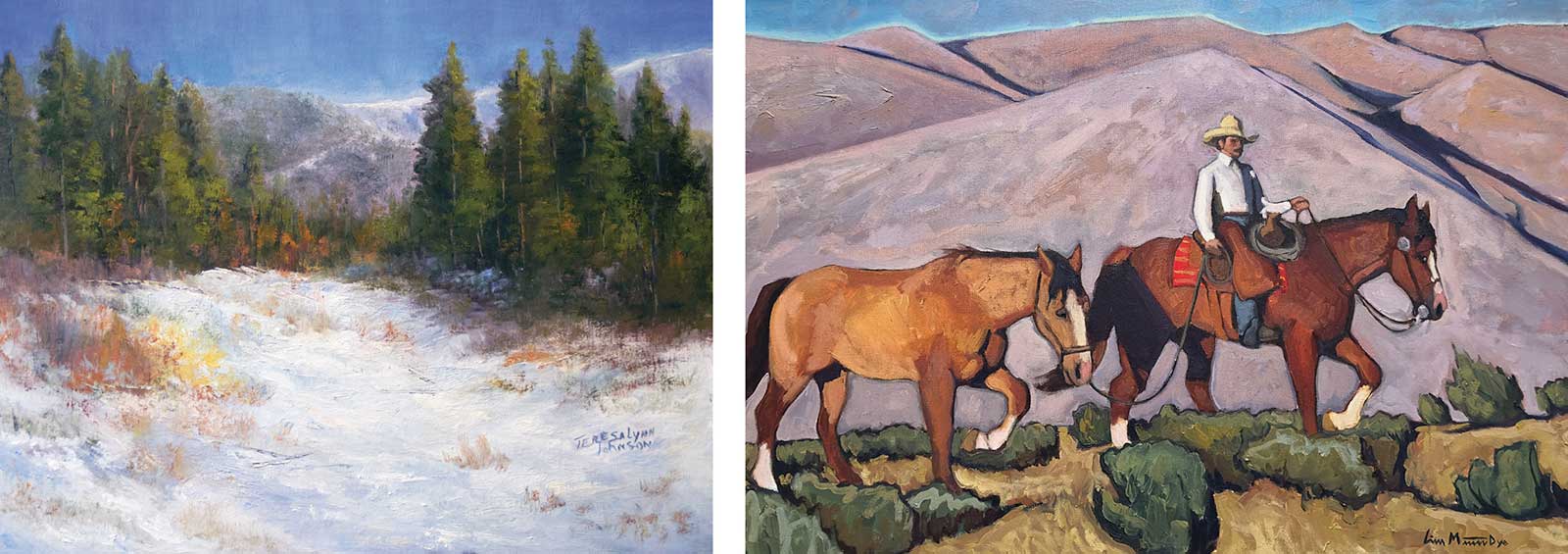
Teresa Lynn Johnson, Winter Song, oil on panel, 11 x 14 in.; Liam Matthew Dye, Sagebrush Ridge, oil, 24 x 36 in.
Drawing on the vast landscapes, unique cultural heritage and enduring narratives of the region, Liam Matthew Dye explores the intersection of history, mythology and folklore through a modern lens. His art evokes the self-reliance and rugged individualism that has defined Western lore, while also reflecting the complex relationship between humans and the land. Using a bold combination of abstraction and representation, the artist taps into the timeless and often mysterious qualities of the West. His work channels the spirit of legendary figures and their enduring connection to the land, reflecting a landscape that is as much a cultural symbol as it is a physical reality. “Through my dynamic compositions, I reinterpret Western folklore, allowing its myths to breathe in contemporary form and resonating with today’s audience,” the artist says. “I encourage collectors to trust their instincts, and invest in pieces that resonate deeply with them, as the most rewarding collections are those that reflect personal connection and a genuine appreciation for the art’s story.” —
Featured Artists & Galleries
Featured Artists & Galleries
Sandy Bridgewater
Whitefish, MT
info@sandybridgewater.com
www.sandybridgewater.com
Naomi Brown
www.naomibrownart.com
Instagram: naomibrownart
Liam Matthew Dye
liammatthewdye@gmail.com
www.liammatthew.com
Gallery Wild
info@gallerywild.com
www.gallerywild.com
Jackson Hole, WY - (307) 203-2322
Santa Fe, NM - (505) 467-8297
Gary Johnson
www.garyjohnson.com
(760) 402-9986
Teresa Lynn Johnson
Aztec, NM, (505) 334-1744
www.teresalynnjohnson.com
Instagram: teresalynnjohnsonartist
Legacy Gallery
225 Canyon Road, Santa Fe, NM 87501, (505) 986-9833
7178 Main Street, Scottsdale, AZ 85251, (480) 945-1113
www.legacygallery.com
Medicine Man Gallery
6872 E. Sunrise Drive, Suite 130
Tucson, AZ 85750
(520) 722-7798
www.medicinemangallery.com
Calvin Nicholls
Ontario, Canada
info@calvinnicholls.com
www.calvinnicholls.com
Instagram: calvinnicholls
Darcie Peet
www.darciepeet.com
Facebook: /darciepeet
Phippen Museum
4701 AZ-89 Highway, Prescott, AZ 86301
(928) 778-1385 www.phippenartmuseum.org
Powered by Froala Editor


