In 2015, the Denver Art Museum hung an exhibition of floral still life paintings. Almost all of the works were by European impressionists. To help set the tone of the exhibit, the museum quoted from the artists directly. Many of the quotes were about the fundamental nature of still life, as if the artists felt the need to justify the genre to a hostile public.
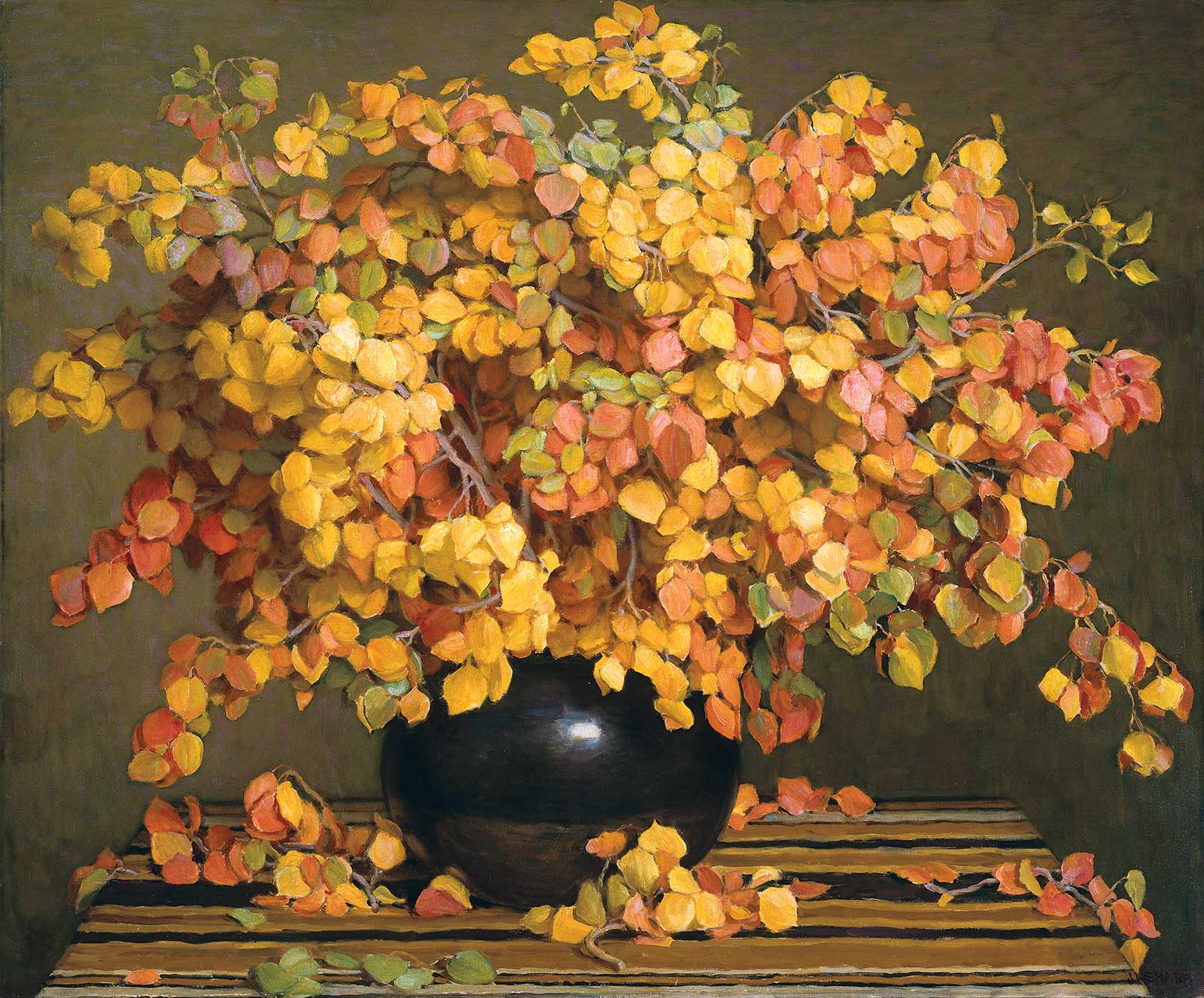
Joseph Henry Sharp (1859-1953), A Million Aspen Leaves, oil on canvas, 40 x 48 in. The Eugene B. Adkins Collection at the Fred Jones Jr. Museum of Art, the University of Oklahoma, Norman, Oklahoma and the Philbrook Museum of Art, Tulsa, Oklahoma.
“What seems to me to be one of the most important things about our movement is that we have freed painting from the tyranny of subject-matter,” Pierre-Auguste Renoir said. “I am free to paint flowers and call them flowers, without having to weave a story round them.”
Henri Fantin-Latour had to explain his methods: “(T)o make a painting representing things as they are found in nature… (I) put a great deal of thought into the arrangement, but with the idea of making it look like a natural arrangement of random objects. This is an idea that I have been mulling over a great deal: giving the appearance of a total lack of artistry.”
Édouard Manet was far more blunt: “Bring a brioche, I want to see you paint one: still life is the touchstone of painting.”
The artists were right to fight back. In 1862, in response to Fantin-Latour’s still lifes, an art critic had coldly dismissed his work: “How charming it is, how very pretty, but after all, it’s nothing but an apple, a cherry, a glass of water.”
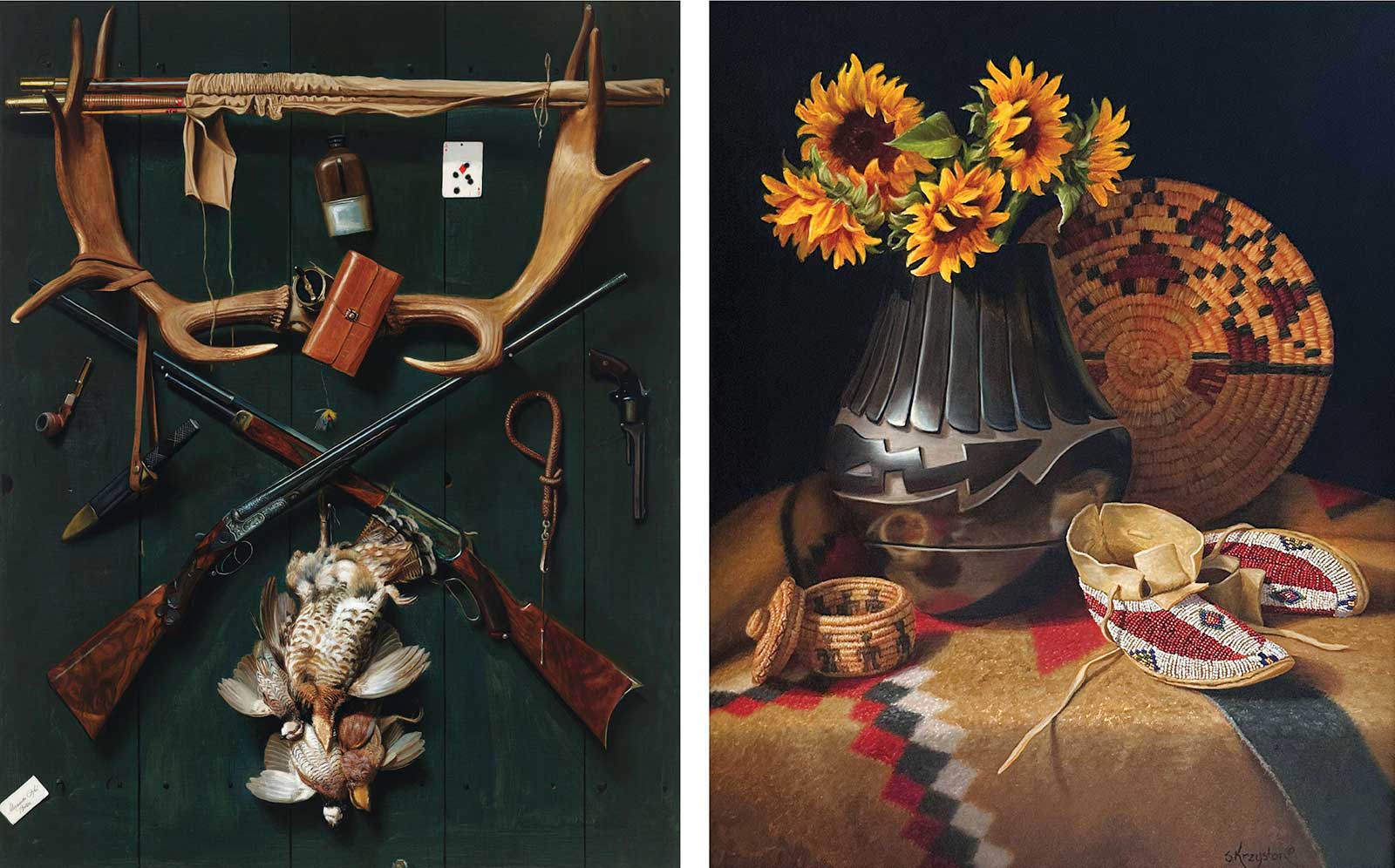
Alexander Pope (1849-1924), Sportsman’s Still Life, 1895, oil on canvas, 54 x 42¼ in.; Sue Krzyston, Moments and Memories, oil, 30 x 24 in.
More than a century later (and across an ocean), still life is flourishing in Western art. The same principles used by Renoir, Manet, Van Gogh and others are still used to create beautiful imagery of common household items, Western tack and gear, historical Old West material, florals and, yes, the occasional brioche.
Artists have long painted Western material into still life compositions, which makes the genre an especially rich tradition. Consider Alexander Pope’s Sportsman’s Still Life painted in 1895. Although all of the painting’s objects—antlers, shotgun, rifle, fishing rods and an ace of diamonds used for target practice—likely originate from the East Coast, where Pope was based, they speak to the sporting lifestyles made famous by Western greats such as Carl Rungius, Ogden Pleissner and Philip R. Goodwin.
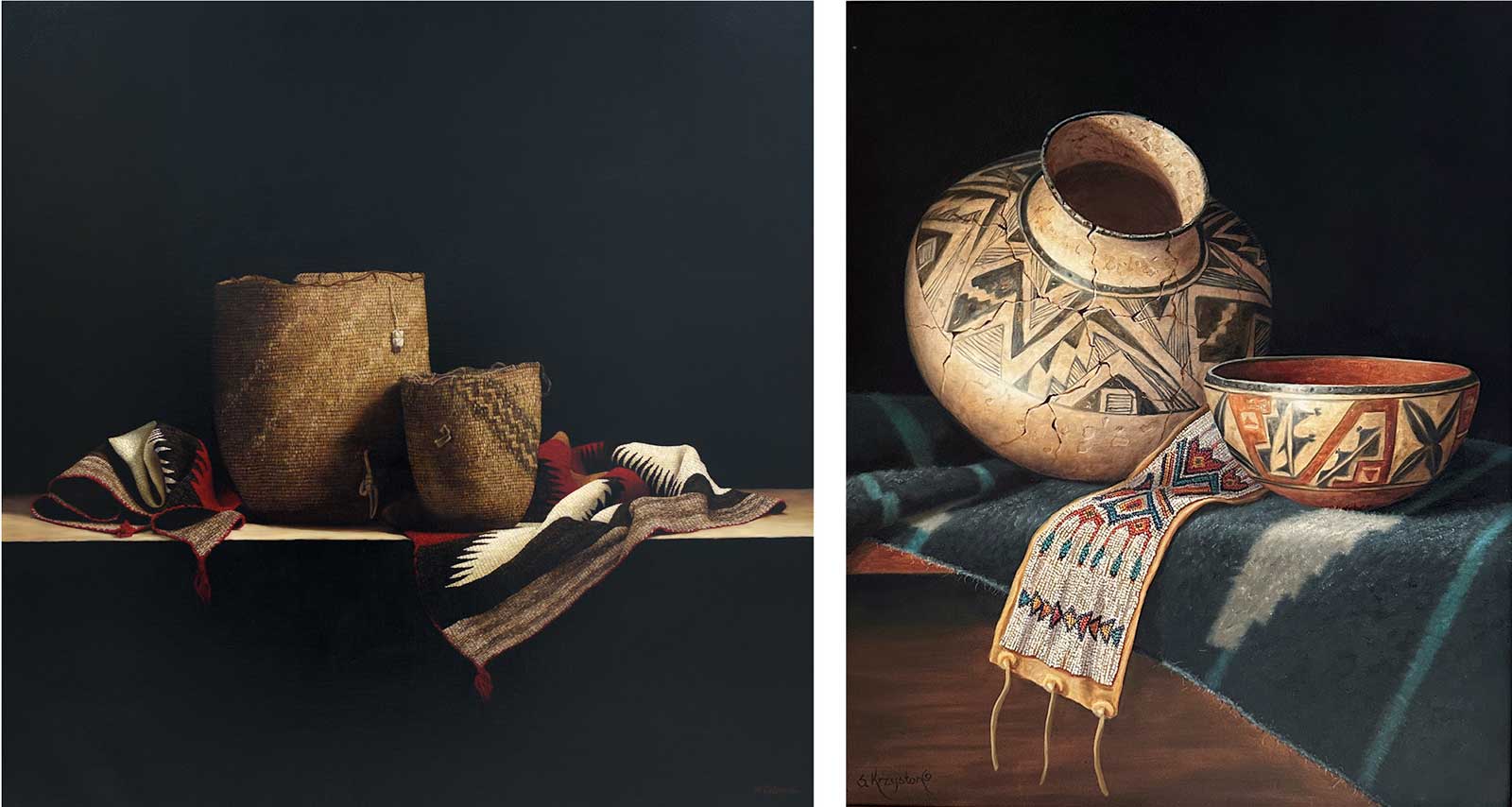
King Galleries, Huckleberry Baskets, oil on linen, 48 x 48 in., by Mary Calengor; Sue Krzyston, From Long Ago, oil, 24 x 20 in.
Another early Western artist who was exploring still life was Joseph Henry Sharp, whose floral pieces are some of his more classical work not rooted in New Mexico or Montana. In A Million Aspen Leaves, Sharp paints a bouquet of yellowed leaves with the utmost care given to each and every petal-like piece. The piece is part of the collection at the Fred Jones Jr. Museum of Art at the University of Oklahoma.
In the present day, artist Mary Calengor, who shows her work at King Galleries, is exploring new objects, fresh compositions and detailed textures that will make viewers want to run their fingers across her canvases to feel every meticulous brushstroke. In her work Huckleberry Baskets, every fiber of her baskets seem alive, as does the wool from the weaving.
Sue Krzyston is another one of the top Western still life painters working today. She, too, emphasizes realistic texture alongside her lively compositions with many kinds of objects. “As I contemplate a new composition for a painting, I select pieces from my artifact collection that vary in shape, texture and size,” she says. “It is important to me to convey the beauty of each item as well as to have the seemingly unrelated pieces relate to each other. The use of light, reflected light and shadows are so important to lead the viewer’s eye through the arrangement, as well as to create depth and a focal point in the composition. Subtleties such as reflections in a pot, or the shadow cast by an object create interest and bring life to the objects.”
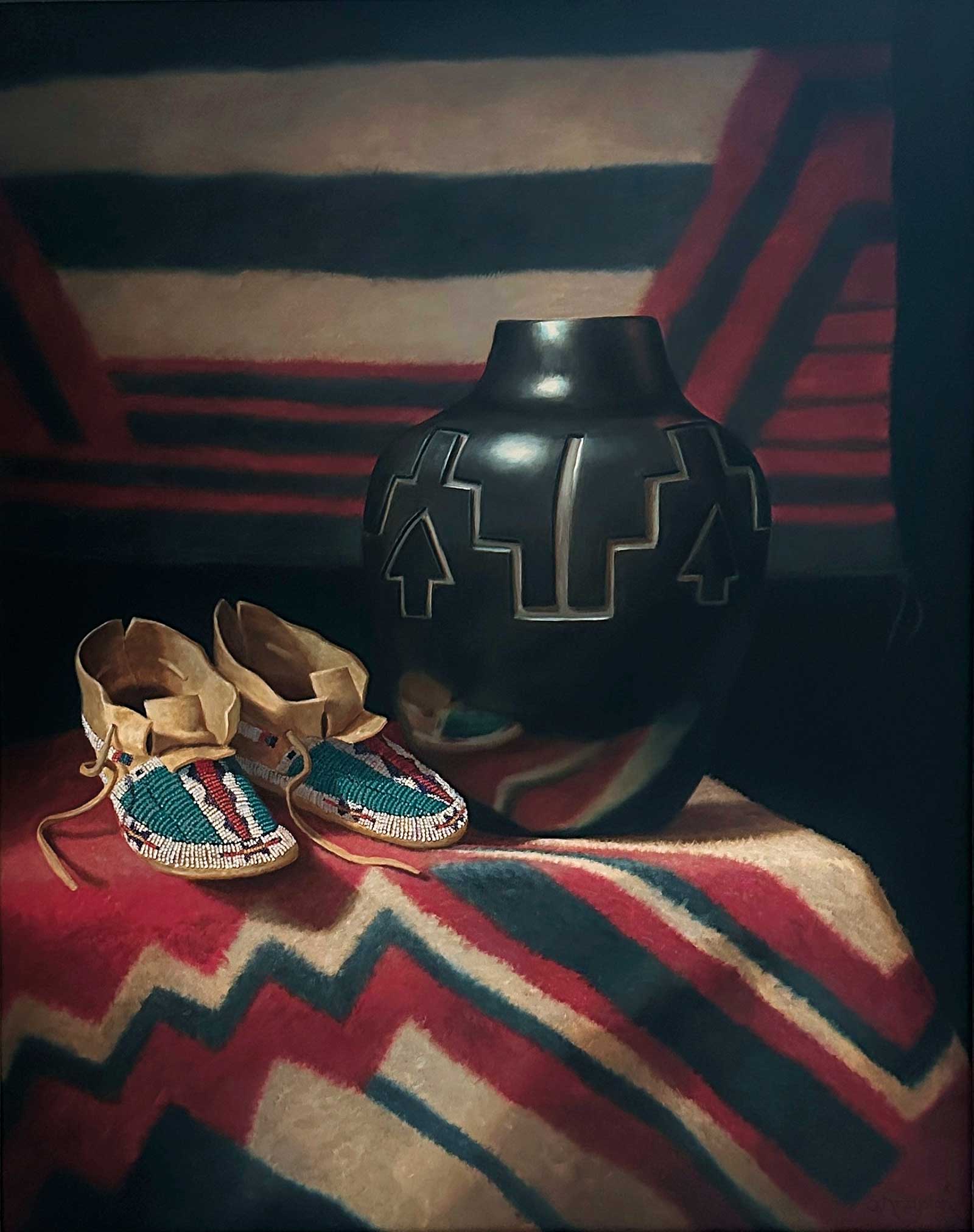
Sue Krzyston, A Peaceful Moment, oil, 30 x 24 in.
Krzyston adds that she is inspired by the “intricacy and elegant beauty of Native American” artwork, which she has collected for many years. “When I began painting still life compositions, it was natural for me to be drawn to paint them as my subjects. I think of my paintings as an artform within an artform. I strive to pay tribute to the artisans who created these pieces,” she says. “When composing a painting, I combine a variety of surface textures that will complement each other in each arrangement. By using an interplay of light and shadow depicting the textures of the artifacts, I try to capture the nuances and details of each item that the viewer may not see at first glance. A collector recently said, ‘Your light-filled oil paintings seem to be three-dimensional and make me feel that I could pluck a glistening moccasin or glowing pot from your composition.’”
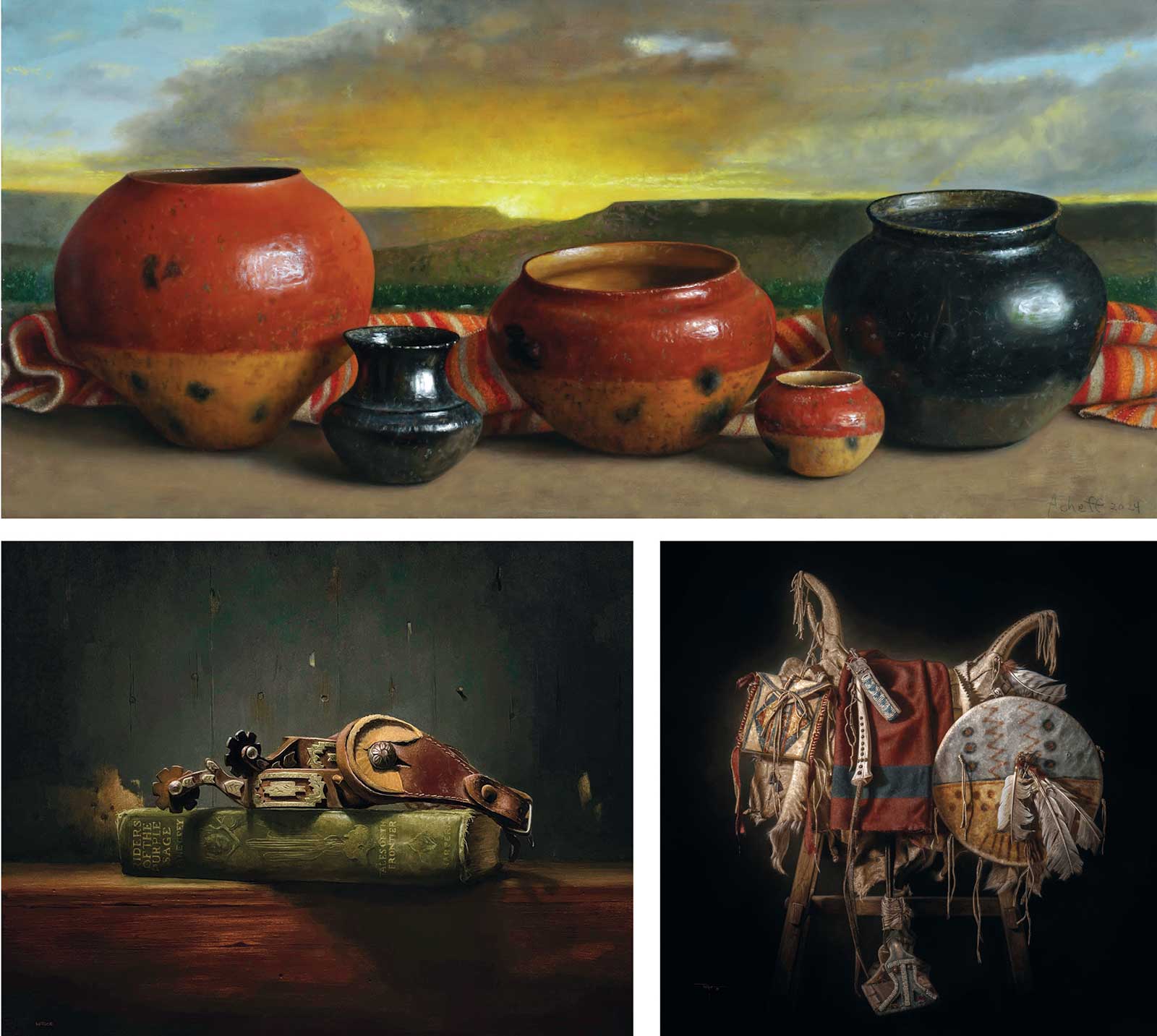
Top: Legacy Gallery, Sunset at San Juan Pueblo, oil, 12 x 26 in., by William Acheff. Bottom: Sean Witucki, Riding the Purple Sage, oil on panel, 11 x 14 in.; Legacy Gallery, Spirit Rider, oil, 39 x 39 in., by Kyle Polzin.
To find even more significant Western still life artwork, look no further than Legacy Gallery based in Scottsdale, Arizona. The gallery features the work of artist William Acheff, renowned for his highly realistic still life paintings of Native American artifacts of the past. The Taos Pueblo has provided him with inspiring subjects to paint, like in his oil Sunset at San Juan Pueblo. “Artifacts and traditions of the past,” he explains, “seem to hold more mystical and aesthetic value than those of contemporary times.”
Kyle Polzin is yet another inspiring still life Western artist shown at Legacy. He grew up in South Texas, and began developing his artistic skills at a young age under the guidance of his father. Brought up around horses and the Gulf Coast, Polzin grew to appreciate the beauty and heritage of his Texas surroundings, which is reflected in his art—as in the case of his piece Spirit Rider. He worked closely with his grandfathers who were both skilled carpenters. Through their teachings, Polzin learned the value of craftsmanship and the reward of creating with his hands.
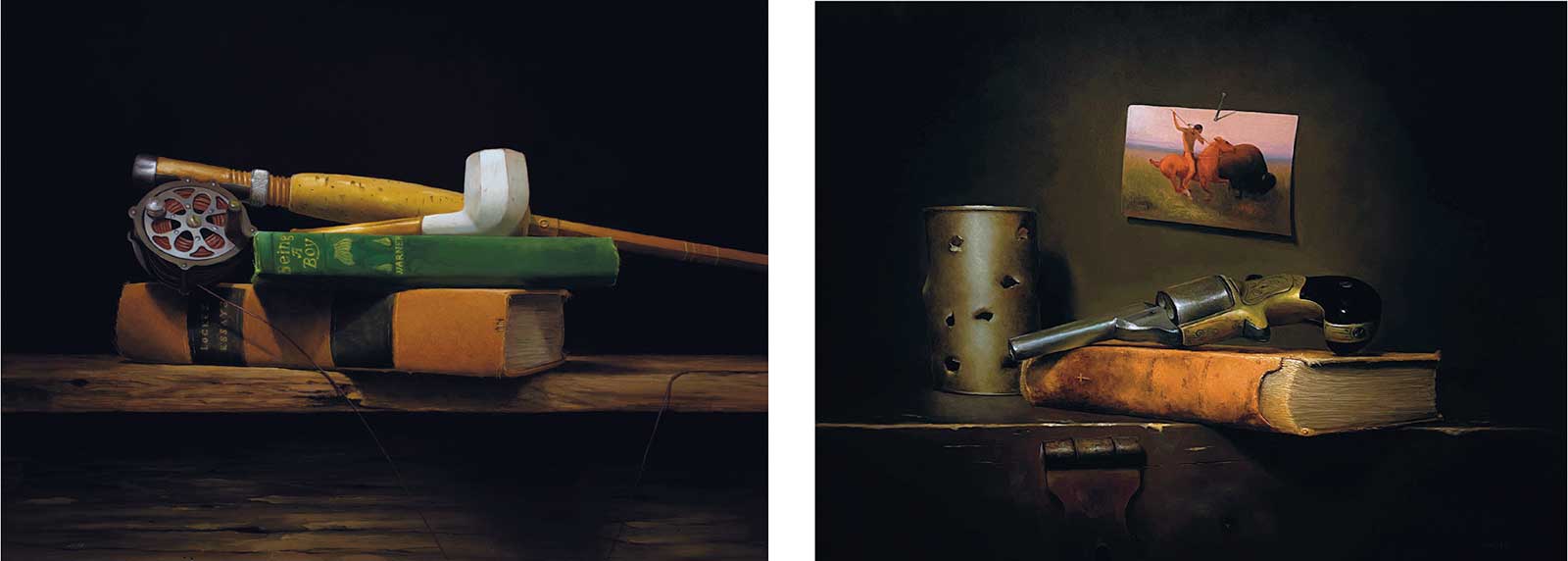
Sean Witucki, Reminiscing on Being a Boy, oil on panel, 12 x 16 in.; Sean Witucki, Teaching Her to Shoot, oil on panel, 12 x 16 in.
Both artworks mentioned will be available at Legacy’s Western Horizons show from February 21 to 22.
Artist Sean Witucki is a self-taught painter who resides in western New York, “where the early frontier began,” he says. “I am intrigued by the history of many regions and its people within the United States. This provokes me to explore a variety of subject matter from the Revolution to the American West and beyond.”
Witucki also has a great passion for the outdoors, and enjoys working with worn and used items. “They tell the story of the unknown and countless people who have used them in the past,” he says, but above all, God plays the most important role in the artist’s life and work. “This, I hope, is evident in the way I use dramatic light in much the same way as the Baroque painters,” he adds. “I’m grateful for the opportunity to continuously research and study objects visually, as well as their contemporary, historical and spiritual context in our lives.”
Find Witucki’s work at Paderewski Gallery in Beaver Creek, Colorado; and the First Strike Friday Night Auction at The Russell on March 21 in Montana.
Featured Artists & Galleries
Fred Jones Jr. Museum of Art
555 Elm Avenue, Norman, OK 73019-3003
(405) 325-3272, www.ou.edu/fjjma
King Galleries
7077 E. Main Street, Suite #20, Scottsdale, AZ 85251, (480) 481-0187
130 Lincoln Avenue, #D, Santa Fe, NM 87501, (480) 440-3912
www.kinggalleries.com
Legacy Gallery
7178 Main Street, Scottsdale, AZ 85251
(480) 945-1113, www.legacygallery.com
Sue Krzyston
www.suekrzyston.com
skrzyston@aol.com
(602) 615-0327
Sean Witucki
(716) 510-8907
seanwitucki@seanwitucki.com
www.seanwitucki.com
Instagram: seanwitucki
Powered by Froala Editor


